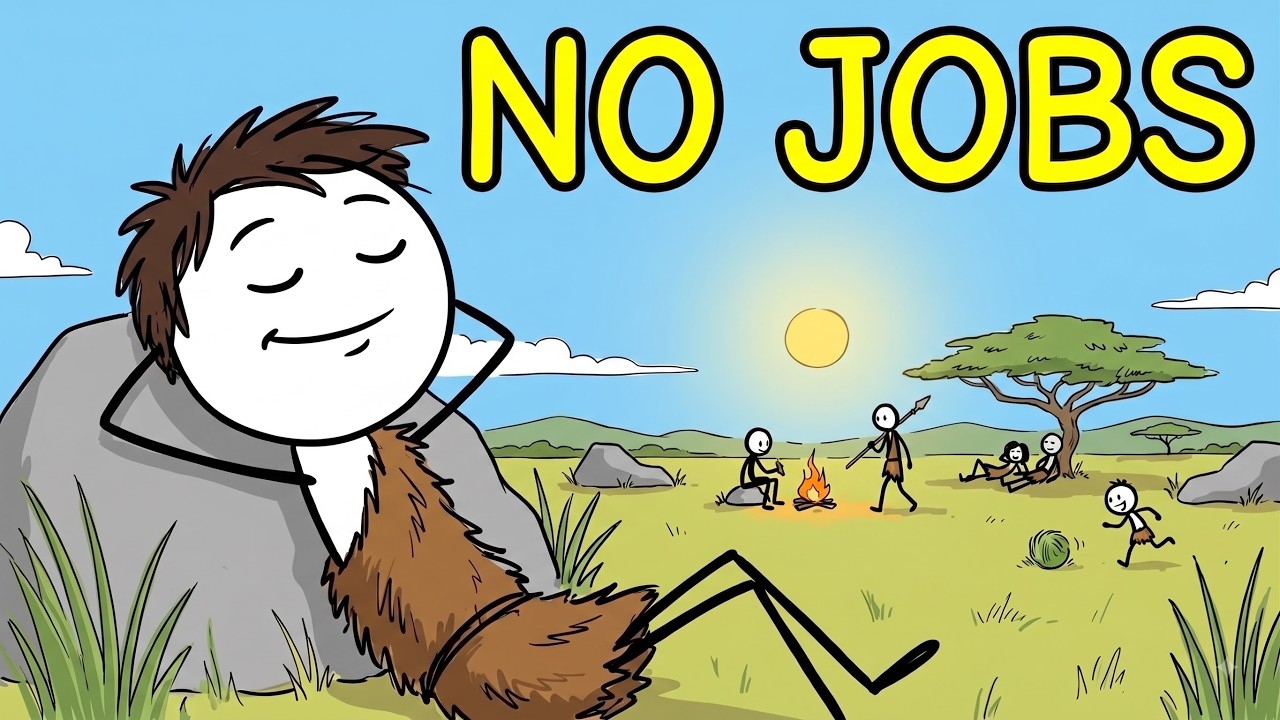
Explores how ancient humans survived prolonged rain by prioritizing fire, crafting tools, and creating art in shelter.
Ask about this video. Answers come from its transcript only — with the timestamp, so you can check them.
Generated from the transcript and can be wrong — check the timestamp.
Key Takeaways
- Fire maintenance was the top survival priority during prolonged rain.
- Rainy periods enabled focused tool production and innovation like rope and needles.
- Shelters were made comfortable with bedding and pest control long ago.
- Social activities, storytelling, and art flourished during forced indoor times.
- Rain was both a crisis and an opportunity that influenced human evolution.
What the video covers
- Ancient humans faced life-threatening challenges during prolonged rain, including cold, flooding, and predators.
- Maintaining fire was critical for warmth, safety, and social interaction, with evidence of fire kits and ember transport.
- Rain forced humans to stay in caves and rock shelters, where they engaged in tool-making and production activities.
- Archaeological finds show advanced manufacturing like ochre processing, bone needles, and rope-making during rainy periods.
- Bedding and pest control were practiced 77,000 years ago, indicating efforts to make shelters comfortable and livable.
- Rainy weather provided time for creating complex tools and art, which were not made during good weather or hunting times.
- Storytelling and ceremonies around fire helped maintain social bonds and preserve oral traditions over millennia.
- Rain also brought ecological benefits like termite swarms, providing easy food sources for early humans.
- Overall, rain shaped human behavior, technology, culture, and survival strategies throughout history.
Chapters
- 00:00The Crisis of Prolonged Rain for Ancient Humans
- 00:48Rain as a Life-Threatening Crisis
- 01:34Dangers of Cold, Flooding, and Predators
- 02:19The Vital Role of Fire During Rain
- 02:52Fire Maintenance and Ember Transport Techniques
- 03:32Strategies for Keeping Fire Alive
- 04:08Manufacturing and Tool Making Indoors
- 04:55Advanced Tools: Bone Needles and Rope Making
- 06:07Making Shelters Comfortable and Pest-Free
- 07:27Art, Storytelling, and Social Life Around Fire
Full Transcript — Download SRT & Markdown
Speaker A
Imagine you haven't eaten in two days. You know exactly where the herd is. You tracked it yesterday. You found the prince. You mapped the route in your head. And now all you have to do is get there. And then it starts raining. Not a
Speaker A
light drizzle. A heavy soaking, wind-driven rain that doesn't stop. It goes all day, then all night. Then the next morning, and it's still going. So now you can't hunt. You can't see tracks because the mud has washed them away. You
Speaker A
can't move through the open because wet ground and bare feet on rocky terrain means a twisted ankle. And a twisted ankle out here means death. The river near your camp is rising. And the fire, the one thing keeping you warm, keeping
Speaker A
predators away and keeping you alive, is now starting to struggle. You're not bored. You're trapped. For most of human history, rain wasn't an inconvenience.
Speaker A
It was a crisis. And what ancient humans did during that crisis might be more important than anything they did on a clear day. Today, when it rains, you close your window, make some coffee, maybe grab a blanket, and open Netflix.
Speaker A
You get cozy on the couch, start wiggling into that perfect spot, and just sink in. For you, rain is just background noise. It makes you feel calm, makes you feel sleepy. You might not even make it through the episode.
Speaker A
But for a human being 50,000 years ago, that same rain, the exact same sound you're falling asleep to, could kill you in three different ways before it even stopped. The first one is cold. A wet human loses body heat up to 25 times
Speaker A
faster than a dry one. Without clothing, without waterproof shelter, a long rainstorm in anything below about 50° Fahrenheit could drop your core temperature into hypothermia range within hours. And most of the world our ancestors lived in got that cold at
Speaker A
night, even in Africa during the wet season at higher elevations. The second one is flooding, caves and rock shelters. The main places humans lived are often at the base of hillsides or near rivers. So, heavy rain meant flash
Speaker A
floods. Archaeologists have found layers of flood sediment inside occupied caves, meaning the water came in while people were living there. Some of those layers are thick and they found out that those caves were never used again. And the
Speaker A
third one, maybe the worst, is predators. Rain drove animals into shelter, too. And sometimes that shelter was the same cave you were in. There are cave sites in South Africa where human remains and large cat remains are found
Speaker A
in the same layers. Some of those humans have puncture marks in their skulls that match leopard teeth perfectly. So rain didn't just make life uncomfortable. It compressed the entire world. Humans, predators, prey, all of them squeezed into the same small, dry spaces at the
Speaker A
same time. And in the middle of all that, one job mattered more than everything else, keeping the fire going.
Speaker A
And here's why that was so terrifying. Before roughly 40,000 years ago, we're not entirely sure how reliably humans could start fire from scratch. There's evidence of controlled fire use going back at least 400,000 years at a site called Qesem Cave in Israel and possibly
Speaker A
as far back as a million years at Wonderwerk Cave in South Africa. But here's the thing. Controlling a fire that already exists and creating one from nothing are two very different skills. And for most of human history, most people probably couldn't do the
Speaker A
second one. So if your fire went out, you might not be able to relight it.
Speaker A
You'd have to carry an ember from somewhere else, which some groups actually did. They transported smoldering coals wrapped in green leaves or packed inside a type of woody mushroom called tinder fungus that could catch a spark and smolder inside itself
Speaker A
for hours. It was basically a biological lighter. And we know this wasn't just guesswork. When they found Ötzi the Iceman, the 5,300-year-old frozen man preserved in the Alps, he was carrying a complete fire kit in his belt pouch.
Speaker A
Tinder fungus, flint, iron pyrite for striking sparks, and extra plant tinder as backup. Even 5,000 years ago, losing your fire was serious enough that people carried dedicated equipment to prevent it. So, when rain hit, the first priority wasn't shelter, it was the
Speaker A
fire. Move it deeper into the cave. Shield it with hides or brush. Feed it carefully. Not too much, not too little.
Speaker A
Find dead lower branches from coniferous trees, the ones still protected by the canopy above, usually still dry underneath. Split open wet logs to get at the dry wood inside. Use birch bark as kindling because birch contains a chemical called betulin that actually
Speaker A
burns even when it's wet. One person's entire job during a rainstorm might have been just sitting next to that fire for hours, feeding it, shielding it, making sure it didn't die because that fire was everything. It was warmth, light,
Speaker A
safety, cooked food, and the center of every social interaction the group had. Letting it go out wasn't just careless.
Speaker A
It was potentially fatal for everyone. All right, so the fire is going and you're mostly dry, but you cannot leave.
Speaker A
So what do you do? You make things. The archaeological record is very clear on this. Caves and rock shelters are absolutely packed with evidence of manufacturing. Stone tools in every stage of production. Piles of flaking debris, those tiny chips of rock that
Speaker A
fly off when you're shaping a tool found concentrated in specific spots inside caves. Exactly where someone would sit near firelight and work for hours. But it wasn't just stone tools. At Blombos Cave in South Africa, archaeologists found a 100,000-year-old ochre
Speaker A
processing workshop. Abalone shells used as mixing bowls. Ochre ground into powder. Bone tools used to stir and apply it. This wasn't basic survival.
Speaker A
This was production. Someone sat in that cave probably while the rain pounded outside and manufactured pigment on purpose with a system. And then you've got bone needles. They start appearing in the record around 61,000 years ago in South Africa and later across Europe and
Speaker A
Asia. These are delicate, precise tools with tiny drilled eyes. You don't make a bone needle while you're running from something. You make it when you're sitting still, focused with hours to spare. Rainy days gave people that time.
Speaker A
Now, here's where it gets really interesting. At a Neanderthal site called Abri Du Maras in France, archaeologists found a tiny fragment of twisted plant fiber string dating to roughly 52,000 years ago. That's the oldest direct evidence of string ever
Speaker A
found. And then at Hohle Fels Cave in Germany, they discovered a 35,000-year-old tool carved from mammoth ivory with four holes and spiral grooves designed specifically for twisting plant fibers into rope. Someone sat in that cave and carved a dedicated rope-making
Speaker A
machine. Making rope is slow, repetitive, and requires patience. It's the perfect bad weather task. And rope changed everything. It let you tie things together, build better shelters, create snares and traps, bind tools to handles. An incredible amount of human
Speaker A
technology runs on string. And string was almost certainly invented by someone stuck inside waiting for rain to stop.
Speaker A
And it wasn't just tools and rope. People were also making their shelters livable. At Sibudu Cave in South Africa, archaeologists found something most people wouldn't expect from 77,000 years ago. Bedding. Actual bedding. Layers of sedges, rushes, and grasses carefully
Speaker A
arranged as sleeping mats. The top layers included leaves from a plant called Cape Laurel, which is a natural insect repellent. Someone wasn't just surviving in that cave. They were making it comfortable. They were making it home. And the bedding was periodically
Speaker A
burned and replaced to keep it clean. 77,000 years ago, people were already doing pest control. But here's where the story takes a turn that nobody expects.
Speaker A
Because all of that, the tools, the rope, the bedding, that's the practical stuff. What came next is something else entirely. The art. The Chauvet Cave in sout
Speaker A
level of skill and observation that still shocks people today. The artists understood anatomy, movement, perspective. Some of the animals are drawn midstride, muscles tensed, heads turning. These aren't doodles. These are the work of people who watched these animals for thousands of hours and then
Speaker A
recreated them from memory deep underground by fire light. And Chauet isn't alone. Lasco, Altameira, Sulawei, and Indonesia, where cave art dates to at least 45,000 years ago, making it the oldest known figurative art in the world. But here's what makes this really
Speaker A
interesting. These paintings aren't at the entrance of the cave where you'd sit for shelter. They're deep, sometimes hundreds of meters in through narrow passages in chambers you'd have to crawl to reach. Someone carried animal fat lamps into total darkness and painted.
Speaker A
And think about that for a second. Nobody does that when the weather's perfect and the hunting's good. You do that when you can't go outside. When the rain has been falling for 2 days and you've already sharpened every tool you
Speaker A
own and there's nothing left to do but go deeper into the dark and create something. Now, we can't prove that cave art was a rainy day activity. But the logic holds together. The most creative explosion in human prehistory happened
Speaker A
in the exact places where people were most likely to be stuck inside for extended periods. And that leads to something even bigger. Rain didn't just create art. It might have created culture itself. Think about it. What happens when 15 to 30 people are forced
Speaker A
into a confined space together for days with nothing to do? You talk, you listen, you share information. In 2014, anthropologist Paulie Weisner published a study where she compared daytime conversations and nighttime fireside conversations among the Ju Hoansi Bushmen in the Kalahari Desert. During
Speaker A
the day, people talked about practical things, land rights, resources, complaints. But at night, around the fire, over 80% of the conversation shifted to stories, songs, and ceremonies. The fire light changed what people talked about. It softened faces, reduced tension, created a space where
Speaker A
people opened up. The campfire wasn't just warmth. It was the original social network. And the stuff being shared around that fire wasn't small talk. It was survival. Where the water sources dry up in summer, which plants are safe
Speaker A
to eat, where the best flint deposits are, how to track a specific animal. That's not gossip. That's critical knowledge being passed from one brain to another through speech. And then beyond the practical stuff, there was something else. stories, myths, explanations for
Speaker A
why the rain comes and where it goes. Every ancient culture on Earth has rain mythology, and someone invented those stories. They almost certainly did it while sitting in the exact situation the story was trying to explain. And here's
Speaker A
something that shows just how powerful this storytelling actually was. The oldest known oral traditions that have been verified against real geological events are Australian Aboriginal stories describing sea level changes that happened roughly 7,000 years ago. Those stories survived for 7,000 years through
Speaker A
nothing but people telling them to each other. That kind of cultural memory doesn't develop unless groups spend enormous amounts of time doing exactly that. Sitting together, retelling stories over and over and over again. So rainy days weren't dead time. They were
Speaker A
transmission time. The days when knowledge moved from the old to the young. When skills were taught by demonstration, when the group's collective memory got reinforced and updated. Now, here's the part nobody talks about. Rain wasn't always bad.
Speaker A
Sometimes it was actually the best thing that could happen. After a heavy rain, the ground is soft. And soft ground means perfect tracks. deep, clear, detailed. You can see exactly which animals walked past, how long ago, how fast they were moving, and where they
Speaker A
went. Some of the best tracking conditions in the world come right after rain stops. Rain also meant water.
Speaker A
Humans could collect and store rain water, and even early hominins may have understood this. Rock depressions that fill with clean water during rain are found near almost every known prehistoric campsite, and some of them show signs of being deliberately carved
Speaker A
deeper to hold more. But water wasn't the only thing rain brought. Mushrooms and certain plants explode after rain.
Speaker A
Tubers are easier to dig from wet soil. Insects come to the surface. A rainy period didn't stop the food supply. It changed it completely. And the groups that understood those changes had an enormous advantage over those that didn't. Termites are a perfect example.
Speaker A
They swarm after rain in tropical Africa. They're one of the most protein- dense foods available. You don't need tools. You don't need weapons. You just pick them up. There are chimpanzees today that gorge on termite swarms after rainstorms. Early humans almost
Speaker A
certainly did the same thing, probably on a much larger scale. So, what did ancient humans do when it rained all day? Everything that mattered. They kept the fire alive. They made the tools they'd use for the next hunt. They sewed
Speaker A
the clothing that would keep them warm through winter. They twisted the rope that would hold their shelters together.
Speaker A
They ground the pigment they'd used to paint animals on cave walls deep underground. They told the stories that would carry survival knowledge across generations. And when the rain finally stopped, they walked outside into soft ground, covered in perfect animal
Speaker A
tracks, and got back to work. Rain didn't slow them down. It gave them time to prepare for everything that came next. Every tool, every piece of clothing, every story, every painting on a cave wall, all of it came from
Speaker A
downtime. From the hours and days when they couldn't go out and had nothing to do except sit near a fire and think.
Speaker A
Boredom didn't exist for them the way it does for you. Because when you're sitting in a cave with the rain hammering outside and your survival depends on what you make with your hands in the next few hours, you don't get
Speaker A
bored. You get creative. And that might be the single biggest reason we're still
Topics:ancient humansrain survivalfire makingprehistoric toolscave sheltersarchaeologyhuman evolutionNeanderthalsprehistoric artearly technology