Lecture covering security threats to user authentication: client attacks, host attacks, eavesdropping, replay attacks, Trojan horses, and denial of service, with defenses like high-entropy passwords,
Key Takeaways
- Multi-factor authentication is the strongest general defense against most authentication attacks.
- Hash stored passwords and protect the authentication database to defend against host attacks.
- Use high-entropy passwords, rate limiting, and login delays to resist brute-force guessing.
- Challenge-response and one-time passcodes defend against replay attacks and credential reuse.
What the video covers
- Introduces the main security problems facing user authentication: client attacks, host attacks, eavesdropping/copying, replay attacks, Trojan horses, and denial of service.
- Client attacks (impersonation, guessing) rely on common passwords, dictionary words, exhaustive search, or fake biometric matches; defenses include high-entropy passwords, limiting login attempts, adding delays, and multi-factor authentication.
- Token-based defenses include physical possession requirements and one-time passcodes (OTPs), which greatly increase guessing resistance.
- Host attacks target the server's authentication data store; defenses include hashing passwords (irreversible), protecting password databases, using one-time passcodes, and challenge-response for biometrics.
- Eavesdropping threats include shoulder surfing, keylogging malware or hardware keyloggers, and observing the user typing; defenses include keeping passwords secret and quickly revoking compromised ones.
- Hardware token cloning and biometric spoofing are countered with multi-factor authentication, tamper-resistant or tamper-evident tokens, spoof detection, and capture device verification.
- Replay attacks capture a valid challenge-response exchange and resend it later; challenge-response with random challenges counters this.
- Denial-of-service attacks flood the authentication server with requests to lock out legitimate users; rate limiting per IP address helps mitigate this.
- Overall best defense is combining multiple layers: strong passwords, rate limiting, challenge-response, encryption, and multi-factor authentication.
Chapters
- 00:00Introduction to Authentication Security
- 01:06Types of Security Problems
- 02:18Client Attacks and Brute Force Defenses
- 05:18Host Attacks and Data Store Protection
- 06:58Eavesdropping and Keylogging Threats
- 09:03Hardware Cloning and Biometric Spoofing
- 11:01Replay Attacks
- 12:12Denial of Service and Overall Defenses
Full Transcript — Download SRT & Markdown
Speaker A
In the name of God, the Most Gracious, the Most Merciful. Welcome to the sixth lecture or the sixth section of the User Authentication chapter. Today, we will discuss security for user authentication and some tasks and issues related to security, especially
Speaker A
in user authentication. First, what are the types of security problems that user authentication faces? First, we have client attacks, where someone tries to impersonate a real user, and host attacks, where someone tries to attack the host or the server. And
Speaker A
steal the credentials stored inside the server. Eavesdropping and copying; someone tries to sniff the network.
Speaker A
Monitors the network. And steals the credentials, or takes a copy of them. Replay attack; I have a connection, correct? And a reply occurred. And there was a response. Someone wants to take it, capture the response. And send it to the server again. Trojan horses,
Speaker A
which is a fake application. Or a fake device. And it tries to capture my credentials. Denial of service to lock legitimate users out. That I try to block the service from someone. From a user. A user attempting to log into the
Speaker A
authentication system. Correct. That is mainly directed toward the authentication token. It has specific weaknesses. Okay. Client attacks and brute force. A client attack means I try to identify the client, or I want to know the client's credentials. No
Speaker A
access to that network path; the attacker has no access to the host or the network path. So what do they do?
Speaker A
They tell me they try to impersonate the user. Attempting to log into the system. So how do they impersonate the user? They say they try to guess. How?
Speaker A
By trying common passwords, personal info, and dictionary words. Correct. And they try to perform an exhaustive search of all possible password combinations. This is in the case of passwords. In the case of biometrics, they try, for example, fingerprints,
Speaker A
trying different prints in different shapes and positions, hoping to achieve a false match. Correct. Defense against brute-force passwords is high entropy.
Speaker A
It says my password must be long and unpredictable. I call this high entropy . Entropy means it is unpredictable.
Speaker A
Okay, limit login attempts. Correct. System login attempts; if someone from a specific IP tries to access the system two or three times in a row, I should block their access. Add delays between attempts; I should not let the
Speaker A
attempts happen directly. Keep some time delay between them. Consequently, the process of attacking using guessing becomes costly for the user. Use multi-factor authentication, meaning besides the password, you use two things. Like a token, biometrics, or something similar. Correct. We have
Speaker A
higher entropy, meaning the higher the entropy, the lower the probability of predicting the value. Obviously, since we have high entropy, we will have a larger search space. Consequently, the probability of finding the password will be low, it becomes harder to guess
Speaker A
, and therefore difficult to guess. Token security against the guessing process. I was saying, we need multi-factor authentication like a password with a physical token.
Speaker A
Consequently, our system becomes much stronger. For an attacker to succeed here, they must have both the password and the physical token. And that is very difficult. All right. Token provided. And so, it will be unpredictable. The search space for it
Speaker A
is very large. You try to limit the number of login attempts, so after a second or third try, the system stops access. Physical possession requires that you have a token, having something physical. This makes the login process not rely on the password alone.
Speaker A
One-time passcodes, all right. The OTP is used only once. So we will have a physical token, but with dynamic password tokens. Greatly increases resistance, all right. These tokens attempt to do what? They make the process...Guessing resistance is very
Speaker A
high, all right. Host attacks. Host attacks target the authentication data store server. I have my data stored on the server. The password, or the password hashes, and biometrics are stored on my server. Host attacks aim to attack the authentication data store
Speaker A
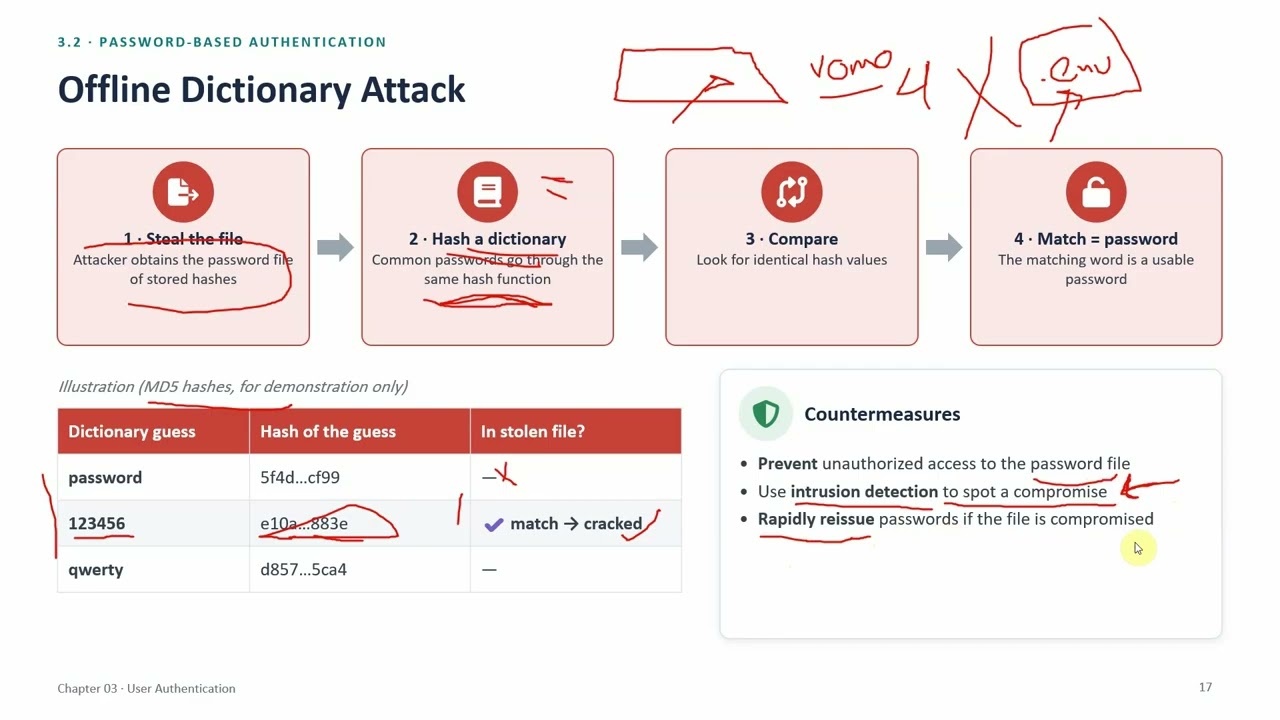
on that server. All right. The authenticator, like a password, for instance. If the password is stored on the server as plain text. It will be taken as plain text, or what will happen? I will perform a dictionary or
Speaker A
brute force attack, trying all possible password combinations. Token passcode, meaning the OTP is stolen. Biometrics template, like your fingerprint stored on the server. Defenses: password hashing, protecting passwords. It says in the case of a password, hash the password. And store the hash of the
Speaker A
password, not the password itself. Since hashing is irreversible, I cannot retrieve the original password from the hash, so this is a strong factor for the database. High integrity. And I want to protect the password database.
Speaker A
In addition to creating high-entropy passwords, which are passwords that are hard to guess. Token: I want to try and always use a one-time passcode with the user. And once it is used, it changes on the token device. In the case of
Speaker A
biometrics, I want to try using challenge-response. Not just sending the fingerprint alone. No, give it, for example, a challenge-response. Next time, a voiceprint. Each time a specific text is read, the voiceprint text changes. The third type of, which
Speaker A
is...Security issues were eavesdropping . So, all right, password...what do we have in the case of passwords? Someone comes along for shoulder surfing.
Speaker A
Meaning someone comes up behind me and looks. At me. While I am typing the password, if I wrote down the password on a piece of paper. And the paper was stolen. Keylogging malware or hardware keyloggers. This is a program that gets
Speaker A
installed on my device. What does it do ? It records every keystroke that happens on the...Keyboard. I call it keylogging. The fourth new thing, which is observing the user. I want to observe the user while they are entering the password. And thus, I
Speaker A
might be able to deduce the password. The defenses I need to interact with in this situation. First, it must be secret; I won't write the password in.
Speaker A
Any place or anyone could see me typing it. I also say quick revocation for compromised passwords; if I suspect a password was stolen or discovered, I must immediately revoke it and stop using it, and also use Multi-Factor Authentication for the token. That the
Speaker A
token itself gets stolen. Or someone comes to do hardware cloning or counterfeiting. What does stolen hardware cloning mean? We will get a device to copy, for example, the contents of my card to it. Consequently , he can copy it to another card and
Speaker A
use it. So, what is the defense? I will use multi-factor. Not just the token.
Speaker A
It will also have, for example, a fingerprint or face print. Or it will have, for example, a password or a PIN.
Speaker A
The second thing is defense with tamper-resistance or tamper-evident tokens. I want to always try to have my tokens be tamper-resistant. And resistant to tampering in the case of biometrics. Or empty threat. Okay.
Speaker A
Spoofing simply means someone managed to know my fingerprint. And took an image of it. Consequently, he will be able to clone it. The defense is spoof detection. Okay. I want to always try to know if it's a clone and detect this
Speaker A
issue. Capture device verification. And the last one is the challenge-response we talked about. Okay. So what is the best overall defense? Always multi-factor authentication. Like a password with a token or a password with biometrics and so on. So, let's
Speaker A
come to the fourth type, which is replay. The attack is based simply on a user making a connection with the server. The server sends him a challenge. The user sends him a response. Things are 100%fine, but an attacker is standing in the middle. He
Speaker A
will take the challenge. Meaning, the server (host) sent challenge R1 to the user. The user replied to it with a valid response. Okay. What did the attacker do? He saved a copy of the response. That's good. At a later time,
Speaker A
the attacker wants to try to make a connection with the server. He connects with the server. The server sent him challenge 2, and he replies with the old response. The same old response, which is valid response FR. One.
Speaker A
Consequently, for the server, R1 is no longer used. It is used for R2. Therefore, it detects that there is a retransmission process. And prevents the attack. And grants. Okay, defense.
Speaker A
As we said, challenge-response, random challenge for. Okay. It is about. Okay. And it's about an application. In reality, it's a program. Bad, okay, or a device that in reality is a bad device; both try to pretend to be
Speaker A
trusted devices so they can take credentials, meaning simply. Someone, for example, brought a device that looks like it belongs to it. Put it in a public place. Put a card reader device. You come to the device. This one, and try to enter your data into it
Speaker A
, it will capture the ID and the PIN. The attacker then can perform identity theft. Because he now has your ID and your PIN. The defense is to authenticate clients and devices, it must always be. Defense. Alright, the
Speaker A
second type. Okay. I want to send a flood of authentication requests to a specific server. Then, the person authorized to access the server won't be able to log in. It will tell them to run and try again. This results in an
Speaker A
authentication flood. What do these failed attempts do? They prevent legitimate users from accessing the login system. And consequently, the account becomes locked. Right, defense as we mentioned also includes multi-factor authentication techniques.
Speaker A
These are the types we covered: password entropy and rate limiting. High entropy plus rate limiting, correct. Brute force, what is it?
Speaker A
It’s when we have high entropy, how would it be? Passwords that are hard to guess. In addition to rate limiting, for example, I forbid this specific IP from sending more than 10 requests. Per minute, if I get more than 10 requests,
Speaker A
I understand that this IP is attempting a brute force attack. Password database theft, what is its defense? Store the password itself. In a hashed format in the database. Like the database, always try to increase security around it.
Speaker A
Token theft from my card. Our protection methods will be encryption. Token spoofing. I want to try to detect anyone trying to spoof. Plus, my device must be a trusted device. With what? It must be. Right, strong passwords.
Speaker A
Limited attempts for each login account . And a challenge-response if I am using a token or biometrics. Encryption and multi-factor authentication, correct. These together give strength to my system. Therefore, I need to combine two, three, four, or sometimes
Speaker A
five of them. To be able to reach a secure authentication. An authentication mechanism that can resist all types of attacks. Right.
Speaker A
Okay, multi-fac. Right. Thank you all.
Topics:user authenticationnetwork securitybrute force attackmulti-factor authenticationreplay attackpassword hashingchallenge-responsedenial of servicebiometricsone-time passcode