Skip to content
Get App

Lecture 19 Chapter 03 section 3.4 Biometric based Authentication

Lecture on biometric authentication covering static and behavioral traits, enrollment, verification vs. identification, and probabilistic matching with FMR/FNMR trade-offs.

Key Takeaways

  • Biometric systems balance accuracy and cost, with the right trait depending on budget and security needs.
  • Enrollment, verification, and identification are distinct processes with different matching approaches.
  • Biometric matching is probabilistic and requires a threshold trade-off between false accepts and false rejects.
  • Iris recognition offers the highest accuracy, while voice offers the lowest cost and accuracy.

What the video covers

  • Biometric authentication verifies users via physical (static) traits like fingerprints, face, hand geometry, retina, and iris, or behavioral (dynamic) traits like voice and signature.
  • Static traits rely on physical characteristics; dynamic traits rely on what a person does, such as voice or handwriting style.
  • Pattern recognition is used to identify fingerprint, handprint, and face print patterns, which is more complex and requires special resources.
  • Fingerprints are ridge and valley friction patterns stored as numerical features; retina vein patterns are captured with low-intensity light; the iris is highly distinctive.
  • Cost versus accuracy varies: voice is the cheapest and least accurate, while iris is the most accurate and most expensive; the best choice balances budget with data sensitivity.
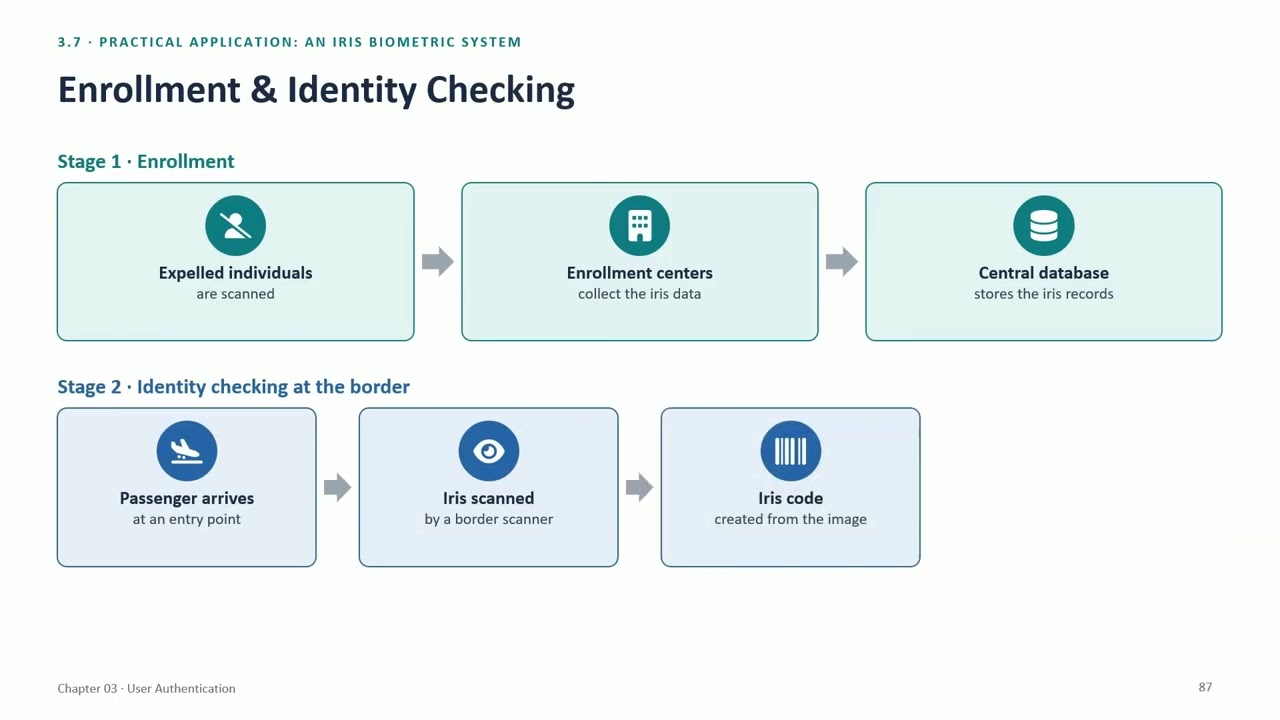
  • The system has three processes: enrollment (registering a template linked to a PIN), verification (one-to-one comparison against a stored template), and identification (one-to-many comparison against all templates).
  • Biometric matching is probabilistic because samples vary due to finger pressure, moisture, sensor noise, and placement; a similarity score is compared against a threshold.
  • A higher threshold reduces false matches (impostors accepted) but increases false non-matches (genuine users rejected), and a lower threshold does the opposite.
  • Error trade-offs are shown with ROC-style curves; the Equal Error Rate is the point where false match and false non-match rates are equal.
  • The iris achieves very low false match rates, illustrating why it is chosen for high-security applications.

Answers

Questions about this video

What is the difference between verification and identification in biometrics?

Verification is a one-to-one comparison where the user provides an identity (such as a PIN) and a biometric sample, which is matched against one stored template. Identification is one-to-many: only a biometric sample is provided, and it is compared against all templates in the database to find the matching person.

Why is biometric matching probabilistic rather than exact?

Biometric samples vary from one capture to another due to factors like finger pressure, dryness or sweat, sensor noise, and placement. Because of this, the system computes a similarity score and accepts or rejects based on whether it meets a defined threshold.

How does changing the matching threshold affect security?

Raising the threshold reduces false matches, meaning impostors are less likely to be accepted, but increases false non-matches, meaning genuine users are more often rejected. Lowering the threshold does the opposite and weakens security.

Full Transcript — Download SRT & Markdown

00:01
Speaker A
Welcome to the fourth lecture of the third chapter on user authentication. In this lecture, we will discuss biometric authentication. How do I verify a user using biometrics?
00:11
Speaker A
Biometrics refers to biological measurements, such as fingerprints, face prints, eye prints, or iris scans.
00:21
Speaker A
We will discuss these matters. In short, as a characteristic, I verify the user using their unique physical traits or behavioral ones. For example, voice, or typing style. Okay.
00:45
Speaker A
Every person has a typing pattern different from others. Every person has a voice print different from others.
00:52
Speaker A
Okay. We said it would be either static, which is physical, or dynamic, which is behavioral. Regarding static, we have fingerprints, hand geometry, face shape, or retina. The shape of the eye or the iris. Dynamic is what you do, what
01:11
Speaker A
you actually perform: your voice or your signature. Okay. We will rely on pattern recognition. Okay, which is identifying patterns. We will rely on this, as it is more complex. Pattern recognition will identify the fingerprint pattern, the handprint pattern, the face print pattern. Okay.
01:28
Speaker A
It will be more complex. Why? Because it requires special resources. Consequently, the use of it has been standardized. Now that mobiles contain a camera, microphone, and processor. Okay. Biometric characteristics. What are the fundamental characteristics? We said
01:55
Speaker A
face, fingerprint, hand geometry, retina. Face, which is the face shape, the eyes in the face, the eyebrows,
02:03
Speaker A
eyelashes, nose shape, lip shape. Okay. Or infrared. We can also use thermograms. Okay, which is taking the thermal print of the face using infrared rays, to be able to detect the veins and arteries in the face, so
02:24
Speaker A
we can perform face recognition. Fingerprints are patterns of ridges and valleys. Okay, which are the friction patterns, that is, the fingerprint, the shape that is in it, which consists of either protrusions or grooves. Stored as numerical features, in
02:45
Speaker A
a numerical format, in the form of numbers. Hand geometry, the shape of the hand: finger size, length, and width. Retina vein patterns beneath the retina. Okay, for the eye shape, captured with low-intensity light.
02:58
Speaker A
There is very faint light, okay. The iris, which is the detailed structure of the eye. The size of the iris, from within, has a specific form. Of course, there is an entire field of research into iris structure, okay. Highly
03:18
Speaker A
distinctive, the differentiation process is very high. Signature is a behavioral writing style. Okay. Every person has a writing style different from another. No two average people have identical signatures. Voice is linked to the
03:41
Speaker A
anatomy or structure of the human body. Samples over time: these are the samples we take from the voice, which vary over time. In the case of health, in the case of illness, in the case of having
03:59
Speaker A
talked a lot or a little. Okay. It varies based on the pattern it links together. Okay. It tells me here that the light green color represents static or physical. The purple color represents behavioral. Okay. Cost versus accuracy of biometric
04:16
Speaker A
characteristics. It says the lowest in accuracy and cost is the voice. The highest in accuracy and cost is the iris. The retina and finger give me average accuracy, but they are average. Okay. So, the iris is the most accurate.
04:35
Speaker A
And its cost varies from one to another. Voice is the lowest. Okay. Well, there is no single metric. We don't have something called that. The only true biometric that is best to use is the one that balances
04:59
Speaker A
accuracy and cost. Why? Because I need to balance between accuracy and cost. Cost based on my budget, and accuracy based on the sensitivity of the data I want to protect. Okay, got it. So, how does the system work? First, we have the registration process in the system. I
05:17
Speaker A
give you the user, which is the user's PIN number. Okay. I give it to the database. What do I give with it? The user takes an image of their fingerprint. The biometric sensor takes the fingerprint image. It performs
05:30
Speaker A
feature extraction. The extracted feature is stored in the database. With whom? With the PIN number. Okay.
05:38
Speaker A
Enrollment is the process of registering in the system. So, how do I perform verification? For verification, I give the user, or their name, or the PIN number. It will go to the database.
05:48
Speaker A
It will extract the template related to the PIN number. The same thing: I will take my fingerprint on the biometric sensor. It will perform feature extraction. It will perform a comparison. After extracting the feature, it will do a feature match
06:01
Speaker A
with whom? With the data brought from the database. If the feature matcher says okay, it means true, so you are the correct person. False means you are not the correct person. And thus, it performs the verification process.
06:12
Speaker A
There is a third type called identification. I do not give you your PIN or name number. Here, it is stored in my database. I will only give you my fingerprint. You will take it and what will you do? In verification, there was
06:24
Speaker A
a template. In identification, I will take all templates from the database one by one until I find one. What do I do? A feature match happens. It matches with whom? Its features match the features of your current finger, or the
06:37
Speaker A
current print you have taken. And thus, I can identify them. Enrollment, verification, identification. Enrollment: the process of registration. Verification: I give you data about me, and I give you my fingerprint or my iris print, and you try to just
06:52
Speaker A
identify if this is me or not. Identification: I don't give you a name. I don't give you any data. I give you just a fingerprint, or a face print, or an iris scan, and you want to know
07:00
Speaker A
who I am. Okay? In all cases, they all work the same way. The fingerprint, for example, or the face, we have a sensor that reads it. The sensor gives me a digital image. The digital image. I need to perform feature extraction on
07:14
Speaker A
it. Feature extraction. I need to compare it with the stored verification features. Identification, verification, one-to-one. I have a fingerprint, and I have a username.
07:26
Speaker A
Does this user's fingerprint, stored in my database, match the fingerprint they just gave me or not? If it matches, it is authenticated. If it does not match, it is non-authenticated. So, it is a one-to-one verification, and it is
07:40
Speaker A
a template against whom? Against the fingerprint we have. Identification is not. Two. I have one fingerprint. I compare it against all templates we have in the database, or we compare it against template after template until I know who you are. Clear? Consequently,
07:55
Speaker A
stored information match is verified. Thus, the user does not have a match with you. The user, I could not
08:02
Speaker A
identify them. Biometric matching is probabilistic. Why? Because we don't have a certainty. We don't have a fingerprint that matches 100% with what is in the database. Why? Because, for example, the finger shape might differ, finger pressure. And pressing the
08:17
Speaker A
finger harder is not like pressing it lighter. Or if, for example, the finger had sweat on it. The sensor had noise on it. Okay. Therefore, it differs for us from time to time. Consequently, we have probabilistic matching, a
08:29
Speaker A
similarity score between the present sample and the stored sample. It is the probability or the similarity between the current sample and what is stored in the database. It tells me if the sample similarity was less than a certain threshold I define. That means
08:46
Speaker A
we have a mismatch, that it is not compatible, and I reject the fingerprint or I reject this biometric trait. I deny entry to the system. If it was greater than or equal to, I accept, who is it, who is it, the user,
09:00
Speaker A
and let them into the system. So why do one person's samples differ? Let's talk, for example, about the fingerprint. It tells me there might be noise on the sensor.
09:11
Speaker A
Meaning, for example, the sensor had dust on it. Clear, dry or sweaty finger . The finger might be dry or. It might be sweaty. Therefore, the finger placement differs. I might place the fingerprint on the scanner directly. I
09:27
Speaker A
might shift it right, shift it left, a little up, a little down. Therefore, its location differs. Also, what other reasons could we have for this? Okay.
09:37
Speaker A
Overlap. Why the overlap? It tells me that sometimes it is possible to find two fingerprints that are very close to each other. Of course, this probability is high, a, very weak. Consequently, an overlap might happen between two people
09:51
Speaker A
who entered the system. Okay. Then we said, if you remember in. The accuracy here, let’s go back to the accuracy chapter. What did we say in the accuracy chapter? We said voice, face, signature, and hand biometrics have low
10:04
Speaker A
accuracy. I might place my hand on the scanner, and the shape could change, or resemble another person's hand. The same goes for fingerprints, exactly.
10:15
Speaker A
Therefore, we may encounter an overlap. Unlike passwords, biometric samples never match exactly. It says that unlike passwords, it is impossible for biometrics to match each other perfectly. So, what will our authentication process be like here?
10:37
Speaker A
Our authentication process will be probabilistic; I have to measure the probability of a match between the two and make a judgment based on that.
10:55
Speaker A
False Match and False Non-Match; as the name implies, "False Match" means I verified someone and claimed they are the person stored in my database, even though they are not. Thus, we get a False Match. False Non-Match: this is a
11:11
Speaker A
real person, and this is their biometric data. But I told them, "You are not the person I have on file." That results in a False Non-Match. A False Match rate means different people are identified as the same person. I
11:22
Speaker A
have two different people. My system identified them as one single person. Consequently, an impersonation could occur. And an intruder could enter our system. The False Non-Match Rate, as the name implies, means "no match." It means I have a person I couldn't
11:36
Speaker A
recognize, right? Meaning the same person, but what happens? One time I told them, "You are Ahmed." And the next time I tell them, "You are not Ahmed." Or, for example, "You are someone else." Is that clear? I call
11:45
Speaker A
that the False Non-Match Rate. As a result, a valid user is rejected. Okay, here is our probability table. If we look at the probability table here. Or at the probability distribution, we have the average matching impostor rate . Right. Here is how to read the figure
12:15
Speaker A
. The left curve represents the impostor scores. The right curve represents the genuine user scores.
12:23
Speaker A
Right. Here on the right side is the probability of an impostor succeeding. That they take the place of a genuinely real person; there is a small probability, but it happens. There is the threshold shown. There is a very
12:41
Speaker A
small probability that an impostor could enter. I say this is Ahmed, while in reality, it is not Ahmed. This is what I call a False. Match is possible, exactly. That is the curve on the left.
12:51
Speaker A
What does the one on the right represent? It represents the genuine user. For a real user, the probability of accessing the system is very high.
12:58
Speaker A
But there is a small probability for them to fall into the False Non-Match. The False Non-Match Rate, exactly. Okay , and this is based on what? It is based on the threshold you have. Right.
13:21
Speaker A
Based on what? On the threshold we have . Now, for the threshold trade-off, I need to make a compromise. How should I set the threshold? Should I set it high , low, or in the middle? Okay. It says,
13:32
Speaker A
what will a lower threshold do? It will give us very high false matches. Okay.
13:37
Speaker A
That is, people are identified as real people, when they are not real. It will be very high because it will accept low similarity. Meaning, if I told you, for example, the threshold, if my similarity is 50%, allow it. Okay. That
13:49
Speaker A
means I might have anyone at 50% recognized as being Ali, while it is not Ali. What if I set the threshold, for example, to 30%? The more I lower it, the higher the probability of false matches for us. Okay, fewer false
14:03
Speaker A
non-matches. Okay, it tells me. False non-matches will decrease very significantly. Why? Because the similarity will be very low. Okay, it will give us less security and more convenience. There will be a high reservation about the system, that it
14:18
Speaker A
is letting in unauthorized people. Okay , now for a high threshold, it says. If I have a very high threshold. I, for example, requested that the matching between the pattern I have, stored in the database, and the pattern you
14:32
Speaker A
provided for the fingerprint be very high. For example, 0.95 or 0.98, okay. So the more you increase it, the false matches decrease. The probability decreases that I identify an unauthorized person entering the system as an authorized person. So, we have
14:48
Speaker A
fewer false non-matches. The probability increases that Ahmed is not recognized the first time as being Ahmed. Okay. It will give me more security. Very high security. Why?
14:59
Speaker A
Because I am looking for a very high similarity. Consequently, the reservation about our system's credibility decreases. Moving, it says the process of moving the threshold up or down. Doesn't solve it for us. It doesn't eliminate the error significantly at all. But what it does
15:18
Speaker A
is shift them from type to type. But what does it do? It shifts it from one type to another. Meaning, it shifts from non-match to match, or from match to non-match. So if I increase the threshold, it will shift the match to a
15:32
Speaker A
non-match. If I decrease the threshold, it will shift the non-match to a match. Consequently, the error will be present in all cases. But the type of error that will change or increase depends on the size of the threshold. Okay. Okay,
15:44
Speaker A
operating characteristic curves. Okay. The operation of the characteristic curve. Our axis, the first axis is the False Match Rate. It is basically. The X. The X-axis coordinate. The False Non-Match Rate. What is it? It is the Y-coordinate. As we said, the more I
16:04
Speaker A
move my threshold, it will increase. Either if I increase my threshold, it is fine. I am increasing the threshold.
16:11
Speaker A
That means the False Non-Match Rate will increase, okay. In return, what will happen? The False Match Rate will decrease, okay. But what if I decrease my threshold? If this is low, what if this is low, okay. If I decrease my
16:27
Speaker A
threshold, what will happen to me? The False Match Rate will increase, okay, and what will increase. And the False Non-Match rate will decrease. And in return, our False Non-Match Rate will decrease. Is that clear? Alright, good.
16:41
Speaker A
As we said, it's a good point, it's upward. The more you increase to the left and upward, our threshold will increase. And consequently, our False Non-Match Rate will increase. And our False Match Rate will decrease. If you go down-right, moving downwards to the
17:03
Speaker A
right. Our threshold will decrease. And consequently, our security will decrease. The dashed line shows me the Equal Error. It says the line, which is the dashed line. This dashed line represents the Equal [Error Rate] for me. In this case, we have an Equal
17:21
Speaker A
Error Rate, correct? You will find the False Match Rate matches the False Non-Match Rate, correct? In this case, what is the better system? It says there is no such thing as a "better system." The lower the error, the
17:34
Speaker A
better it is for us. But our goal is to strike a balance between security and convenience. That I get acceptable security with acceptable convenience, correct? Okay, it says "Compare biometric systems." It will make a real comparison between the biometric
17:51
Speaker A
systems. It says face [recognition] represents what for me? It represents it as points. So here, for the face, we will find that the face...is in the form of points. What is the face always like for us? See the face, it tells me,
18:09
Speaker A
for example, our False Match Rate. Does it decrease with or increase over time, the False Match Rate? And if we move from left to right. It decreases over time, product scales make it further.
18:27
Speaker A
Correct. Now, the iris is represented by a single point. See, here is the iris point, where is it? At the far left, and therefore, at the False Non-Match Rate of less than 10%, and the False Match Rate—that it confirms
18:43
Speaker A
this person is a real person—is very low, less than 1 in 10,000%. It's nice to say that this person is Ahmed. While in reality, it is not Ahmed. What is the probability of that happening? Less than 10,000%. But to say that this...is
19:01
Speaker A
not Ahmed when it is Ahmed, it says the probability is about 12 or less, less than 10%, right? It comes out to about 2 or 3%, right? This is in the iris; let's look at face detection. The probability for the face. It says the
19:20
Speaker A
face is a high-security risk. And it is the weakest of them in the foreseeable range. In the...in the case of...is the False Match, False Non-Match Rate?
19:30
Speaker A
Correct. Fingerprint, voice, and hand are between them. Correct. It says operating curves. Let's compare systems objectively. Let's compare them objectively. As we said, in the case of the iris, we had a probability of identifying a person as a real person
19:47
Speaker A
when they are not, of less than 1 in 10,000%. While the probability of identifying a non-real person as real —that is the non-match rate—is less than 5%. Correct, things are clear.
20:02
Speaker A
While in the face, it differs a bit for us. Correct. Face was the highest, and Iris was the lowest among them. So, how do we choose the threshold? The limit upon which I will build my decision. It says a high threshold will give me high
20:19
Speaker A
security. Very high, with a very low false match rate; the chance of identifying a fake person as a real one is low, providing very high security, so my system will be very robust, but at the same time, the probability of
20:37
Speaker A
rejecting trusted people increases, and if the threshold is very low. Who does it benefit? In forensic applications.
20:46
Speaker A
In criminal investigation. What will it do? It will give me more potential suspects who might have committed the crime. And thus, it provides me with more potential candidates. Consequently , it increases our chances of discovering the criminal. Well, it says
21:01
Speaker A
most systems try to balance between them. To create an equal error rate. I need to have a convincing reason to do so. My convincing choice is to take a middle ground. That the rejection process is. Equal, or the rejection
21:17
Speaker A
error is equal to the acceptance error, and therefore my system will be more usable, okay. If your application is a criminal investigation, I will take a low threshold; if your application is a verification system. A financial system or a very high-security system. I will
21:37
Speaker A
take a high threshold if your application. I want to log in to Facebook. I want to log in. On my mobile, I want to log in, for example.
21:43
Speaker A
To a chat, or anything else. I might take an equal error rate, okay. Thus, biometrics use a, okay. We have sensed a certain decision zone. One for rejection. One. For error. Okay. As one decreases, the other increases.
22:12
Speaker A
Therefore, I need to balance between security and the preservation of my system, okay. Thank you very much. Yeah .
Topics:biometric authenticationfingerprint recognitioniris recognitionenrollmentverificationidentificationfalse match ratefalse non-match rateequal error ratepattern recognition

Get More with the SozAI App

Transcribe recordings, audio files, and YouTube videos — with AI summaries and speaker detection. 30 minutes free.

Or transcribe another YouTube video here →