Explores how economic collapses are engineered by financial elites, debunking natural boom-bust cycles and revealing the role of central banks and global institutions.
Key Takeaways
- Economic collapses are not accidental but engineered by financial elites.
- Central banks use interest rates primarily to control bank lending and liquidity, not consumer spending.
- Money functions as a collective social construct that shapes reality.
- Global financial power is concentrated in a few elite institutions coordinating the flow of US dollars.
- The international order is designed to appear fair and transparent to maintain public trust.
What the video covers
- The video challenges the traditional economic view that financial collapses happen naturally through boom-bust cycles.
- It argues that economic collapses are deliberately engineered by powerful financial actors behind the scenes.
- Explains the boom-bust cycle as a collective delusion fueled by overconfidence and optimism during economic booms.
- Describes how banks create money through lending, effectively 'printing' money and influencing liquidity.
- Central banks coordinate liquidity by setting interest rates, which control how much banks lend, not consumer behavior directly.
- Money is portrayed as a collective hallucination or a coordinating mechanism for societal reality.
- The global financial system is controlled by elite 'game masters' including institutions like the BIS, IMF, World Bank, Wall Street, and City of London.
- Multilateral organizations like the WTO and UN are used to create an illusion of fairness and transparency in global economic governance.
- Media, education, and culture reinforce the belief in a fair and transparent international order.
- The video uses metaphors like Plato's cave to explain how society is manipulated to accept this engineered economic reality.
Full Transcript — Download SRT & Markdown
Speaker A
Today, I want to look at how the global economy will collapse, specifically how the US economy will collapse because of this war.
Speaker A
Now, the argument I want to make to you today is that financial collapse do not happen accidentally or naturally.
Speaker A
It has to be engineered, and this is a very hard concept for us to understand, okay?
Speaker A
So, uh, in economics, there's something called the boom bust cycle.
Speaker A
Which basically states that in capitalism, you have, um, the economy booming, then suddenly, for whatever reason, it collapses, okay?
Speaker A
It's called a boom bust cycle. And the idea is that if you study economics,
Speaker A
they teach you that this is just a natural part of capitalism because in good times, people spend too much money.
Speaker A
They become overconfident, and so then they, uh, waste a lot of money.
Speaker A
And then it collapses, the economy turns bad, and so you have to focus on being more lean and efficient and resilient.
Speaker A
So think of, you know, gaining weight, okay?
Speaker A
You're gaining too much weight, and then you feel bad, so then you lose weight.
Speaker A
And that's the idea of, um, the boom bust cycle.
Speaker A
The problem, though, is that no one could explain properly how and why suddenly the bubble pops, okay?
Speaker A
What's the mechanism or trigger for the collapse?
Speaker A
If you study economics, you will never ever know the answer.
Speaker A
So we are going to focus on speculation today, okay?
Speaker A
So again, um, the internet knows this, but I've never studied economics.
Speaker A
I don't know much about economics, but I'm curious as to why this happens, okay?
Speaker A
Why is it that bubbles pop, how does, um, how do economies rise and fall, okay?
Speaker A
So I'm not an expert, I'm not even a professor.
Speaker A
Yes, I understand, but what I do is I engage in speculation.
Speaker A
For fun, for entertainment, okay?
Speaker A
So just see this as a fun class where we're going to explore some fun topics.
Speaker A
That have no scholarly basis, okay?
Speaker A
All right, so just keep this in mind, guys.
Speaker A
All right, so let's look at very quickly the main explanation for why booms and busts happens.
Speaker A
And this is from, uh, Andrew Ross Sorkin, who is probably the most influential financial journalist in America.
Speaker A
And he wrote a book called 1929, which looks at the stock market collapse of 1929.
Speaker A
And he offers a very good explanation as to why it happened.
Speaker A
Okay?
Speaker B
Of course.
Speaker A
Amber, could you read for me, please?
Speaker B
Of course.
Speaker B
Lengthy, uninterrupted booms, like the one in the 1920s, produce a collective delusion.
Speaker B
Optimism becomes a drug, or a religion, or some combination of both, people lose their ability to calculate risk and distinguish between good ideas and bad ones.
Speaker A
Okay, so again, this is the standard explanation for why there's a bubble burst.
Speaker A
Because it's delusional, and then it's like you fly too high.
Speaker A
Okay, but you're not supposed to fly, so then you fall down to the ground eventually.
Speaker A
It's just gravity, okay?
Speaker A
The idea of gravity, but I want to, what I want to show you today is,
Speaker A
there's actually another explanation, which is this is all being engineered.
Speaker A
There are people behind the scenes who have the power to cause economies to rise and to fall.
Speaker A
Okay, so let me give you an example of this.
Speaker A
All right, let's just say you're a bank.
Speaker A
You're a bank, and your job is to take those money,
Speaker A
save it, and then use it properly in order to, um, promote the economy.
Speaker A
Okay?
Speaker A
So let's just say we put a million dollars into the bank.
Speaker A
Okay?
Speaker A
What does the bank do with it?
Speaker A
The bank then lends it out to entrepreneurs, right?
Speaker A
So maybe I want to start a restaurant, and so I borrow a million dollars from the bank.
Speaker A
Okay?
Speaker A
Question, how much money is the bank now?
Speaker A
It should be zero, right?
Speaker A
Okay, that's that's math, guys.
Speaker A
Look, if I take a million dollars and I lend it out a million dollars,
Speaker A
I should have zero because that's just basic math.
Speaker A
But that's not the answer.
Speaker A
The actual answer is two million dollars.
Speaker A
And what you need to understand is that each bank has the ability to print its own money.
Speaker A
And the bank is the mechanism for liquidity in the economy, okay?
Speaker A
And this is the great illusion, the this is the delusion, okay?
Speaker A
Um, behind the economy where money is just a is just an idea.
Speaker A
It's a concept, it's a collective hallucination.
Speaker A
All right?
Speaker A
Um, now, but the problem is, there are thousands, tens of thousands of banks everywhere.
Speaker A
So how do they know how to coordinate together?
Speaker A
Okay, and this is something else you need to understand about the system.
Speaker A
There's actually something called a signaling mechanism.
Speaker A
Okay, um, so all these banks are separate, but they are linked together into something called a central bank.
Speaker A
Okay?
Speaker A
A central bank.
Speaker A
And what does the central bank do?
Speaker A
The central bank signals whether or not to lend money or not to lend money.
Speaker A
And it's in this mechanism that's called the interest rate.
Speaker A
Okay?
Speaker A
Now, again, if you study economics, what they will teach you is that depending on the interest rate,
Speaker A
if it's low, maybe 1% or 5% or high 5%,
Speaker A
then that will determine how consumers behave.
Speaker A
If the interest rate is 1%, well, this means is I can go to the bank,
Speaker A
get money and buy a house, right?
Speaker A
If it's too high, 5%, then I don't want to go to the bank to buy a house.
Speaker A
And this is what you're taught in economics class.
Speaker A
But there's actually another explanation.
Speaker A
Which is the interest rate is not to signal consumers or homeowners to buy,
Speaker A
but rather for banks to lend or not.
Speaker A
Okay?
Speaker A
Doesn't make sense?
Speaker A
Okay.
Speaker A
Because the banks, what they can do is depending on the interest rate,
Speaker A
they know that, okay, my job is to release more liquidity into the system.
Speaker A
Release more money into the system, and therefore I will make it easier to take out a loan.
Speaker A
Okay?
Speaker A
But if the interest rate is high, then I know, okay, I must not release too much liquidity into the system.
Speaker A
Therefore, I will make the loan application hard.
Speaker A
Okay?
Speaker A
So, in other words, okay, the interest rate is not, it is not set in order to guide consumer behavior.
Speaker A
It is set in order to coordinate liquidity in the marketplace.
Speaker A
Okay?
Speaker A
Doesn't make sense?
Speaker A
Okay.
Speaker A
So these are two very curious aspects of this system that people don't really understand.
Speaker A
So, in order to understand the system, I will explain to you how the world works.
Speaker A
Okay, I explained this before, but I want to summarize and apply it to this scenario.
Speaker A
Okay?
Speaker A
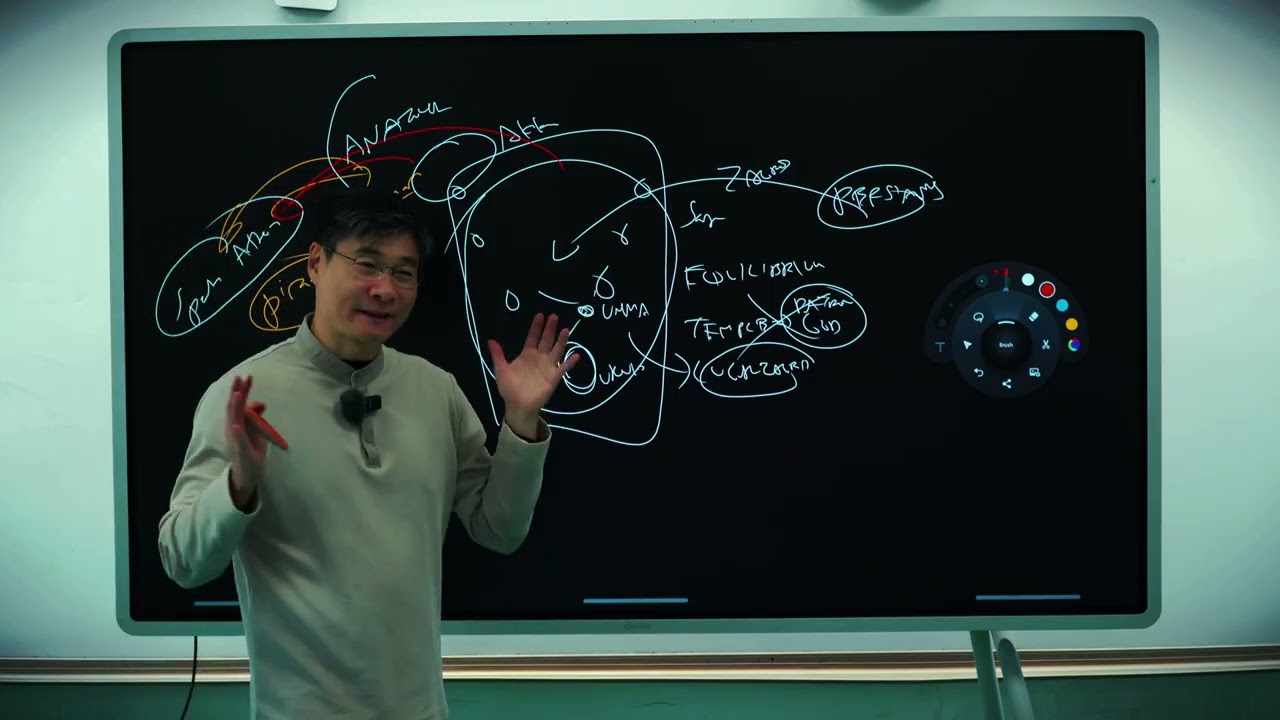
So the first thing to understand is that we live in Plato's cave.
Speaker A
Okay, meaning that we're all chained to the floor,
Speaker A
and we're all watching a screen.
Speaker A
And behind is this great fire where the elite create, uh, puppets.
Speaker A
For so that we can collectively hallucinate our own reality.
Speaker A
All right?
Speaker A
And this mechanism that allows us to coordinate our imagination,
Speaker A
is of course called money.
Speaker A
All right, so think of money as God.
Speaker A
Right, and so what money is doing is it's focusing our minds in a certain way that creates our reality.
Speaker A
All right?
Speaker A
So because of this concept, this allows us to create the world that we live in today.
Speaker A
Okay?
Speaker A
So remember how the world is structured.
Speaker A
Um, you have the empire.
Speaker A
But then you have the game masters.
Speaker A
Who are the game masters?
Speaker A
They're the people in finance.
Speaker A
Okay, and this includes Bank of International Settlements, uh, World Bank, uh, International Monetary Fund,
Speaker A
uh, Wall Street, City of London, okay?
Speaker A
These are different financial organizations that coordinate together.
Speaker A
And they are the game masters.
Speaker A
And what they do is they control how US dollars, which is the currency of this game,
Speaker A
they control how US dollars moves around the system.
Speaker A
Okay?
Speaker A
So USD.
Speaker A
And this creates, of course, the global economy.
Speaker A
But you cannot allow people to think that they're actually a set of people manipulating this game.
Speaker A
Because then people will think this is not fair.
Speaker A
It's not transparent.
Speaker A
Right, and it's and it's not a clean game.
Speaker A
So what you do is you create multilateral organizations called the rules based international order.
Speaker A
Like the WTO, UN, and you make them believe that, oh, it's these impartial organizations that actually control the game.
Speaker A
So it's fair and it's transparent.
Speaker A
And it's accountable to the people.
Speaker A
Okay, and then you reinforce this using media, um, education and culture.
Speaker A
And together these three will, um, create the values and norms.
Speaker A
That make us believe that this is a fair, open and transparent game in which we can all win.
Speaker A
Okay, so that when there's a collapse, it's not because there are people engineering this collapse behind the scenes.
Speaker A
It's because it's a law of gravity.
Speaker A
This this happens naturally in this game.
Speaker A
It's no one's fault.
Speaker A
It's just like we were too lazy and corrupt.
Speaker A
Okay?
Speaker A
All right, so certain things to remember about the system is that,
Speaker A
this system is not as clean as you think.
Speaker A
Because there are opposing forces to it.
Speaker A
All right, and these opposing forces are such forces such as nationalism.
Speaker A
Okay?
Speaker A
Or ethnic identity.
Speaker A
Then you have social democracy.
Speaker A
Individual rights, right?
Speaker A
And then, of course, you have religion.
Speaker A
All right, so there are these countervailing forces that try to break apart the system.
Speaker A
So then what happens is that there are other, um, systems.
Speaker A
That keep this system in place and respond to these countervailing forces.
Speaker A
All right?
Speaker A
And they are intelligence, spies, basically.
Speaker A
Crime and science.
Speaker A
And behind these three forces are three sets of powerful institutions.
Speaker A
Okay?
Speaker A
These are transnational capital.
Speaker A
Um, secret societies.
Speaker A
And the last is elite families.
Speaker A
Okay, some people call them the Illuminati.
Speaker A
Okay, doesn't matter.
Speaker A
All right?
Speaker A
So this is how the world works.
Speaker A
And underpinning this elite is something called the occult, which we'll study later on.
Speaker A
Okay?
Topics:economic collapseboom bust cyclecentral bankinterest ratesfinancial elitesglobal economymoney creationPlato's cavegame theoryinternational order