Tizzy RBLX reveals 5 key elements that guarantee a viral Roblox game, focusing on clickable ideas, onboarding, engagement, and emotional investment.
Ask about this video. Answers come from its transcript only — with the timestamp, so you can check them.
Generated from the transcript and can be wrong — check the timestamp.
Key Takeaways
- A strong, clickable core fantasy is essential for viral success.
- Onboarding should emotionally engage players, not just teach mechanics.
- Social and cosmetic features drive player retention and virality.
- Designing for content creators amplifies game exposure.
- Data-driven iteration on onboarding and engagement improves player retention.
What the video covers
- A viral Roblox game starts with a clickable core fantasy that sparks imagination, similar to popular movies and games.
- Onboarding is crucial and should emotionally invest players by introducing one mechanic at a time with meaningful context.
- Effective onboarding uses minimal UI and level design to guide players and reduce bounce rates.
- World-building and storytelling in onboarding help players understand why they should care about game actions.
- Engagement is boosted by social features, such as making the game more fun with friends to encourage invites and growth.
- Cosmetics and visible player progress create FOMO and motivate players to keep playing.
- Content creator support is vital; designing games with creators in mind can amplify reach and virality.
- Console players are an important audience segment due to their longer and more frequent play sessions.
- Analyzing player funnels helps diagnose onboarding effectiveness and player retention.
- Executing these five elements well can guarantee at least 10K concurrent users (CCU) on Roblox.
Chapters
- 00:00Introduction and Overview
- 00:51Core Fantasy and Clickable Ideas
- 01:52Examples of Strong Core Fantasies in Games and Movies
- 03:59Importance of Clickable Ideas and Emotional Impact
- 05:09Onboarding: Emotional Investment and Tutorial Design
- 06:08Using Cutscenes and Level Design for Player Engagement
- 07:13Examples of Effective Onboarding in Roblox Games
- 08:16Engagement and Social Features
- 09:09Content Creators and Game Virality
- 11:11Conclusion: Guaranteeing Viral Success
Full Transcript — Download SRT & Markdown
Speaker A
I found the five things that guarantee a viral Roblox game. Guys, in this video, I want to break down the top five things that I look for when looking to either build a game, invest in a game, or determine if a game is worth my time. If
Speaker A
you guys don't know me, my name is Tizzy. I have a top 100 Roblox game right now called Build a Base and Steel.
Speaker A
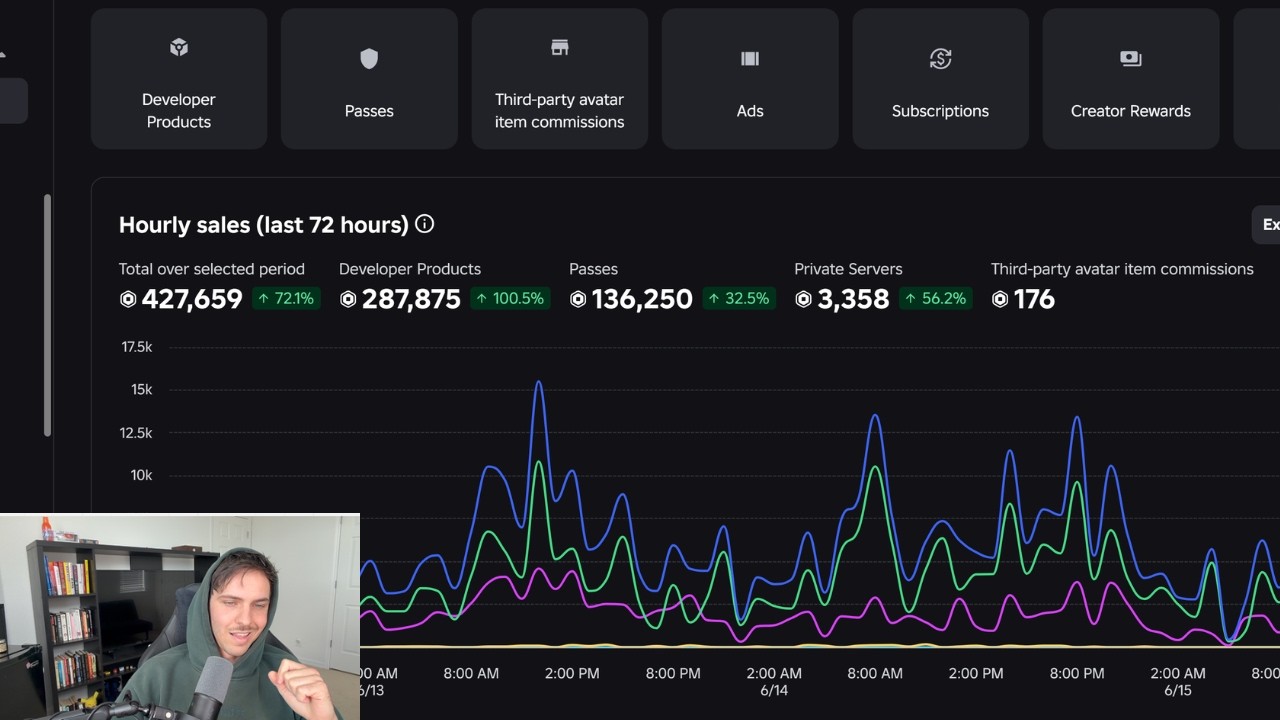
Around 33 million visits. Uh, this data hasn't updated. It actually peaked at 60K last Saturday during admin abuse.
Speaker A
You can see it's number 81 at most popular, number 10 on up and coming, etc., etc. And that's why I feel like I'm credible to help you guys with this information. Now, without further ado, let's get straight into this. Okay, what
Speaker A
is the first thing that determines if a Roblox game is guaranteed to go viral?
Speaker A
And for me, this is what's also been taught to me from a guy named One Cole.
Speaker A
Shout out to Cole. And that is, is the idea clickable? Okay. What's the core fantasy of this game? Now, the way I like to think about this dude is I picture a seven-year-old kid trying to fall asleep at night, right? And kids
Speaker A
have such a wild imagination, right? And he's trying to fall asleep at night thinking about all these different wild scenarios. Most common scenario is there's a monster in my freaking closet, right? We all thought there was a monster in our closet when we were kids.
Speaker A
Kids have a wild imagination. And what we want to do is give kids or just players in general, it doesn't have to be just kids, the opportunity to fulfill their fantasies through our game. So, if we look at this game that blew up
Speaker A
recently, Animal Hospital, what is the actual fantasy here? What is that kid thinking about when he's trying to fall asleep at night? He's thinking, "What if there was a hospital, but instead it was run by animals?" Okay, that's a kid's
Speaker A
fantasy. It's not just exclusive to video games, though. Like, if you want to look at one of the bestselling movies of all time, Zootopia 2. Okay, what's the actual fantasy? It's what if there was an entire city run by animals? Okay,
Speaker A
there's a reason why this movie has sold so well. It has a strong fantasy.
Speaker A
There's obviously tons of other elements like the animations, the characters, the writing, but at its core, it's a really strong fantasy. Okay, if we look at this game, Fly to Space, what's the kid thinking? What would it be like if I
Speaker A
could go to the moon or I could fly to the moon? All right, Toy Story, one of the best selling movies of all time. Of all time. What's the fantasy? What's the kid thinking about when he's trying to
Speaker A
fall asleep at night? What if the toys that I have in my toy chest, what if they were actually alive and were living their own life? Okay, you can see this recurring theme not just in video games, but in media as well. If we look at this
Speaker A
movie again, another top selling movie of all time called Inside Out. I don't know if you guys have seen it, but what's kind of the fantasy here? It's what if there were these little characters that lived inside my mind
Speaker A
that controlled my emotions. Okay? And for all my old heads, if you ever seen Osmosis Jones, this is me revealing my age. This is a movie from the [ __ ] 90s, dude. And basically the premise is this dude Osmosis Jones, he is a white
Speaker A
blood cell and he has to fight off a virus inside this guy's body. Okay, so start thinking about core fantasy in a clickable idea. And the way I like to think about it is like what is a kid
Speaker A
thinking about and imagining when he's trying to fall asleep at night? And you can see this theme not just with games but with movies as well, right? Strong interesting core fantasies. Okay? And that comes down to a clickable idea,
Speaker A
right? You want this kid when he goes on his homepage to see your game idea, see the way it's packaged, and he just can't help but freaking click on that thing. Dude, this is actually something Mr. B said is when
Speaker A
he thinks of a video idea, he thinks of something so insanely crazy that even if you scroll past his video, you're still trying to fall asleep at night thinking about, man, I wonder what the f is in that video, bro. Okay, now number two,
Speaker A
highly overlooked is great onboarding. Now guys, onboarding. I mean, a lot of people ask me about onboarding because I know in my last videos I've talked about that for Build a Base and Steel, we had like seven or nine different iterations
Speaker A
of the tutorial. Okay, the main things I've learned about onboarding is you don't want to just tell the player what to do. A lot of people get this wrong, right? They think, okay, onboarding means tutorial. That means I just tell
Speaker A
player click this thing, buy this thing, place this thing, boom, tutorial done. No, you need to give them time to understand why they should care about the actions they're doing. Okay? Explain why they are doing it. So for my game
Speaker A
Farmer Die, which rest in peace to it, the core mechanic was curing the survivors. Okay? So if we just told players, hey, give this survivor medicine, it's not as meaningful.
Speaker A
Whereas if we at the very beginning the first thing they see in the title sequence is cure the survivors or you do some world building where hey survivors are sick you have to save them. This is why you should care about what you're
Speaker A
doing. You need to get them emotionally invested into the game in the first 90 seconds. Okay? You can do this with cutscenes. Lowkey OP method. Cutscenes help a ton with bounce rate. Okay.
Speaker A
Another thing I've learned with onboarding is you want to introduce one mechanic at a time. A lot of people get this wrong. They think that, okay, let me just speedrun the tutorial. Let me just get a high tutorial completion
Speaker A
rate. But guys, it's the tutorial completion rate is only one piece of the story. Yes, a player can complete your tutorial at a high rate, but are they actually emotionally invested? Do they actually care about the game? And this
Speaker A
happens when you introduce them to one mechanic at a time. Okay. So, an example for a Build a Base and Steel is the cutscene. We show the pet gets stolen.
Speaker A
Okay. Then immediately we put them into the tutorial. They now know that the pet can get stolen. The threat is immediately felt. Okay. And now they want to protect the pet. They saw it get stolen in the cutscene. Now they're
Speaker A
emotionally attached to it. They want to protect it. Okay. So we introduce that build mechanic first. All right. Now another thing that's very commonly overlooked is using level design to help guide the player. Okay. If you look at
Speaker A
Escape Tsunami for Brain Rots. Okay. Go play this game. You guys may call it slop. I don't care. Obviously, it did well. It's not slop in my opinion. It's beautiful game design. You load into Escape for Brain Rots. What do you see
Speaker A
immediately? In the first 5 seconds, immediately you see these giant tsunamis coming at you. So immediately in the player's brain, it's registered that I just clicked on a game called Escape Tsunami. Immediately I see the tsunami.
Speaker A
The threat is felt. It's known. And okay, now I actually care to see how far can I run down this runway to actually go catch a brain rot and bring it back.
Speaker A
Okay, Escape Tsunami for Brain Rots. Great example of level design in my opinion. Now, if you ask me, some of the best onboarding I've ever seen on this platform in the little time I've been on this platform is Sell Lemons. There's a
Speaker A
few key things with Sell Lemons, dude. First and foremost, there's literally no UI during the tutorial, during the onboarding. It's very simple and the way progression happens so fast in that game. I highly recommend you guys go play this game on an alt and see how
Speaker A
they did onboarding. Okay, they introduce one mechanic at a time. The player immediately becomes emotionally invested and they use minimal UI.
Speaker A
They're not spamming freaking packs or like starter packs or all these like 2x money for nine Robux, right off the gate, right? They first introduce the player to the game in such a way where the player actually cares about
Speaker A
the game, is emotionally invincible.
Speaker A
This is a question I get asked a lot. Where you want to go is to engagement.
Speaker A
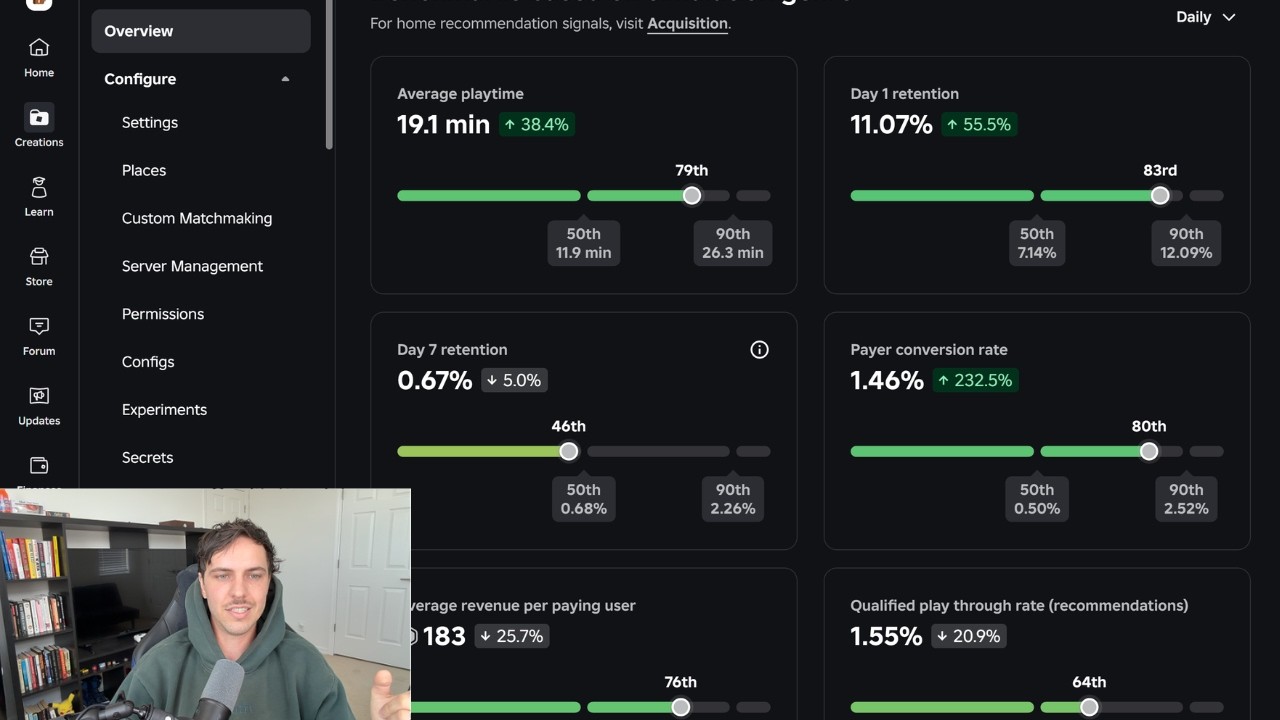
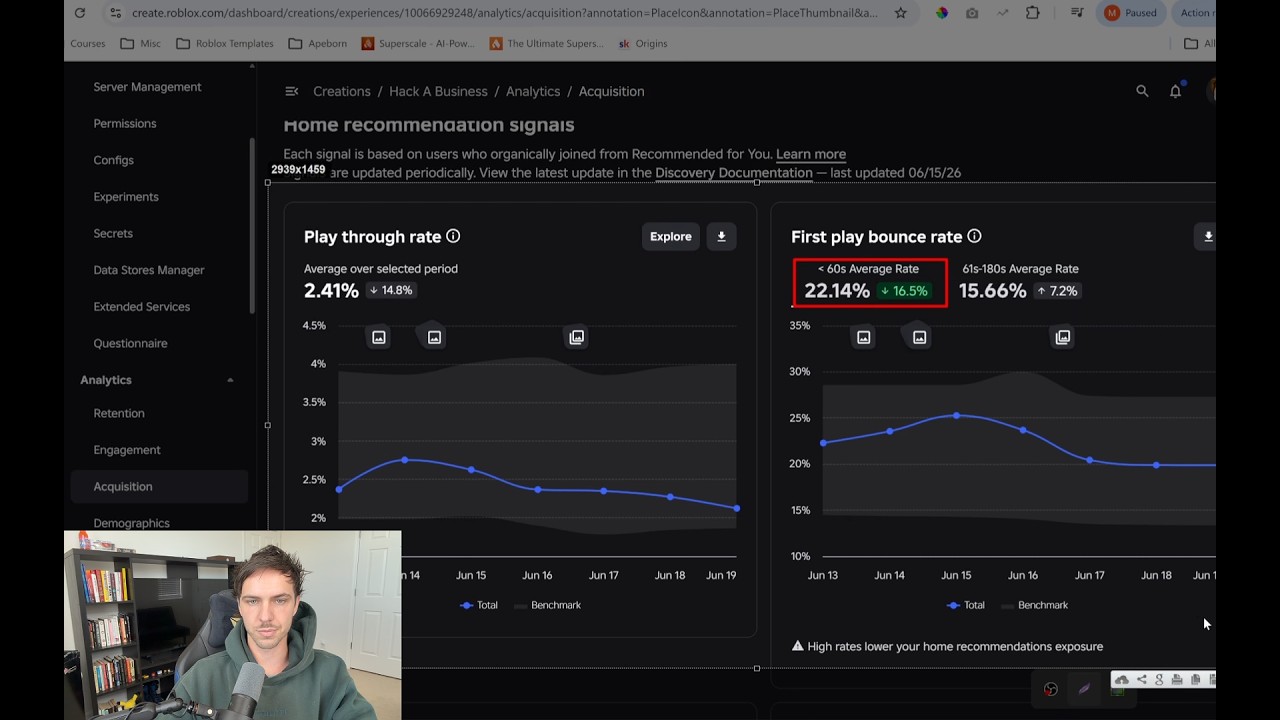
Okay, go to your engagement right here. If you go engagement, okay, go engagement. You can chop it up however you want. And then look at this right here. Okay, new user first session retention. This is going to tell you a lot because a lot of
Speaker A
people will flex, hey, I have a high tutorial completion rate, which is not always a flex, and I'll explain why in a second. What you want to do is you want to hover over this line, and you can see
Speaker A
in the first 30 seconds, we're retaining 95% of our players. That's pretty good in my opinion. the first minute we still have 87% of our player base. Okay, so these kids are invested. Okay, now over time it starts to decline, but at 5
Speaker A
minutes we still have 65% of our player base. I've seen a lot of graphs from people in my Discord. They've showed me and they have like a 20 or 30% new user first session retention. This has everything to do with onboarding and not
Speaker A
just explaining mechanics but also getting them emotionally invested in those mechanics. Okay. Now, how do you diagnose onboarding? Again, you can go to funnels.
Speaker A
You should be tracking every single little step in your funnel. This is commonly overlooked. People will flex saying, "Hey, I have a high tutorial completion rate." But bro, look at our funnel for example. Okay, we have open gear shop is one step. Bought a bat is
Speaker A
the next step. Close the shop is the third step. A lot of people will chunk this down as just one step. They'll just be like bought gear from shop. But no, you want to track every single little step to see where the friction is
Speaker A
actually happening. And better yet, slice and dice the data in such a way where you can sort by device, dude.
Speaker A
Because a lot of people, they'll have a game that has great tutorial metrics, but absolutely ass on console. People overlook console all the time, by the way. I've said this in previous videos.
Speaker A
Don't overlook console, bro. Console players play for a long time and they play often and they play a [ __ ] ton.
Speaker A
Like I said, and the simplest way, dude, I probably sound like a [ __ ] broken record, but just study top games, bro.
Speaker A
Play your game on mobile. play it on console, especially mobile, and see how much friction it costs on mobile.
Speaker A
There's a recent game I reviewed. I know immediately that it's not going to do well simply because of the friction that is on mobile. There's certain mechanics that are a little clunky. It's not intuitive. I don't know where to tap on
Speaker A
the screen. There's all these little details add up to create a frictionless experience that makes for great onboarding. So, it's not just introducing and teaching the mechanics, but also getting them emotionally invested in progression and the game itself. Okay? And there's a lot of
Speaker A
different ways to do that. We talked about an example from Escape Tsunami where they used the level design to get the player emotionally invested. Cell Lemons did some hacks with out showing the UI directly, right? There's different ways to chop this up. Okay?
Speaker A
Okay. So, what you want to do is look at these top games and ask yourself why they did this and not just copy the game one for one, bro. Like, don't just copy the game one for one, but copy the
Speaker A
functionality, not the style. Okay. Now, third thing that determines if a Roblox game is guaranteed to go viral is socialization.
Speaker A
This I've seen so overlooked by kids in my Discord server. They'll have a great game. It's a great incremental. It's a great tycoon, but there's no way to interact with other players and you're destroying your potential to go viral.
Speaker A
Because let me explain something to you guys. If your game is good, better at if your game is better to play with friends. This is the key. Your game should be more fun to play with friends.
Speaker A
It should be 10 times more fun to play with friends. What happens? Friends invite friends. Okay? Then those friends invite friends. And then those friends invite friends. And then those friends invite friends. and then those friends and all of a sudden you've created this
Speaker A
flywheel effect where your game is naturally going viral through word of mouth. This kid goes to school. He's showing his friend on the bus to school.
Speaker A
He's like, "Look at this game." His friend's like, "Yo, that game looks so cool." His friend hops on the game after school. Then he tells his friend, then he tells his friend. Dude, this is such an underrated way to go viral is just
Speaker A
design a game in such a way where socialization and interaction with other players is part of the core loop. Okay, you look at 99 Nights. That game is infinitely more fun with friends. Okay, a little hack is obviously leaderboards.
Speaker A
This one's pretty known. It's not even really a hack, dude. But leaderboards, that social flex element I've talked about in a lot of videos, you can do this through level design.
Speaker A
There's so many different ways to do this through cosmetics. Immediately, I mean, you look at plus one speed keyboard escape, right? You load into that game, immediately you see a kid just zooming past you, right? creates that FOMO, creates a little bit
Speaker A
emotional investment, creates a little bit of envy. You're like, "Damn, dude. I want to get as good as that kid. He's [ __ ] zooming by, bro. He's fast as [ __ ] boy." Okay, socialization.
Speaker A
Do not skip this part. Ideally, okay, you look at a game like Missiles versus Cities again, ideally interaction with other players is part of the core loop, bro. the way it's designed. This, in my opinion, starts from the actual initial
Speaker A
design of the game. Okay, number four, simple mechanics with tons of depth. Let's look at build a plane, right? What is build a plane? Voxal block building.
Speaker A
Okay, one simple mechanic, tons of depth, tons of depth. Because if you look at, and I'm going to get this in get to this in a second. If you look at their community, go look at build a plane on Tik Tok, dude. Okay? Tons of
Speaker A
videos of kids that love this game talking about this is how to make a freaking fighter jet and build a plane.
Speaker A
This is how to make a helicopter. This is how to make etc etc. Right? All this depth from this one mechanic. And it's also very communitydriven, which we're going to get into in a second. But simple mechanics, tons of depth. What's
Speaker A
what's Brook Haven? Right? Role playing game. Okay, you role play, but every single time you log into this game, you can role play as someone else. Okay, I don't know much about role play, but so I'm not going to speak much on it, but
Speaker A
from my understanding, you log in, you can be whoever you want. Every single session is new. Every single session is different. Same thing with build a plane, you can build a new plane every single time. Build a boat for treasure,
Speaker A
you can build a new boat every single time. Every single session is new. It's fresh. It's different. This is also why PvP can work really well. Okay, you look at 99 nights. Every single session is different. How far can I get this time?
Speaker A
What scary monster am I going to see this time? What new thing can I unlock this time that I didn't unlock that time? What if I do my base like this this time versus last time I did it like
Speaker A
this, but the cultist got me? And maybe, you know, this time I'll do it like this, so the cultist can't get me and I can get a little bit further. All these top games have very simple and easy to
Speaker A
understand mechanics that offer a ton of depth. Now, the key here is mobile user experience and accessibility is a must.
Speaker A
Okay, whatever mechanic you choose to be the core of your game that offers tons of depth needs to be very easy to use on mobile. And to be completely honest with you guys, I think this right here is
Speaker A
what's limiting build a base and steel. Okay, I think we would be at 100k 150k CCU right now if the voxal block building wasn't as clunky as it is on mobile. And that's nothing to do with, you know, the
Speaker A
way it was developed or anything. The the snap to grid system works perfectly. It's just the friction of having to tap your screen so many times to build that base before a pet gets stolen. Okay, you look at steal a brain rot. You don't
Speaker A
actually have to build a base. Base is already done. Very easy, simple to use.
Speaker A
Mobile UX. Okay, same thing with the sandwich game I talked about my last video. This is a major major key. Okay, fifth and commonly overlooked is clippable/strong community. Okay, you look at again Build a Plane. Look at Mecca Chameleon, dude. That game went
Speaker A
[ __ ] nuts on Steam, bro. All of the clips of people finding unique hiding spots, painting their character. I mean, clippable and simple mechanic with tons of depth. Mecha Chameleon. You look at all the games on Roblox, Paint or Die,
Speaker A
Paint and Seek, right? Which are literally just clones of Mecca Chameleon, but they're smart because Oh, RP to this game. It looks like the trend is is slowing down, but still, I mean, smart. Okay, simple mechanics, tons of depth, and clippable, bro. When
Speaker A
you're designing your game, visualize in your mind what it's going to be like for a content creator to actually play the game. Okay, for Build a Base and Steel, I watch nearly every single video that a content creator makes in our game, and I
Speaker A
take note of the specific moments in the game that they choose to include. And for our game, it's mainly building a cool base or stealing a cool pet. Okay, if you can get this right, dude. In my opinion, this is why Build a Plane has
Speaker A
been at like 8 to 9K CCU for couple years now. It seems like a year and a half, two years. Because they have such a strong community and there's kids that are just I mean, look at this, bro. 143K
Speaker A
likes on this video. How to build an F22 Raptor, right? Communitydriven content and it's clippable because of the design choices of the simple mechanics. And shout out to Blaze. This is his game.
Speaker A
He's a goat. He's a coach inside of our community. So guys, I tried to take concepts and chunk them down for you to make this understandable. If you can have all five things here integrated in your game, you're pretty much guaranteed
Speaker A
at least 10k CCU, bro. At least if you execute these five things really, really well, you are without a [ __ ] doubt in my mind guaranteed at least 10K CCU.
Speaker A
That's it for this video. Love you guys. Peace.
Topics:Robloxviral gamegame designonboardingplayer engagementcore fantasylevel designcontent creatorsgame developmentTizzy RBLX


![FREE High Ticket Sales Training [COMPLETE COURSE] — Transcript](https://i.ytimg.com/vi/vFsMKg9kck0/maxresdefault.jpg)