Skip to content

Only the top 1% of Roblox developers know this...

Discover the top skill Roblox developers use to succeed: game design. Learn the 'games to watch' method to improve your design intuition.

Ask about this video. Answers come from its transcript only — with the timestamp, so you can check them.

Generated from the transcript and can be wrong — check the timestamp.

Key Takeaways

  • Game design is the foundational skill for top Roblox developers.
  • Studying and hypothesizing about trending games can accelerate learning game design.
  • Tracking game performance over time validates and refines design intuition.
  • Clear tutorials and engaging core mechanics are critical for player retention.
  • Social features and level design significantly impact game success.

What the video covers

  • The most crucial skill for Roblox developers is game design, not programming or modeling.
  • Game design involves creating the rules, mechanics, and interactive systems that make a game fun and playable.
  • The 'games to watch' method helps solo developers improve game design without needing a team or frequent releases.
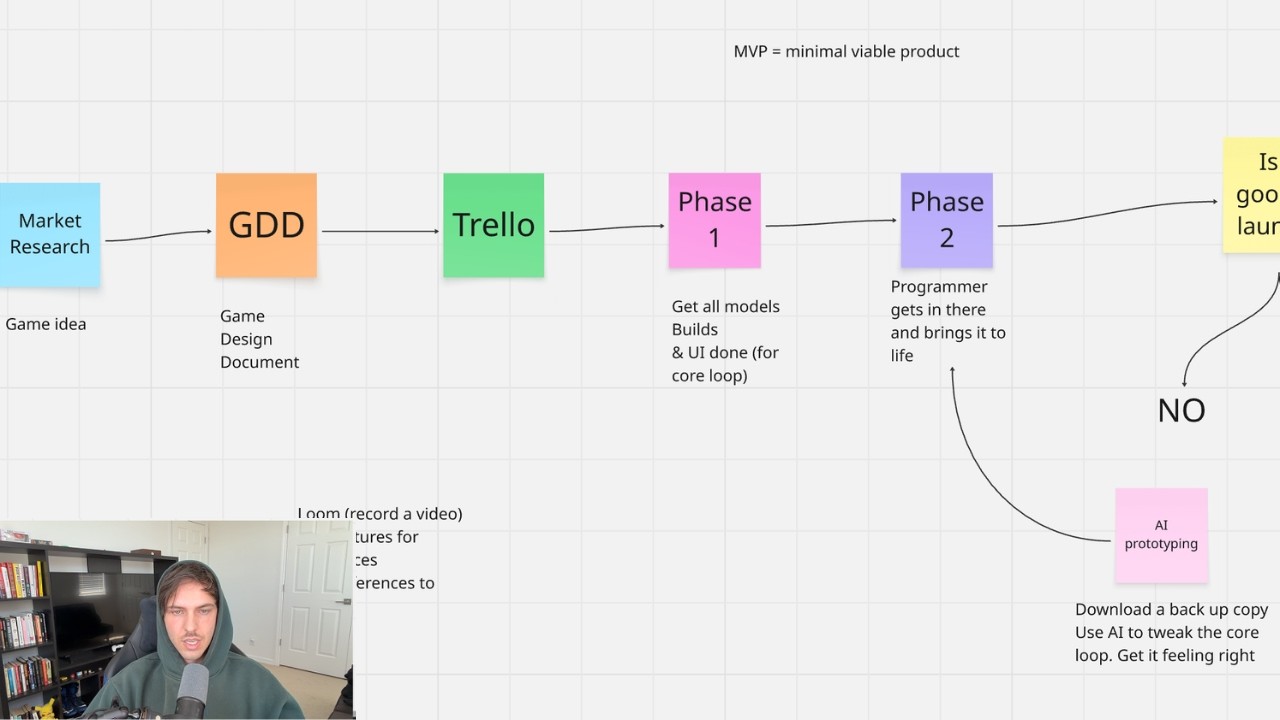
  • This method involves studying trending games on Road Trends, taking detailed notes, and forming hypotheses about their success.
  • Developers track these games over time to see if their predictions about player engagement and growth hold true.
  • The process builds game design intuition by analyzing what makes games succeed or fail.
  • Game design is distinct from game development, which is about execution like coding and asset creation.
  • The video provides real-time examples of applying the method, including evaluating first-time user experience and game mechanics.
  • Key elements to observe include tutorial clarity, core fantasy, social features, and level design issues.
  • The approach is accessible and free, ideal for developers without resources to rapidly produce games.

Answers

Questions about this video

What is the most important skill for Roblox developers according to the video?

The video emphasizes that game design is the most important skill for Roblox developers, more so than programming, UI, modeling, or animation.

How can solo developers improve their game design skills without releasing many games?

Solo developers can use the 'games to watch' method, which involves studying trending games, taking notes, forming hypotheses about their success, and tracking their progress over time to build game design intuition.

What does the 'games to watch' method involve?

It involves selecting games from Road Trends, analyzing their mechanics and user experience, hypothesizing about their potential success, and revisiting them later to see if those hypotheses were correct, thereby improving design skills.

Full Transcript — Download SRT & Markdown

00:00
Speaker A
Only the top 1% of Roblox developers understand this. There is a skill that is the skill of all skills on this platform. Now, that skill is not programming. That skill is not UI. That skill is not modeling. That skill is not building. This might be a little bit controversial, so stick with me. That skill is not animation. What is this secret magical skill? That skill is game design. Now, you're an experienced dev. Stick with me. This might seem obvious to you. You might say, "Holy [ __ ] this guy is like saying water is wet." Stick with me, brother. You may be wondering, "How can you actually get good at game design?" And most people would just say, "Just make more games." But what if you are a solo dev? What if you can't release games monthly? What if you don't have cash to pay for a team? There is a simpler way to learn game design. And this is what I wish someone showed me day one before I ever launched my first game. And I call it the games to watch method. What is the games to watch method? Well, I'm going to dive straight into that [ __ ] man. And I'm going to show you guys what it looks like, the framework, the mental model, and then I'm going to show you how I apply it myself. Okay, so the first thing you're going to want to do is find a game on Road Trends, right? We know this from previous videos. Usually, I like to go to top moving today. Okay, I'll go, um, I mean, we can do momentum, we can do visits and descending order. It doesn't really matter. The whole point of this is you want to find a game that you think looks interesting, okay? And you want to add it to a little Google sheet. And what you want to do is you want to take notes on the game. Okay? I'll show you guys an example of what this looks like. I made this months ago, um, last year, and you can see kind of my thought process. So, for example, when I was first studying Alien Ranch, these are the types of notes I took. Okay. Why are we taking notes? Good question. What we want to do is form a hypothesis of whether or not we think this game will do well. And this is how you can improve your game design intuition. It's a very simple way to do it. Okay? Because game design is the process of creating the rules, mechanics, and interactive systems that make the game fun and playable. So again, debatably, this is the most important skill to have, and all the top, top developers are incredible game designers. Okay, the difference, if you're wondering, between building a game and designing a game, this is what Google says. Game design is the blueprints, the rules. It answers questions like, "What does the player do? How do they win?" Game development is the execution. It involves writing the code, drawing the 3D models, recording the audio to actually build the game. If you're an experienced dev watching this, you're like, "Okay, yeah, water's wet. Get it?" Some people don't know this, dude. All right. I'm trying to help them. Now, what do we do? We get a Google sheet here. We're rocking. We're rolling. I put a link to the Road Trend game that I want to study. And I'll take notes. Here's an example. This was for Alien Ranch a while ago when I was looking for game ideas and trying to study games. I wrote potential simply because the playability with friends and freedom of choice for the players, deep upgrade paths. Players can choose between fending off aliens, feeding cows, milking cows, etc. Leaves room for strategy and fun collaboration with friends. Some game-breaking bugs like not being able to put my money in my money collector. Milk getting stuck when trying to sell to customer. Okay. And I'll take a note like this. Will not reach 10K CCU until mid to late game is improved and first-time user experience is improved. Still very clunky. Great unique ID with unique art style and first of its kind core loop which I believe is carrying it but without further polish will not go far. Okay, I take notes like this. This is how the process works and I form a hypothesis and the main hypothesis is mainly will this game do well? Is it going to get more home recommendation impressions? Is CCU gonna go up or down? And I form a hypothesis. I take notes on this. All right. Then what I'll do typically is maybe a week, two weeks later, maybe a month later, I'll check Road Trends again and I'll see where is this game at. This is not a good example. Let's see if I can find an example of a game that's, we, we'll do live examples, don't worry. But I'll check Road Trends and I'll see has CCU gone up. Is my hypothesis true or false? And I'll take notes again. Was I correct? Did this game start to blow up? Why or why not? Why do I think it didn't blow up? What was I wrong about? Was my thinking process correct? Did I make a good guess? Did I make a bad guess? Why or why not? So, this is like early observation, this column right here. Okay, this is first time I encountered the game. And then ideally you're going to want to do a week, two weeks later what happens. This is a very simple way. Anyone could do this for free if you don't have cash to pump out games like crazy. This is a great way to develop what I call game design intuition. Now, am I the world's best game designer? No, bro. I'm an up and coming developer. I'm just developing. I'm just documenting the journey. Okay. Let me show you guys how I would do this. I'm going to start a whole new one right here. Okay. And I'm going to say game link. Okay. Notes V1. So, this is like notes after one week. Let's do a couple of these in real time. So, here we have a game, My Gaming Cafe. Let's go ahead, get this Road Trends link. I'm going to do this and I'm simply going to play the game and let's see how the first-time user experience is. Okay. Unlock the PC, monitor, and keyboard on your first desk. Um, I see this. I'm going to click this. Oh, RNG mechanic. Okay, that is a good thing. So, that's already making me a little bit more bullish. Let's see another RNG mechanic. Okay. So, I'm going to take a few notes. My Gaming Cafe. Okay. I'm just going to say interesting core fantasy. Now, mind you guys, this is all about forming a hypothesis. So, it doesn't matter if you're right or wrong. You're still going to learn. Okay? If you make a judgment call, you think that a game's going to blow up, but it doesn't end up blowing up, you still learned, right? If you make a judgment call that you think a game is going to blow up and it does blow up, you still learned. Let's keep playing. Buy your second desk. Okay, this is a bit clunky with this arrow going through the wall. Maybe they could start without the walls already existing. Just a thought, but let's see. Press the spin button. Roll for an item. Okay, another RNG mechanic. Okay. Take the rolled item from the pad. Walk the desk. Replace a component with your held item. Tutorial complete. Okay. So, I would say pretty clear tutorial progression is obvious within first 60 seconds. And that's something I've also been taught and come to learn is like within the first 60 to 120 seconds, you want it very clear what the goal of this game is, how they can progress, and you want to open some sort of curiosity loop. And the curiosity loop that is being opened from my understanding is what are the other computers going to look like? How big can I make this computer cafe? What's this guy doing over here? Look at all of his computers. Okay, we have this social flex element which is something I'm going to take note of. Social flex element. I can see others' plots. Um, let me wrap this. However, the plots have walls. And what I mean by that is like most players are probably not going to zoom all the way out. So, it's not very evident and obvious how the other players are progressing and that is, in my opinion, a level design issue. Okay. So, I think that is limiting the game right there. You guys know what I'm talking about with like social flex element, right? Like I want to be able to immediately come in here and see that this guy over
00:25
Speaker A
building. This might be a little bit controversial, so stick with me. That skill is not animation. What is this secret magical skill? That skill is game design. Now, you're an experienced dev.
00:40
Speaker A
Stick with me. This might seem obvious to you. You might say, "Holy [ __ ] this guy is like saying water is wet." Stick with me, brother. You may be wondering, "How can you actually get good at game
00:52
Speaker A
design?" And most people would just say, "Just make more games." But what if you are a solo dev? What if you can't release games monthly? What if you don't have cash to pay for a team?
01:07
Speaker A
There is a simpler way to learn game design. And this is what I wish someone showed me day one before I ever launched my first game. And I call it the games to watch method. What is the games to
01:22
Speaker A
watch method? Well, I'm going to dive straight into that [ __ ] man. And I'm going to show you guys what it looks like, the framework, the mental model, and then I'm going to show you how I apply it myself. Okay, so the first
01:36
Speaker A
thing you're going to want to do is find a game on road trends, right? We know this from previous videos. Usually, I like to go to top moving today. Okay, I'll go um I mean, we can do momentum,
01:48
Speaker A
we can do visits and descending order. It doesn't really matter. The whole point of this is you want to find a game that you think looks interesting, okay? And you want to add it to a little Google sheet. And what you want to do is
02:06
Speaker A
you want to take notes on the game. Okay? I'll show you guys an example of what this looks like. I made this months ago um last year and you can see kind of my my thought process. So, for example,
02:19
Speaker A
when I was first studying Alien Ranch, these are the types of notes I took.
02:25
Speaker A
Okay. Why are we taking notes? Good question. What we want to do is form a hypothesis of whether or not we think this game will do well. And this is how you can improve your game design intuition. It's a very simple way to do
02:43
Speaker A
it. Okay? Because game design is the process of creating the rules, mechanics, and interactive systems that make the game fun and playable.
02:56
Speaker A
So again, debatably, this is the most important skill to have, and all the top top developers are incredible game designers. Okay, the difference, if you're wondering, between building a game and designing a game, this is what Google says. Game
03:12
Speaker A
design is the blueprints, the rules. It answers questions like, "What does the player do? How do they win?" Game development is the execution. It involves writing the code, drawing the 3D models, recording the audio to actually build the game. If you're an
03:25
Speaker A
experienced dev watching this, you're like, "Okay, yeah, water's wet. Get it?" Some people don't know this, dude. All right. I'm trying to help them. Now, what do we do? We get a Google sheet here. We're rocking. We're rolling. I
03:37
Speaker A
put a link to the Road Trend game that I want to study. And I'll take notes.
03:41
Speaker A
Here's an example. This was was for Alien Ranch a while ago when I was looking for game ideas and trying to study games. I wrote potential simply because the playability with friends and freedom of choice of for the players
03:53
Speaker A
deep upgrade paths. Players can choose between fending off aliens, feeding cows, milking cows, etc. Leaves room for strategy and fun collaboration with friends. Some game-breaking bugs like not being able to put my money in my money collector. Milk getting stuck when
04:05
Speaker A
trying to sell customer. Okay. And I'll take a note like this. will not reach 10K CCU until mid to late game is improved and first-time user experience is improved. Still very clunky. Great unique ID with unique art style and
04:17
Speaker A
first of its kind core loop which I believe is carrying it but without further polish will not go far. Okay, I take notes like this. This how the process works and I form a hypothesis and the main hypothesis is mainly will
04:32
Speaker A
this game do well? Is it going to get more home recommendation impressions? Is CCU gonna go up or down? And I form a hypothesis. I take notes on this. All right. Then what I'll do typically is maybe a week, two weeks later, maybe a
04:46
Speaker A
month later, I'll check road trends again and I'll see where is this game at. This is not a good example. Let's see if I can find an example of a game that's we we'll do live examples, don't worry. But I'll check row trends and
04:58
Speaker A
I'll see has CCU gone up. Is my hypothesis true or false? And I'll take notes again. Was I correct? Did this game start to blow up? Why or why not? Why do I think it didn't blow up? What was I
05:16
Speaker A
wrong about? Was my thinking process correct? Did I make a good guess? Did I make a bad guess? Why or why not? So, this is like early observation, this column right here. Okay, this is first time I encountered the game. And then
05:32
Speaker A
ideally you're going to want to do a week, two weeks later what happens. This is a very simple way. Anyone could do this for free if you don't have cash to pump out games like crazy. This is a
05:43
Speaker A
great way to develop what I call game design intuition. Now, am I the world's best game designer? No, bro. I'm an up andcoming developer. I'm just developing. I'm just documenting the journey. Okay. Let me show you guys how
05:55
Speaker A
I would do this. I'm going to start a whole new one right here. Okay. And I'm going to say game link. Okay.
06:01
Speaker A
notes V1. So, this is like notes after one week. Let's do a couple of these in real time. So, here we have a game, My Gaming Cafe.
06:14
Speaker A
Let's go ahead get this Road Trends link. I'm going to do this and I'm simply going to play the game and let's see how the first time user experiences. Okay. Unlock the PC, monitor, and keyboard on your first
06:31
Speaker A
desk. Um, I see this. I'm going to click this. Oh, RNG mechanic. Okay, that is a good thing.
06:46
Speaker A
So, that's already making me a little bit more bullish. Let's see another RNG mechanic.
06:59
Speaker A
Okay. So, I'm going to take a few notes. My gaming cafe. Okay. I'm just going to say interesting core fantasy. Now, mind you guys, this is all about forming a hypothesis. So, it doesn't matter if you're right or wrong. You're still
07:14
Speaker A
going to learn. Okay? If you make a judgment call, you think that a game's going to blow up, but it doesn't end up blowing up, you still learned, right? If you make a judgment call that you think a game is going to blow up and it does
07:27
Speaker A
blow up, you still learned. Let's keep playing. Buy your second desk. Okay, this is a bit clunky with this arrow going through the wall. Maybe they could start without the walls already existing. Just a thought, but let's see.
07:48
Speaker A
Press the spin button. Roll for an item. Okay, another RNG mechanic. Okay. Take the rolled item from the pad. Walk the desk. Replace a component with your held item.
08:01
Speaker A
Tutorial complete. Okay. So, I would say pretty clear tutorial progression is obvious within first 60 seconds. And that's something I've also been taught and come to learn is like within the first 60 to 120 seconds, you want it very
08:27
Speaker A
clear what the goal of this game is, how they can progress, and you want to open some sort of curiosity loop. And the curiosity loop that is being opened from my understanding is what are the other computers going to look like? How big
08:41
Speaker A
can I make this computer cafe? What's this guy doing over here? Look at all of his computers. Okay, we have this social flex element which is something I'm going to take note of. Social flex element.
08:54
Speaker A
I can see others plots. Um, let me wrap this. However, the plots have walls. And what I mean by that is like most players are probably not going to zoom all the way out. So you it's not very evident and obvious
09:18
Speaker A
how the other players are progressing and that is in my opinion a level design issue. Okay. So I think that is limiting the game right there. You guys know what I'm talking about with like social flex element, right? Like I want to be able
09:34
Speaker A
to immediately come in here and see that this guy over here is way ahead of me and this guy over here is way ahead of me without having to actually physically go over to their plot. Okay, but let's
09:45
Speaker A
keep playing. Let's see. I do like the RNG mechanic. It opens a curiosity loop that I want to close.
09:55
Speaker A
Okay, within the first five minutes, I already feel like I'm progressing. So, balancing feels good.
10:03
Speaker A
And then the ways to progress are very clear. I just think the execution of the social flex element could be a little bit better. I see that this guy has a bigger building. Okay, that's interesting.
10:15
Speaker A
I get that it's a gaming cafe. Maybe it could be an outdoor gaming cafe potentially.
10:22
Speaker A
That's the thing with mixing fantasies and design is like sometimes something would be better design-wise, but it doesn't necessarily align with the fantasy. Like this is a gaming cafe. I get that it's indoors, but it would be better if I could see again people's
10:38
Speaker A
progress very clearly and immediately when I spawn in. Okay, so let's buy another table.
10:47
Speaker A
Progress feeling good. So I would say overall good first- time user experience. Um, progression is quick in first five men.
11:02
Speaker A
Okay. Now, if I really wanted to get deep into this, I would play this game probably for an hour and see how the mid mid game feels. Um, play tomorrow, see how it feels for retention. Right now, I am curious a reason to come back.
11:18
Speaker A
There is the curiosity of like how big can my cafe get? I would like to see a new computer here and feel like I can unlock something new because I've already seen the same model three times.
11:29
Speaker A
So, I think that could be also a limiting factor. Okay. Yep. Yeah. I've seen the same basic monitor three times. Let's see if the fourth one is going to be something cool.
11:46
Speaker A
Okay. Something a little bit new and interesting. I would maybe put this a little bit earlier. Again, this is this is just hypothesis that I'm saying out loud. And again, all these little things that I'm looking at progression, I'm looking at the
11:59
Speaker A
first-time user experience and trying to determine, do I think this game will do well. Okay, but yeah, I haven't gotten anything cool fast enough in my opinion. Okay, now I'm not looking at all of the monetization and everything. I'm just looking at the core
12:20
Speaker A
loop. How does progression feel? So now what I would do is I would go back to row trends. Okay.
12:29
Speaker A
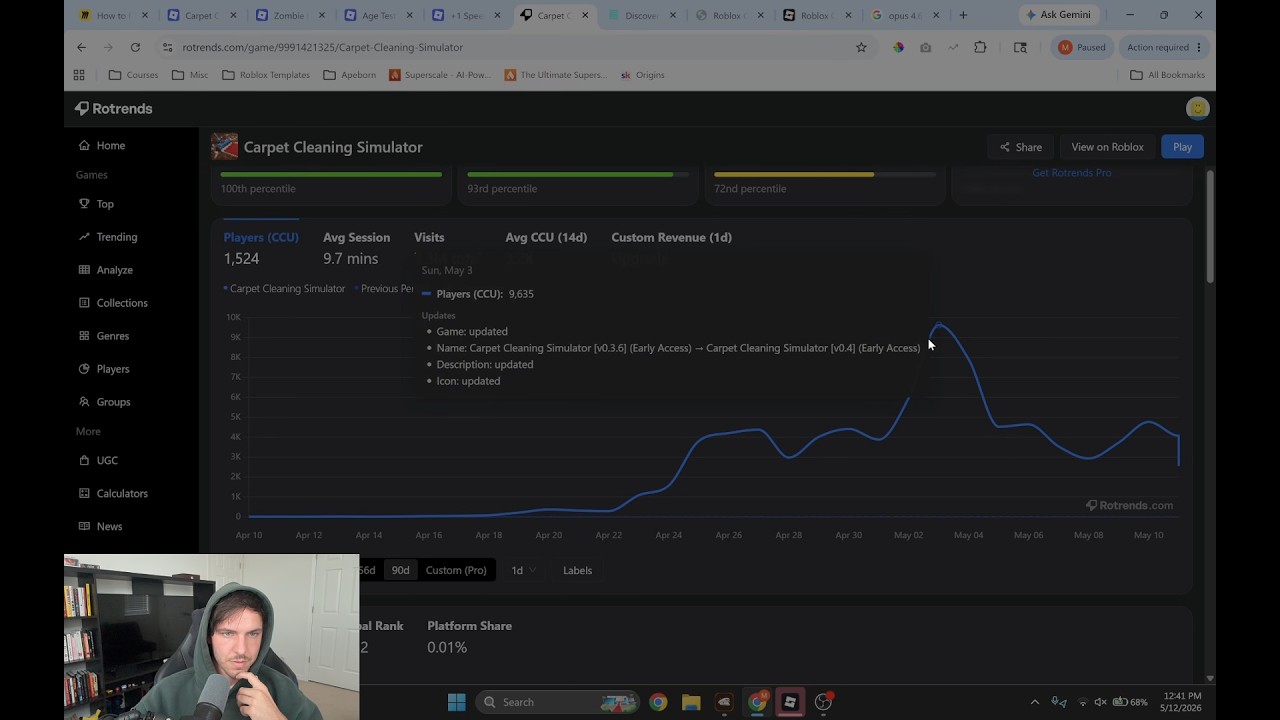
And I would take a look. Okay. 220k visits. Let's look at a 90-day window.
12:34
Speaker A
This game started to pick up traction. 600 actually 833 CCU. So I would form I guess like a final hypothesis.
12:43
Speaker A
And again, it's okay to be wrong because this is how you can learn. So I want to say game has potential to peak at 3K to 5K CCU.
13:00
Speaker A
Main issue being social flex element not immediately visible. Like if I go into grow a garden for example, I immediately see people have huge gardens and that immediately makes me want to grind harder. So now what I would do is a week later come
13:18
Speaker A
back into Road Trends, right? Open this link and see where's the game at. Was I correct? If you want to take a step further, come back two weeks later, see where the game's at. Take more notes.
13:29
Speaker A
But this is the iteration cycle, right? So let's just summarize. You find a game on Road Trends that is up and coming.
13:36
Speaker A
Okay, take notes. Form a hypothesis. Will this game do well? Why do you think it will do well? Or why do you think it won't do well? Check Road Trends again in a week. We can actually do this,
13:45
Speaker A
guys. I can make a follow-up video. See if if this game does well. And then a week later, after you check the stats, you want to see if your hypothesis is correct or not, which is what you would
13:56
Speaker A
put here. And this is how you can start to develop game design intuition without having to launch your own games. You should still 100% launch your own games. It's it's a must. Don't just sit in theory world all
14:10
Speaker A
day. Launch your own games. But this is a great way to study and start to develop this intuition because game design in my opinion is the most important thing. Okay, so hope you guys got value from this video. This is what
14:23
Speaker A
I did when I first started. I actually need to get back into it. So it's a great reminder and shout out to all the amazing devs that have been helping in the server. I've been learning a ton from you guys. Much love. Peace.
Topics:Roblox developmentgame designgame design intuitionRoad Trendsgame developmentsolo developergame mechanicstutorial designplayer engagementgame analysis

Get More with the SozAI App

Transcribe recordings, audio files, and YouTube videos — with AI summaries, speaker detection, and unlimited transcriptions.

Or transcribe another YouTube video here →