Skip to content

Why your trading strategy doesn't matter on prop firms

Learn why your trading strategy may not matter on prop firms and how optimal sizing and risk management can create expected value even with zero edge.

Key Takeaways

  • Your trading strategy alone is less important than how you size and manage risk in prop firm accounts.
  • Using a 1.5 risk to reward ratio is statistically optimal for prop firm trading environments.
  • Properly sizing trades differently for eval and funded accounts can increase your expected value significantly.
  • More trades and accounts can increase profits but also increase variance, especially with copy trading.
  • Fees and costs reduce profitability, so they must be accounted for in any prop firm trading strategy.

What the video covers

  • A zero-edge trading strategy with a 40% win rate and 1.5 risk to reward can still generate expected value in prop firm environments due to pricing and fee structures.
  • Prop firms price their accounts so that a break-even coin-flip strategy has about a 5% chance to break even, but optimal sizing can increase this chance to around 9%.
  • The 1.5 risk to reward ratio is statistically optimal for prop firm trading, but most traders do not use it, leading to losses.
  • Different stages of prop firm accounts (eval, funded, post-payout) require different sizing and goal optimization to maximize expected value.
  • Volume and frequency of trades matter; more trades and accounts can scale profits but come with variance trade-offs, especially with copy trading.
  • Copy trading multiple accounts increases variance and risk of losing years, while trading accounts independently lowers variance significantly.
  • A real trading edge (e.g., 45% win rate) changes the approach and can generate positive expected value even with higher risk strategies.
  • Fees such as eval fees, commissions, spreads, and slippage significantly impact profitability and must be factored into strategy and sizing.
  • Optimal trading on prop firms is a mathematical and statistical challenge involving risk management, profit targets, and stop losses.
  • Understanding and applying these principles can help traders improve their chances of passing prop firm evaluations and generating consistent profits.

Answers

Questions about this video

Can a zero edge trading strategy make money on prop firms?

Yes, a zero edge strategy with a 40% win rate and 1.5 risk to reward can generate expected value in prop firms if sized optimally, due to how prop firms price their accounts.

Why is a 1.5 risk to reward ratio important in prop firm trading?

The 1.5 risk to reward ratio is statistically optimal for prop firm environments, maximizing the chance to break even or profit given the fee structure and payout conditions.

How does trade sizing differ between eval and funded prop firm accounts?

Eval and funded accounts have different goals and expected values, so optimal trade sizing must adjust accordingly to maximize the chance of passing evaluations and generating payouts.

Full Transcript — Download SRT & Markdown

00:00
Speaker A
If you keep failing prop firm evals and you think you need a better strategy, stay with me for 90 seconds. I'm going to show you a strategy with zero edge to make money in a prop firm environment, a coin flip. And I'm going to show you how
00:08
Speaker A
that coin flip can generate you $4,000 a year. A strategy with no edge at all would be a 40% win rate on a 1.5 risk to reward trade, which gives you zero edge per trade. So, it's literally exactly
00:18
Speaker A
break even. It is a coin flip. If you run this on a live account, you are never going to make a single dollar. You are going to lose money because you are paying fees to enter each trade, same
00:25
Speaker A
with commissions and the spread. If you trade that for 10 years, you are going to finish exactly where you started or down a good amount. But, if you put that into a 50K prop firm account that costs $100 a temp, you might be able to
00:36
Speaker A
generate some expected value. Now, why is this allowed to exist? First of all, that is assuming that you know to use a 1.5 risk to reward, which is statistically optimal for the prop firm specific environment, and well, now at
00:47
Speaker A
least now you know. Most people are not even doing close to that, which is why they are losing so much money to prop firms. Second, even with the optimal risk to reward, which is a 1.5, the product is still calibrated, okay? To
00:58
Speaker A
cover your $100 eval fee, you need to get a $2,000 payout 5% of the time to break even. And that assumes you buy an eval, you have a 5% chance of getting a $2,000 payout from the funded account if
01:08
Speaker A
you pass the eval. That is not luck, that is how they price these accounts so that a person who is coin flipping at normal size is going to have a 5.1% chance. So, 5% chance to break even, but
01:19
Speaker A
you could have a 5.1% chance if you follow that optimal 1.5 risk reward on eval, and then the same thing on funded.
01:26
Speaker A
They literally size that perfectly so that you might have a slight edge if you are able to find out the most optimal approach, which is why they make money because pretty much nobody follows the optimal approach. However, the whole
01:37
Speaker A
prop firm game is played in the gap between what they price and what you can actually do because I promise you can do a lot better than 5.1%, which is 0.1% above break even. Now, before I get into
01:48
Speaker A
exactly how that works, here are some different win rates with a 1.5 risk to reward. Obviously, this one here with 40% is the break even one. This is a losing strategy, and this is a severely winning strategy, which might not even
01:59
Speaker A
be possible to replicate with multiple trades per day. Now, six point difference from 38% up to 44% takes you from $2,000 to $9,000 a year. And this is just assuming a group of account This is not assuming max allocation at all.
02:12
Speaker A
This is just a very conservative simulation. If you size optimally for the eval and the size optimally for the funded account with zero R, you're going to get paid about 9% of the time. I know I said 5.1%, but that is assuming you
02:23
Speaker A
trade the eval the exact same as the funded which automatically we know is not optimal because there are different goals on both accounts. And remember this 40% is a gross number, so it is after commissions, spread, and slippage
02:33
Speaker A
because that usually costs you a few percentage points. Somebody who measures 42% might actually be realistically at 40% even though it is a simulated environment, they are still taking commissions, spread, and there is slippage. Now, obviously, once the
02:44
Speaker A
sizing is right, you want volume. Lots of traders are going to be taking one trade a day because it fits their strategy, and maybe they're making money, but they have no way to scale it because there is no volume. So, you need
02:53
Speaker A
more trades, you need more accounts, but unfortunately, both of these have a catch, which I'll get into in just a second. Now, remember how I mentioned earlier you would need a 5% chance of a $2,000 payout to break even versus your
03:04
Speaker A
eval fee of $100. Now, we're going to still assume the same no edge 40%. We're not going to change anything about the trading assuming your strategy is break even on a live account. And remember, all these assumptions for this video is
03:15
Speaker A
that your strategy is break even on live. If you perform plus EV on live, then you'll be even better than these rates on a proper specifically, but I just wanted to show you that even break even strategies make money on props if
03:25
Speaker A
sized correctly. Now, sizing the obvious way means you're going to do that same 1.5 R on evals and on funded accounts, and you are going to take the exact same risk and exact same profit target per trade all the time. But automatically,
03:36
Speaker A
that's not optimal for two reasons. First, your account is worth a different amount at different stages in its journey. An eval is worth different than a funded, which is worth different than a funded that is close to a payout,
03:45
Speaker A
which is worth different than a funded that has taken a payout. So, your account is worth different amounts at different points in its journey, and you have different goals at different points in your journey as well. So, not only is it worth a
03:55
Speaker A
different amount of expected value, it has a completely different goal at each stage in its journey. Your eval goal, all you have to do, your only goal to optimize for is your chance of making 3,000 before losing $2,000.
04:06
Speaker A
If you did this on the funded account, [clears throat] it's not going to be bad. You still are optimizing for some amount of profit before max loss, which is good. It's better than doing for a live account. However, you should be
04:15
Speaker A
optimizing your expected value on a funded account, which is basically your chance of getting a payout multiplied by how large that payout is. So, different goals, if you're trading them the exact same way, that is the obvious way that
04:25
Speaker A
is going to be a 5.1% chance and you're going to make about $11 a year.
04:29
Speaker A
Uh so, basically exactly break even, which is why prop firms make so much money is because nobody knows how to size them statistically optimally on the eval, then on the funded, then on funded that have taken a payout, and then on
04:39
Speaker A
the live account when you eventually get moved to a live account. But, if sized correctly, that number could go up towards 8.9 to 9.3% depending on the prop firm, that's why I have two numbers. And this is assuming the same
04:49
Speaker A
exact strategy, a 1.5R with zero edge. And by zero edge, I mean it's winning at about 41%, which is slightly plus EV.
04:56
Speaker A
However, you are paying fees, commissions, and fills, slippage, all that sort of stuff, which brings it down towards 40% realistically. You are able to make plus $85 per attempt. Ignore this per year number, but $85 per attempt means you spend 100, you're
05:09
Speaker A
going to get $185 back in expected value. Then, if you have an edge, all you want to do is get the most exposure as possible to that edge. However, you have to make sure you go about that correctly. Now, let's look at 10
05:20
Speaker A
different accounts over the course of a year, obviously replenishing accounts that lose. Same zero edge strategy, but you're going to size it correctly, meaning optimally. There is expected value in both ways. This is copy trading, and this over here on the right
05:33
Speaker A
is not copy trading. Um so, this is just basic simulations going to show you that the expected value is the exact same when you copy trade versus when you don't copy trade. Uh so, pretty much the exact same average per year. Obviously,
05:42
Speaker A
it's off by a little bit just due to the simulation, but on average it's going to be the exact same profitability per year because you have the same expected value and you're taking the same trades. Now, with copy trading, you're going to have
05:52
Speaker A
way higher variance. So, you have a 16.5% chance of a losing year while copy trading 10 accounts with an edge. But, if you're doing 10 accounts individually, basically it is 0% chance.
06:02
Speaker A
Obviously, not exactly zero, but the number is so small that it is basically zero. Your worst year, one in 10 is plus $27,000 because your attempts are independent. Now, your bad year, the worst one out
06:12
Speaker A
$8,000 of loss. So, copying one sequence across 10 accounts is not actually 10 accounts, it is just one huge account 10 times bigger. Um same expected value, but no diversification. Most people are copy trading by default, which is
06:24
Speaker A
automatically wrong. Even if you don't believe this, at least understand increased risk on one account is much better than increased risk across all of your accounts. Just in terms of variance, assuming you keep your expected value the same because
06:35
Speaker A
remember, copy trading does not add expected value, it only adds variance. A real edge does not just add money to your account. Obviously, a fake even edge will still make money on a prop firm environment if it is sized
06:46
Speaker A
correctly. A real edge changes the answer to how you would approach it. And so, let's change our win rate from a 40% at a 1.5 to a 45%. It is going to be a real edge. Watch what happens to the
06:56
Speaker A
sizing of the accounts. Here, we have a table sorting by risk. More risk at the bottom, less risk at the top. If we start with these higher risk ones, you're still going to make money because your strategy has an edge and your days
07:06
Speaker A
per attempt is going to be lower. So, you are going to get to where you want to be, meaning payouts, faster because you are risking more. So, your account is going to lose or pass faster. Now, if you risk less, you have more opportunity
07:16
Speaker A
to realize your edge, hence why the expected value is greater for lower risk. However, lower the risk is going to take you longer to pass the funded account, which, even though it might be generating more expected value, could
07:29
Speaker A
make you less money per year when you're multiplying things together. This is a super high risk strategy, almost risking the entire account at the time, but you have an edge. So, per attempt that is going to generate you positive expected
07:39
Speaker A
value, assuming you're spending 100 on the eval, you're getting back $178. It is going to be a very fast way to pass the account and assuming one account at a time, then per year you're going to make about $10,000. But remember,
07:52
Speaker A
there's only one account at a time and that is a very large trading edge. Now here's the actual question that you have to ask yourself after finishing this video. There are going to be three inputs to determine how much money you
08:01
Speaker A
are going to make and then there's going to be one answer. The first input is your edge. There is no guessing about this. You need to have an exact rate preferably over 500 trades or more.
08:12
Speaker A
Next, your frequency. How often can you place a trade with your edge? Is it once per day, twice per day, or even 10 times per day? Lastly, what fees are you paying? That is eval fees, that is slippage, that is commissions, and that
08:23
Speaker A
is bad fills. Obviously, it is a simulated environment in the prop firm. However, fees are still existing in that environment just so the prop firms can make a little bit more money. So these three things here are pretty much
08:34
Speaker A
everything that is going to decide your sizing. Nothing else is going to decide your sizing. Not the entries, not indicators, not the setup. That is obviously equivalent to your edge, but if you change any one of these three,
08:44
Speaker A
the right answer is going to change like I just showed you earlier. You could have a larger frequency of getting to a payout faster just by changing a different amount of risk. Same thing with your edge. You could increase your
08:54
Speaker A
edge, but it might take you longer to get payouts. Obviously, different answers would be correct based on your different edge, your frequency, and the amount of fees that you're paying. Now this answer is going to be different for
09:03
Speaker A
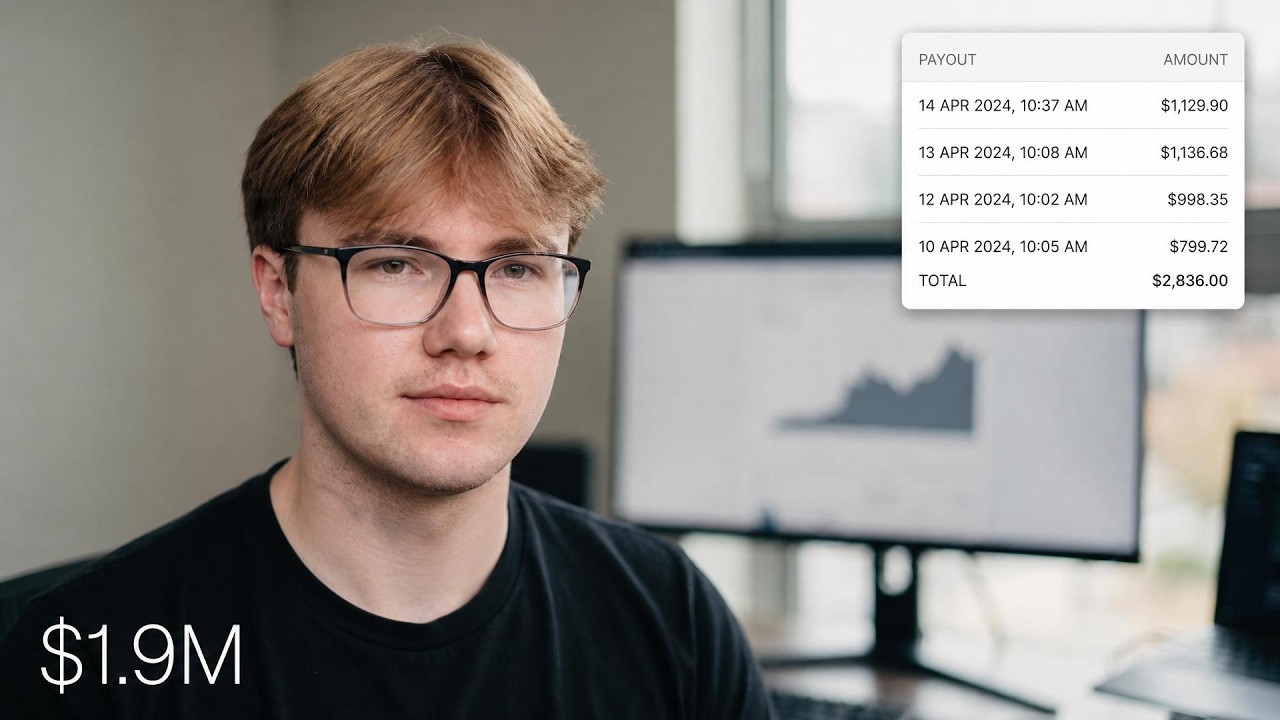
everybody, of course. Me personally, I've done $1.8 million worth of prop firm payouts and I have spent $550,000 on trading evaluations giving me a profit of about $1.3 million.
09:14
Speaker A
I started with $5,000, made $17,000 in my first month trading. So I've been receiving about a 3.5x return on my investment. But the great thing about that is it has been able to scale up to spending about 40K a month and then
09:25
Speaker A
getting back on average about 140K, some months less, some months more, but consistent about six figures a month and my specific edge is 41% win rate.
09:35
Speaker A
41% at a 1.5 risk to reward. The good thing about this though is that it allows me to trade 10 times per day.
09:41
Speaker A
So I'm basically trading on a bias for a reversion. You can check my strategy videos, but I get multiple entries throughout the day. Strategy is optimized for that specifically then paired with optimized risk and profit targets for the prop firm environment.
09:53
Speaker A
So pretty much the optimal sizing based on the rule set that I'm given and based on the expected value of my account. It does of course change as things are going through the prop firm environment as prop firms are changing rules, as
10:04
Speaker A
they're moving me to live accounts, and as eval fees are increasing, all that sort of stuff. It is constantly going to change, but all I wanted you to take away from this video is that you can have a 41% win rate, which then becomes
10:14
Speaker A
pretty much about 40% after you pay fees and commissions, slippage, whatever. So you can have a basically account break even that would perform break even on a live account, maybe even lose money on a live account because you're paying fees,
10:25
Speaker A
but worst case break even on a live account with a slight bias. When you transfer that into a prop firm environment and you size it specifically for the prop firms, then you could have a positive EV strategy in said rule set.
10:36
Speaker A
Imagine a positive EV, a plus EV live account strategy that is positive drift over time. You might have sets of drawdown like this that blow accounts.
10:45
Speaker A
I trade a strategy based on a bias, so it is less likely for this to happen, and the strategy fits perfectly into the prop firm specific environment. You can check it out for free on my YouTube channel, but the most important part of
10:55
Speaker A
prop firm trading and of trading in general is math and statistics, which is why I have spent my entire prop firm trading career trying to find out the optimal profit targets, optimal stop losses based on the rule set that I am
11:04
Speaker A
given just so my strategy that wins about 40% of the time generates 40% of said expected 41% of value after fees on the prop firm environment is going to make me $100,000 per month because it is sized to exactly how much my accounts
11:18
Speaker A
are worth and exactly how much they will be worth if I win that trade at X percentage. Of course, I trade evals and fundeds differently. I trade a different risk to reward on different firms. I trade a different risk to reward based
11:28
Speaker A
on what my balance is. So lots of changes, lots of optimizations to make, but most importantly, you can have a break even edge if you size it correctly. It is going to make money on the prop firm specific environment. Now,
11:39
Speaker A
the strategy was never the variable. You have seen what that number is worth. You have seen what 41% 10 trades a day, 1.5 R does for me. You've seen what it does for all of my students, and I'm not
11:48
Speaker A
going to be putting my exact risk management into a YouTube video ever just because it is the most statistically optimal sizing. If you would like to learn from me, you would like to learn how I solve for those
11:56
Speaker A
values, how I simulate it, and get those actual values, then apply it at the link in the description to work with me in my mentorship.
Topics:prop firm tradingtrading strategyrisk to rewardtrade sizingexpected valueprop firm evaluationcopy tradingtrading edgetrading feesstatistical trading

Get More with the SozAI App

Transcribe recordings, audio files, and YouTube videos — with AI summaries, speaker detection, and unlimited transcriptions.

Or transcribe another YouTube video here →