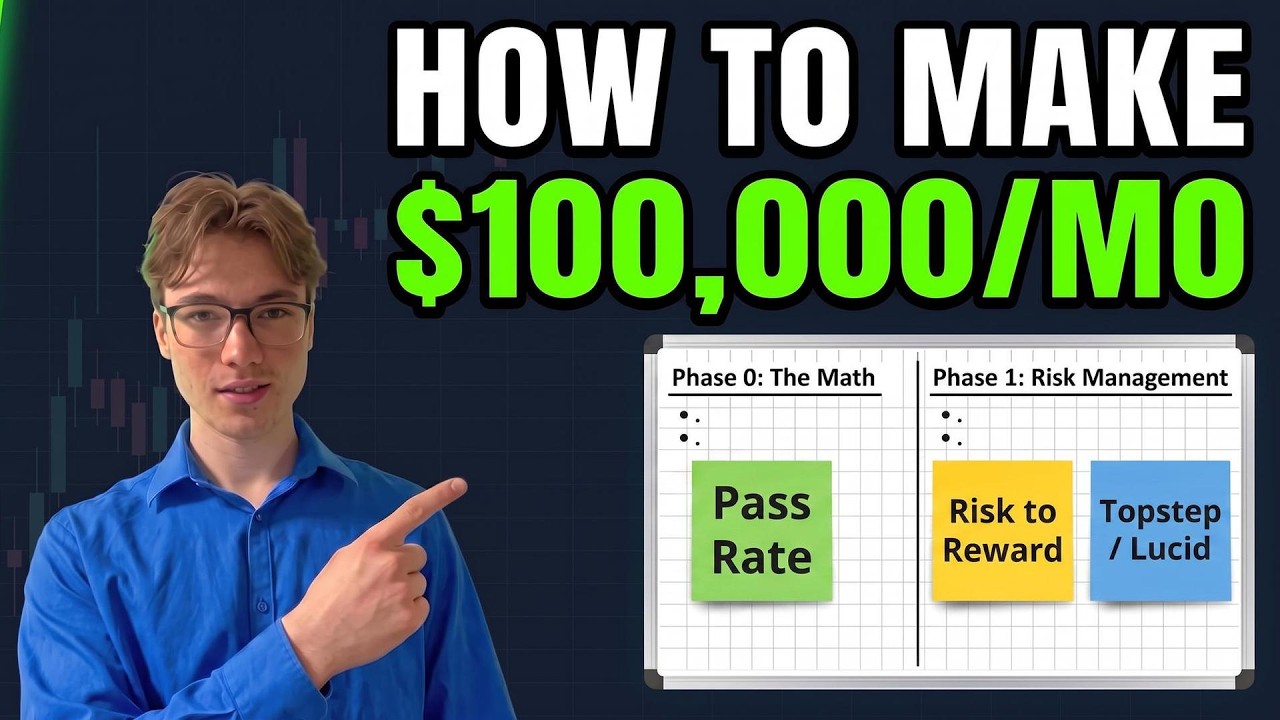
JJ Simon reveals his exact prop firm trading strategy that earned him $1.2M in 12 months, focusing on high timeframe mean reversion and low timeframe continuation.
Ask about this video. Answers come from its transcript only — with the timestamp, so you can check them.
Generated from the transcript and can be wrong — check the timestamp.
Key Takeaways
- Prop firm trading allows for high leverage with controlled risk, unlike live accounts.
- Combining high timeframe mean reversion with low timeframe continuation creates a strong trading bias.
- Strict risk management and precise entries are critical for consistent profitability.
- Scaling should be done cautiously, avoiding copy trading until sufficient capital and statistics are known.
- Understanding and adapting to different prop firm rules enhances profitability.
What the video covers
- JJ Simon shares proof of over $1.2 million in payouts from multiple prop trading firms within 12 months.
- The strategy focuses on trading prop firms rather than live accounts due to better risk management and lower capital risk.
- Trades are based on a combination of high timeframe mean reversion and low timeframe continuation, primarily during the New York session open.
- He emphasizes strict risk management and adjusting risk based on market conditions and the specific prop firm’s rules.
- JJ categorizes setups into A+, A, and B based on alignment of biases and technical signals like displacement and break of structure.
- He discusses how to trade on news days with the same core strategy and how news can affect fair price assumptions.
- Scaling the strategy differs on prop firms versus live accounts, with caution advised around copy trading due to risk of ruin.
- JJ uses multiple prop firm accounts to optimize risk and profit depending on market conditions and target points.
- He provides detailed trade recaps to illustrate the strategy in action and how to replicate it.
- The video includes insights on evaluation fees, payout statistics, and the importance of understanding pass rates for scaling.
Chapters
- 00:00Introduction and Proof of Earnings
- 01:49Overview of Prop Firms and Earnings Breakdown
- 03:50Core Trading Strategy Explained
- 05:26Setup Classifications: A+, A, and B Setups
- 07:18Scaling Strategy and Copy Trading Advice
- 08:58Trade Awareness and Market Conditions
- 10:44Fair Price Theory and Market Opening
- 12:32Evaluation Fees and Risk-Reward Considerations
- 14:22Adjusting Accounts Based on Market Observations
- 15:53Trade Recaps and Practical Examples
Full Transcript — Download SRT & Markdown
Speaker A
Okay, this is going to be a full overview of the exact trading strategy that I've been using for the past year and this is the strategy that has helped me to generate over 1.2 million dollars in payouts in the last 12 months.
Speaker A
So, the way this video is going to go, first I'll show you proof that I actually did do that many payouts. Then I'll go for what I look for, key things to know, fair pricing theory, which is basically what is why the strategy
Speaker A
works. And then I have just this past week of trades, so I'll just go through the trades I took this week and then hopefully you can see a little bit about it in action and then be able to
Speaker A
replicate it yourself. So, this is the step-by-step trading strategy that made me 1.2 million dollars in payouts in the last 12 months trading on prop firms. So, first a little bit of proof. This is taken from my Mac.
Speaker A
I have it in my Discord server actually. Pretty much just Topstep payouts, so you can you can pause, look through them if you want, but yeah, this is Wise. That's where Topstep pays out. Eight Futures, really good firm to use, 172k in payouts there.
Speaker A
Alpha Futures, I'm on the live account now. I haven't sent live in like 2 months, but was at like 75k or something.
Speaker A
Um there's a bit more. Lucid, I'm on live as well. Uh 75k payouts on Lucid in like a month or 2 months.
Speaker A
Trade F7, 100k payouts or so. I'm on live there as well. Apex, about 60k in payouts. They did ban me. Um I wasn't given a reason. Funded Next, 67k payouts.
Speaker A
Um another Topstep picture, I guess. Uh but most importantly, uh 1099 tax form. You can't fake this stuff. Topstep paid me 250k last year and then RiseWorks paid me 450k.
Speaker A
Uh and then the other firms send their own 1099s cuz they just paid my bank accounts.
Speaker A
Uh how much did I spend on evals? About 200 to 250k. I don't know the exact amount, but it's under education business services.
Speaker A
Um this was January, so yeah, so I didn't really sell anything at this point. It was just all prop firms. So, Apex, Lucid, Topstep, RiseWorks, E8, stuff like that. So, unfortunately, I was 14k off a million in my first year. Uh I started in March.
Speaker A
Um March, I think February or March actually. So, I didn't really get 12 full months to do it, so that's why I didn't hit a million. Very unfortunate.
Speaker A
But yeah, hopefully I'm going to hit that this year. So, hopefully you believe that I am who I say I am. I'm who I say I am. I've documented two full months of 100k payouts on my Instagram, so if you want
Speaker A
to see like what firms I'm getting my payouts from, then you could take a look that as well.
Speaker A
Now, for the strategy, the most important part. I trade high time frame mean reversion, low time frame continuation. So, what I'm looking for is the New York session open. It's like the main session obviously to to trade for
Speaker A
me. Um continuation. I only trade it in the first 5 to 10 minutes or I guess like 0 to 10 minutes. Like I'm looking for my first trade pretty much instantly. After 10 minutes, I'm I'm going to look for mean reversion
Speaker A
assuming there's been a move away from the opening price. Mean reversion then obviously is from 10 minutes to 90 minutes because continuation is the first 10, mean reversion is just after that.
Speaker A
Three to four trades max. You don't want to over risk into a situation that's not playing out in your favor. If you're winning, then you can keep trading obviously. If you're losing, it's not the best to continue because that
Speaker A
usually means your bias isn't playing out and then you should stop. Um for the entry, I look for a displacement or a break of structure and a close just depending on the volume and what session I'm trading.
Speaker A
And basically, the way to be profitable on prop firms is to have a bias that you're right a majority of the time plus very, very good risk management as well as a precise entry. So, the bias that I have is from high time
Speaker A
frame reversion and low time frame continuation. I'll go into that in the trade recaps, but that's how I form my bias.
Speaker A
And always, that's usually going to be the fair price at open. So, a few key things to know. This prop firm This strategy only works on prop firms.
Speaker A
If you were to trade it on a live account, it would probably break even, maybe win a little bit, but the reason why I don't trade on live is that the risk is so large just to make basically like the most edge you can
Speaker A
have probably is like 1 to 5%. So, you'd be risking tens of thousands of dollars just to get 5% of tens of thousands of dollars, which is definitely not worth it when you could be trading a prop firm
Speaker A
with pretty much the same amount of capital and basically no risk, just the eval fee.
Speaker A
Risk management is definitely the most important part for trading in general. Um it's just you're not going to be you're not going to be profitable unless you have very specific, strict risk management.
Speaker A
Uh and the way that works for me is I'm trading a different prop firm account based on what I'm seeing in the market.
Speaker A
And uh I think it's a very unique approach. Not Not not that many people that I know actually take this approach.
Speaker A
So, what I'm doing is what I see in the market is a specific amount of points that I can target. Uh usually in the direction of the session open. So, some days I'll see 50 points on a reversion,
Speaker A
some days I'll see 20. Based on that, you should trade a different prop firm because each prop firm you should be using a different risk on.
Speaker A
And again, that's because risk management is the most important thing. Second, that's just because prop firms have different rules. So, if you want to optimize your profit on prop firms, then you need to optimize your risk management and trade a
Speaker A
different account based on what you see in the market. Um also going to go over A A+ A and B setups, just pretty much like your bias.
Speaker A
You need both biases to line up, high time frame reversion and low time frame continuation to make an A+.
Speaker A
And then displacement plus break of structure. Break of structure and a close is an A+ setup. It's a lot more likely to win when that happens.
Speaker A
Um I am trading pretty much every displacement I see just because there's a slight bit of edge that I want to capture every single day in the market.
Speaker A
So, displacement is usually an A and then B is when your biases are like going the opposite way. So, you definitely don't want to trade you don't want to trade the B+ setups, the B setups.
Speaker A
Uh how to trade news days. Um I will Okay, I'll add a little thing here about how I trade on news when I'm done with these trade recaps. Uh it's pretty much the exact same thing though, thankfully.
Speaker A
How to scale. Now, scaling is very different on prop firm versus live. Like on live, you're tracking your metrics, you're slowly increasing your risk. Prop firms, you need to take a different approach. The reason for that is risk of
Speaker A
ruin. If you have an edge in the market like I do with the strategy, you don't want to bust, which basically just means lose all of your money and then not be able to continue trading to capture your
Speaker A
edge. So, in in terms of scaling, copy trading is very complicated. Y- you want to have the exact pass rate. Like you want to know your exact pass rate, your exact payout chance, your average payout. All of that, you need to know these exact
Speaker A
statistics before you start copy trading just so you can confirm that your chance of losing everything is less than 5%. If it's more than 5%, then you don't want to do it. If you don't know, then you definitely don't want to copy trade.
Speaker A
Obviously, if you have Okay, well, I'll just tell you like if you have more than $10,000, it's fine to start copy trading, but most people do not. So, I would recommend stay away from copy trading.
Speaker A
Uh it is just going to ruin your your bankroll. Your risk of losing everything is way higher, so start with one account, get payouts from there on, and then you can invest those and then start copy trading.
Speaker A
[snorts] But the way I scale is I couldn't copy trade at first. Um just cuz I guess I didn't have enough money or I didn't feel comfortable doing it. What you should do is find a strategy like mine or you could use your
Speaker A
own, but find a strategy that works multiple times per day. So, you're able to trade multiple times per day.
Speaker A
And the reason for that is you want to trade each account once per day instead of copy trading all of them once. So, if you have five accounts, you want to trade five different setups per day ideally. Now, I know most most day
Speaker A
trading strategies only work like once a day. That's true, I I guess, but the way that I created the strategy was so that it worked five times a day.
Speaker A
Uh it works on every single session open. So, [snorts] that would be any EST, the 6:00 p.m.
Speaker A
when the market reopens, 8:00 p.m. Asian session, 3:00 a.m. London session, uh 8:30 a.m. when there's news, 9:30 a.m.
Speaker A
Eastern, and then 2:00 p.m. Eastern for the New York PM session. I'll go into that in the fair pricing theory like in literally like 1 minute, but that is how I just trade every single session because I have 40
Speaker A
accounts, I'm copy trading five at once, and I want to get maximum exposure to the edge before it dies.
Speaker A
Now, why does it work? This is obviously fair pricing theory. It is what I studied in college. I graduated with a degree in quantitative finance, and so that is what I've been applying to trading on prop firms, risk
Speaker A
management, strategy generation, that sort of stuff. Basically, a brief overview of fair pricing theory is the New York session open acts as the first major intraday reference point for fair auction.
Speaker A
Early moves away from that price are often driven by opening flow, liquidity imbalances stops hedging momentum participation, not necessarily by a true, long-lasting repricing of the index.
Speaker A
So, what I mean by this is we need to actually be aware of what we're trading.
Speaker A
We're trading Nasdaq futures. And on Nasdaq, Nasdaq's made up of 100 companies, right? So, we're trading actual, valuable companies. We're not trading something like Bitcoin where the value is unknown. The value is determined by an auction place of people agreeing
Speaker A
what's a what's a fair price for Bitcoin. We're trading actual companies that have an actual fair price. That's in the long term. Now, in the short term and why I think we can have an edge trading this sort of market is
Speaker A
um on the very short term, there is a little bit of not liquidity. I don't really believe liquidity is a very important part of Nasdaq just because it's so liquid.
Speaker A
But but basically, there's some sort of auction marketplace theory at play in the short term just because a bunch of people gain access to market at the same time.
Speaker A
Like 9:30 open, all the overnight orders come in, all the banks start doing their trading then, stuff like that. So, I believe that the fair price would stay the same even when the the price on the chart is
Speaker A
like moving up or moving down from that just because of the introduction of new market participants, opening flow, liquidity imbalances, stopped hedging, momentum participation, that sort of stuff. So, basically, I believe the 9:30 a.m. is the fair price. Any move away from that
Speaker A
is unfair. So, I would trade a reversion back to the opening price. And that is the high time frame reversion. Usually, it's it's more of a medium time frame reversion, I guess.
Speaker A
And then I just use a continuation for my entry. And the fair price is at open.
Speaker A
So, let's just take a look at this week. I'm recording this on the 28th, Saturday.
Speaker A
So, yeah, this would be Friday. Let me just zoom in here. 9:30 a.m. EST, we are getting the opening candle right here. It's this red one.
Speaker A
So, what I believe is the price before is the fair price. And just because the market has opened and all these new participants have gained access and they're treating it now like a peer-to-peer auction, does not mean the inherent value of
Speaker A
Nasdaq should have changed. So, what I do is first I trade a continuation away from this price just because the group of overnight orders that come in are usually set in one direction like this case is obviously red because the
Speaker A
majority of the orders are crossing the spread in the down direction. So, I like to trade a continuation of that move just because usually displacement continues more often than it does not.
Speaker A
So, in that sense, you can gain a little bit of edge just by trading a continuation of that move. And then after that, I definitely love to trade mean reversion back towards the opening price.
Speaker A
So, I'm not going to cherry-pick any examples. I'm just going to go through this exact week and tell you exactly what trades I took and why. So, the first trade, continuation. The only way you want to look for a continuation is
Speaker A
short because the first candle was red, which means the overnight orders were mostly short. So, you're going to look for shorts. And in terms of an entry, like I said over here, break of structure and close or displacement. Displacement candle
Speaker A
usually, at least in my opinion the way I trade it, is a candle that's larger than the previous one and it doesn't really have any wicks. So, this would be a displacement candle since it's larger than the previous one and it has no
Speaker A
wicks, basically. This one would not cuz it has lots of wicks. This one, no.
Speaker A
This one, kind of, like 50/50. Yes, no, yes, that sort of thing. But yeah, break of structure. So, it broke this structure right here.
Speaker A
The opening sort of wicked this structure, so I didn't like it. If the opening candle closed here, I would have shorted. But the reason I took this candle is because it broke this structure and it closed below. So, I was
Speaker A
predicting on a displacement away from the opening price. And just for all these trades, I'm just going to be using a 1 to 1.5 risk to reward. It's a very common one. I think most people should be using that. I'm not sure if you are,
Speaker A
but at least on your evaluation, you should be using it. The reason for that is most evaluations are plus 3,000 before they're minus 2,000. And essentially, that's three to two, which is 1.5 risk to reward. So, like your
Speaker A
entire challenge when you have three up here and two down here, that's the exact same as a 1 to 1.5 risk to reward. So, you can sort of just like compact the entire challenge into a 1 to 1.5 and just keep on trading that. It's
Speaker A
just I don't know what I've done to simplify it. But yeah, so that I'm just going to have all of them be 38 points TP, 25 points stop loss, and then you can choose your contract sizing based on your risk
Speaker A
aversion. Now, obviously, break of structure and it closes below there. So, first short, continuation of this move. Next, mean reversion. There is not any structure to close above. There's kind of this one right here, but there's not any
Speaker A
structure to close above like there is here. Obviously, this is a really important piece of structure, which basically just means like it's lower than these two points.
Speaker A
So, you can easily get a close below. There's no structure here to close below, so you can enter on a displacement. This is like very obviously displacement candle. There's no wick down here. This wick is very small compared to the candle. And this
Speaker A
candle is bigger than this entire previous candle. So, right when this one closes up here, I'm trading a mean reversion back in the direction of the opening price.
Speaker A
What I was saying earlier about fair price at open and trading a different account based on what you see, technically, you would have edge all the way from here, this close, up to the opening candle here. So, yeah, it does
Speaker A
come up here, it taps the opening candle, then it continues its shorts. So, in that sense, you would For your take profit, either you could just stick with consistent 1 to 1.5 like I do, or you can move this take profit
Speaker A
up to all the way up here. That would be fine as well if you want to capture more points on a funded account or something like that.
Speaker A
I have very different specific risk management approach, so honestly, it's whatever works best for you.
Speaker A
And then changing your account based on what you're seeing in the market is sort of what I do sometimes.
Speaker A
Um Like if I was to enter if this dropped all the way down here and I was able to take longs here, I'd have a lot more points in favor of the opening price.
Speaker A
So, I would trade an account that I need more points on if that makes sense, just based on my risk management.
Speaker A
So, yeah, that was the first entry, displacement, closed above this one, pretty standard. Next, I usually don't look for shorts this late, but this is like the most perfect short setup just because you can see previous structures right here.
Speaker A
Incredible displacement down, closed right below the structure. Like at this point, I was so confident it was going to come down here to this low. And 38 points is pretty much exactly to this low, so there's like literally no reason
Speaker A
not to take it. I know it does deviate away from the time, so I guess it could go from an A+ down to an A setup, but I mean, it was just perfect setup. You get displacement, you get close below,
Speaker A
everything. Everything needed for continuation shorts. Next, I was going to look for more mean reversion. In this case, pretty much the same thing.
Speaker A
There were lots of wicks here, so none of these are displacement candles except for this one, but it's not really that large compared to this one previous and it didn't close consistently above it.
Speaker A
Like see this one closed way above this one, so it's like a real displacement in that sense. This one, not really.
Speaker A
So, I was waiting for a close above this this this box of absolutely choppiness.
Speaker A
So, finally, we get the volume spike, we get a close above this box right here, and then I just longed. Um I guess it just speaks for itself, I hope. Just long because it closed above, mean reversion in this
Speaker A
middle medium time frame, I guess, reversion. Also, I usually stop looking for trades at 11:00 or just whenever the volume dies out.
Speaker A
Next, well, this is actually a very good day. I think I posted this one on Instagram, but this was four wins, so um and nothing cherry-picked. So, this was literally just my past week of trading.
Speaker A
I should mostly be on Instagram, but okay. 3:26, this was Thursday. Now, basically, first thing you can do is you can mark out the candle pre-open, which we believe is the fair price. Any move away from that is unfair. So, this
Speaker A
initial displacement is a really good candle to short on. It is an unfair move, so you are predicting a continuation of the unfair move, which is fine.
Speaker A
That's that's just why you don't want to look for continuations too far after the open.
Speaker A
So, yeah, first trade, it closed below just like it did in just like it did on this day. It closed below this structure, this structure, all of that. Just closed below, short 25, 38 take profit. You can also backtest just double-check.
Speaker A
Hmm, almost stopped me out, but it was a it was a win. You can go back and check if you want.
Speaker A
So, yeah, this is a win. And then after that, so I'm going to look for a mean reversion. So, basically, longs coming back to this price here. Um So, the first candle, there is no real displacement here because the wick is
Speaker A
humongous. Same here. This is a decent displacement candle. So, I guess I could have entered here if I wanted to. The reason I didn't is just because I thought this structure here was going to be really key.
Speaker A
And if we were to close by the structure, I was pretty confident we'd come back to at least the top of this opening candle here. And then from there, I just had a little bit more of take profit. So, uh
Speaker A
you can just let it run. Essentially, it's pretty much random, at least in my opinion, once it gets back to the opening price. It's pretty much random from there. So, I was pretty confident at a 1 to 1 when it got back to here and
Speaker A
then just letting it run for the rest. And the reason for this entry was break of structure, close above.
Speaker A
Um And it's sort of a continuation trade. That's what That's I think that's what I mean when I say high time frame reversion, low time frame continuation.
Speaker A
High time frame reversion, even though it's like 5 minutes, I guess I mean medium time frame because we're coming back to the opening price. So, by reversion, I just mean coming back to the opening price. And by continuation,
Speaker A
I just mean like this this series of green candles or the series of gray candles for this continuation.
Speaker A
This one's not the best example. This one's a little bit better, but yeah, continuation, I guess, kind of.
Speaker A
That's just the words I use to describe it. Then from there, I believe this move up was unfair, so I was going to trade another reversion back to the opening price, which you can see it perfectly came back into. There's no structure,
Speaker A
really. There is a bit bit of structure here. The problem is if it was to close below here, which it did, this would be a not the best short. It'd be like a an A to B+ setup just because you're already
Speaker A
at the fair price, which I believe was to be in this rectangle somewhere. You're already here. So, essentially, from here, it's random. There is a little bit of momentum continuation, but you don't want to rely on just that
Speaker A
alone. My favorite thing ever is to mean revert back to the session open. So, you're already at the session open, so there's no point in reverting anywhere, basically. From here though, very good trade to revert to the session
Speaker A
open. This is a displacement candle, so this is where I can enter off a displacement.
Speaker A
It is the first displacement that occurs because this one, too big of wick. This one, a little bit too big of wick.
Speaker A
Kind of the same size as and it's definitely smaller than this candle here. Kind of the same size as this one and it's like right on the opening price. This one, wick. This one's finally displacement, bigger than this
Speaker A
one. Basically, no wicks, consistent close below here. So, very good entry there as well. So, that's how we enter off displacement.
Speaker A
This is another three for three day. That's the wrong tool. Okay. Three for three.
Speaker A
So, honestly, like I barely ever did not lose on these days. I did lose these days, so you're about to see you're about to see what a losing trade looks like.
Speaker A
Okay, first example. Opening candle, this is on Wednesday. Opening candle right here, I just marked that out. And you can see it sort of plays around the candle.
Speaker A
Like the opening candle here would be all the way over here. It just comes up, taps that. It sort of plays around the fair price, and that's why that's just what I've noticed over like just look at this candle like the wick there, boom.
Speaker A
Wick there, boom. It sort of chops around it here for a bit before dumping.
Speaker A
Just makes me think that the opening candle actually has something to do with the the fair price of NQ. And again, just what I said earlier about why it works is the influx of participants creates an unfair move away. So,
Speaker A
yeah, lots of action around the opening price like throughout the the period. I got a little bit more into fair price in my one-on-one. So, if you're interested in that, link will be in the description. I also go over like the exact risk
Speaker A
management approach you should take, how many accounts to buy, which firms to use, how much to risk per trade in terms of dollars, points, all that sort of stuff, how to risk on different firms, copy trading, scaling, all that stuff.
Speaker A
But yeah, I mean it it sort of can If I could extend this rectangle here, this is just picture, but if I could, then it sort of chops around here, which may again makes me believe this is a very
Speaker A
fair price. Uh and one thing I forgot to say, news does change fair price because news changes the inherent value of Nasdaq futures, at least in my opinion. I mean, I could be totally wrong or I could be
Speaker A
right, but I mean, again, I've done like a good amount of payouts, and it's been very consistent, so I believe it I believe it's true.
Speaker A
News changes fair price, but opening session does not. So, you do have to be careful if some sort of news comes out and changes fair price. Obviously, like you look at this past week, there's been a lot of news with the war, tweets,
Speaker A
stuff like that. That's more related to fair pricing theory. I do a lot more of that one-on-one, so it's like too complicated to explain here, and there's not really any point. I'm just just explaining the the very basic strategy that I use. So,
Speaker A
Wednesday, mark out the opening candle, displacement up, close above here, very good for a long.
Speaker A
Just continuation. I think that's pretty standard. And then next, I wanted to take a short.
Speaker A
Good displacement candle here. We're getting 38 points or so back to the opening price here, so very standard short as well. This one did lose.
Speaker A
That is totally okay. Losing is very very common. It's part of trading, as you should know. You need to take your losses better than you take your wins, just because the inherent value of losing or the the emotional value of
Speaker A
losing is two times as much as the absolute value of winning. So, you need to learn to handle your losses better than you handle your wins.
Speaker A
And then for your short, another short would be fine because we're coming back to the opening price. This one closed below here.
Speaker A
And it's a displacement, everything A+ setup, like 100% going to win this trade. Maybe not 100, maybe like 70 to 80, but that's really good cuz it's 1 to 1.5 so Yeah, that was why I shorted here and
Speaker A
here. Just displacement. This is an A setup. I love the break and close below. It's an A+.
Speaker A
But yeah, I mean, I'm going to I'm just going to enter every A setup I see. Some B+ I'll enter.
Speaker A
Just cuz, you know, I'm trying to trade all my accounts. Next, it displaced all the way down through the fair price.
Speaker A
So, the reason I didn't take continuation shorts or anything here is because the opening candle right here was very green, so I wanted longs to start. And then after this initial displacement up, sort of just trade reversion because the initial unfair
Speaker A
move is sort of over. But yeah, so that's why I didn't take shorts here.
Speaker A
Next, I'm definitely trading a mean reversion back to here. In this example, this was off a displacement candle, so again, not the best entry, and but that's fine. I mean, you have some points in your favor coming back to a reversion.
Speaker A
Displacement again, it closed above the previous one. Barely any wick. I would prefer the body to be a little bit larger, but I mean, I'm still just going to enter on this.
Speaker A
And it's larger than the previous one, so just long here. And something like this. This one did get stopped out. Usually, if I get stopped out, it's due to a displacement down, which is unfair, and then I can
Speaker A
just reenter instantly, which is what happened here and is what happened here. Displacement candle close.
Speaker A
Definitely not the best entry, for sure. I mean, I would have probably preferred this candle right here, actually.
Speaker A
But yeah, I didn't want to miss out on it. And this candle was like very large in volume, but I definitely should have entered here. It's pretty much the same.
Speaker A
This one's a lot more sure to win just because it closed almost above this.
Speaker A
I don't like the wick, though, so not not the best action here. Probably could have been better to actually just not trade not take this trade at all, but win loss win loss, win. So, three and two, so
Speaker A
that would be three out of five on this day. Two more days, and then and then we'll be done. So, I know it's been a long video, but hopefully you are understanding this, and hopefully you can implement it yourself.
Speaker A
I will mention Let me just mention news, how to backtest. Okay, so I'll go over these things as soon as I get through these next two days.
Speaker A
Okay Tuesday. Not the best day, unfortunately, but that's fine. First candle, we mark out the pre-opening candle right here. We believe that's the fair price, so it it chops around here forever, so I mean, probably is the fair price.
Speaker A
Okay, so on longs, I wanted it closed above this structure. I really wish this candle here, which is the opening candle, I really wish it didn't have these large wicks. I wish it just opened here and then closed here. That'd be a
Speaker A
perfect long. The problem was it didn't, so I had to long all the way up here.
Speaker A
Not my favorite to long at the all-time high of the last 30 minutes, but I mean, it's fine.
Speaker A
I [clears throat] truly believed it was just going to go up from there based on the strategy, and I always follow the strategy. So, it's a fine entry.
Speaker A
Unfortunately, it doesn't play out. You could take Honestly, I have no idea why I did not take this, but looking at it now, this is a displacement candle.
Speaker A
And this closed below here, so you could take a mean reversion short here. I guess there might not have been enough points in my favor to take this trade.
Speaker A
Or I might have taken it and just not marked it out, but that would have been a pretty standard trade as well, to be honest.
Speaker A
Okay, and then it displaces So, yeah, it chops around here for a bit, confirming that this is probably the fair price, and then this displacement here, I believe is unfair. So, displacement candle up, close above here. It's displacements again, since the body is
Speaker A
larger than this one, there's no wicks. Send another one long back to the opening price for the reversion.
Speaker A
This one stopped out. Second attempt, another displacement, close above here. This one won, so two losses and one win.
Speaker A
Not the best day, but it's all part of the broad process, so just getting in as as much reps as possible. Monday was a very weird day.
Speaker A
I have just I just have the 5-minute chart here. I'm always on the 1-minute.
Speaker A
But Monday was a very weird day. The reason for that is the wicks were so bad. Like the open Let me find an example. The open literally looked like this. If you go back and look at Monday, you'll see what I mean. The open looked
Speaker A
like this. So, there was literally nothing at all. Monday is like usually the least volatile day, I think, or it could be Friday, just cuz there's no news in the morning. But yeah, Monday was absolutely no volume, so I literally took one
Speaker A
trade. It was the shortest trade ever. And what I did on this trade is usually when there's no volume or if I'm on a different session where there's no volume, like Asian session or New York p.m., I'll go to the 5-minute, and I'll
Speaker A
trade the exact same strategy. So, yeah, as you can see the open, this was the opening candle right here.
Speaker A
Like the wicks were were very very large and compared to the body, meaning it sort of chopped around in here, and then wick, wick, so pretty much nothing to trade.
Speaker A
But yeah, so 5-minute, I take the exact same approach. I'll wait for a break and a close below previous structure.
Speaker A
And I'll look for high timeframe reversion, low timeframe continuation. So, the open was here, so this is the fair price.
Speaker A
We are getting a high timeframe reversion because it's gone up, and we're getting a low timeframe continuation because it's gone down recently.
Speaker A
And in terms of the entry, I wanted a break of this structure. It's pretty much the only structure. This is kind of not the best. These are like equal.
Speaker A
But I mean, this this candle would break this one just like it breaks this one, but there's no structure here.
Speaker A
No structure here. So, you want a break and a close below structure. So, this is where you get the break, the close on 5-minute. You break, close, low timeframe continuation, high timeframe reversion. So, you're getting all four of those.
Speaker A
And then yeah, you're also getting points in your favor back to the open. So, everything lined up, so I just took one trade today, and it was just this short, I believe, so Honestly, pretty easy if you don't see
Speaker A
any volume, so that would work as well. We're 28 minutes in, so hopefully I'll wrap this up really quickly with news and how to backtest.
Speaker A
News, let me check if there's any news this week I can go over. What exactly I traded.
Speaker A
Okay, so news, I'm always talking about 8:30 news. There's some little niche things like you don't want to be in a trade when 9:45 or 10:00 a.m. news comes out, but that's like kind of niche. But red folder news 8:30 is what I'm mainly
Speaker A
referring to. So, let me just look at Thursday 8:30 and how to trade news.
Speaker A
Yeah, this is the open. News. Okay, so on on news days, what we believe is that the This is Wednesday.
Speaker A
We believe I believe that the fair price is the candle before news. And just because news came out, news is already priced in on average. Everyone knows the desired Not desired. Everyone knows the average outcome of news, just because of insiders, there's quant
Speaker A
funds, Polymarket as well, like telling you what the average news is going to be.
Speaker A
Like the average price of news is already priced in. And usually like [clears throat] the overnight is usually trying to price in news, at least in my opinion. So, when news comes out, the volume spike off news is so unfair. That's literally
Speaker A
just funds taking advantage of uninformed retail traders, kind not hunting their stop losses, but just taking advantage of uninformed participants in the market. I don't believe stop losses are truly hunted.
Speaker A
That's not really a thing. But yeah, just taking advantage of uninformed participants. So, I I'll do is I always mark out the candle before news. So this will be the 29 candle.
Speaker A
Um and then from there any move away from that is unfair. So I'll go low time frame continuation, high time frame reversion, close above break of structure, and points in your favor. So let's see if we can get all five of
Speaker A
those things in our favor. First, we are going to obviously we're going long because it dropped off. So that's the first one.
Speaker A
Second, we are getting this continuation trend of green. Good. Now we just need a break a close above and like points in our favor.
Speaker A
Which points in our favor means don't long here because you're in the fair price.
Speaker A
Uh so we'll look for a structure which happens to be here and here. This one, all right, there we go. It closed above as expected. We're getting points in our favor, 32 or so.
Speaker A
Uh I'll just set it to 38.25 is just the average what I do. 1:1.5, 1.5. There you go.
Speaker A
So reversion back to the fair price pre-news. This this works on every news. You can go back and look. Um back test it.
Speaker A
And yeah, it's a close above. Low time frame continuation, high time frame like zero medium time frame reversion I guess is what I mean by that. But yeah, pretty standard news entry there.
Speaker A
So that's how you trade news and then how to back test. Back testing is very important. Um the way I would recommend you back test is most people back test and all they care about is their equity curve. So they
Speaker A
will think okay, this is a profitable strategy because on average I've made money. That's true if you were in the live market. Now prop firms have a very specific set of rules though where a live strategy that makes money would not
Speaker A
work on prop firms because of their specific rules. So everyone who's back testing and saying, yeah, I made money on this live. I'm going to trade on the prop firm. That's not going to work most of the time. Some of the times it will
Speaker A
work if you're on a funded account and you're in a high amount of profit. At that point like if you're up 10k on a funded account then it would work because you're making money on a $10,000 balance. Funded accounts have drawdown,
Speaker A
consistency rules, payout rules, winning day rules, all that sort of stuff. And you see this drop off here where that wouldn't kill you in a live account, it would kill you in a prop firm account.
Speaker A
So you're not able to realize this full expected value of this linear uptrend essentially in a prop firm account. So what you should do on a prop firm challenge is let me extend this down here. Let me mark this as 48.
Speaker A
This is going to be for 50k, 53. What you should do when you're back testing is do this sort of thing. Start here.
Speaker A
One trade per day. Just one trade per day. So instead of your equity curve looking something like this, your equity curve is going to look something like this.
Speaker A
I guess it'll be something it'll be more like this. Assuming you won. It'll look like this because you finished the day with a win.
Speaker A
If it I hope that makes sense. Uh you finish the day with a win or if you were to lose, you finish the day with a loss. So you don't have a curve.
Speaker A
You just have a a teleport. It sort of just teleports like you win or you lose because of how the drawdown works.
Speaker A
So I want you to back test like this. Take one trade per day. Say you go for a thousand. You win a thousand. Now you're right here.
Speaker A
So it looked like this because you ended the day up a thousand. Now this is no longer your drawdown. Now your drawdown is 49,000 because the way end of day trailing drawdown works.
Speaker A
From here, say you risk another thousand, you come back to here and then you lose again.
Speaker A
That would [clears throat] mean you lose the eval, right? Obviously cuz you hit 49.
Speaker A
So I want you to back test and find your pass rate. You need to pretend that you're trading a prop firm challenge.
Speaker A
You don't want to pretend that you're trading a live account because you're not. You're trading a prop firm. So you need to take this exact approach to back testing. You do not want to do this ever unless you're in a live account. You
Speaker A
want to trade like this. You want to back test like this because you're trading a prop firm account. So you need to find your exact pass rate. You need to make sure your drawdown trails. So if you win, you bring your drawdown up to
Speaker A
49. If you win again, you hit 52, you bring your drawdown up to 50. Drawdown stops trailing at 50.
Speaker A
So you need to find out how often you're going to pass the prop firm challenge.
Speaker A
And then based on that, if it's $100 for the prop firm and you're passing 33% of them, meaning you're hitting 53 before the trailing drawdown, uh 33% of the time you win, then this would be $300.
Speaker A
You can find out your average cost to achieve the funded account based on this. So the cost, your pass rate, which you can back test, divide it and then you get the average cost of a funded account.
Speaker A
From that, you can know if you're profitable based on more statistics like your average payout and your payout chance.
Speaker A
Um but yeah, this is how you should back test. Please do not back test like it's a live account. A whole group of strategies that do not work on live will work on prop firms. Strategies that work on prop firms do not work on live. This
Speaker A
is a prop firm specific strategy. If you back test it on live, I assume it's going to break even. I haven't even done it. Like there's literally no point for me to back test this thing on live because I only trade prop firms. I only
Speaker A
need to optimize it for the pass rate. I only need to optimize it for the average payout times the expected payout. So I hope that makes sense. I hope you go back, back test, pretend you have 10 prop firm accounts. See how many of them
Speaker A
you can pass using your strategy, if you want, using this strategy, if you want.
Speaker A
But yeah, please just use prop firm back testing, okay? You need to find your pass rate. You do not need your average profit, your sharp ratio your expected profit per trade, your win rate. That does not matter. The only
Speaker A
thing that matters is this. So hopefully that made sense. And I will as well have a one-on-one mentorship link in the description of this video if you're interested in learning more from me specifically about how I trade prop firms.
Topics:prop firm tradingtrading strategymean reversioncontinuation tradingrisk managementJJ Simonscaling tradingtrade recapsfair price theorynews trading