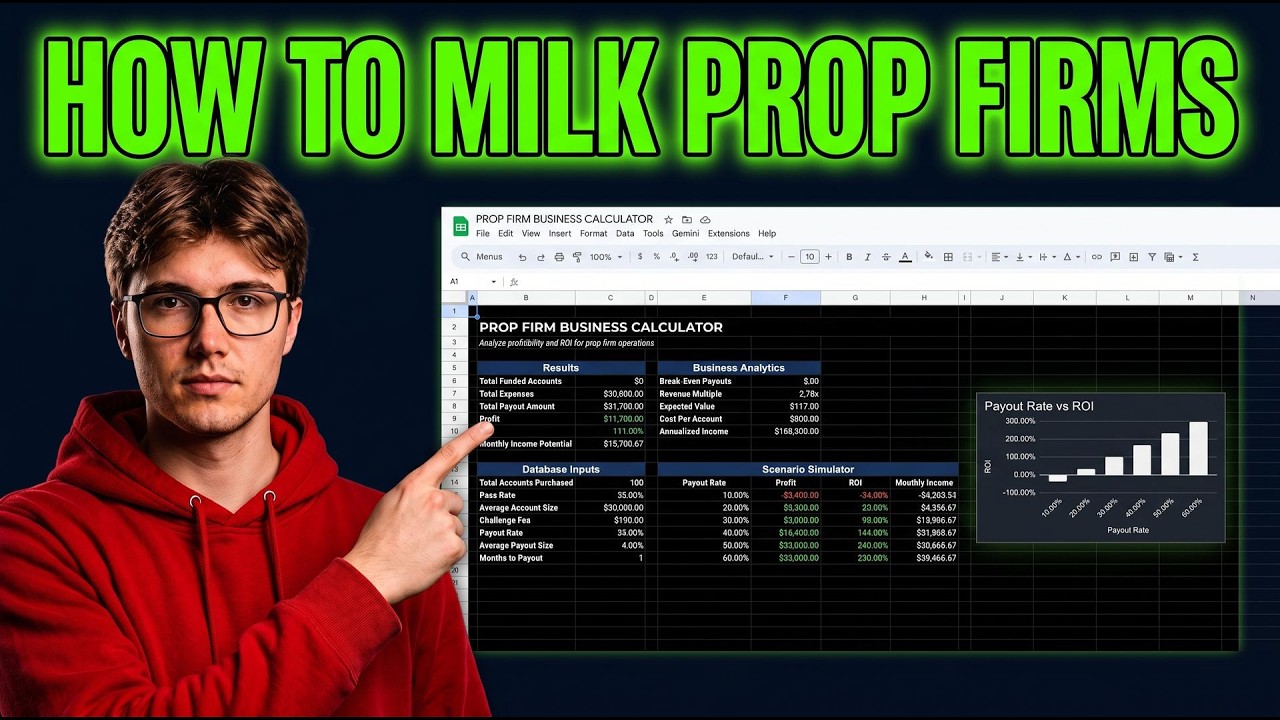
JJ Simon reveals his $1.6M prop firm trading strategy, focusing on fair pricing theory, risk management, and aggressive trade entries.
Ask about this video. Answers come from its transcript only — with the timestamp, so you can check them.
Generated from the transcript and can be wrong — check the timestamp.
Key Takeaways
- Fair pricing theory is the foundation of JJ's prop firm trading strategy.
- Aggressive, high-frequency trading during the New York session maximizes profitability.
- Risk management tailored to prop firm rules is essential for success.
- Different trade setups have varying strength and should be selectively traded.
- The strategy is optimized for prop firms and less effective on live accounts.
What the video covers
- JJ Simon shares a step-by-step trading strategy that earned him $1.6 million from prop firms.
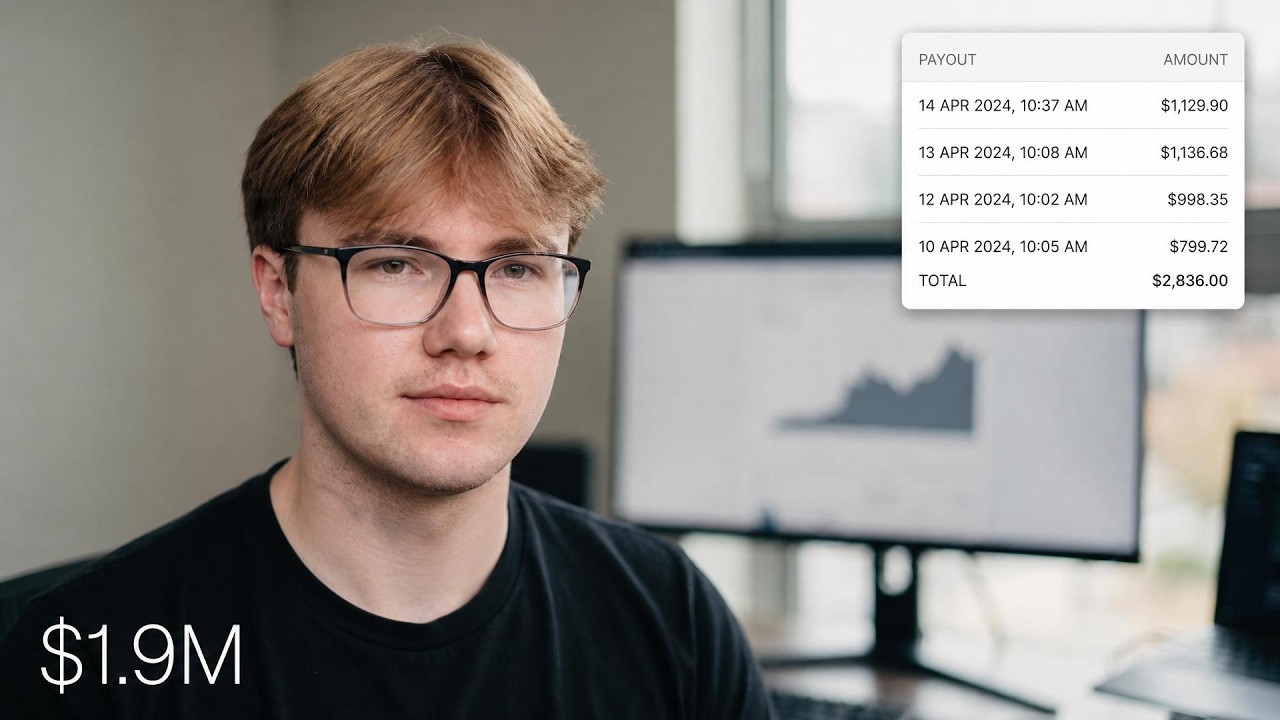
- He provides proof of payouts from multiple prop firms including Topstep, E8, Funded Engineer, and others.
- The strategy centers around trading the New York session open with a focus on fair pricing theory.
- Trades are mostly displacement candles aiming for mean reversion within a 90-minute window.
- JJ emphasizes aggressive trading with around 10 trades per day during the New York session.
- Risk management is crucial, with different prop firm accounts used depending on market conditions.
- He categorizes setups into A+ (break of structure), A (displacement), and B (to be avoided).
- The strategy works best on prop firms due to their evaluation rules and profit targets.
- JJ explains how to handle news days and scale trades aggressively on prop firms.
- He details a 1:1.5 risk-to-reward ratio optimized for prop firm evaluations with specific stop loss and take profit points.
Chapters
- 00:00Introduction and Proof of Payouts
- 01:46Overview of Trading Strategy and Session Focus
- 03:17Risk Management and Trade Setup Classifications
- 04:54Fair Pricing Theory and Market Behavior
- 06:36Trade Recap and Entry Criteria
- 08:23Examples of Displacement Trades and Break of Structure
- 10:58Layering Trades and Aggressive Scaling
- 17:34Handling News Days and Final Trade Examples
Full Transcript — Download SRT & Markdown
Speaker A
What's up? It's JJ. I'm going to go over the exact step-by-step strategy that made me $1.6 million, show you the proof as always, and then go through what I look for, a few key things to know, and then talk about fair pricing theory,
Speaker A
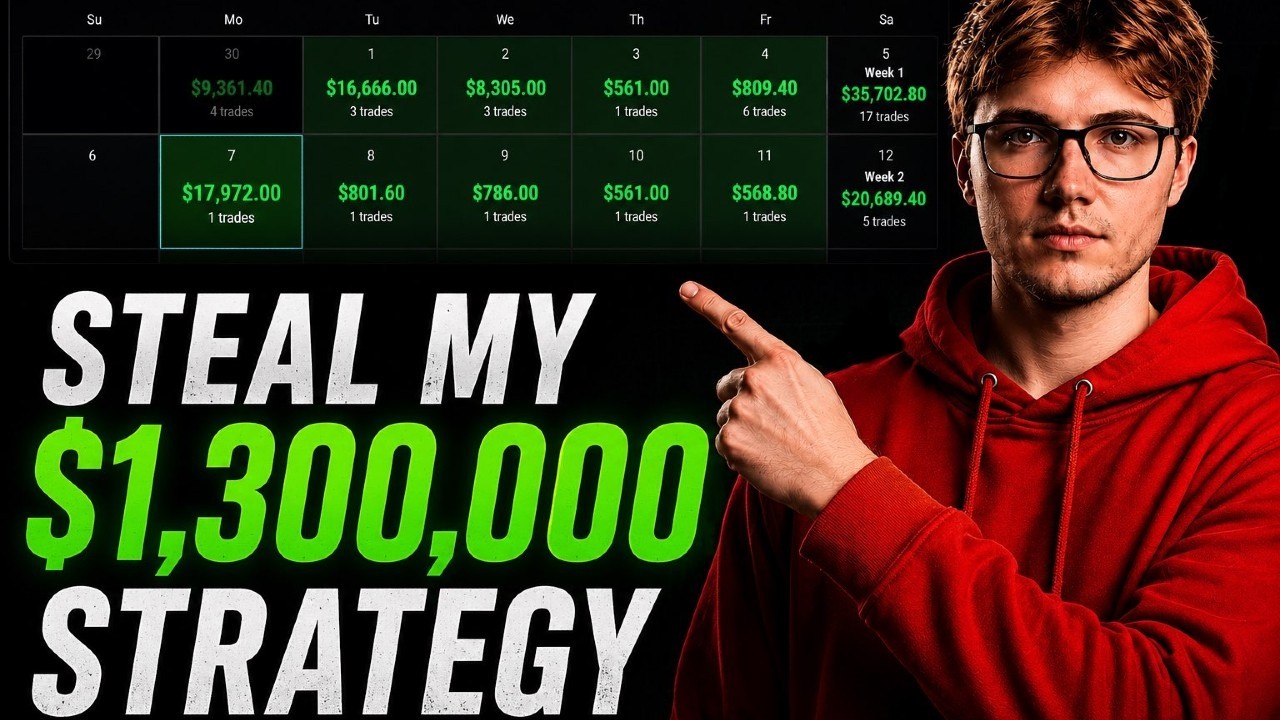
which is basically my entire strategy, like why that works. And then I have 2 weeks of data, 80 trades, 8 days, 10 trades per day, just showing you exactly what I did, and then how I got a 57.5% win rate on 1.5 risk to reward.
Speaker A
So, without further ado, this is my step-by-step trading strategy that made me $1.6 million from prop firms. Here's the proof. This video might be available publicly, but anyways, let's get right into it.
Speaker A
Uh, first is Topstep. I have $292,000 worth paid out with them, plus about 50K on the old dashboard, but that doesn't really matter. E8, $222,000. You can scan that QR code. Funded Engineer, $180,000 in payouts with them. My Funded
Speaker A
Futures, $92,000 with them. Funded Next is at $129,500 right now. Lucid, [clears throat] about $105,000 total. You can pause, look through that. Apex, 60K total, I believe. Might be a little more.
Speaker A
And then Alpha Futures is 75K total. Bulwark Prime, 55K total. There's also some little random sites out there that I use, smaller sites that are not worth wasting your time showing you that, but that should be all of the proof that you
Speaker A
need that I know what I'm talking about. So, let's get into the strategy, and then I'll go over some examples. Now, this is an updated video. I changed the strategy a little bit as the market regimes change. Obviously, now we're in
Speaker A
a war regime, so there's a little bit of a different approach that I'll take.
Speaker A
Uh, but this video I really wanted to make and show you guys exactly how I run it on prop firms, because running on prop firms is so important. It's so much more value to be trading a prop firm
Speaker A
than a live account right now, because they're so profitable. But, let's get straight into it. Here's what I look for. The first thing I look for is the New York session open. This works with any session open, but New York is the
Speaker A
best, and that's what I'm going to go over in the video. I'll do a continuation in the first 5 minutes.
Speaker A
After that, I will look for mean reversion for 5 to 90 minutes. So, 5 minutes, and then anything after that, look for a reversion.
Speaker A
There's no maximum amount of trades. My goal when trading prop firms is trade each account one at a time and get through all of my accounts every day. Sometimes I'll copy trade two together, but you should not copy trade until you're making like 20k
Speaker A
a month. Entry criteria is literally just a displacement candle. I'm being extremely aggressive. I'm looking to get in at least 10 trades per day on New York AM.
Speaker A
So, I will have to be extremely aggressive obviously to find 10 trades in a day. Obviously, if you want to run this on live, you would optimize for a few different things. You'd optimize for your profit factor, you'd optimize for
Speaker A
your Sharpe ratio, and then just don't even, don't even be concerned about running it on live because prop firms is way more profitable right now. Fifth, the actual entry strategies that I'll use in like direction is fair price continuation.
Speaker A
So, I'll take a continuation away from fair price. After that, which is only first 5 minutes, after that I'm only looking for reversion. And reversion is the following 85 minutes to make it a 90-minute session total.
Speaker A
The fair price is 95% of the time going to be the market open. I'll go over in the examples when it changes, how I change it, all that sort of stuff. But, that is what I look for, that's the
Speaker A
strategy in general. I'm taking displacement trades towards fair price. Now, here's some key things to know. The strategy performs better on prop firms.
Speaker A
It will still work on a live account, but what I'm about to show you, the risk management, that sort of stuff is not going to work on live. I'm doing prop firm only. Second, risk management. Yep, like I just said, risk management is the
Speaker A
most important part of prop firm trading. That is mostly what I teach in my mentorship, but risk management is the most important part ever. You need to trade a different account based on what you see in the market.
Speaker A
What I mean by that is if fair price is here, the market goes up here, and you want to short, and you're seeing this many points, then you should trade a specific prop firm account that needs that many points. If it goes up this
Speaker A
far, and you see this many points, you should trade a different prop firm account. Just based on what you're seeing in the market. So, different amount of points back towards your fair price. I'll also go over A+, A, and B
Speaker A
setups. Basically, an A+ setup is a break of structure. An A setup is a displacement, and a B setup is something you would never take. So, that shouldn't even be a thing. Just don't take a B setup. Um, A structure A plus, sorry, is
Speaker A
break of structure. It's just a stronger trade in general because break of structure is a more confirmation, stronger win rate, and that's what it That's something I trade on live, right?
Speaker A
But on props, I'm trying to get in so many trades per day, and that's what I want to target in this video. Next, how to trade on news days. Pretty much the same thing. I will go over two news days
Speaker A
in the examples here. How to scale? Basically, take more trades, be very aggressive because we're on prop firms again. Literally, take any displacement entry you see towards fair price. And now, why does the strategy work? Well, the strategy is just fair pricing
Speaker A
theory. So, basically, the New York session open is the first major intraday reference point for fair auction.
Speaker A
Basically, new institutions will begin trading, all the overnight orders will be executed. There's an early move away from the initial price, which is driven by opening flow, liquidity imbalances, stops, hedging, and momentum participation, all of which are unfair
Speaker A
moves. Basically, none of them are true, long-lasting re-prices of the index. So, basically, everything that happens on the market open makes it move unfairly.
Speaker A
Um, and just remember that you're trading companies, so you want to trade a reversion towards a fair pricing of said companies. And without further ado, let's get into the trade recap. There should be 80 trades, eight days of 10
Speaker A
trades, all New York session, and how I got these specific results. I'll also talk about why I'm on prop firms specifically just throughout these trades.
Speaker A
All right. So, the entry criteria for the continuation is pretty much just the opening candle color. Because I'm taking an unfair trade, meaning a move away from fair price, I want to get in and out literally as soon as possible. So,
Speaker A
for every single trade in this video, I'm going to show you a 25-point stop loss and a 38-point take profit. That is a 1 to 1.5 risk to reward ratio, which is optimal for trading evaluations on prop firms. The reason why is
Speaker A
evaluations have $2,000 of drawdown, $3,000 of profit target, which in itself is a 1 to 1.5. So, separate your trades in the 1 to 1.5, and you will automatically have a higher pass rate just based on how the drawdown trails.
Speaker A
So, for this first entry, it is literally just a green candle and there's a wick down here rejecting shorts, which makes me a little bit more confident, but you know what? I'm just going to buy anyways because I'm trying
Speaker A
to be extremely aggressive and get through at least 10 trades per day in New York session alone. Anyways, opening candle green, just buy right at the top.
Speaker A
The only time that I would consider using a smaller size of 76 tick profit and a 50-point stop loss is if the opening candle is larger than 25 points.
Speaker A
In this case, it's not, so just send it in for 38 points. Quick little take profit. After that, first displacement candle we see is right here and the qualification for displacement candle to make it absolutely zero discretion, the body of the candle is larger than
Speaker A
the body of the previous candle. This one is 10 points larger, so it is a d
Speaker A
Uh like here, these one, two, three kind of displace this green candle and then and so you could just short that. Um it's a little bit of discretionary, but if you want to keep it literally step-by-step, is the body bigger than
Speaker A
the previous one? Then you do it. Anyways, there's the first reversion, 38 points, 25 points stop loss for every single trade. Next, another displacement, the body's bigger than the larger than the previous one. It is literally that easy. This one, body is
Speaker A
bigger, but due to my discretion, it did not close below this wick right here and that's something that I would prefer for it to have, so I just didn't take that one.
Speaker A
This one, another displacement, send it short. This one is also break of structure so on the break of structure entries, these are much stronger because it's just an extra confluence that you can add because for it to break structure, it
Speaker A
must be a displacement candle like majority of the time. So, off break of structure, sometimes you can send it all the way back to the open, but 1 to 1.5 risk to reward will most likely treat you better in the long run
Speaker A
on prop firms. Remember, if you're on a live account, you shouldn't be, but you will do much different profit target and risk management. If I was on live, my target would be this value right here, what I believe to be the fair price.
Speaker A
But, since I'm on a prop firm, my target is exactly 38 points because that is the statistically optimal profit target based on my contract size and my current prop firm account. Or I'll just use 38 for all of the for all of the
Speaker A
trades in this video because 38 should be your profit target if you're on evaluation. Funded account is a bit different, but for evals this is perfect. After that, we see another sort of displacement 1 2 3 like I said, use a
Speaker A
little discretion and then say that okay, these three are larger than the red one or the green one, so I'm just going to short there. It's fine. I'm trying to force a lot of trades, so I do need to be a little bit aggressive with
Speaker A
my discretion just to get all of my accounts traded every day. Next, quick move up and in this case, I adjust fair price from down here all the way to up here. The reason for that is there's some consolidation here
Speaker A
and then it breaks structure and continues up farther. So, the volume moves it up.
Speaker A
This volume should have moved it back down towards the open if the pre-open price was fair. In this case, it moved it up, so now I've just delete the pre-open in my mind, that's no longer a fair price. Now, my target for the rest
Speaker A
of the day is just going to be this most recent consolidation. There's also news at 10:00 a.m. which kind of helps prove that theory. Now, for the entry model, the exact same thing. Displacement candle, send it short.
Speaker A
This is not displacement, it's smaller than the the previous one. Another displacement, another displacement. You can get a little bit discretionary.
Speaker A
These two are basically the same. These two are basically the same. Um these three kind of combine to be one, but when there's outstanding structure, I prefer for it to like make a a an attempt to break that structure.
Speaker A
In this case, it doesn't, it wicks and it comes back, but you could definitely add more entries like this and it definitely would it would not be bad at all.
Speaker A
Um the key on prop firms is to take one account at a time and use optimal risk on that one account. So, this is like a fine entry, but it's just one that I didn't take. And remember on prop firms,
Speaker A
one account at a time and one trade per account per day. That is the optimal way to trade them.
Speaker A
Get yourself some optimal risk, get yourself a decent entry model like this one works that you can replicate multiple times throughout a session.
Speaker A
After that, another trade 25-38, just keep on sending them. Technically, I could even send this one right here because it breaks structure in my favor and I could literally just layer into. I do that quite a bit. I don't know why
Speaker A
it's not marked out here. I must not have taken it for whatever reason. Maybe I just finished trading all my accounts, but you can add extra entries just like that. Literally, just use your discretion.
Speaker A
Anytime there's points in your favor towards a fair price, it is plus EV to send a funded account with optimal risk because all you need to do is have your bias right in the long run. Now, let's look at the next day. This next day was
Speaker A
basically no trades and the reason for that was it kept dumping, so I kind of wasn't able to find any reversions.
Speaker A
Anyways, opening candle was green and that's obviously, I'm just going to take a continuation. It is 44-point body candle, so I use a 50-point stop loss and a 76-point take profit. That one loses. It is what it is.
Speaker A
Now, I'm going to look for trades back towards the open and I will look for displacement entries. Unfortunately, there are not any. This one is a good displacement, but it didn't close above the wick of this candle, so it's just
Speaker A
one that I did not take for whatever reason. This one is not displacing to smaller. This one is a nice displacement and break of structure, but unfortunately, it's already back at the fair price. So, there is basically no
Speaker A
reversion that you could even catch in this move here. Unfortunately, after that, it breaks structure to the downside. And like I said, for the previous day, I would delete the 9:30 fair price. Now, I'm going to assume fair price is this most recent
Speaker A
consolidation because when volume came in, it moved away from the session open. Then, first displacement candle I see, I will buy and lose by one point, whatever. Now, another break down, adjusting fair price once more. First displacement candle I see, I buy.
Speaker A
That one doesn't win, barely. It was making good progress, whatever. Keeps going down, another displacement.
Speaker A
Body is larger, didn't close above the wick, but take this one for whatever reason and that one wins.
Speaker A
Really strong displacement here. Obviously, the candle's way larger than all of these and it closes significantly above this wick and this wick, which is something that I like to see. This one's not displacement. It is a very good
Speaker A
direction directionally biased candle, but it is not larger than the previous one. Uh so, I just don't take that one.
Speaker A
That was about it for this day. Nothing really interesting happened. Unfortunately, I end trading at 11:00 and after 11:00, it reverted all the way back up here. So, it is what it is. Just can't catch that one because
Speaker A
I tell myself 90 minutes and I'm done. So, I stick by it. Sometimes it hurts, sometimes it helps, but it is good to stick by it in the long run. All right, this day seems to be six wins, six loss.
Speaker A
And remember, it's all 1.5 risk to reward. Now, let's go over the entries. Fair price again at the 9:30 a.m. open.
Speaker A
There is a 50-point candle, so I'm going to use a 50-point stop and a 76-point take profit. So, still 1 to 1.5. Nice win there. Then I see a displacement candle. It didn't close below the wick, so that makes it a little bit less
Speaker A
likely. Um, but it was way larger than the body. So, decided why not send it in. These two are not displacement because it is kind of hard to displace this green candle without coming all the way back down here. So, just didn't take that
Speaker A
one. This one, strong displacement. Just as standard, larger than this one. Closes below. Send it for 38.
Speaker A
This one is a break of structure of this right here. And I would just send another one in there. That one loses. It is what it is.
Speaker A
Another displacement here. Closes below the wick and the body is larger than this one. Send another. Lose it. Another displacement. Didn't close below the wick, but I don't really care. It's larger than the body. So, send another one.
Speaker A
And then one more displacement. This one might be a fine displacement. You could classify these two together as a discretionary. Okay, it is larger than this one. So, one, two. Boom, send one short. Or just wait for the break of structure
Speaker A
here and then send this one. Both are fine. Next, I classified for some reason these three together as displacement. But like I said, it's hard to displace this one and this one lost.
Speaker A
I guess probably should not have even taken that one, but it is what it is.
Speaker A
After that, what the hell is this candle doing? Whatever. I would just send another one short here because of displacement.
Speaker A
Not the strongest, but I still want so many trades so I can let my edge play out across all of my accounts. That is how you scale on prop firms. Next, clear displacement candle here. These two could combine to be displacement of this
Speaker A
one. That would work. Or you could just wait for break of structure. Usually, I wait for break of structure, uh which we get right here, and then send that one in.
Speaker A
Final trade for the day. Still coming back there. And no fair price adjustments to this consolidation because it was coming back down. It was not breaking further up. So, pretty good to have the bias play out of the reversion on this day specifically.
Speaker A
Lots of consolidation there, and then it hits 11, so I'm done. All right, Thursday opening candle. Very red.
Speaker A
50-point body, so I'm going to use a 50-point stop loss. 75 76-point take profit whatever.
Speaker A
And this one loses. Oh, well. Displacement entry. Send one in here. Unfortunate loss. Your bias is towards fair price, I hope. Another displacement and break of structure, so much stronger entry here. Send this one in. Lose, but, you know, it is what it is.
Speaker A
Uh the only time that I will layer trades in, meaning if one is like halfway to take profit, I'll send another one in, is usually if it breaks structure in my favor while I'm still in that trade.
Speaker A
Now, here's a great example of that. Just see a displacement here. First entry, I will send it in. Now, it's like halfway to take profit or 75% of the way, and then break of structure here. Send another one.
Speaker A
Another one in. This one wins. Another displacement here. This one's not really displacing anything, but at this point it is very likely coming back towards fair price just because of how strong the move is, so I just want to get in on
Speaker A
that. You can pretty much enter any point throughout this candle, and it would be fine.
Speaker A
Uh probably can't get an entry in this candle unless you have a limit order at the structure, but uh for break of structure, I prefer for it to close below instead of wick. More recently, it's been extremely wicky, so
Speaker A
just a little change that I've made. No more limits. Now, I'm just waiting for a close. After that, it even moves below fair price, so let's trade it back.
Speaker A
First displacement candle you see right here. Win very quickly. Another displacement candle. Win as well very quickly. This one is not displacement, plus it's too close to to the fair price to trade that. Next, really nice break of
Speaker A
structure here, but I got in on displacement. Unfortunately, there's only like 24 points, so maybe I shouldn't have taken it if I'm going for 38, but like I keep saying, I love to trade all of my accounts. I love to take
Speaker A
so many trades. Um just the reason Also, another reason why I take so many trades is look, you see the stats up here. When I take 10 trades, it's more likely that I'm break even-ish, right? Like the variance is
Speaker A
going to play out a lot more than if I just take one trade. Like if you're taking one trade per day, that variance on a week is crazy. Like 2 weeks of your trading is literally 1 day of mine. And
Speaker A
that's how I'm able to make money so much faster on prop firms, as long as you have optimal risk, of course.
Speaker A
But anyways, one more displacement end off the day. 11:00 a.m. I am done. But, very good win rate here because it's reverting. So, these days where it reverts are obviously it's going in our favor in our bias, so you can have very, very good
Speaker A
win rates. Um if you were to break even, it would be four wins, six losses, because you have a 1 to 1.5, and the break even on that would be 40%. But, anything above 40% and you're going to
Speaker A
make money on prop firms, for sure. All right? Now, Friday, opening candle is green, 40 points more than 25, so I will use a 50-point stop and a 76-point take profit.
Speaker A
This one is weird one. So, in this case, I would go break even. I am not usually a fan of going break even unless it's absolutely necessary. In this case, it is. The reason for that is the initial unfair continuation
Speaker A
basically stops, and it breaks structure against you. So, I would just get out and then send one short. But, I prefer you get out at break even than out at like plus 300, cuz that's going to mess up your risk. So,
Speaker A
send another one short right there for 38, off break of structure. At this point now, start looking for displacement candles. These three together could be classified for whatever reason I didn't take it. Maybe it was these wicks here being very large
Speaker A
just threw me off or something like that. I don't know exactly. Um but, I entered here displacement because this candle is larger than the previous one, so send it short. Um and then next displacement here being larger than
Speaker A
these two, and it closes below them, so this a really good entry. Uh this is another one where I layered entry for whatever reason. Uh strong displacement here. I definitely should have waited for break of structure, or maybe I
Speaker A
mismarked it because I definitely would have entered off break of structure. But yeah, you can layer them in if it breaks structure in your favor. Another break of structure in our favor, um all within the same move down. Unfortunately, this
Speaker A
one gets pretty close to the the fair price, but doesn't go all the way. Then another displacement, send one short. And then this right here is a Trump tweet. So, for Trump tweets, it's obviously not possible to predict when he's going to
Speaker A
tweet or what he's going to tweet. But the market starts moving incredibly fast in one direction. You can literally just send an eval in, and it's going to win slightly above break even, so it's plus EV. Um so, that's kind of what I did
Speaker A
there. Next, displacement candle would be this one. This one's good displacement, but is already at fair price. So, like you can't really even win anything. Um this is not displacement cuz it's smaller than this. This is not smaller than
Speaker A
this. Uh this one's a little bit weird because there's no real body to the candle. Uh for displacement, I like it to open and then go straight down.
Speaker A
Uh this one kind of went all four directions. Up down up down. This one though, break of structure. Um just below that, so send the final trade of the day. Then it hits 11:00 a.m. Um another good day for reversion.
Speaker A
Remember, the pre-open price is going to be fair unless something changes it. And the only thing, in my opinion, that changes fair price is news.
Speaker A
So, news is traded a lot differently. That will be Tuesday and Wednesday of this next week that I'm about to show you. But news is traded much differently. Or not Or not not really.
Speaker A
Like you trade news the same, but news is what changes fair price. So, it would change how you target trades, basically. Anyways, here's Monday. Opening candle is green, so I want to buy for a continuation long, but in this case, there's
Speaker A
literally nothing. Um I would not take continuation shorts because there's a huge wick rejecting shorts, and the opening candle was green. But they won, so uh I would not take that. Next, I would look for a reversion. So, this is the
Speaker A
first displacement candle we get, just cuz it's larger than these two, same as always.
Speaker A
Then the next displacement candle you get is this one right here. Send it long. Layer it in. Send another one here because it broke this structure here. And then send a final one here for whatever reason. I don't know. Probably
Speaker A
should not have done that cuz it didn't break this structure, but I got greedy.
Speaker A
I thought I was going all the way back instantly. Next, another displacement candle here being larger than one, two, three of these and closing above this one here.
Speaker A
Then this one breaks this structure right here. So, I sent another one. It is what it is. I don't really care if I lose. Um trying to get through so many accounts and realize my bias. Next displacement, clearly larger than this one, closes
Speaker A
above the wick. Nice. This one, break of structure, hence why I layered it. Another break of structure, send it in.
Speaker A
Barely a displacement, not the strongest, definitely not the strongest. There's a huge wick, well not huge, but there's a wick on top which does decrease the win rate a little bit. And it didn't close above this one here, but
Speaker A
I don't care. Next, another displacement, send it long. One more displacement. I guess there wasn't really any structure broken, but a strong displacement and it's pretty close to fair price, so might as well send another one in. Final
Speaker A
displacement to end off the day here. So, as you can see, 13 trades. I'm incredibly aggressive and all 13 of my trades were long. The reason why? My bias is long back towards this opening price here. If you are on a live
Speaker A
account, all you have to do is buy some point below this line, have your take profit be there and have your stop loss be below wherever.
Speaker A
That's all you have to do on a live account because all you have to do is realize your bias to make money. On a prop firm account, that's not going to work. The prop firms are designed to make you lose money doing strategies
Speaker A
like that based on how their drawdown trails, how their profit targets exist, consistency rules, when they move you to live, all that sort of stuff. It is designed to make live traders fail. So, adopt your strategy so it works on prop
Speaker A
firms. I'm just giving you mine. This one works incredibly well. It's made me 1.6 million, so I literally just do the same thing every day. Just keep on buying until it gets back towards the fair price.
Speaker A
Have good risk management, of course. Now, let's go over Tuesday, which is a news day. Here's how I trade news.
Speaker A
Obviously, a lot going on here. Another 13 trade day, but 10 wins, so I'll take it. Anyways, news is always priced in, okay? News like this, which is 8:30 a.m. It is red folder news. So, if the news is expected,
Speaker A
meaning you see it on Forex Factory, and it's a red folder, that is priced in.
Speaker A
They already have a forecast for that, and it's not going to be far away from the forecast.
Speaker A
So, this is priced in. And what I mean by priced in is I mean fair price is down here, okay? So, this move up is completely unfair, and I'm going to revert the whole thing.
Speaker A
Let me go over one other example really quick. If the price is here, and Donald Trump tweets, then the price goes down to here. Maybe some of you think, okay, the fair price is just this consolidation here. It's
Speaker A
the pre-news price, right? Um no. Because this was unexpected news, it changes the fair price of the market.
Speaker A
Then there's more consolidation, then this down here would be the fair price, not the one up here, because this one is unexpected.
Speaker A
Unexpected changes fair price. This one is expected, so it does not change fair price.
Speaker A
Now, for the entries on this, there's so many possible entries. I just marked out 3825 for all of them, but you could even enter off this one.
Speaker A
It's a little bit aggressive. I like to wait for a tiny bit of confirmation, cuz sometimes it can absolutely shoot up like crazy, just cuz of how large this candle is. There's some pretty strong momentum. But anyways, I just waited for
Speaker A
the first break of structure, and then sent it short. Now, remember, on a live account, here's what you do. You put your take profit all the way down there at the bottom, and you put your stop loss above there, what whatever stop
Speaker A
loss system works best for you. That's what you do on a live account, cuz you want to realize your bias all the way back down towards fair price.
Speaker A
Unfortunately, like I said, on a prop firm, you can't do that. So, what I'm going to do is I'm going to separate the bias into apparently 13 different trades of 3825. There's the first one, off break of structure. There's the second
Speaker A
one, off displacement. These two could work together to be a displacement. Not the worst idea. The wick on the bottom's a little large, so it kind of threw me off there. That's why I didn't send that one. Now, there are four trades in here.
Speaker A
Let me figure out the best way to show you exactly all of them. I'll just do one at a time. So, this first one um just as good break of structure for 3825, extend that out and it wins down
Speaker A
there. I'm going to eat it. Next one was this one. Displacement candle, extend it out, barely did not hit the minus 25, hit 38 right there.
Speaker A
Next, another boom boom displacement. Combine these two because it went below that wick. That one lost, whatever.
Speaker A
Another displacement, clearly larger than these three. Send that one for 38, win. Um I could have sent another one in here. I'm not sure why I didn't. I might have been Oh, the reason why I probably didn't was because I was just in four
Speaker A
trades and all of them won right there. So, that was probably why I didn't send one here, but it would be totally fine to send one there if you missed the others for whatever reason.
Speaker A
Now, waiting for the open. Another displacement here. Market open now. Okay. Market open candle. I'll just delete this so it doesn't get in the way. Open, 44 43 points. So, when a candle's 43, remember larger than 25, 50, 75, or 50
Speaker A
76 um because you want to account for the fill. Just send it short back towards the fair price. Pretty easy, I hope. After that, it keeps jumping back up. So, I'm just going to short every single time I see a
Speaker A
displacement. Now, this is not a displacement cuz it's smaller. This one, perfect displacement. Clearly larger and it closed below. Send it in.
Speaker A
And this one loses, whatever. These two kind of No, not enough. There's a huge wick down here and it didn't close below the wick of the green one, so it's not considered displacement, even though it looks pretty tempting.
Speaker A
Next displacement Oh, this is actually break of structure. So, send it in off break of structure and displacement. So, this should have won, whatever.
Speaker A
Another displacement, clearly very large directionally biased red candle. After that, it moves below fair price, so I'm just going to buy back towards it. First entry off displacement, larger than these three, closing above all three wicks. Send it long.
Speaker A
Unfortunately, can't really get in here or here as well um cuz there's no structure that it breaks.
Speaker A
Consolidation at fair price, move up, which I'm going to get First entry right here. Second entry should have been here off break of structure, but for whatever reason I waited until more confirmation. I have no idea why, but I should have entered
Speaker A
there. Um but yeah, just displacement, break of structure here, another displacement. So, a bunch of reasons to short. And then it hits 11:00 a.m. Done for this day. But yeah, very positive day. Anytime news is coming out and it's expected as red
Speaker A
folder 8:30 news, it is priced in, okay? Now, final day and then I'll end it off with some final thoughts about how you should approach prop firms optimally.
Speaker A
Another news day. So, 8:30 a.m. big green candle, short. First attempt off break of structure.
Speaker A
It's also the first displacement candle we get. Unfortunately, that one loses. Then another move up. This one is not displacement cuz it's not getting below this wick right here. Keep waiting, keep waiting, keep waiting. Not a displacement. It is smaller or I guess I
Speaker A
guess it's larger somehow, but no, that's got to be bugged. Okay, something here is bugged. This one looks smaller. Smaller, smaller. Hey, there we go. There's a larger one. Send it short. 25:30. Stack it. Send another one short. Huge wick projecting longs,
Speaker A
which is always good. Or you could just wait for break of structure and enter here. Both of them are fine. That one's probably a little better if you want to layer them in. It's a little bit better.
Speaker A
Uh-um and then another displacement. Layer a third one in. That works, too. Ideally, wait for break Looks like it broke structure, so send a third one in.
Speaker A
Third one loses, but whatever. Now, market open. Red candle. Displacement. First one we see is here.
Speaker A
So, this is kind of a continuation plus a reversion. And then unfortunately, it literally loses by like .5 for whatever reason. I don't know.
Speaker A
Comes back down towards the pre-news price. Consolidates a bit. Drops down more. Now, I'm going to buy back towards it.
Speaker A
Displacement. Send one in here. Break of structure. Send it in here. And then another set of three displacements {slash} break of structure. Ideally, there's a little bit better cuz of break of structure, but whatever reason, that works, too. That
Speaker A
is all of the trades for the past eight days. That is 80 trades being extremely aggressive. Remember, you can get this up if you are way more conservative and only take break of structure trades. I don't want you to copy trade, preferably
Speaker A
not, because copy trading means you reduce your risk on one account and spread it out across all of your accounts, which is not something that is good on prop firms. You want all your risk to be concentrated on one account,
Speaker A
take a bunch of trades, that way it basically evens out and all of your accounts are being high risk, high reward. So, that is my exact trading strategy. Pretty long video, but I appreciate you watching and I hope it
Speaker A
makes sense. All I'm doing is taking displacement entries. I'm getting through as many accounts as I possibly can. I believe that the pre-open price is fair due to fair pricing theory and I'm literally just taking as many accounts as possible. Every account I
Speaker A
showed in this video was a 1.5 risk to reward, 25 point stop loss, 38 point take profit. The risk management exactly is what I go over in my mentorship just because I don't want that public.
Speaker A
It is the most important part, at least in my opinion, just because you want to trade different accounts based on what you're seeing in the market and obviously ideally you would catch entire moves like this instead of just 38
Speaker A
points. Also, please trade on prop firms, please do not trade live accounts. On live, you need to be the best trader in the world because your competition on live accounts is institutions. Your competition on prop firms is losing prop firm traders. So,
Speaker A
I'd give the strategy a try. It works extremely well for me. I'm able to get through so many accounts, diversify my risk across all of them, all thanks to fair pricing theory. So, thank you for watching this strategy video and I will
Speaker A
see you in the next one.
Topics:prop firm tradingJJ Simonfair pricing theoryNew York session tradingdisplacement candlerisk managementtrading strategymean reversiontrade evaluationprop firm payouts