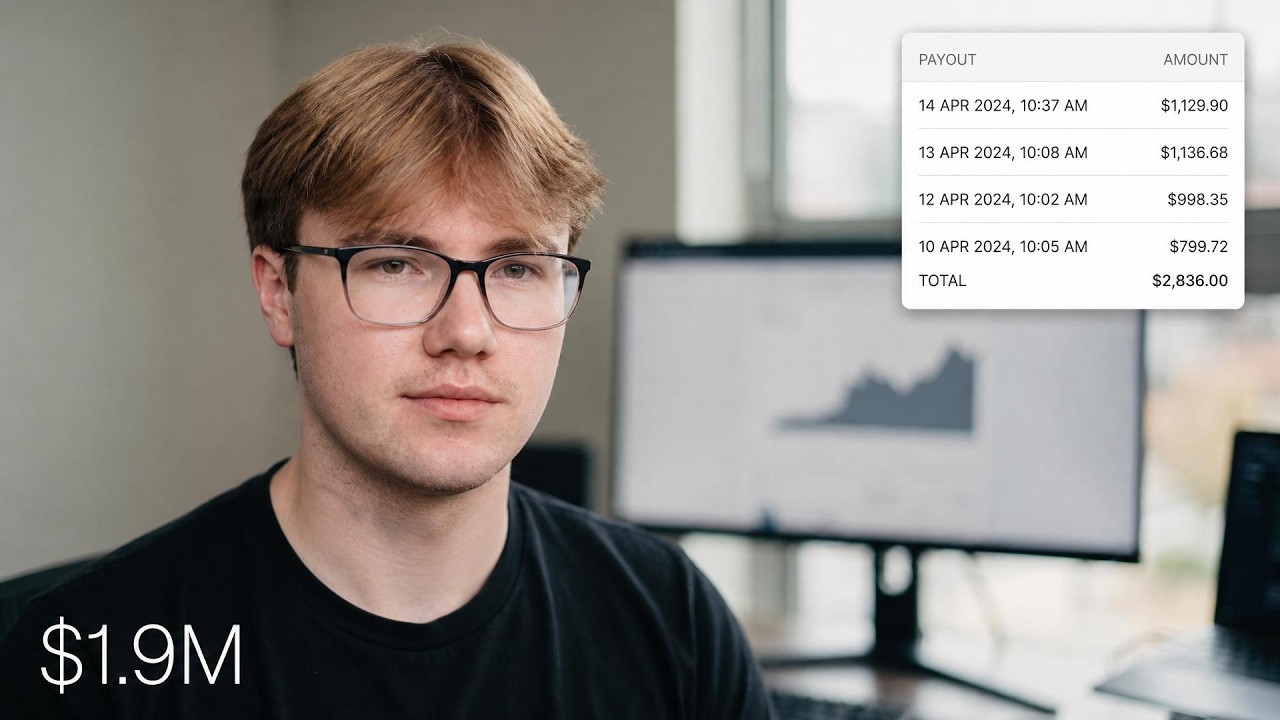
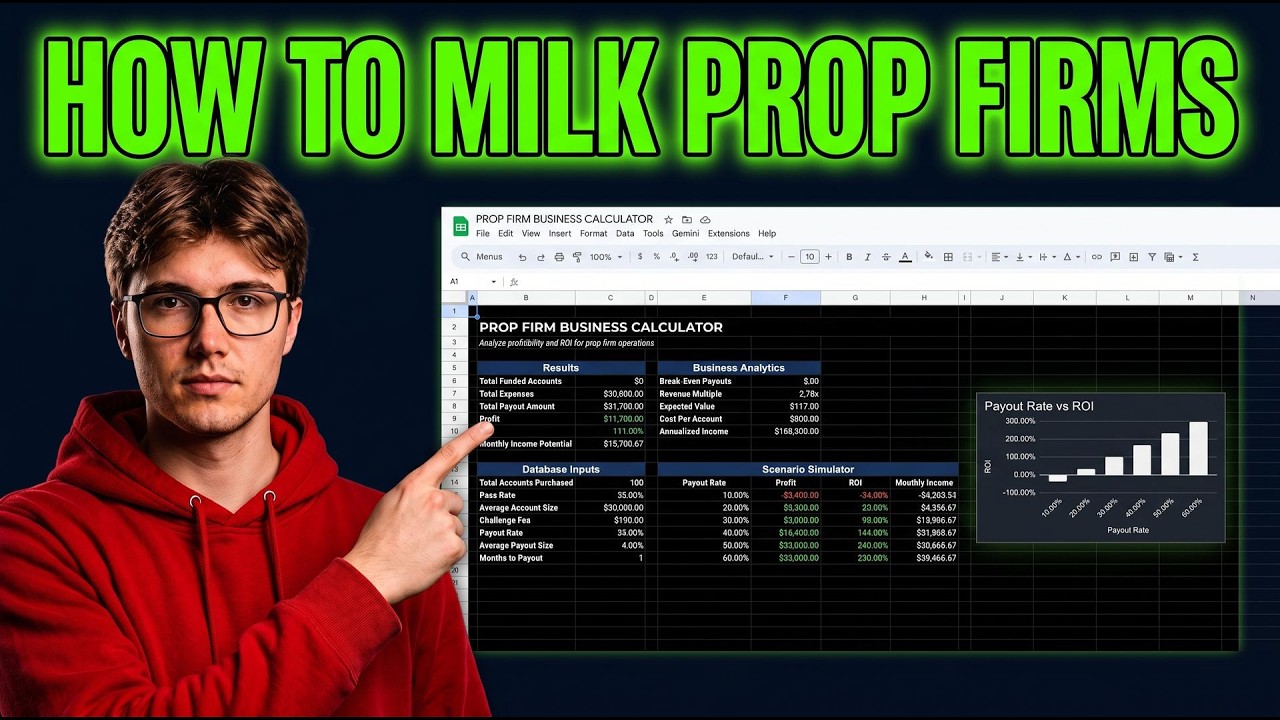
JJ Simon shares his journey from losing money in trading evaluations to making a million dollars by age 19 through persistence and education.
Key Takeaways
- Consistency and disciplined routines are critical for trading success.
- Education in quantitative finance and risk management improves trading outcomes.
- Poker skills can translate to understanding financial markets and risk.
- Failing early is part of the learning process; persistence leads to success.
- Good risk management and trading psychology are as important as strategy.
What the video covers
- JJ Simon started trading at 14 but initially lost money on prop firm evaluations.
- He worked as a math tutor to fund more trading attempts but continued to face failures.
- In college, he switched from engineering to quantitative finance after discovering poker's similarities to trading.
- He turned $25 into $25,000 playing poker, but chose not to pursue it full-time due to high variance.
- JJ applied his college finance knowledge and internship experience in risk management to improve his trading strategy.
- He focused on prop firm trading, emphasizing consistency and risk management.
- After eight months of disciplined daily routines, he scaled his trading profits significantly.
- JJ now lives his dream life in New York City, attributing success to education, consistency, and psychology.
- He warns that strategies from YouTube alone won't work without proper risk management and psychology.
- His story highlights the importance of perseverance, learning, and applying quantitative methods in trading.
Chapters
- 00:00Introduction and Early Trading Attempts
- 00:36Working to Fund Trading Evaluations
- 00:54Five Years of Failure and Learning
- 01:11College, Poker, and Finance Studies
- 01:51Poker Success and Career Decisions
- 02:31Switching to Quantitative Finance Major
- 03:29Internship and Developing Trading Strategy
- 04:19Scaling Trading and Consistency
- 04:56Success, Lifestyle, and Final Advice
Full Transcript — Download SRT & Markdown
Speaker A
I made a million dollars at 19 years old. Here's my trading journey. Let's go for a drive.
Speaker A
[music] I first found out about trading when I was 14 years old. I saw that Topstep was giving you money to trade with if you spent $50 in one of their evaluations.
Speaker A
So, I figured, why not buy the evaluation with all the $50 I had? Well, unfortunately, I lost the $50 in the evaluation. In high school, I started learning a lot more about math and engineering, and I felt like I was able
Speaker A
to apply some of that to the financial markets. So, I decided that I was going to attempt two more evaluations with Topstep in my senior year of high school, but I had to get a job first because I literally had no money. My
Speaker A
parents wouldn't give me any money because I lost the first evaluation. So, what I did was I became a math tutor at Kumon Math. I worked there for about $15 an hour for just a few weeks, so I was
Speaker A
able to get enough money to buy Topstep evaluations. So, I took all of my money, invested back into Topstep again, feeling like I had a better chance of passing this Topstep since I knew a lot more math, physics, and statistics.
Speaker A
Well, unfortunately, I lost those as well. So, in my five years of a trading introduction, just learning off of YouTube, all I was experiencing was failure. I wasn't able to pass the evaluations. So, I knew something must be wrong with either me, my strategy, my
Speaker A
psychology, or just trading in general. Maybe it wasn't even possible. I never like to take that mindset with anything.
Speaker A
So, my next step was college. I was originally going to college for engineering, but the first few months at college, I started playing a lot of poker. I really enjoyed it, and I took an intro to finance class. I figured if
Speaker A
I was able to switch my major to quantitative finance, I'd be able to learn a lot more about the financial markets. So, in my first few months of college, I was playing a lot of poker, and poker was pretty similar to the
Speaker A
financial market, just like a big problem that you have to solve. There's obviously expected value, there's variance, there's tons of statistics that goes into poker, not just reading other people. So, you're actually able to study that, and you can do that by
Speaker A
using coded simulations to find out optimal moves for pretty much every single possibility of a poker hand playing out. So, it was a lot of memorization, a lot of understanding the theoretics behind poker itself, and eventually I became quite good at poker.
Speaker A
I started with probably $25 to my name playing with one to five dollar buy-ins at in college, and I turned that into $25,000 in probably about six months of going to the local card room for some higher stakes. And from there, I found
Speaker A
my success at poker was pretty good for my age. Problem was, poker is not like a full-time career. You can't exactly take that professional unless you're willing to sacrifice pretty much everything and not go the route of a
Speaker A
traditional 9-5. I already knew from the start that I didn't want a 9-5, but I just felt like the variance behind poker and firing these massive buy-ins for large percentages of my net worth would probably make me a little bit too
Speaker A
uncomfortable to do it full-time. That's when I looked into quantitative finance. So, I remembered my past experience with Topstep. I felt like I was way more prepared now that all of my poker experience had proven that I was able to
Speaker A
get really, really good at something. So, I decided to switch my major in college from engineering to quantitative finance. I figured maybe I would be able to learn so much in college that it would be silly for me to not succeed on
Speaker A
prop firms. I honestly didn't know how far it would take me at the time. I just felt I didn't want to get a 9-5 and that this would be the best next step for me if poker wasn't going to work full-time.
Speaker A
So, throughout my two years in college, I kept playing poker, of course, but I had a lot of classes talking to me about finance, specifically pricing options, pricing futures, which is what I trade now, and I was understanding so much
Speaker A
more about the financial world. It explained to me exactly why I was losing money, [music] and then it explained to me exactly how to make money. I then decided to graduate college early. I had enough money saved up from poker. I
Speaker A
wanted to move out. I also had an internship in place in New York City.
Speaker A
So, I took the $25,000 I made from poker, took it to New York City, and proceeded with my internship. At this time, I had just started prop firm trading again because I knew by the time my internship was over, I had to have
Speaker A
made at least $50,000, or else I wasn't going to be able to do prop firm trading full-time. I turned 19 in May, and I left for my internship the first day of June. My internship was in risk management, so it's related to what I
Speaker A
studied in college, and it's also related to how I trade prop firms right now. So, I think that set me up really well. It didn't pay too well, so honestly, during the online meetings, I was just trading in the background. So,
Speaker A
throughout that internship, I was trying to apply the things I was learning there, plus what I'd already learned in college about the financial markets, to create a very, very strong prop firm specific trading strategy. And that's what I was able to do. So, through the
Speaker A
internship, I invested all of my poker money into prop firm evaluations. Obviously, I started off a little bit rough, but that's how it goes for everyone. You can't have instant success. Then, I took what went wrong, and I flipped it around and made it to
Speaker A
something that would go right. So, coming out of the internship, I had made more from trading than I did in the internship, and at that point, I knew there's no way I was going to return to them. They offered me a return offer. It
Speaker A
was to start in nine months, but I literally told them up front, "Nope, I can't take this return offer." So, now I was 19 years old living in New York City, and I had no safety net. I knew I
Speaker A
had to make trading work out for me, but thankfully, I had already had a good start. I used what I learned in quantitative finance in my portfolio management classes to turn prop firm trading into more of a portfolio
Speaker A
management problem. The next few months were focused on scaling. I invested everything I had made from my internship back into prop firms. I was paying rent for $1,200 a month. But now, for scaling, consistency was the most important thing. I literally had the
Speaker A
exact same daily routine for eight months straight. I woke up, traded the AM session, had lunch, traded the PM session, had dinner, traded the AM session for eight months straight, and I still live by that today. Consistency is
Speaker A
100% the most important thing in trading because if you're able to master a strategy and your risk management, literally all you have to do is be consistent. If you're consistent, then you can scale with no problem. So, if
Speaker A
you can make $1,000 a month consistently, you should be able to make $2,000 a month consistently, and then keep compounding that to 4, 8, 16, etc.
Speaker A
Fast forward eight months. Now, I'm still doing the exact same thing, but I'm making a ton more money doing it. All the work that I did in the past 100% paid off, and now I'm living in my dream
Speaker A
apartment in New York City, driving my dream car, living the dream life, honestly, and it's all because I was able to put in consistent work for eight months straight. So, one final thought I'm going to leave you with, if you're
Speaker A
seeing a strategy purely on YouTube, it might work, but if it's not paired with good risk management and good psychology, then you're probably not going to make money at all.
Topics:trading journeyprop firm tradingquantitative financerisk managementpoker and tradingconsistency in tradingtrading psychologyTopstep evaluationstrading success storyJJ Simon