Skip to content

Here's How You Can Make $100,000 Per Month On Prop Firms

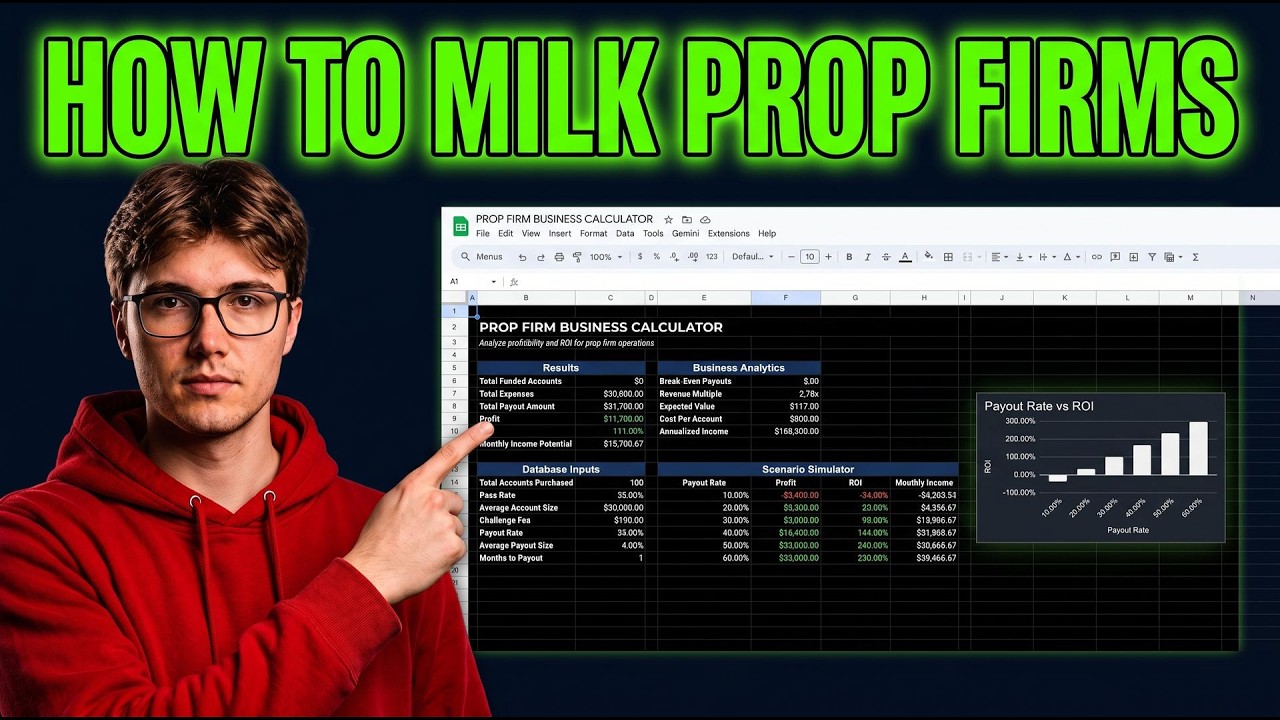
JJ Simon reveals how to make $100K/month trading prop firms using math, risk management, and strategy optimization.

Ask about this video. Answers come from its transcript only — with the timestamp, so you can check them.

Generated from the transcript and can be wrong — check the timestamp.

Key Takeaways

  • Mathematical understanding of pass rates, payout probabilities, and expected value is crucial.
  • Cost per drawdown must be optimized to ensure profitable trading on prop firms.
  • Risk management involves balancing stop-loss and take-profit, not just limiting losses.
  • Scaling and managing multiple funded accounts is key to achieving $100,000 per month.
  • Adapting strategies to prop firm rule changes improves long-term profitability.

What the video covers

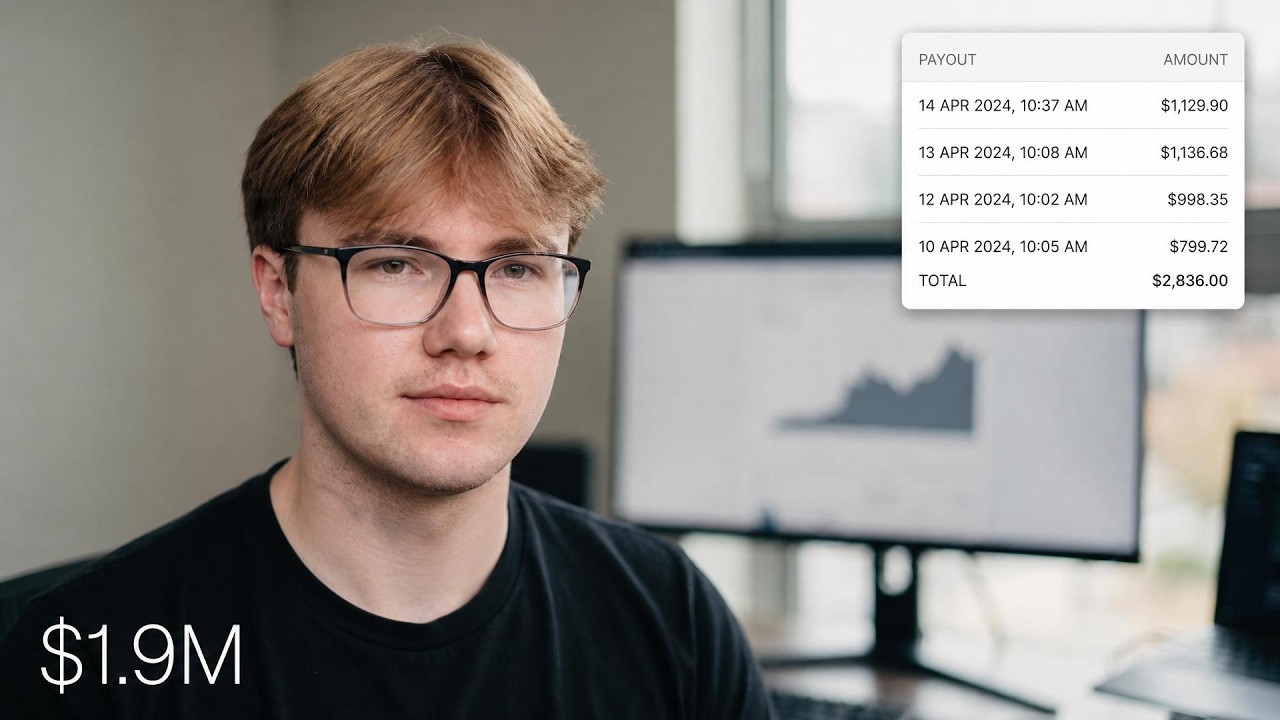
  • JJ Simon shares proof of $1.5 million in prop firm payouts across multiple firms.
  • He explains the importance of understanding pass rates and cost to fund accounts.
  • The video covers calculating expected value based on payout probability and payout size.
  • JJ emphasizes the critical role of math and statistics in prop firm trading success.
  • He discusses optimizing cost per drawdown to ensure profitability on different accounts.
  • Risk management is redefined as managing both stop-loss and take-profit levels.
  • JJ provides examples of scaling strategies and managing multiple accounts simultaneously.
  • He highlights the need to adapt strategies based on changing prop firm rules and profit targets.
  • The video includes practical trading session insights and trade volume requirements.
  • JJ offers coaching services for traders aiming to reach six-figure monthly incomes.

Answers

Questions about this video

How does JJ Simon calculate the cost to get a funded prop firm account?

JJ calculates cost to funded by dividing the evaluation fee by the pass rate. For example, if an eval costs $100 and the pass rate is 30%, the cost to get funded is $100 divided by 0.3, which equals approximately $333.

What role does expected value play in prop firm trading according to JJ Simon?

Expected value helps estimate profitability by multiplying the probability of payout by the payout size. It allows traders to assess if their payouts will exceed expenses before buying accounts.

Why is risk management more than just setting stop-losses in prop firm trading?

JJ explains that risk management includes both stop-loss and take-profit levels, focusing on risk-to-reward ratios to optimize profits rather than only limiting losses.

Full Transcript — Download SRT & Markdown

00:00
Speaker A
What's up, YouTube? I'm JJ. I have $1.5 million worth of prop firm payouts, and today I'm going to teach you how you can make $100,000 per month on prop firms.
00:08
Speaker A
But first, let's start with the proof. Everybody knows my payouts are real. Here we go. Top step, $292,000 worth of payouts. E8, $222,000 worth of payouts.
00:18
Speaker A
Difi, $180,000 worth of payouts. I'll refresh them all here for you as this plays. 92K from my funded futures, $130,000 from funded. Next, Lucid. We have about 105,000 total. Apex about 60K total. Almost done here. Alpha 75K total payouts. And
00:40
Speaker A
lastly, Holar Prime 55K total payouts. Obviously, the proof is real. Just wanted to show everybody so that there's no doubt about it. I do trade on some smaller sites that are not worth including there to waste your time. But
00:52
Speaker A
anyways, here's how you can make $100,000 per month trading on prop firms. First, I'm going to start with the math. Then, I'm going to get into the risk management, show some actual examples, then talk a little bit about
01:02
Speaker A
my strategy. Not many bullet points, but that's because it's pretty visual. And then lastly, scaling because scaling is the most important part, and I'll go over pretty much all the firms that I use and have used. So, without further
01:12
Speaker A
ado, let's get right into the math. All right, first is the evaluation. Obviously, you're on the eval so you need to know what your pass rate is.
01:20
Speaker A
Now, the pass rate basically means if you buy 10 accounts and you pass three, then your pass rate would be three out of 10. It's pretty easy math, but that would be 30% pass rate. From your pass
01:31
Speaker A
rate, you can solve for your cost to funded. Basically, that means if it costs 100 for an eval and you pass one out of three, you divide 100 by 0 point or if you pass one out of 10, we'll do
01:42
Speaker A
three out of 10. If you pass three out of 10, you just divide it by 0.3 and that will give you your cost funded, which would be like 333. So now I know it's going to cost about $333 to get
01:54
Speaker A
this funded account. From there, I'll get into an example in a second. You need to find your payout rate.
02:00
Speaker A
Basically, your chance of getting a payout. If you're given the $2,000 worth of 50k draw down, what is your chance of getting a payout? This is going to help you with your expected value. The reason why is once you get your payout, you're
02:12
Speaker A
realizing expected value. Once you get the account, you obviously have a chance to generate positive EV, but you haven't generated the EV until you've actually started trading on it. But before you even take a single trade on proper, you
02:24
Speaker A
can simulate it. So instead of all these people that go ahead and they simulate a live account balance, they're like, "Oh, wow. This strategy is really good." Like obviously it looks good. It's a positive strategy, but they don't
02:34
Speaker A
understand that draw down's going to hit their max loss. Same with that one. Same with that one. Same with that one. Same with that one. And this is a really positive equity curve. There's obviously a bunch of equity curves that start
02:44
Speaker A
going straight down before they go up. And of course, these are also going to fail your accounts. Maybe you have a really good strategy that starts bad, but then finishes strong and you quit just because it lost twice in a row. So
02:54
Speaker A
on prop firms, pretend that you're trading a prop firm account while you're back testing. Find your exact pass rate.
03:00
Speaker A
Then you'll know, okay, if I buy the top step account, I've simulated 10 top step evals and I passed 30% of them. Then I know it's going to cost me $333 if it's 100 per eval to get the funded account.
03:11
Speaker A
Now once you're on the funded account, same simulation. Don't simulate for your equity curve. Don't do that. Simulate for your chance of getting a payout. And then obviously you have to know how large that payout is. The chance, so
03:22
Speaker A
probability of payout, multiplied by size of the payout is going to give you a pretty approximately a pretty good estimate for your expected value. You could just go off of it. It's a little bit different, but it's going to be very
03:34
Speaker A
very close. So now you haven't bought a single account. You're just starting out and you automatically know I'm going to spend 33 and I'm going to get back what a,000. If you have a 50% chance of getting a $2,000 payout, that's $1,000
03:44
Speaker A
worth of EV, give or take, but very accurate. So not bad at all. Three times return on your investment. From there, you can tell if your payouts are going to be larger than your expenses. If so, that means you're making money. You just
03:55
Speaker A
need to execute on the evals. You do really need a strong understanding of math and statistics in general if you're going to be trading on prop firms or at least pretty solid knowledge about these topics that I'm going over right now
04:07
Speaker A
because these are the actual ones that you're going to be using when figuring out which accounts to buy, how you should trade, which strategy is the most optimal. Um, because obviously math is the most important thing in proferm
04:18
Speaker A
trading. I have a degree in quantitative finance. So, I literally have studied this exact math and statistics applied to the actual financial markets, but now I'm just applying it to prop firms, which is even easier. Anyways, here's a
04:28
Speaker A
nice example of another thing that you can consider. Basically, we're going to pay 250 for an eval, and we're going to pass one out of three. That means our average cost of funding using this formula right here is $750.
04:41
Speaker A
This is going to give us $4,500 worth of draw down. This is on the 150k account.
04:46
Speaker A
That means if I'm paying 750 and I'm getting $4,500 worth of draw down, then my cost per draw down or cost per dollar of draw down is 16.6.
04:57
Speaker A
So if I give a prop firm 16.6, they're going to give me $1 worth of draw down. That's just this ratio right here. You can usually know or you can usually be like if your cost per draw down is greater than 50 cents, you're
05:10
Speaker A
not going to be profitable on that specific site. Um, so that would be like on the 50ks when you're given 2k of draw down, if it cost you $1,000 to pass it, realistically you can't get more than half of that in EV. So on the $4,500
05:25
Speaker A
draw down account, realistically you can get 2250 in EV. On this one here, the 2k draw down account, realistically you can get a,000 in EV. So your cost per draw down must be less than 50 or else you
05:37
Speaker A
shouldn't even be trading. Okay, so like I said, math is literally the most important thing. All of this math, it seems very simple and it is. It's not applied to many different concepts. Just your evals, just your fundeds and then
05:48
Speaker A
obviously your payout expenses come from that. So, it is quite simple just to apply it once. Now, obviously when you're doing six figures a month, you have to apply it in a bunch of different places. You have to maximize every
06:01
Speaker A
little thing that you can find with your strategy, your pass rate, your payout rate, expenses, cost per draw down, everything that you can find. You need to optimize it. Also interesting thing I'll get to in a bit with a strategy um
06:13
Speaker A
is based off of risk management obviously again math is the most important part but math is what creates risk management so you have to know this to understand this now there's a bunch of different ways to approach risk
06:24
Speaker A
management the most important thing to understand though when I say risk management you might think of my stop loss I'm going to risk 1% half a percent $1,000 that's the traditional understanding of risk management what I'm talking about and what you've seen
06:38
Speaker A
through all my other videos is risk and reward. That's my stop-loss and my take-profit. Most people are going to think, "Okay, on a prop firm, you're right. I'm given $2,000 worth of draw down. Maybe it's optimal to risk a
06:49
Speaker A
quarter of that, half of that, all of that, an eighth of that." It's good to It's good to be thinking that way for sure. And it's honestly not going to change much. Different risk is not going to change much. Reward is
07:01
Speaker A
where everything changes. Risk management is your take-profit and your stop-loss. It is both.
07:14
Speaker A
prop firm rules. Prop firms give so many rules. They give you consistency rules, minimum winning day rules, profit targets, max draw downs, daily loss limits, you name it, they probably have it. And when they give you so many
07:25
Speaker A
different rules, you need to optimize your approach so that they are fitting within those rules. I'll go into two two examples over here really quickly, but these are the examples right here. um there's going to be a change across your
07:38
Speaker A
accounts. And the reason why is based on the rules they give you, there must exist a statistically optimal take-profit sizing as well as a stop-loss sizing. The stop-loss sizing is based more on your strategy and more on the speed at which you want to get
07:55
Speaker A
through your accounts and scale and hit payouts. The reward is a static number. It is going to be exactly $1,000 win, exactly 2,000, 3,000, 500. is going to be static and it's going to be statistically optimal based on your
08:08
Speaker A
current account balance, which firm you're on, and which rules they give you. If you're able to find that out, you're going to make six figures a month on prop firms. I promise you that is literally the only thing I started with
08:18
Speaker A
and it is the most important reason why I'm profitable right now on prop firms.
08:21
Speaker A
Again, there are obviously more things that you have to pair it with the strategy to pair it with scaling, but it is the biggest foundation in my trading personally and all of my students trading. Now, from there, like I keep
08:31
Speaker A
saying, optimize your profits. probably wondering, what does that mean? Optimize for propers. I know they have different rules, but how could I optimize? Well, here's some examples. This example is from E8 Futures. This example is one of my students on Tradeify. Now, let's look
08:47
Speaker A
at his risk management. Ignore that. It should not look like that. Ignore this one. But let's look at these days because we're focused on the profit.
08:55
Speaker A
We're not going to focus on the risk. We're going to focus on the reward in this video. All of his wins are $1,800.
09:03
Speaker A
are pretty close. They should be $1,800. These are these are a bit off, but it should be 1.8K. So, we have that here, here, here, here, here, and coming to the next month, we have that here. After that, though, it's going to change. I'll
09:14
Speaker A
get into that in a second. But the optimal profit target on this firm on this account was $1,800 per day. That's why I told him, you need this per day. I don't care how you get there. You just
09:26
Speaker A
need this as your target. So, that's what he did. Now, after this line right here, he took his first payout. It's going to change again after that. So, what we've done is we've optimized his profit target. Now, the optimal profit
09:37
Speaker A
target is any value between a,000 and 1,200, which he should have followed here. Let's see if he did. Yes. Yes.
09:45
Speaker A
Yes. Yes. Yep. There we go. Okay, perfect. So, he did follow after that. Oh, wait. It does change again here because I assume he got another payout here. So, let's see. 1 2 3 4 5. Okay.
09:55
Speaker A
So, it does change again there, but after the payout, now he's given a different set of rules on the specific account. It's a direct account. The new rule they gave him was you need to make $3,000 or something for your next for
10:08
Speaker A
your next payout. At first, you need to make 9,000 for your first payout. Now, you need to make 4500 or now you need to make 3K. The thing is that when the profirm changes the rules, the optimal profit target changes. It's not a huge
10:19
Speaker A
change, but it's still definitely a change. Now, also the risk for these positions. There's so many different options. I told him just do minus200 because it's a 1 to 1.5 and that's what my strategy personally works be best
10:30
Speaker A
best with and that's what he was doing. Same thing over here, but I told him do a 1 one.
10:34
Speaker A
So if he was going to go for 1,200, he needs to risk 1,200. I'll get into a different strategy in this one in a second. But again, the most important thing is your profit targets so you can fit within the prop firm rules
10:45
Speaker A
specifically. That's what he did here. These loss days, I don't know what happened, but I'd have to ask him.
10:51
Speaker A
Anyways, again, profit target the most important thing on the props. Now, from that risk, I'll get into how the strategy actually works with that. So, I I will zoom in here. It is quite blurry.
11:02
Speaker A
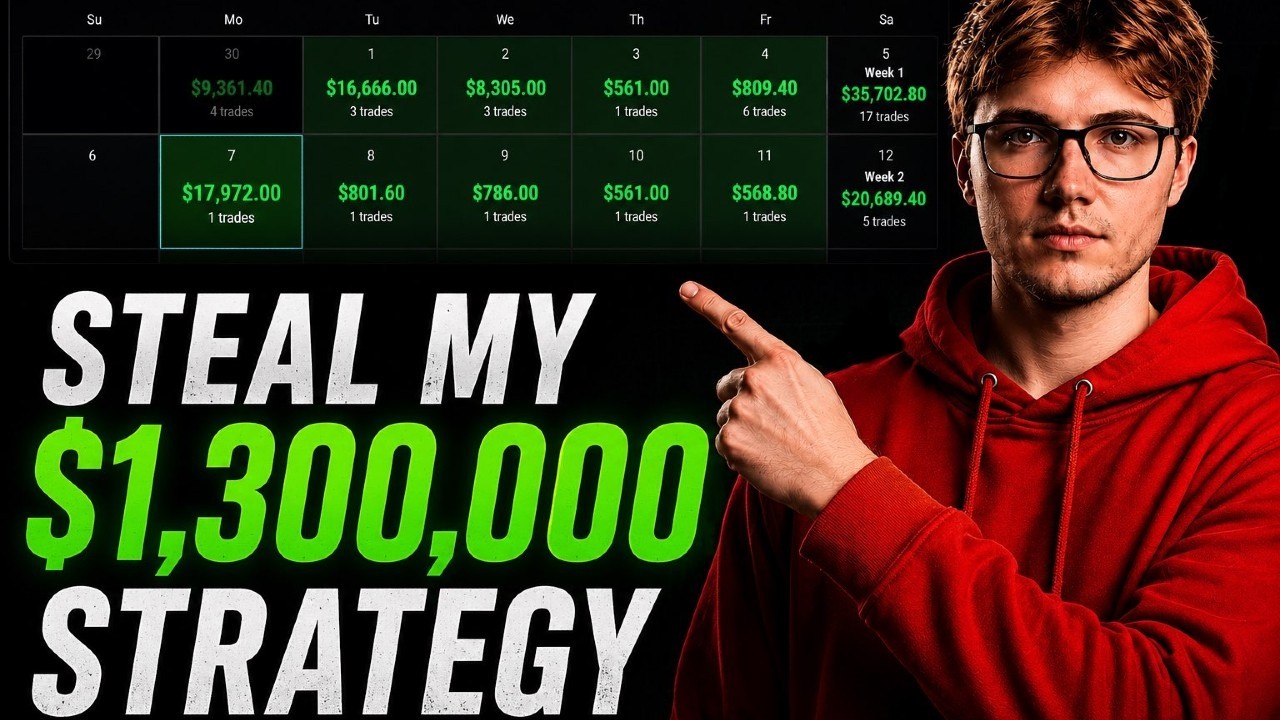
I hope hopefully you can see it, but this number is $47,000 worth of profit in this month. The firm right here is E8 Markets. Uh it is quite blurry. The picture was taken November 1st from my camera roll just for this video.
11:16
Speaker A
Anyways, you can kind of see my risk management minus 3K plus 15,000. 1 2 3 4 5 and this one was 11K. Whatever. Um, but 15K was my profit target.
11:30
Speaker A
15,000. Definitely a lot. And then my risk was 3,000 per trade. So, is that a one to one to five? This is a 1 one.
11:38
Speaker A
This is a 1 to 1.5. So, two things should automatically be sticking out to you about wow these numbers are incredibly different. The first the risk-to-reward. This one's a 1.5. This one is a five. That is so incredibly
11:51
Speaker A
different. If you open up your chart, put that little tool on there to see your riskreward. It is so incredibly different. Second, the dollar sign.
11:57
Speaker A
$1,800 versus $15,000. This one's almost 10 times as much. So, when we're changing things like that, when when our profit target is 10 times more, when our risk-to-reward is almost is like three times higher, we need a different
12:12
Speaker A
strategy. The same strategy is not going to work on both. Not at all. First of all, because this trade needs to run for longer to make more money and second of all, the stop loss needs to be tighter
12:21
Speaker A
because we have a higher risk-to-reward. So in cases like this, it's important to have a strategy that can either work for a bunch of different riskrewards and a bunch of different profit targets. Like this one was probably 300 point trade.
12:32
Speaker A
This one's probably like a 30 point trade. Maybe maybe even 25 points. Depends on how many contracts I use, of course. That's why I built my strategy in the way that it gives me so many different trading opportunities
12:42
Speaker A
throughout the day. If you're trying to make six figures a month on prop firms, you need these to be optimized. $15,000 was the optimal profit target on this account. The reason why they had uncapped payouts. So, there's a $45,000
12:56
Speaker A
payout. This account over here, if I made $45,000 on it, great. But the firm would send me live. in that live account, $0. $4,500 worth of end of day trading draw down. So, if I had this profit target here and applied it to
13:10
Speaker A
this firm, all of that 45K would have been gone and I would have gotten a live account worth $4,500. So, I would have lost $40,000 just by doing that one simple change. So again, I know I keep saying it, but it's extremely important
13:23
Speaker A
to optimize your profit targets and then make a risk-to-reward or like a risk management system that goes best with that as well as a strategy that goes best with that. So that's the example.
13:34
Speaker A
I've optimized a strategy for prop firms. I've optimized the risk management for prop firms. Obviously, as you can see here, it changes different firms, drastically different targets.
13:42
Speaker A
Like this is incredibly different. Now, a few things you need to understand about prop firm trading. Spend a little, withdraw a lot. It's not really going to happen. Don't treat propers like a lottery ticket. Don't expect to spend
13:54
Speaker A
$1,000 and get back $25,000. Those sort of returns are not possible with proper. Treat it more like I'm going to spend $3,000 and from there I'm going to take back 10K. So, it's a you're making money.
14:07
Speaker A
You're making 7K. It does seem like a lot honestly because EVAs are so cheap.
14:12
Speaker A
$3,000. That's a lot of money, but you're making 7K. If you're going to hold a traditional investment, you're going to get 10% a year. That's 300 bucks. Instead, you're making 7K. It's that same sort of investmentminded approach to prop firms that I trade
14:26
Speaker A
with. And you're just going to have to reinvest like a business. 3K to 10K is great, but from 10K, if you basically tripled here, you want to triple again.
14:33
Speaker A
You want to hit 30K. From there, you want to triple again. You want to hit 100K. You might be thinking, $3,000?
14:38
Speaker A
That's a ton of evals, right? If each eval is $100, that's 30 evals. Okay, maybe that's doable across a bunch of sites throughout a whole month. But then when you get over here and it's 30 times larger, how many evals is that? 900.
14:52
Speaker A
How can I trade 900 evals to spend 100k in a month? Well, you don't want to spend 100k in a month. Realistically, you're not going to spend more than 30k in a month, but still, that's 300 evals, right? That's a lot of evals. That is
15:02
Speaker A
going to lead me into the scaling one, which I'll get to in a second. But I hope I convinced you that risk and reward is the most important thing. You can optimize that for the prop firms and then make your strategy work around that
15:12
Speaker A
because this is way more important than the strategy. I promise. You will also have to understand variance. Like with this example here with a five with a five RR trade, I don't know if you can see that, but with a fiveR trade, you're
15:23
Speaker A
going to have a bunch of losing days. Look at that. One, two, three, four, five, six, seven in a row. I lost seven days in a row. So, I lost $21,000 in a row, but I still made 48K on the month,
15:34
Speaker A
and I got a 45K payout from it. So, just understand variance. You can even calculate your variance. So, remember this example I started with up here, 33% pass rate, 33% payout rate. And say your payout's $2,000. That's a pretty
15:45
Speaker A
standard payout u from a from a firm account. You're going to buy 10 emails when on average one of them is going to get to the payout. If you buy 10, say three pass from those three, one's going
15:57
Speaker A
to get to a payout. So, you spent $1,000 to get 10 evals, which $100 per email should be pretty standard. But that one account that got you payout, it's going to give you 2K, which is great. So, you've doubled your money. Remember, you
16:12
Speaker A
can automatically find your statistics, you can find these just by back testing. Back test, but pretend you're in a prop environment. Do your trades, make the draw down trail, have the profit target, have the consistency rules, ju just
16:22
Speaker A
treat it like that. You'll automatically find out if you're going to be successful in prop firms. So, even on this strategy where you know on average you're going to double your money, which is a very good return, each time you buy
16:33
Speaker A
one account, you have a 90% chance of getting nothing. You have a 10% chance.
16:38
Speaker A
So, you have a 10% chance of getting $2,000, which is $200 on the positive side of the expected value. Conversely, you have a 90% chance of getting nothing. And when you get nothing, you lose the $100 eval. So, that's - $90. This is plus
16:55
Speaker A
$110, which is which is great. Okay, so you understand you're going to make money. But again, 90% chance of getting nothing when you buy this account. So, let me do a little bit more math in here. With that 90% chance if you buy 10
17:08
Speaker A
evaluations, your chance of failing every single one and not getting a payout is 35%. So, it is totally possible you could have a very plus EV 2x return on your money and get nothing 35% of the time if you start
17:21
Speaker A
with $1,000. So, please understand the variance. Don't give up the instant one account loses because you need to see out the numbers in the long run. If these numbers that you saw for are proven and are statistically correct,
17:30
Speaker A
you will make money. Now, that leads us to the strategy. As you saw in this previous example, 15K profit target versus 1,800 or even a,000 like drastically different. The reason why I trade fair pricing theory as opposed to
17:45
Speaker A
all these other strategies, two main reasons. Number one, it works 10 to 20 times per day. Okay? If you're trying to make six figures a month, you're not going to be able to do that taking one trade a day. I promise you, not on prop
17:58
Speaker A
firms. You need volume. You need an edge. And you need as much exposure as possible to that edge. You're not going to make six figures a month taking one trade a day. You're going to get 20 trades in per month. And you can even
18:10
Speaker A
check with your expected value calculations back here. How much am I making per trade, right? Just this example here where you spend 1K and you get 2K. It takes two trades to pass the eval. five winning days to get the
18:23
Speaker A
payout. So that's seven trades minimum to make 1K. Okay? And if someone's taking one trade a day, that's 22 trades a month. So if they were doing this, they would make 3K a month. Not bad.
18:35
Speaker A
It's profit, but it is way easier to add more trades if you're getting a positive expectancy like this from each trade. So that's the first that's the first thing.
18:47
Speaker A
I like the strategy because it gives me so many different entries per day. Number two, it is so perfectly optimized for prop firms that it's crazy. Okay, imagine this.
18:58
Speaker A
This right here, this is time. This is the 9:30 open. This is the price. It comes in and then boom, 9:30. I don't know why I drew a line here. This is 9:30. All right, it's going up. Boom.
19:08
Speaker A
Okay, right here. I see an entry. It's going to break structure here. It's going to come all the way down here. I see whatever 200 points of candle possibility to move. I see 200 points.
19:21
Speaker A
Okay. Now, let me give you the same example but on a different day. Same thing. 9:30 here. Same chart. It looks the exact same. Something like this. And then boom, entry criteria right here.
19:32
Speaker A
This day I see 30 points. There is a crazy amount of difference in the amount of points available for this specific reversion. And like I keep mentioning, go back here. I'm going to take this one on the 200 point account. I'm going to
19:45
Speaker A
take this one on the 30 point one. It's perfect. I have so many different profits lined up. Literally every single point value separated by 10. So like 200, 190, 180. I have a prop firm account that statistically the optimal
20:00
Speaker A
sizing for that account's win is exactly 200 points. Maybe 205. And I'm just going to take it on that one. But there's no way I'm going to go for 15K when I only have 30 points. And there's no way I'm going to go for only a,000
20:09
Speaker A
when I have 200 points because I could capitalize on this reversion so much more by taking this account. So with fair pricing theory, we assume the open is fair. This move is unfair and I'm going to revert it. Now let me show you
20:19
Speaker A
the actual strategy in action on evaluations. My evaluations, they're going to be 1 to 1.5 risk-to-reward. The reason for that is eval are minus 2K max loss and they're plus 3K profit target. So it's automatically optimal to do a one to 1.5
20:33
Speaker A
sizing since that's how the evaluation is broken up. And because of how draw down trails, it's just going to make passing it a higher pass rate automatically. So, you kind of have to do it anyways for the 9:30 open. This is
20:43
Speaker A
the opening price right here. This is the fair price. These are all my evals today, by the way. Or not today. This is just a random day from Oh, there's me.
20:50
Speaker A
There's a random day from my strategy video, which is like two videos before this. Now, the entry criteria I use is literally just bias plus displacement candle or breakup structure. If I'm taking a funded again, my strategy is
21:05
Speaker A
optimized for profit. I have biased entries and I take 10 to 20 per day. So look at this. Look at this chart here. 1 2 3 4 5 6 7 8 9 10 11 11 entries in one morning. I stop at 11:00 a.m. So 11
21:20
Speaker A
entries just displacement continuation. Displacement reversion. Displacement reversion. Displacement. Bang. Bang. Bang. They keep coming. More entries.
21:30
Speaker A
more entries except for the first one. They are all directed at the fair price which is the open. So that's my bias. If you're able to capitalize on a bias with optimal risk, optimal profit targets, and get in significant amounts of trades
21:45
Speaker A
per day to where all of your accounts end the day traded, you're going to make six figures a month on prop firms, assuming everything's optimal, just the way I run it. Now, you might be thinking, maybe if JJ has 40 accounts
21:57
Speaker A
and he takes 20 trades per day, he's going to do two accounts at a time. Yep, that's that's totally possible. I'm going to run 40 accounts, but I'm going to take one trade. It's going to be a better trade than mine. It's going to be
22:07
Speaker A
a better trade than JJ, but I'm going to take one trade. I'm going to copy all my accounts together. Okay. Interesting interesting concept to think about. If you're going to take 40 accounts, if I risk $4,000 across, if I risk 4K at once, okay, and
22:24
Speaker A
you risk $100 at once, we're risking the same amount, right? Because you're risking 40 accounts of 100, I'm risking one account of $4,000. Maybe my profit's 8K for a 1 to2. And maybe your profit's $200. Okay, perfect. So, now we're
22:38
Speaker A
risking the same, and our profit targets the same. Sweet. Let me give you another equity curve. Okay, here's my equity curve per account.
22:48
Speaker A
Account lost account passed. Here's your equity curve. Maybe you have a better strategy than me. Maybe the thing is with this small of risk, it is going to take you absolutely forever to pass your accounts. Literally forever. Just think
23:10
Speaker A
about how many times you're going to oscillate. Even if you have a really good strategy, you're just going to oscillate so so so so much. You're never going to get there. Like you're maybe you win like five in a row, which is
23:21
Speaker A
great with a two- risk reward. It's amazing. You're only going to be up 1K.
23:24
Speaker A
Now you're probably going to lose like five in a row and then you're just getting nowhere. It's going to take forever. When you do high risk, high reward on one account at a time, spread out your risk across every account. That
23:33
Speaker A
is how you scale. I'll get into the scaling in a second, but this is automatically way more profitable than copy trading. Also, psychologically, it's way easier to just do one account at a time. One bad loss, one bad streak
23:44
Speaker A
is not going to blow everything because the risk is spread out. So, please don't copy trade. It is not worth it. As soon as you hit 30K a month, you can consider it for the EOS, but just never copy
23:53
Speaker A
trade funded. It's not worth it. It's not going to make you money. Same with these one trade a day strategies. It's going to work. It will make you money, but there's zero chance you can make 100K doing one trade a day. Zero. Even
24:02
Speaker A
if you copy trade it, the only way to have significant returns is to risk incredibly much like 40k and go for 80k across all the accounts. And then 1k is is too much on one account. I know I do
24:12
Speaker A
4k, but it's 4k per spread account. One one at a time. $1,000 on every account.
24:18
Speaker A
If you ever lose four in a row, you just lost every single account that you have.
24:21
Speaker A
If I lose one in a row, I lose my account. But I don't really care because I have 40 accounts, right? So one bad streak, I lose four accounts. If I lose four in a row, if you lose four in a
24:29
Speaker A
row, you lose 40 accounts. So, it just it just makes more sense to run it this way. Now, I forgot to go over this lesson, but you probably know by now.
24:37
Speaker A
Don't trade it like it's a live account. It's not. You need to optimize for the prop firm. And then the lesson here, beat the prop firm, not the market. Your strategy, if you're making a live strategy, good, but please run that on a live
24:48
Speaker A
account. Don't run on a prop firm. It's not going to work. Or maybe it will work, but it's not going to make you six figures a month. Scaling is coming next.
24:55
Speaker A
Like I said, don't put every account at risk at the same time. Don't do that copy trading stuff that people tell you to. It's so bad. You also do need a different strategy and riskreward on funded versus evals. I haven't even
25:04
Speaker A
mentioned that yet. Hold on. Evals, your only goal is to pass the account. I don't care how you do it. You just got to hit 3K before minus 2K. Funded account, your only goal is to maximize your expected value. How much in payout
25:16
Speaker A
and times chance of payout can I get from this account? What is the max I can make my account worth? That is all you need for funded accounts. Now, let's get into scaling. Okay, for scaling, you want to hit 50K a month. You want to hit
25:28
Speaker A
100K a month. Perfect. You will you will need to spend 30 to 40k a month. The best profit from traders that I know that my students are me personally we're getting 4x return are on our investment at the highest. Okay. So the best we can
25:41
Speaker A
do is spend 40k and withdraw 16k. Now that's just based on the prop firm rules. They have to limit winners. They have to send you to a live account. They just have to limit you so their business can stay intact. Obviously it's totally
25:50
Speaker A
understandable. We try and work around that as best we can but obviously never fully right. So at best I'm aiming for a 4x return. At worst, I am aiming for a 3x return. Okay, most of the time it's
26:01
Speaker A
going to lie in between these. And this is 80k a month. This is 120k in the month. The middle of them, 3.5k a month would be 100k a month, which is just what I'm personally aiming for. Always I'm adding more sites. I'm increasing my
26:12
Speaker A
risk, trying new things. Well, not trying new things. But I'm making 100k a month on average. Some months less, some months more. Just depends on when my payouts stack when I get moved to live accounts. But you definitely have to
26:24
Speaker A
understand you need to spend to make you need to spend money to make money. Okay.
26:28
Speaker A
And also when you're scaling 40k it sounds like a bunch. I know $40,000 that is well I don't know why I do that. That is $1,000 40 times for $1,000. That's four evals for 250 if you're on the 150k
26:42
Speaker A
accounts. Also quick thing I forgot to mention. Strategy is kind of the same on the 150k accounts. You need to make a strategy that works for 50k accounts and then you most likely will have to change it for the 150k accounts. But now back
26:53
Speaker A
to this that is four eval,000 and you need 40 sets of that. So you need 160 evals per month to spend 40k. So my goal is not make 100k a month. My goal is how am I going to spend 40k a month. You
27:08
Speaker A
need to break it down. Okay. To make 160 in payouts or we'll do 140. To make 140 in payouts, you need to spend 40k.
27:16
Speaker A
That's going to make you 100k. So now, how am I going to spend 40k? Well, I'm going to do 160 evals for 250 bucks each. And I already know that my trading plan, my EV, my simulations, my variance
27:28
Speaker A
is all going to be on my side. I already know I'm going to make money. Now, I just need to figure out how can I possibly trade 160 evals per month.
27:33
Speaker A
First, make the eval pass or fail as soon as possible. So, high risk, high reward on the evals just to get it done with. Now, from the evals, you know, it's probably going to take you like two to four trades to pass it. Maybe you get
27:43
Speaker A
lucky, you win twice in a row, you can pass it super fast. Realistically, it's going to take like four. Um, but try not to let the eval run longer than four. If we're talking six figures a month here,
27:52
Speaker A
maybe when you're just starting, you can you can risk a bit less, but when you're at scale, don't let the eval take more than four days or four trades. I also do one trade per day on each of my
28:01
Speaker A
accounts. Just makes it easy. So, I need 160 evals each with probably like minimum two trades, but most likely four if we're going to be conservative. Okay, so that's 64 640 trades on evals alone per month.
28:17
Speaker A
Okay, funded is even going to be more because you need winning days for payouts and all that sort of stuff. But just think about evas on 640 trades per month. How are you going to do that with a strategy that takes one trade a day?
28:28
Speaker A
You're not except if you copy trade, which I already went over is super super bad. You shouldn't be doing that. So in order to do this, you need a strategy that executes so many times per day. You need to layer in trades and you need to
28:37
Speaker A
have exposure to a bias. Imagine 640 different evals. Imagine how profitable a 1% bias is. 2% 3%. A small bias. It's going to make you so much money. Even if your entries aren't the best if they're not optimized for a live account. Like
28:52
Speaker A
where there's no point talking about live accounts when you can be making six figures a month on prop firms. Okay?
28:56
Speaker A
Everyone talking about live accounts. Just ignore that. You need a strategy that executes this many times. And personally, you can execute that many times or you can copy trade, but you need to copy trade in a high-risisk approach where your profit targets are
29:07
Speaker A
optimal. Remember, like back over here, those $200 wins, there's zero chance those are optimal. First, it's going to take forever. Second, every time you win, the draw down's going to trail. So, if you're making 2K in 10 trades, the
29:18
Speaker A
draw down's going to trail 10 times. Okay? So, you're losing about 33% of that $2,000 worth of EP. So, automatically, instead of going for 200, if you went for 2,000, you would make $666 worth of expected value. That's
29:29
Speaker A
just something I simulated. Now, let's talk about being more aggressive. I will get back to this one. I'll get back to this one.
29:38
Speaker A
Spreading risk across firms is something I've already talked about. Um, basically you want your accounts to be spread across a lot of firms. You kind of have to do it anyways. Like there's no choice. You can't make 100k a month on
29:48
Speaker A
one firm because they're going to send you live and 150k accounts. I already talked about that. But let's talk about being more aggressive. Now, obviously 640 trades is quite a bit. This is just like stuff I've simulated. 640 trades
30:00
Speaker A
over 30 days, that's about 20, well, I'll say 21 trades a day. Uh, not too many, right? It's not too many. Um, in this example, New York AM took me 90 minutes. Just a standard trading session. I got through 11, I think it
30:14
Speaker A
was. If I copy trade two accounts together, it's going to increase my risk, but I'm going to keep my reward the same on each account. I'm going keep my risk the same on the account. The variance will be higher, of course, but
30:22
Speaker A
it's just something you got to deal with. So, I could hit this target just by copying two accounts together in New York session. It'd be fine. Just remember, don't copy trade and go for these tiny profits. First find the
30:32
Speaker A
optimal risk and the optimal reward for every single trade you ever take based on the profit rules and then copy trade two of two of them together if they have the same one. So you need to be more
30:40
Speaker A
aggressive. You can get a bunch of trades in, but you need a strategy realistically that's going to print money like this one is. Next, adding new firms. Adding new firms is something that I do personally because I'm constantly being moved to live accounts.
30:52
Speaker A
There's not really much to talk about about adding new firms except for the firms that I'll just mention like all the firms I trade with. Let's talk about consistently constantly moving to live accounts. So, if you run up a 50k sim
31:02
Speaker A
balance, the prop firm's looking at you like, "Oh [ __ ] I'm going to have to pay this guy 40k over the next few days or the next few months because he's got a bunch of money in his accounts. He's
31:10
Speaker A
just going to get his winning days. He's going to take a bunch of payouts. Oh [ __ ] I don't want to do that. I'm going to move him to a live account. Congrats.
31:16
Speaker A
You've been moved to a live account. You're given five accounts with $0 balance." They have $4,500 end of day draw down, which is the same as the funded account that you just grew to $10,000 in profit. Okay, thanks for
31:29
Speaker A
nothing. I guess you just need to be aware when the firm's moving to live, how they move you to live, what that live account looks like, and then you could purposefully hit those live triggers to purposely go live and start
31:38
Speaker A
trading that live account or understand that, oh [ __ ] if I move live, I'm going to lose 40k. I don't want to go live, so I'm not going to hit that live trigger.
31:45
Speaker A
Sometimes it is optimal to go live, sometimes it's not. Also, you can optimize the expected value of the live account because these also have specific rules. It's not like they give you a 40k account. If you ran up 40k and same, you
31:56
Speaker A
get a 40k live. Trade it how you want. It's not how it works. They delete everything. You get a $0 account. They give you bonuses. They give you trailing draw down, of course. They give you I don't think they give you consistency
32:06
Speaker A
rules actually, which is which is nice, I guess. But they give you a bunch of rules. Same thing as the eval. When you're given rules, you optimize around them. That is kind of the only thing that slows down making money on prop
32:16
Speaker A
firms is if you're a big winner, you have to be limited at some point, which is fine. Just understand it, be ready for it, and optimize the best you can around it. Which leads me to the last point. adding new firms. Uh here is all
32:30
Speaker A
the firms that I am currently or actually these are all the current firms. Topstep trade of eight I'll go into in a second. Trade of eight I just trade on them with like 10 different firms. YRM E8 crypto fiver gounded
32:42
Speaker A
futures tradeify breakout level up funded onyx alpha. This is alpha funded trader next prop. This is my copier if I was to use one which I don't yet. uh on trade of eight there's so many E8 funded next my funded futures blue sky blue
32:58
Speaker A
guardian futures elite hole of prime the trading pit there's probably two more I can't think of right now but oh tradeify lucid there's more anyways I'm on so many different firms and I play it chill on some firms I run up huge balances on
33:10
Speaker A
other firms like this each firm has a different strategy okay because it's optimal to do a different thing on different firms because they have different rules remember if I was to make 45k on these accounts, I'd get none
33:21
Speaker A
of it because I get sent live. I'd make 45K and I would get nothing. So, just optimize. Different firms, different rules, different optimizations. So, keep the same consistency you've been doing.
33:30
Speaker A
If you can hit 50K a month, just keep the same consistency, add more firms, learn more about the live accounts.
33:35
Speaker A
That's where most of your EV is getting dumped, and you can make six figures a month on prop firms. Now, I know it's a long video, but I have worked with traders at every single stage. 10K a month, zero a month, 30K a month, and
33:47
Speaker A
I've gotten some students up to 100K a month like you've seen in my other videos. If you would like to work with me, I do personally believe I would be able to get you to the next level. So,
33:55
Speaker A
if you're interested, there is a link in the description. But other than that, hopefully you learned a lot from this video. Hopefully, there's a lot of value. I appreciate you guys watching and I'll see you in the next
Topics:prop firmstrading strategyrisk managementexpected valuepass ratefunded accountsscaling tradingJJ Simonprop firm payoutsquantitative finance

Get More with the SozAI App

Transcribe recordings, audio files, and YouTube videos — with AI summaries, speaker detection, and unlimited transcriptions.

Or transcribe another YouTube video here →