Skip to content

Why You Pass Evaluations But Never Get A Payout (Ep. 11)

Learn why traders pass prop firm evals but fail to get payouts and how to optimize trading strategies for funded accounts.

Key Takeaways

  • Optimize eval trading for pass rate, funded trading for expected value.
  • Maintain consistent performance and understand variance to avoid premature quitting.
  • Avoid revenge trading as it increases variance without improving expected value.
  • Use static, statistically optimized profit targets and stop-losses based on prop firm rules.
  • Spread risk across accounts and follow a disciplined, emotionless trading strategy.

What the video covers

  • Many traders pass evaluation accounts but fail to secure payouts due to different trading approaches between eval and funded accounts.
  • The video explains the importance of maintaining consistent performance and not increasing pressure on funded accounts.
  • Traders should optimize for pass rate on evals and maximize expected value on funded accounts, which involves different goals and strategies.
  • Understanding variance and avoiding revenge trading are critical to sustaining funded accounts and reducing risk.
  • A proper risk management system with statistically optimal profit targets and stop-losses tailored to prop firm rules is essential.
  • Static profit targets and stop-losses outperform discretionary ones in prop trading environments due to fixed rule sets.
  • The presenter shares his own payouts and trading strategy to illustrate emotionless, strategy-driven decision making.
  • The video includes a detailed walkthrough of trades over a week, demonstrating how to apply the strategy in real market conditions.
  • The importance of spreading risk across multiple accounts and avoiding impulsive trades is emphasized.
  • Viewers are invited to learn the exact mathematical system used to achieve over $1.85 million in prop firm payouts.

Answers

Questions about this video

Why do traders pass prop firm evaluations but fail to get payouts?

Traders often trade differently on funded accounts compared to evals, applying more pressure and changing their performance, which reduces their chances of payouts. They also fail to optimize for expected value on funded accounts.

What is the difference between optimizing for pass rate and expected value?

Pass rate optimization focuses on reaching a profit target before hitting a loss limit during evals, while expected value optimization on funded accounts considers both the probability of payout and the size of the payout to maximize long-term profitability.

Why is revenge trading harmful in prop firm trading?

Revenge trading increases variance by adding more positions impulsively without improving expected value, leading to higher risk of blowing funded accounts, especially if the trader does not have a large enough bankroll.

Full Transcript — Download SRT & Markdown

00:00
Speaker A
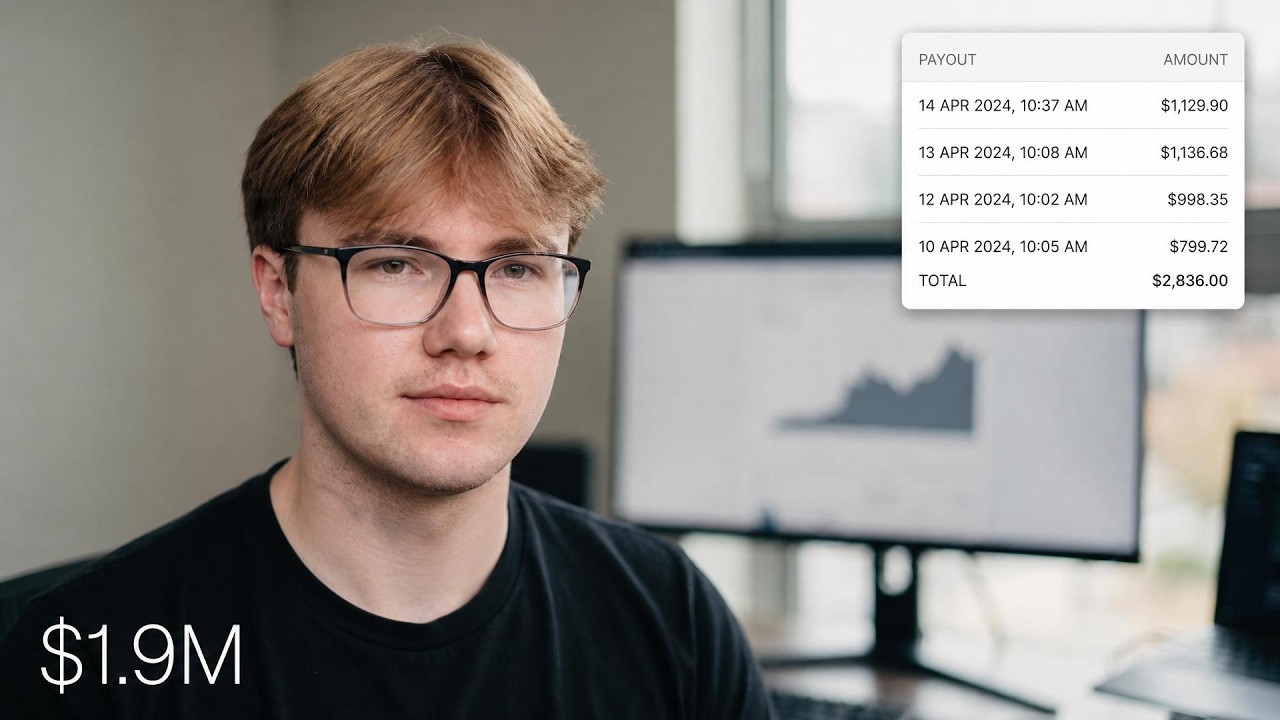
Most of you watching this can pass evals all day long, but you can't get a payout. I'm going to show you exactly why. In the past two weeks, I received another $36,000 worth of payouts. Here were the payouts from Rise. Here on
00:11
Speaker A
Futures Elite, I received two payouts for about $3,600 each. And I also received $1,660 on Riseze this month so far. Not showing you this to flex. I'm showing it to you because I'm going to break down the exact reason why I'm able to do this and
00:24
Speaker A
you most likely are not. As soon as it loads, I'll get into the video. All right. So, you are most likely trading evals and funded accounts differently.
00:31
Speaker A
First, you're probably putting more pressure on your funded account, which is going to decrease your performance by just a little bit, but that little bit might have a ton of expected value. So, make sure that your performance does not
00:41
Speaker A
change when you switch from the eval to the funded account. Do some backtesting and prove to yourself that you are profitable on the profit from environment before you even touch a funded account. Next, you should have different goals on eval versus funded
00:50
Speaker A
accounts. The reason why on an eval, your only goal should be to make $3,000 before losing $2,000. Most people don't even optimize for this alone, but that's the first thing that you should do. Most likely be trading a 1.5 risk-to-reward
01:02
Speaker A
just because a 1.5 is a $2,000 to $3,000 limit. Then once you get to the funded account, you need to trade something completely different. Funded, you need to maximize your expected value. Your expected value on a funded account is
01:13
Speaker A
not your chance of reaching 3K before minus 2K. That's your pass rate, and that's all you should optimize for in the EV out. But when you get to the funded account, you want to maximize your expected value, which is basically
01:22
Speaker A
the probability of getting a payout multiplied by how large that payout is. So now that you've optimized your eval for your pass rate and you've optimized your funded account for expected value, once you get to that funded account, you
01:31
Speaker A
actually have to be consistent. If you are not consistent, well, some days you're going to do well, other days you're going to do bad. And you're going to tell yourself that's normal. That's just something built into trading. Some
01:39
Speaker A
days are going to be good. Some days are going to be bad. To be honest, that's mostly variance. And if you don't have a good understanding of variance, then you're not going to know if your strategy actually works. You're not
01:46
Speaker A
going to know if your approach and your risk actually works. You could obviously just quit when you have one down period.
01:50
Speaker A
And then you're never going to realize the positive growth that you could achieve. You have to understand variance. You have to understand the statistical likeliness of losing accounts on evals and the statistical likeliness of losing accounts on funded accounts because you do have a
02:00
Speaker A
probability of a payout. You technically can know that one minus the probability of your payout is the probability of not getting a payout on the funded account.
02:06
Speaker A
So you have to be consistent. You have to understand variance and then hopefully spread out your risk across all of your accounts. Next, revenge trading. Lots of people are revenge trading basically adding more positions and increasing their variance. That is
02:19
Speaker A
something you should never do. You should never copy trade unless you're making more than $10,000 a month. And this is the number one reason that funded accounts die. You are deciding, actively deciding to increase your variance when your expected value is
02:30
Speaker A
staying the same. That is something that you should not do pretty much ever. Maybe if you're doing more than 10K a month, then it would be ideal to optimize your variance just because you're able to replace losing accounts
02:39
Speaker A
because you have enough bankroll to do so. But absolutely skip the revenge trading. It is minus EV. Even though the EV doesn't change, you are increasing variance and that is something that you should not be doing. So please do not
02:48
Speaker A
add more positions. Please do not blow funded accounts just through revenge trading. It is not going to get you anywhere. The loss is much, much larger than the possible gain even if expected value is staying the same. Uh, assuming
03:00
Speaker A
that you are a breakeven trader when you are placing random positions on tilt. Next, you likely have no risk system. This is the most important thing with proper trading just because you are given a specific set of rules that you
03:11
Speaker A
have to abide by to pass the eval consistency $3,000 targets. Some have winning days and then consistency obviously don't make more than half in one trade. They have max loss limits.
03:20
Speaker A
Some accounts have daily loss limits. Then we get to the funded account.
03:23
Speaker A
They have payout rules. So there are a ton of rules that you are given. And if you are given a ton of rules, then there must exist a statistically optimal profit target and a statistically optimal stop-loss to fit within these
03:33
Speaker A
rules. So when you're given five different rules, you could try a bunch of different sizes for your take-profit and stop loss, but one of them must be optimal to fit within this environment and generate the most expected value.
03:43
Speaker A
You need to find that value for yourself. You need to find the most statistically optimal profit target and the most optimal risk per trade for your stop-loss sizing. And most likely, you're going to be trading with a static
03:53
Speaker A
one rather than a discretionary one. If you are making your profit target $800, if the market is showing you an $800 target to your point of interest, then a different trade you're going to do 535 because it's that far to your profit
04:05
Speaker A
target. This is automatically not optimal. Please never do this on a profit environment. You are given a specific set of rules and if you are adapting your strategy and your profit targets to what the market is
04:15
Speaker A
showing you, the prop firm is going to capitalize on that because these are going to fit differently within said rule set. So find which static one gives you the highest pass rate, find which static one gives you the most expected
04:24
Speaker A
value on a funded account. If you'd like to learn from me and find out exactly how I've done more than $1.85 million worth of prop firm payouts, get my exact mathematical system, then click the top link in the description and apply to
04:34
Speaker A
work with me. I'm going to go over the statistically optimal take-profit stop-loss for every single prop firm, every single status in your prop firm, meaning if you're on an eval, if you're on a funded, if you've taken a payout,
04:43
Speaker A
what rules you're given, and how to optimize expected value for that environment specifically. Basically, no more discretionary profit target stop-losses. It is all going to be static because we are choosing the statistically optimal value given our specific rule set and the expected value
04:54
Speaker A
of our account. Now, I'm going to show you what one week worth of emotionless trading strategy-driven decisions look like. Obviously following my specific strategy here were all the trades that my strategy would have followed last week. Starting on Monday with the market
05:06
Speaker A
open, we have a nice green candle with a wick rejecting shorts, displacement and break of structure long. Opening candle is 42 points. So I would take a trade for 76 points as my profit target and using 50 points as the stop loss. After
05:18
Speaker A
that, I'd be looking for reversions back towards the market open. Unfortunately, this is too close. The first entry we would get off displacement would possibly be this candle here. You getting only 14 points in your favor. So remember, like I just said, if you have
05:31
Speaker A
an account that needs near 14 points of a profit target, this would be a perfect trade to do. Unfortunately, most of mine are realistically needing more than 30 points. So this would be a little bit too close for me to take a trade. After
05:40
Speaker A
that, looking for more reversions back towards the open off of break up structure or displacement. First entry
05:51
Speaker A
a target which obviously this is my directional bias of towards a fair price which is the market open then some people would decide I'm going to put my take profit at exactly 43 points because that is exactly where I think the price
06:02
Speaker A
is going to go based on my strategy and then maybe I'm going to put my stop loss below this low. That's a good thing to optimize when you're trading on a live account and you're maximizing for your specific win rate and optimizing your
06:10
Speaker A
profit versus your loss. However, on a prop from environment, like I said, you need to follow the rules and you need static numbers. For me, that static number is 38 points of takeprofit and 25 points stop-loss on the evaluation.
06:21
Speaker A
Obviously, funded accounts, it changes, contracts change as well, but this is going to be a pretty standard risk-to-reward for funded accounts. So, I would take this first trade and then after that, next displacement we get would be here back towards the open. And
06:34
Speaker A
then you get a nice breakup structure here that you could consider layering in another position. Then another nice breakup structure of this breaking this.
06:40
Speaker A
But this one's much closer. So maybe I'd go for 19 points, which is half of 38, but double the contracts that I take because the most important thing is keeping my static profit target the same. There's a few more static 19 point
06:52
Speaker A
trades that you could get in here. This one's a very weak one, but nonetheless, something that you could take if you're trying to be aggressive. Same with this one. After that, market seems to move away from the open a little bit too far.
07:02
Speaker A
Could possibly get in this, but I usually am done trading after 11. Next PM session, do the same exact thing. I don't really trade PM session just because I'm able to trade all my accounts in the A.M. I will trade the 6
07:11
Speaker A
PM open and the Asian open sometimes. For the 6 p.m. open, I'm just doing a continuation and then one reversion on this one would look something like this.
07:19
Speaker A
There's no volume here. So, likely be going break even when Asian session is about to open just because it did not make the initial unfair continuation move that you'd expect. Then Asian open, same thing. Wick rejecting longs. Nice
07:30
Speaker A
break of structure short. seems fine for a continuation short, but unfortunately no volume in this direction back towards 9:30 of that morning. Probably no trades in the Asian session. Just seems a little bit too close to the opening
07:41
Speaker A
price to get anything in. Next Tuesday, New York A.M. opening candle is 14 points. Wick rejecting longs and it breaks structure short. This would be a perfect trade to take continuation shorts on for a 38 point take-profit.
07:54
Speaker A
Barely missed that one, but that's fine. On to the next one. Looking for reversion back towards the open. You get another nice 38 point trade here with a 25point stop. Now just looking for more trades back towards the open. You got a
08:04
Speaker A
nice candle here displacing the previous one and a wick rejecting longs. That is a perfect one to send for 19 points back to the open. This is a little bit too close for reversion. This one is another perfect one to send for 19 points. Then
08:15
Speaker A
another one here for probably 38 points just because it's a little bit farther away. Perfect. Then final displacement would be here for another 38 point trade after that. No displacements in here.
08:25
Speaker A
Nothing in here. Next one we get would be here. And then obviously when it's trending in your favor during a reversion, it is in your favor to be layering in positions if you as you have subsequent displacements or breakup
08:34
Speaker A
structures down in your favor. So layering positions while it's moving in your favor with the trend in a reversion towards your bias. Unfortunately did not have a pretty good start to this day, but 1 2 3 4 5 6 7 8 9 only 10 trades in.
08:48
Speaker A
I'm usually trying to get through more than 10 in an A.M. session. So I will trade past 11:00 a.m. if I'm not able to get all of my trades in during the AM session. So likely would be taking stuff
08:57
Speaker A
down here, breakup structure here, breakup structure here, and then another one here, another one here. Layering in positions as it is breaking structure down in your favor is going to be very plus EV for you in the long run. Also,
09:08
Speaker A
these are for EVELs. All right, every EVAL I take is going to be 2538 or 5076 or 12.519.
09:15
Speaker A
And then funded accounts are going to be much different. Unfortunately, it would be so easy if I could just trade a 1.5.
09:20
Speaker A
Same thing on every funded account, but that is nowhere near optimal. This is pretty optimal for an eval, but funded account absolutely not. Your funded account is worth a different amount of expected value at different points in its journey. If it's new, if it's in
09:31
Speaker A
profit, if you're taking payouts, if you're getting moved to a live account soon, very different expected value through different points in your funded accounts lifespan. So, I'm trading a different risk-to-reward and I'm trading a different static dollars loss, dollars
09:42
Speaker A
take profit based on that as well. Um, so trades can sometimes go for super long, trades sometimes go for super short, and sometimes even they can go for 1.5, which is the same as the Eval, but very rare case. Next 2 p.m. open.
09:53
Speaker A
I'm not trading it, but usually just looking for a continuation then a reversion. Now 6 p.m. open. I haven't been trading as much this week since the volume's been pretty low. But pretty much same concept as usual, just taking
10:04
Speaker A
an opening continuation. 6 p.m. you can obviously do the 19 take profits instead of the 38 point take-profits just cuz there's a lot less volume. If you do the 38 once, make sure to go break even, especially when it breaks structure
10:15
Speaker A
against your position. Next 8 p.m. open. pretty much no continuation since it's very choppy and maybe not even a possible reversion during this session just because it's too close the entire time. Seems like I entered one here actually. So, this would have been a
10:26
Speaker A
fine reversion for 19 points, but pretty much the only trade. So, when the Asian session gives absolutely nothing like that, we're going to have to be pretty aggressive in the New York AM session of this day. So, I will show you exactly
10:37
Speaker A
how to do so on this Wednesday. All right, assuming the open is fair, taking continuation shorts off the opening candle using 5076 just due to the size of the opening candle. This trade would be losing unfortunately. And when it
10:49
Speaker A
displaces long against you, you could exit and then send something back long. The only problem is you'd be exiting down like a quarter or a third of your profit or of your optimal stop loss. So, that can kind of mess with things. Uh,
11:01
Speaker A
but it is definitely something that you could consider after that. Looking for reversions back to the open. Midcandle entries work as well. The only time I'd enter mid candle is if I'm seeing 38 points off this candle and I need to get
11:13
Speaker A
in here. I can't let it go past this. Or else if I enter here, it's going to be going too far past my profit target. I usually like to have 80% of my profit target in my favor towards the open,
11:23
Speaker A
which is the direction of my bias, and then only 20% or less on the other side of it because once it switches to the other side, the bias would be short and you don't want to trade against the
11:31
Speaker A
bias. So, you can consider midcandle entries sometimes as well. After these trades, I would be looking for trades back towards the open. For some reason, I took a short here and lost most likely. Not really sure why I did that,
11:42
Speaker A
so ignore that. Um, after that, here were some midcand entries that I tried. Just three of them. Um, trying to get in midcand displacement, displacement. This one was forming a huge displacement and then I got in with a nice retracement,
11:54
Speaker A
but unfortunately it closed red. So, it's a little bit of a weaker trade, but I'm fine taking weaker trades on EBL since they're worth a lot less than funded accounts. Basically, just looking for reversions back towards the open.
12:03
Speaker A
Ignore this as well. I should not have done that. Then after that, taking more reversions here, off displacement here, and then displacement here. Break a structure here. And then ideally layering in trades as it's moving more in my favor. Not sure why it's not
12:15
Speaker A
marked out. I definitely did something like that. Then after 11, I'd only take positions for reversions. So only looking for shorts after 11. Just trading in the direction of reversion with the trend. So I need to wait until
12:25
Speaker A
the trend switches to be in my favor, which would be right here during the second break of structure. And then more 38 point trades on its way back down towards the open. Wednesday 6 p.m.
12:33
Speaker A
session continuation short at the close of this candle would be perfectly fine to take. After that, looking for reversions back towards the gap being filled, which barely was not filled. So, just looking for reversions in that direction because the gap is really easy
12:47
Speaker A
way to mark out a higher time frame bias. You got a nice displacement candle here, 50 points in your favor. So that's it's pretty large amount for 6 p.m.
12:55
Speaker A
probably be going for 38 here and then layering in positions when it breaks structure here when it breaks structure here and then when it breaks structure here. So multiple layers in this direction. This one would lose. So would
13:06
Speaker A
this one maybe then when Asian session opens you get a nice huge red candle breakup structure reversion to 6 p.m. A+ trade. Uh this is one of the best trades that you can take with my specific strategy just because you're assuming
13:15
Speaker A
fair price would be down here or the bias for reversion would be down here.
13:19
Speaker A
Plus opening candle is red and break of structure. So you're getting a continuation and a reversion in one. So very strong to take trades like this.
13:25
Speaker A
After that, there's another move up. You could take more reversions back down towards the open off break of structures would be totally fine. Then New York A.M. Let's see if we can be super aggressive on this day. Or we wouldn't
13:36
Speaker A
have to be super aggressive, mildly aggressive just since Asia recession did give quite a few trades on the opening candle. You would take longs definitely and unfortunately lose that one. But it's fine. After that, looking for reversions back to the open. Here we get
13:49
Speaker A
a nice displacement candle. So, this one would be great to send back down towards the open. Most likely doing a 38 point, maybe a 7650 just cuz there's enough points in your favor actually. So, something you could consider there. Um,
13:59
Speaker A
and then barely lose that one. But after that, looking for a few more trades.
14:03
Speaker A
Here's a good entry here. And then layering in positions as it breaks structure in your favor once here and then again as it breaks structure in your favor here and then one final one where it breaks structure here. So,
14:13
Speaker A
pretty good reversion there. After that, another move up. Wait for a displacement which you get here. And then another one here. Break of structure here. And more displacements here. Just again layering in positions while it's trending in your
14:26
Speaker A
favor. And then Trump tweets. The day is kind of over after this. If you want to trade, trade with the trend, especially after a tweet. Now 6 p.m. of that day specifically. 2 p.m. I don't really trade, but just looking for reversions
14:37
Speaker A
short back to the consolidation after the tweet. Now 6 p.m. in Asia session continuation, but go break even because it basically stops the unfair move down by breaking structure up. Then you can have a quick trade back towards the 6
14:48
Speaker A
p.m. open if you ever needed nine points on an account. That would be a good one to take it on. Asian open taking a probably long because the opening candle is green and a wick is rejecting shorts.
14:57
Speaker A
So just take a continuation off the breakup structure here. 19 points is probably ideal just because there's basically zero volume in this session.
15:03
Speaker A
As you can see, it only moves like 10 points away at most. Then looking for reversions. So, one here, here, layering in. Same thing here. Multiple accounts being layered in. And then this seems to be an overnight trade that I took and
15:14
Speaker A
did not win. London session, I don't trade obviously because I'm asleep. But if you want to trade, it's the same concept, just continuation of the open and then looking for reversions. So, not a not a good overnight session, but New
15:25
Speaker A
York session was great. I bought quite a few accounts because I was going to trade with four new prop firms that I'm testing out. Basically, I just let my students know if a new prop firm comes out, I'll test it. If they pay me, then
15:34
Speaker A
I'll recommend it to them and show them how to optimally approach it. But anyways, we have news and news is the strongest news reversions are the strongest trade of mine just because we are expecting that news is going to be
15:45
Speaker A
priced in and this huge move down is going to be unfair. So, I'm looking for reversions. First entry here was off displacement. Breakup structure is a little bit of a stronger entry, but they both would have lost at the same time.
15:55
Speaker A
So, nothing you can really do about that. Definitely seems fine to be taking this. After that displacement here, you get a break of structure here. you get another break of structure up here. So, multiple entries that you could have
16:05
Speaker A
taken back towards pre-news price on the open. Continuation shorts would be a little aggressive. If you were not in this long position, then you could take a continuation short, but most likely not just because we're waiting for it to
16:16
Speaker A
revert to pre-news price. Nice displacement here on the open. Maybe you win, maybe you don't. Obviously, depends on your profit target specifically. Um, again, most important thing is that you're trading with a bias. Trading it back up towards pre-News. after it hits
16:26
Speaker A
pre-news and it breaks structure short and this place is pretty strongly short. I would just send some trades back in towards the open since news did open at the high of like the past few weeks. So could always have opened slightly
16:35
Speaker A
unfairly. Most important thing is the bias. Bias plus optimal risk and profit target sizing within the profit rule is going to make like infinite money. So looking for shorts back to the open. You got a nice displacement break of
16:45
Speaker A
structure. Another displacement here. Break of structure here. Displacement here. More trades just back towards the open. Layering in positions when it's moving in your favor. after that one attempt at longs or two attempts at longs back to the open. Um, and then
16:58
Speaker A
here's where I was trading more accounts just because I was not done with my accounts. So, I do go past 11. I'll only trade with the trend in a reversion past 11:00 a.m. Eastern if I'm not able to
17:08
Speaker A
get all of my accounts done in the A.M. session just because I have quite a few accounts, especially when I add new prop firms. I buy like 20 20 accounts with them. You got a nice trend reversal reversal here when it break structure up
17:18
Speaker A
and then another one here and then consecutive breaker structure just layering in positions in your favor.
17:22
Speaker A
Same thing with 2 p.m. session. 2 p.m. opens slightly green and the higher time frame bias is to revert this most recent move down plus come back towards the open. So you get quite a few trades in here. This is a longer account trade
17:32
Speaker A
back up towards the open. Um and then eval breakup structure boom boom multiple breakup structures up. Then at Friday take an reversion end of day on Friday usually because institutions are exiting positions going into the weekend which will create an unfair move that
17:46
Speaker A
you can revert pretty easily. All right. So, if all of that made sense, sizing everything for the profit specific environment, and you would like to learn from me exactly how I do that using math, expected value stuff that I
17:55
Speaker A
studied in college when I got my degree in quantitative finance, then there is a link in the description to apply for the mentorship where I will teach you everything I know about properform trading and proper specific optimizations. So, if you're interested,
18:05
Speaker A
apply there now. If not, I'll see you in the next
Topics:prop firm tradingevaluation accountsfunded accountstrading strategyrisk managementexpected valuevariancerevenge tradingprofit targetstop loss

Get More with the SozAI App

Transcribe recordings, audio files, and YouTube videos — with AI summaries, speaker detection, and unlimited transcriptions.

Or transcribe another YouTube video here →