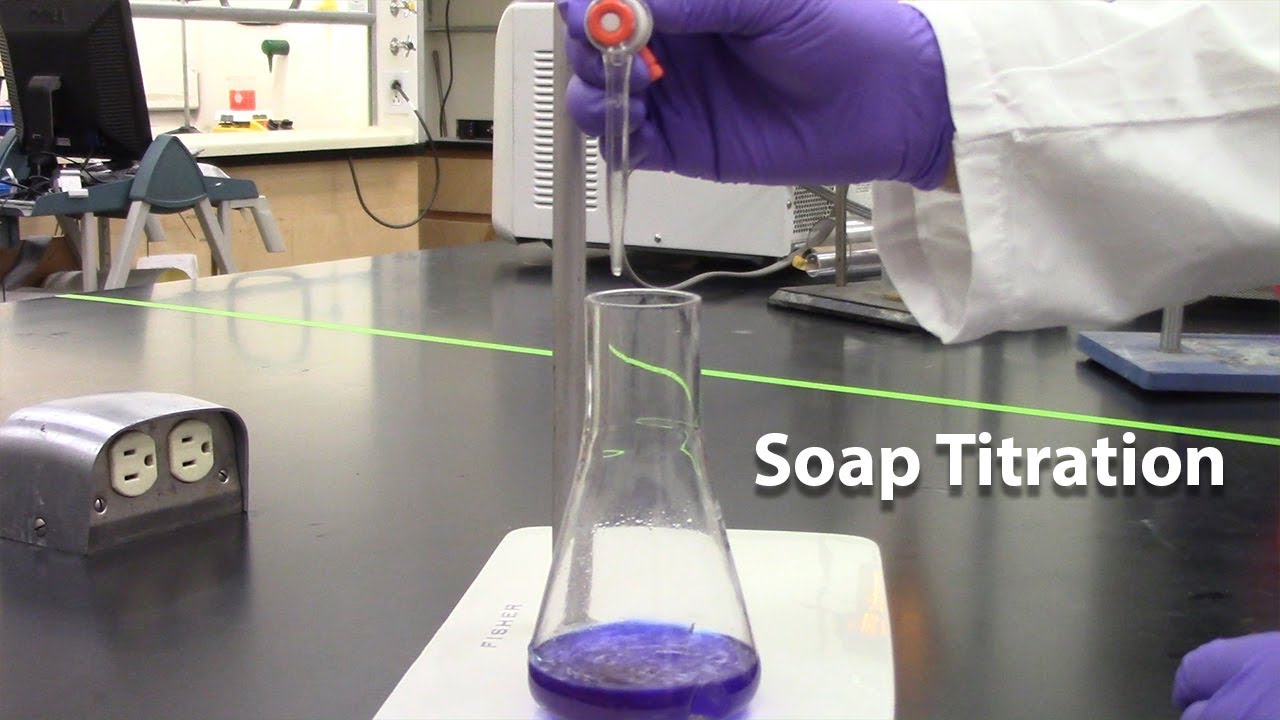
A hands-on demonstration of the soap titration test for biodiesel, using isopropyl alcohol, bromophenol blue indicator, and dilute HCl to estimate soap content in parts per million.
Key Takeaways
- The soap titration is a simple, low-cost way to estimate soap content in biodiesel.
- Bromophenol blue acts as a visual endpoint indicator, changing from blue to yellow.
- Measured acid volume multiplied by 304 gives an approximate ppm soap value.
- Preliminary checks of the solvent's pH help ensure accurate results.
What the video covers
- The video demonstrates a soap titration test on freshly processed biodiesel to measure residual soap content.
- Materials: 100 ml isopropyl alcohol, 0.01 normal hydrochloric acid, bromophenol blue indicator, and pipettes.
- 10 ml of the biodiesel sample is dissolved in the isopropyl alcohol.
- A few drops of bromophenol blue are first added to the alcohol to confirm it is not severely acidic or basic, which could skew results.
- Bromophenol blue stays blue while soaps are present and turns yellow once the soaps are neutralized by the acid.
- The hydrochloric acid is added slowly while stirring, and the presenter records the volume needed for the color change.
- In the example, about 11 ml of acid was required to reach the endpoint.
- The result is calculated by multiplying the milliliters of acid by 304 to approximate parts per million of soap.
- The example sample measured approximately 3,300 ppm soap.
- The test provides a practical quality-control check for biodiesel producers.
Chapters
- 00:00Introduction to the biodiesel soap titration
- 00:23Materials and reagents needed
- 00:39How the bromophenol blue indicator works
- 01:07Preparing the isopropyl alcohol solvent
- 01:47Adding the biodiesel sample and indicator
- 02:35Titrating with hydrochloric acid to the endpoint
- 03:22Calculating soap content in ppm
Full Transcript — Download SRT & Markdown
Speaker A
[Music] All right. Now, we're going to do a soap titration on biodeiesel that was recently processed. To do this soap test in the easiest manner, we typically start out with 100 ml of isopropyl alcohol, 001 normal concentration of hydrochloric
Speaker A
acid, and we dissolve 10 ml of the biodeiesel into our isopropyl alcohol. Some of the lab instruments that are pretty handy are the pipet. Uh you could could possibly use syringes, but this is so convenient. Um we recommend that you
Speaker A
use these and you use bromopenol blue as well. The basic idea idea behind the soap test is that as long as there are soaps in the biodeiesel that's dissolved into the isopropyl alcohol, the bromephenal blue indicator will be blue in this solution.
Speaker A
As we slowly add hydrochloric acid, it'll break down those soaps and when all the soaps are gone, this solution will become acidic and then the bromeopenol blue will turn to a yellow color. And so we're going to take
Speaker A
measure how much hydrochloric acid it takes to do that and that will give us a measurement of the level of soaps in the [Music] bio. I just added a couple drops of bropenol blue to make sure my isopropyl
Speaker A
alcohol wasn't severely acidic or basic. That could possibly skew the results. We're going to dissolve into that uh 10 ml of the fuel that we're going to test.
Speaker A
So here we're introducing the 10 ml of fuel to the isopropyl alcohol where it's dissolving in there. Make sure we get every last bit in there. Our next step is to add around 15 or 20 drops of bromelphenol blue. This is an indicator
Speaker A
that uh right now it's blue and it shows that there's uh still soap present. So we get a fresh clean pipette. We get our 01 normal solution of hydrochloric acid which will break down the soaps that are in here.
Speaker A
and we measure exactly how much of this acid it takes to break down the soaps and turn this back to a yellow color.
Speaker A
So, we start off with 10 ml of the hydrochloric acid solution and we slowly drip it in there. This uh is stirring constantly while we're doing this so that it gets a good homogeneous mixture.
Speaker A
Almost there. It's sort of greenish. So, that took 10 milliliters. Looks [Music] like about 11 ml does the job.
Speaker A
So we put in enough hydrochloric acid to get this to change color. It was right about 11 milliliters. And we just remember one simple calculation. We multiply the milliliters of hydrochloric acid by 304. So here we have 11 *
Speaker A
304 and that equals the approximate parts per million soap in our fuel. So, this sample has approximately 3,300 parts per million.
Speaker A
[Music] [Music] So, Heat. Heat. [Music] [Music]
Topics:biodieselsoap titrationsoap testbromophenol bluehydrochloric acidisopropyl alcoholfuel qualitytitrationbiodiesel testingppm
![Snape Notices Your Scars ASMR [Self Harm] [Comfort] [Concern] — Transcript](https://i.ytimg.com/vi/j0Y79ELOXzk/maxresdefault.jpg)


![Ranking EVERY Gaming Laptop of 2026 [TIERLIST] — Transcript](https://i.ytimg.com/vi/RUK5FPZ5p2I/maxresdefault.jpg)