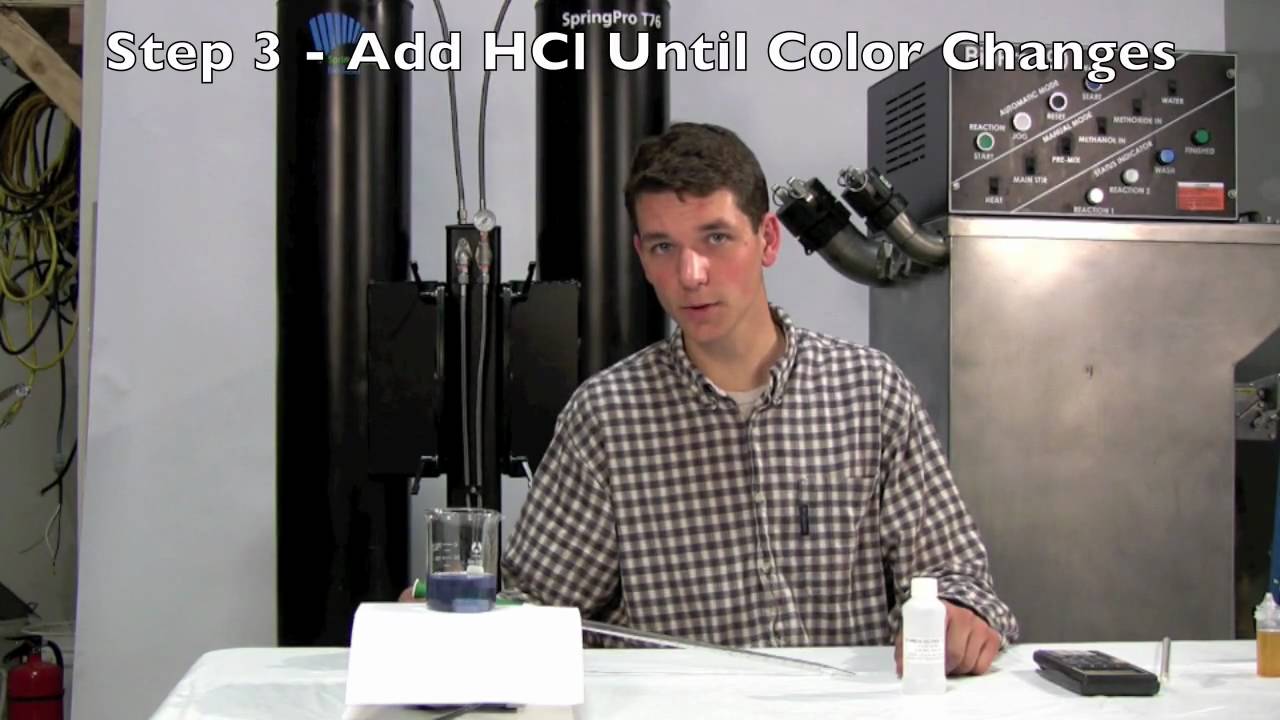
University of Idaho biodiesel lab guide to soap titration: measuring residual soap in biodiesel using acetone-water solvent, bromophenol blue indicator, and HCl titrant.
Key Takeaways
- Soap titration is essential quality control before using biodiesel in an engine.
- Sample size and titrant strength should be matched to expected soap levels.
- The bromophenol blue endpoint (blue to yellow) indicates all soap has been split into fatty acids and salt.
What the video covers
- Soap forms in biodiesel production from reaction of free fatty acids in feedstock with the base catalyst, and must be reduced before use in an engine.
- Soap titration is the recommended method for measuring soap content in biodiesel.
- Required apparatus: a 50 ml burette with stand and a 250 ml Erlenmeyer flask.
- Reagents: titration solvent (acetone with 10% water), hydrochloric acid titrant at 0.1 or 0.01 normal, and 0.4% bromophenol blue indicator in water.
- Measuring soap before washing helps estimate how much washing is needed; unwashed samples can contain up to 2000 ppm or more of soap.
- Higher expected soap levels call for a smaller sample and stronger titrant; washed biodiesel needs a larger sample and weaker titrant for accuracy.
- Procedure: dissolve the sample in 50-100 ml of solvent, add 1 ml indicator, then titrate with HCl until the color changes from blue to yellow at about pH 4.5.
- If the indicator turns yellow immediately, the sample is free of soap.
- The volume of titrant used indicates soap content, expressed as sodium oleate (molecular weight 304.4 g/mol), using oleic acid as a good average for soybean and canola oils.
Full Transcript — Download SRT & Markdown
Speaker A
Hi, this is Chad Dunkel at the University of Idaho's Biodiesel Lab We're here today filming a video on how to do a soap titration.
Speaker A
During the biodiesel production process it's inevitable that you will produce some soaps, this is due to the reaction between free fatty acids in your feedstock and the base catalyst used in the production process.
Speaker A
Soaps are generally removed via water washing or an alternative dry wash step, however, it is important that you do reduce the soap contents to acceptable levels before you put it into an engine.
Speaker A
The best wasy of determining this concentration is to do a soap titration. This method requires a solvent to dissolve the sample, a color indicator, and an acid titrant to split the soaps.
Speaker A
The apparatus needed will be one 50 ml burette and burette stand, a 250 ml erlenmeyer flask, the reagents you'll need: titration solvent, which is acetone containing 10% water, a titrant, which is hydrochloric acid in 0.1 normal or 0.01 normal-this can be prepared and standardized or purchased in the proper normality-
Speaker A
color indicator, which is bromophenol blue 0.4% solution in water. The procedure: it's a good idea to measure the soap in a biodiesel sample before washing to get an idea of how much washing may ne needed. There could be as much as 2000 ppm or more of soap in an unwashed biodiesel sample.
Speaker A
The higher the soap level, the smaller the sample size, and the stronger the titrant.
Speaker A
To obtain more accurate readings, washed biodiesel usually requires a larger sample size and a weaker titrant.
Speaker A
The first step will be to dissolve the sample in 50 to 100 ml of titration solvent in a 250 ml erlenmeyer.
Speaker A
Next, add 1 ml of bromophenol blue indicator. This indicator changes from blue to yellow at a pH of 4.5.
Speaker A
If the indicator goes directly to yellow when added, the sample is free of soap.
Speaker A
Titrate with 0.1 or 0.01 normal hydrochloric acid, depending on the amount of soap expected, until the indicator changes from blue to yellow.
Speaker A
This indicates that the pH is low enough that all the soap should have been split into free fatty acids and salt.
Speaker A
Take note on the ml of titrant used. This gives the amount of soap as sodium oleate, with a molecular weight of 304.4 grams/mole Oleic acid represents a good average molecular weight for soybean and canola oils.
Topics:biodieselsoap titrationfree fatty acidsbromophenol bluehydrochloric acid titrantsodium oleatebiodiesel qualityUniversity of Idahobiodiesel labsoap content
![Snape Notices Your Scars ASMR [Self Harm] [Comfort] [Concern] — Transcript](https://i.ytimg.com/vi/j0Y79ELOXzk/maxresdefault.jpg)


![Ranking EVERY Gaming Laptop of 2026 [TIERLIST] — Transcript](https://i.ytimg.com/vi/RUK5FPZ5p2I/maxresdefault.jpg)