Skip to content
Get App

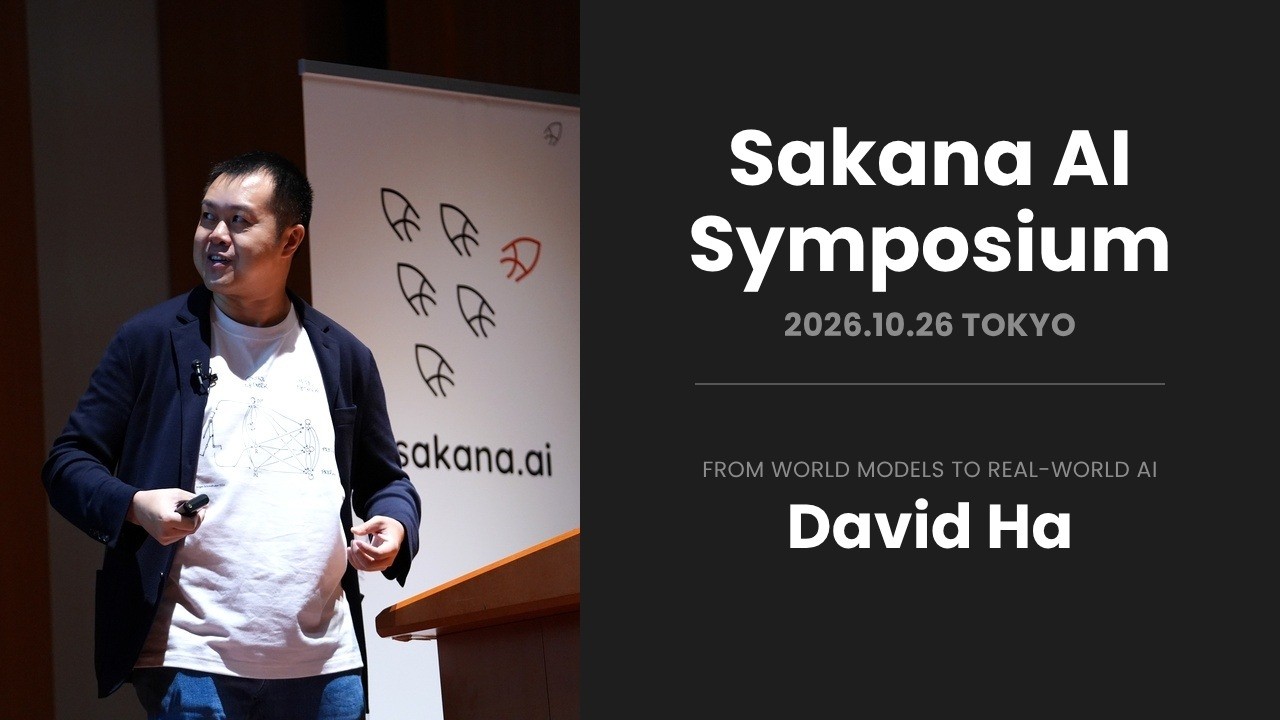
Takuya Akiba – LLM Development at the RSI Lab | Sakana AI Symposium 2026

Takuya Akiba of Sakana AI outlines the RSI Lab's language model strategy, introducing the Sawara model series built from scratch for agentic workloads.

Key Takeaways

  • Language model development is primarily a research competition, not just a scaling race.
  • Research efficiency is as important as raw compute in determining progress.
  • Sakana AI is shifting from post-training specialization to building its own agent-native model, Sawara, from scratch.
  • Talent density and AI-assisted research are central to the lab's strategy toward recursive self-improvement.

What the video covers

  • Takuya Akiba, Chief Scientist at Sakana AI, presents language model development at the RSI Lab, founded in 2023.
  • Sakana AI's agent-layer work includes an algorithm engineering agent that won a live competitive programming contest against human experts, and ABMCTS, a general inference-time scaling algorithm deployed in real business projects.
  • Recent open models are close to frontier performance, and model-layer specialization via agentic reinforcement learning has become an attractive option.
  • Sakana released a fine-tuned version of Kimi K2.6 for Japanese users, removing geopolitical censorship and bias and improving Japanese cultural understanding.
  • The RSI Lab has three subteams: language model, world model, and RSI research.
  • Sawara is a new, provisionally named language model series built entirely from scratch, marking a shift from post-training to pre-training, and designed as an 'agent native' model.
  • Sawara will serve both as the foundation for Sakana's products and as the base for its RSI research, given full control and transparency over recipes.
  • Akiba argues language model development is largely a research competition: final training runs account for only about 10% of compute in R&D at groups like OpenAI and Z.ai, with most compute spent on experimentation.
  • Progress depends on the product of compute and research efficiency, where research efficiency means how much information each experiment yields.
  • Akiba emphasizes talent density over headcount and frames current progress as fractional RSI, where AI assists research and Sawara may eventually take on more of that process.

Answers

Questions about this video

What is Sawara, the model series introduced in this talk?

Sawara is a new, provisionally named language model series that Sakana AI is building entirely from scratch. It is designed as an agent-native model, optimized from the start for agentic workloads like tool-integrated reasoning, coding, and long-horizon tasks.

Why does Akiba argue language model development is a research competition?

He notes that final training runs account for only around 10% of total R&D compute at groups like OpenAI and Z.ai, meaning most compute goes into trial-and-error experimentation. He therefore argues success depends heavily on research efficiency alongside raw GPU access.

What is the planned timeline for Sawara?

Pre-training of Sawara small is set to begin in December, with weights expected to be released the following spring. A larger Sawara large model, with at least hundreds of billions of parameters, is planned for the next year.

Full Transcript — Download SRT & Markdown

00:24
Speaker A
[music] [applause] あ、 あ。 オッケー。 グッド イブニング、 エブリワン。 ソウ、 サンキュー フォー ザ イントロダクション。 アイム タクヤ。 ア チーフ サイエンティスト アット サカナ AI。 ソウ トゥデイ、 アイム ゴイング トゥ トーク アバウト ザ 言語 モデル ディベロップメント アット ザ RSI ラボ。 ソウ アズ デビッド メンションド
00:48
Speaker A
ディス カンパニー ワズ ファウンデッド イン 2023。 アイ ジョインド ディス カンパニー アズ ワン オブ ザ リエスト メンバー メンバーズ。 ソウ アイ ハブ ワークド オン ア バラエティ オブ シングス。 アンド ワン オブ アワ フォーカシス ワズ アット ザ エージェント レイヤー。 ソウ リサーチ アット ザ エージェント レイヤー
01:13
Speaker A
イズ サムシング ライク ディス。 ソウ バシカリィ ウィ アシューム ザ ゼア アー ストロング モデルズ。 アンド ウィ ドゥ リサーチ オン ハウ トゥ ユース ディーズ モデルズ トゥ ドゥ サム インターレスティング シングス。 ソウ レッツ ミー ブリーフリィ レビュー ワット ウィ ハブ ダン イン サ アット サカナ AI アット ザ エージェント レイヤー。
01:34
Speaker A
ソウ ワン オブ アワ ワークス イズ LA エージェント。 ウェア LA スタンド フォー アルゴリズム エンジニアリング。 ソウ ディス ディス エージェント イズ バシカリィ デザインド トゥ ディスカバー ストロング コンビナトリアル オプティマイゼーション アルゴリズムス。 ソウ ウィ テステッド ディス エージェント イン ザ ライブ コンペティティブ プログラミング コンペティション。 アンド アフター パーティシペイティング
02:02
Speaker A
イン イット few times, it got the first rank. It won the competition against human experts.
02:11
Speaker A
So this is about the agent. Another work at this layer is ABMCTS. So this is a general algorithm for inference time scaling.
02:26
Speaker A
Here, inference time scaling means that we basically call language model again and again repeatedly to solve a given very hard problem.
02:44
Speaker A
So this is quite a general algorithm, and that's why it was successfully deployed in multiple real world business projects in Sakana AI.
02:58
Speaker A
So so far, agent layer was so fun. So we had been very successful at the at the layer.
03:05
Speaker A
But recently, I think the model layer has become attractive again. As you know, recent open models are so strong.
03:20
Speaker A
They are very close to frontier models. And they're indeed good enough for some kinds of real work.
03:32
Speaker A
Also, it's actually getting cheaper to build these models. It is because data, training recipes, and software have become more and more accessible.
03:52
Speaker A
And perhaps more importantly, recently, specialization at the model layer has become a very attractive option.
04:04
Speaker A
It is called agentic reinforcement learning. So we can basically optimize our models or even other models from other parties for given any specific kinds of agentic workloads by ourselves.
04:23
Speaker A
So we can optimize these models end-to-end for our tools, our workloads, and our scaffolds.
04:31
Speaker A
And sometimes these specialized models outperform general models. This year we released It's a fine-tuned version of Kimi K 2.6.
04:51
Speaker A
It's mainly post-trained for Japanese users. Because Kimi K 2.6 is a Chinese model, so it's a great model, but it sometimes has some problematic behavior such as geopolitical censorship or geopolitical bias.
05:13
Speaker A
So we removed these problematic behaviors and also improved its understanding of Japanese culture and taught the model the ways of communication and thinking so that it will be more comfortable for Japanese users.
05:38
Speaker A
And then this summer we launched the RSI Lab. This RSI Lab has three subteams, the language model subteam, world model subteam, and the RSI research subteam.
05:55
Speaker A
And I'm representing the language model team, and that 's why I'm speaking here. So I'd I'd to move on to what ne- what's next?
06:07
Speaker A
What are we going to work on at the RSI lab? So today I'd like to introduce our new language model series Sawara.
06:19
Speaker A
So please note that this is still a provisional name, but it's a new language model series.
06:27
Speaker A
Okay, what is Sakana Sawara? Sakana Sawara will be our own language model series. Unlike previous our models like Sakana Namazu, it will be built entirely by us from scratch.
06:49
Speaker A
So in previous projects like Namazu, we focused on post training, but we will expand our effort into pre-training.
07:01
Speaker A
So it won't be adapted by any it won't be adapted from any other models, so we have full control over it.
07:11
Speaker A
And we call it an agent native language model because we design it entirely for agentic workloads from the start.
07:24
Speaker A
So it will be good, particularly in agentic workloads such as tool integrated reasoning, coding, and long horizon tasks.
07:36
Speaker A
How are we going to use Sakana Sawara in this company? So we are going to use it for two purposes.
07:44
Speaker A
One is that we are going to use Sakana Sawara as the foundation of our products and solutions.
07:53
Speaker A
And the other purpose is to use it as the foundation of our RSI research.
08:03
Speaker A
So because we have full control over our model and the the recipes and any process is 100% transparent to us.
08:14
Speaker A
It will be enabler, enabler for our broader scope RSI research. So unfortunately, I don't have much to share with you about Sakana AI because it's still under development.
08:30
Speaker A
So today I'd like to talk about how I think about language model development or my strategy.
08:40
Speaker A
So many people would agree that this competition is basically about using more and more GPUs.
08:54
Speaker A
Well, it is 100% true, but also many people think that these GPUs are mainly for scaling.
09:06
Speaker A
In other words, so they basically need more GPUs because they want to increase, for example, number of parameters or number of pre-training tokens.
09:19
Speaker A
However, this is actually a misunderstanding. Why is it? So according to the left figure from Epoch AI, actually many group uses fraction of compute for the final training runs.
09:38
Speaker A
For example, in this figure, OpenAI and ZAI. So in these groups, final training runs accounted only for 10% among all the compute spend in R&D.
09:58
Speaker A
So it means that actually large fraction of compute goes into trial and error, or in other words, research.
10:09
Speaker A
So So why I would say language model development is more of a research competition than you imagine.
10:19
Speaker A
Then given that language model development is a research competition, then what what's the key factors in this competition?
10:30
Speaker A
So I would say the language model development is product of these two key factors.
10:38
Speaker A
One is compute and the other is research efficiency. The compute part is quite simple.
10:46
Speaker A
So basically so we if we have more GPUs, then we can conduct more experiments.
10:55
Speaker A
But it's also hard to get more GPUs. So it's not basically easy way to increase.
11:03
Speaker A
The other way the other factor is the research efficiency. I think many people are underestimating the effect of this factor, but I would say that this is equally important factor because basically the results will be multiply the products of these two key
11:22
Speaker A
factors. What is research efficiency? Research efficiency is basically how much we can gain or how much we can learn from each experiment.
11:36
Speaker A
So from my experience so far over 10 years, I've seen that there's actually huge difference between experienced researchers and junior researchers in this factor.
11:51
Speaker A
Some people are quite good at designing good experiments or choosing good experiments that which will bring us the largest information as possible.
12:06
Speaker A
Okay, then what drives the research capability of a team today? So I would say it's talent density and AI tokens at scale.
12:19
Speaker A
It's 2026. It's not like 2023. So as you know, we published AI Scientist in 2024 and after that many groups followed up a lot in this area.
12:35
Speaker A
So everyone would agree that so research is a collaboration work between humans and AI.
12:44
Speaker A
And I would say nowadays I we emphasize talent density over head count a lot.
12:55
Speaker A
So I'm I'm quite confident about my team because the team is the most talent dense team I have ever seen.
13:06
Speaker A
And interestingly, this approach, this way of thinking continuously leads to the RSI. Why is it?
13:18
Speaker A
We are already using AI, but probably it's not our models. However, next time some part of that AI could be Sawara.
13:35
Speaker A
Then maybe the next version of Sawara could be helped with Sawara. So it depends on the definition of the RSI, but I would say this is fractional RSI.
13:50
Speaker A
And hopefully maybe in the future Sawara could take on more and more of this process so that it will eventually reach to the RSI.
14:04
Speaker A
Okay, so this is a brief road map of our development. So we are preparing for the training and we will start the pre-training of Sawara small from this December.
14:19
Speaker A
Then everything if everything goes smoothly, we will release our weight in next spring. We also plan to develop a larger version what is which is called Sawara large later next year.
14:37
Speaker A
So it's will be at least hundreds of billions of parameters and I think it will be quite a practical model.
14:48
Speaker A
Okay, that's it from me. Thank you.
Topics:Sakana AIRSI Lablanguage model developmentSawaraagentic reinforcement learningpre-trainingresearch efficiencyinference-time scalingrecursive self-improvementKimi K2.6

Get More with the SozAI App

Transcribe recordings, audio files, and YouTube videos — with AI summaries and speaker detection. 30 minutes free.

Or transcribe another YouTube video here →