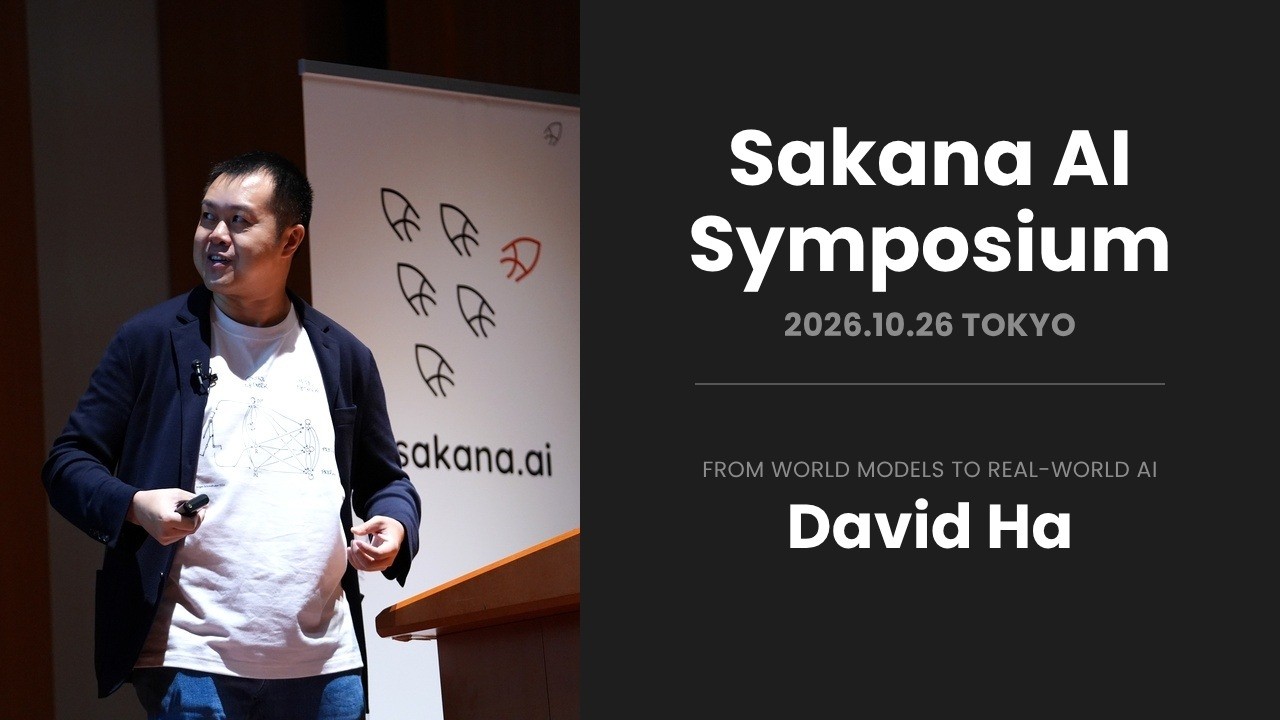
Jürgen Schmidhuber's keynote at the Sakana AI Symposium 2026 traces neural network history from Gauss and Legendre to modern deep learning and recursive self-improvement.
Key Takeaways
- Many foundational AI ideas predate popular narratives and originated in Japan, Ukraine, and Finland as well as the West.
- Deep learning's roots include Ivakhnenko's 1965 eight-layer network and Amari's end-to-end training.
- Recursive self-improvement and artificial scientists are presented as the next major direction.
- Open-source models are eroding the advantage of expensive proprietary models, benefiting smaller actors.
What the video covers
- Schmidhuber opens by explaining artificial neural networks as inspired by the human brain's neurons, connections, and strength-based learning.
- He argues that the core of neural networks dates to Gauss (1795) and Legendre (1805), whose least-squares linear networks match two-layer networks of the 1990s.
- He credits Ivakhnenko in 1965 (Soviet Union/Ukraine) with the first deep learning, an eight-layer network trained layer by layer on British economic data.
- Amari in Japan (1967) introduced end-to-end deep learning using stochastic gradient descent.
- Linnainmaa's 1970 work is credited with backpropagation, grounded in the chain rule.
- Fukushima's neocognitron (1979) and a 1986 handwritten-digit demonstration are presented as the origin of convolutional neural networks, later combined with backpropagation by Wei Zhang in 1988 in Japan.
- Schmidhuber's own 1990 work on robots and minimal control networks is highlighted, linked to the image on David Ha's t-shirt.
- He discusses the concept of an artificial scientist that invents its own problems and relates it to recursive self-improvement.
- Ideas on compression and prediction, including the LSTM (1991), are presented as foundational to sequence modeling.
- He argues that the future will be driven by robots that learn to operate existing tools, and that open-source trends favor smaller players over large companies burning money on data centers.
Chapters
- 00:00Introduction and acknowledgments
- 03:00What artificial neural networks are
- 08:00Gauss, Legendre, and the origins of neural networks
- 10:45The invention of deep learning in Ukraine and Japan
- 16:30Backpropagation and convolutional networks
- 22:00Artificial scientists and recursive self-improvement
- 32:00Compression, prediction, and LSTM
- 42:00Robotics, open source, and the future of AI
Full Transcript — Download SRT & Markdown
Speaker A
[music] [music] Thank you very much for the very kind introduction and thanks to the organizer for for the invitation and especially to David Ha for the very kind and funny and interesting remarks.
Speaker A
I'm really really proud that he chose to show up with a t-shirt that is based on an old drawing from 1990 that I have produced there.
Speaker A
What do we see here? First of all, modern AI is based on artificial neural networks. How many people in this room already know what is an artificial neural network?
Speaker A
Hands up. Yes. How many people do not know what is an artificial neural network?
Speaker A
I see we have a third group in this room who didn't understand the question.
Speaker A
An artificial neural network is something very simple. It's inspired by the by the human brain. In your brain, you've a hundred billion little processors. They are called neurons. And some of them are input neurons like the the little visual processors in your retina.
Speaker A
You've got about you've got a hundred million of them in each eye. And then some of these neurons, they are output neurons. And whenever ever you switch them on, then your speech muscles move or your finger muscles. And some of them
Speaker A
are hidden units. And all these these connections all these these these neurons are connected through connections. And on you've got a hundred billion of these neurons and each of them has maybe on average ten thousand connections, which means you've got one
Speaker A
million billion connections in your brain. And some of these and all of these connections have a strength and they say that's strength says how much does this neuron over here influence that neuron over there at the next time step. In the
Speaker A
beginning, apparently all these strengths are random. But then through learning some of them get stronger and some of them get weaker. And and that's how the entire system learns to drive cars, translate from one language to another, and do all kinds of things that our
Speaker A
artificial neural networks do and our biological networks do. Now, who invented that? Who invented these artificial neural networks? Does anybody know?
Speaker A
Some people think it was invented maybe in the nineteen hundreds, you know, maybe nineteen forty or something in America. But that's totally wrong.
Speaker A
No. All of that was invented two hundred thirty years ago between seventeen ninety five and eighteen o five. By whom? By these famous these famous guys.
Speaker A
That there's this work here. Maybe it doesn't work. Is that my laser pointer that doesn't work?
Speaker A
So my laser pointer apparently doesn't no no sometimes there. This is Gauss. And he's often called the most influential um mathematician since antiquity. And in 1795 he had exactly what in the 1990s was called a linear artificial neural
Speaker A
network. Exactly the same architecture, exactly exactly the same connections between input units and output units, um the weights on the connections and you make some of them strong and some of them weaker such that the mean squared error
Speaker A
on the training set is um is minimized. So back then it wasn't called a neural network. It was called the method of least squares because of this mean squared error thing that they invented back then. And Gauss was not
Speaker A
the first to um to to publish this. The first guy to publish was a couple of years later, 1805, Legendre, a French mathematician.
Speaker A
But this Gauss-Legendre network is exactly what was called a linear neural network, a two-layer neural network in the 1990s.
Speaker A
And um and it's the core of what everybody is doing all over the place, all the famous companies. And the only difference between what we are mostly doing now and what they did back then is that our networks are deeper. The neural
Speaker A
networks are deeper now. They have many hidden layers and um these hidden layers are non-linear. And so they had to invent ways of dealing with these um these hidden units and make the whole network learn something. Who knows who
Speaker A
invented that deep learning? Does anybody know? Does anybody know who invented deep learning and where?
Speaker A
There is somebody who invented it. That's right. Deep learning was invented in 1965 in Ukraine. Um of all places in Ukraine. And back then Ukraine was not called Ukraine. It was called the Soviet Union, you know. But um that's where it came from. And in
Speaker A
1971, um Ivakhnenko, he had a paper in an in an English journal, written in English, and it described a neural network with eight layers. Eight layers to to learn what? It learned to model the British economy by predicting the
Speaker A
next token. So you had a time series of financial data from the British economy, and he tried to predict the future given the past.
Speaker A
19 71 that paper, eight layers, still considered deep in the new millennium. One has to one really has to emphasize that.
Speaker A
So that's how deep learning started, and deep learning of the Ivakhnenko kind was based on layer-by-layer training without back propagation, no? So But then there was a Japanese guy.
Speaker A
Where is he? Here, Amari. And two years after Ivakhnenko, he had the thing that is now called end-to-end deep learning.
Speaker A
Not layer-by-layer training, but end-to-end deep learning where you where you you have a deep network. He had five layers back then when compute was billions of times more expensive than today. And and then he used stochastic gradient descent, which is
Speaker A
basically a reinforcement learning technique to optimize the the weights in the system. And that's how it could learn non-linear things.
Speaker A
That's how end-to-end deep learning started here in Japan 1967. And then in Finland, not far from you know, from and all these things apparently happened around the Soviet Union because Finland is a is a border country from of the
Speaker A
Soviet Union, and Japan also is. And that's where all of this came from. He in 1970, Seppo Linna-Aho, he had [clears throat] back propagation, the thing which is now called back propagation, which is usually trained now, which is usually
Speaker A
usually used by all the major companies from Google to Sakana to train deep neural networks using this technique, which is basically the chain rule invented by this guy here in 19 in 1676 to to to build deep networks where you
Speaker A
figure out efficiently, so an efficient application of the chain rule, how much do I have to change this weight here down deep in the system to to to optimize my my my performance my performance measure, my error function.
Speaker A
So that's how it started. And then another really important thing, another great um Japanese contribution to modern AI in 1979 Fukushima, who had the first convolutional neural network. He didn't call it convolutional neural network, but it that's what it was.
Speaker A
He called it the neocognitron. And there's a famous movie of 1986 where he applies this convolutional neural network to to the problem of recognizing handwritten digits.
Speaker A
1986 and for a long time people didn't know that movie, but recently, I think just last year, I I was able to popularize it and now millions of people have seen it. So 1986 was then this application of
Speaker A
of convolutional neural networks. And two years later, 1988, there was a Chinese guy, Wei Zhang, working here in Japan at a Japanese lab, and he combined Fukushima's convolutional neural network with back propagation and applied it also to to
Speaker A
digit recognition and stuff like that. So that's how convolutional neural networks were completely invented and developed in Japan, and they are today central to to to computer vision.
Speaker A
So um little excursion into history um because I'm here in Japan and I love to point out the super essential things that happened in the development of modern AI here in this country.
Speaker A
So our own contributions came much later and one of them in 1990 and this is the the the picture that is now on the t-shirt of David which makes me very proud.
Speaker A
What you see here is an an a little robot and then you have a minimal control network which has just as as many units as you need to show everything that's going on. There is an input unit down there and there is
Speaker A
inputs coming from the robot and they are moving into this network there and then there's a particular kind of input which is labeled R. That's the reward because the robot usually has pain sensors, you know, and it no not only has one pain sensor but
Speaker A
maybe a million pain sensors just like you have millions of pain sensors and then you want to have these evaluations of what the robot is doing as an input.
Speaker A
And this is important because it is connected. It's one essential ingredient of this thing which is now called recursive self-improvement.
Speaker A
Recursive self-improvement is about building a system that learns not only to do something here and there or something but it learns also to to improve the way it learns something and to improve the way it improves the way it learns something and so on
Speaker A
recursively. And to do that if you want to build a neural network like this one here which which is powerful enough to run a learning algorithm on itself such that the learning algorithm itself can be improved through changes of these weights, then
Speaker A
um it's essentially that you feed this uh this neural network with the with the evaluations that are coming from the environment, with the reward signals or the error signals or something like that.
Speaker A
So if you have a network that doesn't see these error signals and the reward signals, you cannot have um recursive self-improvement. And that was already present back then well so uh you you want to be really general.
Speaker A
You have a bunch of hidden units, you have output units that control then the robot again and over time you want to adjust these weights such that the robot becomes a better robot and doesn't um experience as much pain any longer and
Speaker A
gets more reward over time. And then to to achieve all of that you give it a second helper network which is just looking at the output actions of the robot and at the inputs of the robot and is trying to predict what is going to
Speaker A
happen next if I do this. Yeah. Then you have a model of the world and in the ideal case the model is really good and that's what David was talking about and then you if you have a good
Speaker A
model then you can plan. You can plan the future, you can execute action sequences mentally in mental experiments and you can select those action sequences that lead to a lot of reward and little pain in your in your mental model
Speaker A
and you hope that your mental model is good enough um such that what it promises is really materializing then in in the real world. But of course in the beginning the model is not good enough.
Speaker A
It's stupid. It knows nothing about the world and that's why you immediately have the task of of dealing with that problem by creating something like an artificial scientist.
Speaker A
How do you create an artificial scientist? That scientist is a guy who is not only who is not only trying to solve a problem that somebody else gives to the scientist, no, it invents its own problems all the time.
Speaker A
It invents its own problems that that are related to understanding how the world works. What does a baby do?
Speaker A
How does a baby learn? A baby does not learn by downloading the worldwide web.
Speaker A
No, a baby creates its data through its own self-invented experiments. For example, if a baby does this with its hand, then the video that is coming in changes.
Speaker A
And then what does the baby do? It predicts how the video changes. So that's how it learns through its self-generated experiments about how the world works. And it learns about physics and it learns how the apples fall to the ground and it learns
Speaker A
all kinds of things. It learns how parents react if you cry and and do all it learns many many different things as a consequence of its own actions.
Speaker A
And then suddenly now this baby must be motivated to, you know, not download everything or or look at all possible data, no, very selectively through your own next experiment with your toys create the additional data that you need
Speaker A
to become a better predictor, to become to get to have a better world model.
Speaker A
The the simplest and most stupid way of doing this that I also published in 1991 which is very simple. You say, okay, let's assume that that the the world model is stupid and it knows nothing. Now how do I
Speaker A
incentivize the the controller which is generating sequences of actions that change the environment? How do I motivate it to come up with with action sequences that lead to data that has the property that I can learn something that I didn't know. Well, very
Speaker A
simple. Let's say the world model is minimizing its error, as always, trying to minimize mean squared error, like what Gauss and Legendre did um 230 years ago. And um and um and we say the controller is trying to maximize the same thing that
Speaker A
the um that the model is minimizing. So the controller has probabilistic output units which model basically a probability distribution over possible action sequences that that the um that the artificial scientist could execute. And um and whenever the the
Speaker A
error of the world model is high, it means the model of the world can still learn something here in this corner of the environment, which means that um you get a reward. And the reward is this extra joy, this scientific reward, this
Speaker A
Eureka reward, this extra reward that you get for for inventing an experiment that tells you something about the world that that you didn't know. And then the the world model becomes better and reduces its error. And for the
Speaker A
controller, the whole thing becomes boring. So the controller and the model kind of fights and and one of them is um is generating one of them is um maximizing the same thing that the other guy is minimizing.
Speaker A
So today this is called a generated adversarial network because it is both generative and adversarial. And um and um I call it artificial curiosity. I didn't call it generative adversarial network. So I call it artificial curiosity.
Speaker A
And um and back then one has to see that all of that is was kind of cool, but the the essential ingredient didn't work well, which is the deep learning didn't really work well back then. Back then deep learning
Speaker A
did not work well. Around 1990 deep learning did not work well. Yes, there was um methods, incremental layer by layer training and so on. But you know, eight layers or something is not good enough if you want to have a
Speaker A
really deep learning system where you have recurrent networks and where something that happened a thousand steps ago may be influential and may influence something that will happen in a thousand steps.
Speaker A
So you have to somehow deal with these long time lags and with the deep processing steps that you have to execute to deal with that. And then that's the reason why in 1991 we had a whole bunch of
Speaker A
of papers to solve that problem. And and that's funny enough, that's now the P and the T and the G in ChatGPT.
Speaker A
And back then we had something which is called the pre-training now and it allows us to greatly compress sequences such that we can deal with long sequences of thousands of time of steps by just inventing extra pre-training tasks which are just predict the next
Speaker A
thing. As long as you can predict the next thing, you you you can compress the stuff that is coming in because everything you can predict you don't need to store extra.
Speaker A
So that's how you can greatly compress long sequences. And that's how we how we were able to to deal with the P in ChatGPT in a way that allowed us to greatly facilitate downstream learning. And in the same paper which had the P in
Speaker A
ChatGPT, we also had the distillation of the knowledge of one neural network into another that was something else that is too super popular today and deep seek, but many other not only deep seek, but many other large language models are using it all
Speaker A
the time now. And and and back then also, yeah, the generative adversarial networks. I already mentioned that, but then the first transformer.
Speaker A
The first transformer variant back then in 1991 and it's exactly what's today called the unnormalized linear transformer.
Speaker A
Back then I didn't call it the unnormalized linear transformer. I called it the fast [snorts] rate controller.
Speaker A
So the fast rate controller is something kind of cool, I think, and still relevant today, where you have basically two networks, two feed forward networks. One is the slow network and one is the fast network. The slow network is here and
Speaker A
the fast network is here. Now the fast network has weights that can change rapidly from millisecond to millisecond, you know, by from -7 to +12 or something like this. And [snorts] there's a slow network that learns to generate by
Speaker A
gradient descent keys and values which are used to define the weight changes of the fast network.
Speaker A
So here we have a system that is processing sequences and is trying to predict the next token, like what everybody has been doing since Gauss.
Speaker A
Gauss, by the way, he also predicted the next token. What was the next token in his case? In 1801 the young Gauss became famous by predicting the position of the asteroid Ceres.
Speaker A
Back then they had telescopes. They had discovered this little asteroid and they had measured noisy measurements of this asteroid and then it disappeared behind the sun.
Speaker A
And now the question was, where do I have to put my telescope to to see the the the asteroid next time?
Speaker A
And that's when he used this method of least squares, simple two-layer neural networks to predict the next token, which was the position of the of the asteroid. And he correctly predicted it and he became famous.
Speaker A
And he would have said this is the least of my achievements because he is much more famous for other much more complicated stuff. Um but um but that was when when the young Gauss became famous. And here we also predict that
Speaker A
just the next letter and um or the next word and a sequence of words and stuff like that. And um and how do we do that? Well, the um the the keys and the values which are generated by this slow network, they are
Speaker A
uh rapidly changing this uh weight matrix, which is uh just we using the outer product of the keys and the values to generate new changes, weight changes here. And then you the sum of all these weight changes, that is um
Speaker A
the the new weight which is being uh the new weight matrix which is being applied to the query areas that are coming in.
Speaker A
That was 1991. That is exactly the um the linear transformer uh that was called the linear transformer in 2020.
Speaker A
Uh why is it called the linear transformer? Because um because it scales linearly. The modern quadratic transformer scales quadratically. What does that mean? If you have 1,000 times more text, you need a million times more compute. But with a
Speaker A
linear transformer, you need only 1,000 times more compute. So that's good, huh? And back then in 1991, no journal would have accepted um uh uh transformer that scales quadratically. Now you want to minimize energy. You want to minimize the effort
Speaker A
as David has frequently pointed out in his uh talk. So uh even today um you you still want to do that. You want somehow to to uh reduce the quadratic costs of um modern transformers to something that is linear
Speaker A
or maybe log linear, but at least much better than what you have today because one of the reasons why um why data centers are so expensive and why is many people are spending hundreds of billions of dollars now on
Speaker A
on GPUs is because this quadratic transformer is really inefficient. So you want to greatly improve that situation.
Speaker A
That reminds me of course at the moment you have you have you have a trillion dollars or something like that being invested per year into data centers.
Speaker A
Now on average every five years computer is getting 10 times cheaper, you know? Which means that within the next five years if if you invest 1,000 billion dollars today into GPUs for data centers then someone is going to lose 900
Speaker A
billion, you know, within the next five years. I hope it's not going to be you.
Speaker A
There is no business model at the moment on this planet to recuperate the losses.
Speaker A
And so in the long run all of that is going to play for the little guy. The little guy is going to profit from from this trend that everything is getting cheaper every five years by a factor of 10.
Speaker A
And it's not going to be the big hyperscalers who are going to profit a lot. They are losing, they are bleeding money, they are bleeding fresh they are bleeding free cash flow like crazy currently, taking on debts, you
Speaker A
know, used to be super efficient little nimble software companies like Google for example. David was working for Google or or Meta and you know had a little team and and the little team improved some shitty operating system and rolled it
Speaker A
out for billions of people around the world. And they were all using their own computers, their own smartphones to run the operating system. But now all these big companies they they are in the cloud and they are becoming like utilities.
Speaker A
They have to invest into uh nuclear [snorts] power plants and gas turbines and everything. They are becoming like electricity companies you know.
Speaker A
And they don't have a moat because all the time the open source is is um closing in um and um cheap models are competing with with the expensive models in a way that that doesn't leave them a moat.
Speaker A
So if you are if you are worried about an an upcoming um AI bubble crash or something you you might be on to something.
Speaker A
Anyway, so there are ideas how to deal with how to make neural networks more efficient and computers also are still getting more efficient all the time.
Speaker A
Every five years computers getting 10 times cheaper which is the reason why I'm standing here today because back then when we did that in 1991 nobody nobody was interested in that.
Speaker A
I um I'm sometimes telling the telling the story how uh back then I had a conference an AI conference where I was trying to explain these things and it was a conference a little bit like this conference here except that
Speaker A
there was only one single person in the audience. A young lady I said young lady it's very embarrassing but apparently today I'm going to give this talk just to you.
Speaker A
And she said okay but please hurry I am the next speaker. But then since then every five years compute got 10 times cheaper and and today it's 10 million times cheaper than what we have back then what we had back then and
Speaker A
that's the reason why all the old techniques that we published back then uh are suddenly um are suddenly are suddenly on on all your smartphones and all your and all your other kinds of devices and um in particular this this thing also huh.
Speaker A
There is something which is called deep residual learning, deep residual learning, and this was invented in 1991 by my brilliant student Sepp Hochreiter.
Speaker A
Also in 1991, that was our miraculous year, and the same year when we had the first transformer variant and the first generative adversarial network and the first distillation and the first P, the pre-training thing.
Speaker A
Also in his diploma thesis there was the the deep residual learning. Now the most cited paper of the new millennium is something about deep residual learning.
Speaker A
But it was invented in 1991 by Sepp and it's the core of this long short-term memory. It's something very simple.
Speaker A
If you have a unit, a recurrent unit which has a reconnection to itself of 1.0 and you have inputs coming in and then everything that comes in over time is just added to this stuff which is already in there. So it's this very
Speaker A
stupid simple cell with a linear activation function. So the most stupid kind of neural network basically, but the cool thing about it is if you propagate errors backwards through something like this, you always multiply by 1.0 because the weight of the
Speaker A
connection to itself is 1.0 and you always multiply with the first derivative of the activation function which is linear which is 1.0 which means you always multiply by 1.0 which means you can propagate your errors back into time for thousands and millions of steps
Speaker A
and nothing changes. And that's the core of the LSTM. That's the reason why this long short-term memory recurrent network works so well and can bridge you know millions of time steps or thousands at least of time steps through this thing
Speaker A
which is known now as deep residual learning but it was back then implemented there and we used the same thing then in 2015 to make very deep feed-forward neural networks. We called them highway networks. That was done together with my students Klaus Graef
Speaker A
and and Rupesh Kumar Srivastava. And half a year later there was an this paper on deep residual learning which did essentially the same thing that that is now this highly cited paper.
Speaker A
So all of this goes back to this single year 1991. Many people don't know that.
Speaker A
What David showed in his slide was was a better way was this thing here which is referring to a better way of of planning because the stupid way of planning is millisecond by millisecond planning.
Speaker A
Now you have a controller. The controller wants to optimize its performance. It has this model of the world. The model of the world can be used to you know simulate the future and the naive way of doing it is really
Speaker A
simulate every little detail of of the future. But that is not good. It's good enough for chess and board games and stuff like that and even today people are using it to do a step-by-step simulations of of board games and then select action
Speaker A
sequences that lead to promising and intermediate results and so on. But it's not what you should do because think of yourself. When you are making a plan about the future you want to go from here to Paris you don't simulate all the little
Speaker A
details of your next action sequences. You don't simulate your your hand as it is trying to grab the phone and then you are calling for a taxi and then hopefully the taxi is going to bring you to the airport and so on. No, you don't.
Speaker A
You don't simulate millisecond by millisecond your future and your next 10 hours until you are in Paris. No, you don't. Instead you have just a few high-level ideas about what is important, for example, calling a taxi, going to the airport,
Speaker A
doing the check-in, and once you are finished with the check-in and in the plane for nine or 10 hours, nothing is happening and so on. So for you the way you are planning is you have these high-level ideas, these high-level
Speaker A
subprograms which you have used in the past, like sitting down in the airplane and just watching movies or whatever you do there.
Speaker A
And and and you have a very compact plan which just looks at a few key things that you have to do and and you ignore all these little details.
Speaker A
So this hierarchical planning, that's what you do all the time. Our neural networks of the old kind, they don't do that, but they also have to learn that. And the the simple good way of of doing that is
Speaker A
instead of using the the model, the M for millisecond by millisecond planning, instead of doing that, you you just give an opportunity to the controller to send queries into the hidden units of the M. The M has maybe
Speaker A
seen a lot of information about all kinds of things, has maybe seen all YouTube videos.
Speaker A
And and it has lots of experience with robots that can do all kinds of things.
Speaker A
But you don't use it as millisecond by millisecond rollout planning. No, you you just say, okay, there are some hidden units here in the M and they hopefully know something about the problem that you want to solve currently.
Speaker A
They hopefully know something. And now you have to address the right hidden units and ignore most of the others. You have to attend to just a few of these internal representations that the M has developed. And you have to
Speaker A
get back an answer from there which you can use as a controller, as a as a draft of of a of a weight change of your your own system and as a draft of of a plan that means a change of the behavior of
Speaker A
the controller, which may require the modification of some of these weights, and then you execute that.
Speaker A
And of course, the controller will have to learn over time to send up the good queries into these into the M and has to interpret the answers coming back from the from the M.
Speaker A
And this these queries, they don't have to be in English or in in Japanese or some other language, human language. No, just number vectors. And over time, the system through experience with with lots of tasks will have to learn to wake up
Speaker A
the the right hidden units, the right internal representation in the M that are relevant for solving the the current problem such that the controller can solve it faster. And that's the A C test. Can the controller solve the new
Speaker A
problem faster? Through exploiting this way of addressing the hidden the algorithmic information and the hidden units of the M and understanding the the questions that come back. Or is it easier for the controller to ignore these extra connections to the model and to solve
Speaker A
the problem from scratch? Now, for simple problems, it's easier to solve it from scratch, but all interesting complicated problems, they require they will greatly profit from the algorithmic information that sits somewhere deep in this huge model network.
Speaker A
Yeah. So there we we have a simple way of learning hierarchical and other kinds of algorithmic planning in a way that does not depend on on rollouts.
Speaker A
And then 2018 there was a paper which collapses. Okay, I have still 10 minutes left. This is much more than than I expected. Hm.
Speaker A
Then we we can actually collapse through the distillation procedure that I mentioned before, the model and the controller into one single thing, but I don't have too much time left. Now the more famous paper of 2018 is the one by David Ha
Speaker A
which showed in in great experiments how wild models can be really profitable for practical applications. [snorts] And now this recursive self-improvement which I mentioned before [snorts] in principle is so powerful that all of the stuff that I just
Speaker A
mentioned can be in principle derived through a system that learns to improve its way of collecting data, of learning to improve the learning algorithm itself and so on.
Speaker A
On the other on the other hand at the moment [clears throat] I'm sorry. At the moment it doesn't work as well as we as we would love to see it and we are still profiting from all these other
Speaker A
extra ideas that we that I mentioned there in the past. Now let let me let me step back and and put all of that into into a broader historic context.
Speaker A
And when I talk about a broader historic context let me focus on on two countries which in some ways are quite similar on so much of what I mentioned today happened in in Germany and in Japan. And I mentioned in the beginning these
Speaker A
pioneering AI works of and AI scientists and they they they did that in the sixties and seventies and eighties.
Speaker A
And back then, of course, Japan was the envy of the world, you know? And maybe most of you you are so young that you don't know that any longer.
Speaker A
But in 1990 when when we did the stuff, Japan seemed like the land of the future.
Speaker A
And the the six most valuable companies in the world, they were all from the same country. Today they are from America, but back then they were all from Japan. And the crazy thing is that in 1990 the real estate in this tiny
Speaker A
little country of Japan, which is hard to find on the map not not super hard to find, but you know, it's really tiny compared to the continent-wide countries like like China and Japan and and America.
Speaker A
But this little tiny country had more the real estate in this country had several times the value of the real estate in the United States, which is crazy, isn't it? And apparently the central square mile of Tokyo had the
Speaker A
value of California. Yeah. So that was only 35 years ago. And of course science and technology, they usually go where the money is, you know? And art also goes there. And back then the money was in Japan.
Speaker A
And maybe that explains it a little bit. Actually Japan back then had a big AI project. It was called the fifth generation project and it was mostly about symbolic programming. It had nothing to do with neural networks, but there was enough
Speaker A
funding left, breadcrumbs so to speak, for people like Fukushima and Amari and and and other great pioneers from Japan who who the of is now modern AI.
Speaker A
And and since then, one has to admit um the situation has deteriorated and and there was a big crash, of course. And and this is true for both my own country Germany and Japan. Back then in the '90s, it was
Speaker A
kind of peak post-war Germany. You know, the the Berlin Wall had come down and for the first time the country was united again. And and it was super successful in certain fields such as sports, you know, world champion and the most popular sport and
Speaker A
football. And you know, most gold medals in the Winter Games and sometimes even the Summer Games and all kinds of powerful public appearances.
Speaker A
And and back then it was incredible that that the two great losers of the Second World War together had the same the same GDP, nominal GDP, as America plus China.
Speaker A
China was still small back then. This is 1995, 30 years ago, one generation ago, at least by my standards, one generation ago. And and and this is incredible that a little tiny country like Japan, another little tiny country like Germany, that together
Speaker A
they had the same impact or economic impact as America plus China. And this is only 30 years ago.
Speaker A
Today the situation is really different, you know, than this is in in nominal GDP. And the Americans they love the nominal GDP because then they still look bigger than China, you know. But but if they look at purchasing power
Speaker A
power parity, then China is now by far the biggest company, the the biggest economy. And now Germany and Japan, they are just one fifth of America plus China. So we really have declined a lot. And my hope, of course,
Speaker A
is that that the future is going to be driven by the thing that used to be so so strong in Japan, but [clears throat] also in Germany, which is robots. And and and especially robots that learn to become smart enough to operate all the
Speaker A
existing machines. This is a slide from 2002, more than, you know, a quarter century ago, something like this. And back then, more than half of the robots in the world were from Japan.
Speaker A
And the country with the second most robots was was Germany. And they both had more than America, for example. Today, most of the robots are in China. One has to state that.
Speaker A
Nevertheless, at the moment, the only kind of AI that is working well is the AI behind the screen. Yes, behind the screen, there's a superhuman chess player and a superhuman [snorts] Go player and a superhuman summarizer of documents and a superhuman
Speaker A
mathematician. We have all of that, but it's limited to to to the world behind the screen.
Speaker A
There is no real AI in the real world for real robots that can do what a plumber can do.
Speaker A
No robot comes close to a plumber or an electrician or to what a little boy can do with a with a football.
Speaker A
So the the thing that doesn't work at all at the moment is physical AI in the real world.
Speaker A
In the real world where there are the machines where especially in Japan and Germany had such a rich tradition of, you know, building the leading kinds of machines. [snorts] And I hope and so physically AI is not owned by
Speaker A
anybody. Yes, we have now robots in China that can run faster than Usain Bolt, but this is rather simple stuff because there you don't have to interact much with the real world. You don't have to do all the
Speaker A
things that a can do. But but that's going to come. And now I want to you to under to understand that if we have So for for hundreds of years people have talked about self-replicating machinery, but they had no idea how to build it.
Speaker A
But now we see an opening because for once we have for the first time a robot that can learn to operate all the existing tools and machines.
Speaker A
It doesn't have to be super smart, just smart enough to learn by you know demonstration and and and reinforcement learning to operate all the existing machines, then a collection of machines like that can make more of itself including
Speaker A
the machines that you need to extract the ore from the ground and ship it to the factories where it's transformed into robot hands and and and material and and microchips and whatever.
Speaker A
So once we have this this this single machine that is smart enough to learn to operate the existing machines, then we can we suddenly have an ultimate scaling machine.
Speaker A
And suddenly it's not important anymore how many people are in this country or in this country. No, the important thing is do do you have something like that in your country?
Speaker A
At the moment this doesn't work, but probably in the not so distant future it will work.
Speaker A
And then we have a new kind of life. You have to see that. And suddenly this will trigger this age of abundance because these self-replicating and self-improving machines, they are going to make all the stuff that humans don't want to to do
Speaker A
themselves. This will be truly the age of abundance. We are not there. We are not there because this essential machine is does not exist yet, but we see how to get there.
Speaker A
And I hope that Japan and Germany and maybe a few other robot-oriented countries will be leading there and and will make that a possibility and will maybe connect to former glory in this way.
Speaker A
Self-replicating machinery and the self-improving machinery is not going to be limited to our little planet. No, it's going to work in the rest of the solar system and in the rest of the galaxy in a way where humans cannot
Speaker A
follow, but I will not say too much about that. It's just a natural consequence of of what I just outlined.
Speaker A
Generally speaking, I want to point out again that all the existing trends are working for the little guy, not for the big companies that are trying to make a lot of money, but at the moment they are bleeding a lot of money because
Speaker A
they're all competing to to build these data centers in a way that that is not obviously profitable for them.
Speaker A
AI is going to be like smartphones. 40 years ago I I I knew this rich guy. The rich guy, he had he had a Porsche and in the Porsche there was something incredible. He had a mobile phone in the Porsche, so he could
Speaker A
grab the mobile phone in the Porsche and talk to another guy with a similar Porsche and why is that a light? 40 years ago super expensive stuff.
Speaker A
Today, 40 years later, all over the world in all the developing countries everybody has a smartphone which is much much better than what he had in his Porsche. And it's going to be the same with AI. AI is going to be
Speaker A
cheaper and cheaper and cheaper every five years a factor of 10. The physical limits of this trend are still far away.
Speaker A
We will maybe reach them in 2200 or something. So everybody is going to have lots of AI's making their their lives longer and happier and healthier.
Speaker A
So future is bright. Thanks for your attention.
Topics:Jürgen Schmidhuberdeep learning historyneural networksbackpropagationconvolutional neural networksLSTMrecursive self-improvementSakana AIroboticsAI history