Lecture on ICAM (Identity, Credential, and Access Management): identity lifecycle, credentials, access control, and enterprise vs. application-specific identities.
Key Takeaways
- ICAM combines identity management, credential verification, and access control into one framework.
- Enterprise identities reduce duplication, improve data consistency, and centralize lifecycle management.
- Identity data should be minimized and shared only with applications that legitimately need it.
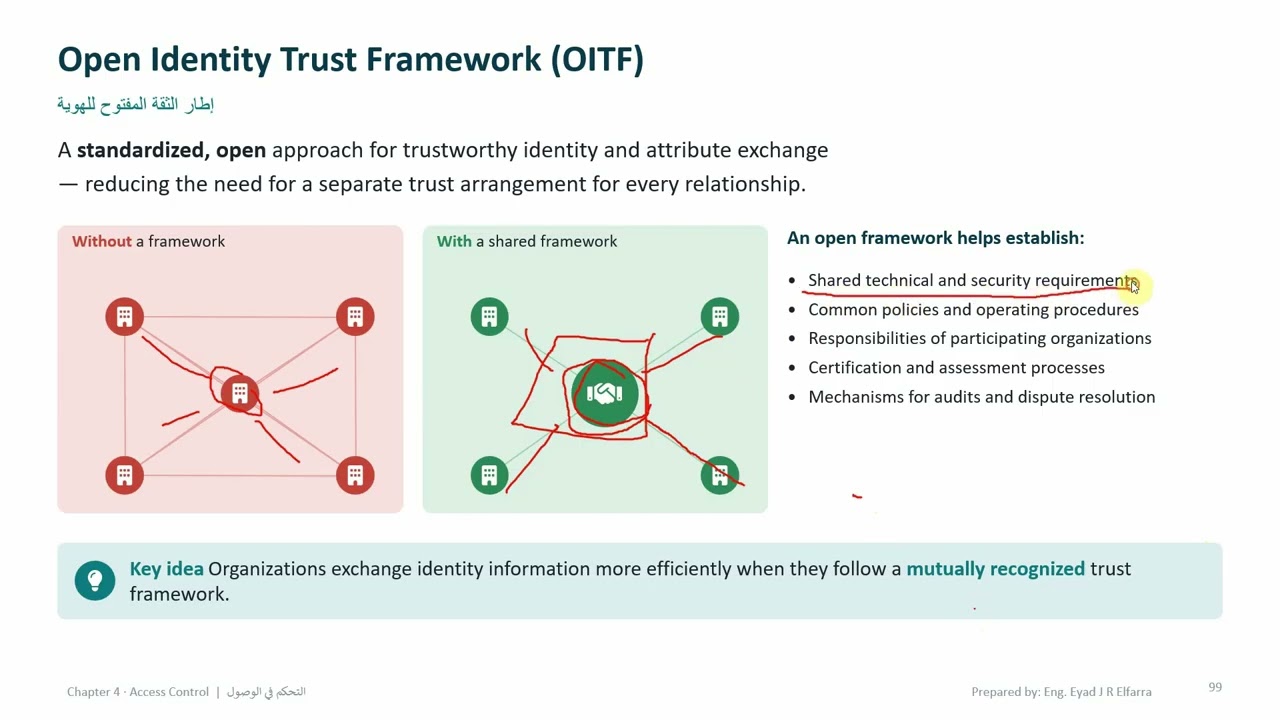
- Identity federation allows trusted institutions to accept each other's digital identities.
What the video covers
- Introduces ICAM as a framework for verifying and managing digital identity, credentials, and access, originally developed by the US government and now used widely in private sectors.
- Explains the three components: Identity (who the requester is), Credential (evidence proving identity, such as username/password, token, or biometrics), and Access (what resources or actions are permitted).
- Notes that identities apply not only to humans but also to non-human entities such as applications, processes, and robots, which also need authentication.
- Describes the identity management lifecycle: enrollment, creating a digital identity, attribute collection, identity verification, attribute linking/provisioning, and de-provisioning.
- Distinguishes enterprise identities (centralized, reusable across many applications and departments, consistent records) from application-specific identities (duplicated per app, harder to maintain).
- Explains how an employee or student's organizational ID can log them into multiple university systems such as email, Moodle, library, and the staff portal.
- Emphasizes protecting Personal Identifiable Information by sharing data only with applications that need it.
- Clarifies that identity is who you are, while a credential is the trusted evidence that you are that person, with credentials maintained through renewal, replacement, or revocation.
- Covers access management: logical access (applications, data, networks) versus physical access (buildings, labs), governed by resource, privilege, and policy management.
- Introduces identity federation, where trusted institutions share digital identities so a researcher's university identity can be accepted by other organizations.
Chapters
- 00:00Introduction to IAM and Chapter Overview
- 01:00ICAM Framework: Identity, Credential, and Access
- 02:30Identity Management Lifecycle and Enrollment
- 06:40Enterprise vs. Application-Specific Identity
- 12:00Protecting Personal Identity Information and Identity Lifecycle
- 14:40Credentials, Identity vs. Credential, and Maintenance
- 18:20Logical and Physical Access Management
- 21:30Identity Federation Between Institutions
Full Transcript — Download SRT & Markdown
Speaker A
In the name of God, the Most Gracious, the Most Merciful. Welcome to the IAM section.
Speaker A
How to manage authentication operations with access. We talked about this before. We talked about user authentication methods.
Speaker A
Right. We will talk about access management at the beginning of this chapter, God willing. Right.
Speaker A
IAM is an abbreviation. It is a framework. Why? To verify and manage digital identity.
Speaker A
That is your credentials or authentication data. And access, which is your reach to the resources I have.
Speaker A
It was developed by the US government. But it is used by all private sectors and other companies. Well, from its name I-C-A-M.
Speaker A
The I is for Identity. Right. C stands for. About what? About Credential. It is.
Speaker A
The I we talk about. Identity, the C we talk about Credential. And the A we talk about whom? Access.
Speaker A
Right. Well, here it says. It could be for people. Or it could be for whom?
Speaker A
What is meant? Non-human entities. Like applications. Like processes. Like, right. Like robots . They are non-human entities. Right.
Speaker A
And these also need authentication. Not every process running on our system can I trust; I must. Know the source of this process. And be able to identify which program it belongs to. Well.
Speaker A
The second component in ICAM, right. I know that I have a user on the system named Ahmed.
Speaker A
Well. The user named Ahmed. How do I ensure that this is him? Is this the one who told me that I am actually Ahmed? That he is indeed Ahmed ? I will verify through whom?
Speaker A
Credentials. Which he has, whether username and password. Whether it is a token. Whether it is biometrics.
Speaker A
Anything from the resources. From the authentication methods we took previously. Right. We will use it in the verification process. And link the identity to the credential. The last thing. Or whom? I knew that this is Ahmed. And I verified that this is Ahmed
Speaker A
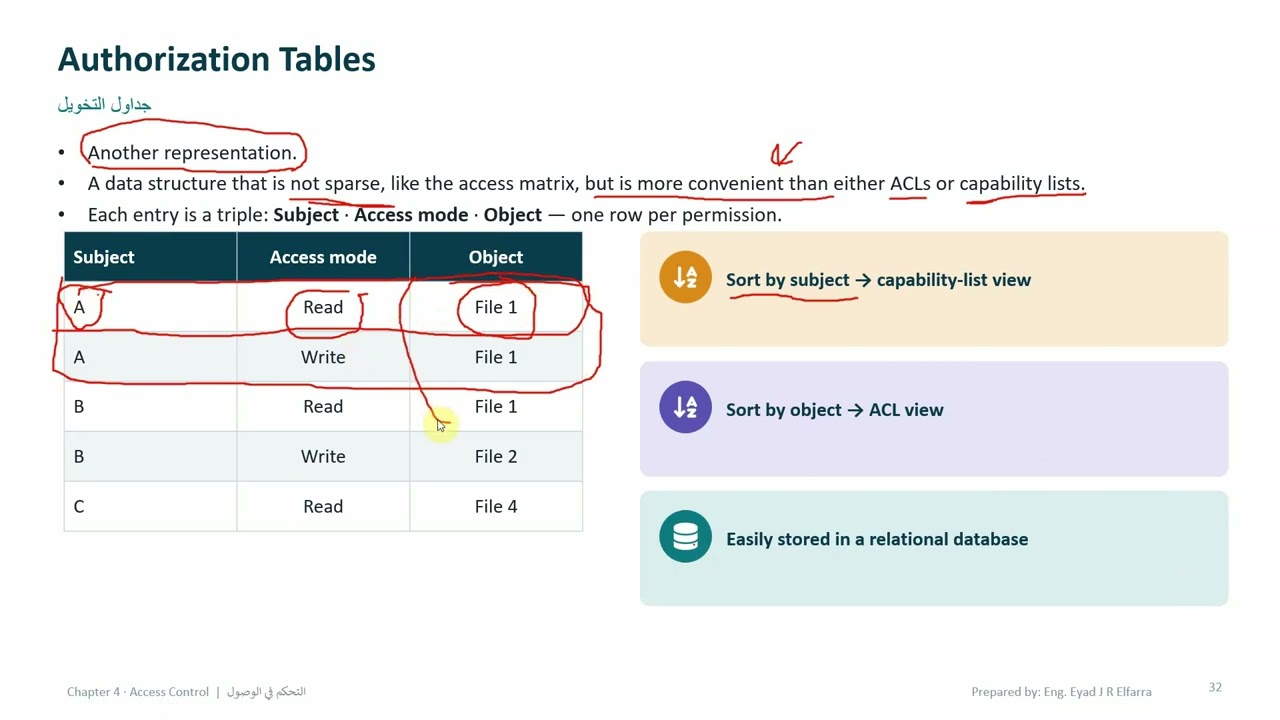
. What permissions does he have to enter our system? I will use access controls.
Speaker A
To verify this. Well, the three main components of ICAM are. Who is Identity Management.
Speaker A
And Access. Identity management. Who is the person requesting the resource? He is. Right. Credential, added to authentication. What is the evidence that proves the validity of your identity? Right, that. Access management . Well, I know who you are.
Speaker A
What are the resources or actions you are allowed to do here on the system?
Speaker A
Of course, access control can be for logical or physical resources. What does logical mean? Logical is like, for example, an application, data we have on the internet. Right. Physical, you want to enter a specific building, a specific lab. So I call this physical resources.
Speaker A
Right. Well, now let's come to the first part. Which is Identity Management. Right. It is the process of creating and managing a secure electronic method. And a guaranteed digital representation for every person and every process on our system. Well, the steps will go through
Speaker A
six steps. The first step is who? Enrollment. I want to collect data that tells me who you are. Meaning your name , date of birth, and your ID, right?
Speaker A
Data that defines who you are. Okay. After I've gathered the data that defines who you are, I will create a digital identity for you. What will the digital identity do? I will create an identity for you that includes, like a
Speaker A
regular ID, your photo, name, ID number , date of birth, place of residence, and mother's name.
Speaker A
I have created an identity for you, and it's all combined. Attribute Identity. I want to collect the attributes that I gathered about you to determine who you are.
Speaker A
Step number three: Identity Verification . I need proof, and based on this proof, I can be sure that your identity is correct or incorrect.
Speaker A
As we will see later, I will link it to certain attributes, connecting to organizational resources, creating a link with attributes.
Speaker A
After that, based on this, the verification will be done through credentials. Alright, you have logged into the system .
Speaker A
And I have verified that you are the right person, or the person you claim to be.
Speaker A
I will then do attribute linking; I will link you to our system resources. Okay, this identity of yours.
Speaker A
I make it available to applications, meaning I provide you to certain applications to prove your identity so I can grant you permissions, or I de-provision you, which means I revoke the identity when it is no longer needed . Meaning you were an employee at the
Speaker A
university, so I gave you an identity as a university employee. Your work at the university has ended; do I keep your digital university identity active or inactive?
Speaker A
I will make it inactive; you effectively become a person, user, entity, or individual who is inactive for me in my organization. Now, let's talk about something called Enterprise Identity.
Speaker A
What is Enterprise Identity? It is an organizational identity. To work on a job system, am I required to create a new identity every time I want to access something in the world?
Speaker A
For example, if I want to do research, do I create a new identity to prove I'm from the university? Or do I have an organizational identity that lets me access multiple applications with the same identity?
Speaker A
Or do I have an organizational identity that lets me access IEEE with the same university ID, access Elsevier with the same university ID, and all international research library sites using my organizational identity?
Speaker A
Consequently, I don't need to create an identity and verify it to others every time.
Speaker A
I just have my identity, and I can log into any global site using my organizational identity.
Speaker A
It can be reused across multiple applications and departments; I can use it across many applications and departments instead of creating a separate identity for each application.
Speaker A
Instead of creating a separate identity for each application. The same applies inside the organization; for example, I have an employee number.
Speaker A
With this employee ID or username, I can log in to, for example, the Moodle program, access the university email, and who else can I access?
Speaker A
The staff portal. For entering student grades, exactly. So, with the same corporate identity, I can log in. To whom?
Speaker A
To applications belonging to the university. It’s the same identity; I don’t need to create a new one for every application.
Speaker A
Now, what is the difference between an enterprise identity and an application-specific identity? For application-specific identities: Every application is always tied to a specific app.
Speaker A
Whereas the enterprise one represents all of me. Applications within the institution. Identity records may be duplicated. Since I created the identity for a specific application. That means in this case, what happens to my identity? It might be duplicated. I will
Speaker A
duplicate it for whom? For the messaging app, the library. For building access, for the staff portal to enter student grades. Exactly.
Speaker A
Because I created it specifically for that app. Okay. But if I had created it for the institution.
Speaker A
The information can be linked to what? All resources belonging to my institution. Right. Regarding the application-specific one, each application requires separate maintenance and management for every single one.
Speaker A
Whereas with the corporate one, we have centralized lifecycle management, which is a centralized lifecycle management for my enterprise identities.
Speaker A
Right. Regarding the application-specific one, they are closely tied to the application and always linked only to that application's needs.
Speaker A
Whereas the enterprise identity can be reused across multiple applications for various purposes. Regarding the application-specific identity, it may result in inconsistent records, meaning it could lead to records that don't match each other.
Speaker A
Why? Because I am saving an identity for each application, so duplication occurs . Even though I have duplication, I am unable to link them together.
Speaker A
Whereas with the corporate identity, I am effectively able to have consistency and reuse it.
Speaker A
Consequently, my data will be consistent ; I don't have to create my identity multiple times for every application.
Speaker A
For example, if an employee wants to use their corporate identity to connect to email and resources like Moodle and the university library.
Speaker A
And to enter a certain building or facility, they can use the same corporate one. Whereas Well, for this corporate identity to be able to access all these resources, I need some additional attributes.
Speaker A
Like job title, department, location, and the tasks required of me. To make my identity clear and explicit for everywhere I want to access.
Speaker A
Identity Attribute Lifecycle Management —my digital identity will contain more than just the ID number, name, date of birth, department, and status.
Speaker A
As a student, for example, your university number, name, date of birth, your department or major, and status— whether you are currently enrolled or graduated.
Speaker A
Thus, these are attributes that define my identity. So, what is the identity lifecycle? It says protecting personal.
Speaker A
First, I want to protect and secure your Personal Identity Information; protecting your personal data, okay.
Speaker A
I want to control who accesses your data ; it means not just anyone can access it .
Speaker A
Not anyone with your student ID can know your data, okay. I control this, sharing data with authorized applications.
Speaker A
Well, for your data now, I want to control access to it. If you are logging into Moodle, do I give it your data based on your student ID or do I prevent it? Naturally, I give it access, why?
Speaker A
Because this is an authorized application to access your data. For example, you went to registration, and you want to register for your courses; do I prevent the registration program from knowing who you are?
Speaker A
Or do I give it your data so it allows you to register correctly? You give it your data so it allows you to register correctly.
Speaker A
Therefore, I will share this data only with applications related to data access . Now, you finished university, what do I do in this case? You log into Moodle, the university, and to the semester registration program?
Speaker A
No, that's it, I withdraw your university access. Because your lifecycle at the university has ended.
Speaker A
Okay. Important. Okay. Any decision for data access must be based on your attributes. The context you are in; logging into Moodle, email, or semester registration .
Speaker A
Okay. This must be taken into account, not just your digital identity. Clear. It doesn't make sense that with your digital identity I let you enter my university system and register for yourself and your colleagues. No, based on your digital identity, you only
Speaker A
register for yourself. Okay. Now, credentials; I managed to build a digital identity for you, and linked the identity to you.
Speaker A
When you come to use your digital identity, how do I prove you are actually the person who owns this identity?
Speaker A
Not another person claiming to own the identity while it is not you. In this case, I need credentials or identification.
Speaker A
It is a data structure I use in an authorized way to link your digital identity with optional additional attributes for a token. This token could be your password. It could be your biometrics. You might have a physical token. Like what? Like smart cards, so
Speaker A
you. Prove effectively that you are the owner of the identity. Okay. As we said, the token we have could be a smart. Card or an application.
Speaker A
Or okay. So this is credential management. It will control my credentials. From its lifecycle. From subscription.
Speaker A
Sponsorship. From commissioning. That this person, we want to let them enter the university system. Like, for example , a registration employee comes, registers. Your data, he tells you, here is your data. Here is your student ID.
Speaker A
And here is your receipt number. Go log into the university website. And create a password for yourself, okay. This is what I call sponsorship, okay.
Speaker A
Until I end the validity of this credential, or revoke it, okay. What is the difference between identity and credential? Identity is who you are . The credential is whether this is actually you. Or what is trusted evidence?
Speaker A
It is the trusted proof that links this person to the identity they claim to be .
Speaker A
Now, what are the five stages? Regarding sponsorship. I told you that there is a person, like an admissions employee.
Speaker A
They told me this student has this university ID number and this national ID number. They initialized your access to the university system, so you can enter and register in the system. Let's call it. Sponsorship. Okay. Now, you went and opened the university website.
Speaker A
And you entered your university number. And your registration receipt number for the first time.
Speaker A
Under identity proofing. How do you want to prove your identity? The original receipt is with you. So you proved your identity. Providing information. Okay.
Speaker A
Then we enter the university system. Your full name. Your ID number. Where you live. Mobile number. Date of birth. All these data points must be entered during the registration process . This is what I call enrollment. Okay.
Speaker A
Well, after that, production. I will create your digital identity or your credential. The method of access or proving yourself to the system. Whether through a password. Smart card. Through a credential. Or your biometric data, etc. Okay. What is issuance?
Speaker A
After creating it, I want to make it available for use. The credential. To be delivered or assigned to you.
Speaker A
And you have received it. Then you enter the maintenance phase, managing the lifecycle. What does the maintenance phase mean? I want to renew it, stop it, or replace your credential, keep it suspended, or block you completely and prevent access
Speaker A
. We have five processes. Sponsorship: I want to say this person needs access. Enrollment: You will come and register based on the data the sponsor had, and prove to me this is you, and enter your data after.
Speaker A
After that, we will produce your credentials and give them to you. After that, you will use them to access the available resources.
Speaker A
Then the maintenance process happens. I want to perform maintenance, renew your digital credential, stop it, replace it , or delete it from you.
Speaker A
Correct, expiration, or revocation: to withdraw the credential from you, replace it, or reissue a new smart card .
Speaker A
Or otherwise, return you to the registration stage to enter the system from the beginning.
Speaker A
PIN reset: which is resetting the Personal Identification Number. Or suspension: which is a temporary stop for your identity or your credential.
Speaker A
Okay, here is a question: what happens after my employee leaves the university ? It is logical that all their credentials at the university must be withdrawn, revoked, or suspended until they might return to the university later.
Speaker A
Okay, Access Management, managing logical and physical assets. Access, we have access to data or access to resources; it can be physical. Or virtual. Okay. In the case of virtual, who gets access to data? Who has logical access to the system? To the
Speaker A
applications? To the network? To the data? This is logical access. What about physical access?
Speaker A
That is access to a specific building, office, lab, or a secure area. Okay, so I call this physical access management. How?
Speaker A
You request the system, it takes your credentials and checks them to ensure you are the authorized person. And whether you have access permissions or not? Right.
Speaker A
So if you have access permissions, it will allow you to reach the data, whether logically or physically.
Speaker A
What will you do? Present your smart card. The system will check to ensure the smart card is valid.
Speaker A
If it is valid, it will check what permissions you have. After it checks your permissions, it will either say enter, or you are denied access. Right.
Speaker A
Support for access management, which is resource management, privilege management, and policy management. Resource management: for every resource we have, I need to define the requirements to access it.
Speaker A
Like credentials, user attributes, resource attributes, and environmental conditions. Right, like what we talked about a little while ago.
Speaker A
This is what is in role-based or attribute-based access control. Right. I defined the conditions for each resource, or the circumstances required for every employee, user, or individual who wants to enter our system.
Speaker A
After we have defined them, we will talk about privilege management. For every employee, what is your title, and what are the attributes?
Speaker A
The entitlements for each individual on the system. Now, policy management comes next. It ensures that your privilege management, your entitlements, and your attribute settings align and do not conflict with the resource management attributes.
Speaker A
If they align, the policy management will say what? If they do not align, it says you are denied access to the system . So we have resource requirements.
Speaker A
And the system determines its policy: whether it allows you to enter the system or not. Okay.
Speaker A
Identity and access management (IAM), how does it make the decision? First, you request access. You provide the access request along with your identity and credential verification.
Speaker A
If I verify your identity and credentials, I will evaluate the attributes and policies, your role, and other conditions.
Speaker A
If they are all met, only then you are granted access. If any condition is violated, what happens? I deny your entry to the system .
Speaker A
The decision here depends on the policy , and the policy depends on what? On credentials. Okay.
Speaker A
If you have a real identity and access authorization, which proves you are a real person existing on the system, does that mean you actually have access to any resource on the system?
Speaker A
No. Therefore, we must apply the policy . Okay, identity federation tells me, sometimes we have organizations saying, instead of every user coming into this organization to create a new username and ID, I want to go to the organization
Speaker A
, verify the identity, verify the credentials, confirm who they are, what their attributes are, and what their permissions are; it tells me this is a valid problem. It says, why don't we create an intermediary organization that can manage these digital identities?
Speaker A
For example, we have a unified login system in government computing; instead of having to prove who I am every time I access a ministry, I effectively create one account to access all ministerial services.
Speaker A
Exactly like talking about Gmail; I create a Gmail account on Google, Google is a trusted company.
Speaker A
I want to access Facebook with my Gmail , I create a Facebook account, or I want to create an account on GitHub, for instance, I create an account on GitHub . You create an account on X or Twitter
Speaker A
. I create an account on Twitter. Exactly. Thus, I have a trusted central authority that distributes.
Speaker A
Trusted digital identities, which can perform identity federation between institutions. For example, take a researcher; this researcher belongs to a university, and the university gave them an identity.
Speaker A
Now, they go to the federated trust, which is the federated authority that enables them to access an external research platform, and they can access it.
Speaker A
The question is, how can... I verify or trust the identities of people from external parties, and the second question is, how can...
Speaker A
The other thing is, how do I allow my users or authorize them to use resources ?
Speaker A
The core idea of federation... You still need to define the resources and their actions. Alright, this concludes section 4.8.
Speaker A
In the next video, which is the last one in this chapter, we will talk about section 4.9.
Topics:ICAMidentity managementaccess managementcredentialsauthenticationenterprise identityidentity federationaccess controldigital identityIAM