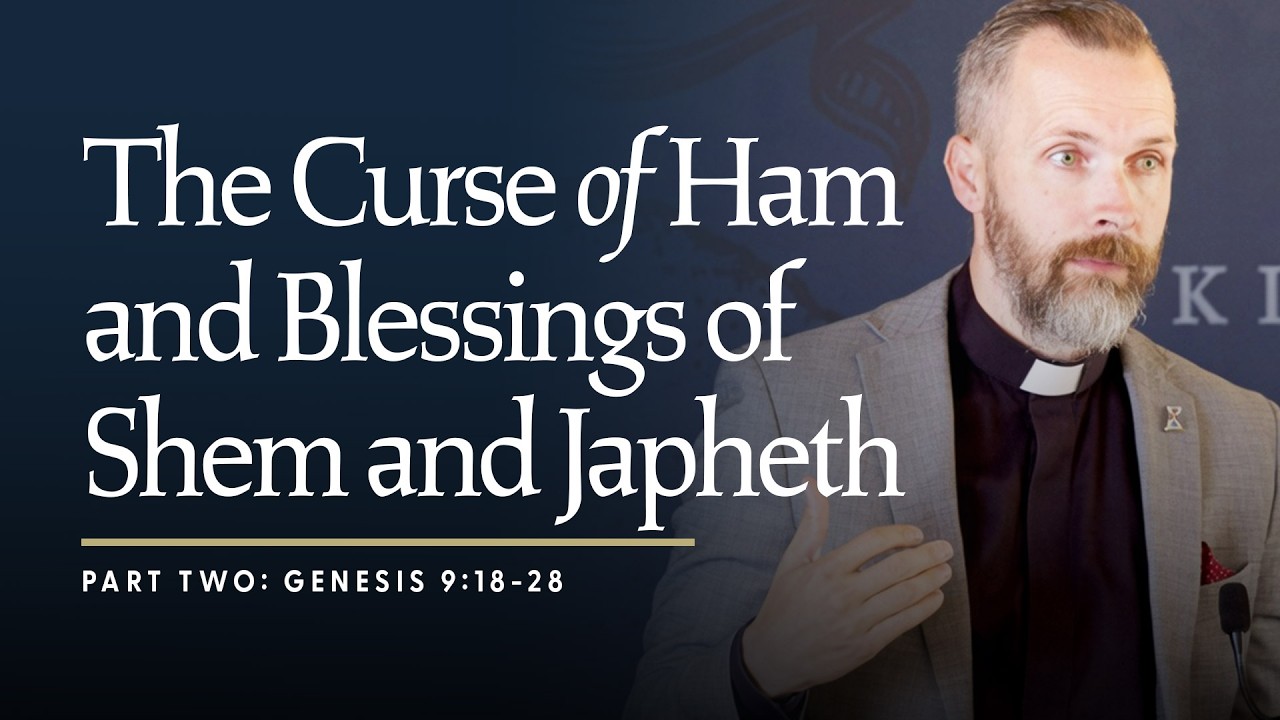
Dale Partridge teaches Genesis 9:18-28 on the origins of nations, arguing for God-ordained order and station and tracing the Curse of Ham.
Key Takeaways
- Scripture presents nations as rooted in the Noahic covenant and the descendants of Noah's three sons.
- God established real distinctions of order and station, which Christians should understand and uphold.
- Human equality before God does not mean the absence of functional distinctions.
- The Curse of Ham passage is interpreted by the speaker as involving serious sexual sin and a lasting generational consequence.
- The speaker's claims about race and nationhood are contested and rest on a contested interpretation of Genesis 9.
What the video covers
- Genesis 9 is presented as the origin of the nations, with Noah and his sons functioning as covenant heads of humanity, a second Adam.
- The speaker argues that the Noah-based account of nations is under attack because it explains reality, order, and station.
- He contends that modern culture rejects order and station out of pride, favoring functional equality over God-given distinctions.
- He claims order brings peace, and that Christians must understand order in marriage, family, church, civil government and the nations.
- He asserts all people are equal before God as image-bearers and fallen in Adam, while God created distinctions of leadership and submission.
- He criticizes the phrase 'the human race' as a modern term downplaying ethnic and racial distinctions, asserting that pre-1940 Christian history recognized three races.
- The sermon examines the Genesis 9 episode where Ham sees Noah's nakedness, reviewing interpretations including mere voyeurism, sexual assault, and maternal incest.
- The speaker argues the episode carries a deeper significance tied to the 'seed' conflict between godly and demonic lines in Genesis, and that Canaan's curse reflects this.
- He links Canaan's curse to later Canaanite wickedness, such as Sodom and Gomorrah, and suggests Ham's descendants carry a remnant of that curse.
- The speaker promises future sermons on the prophecy of Canaan and the Table of Nations in Genesis 10.
Chapters
- 00:00Introduction to Genesis 9 and the origins of nations
- 01:55Noah as second Adam and covenant head
- 03:55Order, station, and the modern rejection of hierarchy
- 07:05Order, peace, and the nations
- 09:00Race, the human race, and nationhood
- 13:20Noah's drunkenness and Ham's offense
- 20:00Interpretations of the nakedness episode
- 28:20Seed conflict, Canaan's curse, and closing prayer
Full Transcript — Download SRT & Markdown
Speaker A
[music] Well, this is Genesis chapter 9. Now, we started Genesis 8 months ago. And so, we've been making our way through this glorious book of the Bible.
Speaker A
Now, today's text is important because it tells us about the origins of the nations. The origins of the nations.
Speaker A
Now, Noah was, in a functional sense, a second Adam. He was a second Adam uh in that he was a head of humanity.
Speaker A
Him and his sons. And they were presented as covenant heads of humanity. If you look to chapter 9 verses 19, it says, "These three were the sons of Noah. And from these people, from these, the people of the whole earth were
Speaker A
dispersed." Now, we also know that God viewed Noah and his sons as covenant heads of humanity because he used that same language that he used with Adam, which was "Be fruitful and multiply and fill the earth." And so, in the same way that we
Speaker A
understand Adam, and it's Well, I should say this. In the same way that it's important for us to understand Adam because it tells us foundational truths about ourselves, it's important for us to understand Noah and his sons because it tells us
Speaker A
fundamental truths about the world and how the world is put together, how the nations have functioned.
Speaker A
Now, like all of scripture, Noah's story is fiercely challenged and rejected in the world. Okay, a simple Google search pulled up an AI response this week for me. And it said, quote, "The concept of dividing the entire global population into the lineages of
Speaker A
Noah's three sons, Japheth, Shem, and Ham, is considered a mythological and obsolete framework." End quote.
Speaker A
So, what we're about to study today and over the next few sermons is under attack and it's under attack because it explains reality. It explains reality but more than that, it explains order and station. Order and station. Now if
Speaker A
there's anything this generation hates more I can't think of something that this generation hates more than order and station. We hate as a as a culture order and station. We are a people of equality, right? That is the banner of
Speaker A
today's generation. Not because we're so virtuous and we just care so much about everybody's equality. No, it's actually because we are so sinful.
Speaker A
We are so sinful. And yes, we are all equal before God, all made in the image of God, all fallen in Adam, all in need of Christ the savior. All of us are equal in that dimension.
Speaker A
But God did not create a world of functional equality. There is not a world of functional equality.
Speaker A
He created a world of distinctions. He created a world of leadership and submission. He created a world of giftedness and ordinary and superior and inferior and sick and well and honorable and dishonorable and wealthy and poor and blessed and cursed.
Speaker A
Every single one of us have felt that reality in our own life. We compare ourselves to one another. We look up and we look down. We have pride and we have humility.
Speaker A
We hate all of these distinctions because we are filled with pride. That is why the world hates these distinctions. It is because of pride. We are unwilling to humbly accept our God-given order and station and the God-given order and station of others.
Speaker A
We don't want to accept that order. The inferior resents having to submit while the superior refuses to lead with virtue.
Speaker A
We covet the place of others, yet we despise those who occupate or occupy those places.
Speaker A
We divide the world into oppressors and oppressed. And what does it do? It creates a world of chaos.
Speaker A
It creates a world of frustration and resentment. It creates a world of conflict among people.
Speaker A
1 Corinthians 14:33 says that God is not a god of confusion, but a god of order and peace.
Speaker A
And I believe it's our responsibility as Christians to bring order to the world. There is nobody else that is going to bring order to the world. You know this, right?
Speaker A
The lesbians are not going to bring order to the world. Okay, the homosexuals and the transgenderism. The Muslims.
Speaker A
The the liberals. They're not going to bring order and peace into the world. They are bringing chaos and disorder and conflict into the world.
Speaker A
And our job is to understand order. And we need to understand order in every dimension of our life, whether that is in marriage, in family, whether that is in the church, whether that's in civil government, whether that's our relationship to
Speaker A
animals, whether that is the order of the nations, the order of geography, the order of how the world works.
Speaker A
Now, we pursue order because what? Order brings peace. Order brings peace. If you want to walk into a household that doesn't understand the biblical order for man and woman, you will find not peace. You will find conflict.
Speaker A
If you want to walk into a church that doesn't understand authority and submission, you will find a place of conflict and chaos. You will not find a place of peace.
Speaker A
And when it comes to the nations, especially with today's mass immigration and the chaos of governments falling and rising and pushing against and revolts and resistance and revolution, there is very little peace.
Speaker A
I think of the statements of the beauty pageants. I want world peace. Well, we want world peace, but we don't want to understand the order that would bring about that peace.
Speaker A
There is little peace because there is little order. If you want order, we must understand the scriptures for God's design for the nations.
Speaker A
In fact, I would argue that the church cannot properly fulfill God's commandment in the Great Commission to disciple the nations if we don't understand what a nation is.
Speaker A
That is very important. And sadly, we know we live in a time that fundamental questions like what is a nation or what is an American or what is a woman cannot be answered.
Speaker A
Well, we know that they can be answered. We just don't want the answers that they provide.
Speaker A
Two days ago, the news claimed that a Dutch man was arrested for planting a bomb in the Netherlands capital.
Speaker A
The man was an immigrant from Egypt. But the media, what they do is they want to have a chaotic understanding of nationhood, of peoplehood.
Speaker A
And so they say they call this man a Dutch man. We know that there was people in Minnesota that were stealing money in the Somali daycares. They would say Minnesota woman got caught stealing money.
Speaker A
Again, the chaos of national order is not because there is no clear answer in scripture, but because we fear the Bible's answer will offend the cultural sensitivities of the people around us.
Speaker A
That is the vast majority of why we refuse to speak the truth on whether it's gender, whether it's family, whether it's masculinity or femininity, whether it's order in the household, order in the world, is because we fear that it
Speaker A
will offend the sensibilities and sensitivities of the culture around us. We fear man more than we fear God, and as a result we get chaos and not order.
Speaker A
And for that reason, most people, especially Christians, do not dare to say the truth out loud.
Speaker A
Now, we are going to cover nationhood more extensively in the table of nations in Genesis chapter 10, which will be the third sermon in this small series on nationhood that I am doing. I'm calling it God's design for nations. But for
Speaker A
now, what we need to know is that all people are equally made in the image of God. All people are born of Adam, they're fallen, they're in need of Christ.
Speaker A
Okay, all people are equal in that capacity. Now, according to scripture, we are mankind, okay? Mankind.
Speaker A
Now, this is important because today many people, especially Christians, have heard this phrase and they say this phrase, "There is one race, the human race." Okay? You may have heard this, "There's one race, the human race." Uh however,
Speaker A
the Bible never uses the term the human race. Uh that is a the phrase the human race is a modern term that is used to downplay the ethnic and racial distinctions that God has providentially created.
Speaker A
The other problem is that all of Christian history testifies against that phrase. All of Christian history prior to say 1940 testifies that there are three races.
Speaker A
There are three races according to scripture. And we encounter this humanity, we have mankind in Adam, and we encounter the first major subdivision of mankind here in this section of scripture, right after the flood.
Speaker A
The three races are made up of Shem, Ham, and Japheth. Shem, Ham, and Japheth, okay? Shem is actually the middle child, and he produced the Shemites, or as we know them today as the Semites.
Speaker A
And is listed first in these genealogies because of the preeminence and the fact that the Messiah comes from the Shemite line.
Speaker A
Ham is the youngest, and we can see that in verse 24. It says that he's the youngest, and he produced the Hamites, which we will talk about in a minute.
Speaker A
And then Japheth, who is the eldest, which you can see in Genesis chapter 10:21, and he produced the Japhethites. Okay, so we have three lines.
Speaker A
Now, in the same way the Israelites were a family, right? We know that they were a family.
Speaker A
Okay, the Israelites were a family, and they descended from one man, Jacob, and essentially Isaac, and essentially Abraham.
Speaker A
But they are one family descending from one man. Okay, in the same way we are going to see three macro families descending from these three men.
Speaker A
And from Shem comes the Jews, the Israelites, and the Arabs, and the other Middle Eastern peoples today. Still to this day they are called Semites or Shemites because they come from Shem.
Speaker A
Now, from Ham comes the African peoples, especially those from sub-Saharan Africa and some of the peoples from India.
Speaker A
Now, from Japheth comes the Europeans, rooted in the Greeks, the Romans, the Celts, the Germans, the Slavs, as well as some northern Asian territories, and even some Hispanics. Okay?
Speaker A
Now, you need to know that very few people struggle being associated with the names Shem or Japheth.
Speaker A
No one really struggles with that. Middle Eastern people still are proudly identified as Semitic today. Europeans have virtually no resistance to the term Japhethite.
Speaker A
But, when it comes to specifically to the Hamitic people, the Hamites, generally the African population, this term is considered discriminatory because they claim it was used to justify historical inequality. Okay? We even uh Wikipedia even says, quote, "Hamites is the name formerly used for
Speaker A
some African peoples in the context of a now outdated model of dividing humanity into different races.
Speaker A
This was developed originally by Europeans in support of colonialism. The term was originally borrowed from the Book of Genesis, in which it refers to the descendants of Ham, son of Noah." And quote.
Speaker A
Now, because of our modern departure from this historical conclusion of this passage, which was held by again, Origen, John Chrysostom, Augustine Aquinas Luther Calvin Matthew Henry, John Gill, okay? Jonathan Edwards, but because of the political correctness of our day,
Speaker A
I conducted all of my research using commentaries and maps and resources prior to the year 1900.
Speaker A
I had to find what was the historical position on this passage of scripture, not what is the modern you know, political correct liberalized version that many churches and scholars have come with today.
Speaker A
Whenever whenever we have done something one way for 1900 years or longer and then all of a sudden in the 1960s we changed our interpretation I go I don't buy it.
Speaker A
I don't buy it. And that happens with so many things, by the way. So, I wanted to know what the historic church and how the historic church interpreted this passage of scripture.
Speaker A
And so, as you will see, the conclusion of this passage of what I'm calling again God's designs for nations hinges on the interpretation of Genesis chapter 9:18-28.
Speaker A
And so, we are going to Well, I'll say this, because Noah prophetic And this is why this is why it all hinges on this.
Speaker A
Noah, as you will see, if you read your had your Bibles open Noah prophetically pronounces a few blessings and a curse upon these three macro families of humanity.
Speaker A
He gives a prophetic blessing upon these three sons. Two get blessings, one gets a curse.
Speaker A
And in these words are clearly prophesied distinctions and stations. One race will be greatly enlarged.
Speaker A
One will carry the Messiah. One will be placed in a position of subordination. Okay?
Speaker A
Now, Deuteronomy 18:21-22 gives us the biblical test of a true prophecy. It says, "When a prophet speaks in the name of the Lord if his words do not come to pass, then it is not of the Lord.
Speaker A
But, if his words do come to pass, and I believe scripture and world history overwhelmingly testifies that it does, we must submit to these words, whether we like them or not.
Speaker A
Now, it all begins with this scandalous passage in Genesis 9:18 through 28. So, verse 18.
Speaker A
The sons of Noah, who went forth from the ark, were Shem, Ham, and Japheth.
Speaker A
Ham was the father of Canaan. These three were the sons of Noah, and from these the peoples of the whole earth were dispersed.
Speaker A
Noah began to be a man of the soil, and he planted a vineyard. He drank of the wine and became drunk and lay uncovered in his tent.
Speaker A
And Ham, the father of Canaan, saw the nakedness of his father, and told his two brothers outside.
Speaker A
Their faces were turned backward, and they did not see their father's nakedness. When Noah awoke from his wine, and knew what his youngest son had done to him, he said, "Cursed be Canaan.
Speaker A
A servant of servants shall he be to his brothers." He also said, "Blessed be the Lord, the God of Shem, and let Canaan be his servant.
Speaker A
May God enlarge Japheth, and let him dwell in the tents of Shem. And let Canaan be his servant." All right.
Speaker A
First, I want you to notice that God does not hide the failures of his people.
Speaker A
Okay, scripture often records dark moments and today is a very dark moment. We see scripture recording Abraham's polygamy.
Speaker A
We see uh scripture recording the deceit of Jacob, the murder of Moses, the adultery of David and here the drunkenness of Noah.
Speaker A
God does not sanitize his saints. Now, second, this is the first mention of alcohol in the entire Bible.
Speaker A
And it is mentioned in the use of abuse. And as we will see, had Noah not been drunk, the tragedy of this entire passage would likely have not unfolded.
Speaker A
And in fact, I would argue in the same way that Eve, her one sin and ultimately Adam's, brought collapse against all humanity because Adam represented all humanity.
Speaker A
Now, Noah's drunkenness and Ham's sin had a similar tragic covenantal effect that affected all that were down from him.
Speaker A
And what this teaches is that in a covenantal framework, upstream patriarchal sin has a massive downstream consequence.
Speaker A
Upstream patriarchal sin has a massive downstream consequence. We can see that with Adam. We can see that here with Noah and with Ham.
Speaker A
You can also see it with Christ in the opposite. Upstream patriarchal righteousness has massive downstream consequences.
Speaker A
Now, I want to focus our attention on verses 21 and 22. The central question of the text is this.
Speaker A
What is meant when it says that Ham saw the nakedness of his father? Saw the nakedness of his father.
Speaker A
And you might be wondering like what why is this so difficult to understand, Dale? This is like it seems like it's pretty clear. He wasn't dressed.
Speaker A
Well, you might not know that this is one of the most debated and discussed passages of scripture in the entire Bible.
Speaker A
Ham just saw his father naked, right? No. No, it is much darker than that.
Speaker A
The reason this passage generates so much discussion is because of the severity of the consequences given in verses 24 and 25. Look at verses 24 and 25.
Speaker A
When Noah awoke from his wine, and knew what his youngest son had done to him, he said, "Cursed be Canaan.
Speaker A
A servant of servants shall he be to his brothers." So, it leaves us with three questions.
Speaker A
Three questions. First, what exactly did Ham do to Noah? We want to know the answer to that question, right? What exactly did Ham do to Noah?
Speaker A
Second, why curse Canaan for Ham's sin? Third, is the curse on Canaan actually a curse on Ham?
Speaker A
All right, today my hope is that I'm going to be able to answer these three questions.
Speaker A
And in my next sermon, I'm going to address three additional questions, which I will reveal at the end of the sermon.
Speaker A
So, let's begin with the first question. What exactly did Ham do to Noah? Now, we are asking this question because of three reasons. Three reasons. Number one, a drunken man lacks awareness of what he's doing.
Speaker A
Let alone the awareness of someone that has seen him naked. Okay? So, the fact that Noah awoke and realized that something had been done to him strongly suggests that more occurred than a mere glance of accidental nudity.
Speaker A
Okay? Number two, the severity of Noah's prophetic curse on Canaan and Ham's line seems to imply a far more serious crime than simply seeing your father uncovered.
Speaker A
And the weight of this kind of prophetic covenantal judgment, I think it suggests a deeper violation against Noah.
Speaker A
Three, scripture never explicitly condemns a child or a relative for accidentally or innocently seeing another person naked.
Speaker A
The Bible nowhere treats nudity as a criminal offense. Okay. Because of these reasons, scholars have generally arrived at three interpretations. And I'm going to present them to you for your consideration.
Speaker A
The first is the view of voyeurism. Voyeurism view, which claims that Ham saw his father undressed, and he mocked him, maybe gossiped about him to his brothers. That's the voyeurism view.
Speaker A
Now, this is the majority modern view, but it's the minority historical view. Okay? And And reason I think it's so popular today is because it is the least intellectually complex conclusion.
Speaker A
And I don't believe that we can think the way that previous generations could think.
Speaker A
It seems to me similar to those that arrive at Arminianism. It sounds right at first glance, but once you start thinking systematically, you realize that it's not.
Speaker A
And if this view is true, it is the only passage in the entire Bible where someone is condemned for visually seeing someone uncovered.
Speaker A
Its weaknesses are this. Its weaknesses are its inability to one, explain the strong language being used.
Speaker A
Two, to explain the severity of the curse. And three, to explain why Canaan was targeted by Noah.
Speaker A
So, it has a lot of weaknesses. The second view is the sodomy view, which claims Ham had sexual relations with his father.
Speaker A
Now, this view and the third view both see the phrase the nakedness of his father as a Hebrew idiom for sexual activity.
Speaker A
Several reformed theologians, including Luther, held this position. The strength of this view is that it explains the severity of the curse and the strong language.
Speaker A
It gives context to Noah's verse Noah's words in verse 24 that says Noah knew what his youngest son had done to him.
Speaker A
Gives you some sharper context there. It gives rational rational explanation for how a drunken man would have known something had been done because he would have physically felt the aftermath of the sexual violation. So, it answers that question, too.
Speaker A
Its weaknesses is that it doesn't explain why the curse was still given to Canaan and not Ham.
Speaker A
The third view. The third view is the maternal incest view. The maternal incest view which claims that Ham had sexual relations with Noah's wife, his mother.
Speaker A
This view is held by E.W. Bullinger, Dr. Michael Heiser, Peter Leithart, uh Roman Catholic scholars Scott Hahn and John Bergsma.
Speaker A
I want to go back to this phrase the nakedness of his father. The nakedness of his father.
Speaker A
And as I said, this is a Hebrew idiom for sexual activity. The term uh uncovering nakedness it's a euphemism throughout the entire Old Testament for sexual intercourse, especially incest or relations with someone biologically forbidden, like a mother sister etc.
Speaker A
I'm going to read you four passages of scripture. Leviticus 18:7-8. You shall not uncover the nakedness of your father which is the nakedness of your mother.
Speaker A
She is your mother. You shall not uncover her nakedness. You shall not uncover the nakedness of your father's wife.
Speaker A
It is your father's nakedness. Leviticus 20:11. If a man lies with his father's wife he has uncovered his father's nakedness.
Speaker A
Deuteronomy 22:30. A man shall not take his father's wife so that he does not uncover his father's nakedness.
Speaker A
Deuteronomy 27:20. Cursed is anyone who lies with his father's wife. Why? Because he has uncovered his father's nakedness.
Speaker A
Now, at first glance, I struggled with this because in our passage it says Ham saw the nakedness of his father.
Speaker A
Not uncovered the nakedness of his father. [snorts] So, I thought, all right, I'm going to be a I'm going to be an exegete here.
Speaker A
It's not the same word. Right? But then I found Leviticus 20:17, which directly links seeing and uncovering as a synonym.
Speaker A
It says, "If a man takes his sister, a daughter of his father, or a daughter of his mother, and sees her nakedness, it is a disgrace, and they shall be cut off in the sight of the children of their people. He has
Speaker A
uncovered his sister's nakedness, and he shall bear the iniquity." So, there you go. It connected seeing as being the same as uncovering.
Speaker A
But there's more verses, and I'm not going to read them because the sermon's already long, but Ezekiel 16:36-37 also links seeing and uh uncovering together, as well as Ezekiel 22:10.
Speaker A
Ultimately, what these passages show is that violating your mother is violating your father. Okay, seeing your father's nakedness is sleeping with your mother.
Speaker A
That's the Hebrew idiom that is being used here. Now why? Well, because under God's law, a wife is one with her husband, right?
Speaker A
One with her husband. So, when you violate her, you violate him. You cannot violate her without violating him.
Speaker A
You cannot see her without seeing him. Now, you might be thinking, uh if this was more than voyeurism, then why does verse 23 of Shem and Japheth say, "Their faces were turned backward, and they did not see their father's
Speaker A
nakedness"? And you might make that, oh, it it sounds like it's a visual crime.
Speaker A
Um to that, I would argue that if the phrase is idiomatic on the front end, then we have to interpret the phrase as being idiomatic on the back end.
Speaker A
And so, when the text says that Shem and Japheth did not see their father's nakedness, it means that they refused to participate in the same sexual crime that Ham did.
Speaker A
Now, the reason I believe this view is the most coherent, has the most explanatory power, is fourfold.
Speaker A
Number one, the Bible has more direct words for homosexuality. Has a specific word for sodomy.
Speaker A
And if the sodomy view were the true view, I think Moses would have used the word for sodomy that he used all throughout the Torah.
Speaker A
So, that's one view, or one point. Number two, uh the idea that Ham would attempt to curse Noah's line by producing illegitimate seed is perfectly consistent with the entire narrative of Genesis and the Old Testament.
Speaker A
Okay? In fact, we see this pattern over and over and over again. Cain, his rebellion, the Nephilim, Abraham's sexual sin with Hagar producing Ishmael, the rivalry between Jacob and Esau.
Speaker A
There is a consistent pattern that there is seeds battling all throughout Genesis, the godly seed and the demonic seed over and over again.
Speaker A
And so this war between the illegitimate and legitimate seeds, it runs throughout the entire Old Testament.
Speaker A
So the idea of Ham committing a sexual sin with his mother to produce a illegitimate offspring, I think it fits squarely within the systematic reading of the Old Testament.
Speaker A
Number three. The Bible sees sleeping with a king's wife as a form of dominance.
Speaker A
Okay, this is what Absalom did to his father David. Absalom publicly slept with his father's concubines on the roof of the palace as a deliberate way to humiliate David and to demonstrate his dominance as taking over the kingship.
Speaker A
Okay, this is a way to disgrace the previous king and establish your own dynasty in royal succession.
Speaker A
That's how the old world thought about these things. And number four and most importantly the maternal incest view is the only view that offers a coherent answer for the curse on Canaan.
Speaker A
Okay? Which leads us to the next question. Why did Noah curse Canaan for Ham's sin?
Speaker A
Canaan wasn't cursed because of what he did. Canaan was cursed because of who he was.
Speaker A
Canaan was the incest child of an illegitimate seed of Ham. That is why Canaan was cursed.
Speaker A
But this leaves us with another question. If Canaan is cursed, what about the consequences for Ham?
Speaker A
Like why punish just Canaan and leave Ham with nothing? Now, in the ancient world, a son was not viewed as an independent individual in the way that we think today.
Speaker A
We are saturated in individualism, and you need to get out of it when you read the Bible.
Speaker A
A son was the extension and public representative of his father. His name, his honor, his shame, uh his future were all bound up in his father's identity. Who is your father?
Speaker A
Very important phrase in the Bible. And this is why the names in scripture often carried their fathers' names. So, you guys know Simon bar-Jonah, right? Literally means Simon, son of Jonah.
Speaker A
When Saul when Saul saw David fighting against Goliath, he didn't ask, "Who is that young man?" No, in 1 Samuel 17:55, he asked, "Whose son is this youth?" "Who is that man's father?" Saul wanted to know the father because
Speaker A
the son represented the father. Starts to make sense a little bit with the Trinity here, right? The son represents the father.
Speaker A
Okay? The glory that David won against Goliath reflected directly back on Jesse, the father.
Speaker A
Now, under God's order to bless So, let just This is very important, okay? Pay attention here.
Speaker A
Under God's order to bless or curse a son was to bless or curse the father.
Speaker A
To bless or curse the son was to bless or curse the father. They are one.
Speaker A
So, this is the key to understanding why Noah cursed Canaan and not Ham directly.
Speaker A
Think about this with me for a second. If Noah had pronounced the curse on Ham, think about this. If Noah had pronounced the curse on Ham, the shame of Ham's sin would have fallen on who?
Speaker A
Himself. Cuz he is the father of Ham. Okay? So, Noah placing the curse on Ham's son, Canaan, the shame and judgment would now fall back on Ham.
Speaker A
Okay, this is again, get our minds wrapped into the old world. In fact, if you look back at verse 18, go to verse 18 in chapter 9.
Speaker A
Moses inserts this point with a parenthetical remark. He says, "Ham was the father of Canaan." Now, just think about this for for a second. To Moses' original audience, he's writing this 900 years after the events that he's talking about.
Speaker A
This is a loaded statement, okay? Everyone knew exactly who the Canaanites were. They were the sworn enemies of Israel.
Speaker A
The wicked inhabitants of Sodom and Gomorrah. Okay? The people whose gross immorality would justify their destruction by Joshua.
Speaker A
So, when Moses wrote Ham was the father of Canaan, he was essentially saying to the readers, "Ham is the father of our enemies." That's basically what he's saying there.
Speaker A
Ham. It was Ham who was the father of our enemies. So, the curse on Canaan was ultimately a curse on Ham.
Speaker A
The curse on Canaan was ultimately a curse on Ham. It was perfect covenantal justice. The fruit was cursed because the root was corrupt.
Speaker A
The fruit was cursed because the root was corrupt. Now, you see, we have to again, we have to kill off this tendency toward uh individualism because in a covenantal framework, there is no disconnecting the curse of Canaan from Ham. It just doesn't work.
Speaker A
So, in this particular event, the direct expression of Ham's curse was Canaan. Okay? The effect was on Canaan.
Speaker A
But, it was only on Canaan because of the already existing evil of Ham. Of Ham.
Speaker A
In other words, while the curse was particularized in Canaan, it didn't stop with him.
Speaker A
Canaan was simply the first and most visible manifestation of this curse on Ham that would flow through Ham's entire line.
Speaker A
So, if Ham, one of the three covenant heads of humanity is cursed. Then his descendants to some degree which I will get into the second and third sermons carry the remnant of that curse.
Speaker A
And scripture and world history testify to that and bear that out. Now the great antagonists of God's people repeatedly come from Ham's line.
Speaker A
If you just do a survey, I'm going to do a very small survey, but if you just do a quick survey of all of the enemies of God's people, they come from Ham.
Speaker A
Babel was the first organized rebellion against God. And it was founded by Nimrod. He was a son of Cush, son of Cush.
Speaker A
That's Ham's other son. Sodom and Gomorrah cities of gross sexual immorality, right? They descended from Canaan.
Speaker A
Egypt Okay, Egypt, Israel's great oppressor and enslaver for 400 years. They came from Mizraim, another one of Ham's sons.
Speaker A
The Philistines the Amalekites the Puts Put is also Ham's other son. Okay, the pattern is clear throughout scripture.
Speaker A
The major enemies of God's covenant people consistently arise from the line of Ham. So the curse of Canaan was not an isolated event.
Speaker A
It was not an isolated event. It was the first and most visible expression of a much broader curse of Ham's line.
Speaker A
Now in my next sermon, what I'm going to do is I'm going to look at the prophecy on Canaan right? A servant of servants you shall be to Japheth and Shem, right?
Speaker A
And I'm going to answer the question, does the servitude only apply to Canaan or does it prophetically extend to all the nations that descended from Ham?
Speaker A
That's the next big question that needs to be answered. And together, we're going to discover why giants of the faith Augustine, Chrysostom, Thomas Aquinas, Luther, Calvin, John Gill. John Gill was the the the He held the pulpit before Charles
Speaker A
Spurgeon. Okay, Matthew Henry, many of the Puritans. They all held this position. That this curse extended not just to Canaan, but to the Hamitic peoples.
Speaker A
And that essentially Japheth and Shem would reign and rule and have leadership over and influence over the Hamitic peoples even to this day.
Speaker A
So, in 3 weeks when I return from travel, cuz I'm going to next week we're going to be at our outside service, and then uh I'll be out of town for a a Sunday. So, on the on the the day that I return,
Speaker A
we're going to examine both scripture and we're also going to examine world history. And we're going to see if Noah's prophecy has come true.
Speaker A
And by God's grace, it will shape how Christians are to think about nationality internationality the world, and order practically, morally, politically, lovingly, and Christianly.
Speaker A
So, that we can understand how to bring order in a Christian way back to the world?
Speaker A
Amen? Amen. Let's pray. Father, we thank you. Lord, that you have given us wisdom from the scriptures. Lord, that we ask that you would help us to be humble.
Speaker A
Lord, that we would look with open eyes that we would see the testimony of your saints, the testimony of history, and the testimony of scripture.
Speaker A
Lord, that you would give us a desire to know the truth. Lord, that we might speak the truth in love.
Speaker A
And that we might rule according to your son, Christ. We ask all these things in the name of Jesus. Amen.
Topics:Genesis 9Curse of HamNoahnationsTable of Nationsorder and stationcovenant headshipCanaanbiblical interpretationDale Partridge