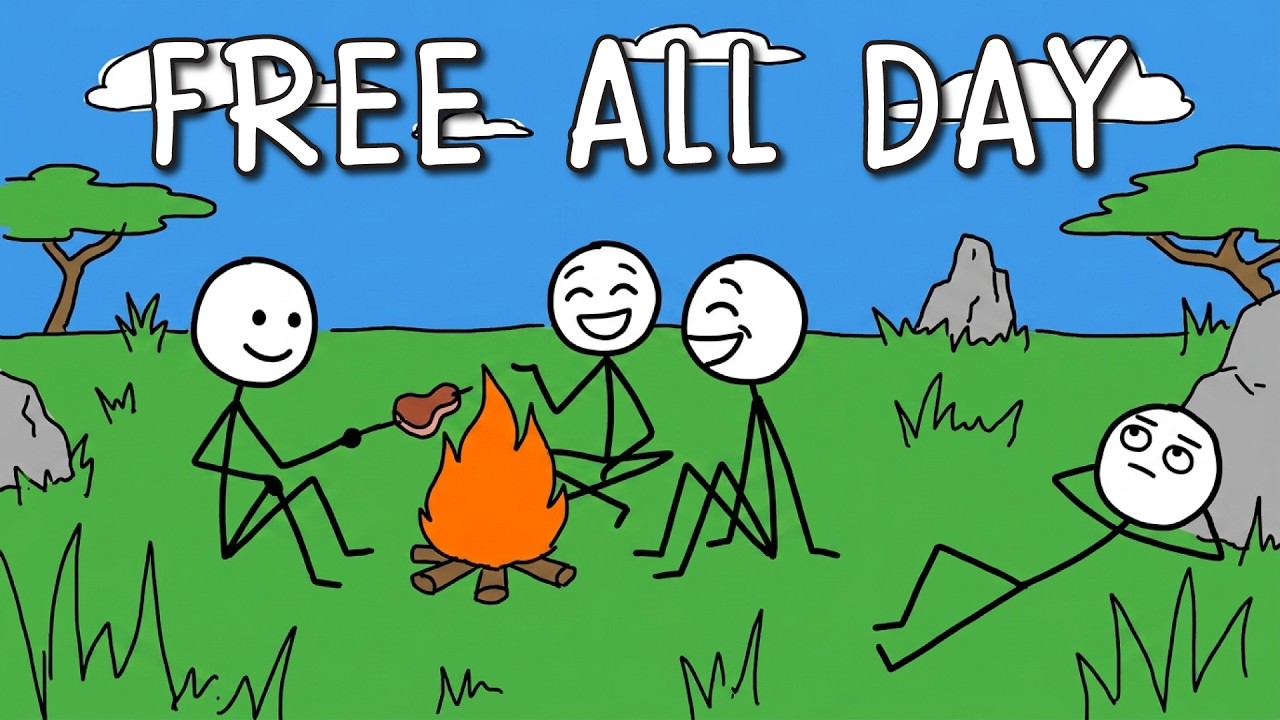
Explores how ancient humans managed boredom through socializing, play, creativity, and natural rhythms without modern distractions.
Key Takeaways
- Boredom is an ancient, adaptive brain mechanism that promotes exploration and creativity.
- Social interaction and play were primary ways ancient humans alleviated boredom.
- Creative activities like crafting served as engaging outlets during free time.
- Modern technology provides instant relief from boredom, unlike the natural challenges faced by ancient humans.
- Periods of quiet wakefulness in segmented sleep offered unique opportunities for reflection and thought.
What the video covers
- Ancient humans spent only 2-3 hours daily on survival, leaving much free time to fill without modern stimuli.
- Boredom is a psychological state causing discomfort and restlessness, pushing for engagement and exploration.
- Evolutionarily, boredom encouraged exploration and prevented complacency, an adaptive trait shared with animals.
- Modern humans have instant digital escapes for boredom, unlike ancient humans who had to engage in real activities.
- Social proximity regulated restlessness; ancient humans spent resting hours in close, social interaction.
- Play, including gambling and games, was a common leisure activity that created meaningful engagement.
- Artifact decoration and crafting were leisure activities that engaged the mind and hands creatively.
- Boredom triggers inward mental activity such as daydreaming and imagination, fostering creativity and complex thinking.
- Ancient humans’ quiet moments likely led to early scientific, religious, and philosophical inquiries.
- Humans historically had segmented sleep with wakeful periods that provided natural, boredom-induced reflection time.
Chapters
- 00:00Setting the Scene: Ancient Free Time and Boredom
- 00:42How Ancient Humans Filled Their Time
- 01:07The Nature and Psychology of Boredom
- 01:45Evolutionary Role of Boredom
- 02:53Boredom in Animals and Ancient Humans
- 03:22Socializing as a Boredom Solution
- 04:15Play and Games in Hunter-Gatherer Societies
- 05:26Creative Making and Crafting
- 06:03Boredom and Creativity
- 07:17Ancient Intellectual Life and Segmented Sleep
Full Transcript — Download SRT & Markdown
Speaker A
You're sitting on the ground. The hunt finished three hours ago. Everyone ate, the fire is going. The sun won't set for another four hours. You have absolutely nothing you need to do right now. No phone, no video, no book, no one texting you. Just you, a fire, some people you've known your entire life, and the afternoon stretching out in front of you with nothing in it. What do you do?
Speaker A
For 99% of human history, this was a real situation that happened constantly. Hunter-gatherers spent roughly 15 to 20 hours a week on survival. The Hadza of Tanzania, the Agta of the Philippines, the Batek of Malaysia, every group anthropologists have studied came back
Speaker A
with essentially the same number. Somewhere between two and three hours of actual work per day, sometimes less.
Speaker A
Which means ancient humans had a staggering amount of time that needed to be filled with something. And the question of how they filled it, and whether what we call boredom even existed for them, is one of the most
Speaker A
genuinely interesting things you can ask about ancient human life. And almost nobody asks it. Here's the thing.
Speaker A
Boredom, as you experience it right now, is not just having nothing to do. It's a specific psychological state, defined by psychologists as the aversive experience of wanting, but being unable to engage in a satisfying activity.
Speaker A
That word aversive is the key. Boredom hurts slightly. It's uncomfortable. It makes you restless, irritable, and desperate for stimulation.
Speaker A
A 2014 study at the University of Virginia found that many participants would rather give themselves mild electric shocks than sit alone with their thoughts for 15 minutes. Not because the thoughts were bad, just because the emptiness was unbearable.
Speaker A
That study was conducted on modern humans. And modern humans are a very specific kind of animal.
Speaker A
One that has spent the last several thousand years in environments specifically designed to fill every available moment with stimulation and whose brains have adapted to expect it.
Speaker A
Whether an ancient human sitting by a fire 50,000 years ago experienced the same uncomfortable restlessness you feel when your internet is down is a genuinely open question. And the answer changes what you think boredom actually is.
Speaker A
Evolutionary psychologists have a clear position on this. Professor Brian Little at the University of Cambridge describes boredom as the evolutionary engine of exploration. His argument is that the capacity to feel bored was naturally selected because it pushed our ancestors out of complacency
Speaker A
at exactly the right moments. Contentment in evolutionary terms is dangerous. An animal that settles into comfortable routine stops exploring, stops looking for new food sources, stops checking the next valley over.
Speaker A
Boredom is the brain's way of saying, "You could be doing more. You should be doing more. This is not enough. Go." This means boredom isn't a side effect of modern life.
Speaker A
It's a feature of the human brain that is extremely old. Animals show boredom-like states, too.
Speaker A
The stereotypical pacing of zoo animals, the frustration of rats in empty cages, the underlying mechanism is ancient.
Speaker A
What changed with modern humans isn't the capacity to feel bored. It's how much stimulation we have available to immediately solve it. For the first time in evolutionary history, the feeling of boredom, designed to push you toward effort and exploration, can be silenced
Speaker A
in five seconds by picking up a phone. The restlessness fires. You reach for the device. Done.
Speaker A
No exploration required. Ancient humans didn't have that escape hatch. When the restlessness fired, the only way out was something real.
Speaker A
So, what did they actually do? The first thing, and the most consistently documented thing, was simply be with other people.
Speaker A
Anthropologist Kim Hill, who has spent decades studying the Aché of Paraguay, describes the resting hours between active foraging periods as intensely social.
Speaker A
People sitting close together, grooming, talking, watching each other, telling stories about what happened that morning. Not organized activity, not a plan, just proximity.
Speaker A
For an animal that evolved in groups of 25 to 50 people, being near other members of the group is inherently regulating. The nervous system settles.
Speaker A
The restlessness that might otherwise become boredom gets absorbed into the background hum of other people's presence. This is why solitary boredom feels so much worse than boredom in company.
Speaker A
Your brain isn't built for alone. The second thing was play. Not children's play specifically, adult play.
Speaker A
Anthropologist David Graeber noted that hunter-gatherers got for free many of the things we pay for: entertainment, music, storytelling, dispute resolution, education. These weren't scheduled, they emerged naturally in the hours when nothing else needed doing. The Hadza, studied extensively by anthropologist
Speaker A
Frank Marlowe of Cambridge University, are documented gamblers. They devote significant leisure time to games involving throwing discs at a target, and the same competitive games appear in ethnographic accounts of groups across Africa, Australia, and South America.
Speaker A
Gambling and games are one of the oldest documented human pastimes precisely because they solve the boredom problem in a specific way.
Speaker A
They create artificial stakes, artificial tension, artificial uncertainty. They give the brain something that feels like it matters even when nothing needs to matter right now.
Speaker A
Then there was making things. The archaeological record is unambiguous about this. The elaborately carved spear throwers found across prehistoric Europe are far more decorated than they needed to be to function. The designs on pottery, the patterns on tools, the
Speaker A
beads drilled through shells that someone carried 40 km specifically to collect, none of this was required for survival.
Speaker A
The most parsimonious explanation, and the one most archaeologists accept, is that people made these things in their free time because making things is inherently engaging. The hands need something to do. The mind needs a problem to solve. Carving a pattern into
Speaker A
a bone or weaving a specific design into a basket is exactly the kind of moderately challenging, progressively improving activity that fully occupies human attention without requiring anyone to organize it.
Speaker A
Psychologist Sandi Mann at the University of Central Lancashire has researched what happens when people are given boring tasks and then asked to be creative. The bored group consistently outperforms the engaged group on imagination tasks. Her explanation is that boredom forces the mind inward,
Speaker A
into daydreaming, into making connections between unrelated things, into what psychologists call mind wandering, which is now understood to be one of the most cognitively productive states a brain can enter.
Speaker A
When you're not focused on a specific task, your default mode network activates and starts doing something that focused attention suppresses. It starts connecting things that don't obviously go together. It simulates future scenarios. It processes social information. It generates ideas. Ancient
Speaker A
humans sitting around a fire with nothing specific to do were, on a neurological level, doing some of the most sophisticated thinking human brains are capable of.
Speaker A
The person who lay on their back looking at clouds and started wondering why the sky was blue or how the river got to the sea or what happened to people after they died.
Speaker A
That person was in the grip of evolved productive boredom. And those questions, followed seriously, eventually became science and religion and philosophy. The entire edifice of human intellectual life may have started with someone who was sufficiently bored to ask a question that had no immediate
Speaker A
practical use. There's one more thing the ancient world had that ours almost completely lacks. Historian Roger E.
Speaker A
Ekirch of Virginia Tech has documented that before artificial light, humans slept in two phases.
Speaker A
First sleep of roughly four hours, then a wakeful period of one to two hours in complete darkness, th
Speaker A
First sleep of roughly 4 hours, then a wakeful period of 1 to 2 hours in complete darkness, then second sleep for another 4 hours. During that middle period, people lay in the dark with nothing to do and nothing to see. No one
Speaker A
could work, no one could socialize effectively. The darkness imposed enforced stillness. Historical accounts describe the wakeful middle hours as a time of quiet reflection, prayer, conversation with a partner, or simply lying in the dark thinking. The philosopher Michel de Montaigne
Speaker A
described it as the sweetest hours of the day. Medieval medical texts recommended it as the ideal time for reflection because people were physically rested but mentally alert in a way that differed from ordinary waking consciousness.
Speaker A
This middle-of-the-night period of quiet wakefulness, imposed by darkness and the rhythm of the natural world, was built into human life for hundreds of thousands of years.
Speaker A
It was unavoidable boredom. It was also consistently described as valuable. We eliminated it with electric light. We filled it with screens. We solved the boredom completely and immediately every time it appeared, and we may have lost something important in doing so. The
Speaker A
brain you are using right now is not a modern brain. It is an ancient brain living in a modern world. It evolved to be bored regularly, to find that boredom uncomfortable, to push itself toward exploration and creativity and
Speaker A
connection to escape it. Every time you feel the familiar restlessness of a quiet moment and reach for your phone before the feeling has finished speaking, you're cutting off a signal your brain has been sending for hundreds of thousands of years. A signal that for
Speaker A
most of human history was answered by sitting with someone, making something, playing a game, or lying in the dark thinking about nothing in particular.
Speaker A
Ancient humans didn't handle boredom. They let it do what it was designed to do. And what it was designed to do turned out to be everything that makes us human.
Topics:ancient humansboredomhunter-gatherersevolutionary psychologysocial behaviorplaycreativityanthropologyhuman historymental states