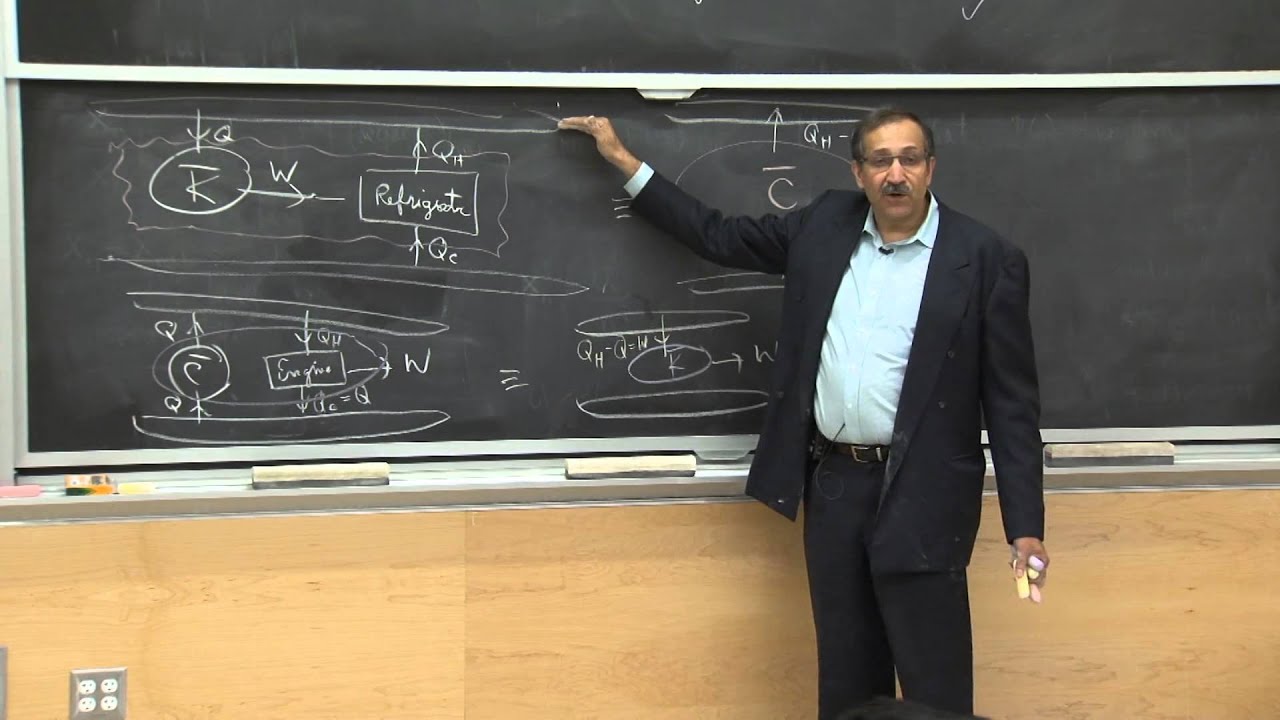
MIT lecture on thermodynamics covering system properties, laws, Carnot engines, Clausius theorem, and entropy.
Key Takeaways
- Thermodynamic systems require both mechanical and thermal descriptions to fully characterize their states.
- The second law introduces directionality in heat flow and limits engine efficiency.
- Carnot engines represent the ideal reversible process with maximum efficiency dependent only on temperatures.
- Clausius's theorem provides a fundamental inequality involving heat and temperature over cyclic processes.
- Entropy is a key state function derived from these principles, governing the spontaneity of processes.
Summary
- Introduction to thermodynamic systems combining mechanical and thermal properties.
- Discussion on equilibrium states and defining system variables like pressure, volume, temperature, and energy.
- Explanation of work and heat exchange, emphasizing slow processes to maintain equilibrium.
- Introduction of the second law of thermodynamics and heat flow directionality.
- Description of engines, efficiency, and the special role of reversible Carnot engines.
- Derivation and significance of Clausius's theorem for cyclic processes involving heat and temperature.
- Clarification on temperature definition during non-equilibrium processes and its relation to heat exchange.
- Exploration of entropy, its calculation, and its role in thermodynamic transformations.
- Discussion on independent variables and functions like Gibbs free energy in thermodynamics.
- Q&A addressing chemical potential, variable dependence, and mathematical foundations of thermodynamic functions.
Chapters
- 00:00Introduction and system properties in thermodynamics
- 02:21Mechanical work and energy functions
- 05:47Reversible processes and Carnot engines
- 09:03Heat exchange and Clausius theorem
- 12:01Proof and implications of Clausius theorem
- 14:45Audience questions and clarifications
- 18:25Entropy and thermodynamic potentials
- 21:41Mathematical foundations and variable dependence