Zyonic develops a new Roblox game, shares his process, challenges, and growth, proving success is not just luck.
Key Takeaways
- Success in game development requires persistence and continuous improvement, not just luck.
- Player feedback and playtesting are crucial at every stage of development.
- Innovative mechanics and smooth gameplay enhance player engagement.
- Leveraging AI tools like Meshie can significantly speed up asset creation.
- Organic growth can outperform paid ads if the game is refined and supported well.
What the video covers
- Zyonic reflects on his first successful Roblox game and questions if it was luck or skill.
- He starts a new game project inspired by a physics mechanic involving Align Position for dodging.
- Develops smooth movement mechanics including running, double jump, and dodging.
- Implements a round system with balls controlled by Align Position and complex hit detection.
- Adds long-term progression with upgrades, tool crates, and monetization features like game passes.
- Uses AI tool Meshie to quickly create and export 3D assets, improving development efficiency.
- Conducts extensive playtesting with fans and iterates based on feedback throughout development.
- Runs ad campaigns to grow player base but initially struggles with low engagement and dislikes.
- Turns off ads to focus on organic growth, leading to a surge in concurrent users and game popularity.
- Rejects a $24,000 buyout offer to continue developing the game independently, resulting in sustained growth.
Chapters
- 00:00Reflecting on First Success and New Game Idea
- 00:34Early Testing and Align Position Mechanic
- 01:01Fine-Tuning Movement and Hit Detection
- 01:34Adding Upgrades and Tool Crates
- 02:06Monetization and Development Challenges
- 02:39Using Meshie for 3D Asset Creation
- 03:47Playtesting and Community Feedback
- 04:14Ad Campaigns and Initial Struggles
- 05:19Turning Off Ads and Organic Growth
- 05:56Buyout Offer and Decision to Continue
Full Transcript — Download SRT & Markdown
Speaker A
One year ago, I released my first successful game. It got millions of plays, and it was great, but it made me wonder, was this just luck or could I do it again? So, about three months ago, it's the spring semester of my sophomore year
Speaker A
in college, and I'm still spending a lot of my time working on Manhunt, my old game, releasing updates and events to keep the game active. But I was getting more and more eager to start a new project. I wanted to apply what I
Speaker A
learned from growing Manhunt to a fresh new game. And I had a game idea that had been stuck in the back of my mind for months. You see, while I was messing around in Studio with some different physics, I discovered that you could use
Speaker A
an Align Position to make a part follow you around, and that dodging it was actually pretty fun. What you're seeing right now is the early testing phase of this, but I thought the idea would be cool and had some potential, so I got to
Speaker A
work. To start, we would need a movement system, one that felt smooth and satisfying to use. So, we added running, double jump, and of course, dodging.
Speaker A
That would end up being the theme of this game. After that, I created a round system that would put you in a map and spawn balls in that you could dodge.
Speaker A
These balls were controlled by an Align Position, and they still are today, but I went on to do a bunch of fine-tuning and changed up their movement a bunch to be quite a bit more complicated. Now that that's done, it's time for hit
Speaker A
detection. And you might think that that's simple, but no. I actually wrote down three full paragraphs talking about this, and I am not going to be reading that, uh, just because I know 90% of you guys are clicking off. I do. So, I'm not
Speaker A
going to nerd out. Just know that it was complicated, and it took a few days to get just right. Little annoying, but we move on. And with the game's main gameplay loop roughly done, we now need something for the players to work
Speaker A
towards long term. So, I started with upgrades. Players can earn cash to upgrade their movement and win more rounds. [music] And then I added tool crates so players can gamble, of course.
Speaker A
They can unlock tools, which make gameplay more fun and less repetitive. And this was the point where I just grinded out tools, okay? We got guns. We got swords. We got bananas. We got freaking jetpacks. And all of that made
Speaker A
it so that now we have a way for players to progress in the game that's fun and exciting. And after this, I focused on the lobby, adding a spinner wheel for more gambling, a leaderboard for grinding, and an obby, which later I
Speaker A
removed and turned into a practice area. And of course, I added some monetization, you know, some game passes and some developer products. But yeah, obviously I'm summarizing and skipping over a lot of development. Honestly, development took about a month, but I
Speaker A
did this while I was still in college dealing with classes and also working on Manhunt, so it was for sure a grind. But I honestly had a bunch of confidence in this game idea 'cause I personally found it
Speaker A
[music] very fun. But first, if you've ever tried making your own 3D assets for a game, you know how much time it can take to model and texture everything from scratch. That's why I've been using Meshie, an AI tool that lets you turn an
Speaker A
idea or even just an image into a complete 3D model in minutes. And the process is actually really simple.
Speaker A
First, I give Meshie a text prompt or upload an image of the asset that I want, then Meshie generates a 3D model, and once I'm happy with it, I can export it directly into tools like Blender, Unity, or Unreal. For example, I can
Speaker A
take this 2D concept art, upload it using Meshie's image to 3D, and Meshie turns it into an actual 3D asset. One of the biggest improvements with Meshie 7 is how accurately the geometry and textures match the original image.
Speaker A
Details, patterns, and the overall art style are preserved much better across the model, even when you rotate around and look at it from different angles. It also has smart topology, which automatically separates the model into clean individual parts and lets you
Speaker A
control the poly count depending on what you need for your game. And if you're trying to create an entire set of assets, Meshie's 3D agent can lock in one art style and match it across different props, characters, and
Speaker A
environments. So everything actually looks like it belongs in the same game. So instead of spending hours creating every asset completely from scratch, you can go from an idea or a 2D image to something you can actually start using
Speaker A
in your game incredibly fast. If you've got an idea, mesh it now and get 50% off using my link in the description. Huge thank you to Meshie for sponsoring this video. Let's get back to it. And another thing I didn't mention is that
Speaker A
throughout development, I was doing a ton of playtesting with fans from my Discord servers. This is super important, especially if you're a solo developer. So, make sure that at every step in development, even when the game is at its most basic, unpolished stage,
Speaker A
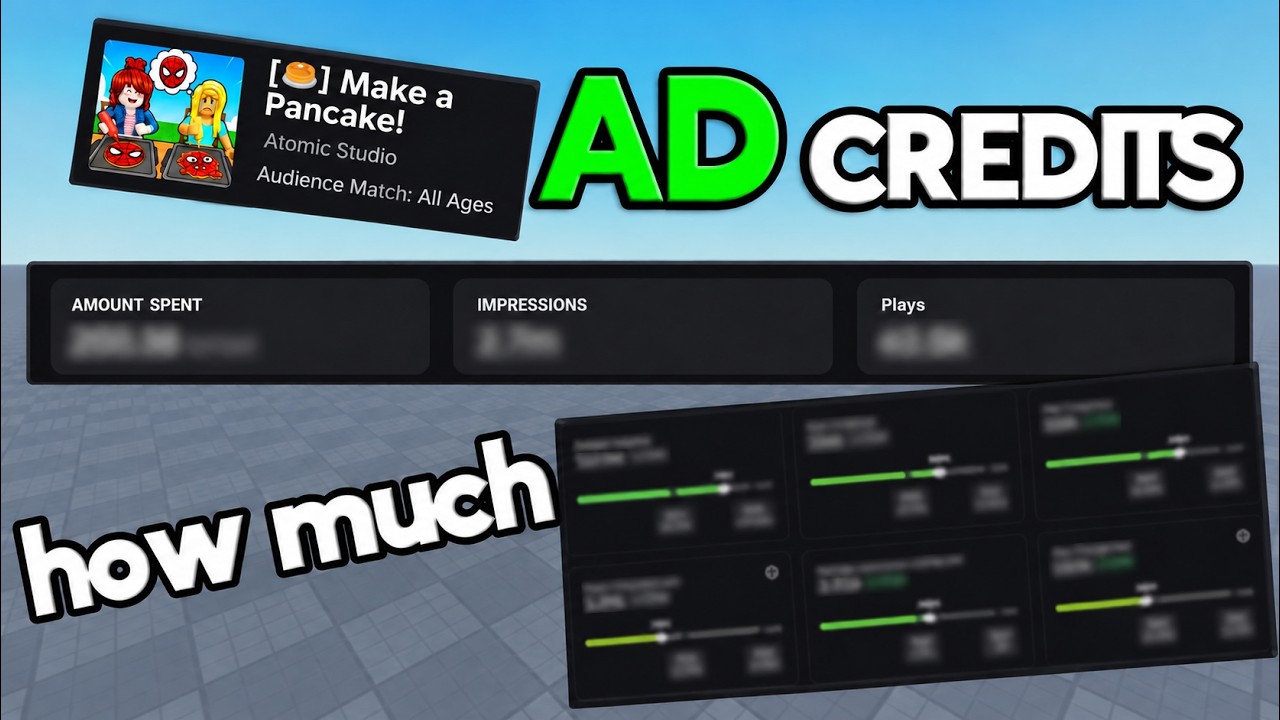
you are getting feedback from your friends and other developers. So, with the spring semester coming to an end, and the game done for the most part, it was time to start ads. I put 280 ad credits in to start for what I think was
Speaker A
seven days. And as the ads ran, I did not stop improving, okay? Every day, I would get a list of things I needed to improve, and I would try my best to improve [music] it. You cannot release a
Speaker A
game and just expect it to take off on its own, right? You need to constantly be improving it. And the game was doing okay. We were averaging about 50 concurrent users, and the metrics were not the best, but I was still hopeful,
Speaker A
okay? Because everybody knows your players are just going to be worse in that initial stage, because they don't know your game, and they're all just joining from an ad. And on top of that, the dislike ratio was pretty insulting.
Speaker A
But I was making sure to constantly listen to player feedback and just keep pushing out update after update, no matter what. And then, the first week of ads ran out. We were still barely getting any home wrecks, which,
Speaker A
honestly, was really scary. So, I decided to run two more campaigns over the next week, in hopes it would finally catch the algorithm. It didn't, not at all.
Speaker A
[music] And it had now been two weeks. The home wrecks were low, and I was getting very seriously worried. But I had been here before, okay? If you watched my Manhunt video, it did the exact same thing, where I thought it was a total flop
Speaker A
right before it slowly took off. So, I knew I had to take a risk and turn the ads off. When I turned them off, the CCU dropped. But day after day, the metrics slowly climbed. And when the metrics
Speaker A
grew, the CCU followed. And the game began to blow up quickly. Home wrecks were coming in higher every day. CCU was booming. The weekend came, and the game peaked at 900 concurrent users. And with this increase in players came some
Speaker A
offers. I'm not going to name any studios in specific, but one studio ended up offering me $24,000 for 70% of the game, and they would handle everything for me. I wouldn't have to keep putting in hours working on
Speaker A
the game. This was a lot of money, and considering the metrics were very mid, it might just be the best option. It would allow me to work on more projects, and I had a very hard decision to make,
Speaker A
which I was seriously very indecisive about for days. I was going back and forth, you know, do I take the money and work on something else, or do I double down on the project and go all in?
Speaker A
I decided to not take it, okay? I decided to bet on myself and the game that I've been working hard on. I turned down that offer. I told them no. I put together a plan to grow the game
Speaker A
further, and over the next few days, the game, the game dropped, yeah. Its CCU was just tanking, okay? All of our momentum had stopped. The metrics were looking worse, and not going to lie, it was definitely at this point where I felt
Speaker A
horrible for not taking
Speaker A
and at the end of the week, the game just started taking off, all right? It just started killing it. Almost out of nowhere, it gained that momentum again, and it took off. And me, I was quick to feed that fire, adding a battle pass,
Speaker A
clans, more tools, more cosmetics, and the game continued growing. It's been about 2 months now since the game released, and I couldn't be happier that I did not sell. Right now, the game has 5,000 concurrent users, and it's a
Speaker A
freaking Wednesday night, dude. Insane insane stuff, and it's been doing that for weeks now. Last weekend, we peaked at over 7,000 concurrent users, and the game just hit 20 million visits. It has honestly been a crazy journey so far,
Speaker A
but honestly, I have loved working on the game, and it's been an absolute dream come true. And on top of that, I've been learning a ton. So, take this as inspiration that it can be done as a solo developer. If you put the work in,
Speaker A
it will be worth it. I promise you. And if there's one thing that you take away from this, know that you need to keep learning and improving your game. Find an idea, prove it works by play testing, and do not give up on it. If you want to
Speaker A
check out Dodger Dot, link will be in the description of this video. Thank you so much for watching. Goodbye.
Topics:Robloxgame developmentindie gamegame designplaytestinggame monetizationAI 3D modelingMeshiegame marketingZyonic