Skip to content
Get App

How Did Samurai Survive Winter in Paper Houses?

How samurai survived freezing Edo winters in paper houses: heating the person with braziers, layered padded clothing, warm stones, and hot baths.

Key Takeaways

  • Japanese winter survival relied on a system of personal heating, layering, and body-focused strategies rather than heating rooms.
  • Architecture designed for summer ventilation made winters extremely cold, forcing residents to adapt through clothing and portable heat.
  • The same fire sources that kept people warm were also the greatest threat to entire cities, as shown by the major fires of the era.

What the video covers

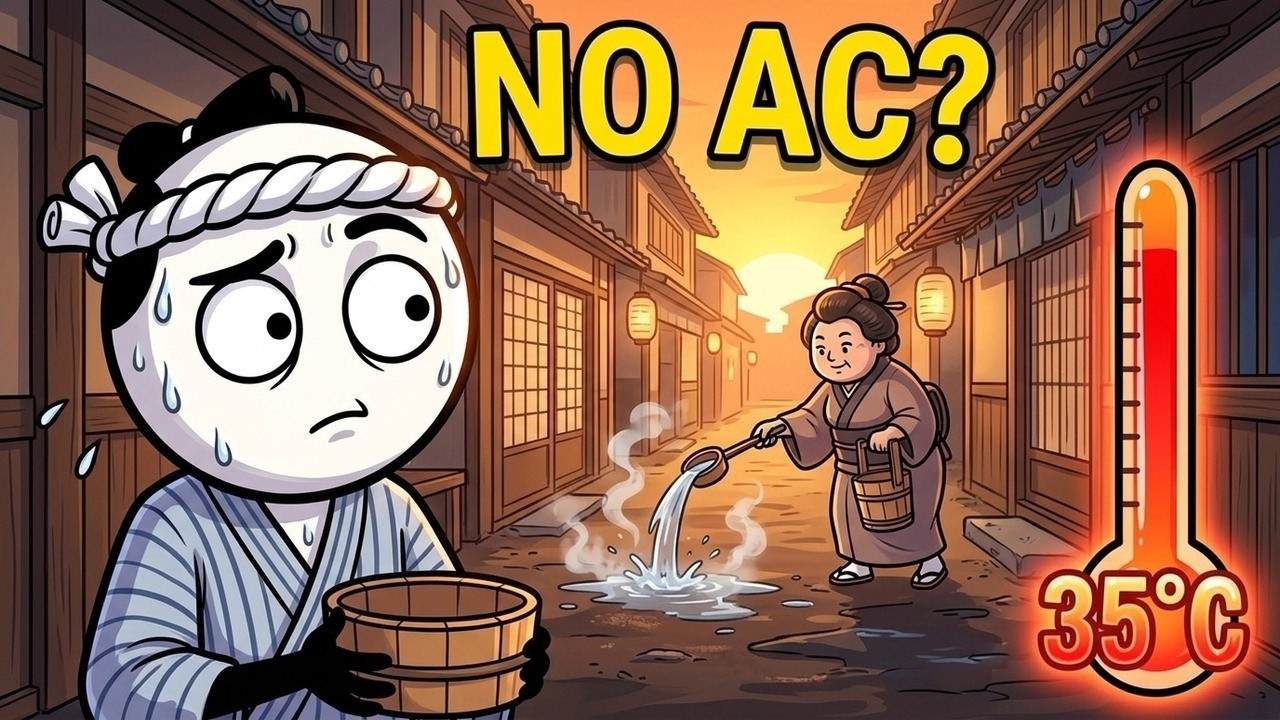
  • Edo-period houses were built for summer ventilation, with paper walls, wood construction, no glass windows, no insulation, and no central heating.
  • Japanese winter survival focused on heating the person rather than the room, shrinking the area that needed warmth to hands, feet, and chest.
  • Samurai slept in a yogi, a padded garment worn like a kimono that sealed out cold air around the neck and sleeves.
  • The hibachi, a low charcoal brazier, was the main heat source; it burned with little smoke and was kept indoors beside people.
  • Layered cotton-padded kimono, momiki leggings, and tabi socks were worn under stiff formal ceremonial clothing, which did not change with the season.
  • Scarves were considered a sign of elderly, monastic, or sick status, so healthy young samurai avoided them to keep their dignity.
  • Warm stones (unjaku) heated in the fire and tucked into clothing, and later metal ash warmers, provided portable heat.
  • Public bathhouses were common because home baths required large fires that posed serious fire risk in wooden cities.
  • Winter fires were a major hazard, culminating in the Great Fire that burned for three days and reshaped the city's layout and fire breaks.
  • Sword protection from wet snow and cold and winter training such as barefoot practice were part of the seasonal samurai routine.

Answers

Questions about this video

What was a yogi and how did it keep samurai warm?

A yogi was a large padded garment worn like a kimono that was used as bedding. Its shaped collar and sleeves kept cold air from getting in around the neck and arms, unlike a flat blanket.

Why did samurai avoid wearing scarves in winter?

According to the transcript, scarves were mostly associated with retired elders, monks, or the sick. A healthy young samurai wearing one would appear weak, so they preferred to stay cold rather than lose dignity.

How did the Great Fire affect Edo?

A winter fire spread across the city on the wind and burned for three days. The disaster led to rebuilding with wider streets and fire breaks, and the main keep of Edo Castle was never rebuilt.

Full Transcript — Download SRT & Markdown

00:00
Speaker A
You wake up in the dark and the first thing you see is your own breath. Not outside, inside your bedroom. A thin white cloud rises from your face and fades into the black. You reach for the water basin by the door and your fingers
00:14
Speaker A
hit something hard, a skin of ice. Between you and the winter night, there is a wall made of thin wooden lattice and paper. Actual paper. And in about an hour, you are expected to walk to the castle in formal clothes and sit at your
00:29
Speaker A
post like nothing is wrong. It is the middle of winter in Edeto, the Shogun's capital, a city of around a million people, one of the largest cities on Earth. You are a young samurai. And almost every house in this enormous
00:43
Speaker A
city, including yours, was built to be cold. That is not an accident. Around 700 years ago, a Japanese monk named Yoshida Kenko wrote one of the most famous lines ever written about Japanese houses. A house, he said, should be
00:59
Speaker A
built with summer in mind. In winter, you can live anywhere. And for centuries, Japan took that advice seriously. Houses were designed to let air move through them, to survive brutal, humid summers, to breathe, which is wonderful in August and a serious
01:15
Speaker A
problem right now. So, how do you get through this day? How did samurai, men who were expected to be sharp, disciplined, and ready at all times, get through freezing winters in houses made of wood and paper with no central
01:28
Speaker A
heating, no glass windows, no insulation, and no electricity at all. The answer is not one clever trick. It is a whole system. And it only worked because three things worked together.
01:40
Speaker A
where the heat came from, what you wrapped around your body, and what you did to the body itself. Break any one of those links, and winter wins. And keep something in the back of your mind as we go. The thing that kept you warm all
01:53
Speaker A
winter was also the thing most likely to destroy your entire city. I will show you exactly how a little later. And there was one snowy morning when a perfectly sensible winter habit cost one of the most powerful men in Japan his
02:06
Speaker A
life. We will get to that, too. So, let us go through your day from the moment you open your eyes to the moment you fall asleep. Because every hour of a samurai's winter had its own small battle with the cold. It starts right
02:19
Speaker A
where you are, in bed. You did not sleep under a flat blanket the way most of us do. You slept inside something called a yogi. A yogi is basically a giant kimono with sleeves and a collar stuffed with
02:31
Speaker A
cotton. You did not lie under it. You wore it. You slid your arms into the sleeves and pulled it up around your shoulders. Because of that shaped collar and those sleeves, the cold air could not sneak in around your neck the way it
02:44
Speaker A
does under a normal blanket. You did not just sleep under your bedding. You wore your bedding. Which is exactly why getting up is the hardest part of the day. Because the moment you slide your arms out of those sleeves, you are
02:57
Speaker A
standing in a room that is not that much warmer than the street. Look around and you will understand why. Your house is mostly wood, plaster, straw, and paper.
03:07
Speaker A
The floor is raised off the ground so air can flow underneath and keep the house dry in summer. The sliding doors and screens are covered in paper. Light comes in through paper. Wind comes in through every gap between them. There is
03:20
Speaker A
no glass in the windows. There is no insulation in the walls. In summer, the whole house works like a giant fan. In winter, it is basically a very elegant tent. and Edeto winters were real winters. The Edeto period overlaps with
03:35
Speaker A
what climate historians call the Little Ice Age, a long stretch when much of the Northern Hemisphere ran cooler than it does today. Artists of the time painted snow in Edeto again and again. Snow on the rooftops, snow on the bridges, snow
03:50
Speaker A
piled on the castle walls. So, you cannot heat the house. Nobody can. What do you do? This is the most important idea in this entire video. Japanese winter living was not about heating the room. It was about heating the person.
04:05
Speaker A
That sounds like a small difference. It is not. Heating a room means fighting the entire outside world through every paper wall. Heating a person means you only have to win a much smaller battle.
04:18
Speaker A
A few centimeters of air around your hands, your feet, your chest. Everything in your winter is built around that one idea. So, the first thing you do is find the fire. In a big country house, that fire would be theori, a square pit cut
04:33
Speaker A
into the floor and filled with ash with a fire burning in the middle and an iron pot hanging over it from a hook in the ceiling. The family sits around it on the floor, cooking, talking, warming their hands and feet. Over the years,
04:46
Speaker A
the smoke turns the roof beams black and glossy. In winter, the idi was the heart of the house, the one place everyone gathered because it was the one place that was actually warm. But you live in the city. And in the city, the fire
05:00
Speaker A
usually lived in something smaller. The hibachi. A hibachi is a braier, a heavy bowl or box lined so it will not burn.
05:08
Speaker A
Filled with ash with a few pieces of glowing charcoal buried inside. Charcoal burns with very little smoke, which means you can keep it indoors right next to you. You kneel beside it and hold your hands over the coals. Someone puts
05:21
Speaker A
a kettle on it. Later in the day, someone else will warm a little sake on it. It does not heat the room. Not really. It heats you. And that is exactly the point. Now you need to get dressed. And this is where a lot of
05:35
Speaker A
people get the samurai completely wrong. There were no thick wool overcoats in your world. No heavy European style winter coat. The Japanese answer to cold was layers. Lots and lots of layers. You put on kimono padded with cotton, then
05:51
Speaker A
another one on top of that. Under everything, close-fitting leggings called momiki to keep your legs warm. On your feet, tabby socks. And if you were relaxing at home, a thick padded jacket over the whole stack. But you are not
06:04
Speaker A
relaxing at home. You are going to the castle. And your formal clothes do not change for the weather. The stiff ceremonial vest with the wide shoulders, the wide pleated trousers, that outfit is the outfit whether it is August or
06:18
Speaker A
January. So all the warmth has to go underneath. Layer after padded layer hidden under the formal clothes. On the outside, you look like a perfectly normal samurai. On the inside, you are wearing what is basically a quilt. Here
06:32
Speaker A
is a detail I love. Scarves existed, but according to one study of winter clothing in the art of the period, they were mostly associated with retired elders, monks, or people who were sick.
06:44
Speaker A
So, picture yourself, a young and healthy samurai, walking into the castle with a big, warm scarf wrapped around your neck. You would not just look cold, you would look weak. Better to freeze a little and keep your dignity. Now, one
06:58
Speaker A
last thing before you step outside. You are going to leave the braier behind. So you take some of its heat with you. For centuries, from roughly the end of the Han period all the way into the Edeto period, people in Japan used something
07:11
Speaker A
called an unjakut, a warm stone. You heat a smooth stone in the fire, wrap it in cloth or soft cotton, and tuck it inside the front of your kimono right against your chest or stomach. Many of these stones even had a small hole
07:24
Speaker A
drilled through them so you could hook them out of the coals with metal chopsticks. a pocket heater made of a rock. Later, people carried small metal warmers filled with slowly smoldering ash. The great great grandparents of the disposable hand warmers you can buy in
07:39
Speaker A
any Japanese convenience store today. So now look at what you have built. Heat close to your body against your chest, layers wrapped around your body, hidden under your formal clothes. That is the first two links of the chain. And you
07:53
Speaker A
have not even left the house yet. You slide open the gate and step into the street. If it has snowed overnight, the whole city is white and quiet. Your breath steams. Your feet crunch. And you do one more small, sensible thing. The
08:08
Speaker A
kind of precautions samurai took in weather like this. To protect your swords from the wet snow, you put cloth covers over their hilts. It is just good maintenance. Snow and steel do not mix.
08:19
Speaker A
Remember that detail. It is going to matter. At the castle, your work is mostly paperwork. reports, records, letters. And here is the image I want you to keep. A samurai sitting at a low writing desk with a small brazier right
08:33
Speaker A
beside him, warming one hand over the coals while he writes with the other, then switching hands all day long. The great warrior class of Japan, fighting winter one finger at a time. If you are enjoying this, hit subscribe now. This
08:48
Speaker A
channel is all about the hidden everyday side of samurai life that the movies never show. It takes about 2 seconds and it means you will not miss the next one.
08:57
Speaker A
Now the sun is going down, your shift is over and you are frozen right through.
09:02
Speaker A
Your warm stone went cold hours ago. And this is when the third link of the chain kicks in, the body itself. Because at some point you have to warm up from the inside. And Edeto had a very good answer
09:15
Speaker A
for that. Hot water. Edeto was a city of public baths. Fire was such a constant danger that ordinary people in Edeto were generally not allowed to have their own bath at home. Heating that much water meant a big fire inside a wooden
09:29
Speaker A
house, and the city simply could not take the risk. So, people went out instead. By the early 19th century, Edeto had more than 600 public bathous for a city of around a million people.
09:41
Speaker A
Picture walking in from the snow. The bathing area is hidden behind a low wooden entrance. And the room behind it is so thick with steam you can barely see. That low entrance was not there to look nice. It was there to keep the
09:54
Speaker A
steam and the heat from escaping into the winter air. It is dark, hot, and loud with people talking. You sink into the water and for the first time all day, the cold is completely gone. And then you walk home through the snow with
10:08
Speaker A
your whole body still glowing. That walk home was part of the plan. Get warm, get home, get to bed before the house can steal it all back. But first, dinner.
10:19
Speaker A
Officially, eating meat was frowned upon for much of the Edeto period. Buddhist ideas, old customs, and the law all pushed people toward fish, rice, and vegetables. But winter has a way of bending rules. In Edeto, there were shops called mumongia that sold the meat
10:34
Speaker A
of wild animals like boar, and deer. And to make it sound respectable, people called it medicine eating. You were not eating meat. You were taking your medicine. They even gave the meat code names. Boar was called mountain whale
10:47
Speaker A
because whale counted as fish. Deer was called mumiji, autumn leaves. One of these shops in the Ryoku area of Tokyo has been in business since 1718 and it is still open today. So imagine it. A pot of bore stew bubbling over charcoal,
11:04
Speaker A
a cup of warm sake, and everyone around the table agreeing that this is purely for health reasons. And after dinner, the best part of the whole day, the kotatu. The kotatu grew out of the old iori. Around the 14th and 15th
11:18
Speaker A
centuries, people started building a wooden frame over the hearth and draping a heavy quilt over it so the heat stayed trapped underneath. In the 17th century, a common version was a pit dug into the floor around the heat source. You sit on
11:30
Speaker A
the edge, drop your legs down into the pit, and pull the quilt over your lap.
11:34
Speaker A
Later, as tatami mats spread through Japanese homes, people started putting the charcoal in a clay pot that could sit right on the floor. Now, the kotatu could go anywhere in the room. Think about how clever this is. Instead of
11:47
Speaker A
heating a freezing room, you trap one small pocket of heat under a blanket. The quilt does the job the walls cannot, and the whole family ends up around the same table, legs under the same quilt, sharing the same small cloud of warmth.
12:02
Speaker A
It worked so well that it never disappeared. The kotatu is still in a huge number of Japanese homes today. It just runs on electricity now instead of charcoal. Which brings us back to the warning from the beginning. Look at your
12:14
Speaker A
evening again. Charcoal in the braier, charcoal under the kotatu, a fire for cooking. And now multiply that by an entire city, a million people. Nearly every building made of wood and paper.
12:28
Speaker A
And inside almost every one of those buildings all winter long, little fires are burning under blankets, next to desks, beside paper walls. Now add the dry winter air and the strong cold winds that blow down from the northwest. The
12:43
Speaker A
thing that kept Edeto warm was the thing most likely to destroy it. Edeto burned constantly. Historians have counted around 1,800 fires in Edeto between6001 and 1867, including 49 great fires. And the great fires came in a very clear
13:00
Speaker A
season. January, February, March, and April, the cold, dry, windy months account for about 70% of them. The worst of all began on March 2nd, 1657. The year before had been dry. Then the winds came. Hurricane strength howling out of
13:17
Speaker A
the northwest. A fire broke out and the wind threw it across the city. It burned for 3 days. Edeto did have firefighters, but the city's official fire brigade had only been set up about 20 years earlier, and it was simply not big enough,
13:32
Speaker A
experienced enough, or well equipped enough for a fire like this. Firefighting in Edeto mostly meant one thing anyway. Tearing down the buildings in front of the flames so the fire would run out of fuel. Against hurricane winds, that was like trying to stop a
13:45
Speaker A
flood with a bucket. When it was over, somewhere around 60 to 70% of Edeto had been destroyed, including the main keep of Edeto Castle itself, the tallest symbol of the Shogun's power in all of Japan. More than 100,000 people are
14:01
Speaker A
believed to have died. And then, as if the city had not suffered enough, a blizzard swept in right after the fire.
14:08
Speaker A
Thousands of people who had just lost everything were left out in the snow. The same winter that made them light those fires now had nowhere left for them to hide. People in Edeto had a saying, "Fires and fights are the
14:20
Speaker A
flowers of Edeto." They said it half as a joke, but it tells you how normal disaster had become. Every winter, everyone had to choose between being cold and being in danger. And almost every time, they chose to keep the
14:34
Speaker A
charcoal burning. After the Great Fire, the Shogunit rebuilt the city with wider streets and fire breaks. Samurai residences and temples were moved to open up space around the castle, and the main keep of Edeto Castle was never rebuilt. One winter fire changed the
14:49
Speaker A
shape of the Shogun's capital forever. Now, let us deal with a myth. Because by this point, you might be thinking, "Fine, ordinary people suffered, but samurai were different. Samurai were tough. Samurai simply did not feel the cold." That is the movie version. Real
15:06
Speaker A
samurai felt the cold exactly like you do. They shivered. Their hands went numb. They wanted the kotatu just as badly as everyone else. The difference was what they trained themselves to do about it. In the martial arts, there is
15:20
Speaker A
a tradition called kango, cold training. During the coldest part of the year, students would train in the freezing early morning or late at night on purpose. In the Edeto period, this was done not only in swordsmanship and spear
15:32
Speaker A
fighting, but even in music and singing. The goal was not really to get better at technique. The goal was to build the spirit to learn in your own body that cold is uncomfortable but it does not get to make your decisions. And this
15:47
Speaker A
tradition never died. The famous Kodokan Judo school in Tokyo has held cold training every year since 1894 for 30 days starting on the 6th of January.
15:57
Speaker A
Kendo clubs all over Japan still do it today. Kids and adults barefoot on freezing wooden floors before sunrise doing exactly what samurai students did 200 years ago. That was the real samurai secret. Not that the cold did not hurt.
16:12
Speaker A
It was that they practiced deliberately working well while it hurt. And now the second story I promised. The morning when a sensible winter habit cost one of the most powerful men in Japan his life.
16:25
Speaker A
Remember those cloth covers over the sword hilts? March 24th, 1860. Enoske was the chief minister of the shogunit, one of the most powerful men in the country. That morning, he set out for Edeto Castle in a palenquin, surrounded
16:39
Speaker A
by around 60 guards. It was a day of unseasonable snow with poor visibility. And his guards did exactly what sensible samurai did in that weather. They wore raincoats, and they put covers over the hilts of their swords to protect them
16:53
Speaker A
from the wet snow. Just outside the Sakurada gate of Edeto Castle, a group of 18 men attacked. The guards reached for their swords and found them wrapped up. Some of them ended up fighting with their swords still in their sheaths or
17:06
Speaker A
with their bare hands, losing fingers as they tried to grab blades. In those few seconds of confusion, the attackers reached the palenquin. Enoske was killed in the snow just steps from the castle gate. Think about that. The same small
17:21
Speaker A
precaution you took this morning. The sensible way to protect a sword from Winter became the reason the most powerful man in the country could not be defended. Winter did not kill him, but Winter took away the few seconds that
17:34
Speaker A
might have saved him. There is one last layer to all of this, and I saved it for the end because it shows a completely different side of how samurai lived with winter. Not every samurai saw snow as an
17:46
Speaker A
enemy. In the 1830s, a daimo named Doy Toshitsura, the lord of the koga domain, became fascinated by snow. Not the cold, the snow itself. He got hold of a microscope imported from the Netherlands. And on cold winter nights,
18:00
Speaker A
he would lay out a piece of black cloth to catch falling snowflakes. Then he would move them very carefully without breathing on them so they would not melt and study them under the lens. He drew what he saw. In 1832, he published a
18:14
Speaker A
book of snowflake drawings. the first collection of its kind in Japan. And something nobody expected happened.
18:21
Speaker A
People in Edeto loved it. Snowflake patterns started appearing on kimono, on tea bowls, on everyday objects. A samurai lord staring at frozen water through a Dutch microscope ended up starting a fashion. And he was not alone. A few years later, in 1837, a
18:38
Speaker A
merchant from the deep snow country of Ichigo, Suzuki Bokshi, published a book all about life buried in snow. the kinds of snow, the customs, the hardships, the strange beauty of it. For people in Edeto, it was like reading about another
18:53
Speaker A
world. That is the thing about Japanese winter. People suffered through it, burned because of it, and sometimes died because of it. But some of them also looked at it closely enough to find something beautiful. So, let us put your
19:07
Speaker A
whole winter day back together. You wake up and see your breath in your bedroom.
19:12
Speaker A
You slide your arms out of a quilt shaped like a giant kimono. You kneel by the brazier and hold your hands over the coals. You put on layer after padded layer and hide all of it under your formal clothes. You tuck a warm stone
19:27
Speaker A
against your chest, cover the hilts of your swords, and walk to the castle through the snow. You spend the day writing with one hand and warming the other. In the evening, you sink into a steaming public bath, eat something hot
19:40
Speaker A
that is definitely medicine, slide your legs under the quilt of the kotatsu with your family, and fall asleep before the house can steal your warmth back. And all around you, across a city made of wood and paper, a million small fires
19:56
Speaker A
are burning in the dark, keeping everyone alive and waiting for the wind. Samurai did not beat the cold by making their houses warm. They gave up on the house entirely and built the warmth around the person instead. Heat close to
20:12
Speaker A
the body, layers on the body, and discipline inside the body. So, here is my question for you. Could you survive one Edeto winter in a house made of paper? Or would you be the first one showing up to the castle in a scarf?
20:27
Speaker A
Tell me in the comments. And if you want to see what the rest of a samurai's ordinary day looked like without the snow, watch this one next. What did samurai actually do all day? It is right here on your screen.
Topics:samuraiEdo periodJapanese historywinterhibachiyogitraditional architectureGreat Fire of EdoJapanese clothinghistory of heating

Get More with the SozAI App

Transcribe recordings, audio files, and YouTube videos — with AI summaries and speaker detection. 30 minutes free.

Or transcribe another YouTube video here →