Discover how a samurai's retirement really worked in Tokugawa Japan: petitions, proxies, heir succession, and the shogun's control over every family's future.
Key Takeaways
- Samurai retirement was a formal, state-controlled process in which the shogunate held ultimate authority over family succession.
- A samurai's family position was a shared institutional asset, not personal property, which shaped how careers and inheritance worked.
- Succession risks, including unapproved heirs or deathbed adoptions, could lead to a family's abolition, making careful planning essential.
What the video covers
- The video follows a 70-year-old samurai on the last day of his career, set in Edo under the Tokugawa shogunate.
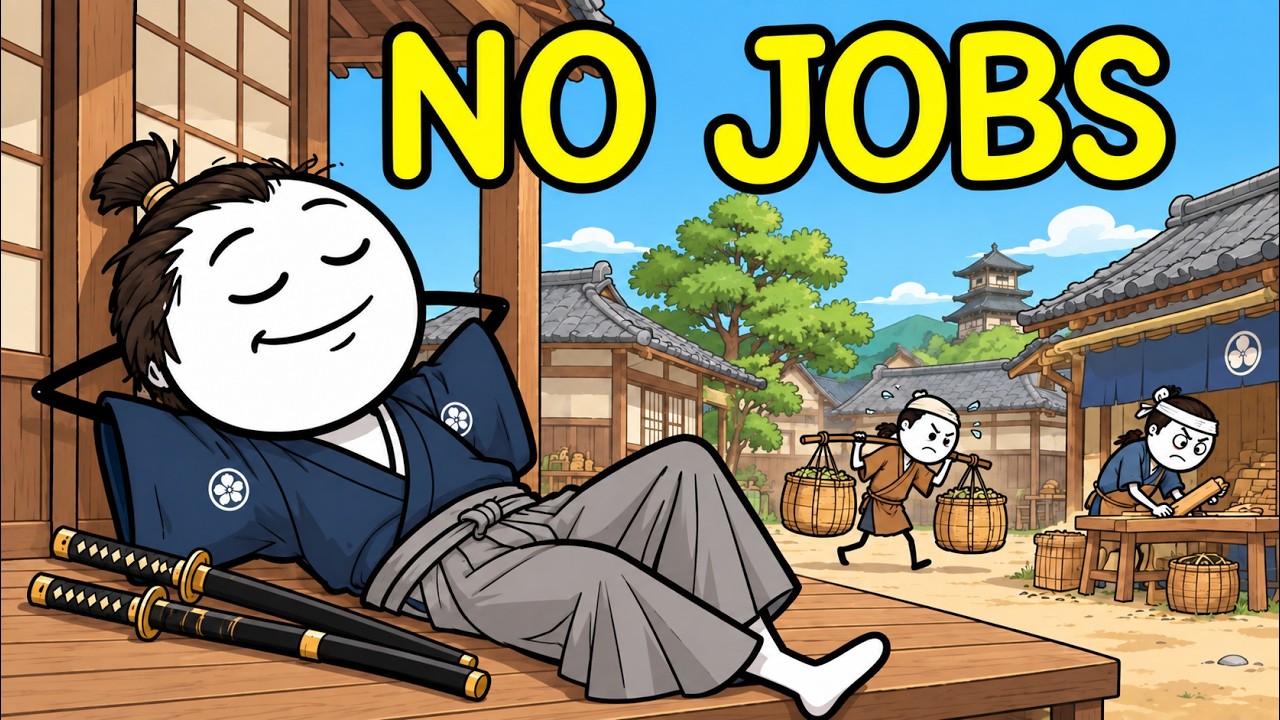
- Most samurai lived through roughly 250 years of peace, so their defining moments were administrative rather than military.
- The term 'inkyo' means living in hiding or stepping aside, describing a retired samurai's quiet withdrawal from public duty.
- The samurai family was a legal unit with a name, rank, and income (measured in koku of rice), and the household head was only its current operator.
- Legal retirement was typically allowed at age 70 for old age, or around 40 for illness, though many men served well past 70.
- There were three paths out of service: retirement by request, dying in office, or forced retirement as punishment.
- Retirement required a petition, approval, relinquishing the post, and a second petition for the heir's succession, which the shogunate decided.
- Because the house and income belonged to the shogun, the heir received his position from the shogun rather than inheriting it from his father.
- The formal announcement was made by senior counselors (roju) at the castle, often with a proxy representing the retiree.
- Retirement finances were awkward: income passed to the son, and retirees often relied on family support or a separate allowance.
Chapters
- 00:00A Samurai's Final Dawn
- 01:16Peace, Paperwork, and the Samurai Family Unit
- 02:26What Retirement Meant: Inkyo Explained
- 03:32Three Ways Out: Request, Death, or Punishment
- 04:38The Retirement Paperwork and the Shogun's Decision
- 06:58Retirement Finances and the Risk of Losing Everything
- 10:14Succession Crises and the Story of Katsu Kokichi
- 12:54The Retired Shogun and the Final Day
Full Transcript — Download SRT & Markdown
Speaker A
You wake up before dawn the way you have every single morning for the last 50 years. Your hand is already reaching for your clothes, the stiff formal jacket, the wide trousers, the two swords on the stand by the door. And then you stop
Speaker A
because today nobody is expecting you at the castle. Nobody is waiting for your report. Nobody will notice if you sleep until noon. Today you stop being a working samurai. You are 70 years old.
Speaker A
You live in Edeto, the Shogun's capital, a city of around a million people. You've served the same house your whole adult life, the same way your father did and his father before him. And this morning, after decades of duty, the
Speaker A
shogunit is finally going to let you go. Here's the part that surprises almost everyone. The biggest day in the life of most samurai wasn't a battle. For most of them, there was no battle. Japan went through roughly two and a half centuries
Speaker A
of peace under the Tokugawa shoguns. A samurai in the year 1830 could live his entire life from his first haircut to his funeral without ever drawing his sword in anger. The swords stayed on his hips. The real weapon was paperwork. So
Speaker A
for a man like you, the biggest day wasn't a fight. It was this one. The day your career ended, your son became the head of your family and your entire household was handed over to the next generation. What actually happened on
Speaker A
that day? Who signed what? Who stood where? And why did the most powerful government in Japan care so much about one old man stepping aside? And here's the strange part. On the most important day of your life, there's a good chance
Speaker A
you won't even be in the room. I'll explain exactly why in a moment. And there's something else. There was one thing that could still destroy everything your family had built right up until the very last step. And it had
Speaker A
almost nothing to do with you. I'll get to that one a little later in this video. First, you need to understand what retirement even meant for a samurai because it's not what you think. In Japan, the word was ino. It literally
Speaker A
means something like living in hiding or living out of the way. And that's a pretty honest description. A retired samurai didn't move to the beach and take up golf. He stepped back. He stepped aside. He became officially a
Speaker A
background character in his own family story. Because here's the thing you have to understand about samurai life. The family wasn't a group of people. The family was a unit. It had a name, a rank, and an income. Usually measured in
Speaker A
koku of rice, a unit roughly meant to feed one person for a year. That income didn't belong to you as a person. It belonged to the house. And the house could only have one head at a time. You
Speaker A
were never really the owner of anything. You were the current operator. Like a man driving a company car for 50 years, keeping it clean, keeping it running, and knowing the whole time that one day he'd have to hand over the keys. Today
Speaker A
is Keys Day. Now, you might assume a samurai could just decide to retire whenever he felt tired. Absolutely not.
Speaker A
This is the Tokugawa Shogunate. They didn't let you do anything without a form. For retainers of the Shogun, there were basically two acceptable reasons to retire. The first was old age. And the rule of thumb was 70. 70. In a world
Speaker A
without antibiotics, the government's idea of old enough to rest was an age a lot of people never reached. The second reason was illness. And for that, there was a custom that you had to be at least around 40. So if you were 35 and simply
Speaker A
bored of your job, too bad. You weren't retiring. You were going to work. And plenty of men didn't retire even when they were allowed to. There are records of shogunal retainers serving far past 70. One is recorded as holding a post in
Speaker A
charge of the shogun spearman until the age of 94. 94. Somewhere in Edeto, there was an old man holding a spear unit together who had probably outlived three of his own doctors. But let's say you've done your time. You're 70, you're tired,
Speaker A
and you want out. How did you actually leave? Not everyone left the same way, and the difference mattered enormously.
Speaker A
Way number one was the one every samurai hoped for. Retirement by request. You petitioned, you were approved, and your son took over while you were still alive to see it. In the legal language of the time, this kind of handover had its own
Speaker A
name, Katoku succession, the passing of the house from a living father to his heir. Way number two was the one nobody planned for. You died in office. Then your heir had to apply for succession after your death and the whole family
Speaker A
held its breath while the government decided whether he'd get it. And way number three was the one nobody wanted.
Speaker A
Retirement as punishment. Yes, that existed. Among the penalties the shogunit could hand down to a samurai, there was a form of house confinement where the man was shut in a single room, not allowed to cut his hair, not allowed
Speaker A
to shave, barely allowed to leave except to use the toilet with meals brought in by his family. And one version of that punishment came with a twist. You also lost your position as head of the house, forced retirement. The family survived,
Speaker A
you in a sense didn't. three doors out of the same life and which one you walked through depended on how the last 50 years had gone. Let's assume they went well. So, here's how the paperwork worked. Step one, you submit a petition
Speaker A
to your superior asking permission to retire. Not a resignation letter, a request. And you wait. Step two, if it's approved, you give up your post. Your official job ends. Step three, your family submits a second petition asking the government to let your heir take
Speaker A
over the house. Step four, and this is the important one, the shogunit decides. Because here's the detail that changes how you see all of this. Legally, you weren't giving your house to your son.
Speaker A
You couldn't. It wasn't yours to give. The house, the rank, the income, all of it came from the shogun. So in the eyes of the law, your son wasn't inheriting from his father. He was receiving his position from the shogun himself. You
Speaker A
were just the man standing between them for 50 years. And this is where we come back to that strange detail from the beginning. Why you might not even be in the room. When the decision came through, a proxy representing you
Speaker A
together with your heir would go up to Edeto Castle. there. One of the shogun's senior counselors, the Roju, the men who effectively ran the government, would formally announce two things. Your retirement and your son's succession.
Speaker A
And then a ceremony was carried out inside the castle itself. Think about that. The single most important moment of your entire career. The moment your 50 years of service get turned into your son's future. and you might be sitting
Speaker A
at home in your own house waiting for someone to walk back through the gate and tell you how it went. If you're enjoying this, hit subscribe now. This channel is all about the hidden everyday side of samurai life that the movies
Speaker A
never show. And it takes about 2 seconds to make sure you don't miss the next one. Now, let's talk about money because this is the question every retiree has asked since the beginning of time. What do I live on now? For a samurai, the
Speaker A
answer was a little awkward. The family income didn't retire with you. It moved to your son. He's the head now. The rice stipen is his. So, what about you?
Speaker A
Sometimes the government granted a separate allowance for retirement. Sometimes it added a reward on top for long service, but not always. For a lot of ordinary samurai, retirement meant something very simple. You now lived in your son's house on your son's income.
Speaker A
The roles flipped. For 50 years, everyone in the house depended on you. Now you depended on them. And at the very top of society, the numbers could get ridiculous. In the early years of the Tokugawa era, some powerful lords
Speaker A
received enormous retirement grants. Asano Nagamasa, who had been one of Toyoto Hideoshi's top administrators, was given 50,000 koku of rice as his retirement allowance. And Maya Toshitsune, the head of one of the richest families in the country, kept a
Speaker A
retirement domain of 220,000 koku. That's not a pension. That's a small country. But those were the exceptions. For most men, the retirement fund was called your son. Which brings us back to the warning from earlier. The one thing that could still destroy
Speaker A
everything. And as promised, it had almost nothing to do with you. It was the air. Remember the rule. The house only passed to an heir the government already knew about. Your son had to be registered with the authorities in
Speaker A
advance as your official successor. Not announced at the last minute. Not found in a hurry. Registered. So what happens if something goes wrong? What if your son dies of fever the winter before your retirement? What if you never had a son
Speaker A
at all? In the early decades of Tokugawa rule, the answer was brutal. If a lord died without an approved heir, his house could simply be ended, abolished. The government took the land back. This punishment had a name, Kayeki, and the
Speaker A
early shoguns used it constantly. Between the great battle of Seek Gajara in 1600 and the middle of the century, by one count, around 130 lords lost their domains. Some for rebellion, some for breaking rules, and a lot of them
Speaker A
simply because the family line ran out at the wrong moment. The obvious fix would be to adopt someone. And samurai families adopted all the time. Adoption was completely normal. But there was a catch. A desperate deathbed adoption. A
Speaker A
dying man naming a son at the last second was banned. The government didn't trust it. And honestly, they had a point. A man on his deathbed surrounded by ambitious relatives isn't always the one really making the decision. So every
Speaker A
time a family line broke, the house could vanish. And every house that vanished created a crowd of samurai with no lord and no salary. Masterless samurai, Ronin. And that turned out to be a very bad idea. In 1651, a group of
Speaker A
Ronin was caught plotting to overthrow the shogunit in what became known as the Kon incident. Thousands of unemployed, armed, angry men turned out to be a security problem. Who could have guessed? That same year, the government relaxed the rule. Deathbed adoptions
Speaker A
became possible. At first, only for family heads between the ages of 17 and 50. Then in 1663, the protection was extended to younger heads and in 1683 to men over 50 as well. But even then, it wasn't a free pass. Officials were
Speaker A
supposed to confirm that the dying man was still alive and actually agreed to the adoption. Over time, that check became more and more of a formality, but it was still there. And the deeper rule never went away. A house without an
Speaker A
approved heir was a house living on borrowed time. So when you sat at home on your retirement day waiting for news from the castle, you weren't just hoping your son would be accepted. You were quietly aware that your whole family
Speaker A
name, every generation before you, was balanced on one young man staying alive and staying out of trouble. Speaking of staying out of trouble, let's talk about the sun. Because the samurai system had a very clear idea of how a family was
Speaker A
supposed to work. The father serves, the son learns, the father retires, the son takes over, clean, orderly. And then there's real life. Let me introduce you to a real samurai named Katu Kokichi.
Speaker A
Born in Edeto in 1802, a lowranking retainer of the shogun with an income of 41 koku, which is a very modest number.
Speaker A
And in his entire life, Kokichi never managed to get an official post. Not one. What he did instead was a long list of things a samurai was absolutely not supposed to do. He fought in the streets. He dealt in swords. He worked
Speaker A
as a kind of bodyguard. He lent money at high interest. He ran away from home twice. At one point, his own family got so fed up with him that they built a cage and locked him inside it. An actual
Speaker A
cage for a samurai. And then one day, Kokichi retired. He handed the headship of the house to his son, Dintaro, who was 15 years old at the time. And Kokichi took a new name for his retirement, Musui, which you could
Speaker A
translate as something like drunk on dreams. In his last years, he sat down and wrote his life story, not as a heroic memoir, as a warning. The book opens with Kokichi essentially telling his descendants to look at his life and
Speaker A
do the opposite. He wrote that only in his early 40s did he finally understand what it meant to live the right way. And when he looked back at his past, he said his hair stood on end. But here's why
Speaker A
this story matters for retirement day. That 15-year-old son, Rintaro, grew up to become Katsu Kaishu, one of the most important men of the entire era. He became a naval commander and in 1868 as the shogunate was collapsing he
Speaker A
negotiated the surrender of Edeto Castle to the new government's army. A city of around a million people was handed over without a full battle in its streets.
Speaker A
The father who couldn't hold a single office raised the son who helped save the capital. And it started on one quiet day when a troublemaker stepped aside and let the next generation take the keys. Retirement wasn't the end of the
Speaker A
father's story. It was the start of the sons and the relationship didn't end there either. Here's a detail that feels surprisingly modern. In the Tokugawa system, a samurai could take leave from his duties to care for a sick parent.
Speaker A
The Chauanate called it Kamio Kottoari, roughly excused for nursing. Some domains had their own version. There's a record from the Numazu domain of a retainer who in 1866 took about a month off from his duties to care for his
Speaker A
father after his father collapsed from a stroke. and the doctor said he likely wouldn't recover. Think about that. 200 years ago, in a society built entirely around duty to your lord, the system still made room for a son to stay home
Speaker A
with his dying father. The house came first, but the house was also made of people. Now, there's one last layer to all of this, and I saved it for the end because it flips everything we've talked about upside down. Because for some men,
Speaker A
retirement wasn't stepping back at all. It was stepping up. The most famous retiree in Japanese history was Tokugawa Ayasu himself, the man who founded the entire shogunate. In6003 he became shogun and just 2 years later in6005 he retired and passed the title to his son
Speaker A
Hittada. Retired the most powerful man in Japan. Except he didn't go anywhere. He moved to Sunpu, a castle town southwest of Edeto and became what people called the Osho, the retired shogun. And from there, he kept making the decisions that really mattered right
Speaker A
up until his death in 1616. Why would he do that? Because retiring solved his biggest problem. By handing the title to his son while he was still alive, Ayasu sent a message to every lord in Japan.
Speaker A
This isn't a one-man government. This is a family business, and the family is staying. The succession was settled while he was still strong enough to enforce it. Nobody got to wait for him to die and try their luck. Retirement
Speaker A
wasn't just a pension plan. In the right hands, it was a weapon, and lords all over the country noticed. Many of them retired early and kept real influence from behind the scenes. Others were pushed into retirement by their own
Speaker A
senior retainers when they behaved badly enough. The quiet word inko, living out of the way, could mean a gentle old man drinking tea in the garden. Or it could mean the real ruler of a domain, sitting just out of sight while his son sat in
Speaker A
the official chair. So, let's put the whole day back together. You wake up before dawn and reach for clothes you don't need anymore. Your petition was approved weeks ago. Your post is already gone. This morning, your son walks out
Speaker A
of the gate in his formal clothes with a representative standing in for you and climbs the road up to Edeto Castle.
Speaker A
Somewhere inside, a senior counselor of the shogun reads out your retirement and your son's succession. A ceremony is held. And just like that, the rank, the income, the name you carried for 50 years belong to him. You're not there.
Speaker A
You're at home, maybe drinking tea, maybe pretending to read, maybe pacing the garden and checking the gate every 10 minutes, like every father waiting for news since the beginning of time.
Speaker A
And when your son finally comes back through that gate, he's not just your son anymore. He's the head of your house. And you are officially the old man living out of the way. That's what the biggest day of a samurai's life
Speaker A
looked like. No battlefield, no enemy, no heroic last stand, just a petition, a proxy, a ceremony you didn't attend, and a son who suddenly carried the weight of every generation that came before him.
Speaker A
The samurai of the movies die young with a sword in their hand. The real ones, more often than not, grew old. They filled out forms. They worried about their sons. And if they were lucky, they got to watch the next generation take
Speaker A
the keys. So, here's my question for you. If you were a samurai, would you retire at 70 and hand everything to your son, or would you be the old man still commanding the spear unit at 94? Tell me
Speaker A
in the comments. And if you want to see what all those 50 years of ordinary days actually looked like before this final morning ever came, watch this one next.
Speaker A
What did samurai actually do all day? It's right here on your
Topics:samuraiTokugawa shogunateEdo periodJapanese historysamurai retirementinkyofeudal Japansamurai successionhistory documentaryEdo daily life