How Roman legions built a fortified marching camp every night: the daily routine, surveying, standardized layouts, and night watch that kept armies safe for centuries.
Key Takeaways
- The Roman marching camp was a standardized, rapidly built fortification that protected armies from night attacks.
- Standardization served both tactical efficiency and psychological comfort for soldiers far from home.
- Roman soldiers were equipped as builders as much as fighters, and daily camp construction was a core military discipline.
- Strict discipline, including the night watch and harsh punishments, was essential to the system's effectiveness.
What the video covers
- Opens with the puzzle: a Roman army camped near a 40,000-strong enemy never feared a night attack because of its fortified marching camp.
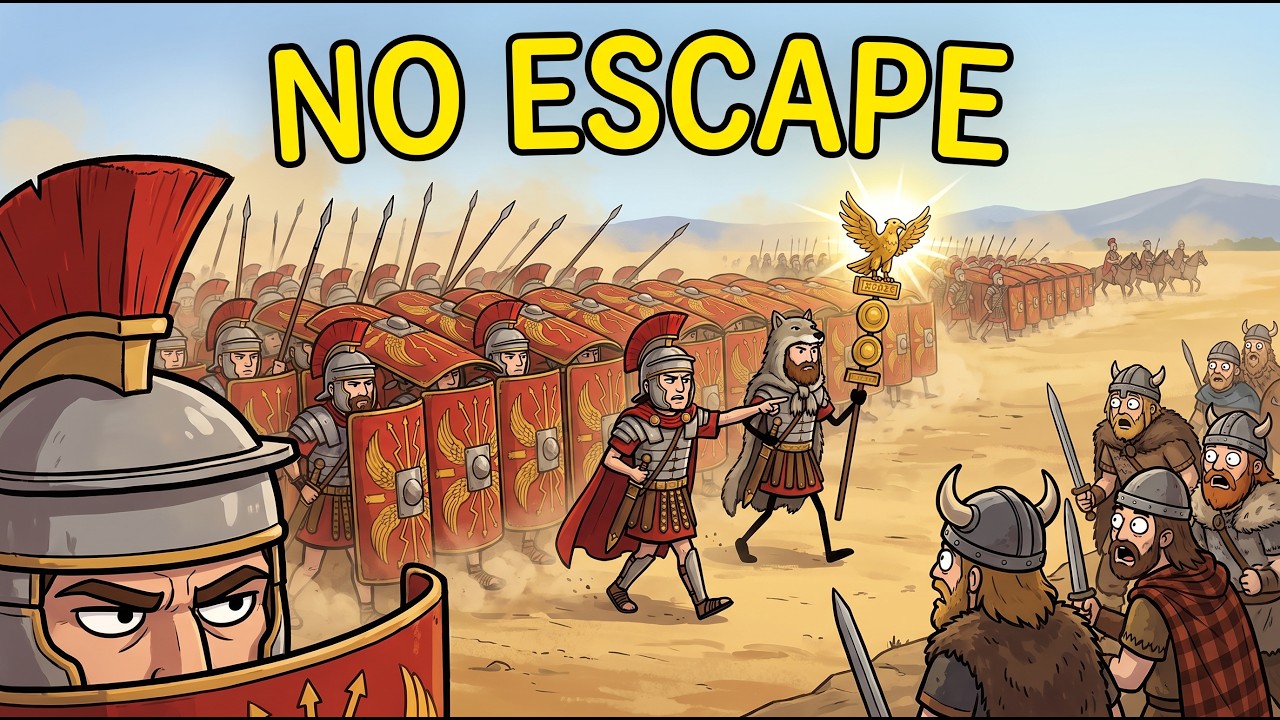
- Explains the vulnerability of an army on the march and the danger of the window when soldiers put down shields to dig, illustrated by Caesar's near-disaster against the Nervii in 57 BC.
- Describes the psychological comfort of an identical camp layout, making a foreign land feel familiar to frightened soldiers.
- Details the daily routine: pre-dawn trumpets, burning the camp before leaving, and a march of roughly 20 Roman miles with heavy loads.
- Notes that legionaries carried construction tools (saw, basket, pickaxe, axe), effectively carrying a building site.
- Covers surveying with a white flag, measuring rods, and the groma, producing the 'playing card' rectangular camp shape with four gates.
- Compares Roman standardization with Greek practice of adapting camps to terrain, arguing identical layouts reduce confusion under stress.
- Explains the grades of defense (turf wall with ditch versus palisade) and the internal layout including the parade ground and commander's tent.
- Describes the night watch system and the harsh punishment (fustuarium) for sleeping on duty.
- Closes with Caesar's siege works, showing the same technique scaled up to weeks of work.
Chapters
- 00:00The Mystery of the Roman Night Camp
- 01:39The Vulnerability of the Marching Army
- 03:20Why Rome Built Camps Every Night
- 05:17The Daily Routine of the March
- 07:04Surveying and Laying Out the Camp
- 08:28Standardized Design and Its Purpose
- 11:06Defenses, Ditches and Ramparts
- 17:54The Night Watch and Military Discipline
- 22:01Siege Works and Caesar's Legacy
Full Transcript — Download SRT & Markdown
Speaker A
Imagine an army of 40,000 men camped two miles from you. Close enough that you can see their fires. Close enough that you can hear them. You have the numbers.
Speaker A
You know the ground. You have every reason to attack them in the dark. And yet night after night you don't because something is standing between you and them. Something that wasn't there this morning. This is the strangest habit of
Speaker A
the Roman army. They didn't hide. They didn't run for high ground. They didn't look for a castle. They walked all day, stopped within striking distance of an enemy that wanted to wipe them out. And then they went to sleep and they almost
Speaker A
always woke up. Here's the part that breaks people's brains. The thing protecting them wasn't a wall of stone.
Speaker A
It wasn't a fortress. It wasn't even permanent. It was a hole in the ground dug by hand by exhausted men in a couple of hours. And it worked for 600 years.
Speaker A
Every Roman soldier on the march carried a weapon that never appears in a single painting of a battle. It wasn't his sword. It wasn't his shield. It wasn't the famous javelin. It was a tool. And the Romans themselves said it broke more
Speaker A
enemies than steel ever did. I'll tell you exactly what it was. And there's a Roman general who said something about it that sounds insane until you understand the system. Stay with me because that line explains the whole empire. First, you need to understand
Speaker A
the problem the Romans were actually solving. An army on the march is the most vulnerable thing in the ancient world. You're strung out in a long line.
Speaker A
Your men are tired. Your gear is packed. Your formation doesn't exist. Hit a marching army and you don't fight a battle. You guarantee total annihilation.
Speaker A
Every ancient commander knew this. And ancient Rome spent most of its history marching through land where everyone hated them. So here's the danger nobody mentions. There is one window every single day where the Roman legion could be destroyed. Not on the march, not in
Speaker A
battle, while they were building. Because to build the camp, you have to put down your shield. You have to take off your helmet. You have to hand your life to the man next to you and start digging. And in 57 BC, in what's now
Speaker A
Belgium, an enemy figured that out. Caesar's legions arrived at a river and started fortifying the way they always did. Men scattered across the slope, cutting timber, cutting turf, digging, and the Nurvi came out of the woods at a
Speaker A
dead sprint. Caesar had to do everything at the same moment. Raise the standard, sound the trumpet, call men back from the woods, form a line, give the watch word. He wrote afterwards that the shortness of time made most of it
Speaker A
impossible. They nearly lost three legions in the time it takes to boil water. So why keep doing it? Why keep taking that risk every single evening for centuries? because of what the camp gave them on the other side of that
Speaker A
risk. Think about what it's like to be 19 years old, a thousand miles from home in a country where you don't speak the language and the trees look wrong. You are terrified constantly and then the sun goes down and you walk through a
Speaker A
gate you dug yourself into a camp laid out in exactly the same pattern as the camp you slept in last night and the night before. And every night for the last four years, same streets, same distances, same gate
Speaker A
on the same side, same seven men in your tent in Britain, in Syria, in the desert, in the snow. The Roman marching camp was the only piece of home that could move. That's the real answer. Rome didn't conquer the world by being
Speaker A
braver. It conquered the world by making the entire world feel familiar to a scared teenager with a shovel. If that idea just landed for you, hit subscribe.
Speaker A
That's genuinely all it costs, and it's what keeps this channel making these because what comes next is the part almost nobody knows. What actually happened in the hours between arriving and sleeping. Let's walk through it. The day starts before dawn. trumpets.
Speaker A
Josephus, a man who watched the Roman military up close as an enemy commander and then as a prisoner, described the routine exactly. The first trumpet call, everyone takes down the tents. Nobody lies still. The second, the baggage goes
Speaker A
onto the mules and the men line up ready to move. And then before they leave, they set fire to the camp they just slept in. Burn it every time. Not out of spite, because a half-finished Roman camp left standing is a gift to the
Speaker A
enemy. A ready-made fort with Roman measurements sitting in the middle of hostile country. So they destroyed their own shelter every single morning, knowing they'd have to build it again in 9 hours. The third trumpet sounds. Then a herald asks the whole army three times
Speaker A
if they're ready for war. Three times 40,000 men shout back that they are and the column starts moving. Now how far?
Speaker A
The Roman writer Vagetius gives us a number and it's a brutal one. 20 Roman miles in 5 hours at the standard military step. 24 if you push to the faster pace. A Roman mile is a bit under a modern one. So call it 18 modern miles
Speaker A
about 30 km before lunch. Now add the weight. Roman legionaries carried their own gear. Josephus lists it. A saw, a basket, a pickaxe, an axe, a leather strap, a hook, and three days of rations, plus armor, shield, helmet,
Speaker A
sword, and javelins. They had a nickname for themselves, Marius's mules. And here's the detail that makes the whole thing click. Look at that list again.
Speaker A
saw, basket, pickaxe, axe. Four of the seven items a Roman soldier carried into enemy territory were not weapons. They were construction tools. The Roman army marched to war carrying a building site on its back. So, the column halts late
Speaker A
afternoon. The enemy is somewhere out there. And the first men to move aren't soldiers at all. They're surveyors.
Speaker A
Roman camp building started with measurement. Palibius, a Greek who was taken to Rome as a hostage and ended up as the sharpest observer of the Roman military system we have, described it in detail. A spot is chosen for the
Speaker A
commander's tent, the place with the best view and the best control. A white flag goes in the ground at that spot.
Speaker A
That flag is now the center of the universe. Everything else is measured from it. Colored flags and standards go down to mark the lines of the streets and the corners of the ditch. They carried measuring rods for this, 10
Speaker A
Roman feet long. They had a surveying instrument, the Groma, for getting lines dead straight. By the time the main body arrives, the empty field has already been turned into a map. No arguing, no deciding, no wasted minutes. And the
Speaker A
shape they marked out is the reason we can still find these camps 2,000 years later. Here's what they were drawing. a rectangle with rounded corners.
Speaker A
Archaeologists today call it the playing card shape because that's exactly what it looks like from the air. Four gates, one on each side. Two main roads crossing inside. A wide one running across the camp and another running down
Speaker A
to the main gate. The commander's tent in the middle with the senior officers around it. Everything else, every unit, every tent line in a fixed position relative to that center. Palibius made a point about this that I think is the
Speaker A
single smartest observation about ancient Roman history anyone has ever made. The Greeks, he said, picked naturally strong ground and shaped their camp to fit the terrain because it saved them the digging. The Romans did the opposite. They leveled the ground and
Speaker A
forced the same plan onto it every single time. More work. Much more work. Why? Because of what identical does to a human being under stress. Think about it from inside the tent. If every camp is identical, then a soldier woken at 2:00
Speaker A
in the morning by screaming doesn't have to think. He doesn't need to ask where his unit forms up. He doesn't need to find a torch. He doesn't need orders. He steps out of his tent and his legs already know the route. Same number of
Speaker A
paces to the street, same turn, same place in the line. Rome had built a fortress that a man could navigate blind. And there's a second layer to it that's even better. Between the outer rampart and the first row of tents, the
Speaker A
Romans left a wide empty strip of open ground. Palibius puts it at 200 Roman feet. 200 f feet of nothing all the way around the camp. It cost them an enormous amount of extra digging because it made the perimeter much bigger. They
Speaker A
did it anyway. And the reason is genuinely clever. That empty ring did three jobs at once. One, missiles.
Speaker A
Anything thrown or shot over the rampart at night lands in the dirt instead of in the tents. Two, fire. If a burning arrow comes in, it has nothing to catch.
Speaker A
Three, and this is the important one, space to form up. An army woken in the dark needs somewhere to assemble that isn't a narrow street full of tent ropes and pack animals. So, the Romans built a parade ground into the design
Speaker A
permanently in every camp just in case. They also drove the cattle and the plunder into that ring at night. Now, stop and notice what's happened here.
Speaker A
We're 9 minutes into a video about sleeping, and I haven't described a single weapon. Because that's the point.
Speaker A
The genius of the Roman Empire was never really the sword. It was that they treated an ordinary evening as an engineering problem with a known answer.
Speaker A
And now we get to the digging. The men arrive. They don't stack arms and rest.
Speaker A
They put down their shields and packs in a ring around their own standards, keep their swords on, and pick up the tools.
Speaker A
Each unit has its own assigned stretch of the perimeter, measured out in advance, marked with flags. Nobody supervises the whole thing. Nobody needs to. Every century knows its own frontage, and they start cutting the ditch. The Jettiius describes three
Speaker A
different grades of Roman camp defense, depending on how scared you should be. If there's no real threat, they cut turf blocks out of the ground, stack them into a low wall about 3 ft high, and the hole left behind becomes the ditch. If
Speaker A
the ground is too loose to cut turf, they dig a quick ditch instead, 5 ft wide, 3 ft deep, and throw the spoil inward to make a bank. That's the light version, the we're not expecting anything tonight version. Then there's
Speaker A
the other version. When an attack is expected, the numbers change fast. The Jettiius calls it a hasty ditch. 9 ft wide, 7 ft deep. And when a serious enemy assault is believed to be coming, they dig what he calls the proper ditch.
Speaker A
The regulation one, 12 ft wide, 9 ft deep, dug by hand in an afternoon after marching 18 mi in armor. And it isn't a flat bottomed trench. The Roman military ditch is cut as a V, narrowing to a slot
Speaker A
at the bottom. That shape is deliberate and it's nasty. You can't stand in it.
Speaker A
You can't brace in it. If you jump down into a V ditch in the dark, your feet wedge, your ankle rolls, and you are now stuck in a hole at the bottom of a slope with Romans above you. There's even a
Speaker A
detail Vagius mentions that sounds like superstition and probably isn't. The width of the ditch was customarily an odd number of feet. 9 11 13 habit, ritual, or a checking system. Either way, it tells you how standardized this was. Now, the spoil. Everything dug out
Speaker A
of that ditch gets thrown to the inside and packed into a rampart. Turf blocks where the ground allows it, stacked like bricks because turf holds its shape and loose earth doesn't. Now, think about the height difference you've just
Speaker A
created. 9 ft down into the ditch. Then, a bank rising above ground level on the far side. An attacker in the dark has to cross open ground, drop into a V-shaped trench he can't see the bottom of, climb
Speaker A
out of it, and then climb a slick earth bank. All while men with javelins stand above him, rested in formation, knowing exactly where he has to appear. And that's before we get to the thing on top of the bank. Because this is where that
Speaker A
mystery tool from the start of the video finally comes in. And it's the single most underrated object in Roman history.
Speaker A
On top of the rampart went stakes. Not a fence built from local wood. Stakes the soldiers carried with them. Wooden stakes, each man hauling a few, roughly the length of a person with a narrow waist carved in the middle so they could
Speaker A
be gripped and tied into bundles. Archaeologists have pulled them out of waterlogged ground at Roman sites in Germany. And you can see the shape with your own eyes. They were lashed together into clumps, points outward, and planted along the crest of the bank. Here's why
Speaker A
that matters more than it sounds. It means the Romans did not depend on the landscape. No trees, doesn't matter.
Speaker A
Marsh, desert, bare hillside in Scotland, doesn't matter. The palisade came out of the packs. Most armies in history could only fortify where the terrain let them. Rome could fortify anywhere on demand in one evening. That is an absurd strategic advantage and
Speaker A
it's almost never mentioned. And now the tool, the pickaxe, the Roman dabra. A pick on one side, a blade on the other.
Speaker A
Every man had one. There's a general called Corbulo who commanded in the east under the emperor Nero. and he was famous for working his soldiers to the bone on fortifications. The Roman writer Fontineis preserved the line he was
Speaker A
known for. The enemy, Corbulo said, must be beaten with the pickaxe. That is the whole Roman doctrine in one sentence.
Speaker A
Not we'll win because we're braver, not we'll win because the gods favor us. We will win because we outdig you. And when you hear people talk about Roman discipline, this is what it actually meant on the ground. It wasn't mostly
Speaker A
about standing still under fire. It was about picking up a pick after an 18-mi march when you are hungry and soaked and your shoulders are raw and digging a trench you will personally set on fire tomorrow morning, every day for 25 years
Speaker A
of service. Here's a myth worth killing. People imagine the camp as a grim military compound, rows of tents, nothing else. Josephus, who saw it, describes something very different. He says the camp looks like a city that sprang up suddenly. Streets laid out
Speaker A
properly, craftsmen working, an open space that functions as a marketplace, places where disputes get settled and officers hear complaints, carpenters ready with their tools, artillery pieces positioned along the perimeter set between the towers, and the commander's tent in the middle, which he compares to
Speaker A
a temple. So, this isn't a bivowak. This is a functioning Roman town with a population of tens of thousands, built in an afternoon, destroyed the next morning, and rebuilt 18 miles down the road. Now, let's go inside one of those
Speaker A
tents because the smallest unit of the Roman legion is not the legion, and it's not the century. It's eight men. Eight men who shared a leather tent. The Romans called the tent a papilio, a butterfly, because of the way the flaps
Speaker A
opened out. Eight men who shared a mule, who shared a millstone to grind their own grain, who cooked together, ate together, dug their stretch of ditch together, and slept pressed against each other for warmth. The group had a name,
Speaker A
the contouium. It means roughly those who share a tent. 10 of these groups made a century. Six centuries made a cohort. 10 cohorts made a legion. But the loyalty, the thing that actually made men stand and fight, lived at the
Speaker A
level of eight. And remember the punishment structure. Stealing from the men inside your own camp was a capital offense.
Speaker A
Rome understood something modern armies rediscovered the hard way. Men don't die for an empire. They die for the seven people they cook with. So the ditch is dug, the stakes are planted, the tents are up, the fires are lit. And now comes
Speaker A
the part the whole video has been building toward the night watch. Because a fortification is only as good as the men who stay awake behind it. And human beings are very, very bad at staying awake. The Romans knew this. So they
Speaker A
built a system that assumed their own soldiers would fail. The night was divided into four watches, each one roughly 3 hours. The watch word, the password for the night, was not spoken aloud and passed down the line because
Speaker A
that leaks. It was written on a small wooden tablet. The tablet was called a tessera. It was physically carried from unit to unit, handed over and handed back. And the way they checked the centuries is honestly one of the coldest
Speaker A
pieces of administration in ancient Rome. Palibius describes it. Men are chosen by lot to make the rounds during each watch. They don't go alone. They take friends with them as witnesses.
Speaker A
They walk the whole circuit. The posts on the rampart, the gates, the pickets out with the infantry and the cavalry.
Speaker A
If they find a sentry awake and alert, they collect his tablet and move on. If they find him asleep, they don't wake him. They don't shout at him. They don't drag him to the commander. They simply take the witnesses, note it, and leave.
Speaker A
And in the morning, the tablets are counted. The century, who still has his tablet in his hand at dawn, has just proved with an object that nobody could collect it from him. He has no defense.
Speaker A
There's no argument. There's no I was awake. He's lying. The physical evidence is sitting in his own fist. And what happened to that man is the reason no Roman century slept. The punishment was called the fuarium. The condemned man
Speaker A
was struck once by the commanding officer in front of everyone. That was the signal. Then the rest of the camp, his own unit, his own tent group, the seven men he ate with carry out the fatal sentence with clubs and stones.
Speaker A
His friends had to do it. That is not sadism for its own sake. And it's worth understanding why Rome designed it that way. The same punishment applied to deserting your post, to stealing from your comrades, and to lying under oath.
Speaker A
Notice the pattern. Every single one of those is a betrayal of the men beside you. So Rome made the betrayed men carry out the sentence themselves. A sleeping sentry doesn't endanger the empire. He endangers the eight men in his tent and
Speaker A
the 80 in his century and the 5,000 behind the ditch. Rome made sure everyone understood precisely who they were letting down. Brutal, effective, and it's why the Roman army could genuinely sleep 2 miles from an enemy.
Speaker A
Now flip it around. Stand outside the ditch and think like the enemy. You've been watching them all day. You have more men. Your warriors are fiercer oneon-one and both sides know it. You wait for night because night is the
Speaker A
great equalizer. And you walk up to find a ditch, a bank, a wall of stakes, and men who are not asleep in the way you hoped. You can't scale it quietly. You can't surprise them. You can't even find
Speaker A
an unguarded side because there isn't one. The camp is the same on all four faces. So you go home and the next day they march 18 miles deeper into your country and do it again. Here's what that does to a war. The Romans have
Speaker A
taken away your best weapon, the ambush. And they've taken it away permanently every night for free, which means the only way you ever get to fight them is in daylight on open ground in a pitched battle, which is the exact fight the
Speaker A
Roman Legion was built to win. And this is the answer to the question in the title. The Romans didn't sleep close to the enemy despite the danger. They slept close to the enemy because it was the most aggressive thing they could
Speaker A
possibly do. A camp planted 2 mi from your opponent is a statement. It says, "We are here. We are not leaving. And we are in no hurry. It lets you control the tempo of the entire war. You can offer
Speaker A
battle when you want it and refuse it when you don't. You can sit there safe while the other army's food runs out and its men drift home to their farms.
Speaker A
Ancient armies were coalitions. They dissolved. Farmers had harvests. Warriors got bored. Romes didn't dissolve because Rome's army was paid, fed, and lived behind a wall it carried with it. So, the Roman marching camp wasn't really defensive at all. It was a
Speaker A
siege weapon aimed at the enemy's patience. And if you want to see what happens when Rome takes that idea to its logical extreme, look at Allesia. 52 BC Gaul. Caesar has cornered verseterics and a very large army inside a hilltop
Speaker A
town. Caesar can't storm it, so he does the Roman thing at a scale that is difficult to believe. He builds a wall of fortifications right around the hill.
Speaker A
by his own account, roughly 11 Roman miles of it. Ditches, ramparts, towers. Then he gets word that a huge golic relief army is coming to attack him from behind. A normal commander retreats.
Speaker A
Caesar builds a second ring of fortifications, facing outward around the first one, another 14 Roman miles.
Speaker A
He deliberately turned his own army into the filling in a sandwich and then fortified both sides of the bread. And the ground between the lines was not empty. Caesar describes what he seated that ground with, and it's genuinely
Speaker A
horrible. Pits with sharpened stakes set in the bottom, covered over with brush so you couldn't see them. The soldiers nicknamed them liies because of the way the stakes were arranged like petals.
Speaker A
Blocks of wood with iron hooks fixed in them driven into the soil so the barbs sat just at ankle height. Rows of sharpened branches embedded in trenches and interlaced so they couldn't be pulled out. Ditches, one of them flooded
Speaker A
with water diverted from a river. So the Gauls had to cross all of that under missile fire from both directions at once. Alicia is the most famous siege in Roman history. And people usually tell it as a story about Caesar's nerve. It
Speaker A
isn't. It's a story about shovels. It's the exact same technique as the ordinary overnight camp. Ditch, bank, stakes, fixed plan. Everybody knows their stretch. Just run for weeks instead of hours. So, what happens when Romans can't do this? We have an answer and
Speaker A
it's the worst day in Roman military memory. 9 AD northern Germany. Three legions under a commander named Varys moving through forest and broken ground, strung out along tracks between trees and swamp. They were ambushed. And the key detail is the terrain. You cannot
Speaker A
form a proper line in dense woodland. You cannot deploy artillery. And you cannot lay out a rectangular camp with a 200 ft clear ring inside it when you are boxed in by trees and bog with an enemy on your flank. The system that kept the
Speaker A
Roman army alive every other night of the year simply could not be run. The legions were destroyed over several days. The emperor Augustus reportedly never recovered from it. The lesson Rome drew was not the Germans are unbeatable.
Speaker A
It was never let the army be caught where it cannot dig. And here's the part that still gets me. These camps were temporary. Built in an afternoon, burned in the morning, never meant to last a week. You can still find them at Msada
Speaker A
in the Judean desert. The Roman siege camps are still sitting there on the rock and sand. You can see the outlines of the walls, the gates, even where the tent lines were and the long wall the army threw around the whole mountain. In
Speaker A
Spain around Numanchia, archaeologists mapped the camps of the Roman commander Scipio Amelianis dug in around a town he was starving out. And in Britain, especially Scotland, hundreds of Roman marching camps have been found from the air because a buried ditch changes the
Speaker A
way crops grow above it. From the ground, an empty field. From a plane in the right summer, a perfect rounded rectangle with gates. 2,000 years later, the shape of one night's work is still printed on the landscape. So, let's
Speaker A
close the loops. The mystery tool was the pickaxe, and the general was Corbulo, and the line was that the enemy must be beaten with the pickaxe. He meant it literally. The reason Roman soldiers could sleep within sight of an
Speaker A
enemy was not courage. It was a routine so drilled that an exhausted army could build a fortified town in the time it takes to watch a football match in the dark without discussion. And the reason it worked wasn't the ditch. Ditches are
Speaker A
easy. It was that every man knew his stretch. Every street was in the same place. Every tablet came back at dawn.
Speaker A
And every one of those eight men in the tent knew exactly what would happen to him if he let the other seven down.
Speaker A
Rome's real weapon wasn't the sword or the javelin. It was the ability to make one specific evening happen identically 10,000 times across three continents for 600 years. Everything else, the roads, the aqueducts, the empire is the same habit just scaled up. Vegitius writing
Speaker A
centuries later complained that the armies of his own day had stopped fortifying their camps properly. He thought it was a disaster. He wanted the old standard brought back. He was writing about the ditch, but he was really writing about something else.
Speaker A
They conquered the world by being boring on purpose every single night. And if you want to see what that same obsession looked like when Rome pointed it at something other than war, watch this one next. It's the other half of the
Topics:Roman armymarching campcastraRoman legionancient warfareJulius CaesarRoman engineeringPolybiusJosephusancient Rome military history