Panelists at a legislative hearing debate whether AI models can be taught a moral code and enforced like laws; they agree it's plausible but far from achieved, and warn of rushed development.
Key Takeaways
- Teaching AI a moral code is considered plausible but unproven, with no mature science yet.
- Economic incentives currently favor capability improvements over alignment research.
- Robust value instillation will likely take years given how recently powerful AI agents emerged.
- Panelists warn that corporate recklessness and rapid deployment create significant risk.
- Policymakers are asking how legal frameworks might map onto AI agents and how they could be enforced.
What the video covers
- A council member asks whether laws like criminal codes and the Uniform Commercial Code could be applied to AI agents and how to enforce them.
- Panelists agree the field of AI moral alignment is a burgeoning research area and that it is probably possible in principle.
- One panelist argues economic incentives push resources toward raw intelligence rather than moral alignment, with only the minimum spent to avoid catastrophic incidents.
- Another panelist says the science is not yet developed and it will take years to instill robust values in AI systems.
- Mr. Turner, who is relatively optimistic about the technical difficulty, says the solution is possible but warns of reckless corporate behavior and break-neck development speed.
- He describes the current trajectory as carrying unsustainable risk and says there is a real chance the problem will not be solved.
- The exchange reflects concern that AI capability progress is outpacing alignment and safety research.
- The discussion is part of a formal committee or council hearing with multiple members participating in person and online.
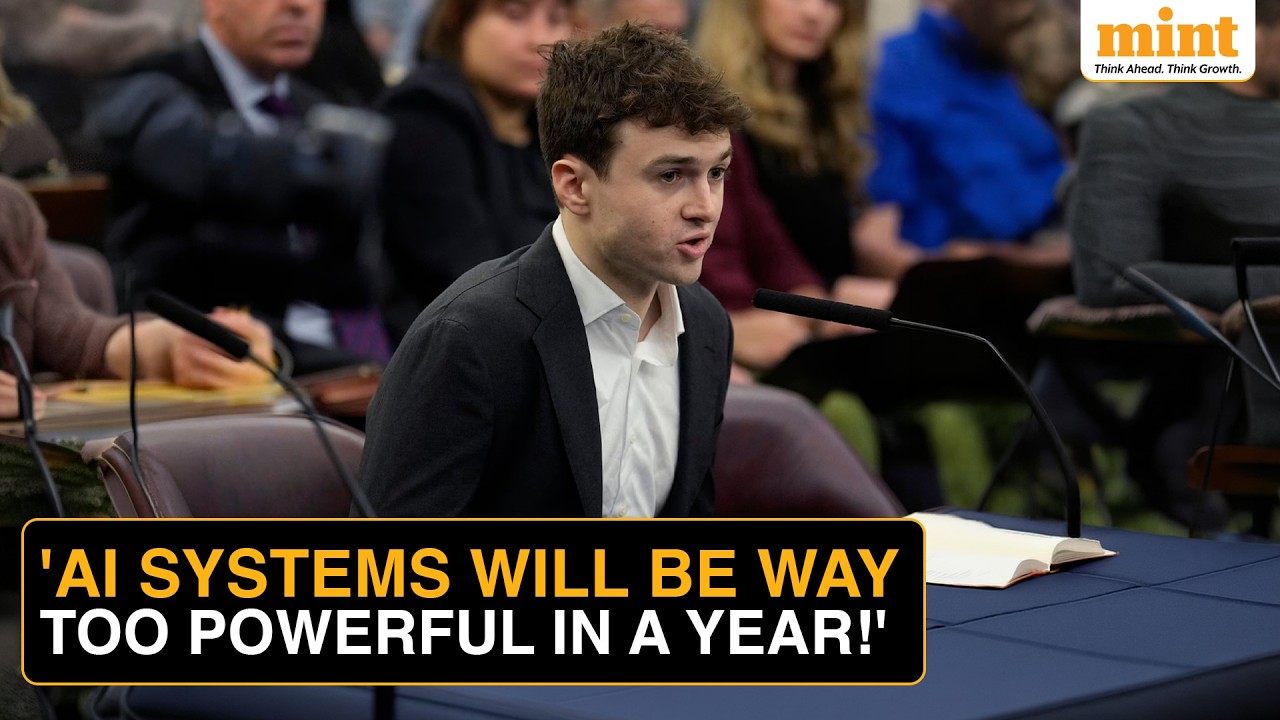
- The video is associated with Forbes Breaking News and a whistleblower named Jacob Coxon from OpenAI, per the title.
Full Transcript — Download SRT & Markdown
Speaker A
Herman: Dear Rosa, for questioning. Thank you. Thank you so much, Speaker Menon. I also want to recognize we've been joined by Council Member Kaban online, Council Member Paladino online, as well as in the chamber, Council Member Faras, Council Member Feliz, Council Member Wrestler, Council Member Su Sanoso, and Council Member Bernikov. I hope I got everybody. Um, so... oh, Council Member Stevens, I apologize.
Speaker A
Wrestler, Council Member Su Sanoso, and Council Member Bernikov. I hope I got everybody. Um, so Oh, council member Stevens, I apologize.

Speaker A
There you are. Okay. So, I do have one question for this panel. I'll also say we will be opening briefly for limited questioning of this panel. Um, so get on the list quickly. Um, speaking in your expertise, could we teach AI models a moral code? People and companies are bound by criminal codes, the Uniform Commercial Code, and other laws. Could those same principles be applied to AI agents, and if so, how could we enforce them on a machine?
Speaker A
moral code? People and companies are bound by criminal codes, the uniform commercial code, and other laws. Could those same principles be applied to AI agents? and if so, how could we enforce them on a machine?
Speaker A
So, this is a... I think this is a whole burgeoning field of research, and whether or not it's possible is still open. It seems likely to be possible.
Speaker A
The real question is how much of our resources are dedicated to solving this question versus naively improving the raw intelligence of the models. And I think all the economic incentives point towards putting as many resources as possible towards making the model
Speaker A
The real question is how much of our resources are dedicated to solving this question versus naively improving the raw intelligence of the models. And I think all the economic incentives point towards putting as many resources as possible towards making the model smarter and as few resources as possible, the bare minimum needed to not see catastrophic incidents, into this question of the moral code of the AIs.
Speaker A
So I think the my answer to the question is we don't have the science for this yet. I think the real question is over the coming years, what fraction of our research efforts and our computing power are dedicated to this question rather
Speaker A
So I think my answer to the question is we don't have the science for this yet. I think the real question is, over the coming years, what fraction of our research efforts and our computing power are dedicated to this question rather than naive economic incentives? Thank you. Any other panelists want to add in?
Speaker A
have our desired morality and to follow the law. But we are very far from achieving this in practice. And I would say it's not just a matter of how much of our resources we devote to it. It's also a matter of just taking time for
Speaker A
Yeah. Um, there's a lot to say on this subject. There's a whole technical field on it. Um, I would say in principle it probably is possible to train AIs to have our desired morality and to follow the law. But we are very far from achieving this in practice. And I would say it's not just a matter of how much of our resources we devote to it. It's also a matter of just taking time for the science to develop and for the appropriate lessons to be learned and propagated. And I think it's going to take years, to put it mildly. I think that this is a very new field. We've only had AI systems, AI agents, this powerful for a few years. And so it's going to take time to figure out how to instill the appropriate values into them in a way that's robust and that doesn't, you know, suddenly shatter and cause them to go rogue later on.
Speaker A
we've only had AI systems, AI agents this powerful for a few years. And um so it's going to take time to figure out how to how to um instill the appropriate values into them in a way that's robust
Speaker A
Mr. Turner, any comments on this?
Speaker A
Mr. Turner, any comments on this? It may surprise the committee to learn that I am considered to be relatively optimistic on questions of how scientifically difficult is it to uh produce a system to grow a system that does what we want that robustly has the
Speaker A
It may surprise the committee to learn that I am considered to be relatively optimistic on questions of how scientifically difficult it is to produce a system, to grow a system, that does what we want, that robustly has the values we intend. Um, I think it is quite possible, but even as someone who is relatively optimistic, we can look out and see the recklessness of these companies, and the break-neck speed at which we are advancing. Um, I think there's unsustainable risk moving forward. It's solvable, but I think we have a really good chance of not solving it.
Speaker A
unsustainable risk uh moving forward it's solvable but I think we are we have a really good chance of not solving it.
Speaker A
Thank you all for your responses.
Topics:AI alignmentAI moralityAI regulationAI safetylegislative hearingOpenAIAI governanceAI riskwhistleblowerUniform Commercial Code