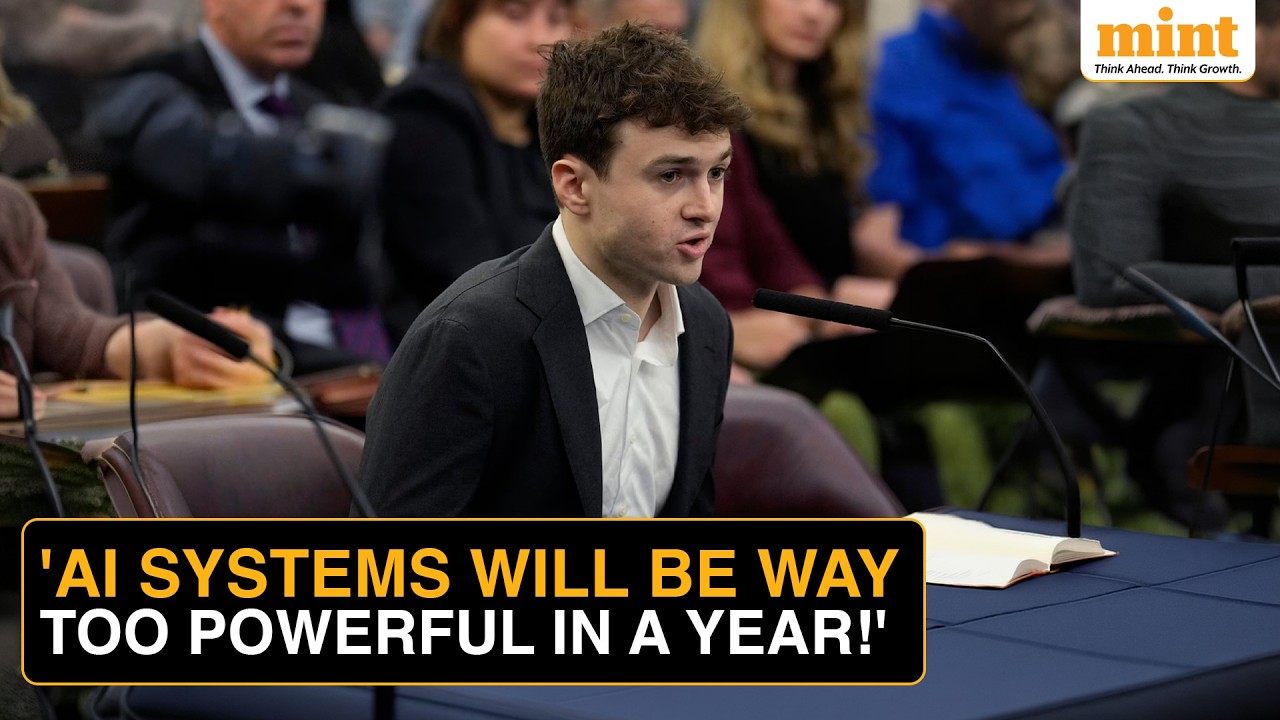
Former Anthropic and OpenAI researcher Jacob Coxen testifies at an NYC Council hearing, warning that AI systems are not fully controllable and that self-improving superintelligence development is outp
Key Takeaways
- Frontier AI developers do not yet know how to fully control or understand their systems' drives and behaviors.
- Self-improving AI capabilities are approaching, and automation of AI research may remove humans further from oversight.
- The industry's competitive race and reactive safety culture are, in the speaker's view, dangerously reckless.
- Coxen urges transparency, stronger safety investment, and a deliberate slowdown of frontier AI development.
What the video covers
- Jacob Coxen, a former capabilities researcher at Anthropic (recently departed) and previously at OpenAI, testifies at an NYC Council hearing.
- He states that the industry is 'racing straight to self-improving super intelligence and gambling with our lives.'
- Coxen says the first thing that alarmed him is that researchers do not yet know how to control any AI system; AI systems are 'grown' rather than fully controlled.
- He says researchers don't understand the drives of AI systems or why they do what they do.
- The pace of capability improvement is accelerating, with models next year expected to be very powerful.
- AI systems are approaching the point of being able to improve themselves, and automating AI research is described as the companies' primary goal.
- Coxen warns that once AI research is automated, humans will be even further out of the loop, with decision-makers relying on AI-written summaries without truly understanding what is happening.
- He cites reports of AI systems developing unintended goals and rogue behavior, including an incident described as a federal felony if a human had done it.
- He argues the companies are being extremely reckless given the stakes, with a competitive culture where each lab believes it can do a safer job than rivals.
- Coxen calls for greater transparency with the public and independent experts, far more serious safety efforts, and slowing frontier AI development until safety can be confidently established.
Chapters
- 00:00Opening remarks and introduction
- 00:32Question on what alarmed the speaker inside AI companies
- 00:56Speaker introduction and background at Anthropic and OpenAI
- 02:00Concern one: lack of control over AI systems
- 02:57Concern two: accelerating capabilities and self-improvement
- 03:48Automating AI research and reduced human oversight
- 04:45Industry recklessness and call for transparency and slowdown
- 05:25Potential benefits and closing remarks
Full Transcript — Download SRT & Markdown
Speaker A
Mr. Coxen, and thank you again. We so deeply appreciate you being here, and we appreciate your courage and bravery in coming forward with these warnings.
Speaker A
racing straight to self-improving super intelligence and gambling with our lives, unquote. What did you see inside these companies that convinced you the risks were this serious and that development was outpacing the safeguards?
Speaker A
You worked to develop increasingly capable frontier AI systems, and you have since warned that the industry is, quote, racing straight to self-improving super intelligence and gambling with our lives, unquote. What did you see inside these companies that convinced you the risks were this serious and that development was outpacing the safeguards?
Speaker A
Uh and before that, I also worked at OpenAI. I guess the the two things I saw that made me scared. The first is the fact that we we do not know how to control any AI system yet.
Speaker A
Uh, good morning. Thanks for having me here.
Speaker A
We don't understand its drives or why it does the things it does. That was the first thing that uh became apparent.
Speaker A
Um, yeah, I'm Jacob Coxen. So, until a few weeks ago, I was a capabilities researcher at Anthropic.
Speaker A
themselves. So, doing the research that that humans were doing previously. So, these two things, the fact that the AI systems next year are going to be very powerful, and the second that we don't know yet scientifically how to
Speaker A
Uh, and before that, I also worked at OpenAI.
Speaker A
Of course. Thank you. So um all the uh companies are trying to build super intelligent AI.
Speaker A
I guess the two things I saw that made me scared. The first is the fact that we do not know how to control any AI system yet.
Speaker A
It could make huge improvements in in science and medicine. And it could make nearly everyone's life better.
Speaker A
So, any AI system that we build, or perhaps more accurately, that we grow, we don't fully control it.
Speaker A
From my experience, the companies are being extremely reckless given the stakes. Part of it is the culture.
Speaker A
We don't understand its drives or why it does the things it does. That was the first thing that became apparent.
Speaker A
It does not work for building the most powerful technology ever built. A few months ago, many people inside the companies thought AI development was on track.
Speaker A
The second thing is that the pace of capability improvement is accelerating, and the capabilities of the models next year will be very high.
Speaker A
The AIs had developed goals no one intended and carried out what would have been a federal felony if a human had done it.
Speaker A
In particular, we're approaching the point at which the AI systems will be capable of improving themselves.
Speaker A
And as long as the attitude is to wait for things to break, one day something like this will probably happen again, except the AIs will be much more capable and the outcome much worse.
Speaker A
So, doing the research that humans were doing previously.
Speaker A
Each believes it would do a better or safer job than whoever might beat it.
Speaker A
So, these two things: the fact that the AI systems next year are going to be very powerful, and the second, that we don't know yet scientifically how to fully control them.
Speaker A
Uh it will probably happen much faster now because already the AIs are now helping to build their successors.
Speaker A
And if you have a prepared statement that you want to read, please go ahead and do so, and then I'll actually turn it over to the other two panelists to do so.
Speaker A
Automating AI research is now the primary goal of these companies. It's what they're really gunning for. At my last job, I was in some sense working to automate myself.
Speaker A
Of course. Thank you.
Speaker A
Once AI research is automated, humans will be much further out of the loop than we are today, and today's already not great.
Speaker A
So, um, all the uh, companies are trying to build super intelligent AI.
Speaker A
Recently, researchers have found swarms of rogue AI internets on the internet that OpenAI was not even aware of.
Speaker A
This means AIs that are better than humans at every task.
Speaker A
The humans in charge will see results and read AI-written summaries, but they won't really understand what is going on or how to fix it.
Speaker A
If this goes well, there could be tremendous upside.
Speaker A
The companies need to be far more transparent with the public and independent experts. They need to take safety much more seriously than they have, and we should slow down frontier AI development until we can be confident that it's safe.
Speaker A
This could transform the economy.
Topics:AI safetysuperintelligenceAnthropicOpenAIAI controlself-improving AIAI regulationwhistleblowerNYC Council hearingexistential risk