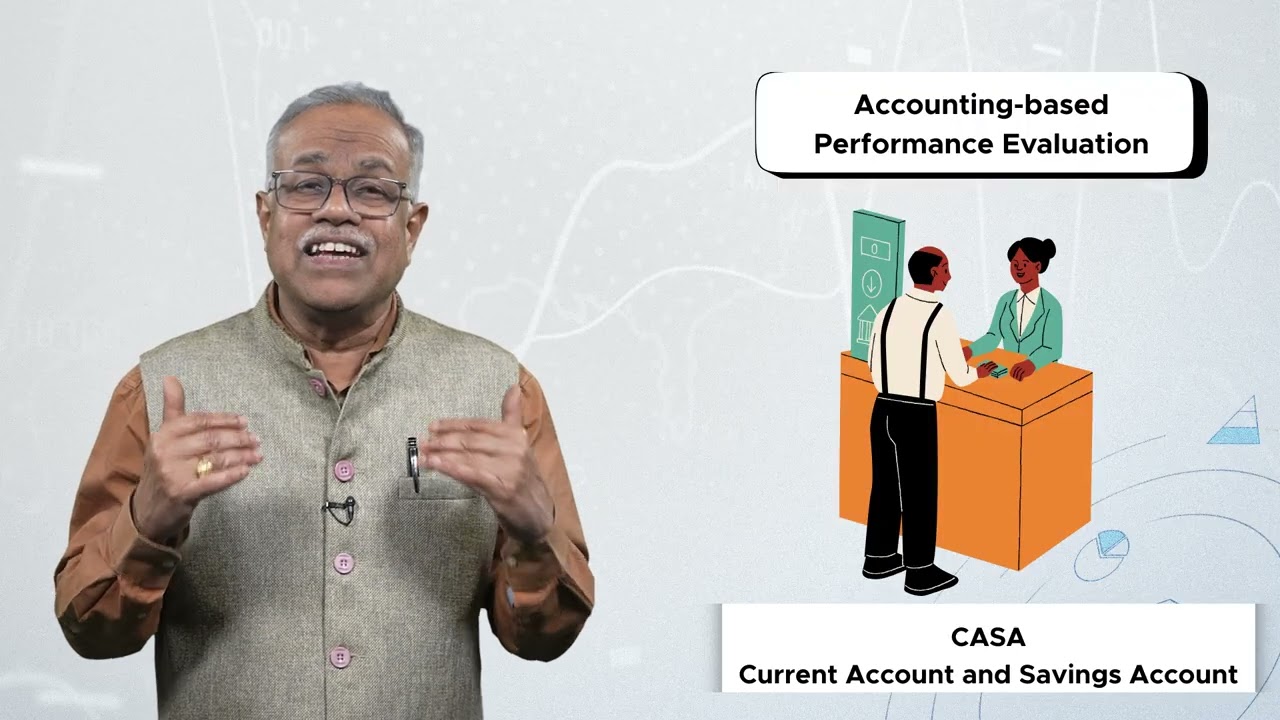
Explains bank performance evaluation using accounting and risk-adjusted measures like Sharpe ratio and RoRAC with a secured term loan example.
Key Takeaways
- Risk-adjusted performance metrics provide a more comprehensive view of bank portfolio profitability than accounting measures alone.
- Sharpe ratio and Treynor measure are key tools in evaluating investment and bank portfolio risk-return tradeoffs.
- RoRAC (Return on Risk-Adjusted Capital) is a crucial metric to assess bank product profitability after adjusting for risk.
- Accounting measures such as yield, net interest margin, and cost-to-income ratio remain important for initial performance evaluation.
- Incorporating credit risk costs like NPAs and write-offs is essential for accurate profitability assessment of bank assets.
What the video covers
- Bank performance can be evaluated at the division, vertical, or product level using interest income and asset yields.
- Investment management concepts like risk-adjusted return and Sharpe ratio are applicable to banks for portfolio performance.
- Sharpe ratio measures return minus risk-free return divided by total risk (standard deviation), while Treynor uses beta.
- Banks consume risk capital in asset creation, so risk-adjusted performance measures the return after considering risk capital.
- Four popular risk-adjusted measures include risk-adjusted return on assets and risk-adjusted return on capital (RoRAC or RoROC).
- An example of a secured term loan illustrates profitability assessment using both accounting and risk-adjusted measures.
- Accounting measures include gross and net yield on advances, indicating average interest income generated.
- Cost of funds and net interest margin (interest income minus interest expenses) are calculated for the asset.
- Operating expenses such as origination, management, overheads, and cost-to-income ratio are considered for cost analysis.
- Risk measures like gross NPAs, technical write-offs, and credit costs help determine the portfolio's rate of return.
Chapters
- 00:00Introduction to bank accounting performance
- 00:17Interest income and asset yield concepts
- 00:34Risk-adjusted return in investment management
- 00:53Sharpe ratio explained
- 01:50Sharpe ratio vs Treynor measure
- 01:55Applying risk-adjusted return to banks
- 02:10Risk-adjusted performance measures overview
- 02:26Example: secured term loan profitability
- 03:12Accounting measures: yield and net interest margin
- 04:26Operating expenses and cost-to-income ratio
Full Transcript — Download SRT & Markdown
Speaker A
We have discussed accounting performance of the bank. And the same logic can be extended to a division or a vertical or a product of the bank.
Speaker A
It means what is the interest income generated and what is the amount of total assets, the yield on advances, the yield on investments, or it can be yield on the capital deployed.
Speaker A
Accounting capital. But the bank is taking risk on creating any type of the asset. So if we look in the investment management, we have the concept of risk-adjusted return.
Speaker A
Risk-adjusted return is on a particular security or a portfolio, what is the rate of return generated by that investment portfolio after considering the risk.
Speaker A
Popularly, we call it the Sharpe ratio. So the Sharpe ratio in investment management gives return on the portfolio minus risk-free return upon the risk of the portfolio or beta of the portfolio.
Speaker A
That means it can be stated as additional rate of return generated by the portfolio over the total risk, not necessarily beta.
Speaker A
Beta can be used for the Treynor measure, and Sharpe measure gives the total risk, that is standard deviation of the portfolio.
Speaker A
This is the concept we apply in the case of investment management or portfolio performance evaluation.
Speaker A
Similar logic can be applied for banks also because the bank is consuming the risk capital in creation of a particular asset or particular portfolio.
Speaker A
So, what is the rate of return the bank portfolio or the product has ended up after considering the risk capital is called risk-adjusted performance.
Speaker A
So, there are popularly four measures: risk-adjusted return on risk-adjusted assets or risk-adjusted return on assets.
Speaker A
Return on risk-adjusted capital. Risk-adjusted return on capital. This is popularly called RoRAC or RoROC.
Speaker A
And we will see one application of that RoRAC in a particular example. Let me take you to our example.
Speaker A
I'm taking an example of a secured term loan of a bank. How the profitability is being assessed both by using accounting measures as well as the risk-adjusted measures.
Speaker A
See, the accounting measure is yield on the advance. It may be gross yield, net yield. That means after considering some cost, we are taking the yield on that one. So, we can say that net yield on the advances.
Speaker A
Which may be 7.81%, 7.41%, some figure is there for example's sake. What is this broadly? This yield indicates average interest income being generated on that asset.
Speaker A
We can also calculate what is the cost of funds used for this asset. And we can take what is the net interest margin generated by that particular asset.
Speaker A
That is interest income minus interest expenses or excess of interest income over the cost of funds and our interest expenditure.
Speaker A
Then we will get the net interest margin on that particular loan portfolio or particular asset.
Speaker A
Then what is the other type of the cost used for generating that asset or managing that asset?
Speaker A
Origination of asset as well as management of the asset. These are operating expenses. Number of people employed, branch network, overheads. So, one can calculate cost to income ratio for that one. That means out of the total income generated out of that particular asset,
Speaker A
what is the percentage of the cost being spent on that one? This cost being spent is relating to overheads.
Speaker A
Not interest cost. So, we can see what is a cost to income ratio for that particular loan or particular asset. And of course, the other accounting risk measures like what is the gross NPAs out of that portfolio.
Speaker A
And what is the technical write-offs written off? And any other type of the cost, credit cost also being considered and that is where we will get what is the rate of return of that particular portfolio out of the accounting information.
Speaker A
Sun. [music]
Topics:bank performancerisk-adjusted returnSharpe ratioRoRACportfolio managementnet interest margincost-to-income ratiosecured term loanbank asset profitabilitycredit risk