Skip to content

M05C04

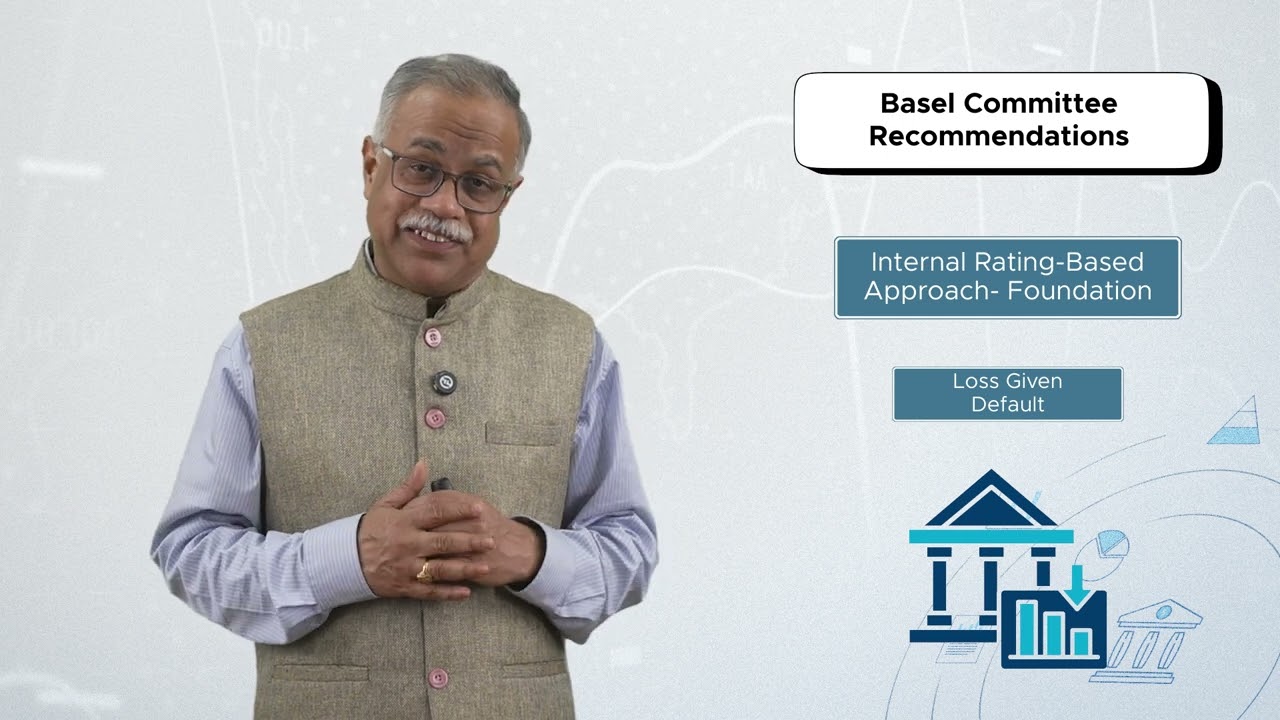
Overview of Basel 2 framework covering its three pillars: minimum capital adequacy, supervisory review, and market discipline.

Key Takeaways

  • Basel 2 expands risk coverage to include operational risk alongside credit and market risks.
  • It provides flexible methods for calculating capital requirements instead of a one-size-fits-all approach.
  • Quality of capital is prioritized by excluding certain reserves that do not represent real loss-absorbing funds.
  • Supervisory review and market discipline pillars ensure ongoing monitoring and transparency.
  • Banks must maintain at least 8% capital adequacy to safeguard against unexpected losses.

What the video covers

  • Basel 2 is a comprehensive framework for risk measurement, management, and identification in banking.
  • It is built on three pillars: minimum capital adequacy, supervisory review process, and market discipline.
  • Minimum capital adequacy covers credit risk, market risk, and operational risk, unlike Basel 1 which excluded operational risk.
  • Basel 2 introduces multiple approaches for risk quantification rather than a single standardized approach.
  • The framework emphasizes higher quality capital by excluding low-quality items like revaluation reserves from capital calculations.
  • Supervisory review involves both on-site inspections and off-site disclosures to regulators and the public.
  • Market discipline focuses on enhanced disclosure requirements beyond traditional financial statements.
  • Basel 2 mandates a minimum capital adequacy ratio of 8% to cover the identified risks.
  • The supervisory process ensures banks address gaps identified in risk management and capital adequacy.
  • Regulators have the authority to intervene and adjust capital requirements beyond the Basel 2 minimum.

Answers

Questions about this video

What are the three pillars of Basel 2?

The three pillars of Basel 2 are minimum capital adequacy, supervisory review process, and market discipline.

How does Basel 2 differ from Basel 1 in terms of risk coverage?

Basel 2 covers credit risk, market risk, and operational risk, whereas Basel 1 only covered credit and market risks.

What is the minimum capital adequacy ratio required under Basel 2?

Basel 2 requires banks to maintain a minimum capital adequacy ratio of 8% to cover credit, market, and operational risks.

Full Transcript — Download SRT & Markdown

00:06
Speaker A
Basel 2 is a comprehensive risk measurement, risk management, and risk identification measure.
00:15
Speaker A
So let us see what are the important components of Basel 2. Basel 2 talks about minimum capital adequacy, which is the fundamental thing of Basel 1 and which is included in Basel 2 also.
00:33
Speaker A
But this minimum capital adequacy is, in addition to that, there is a supervisory review process and also market discipline. So fundamentally, there are three pillars for Basel 2.
00:51
Speaker A
One is minimum capital adequacy. Two is supervisory review process. That means the supervisor is expected to review the bank's performance and risk, especially various types of risks and how they are being covered.
01:08
Speaker A
And third is the bank has an obligation to make additional disclosures in addition to what has been disclosed in the annual report and financial statements.
01:23
Speaker A
So in addition to financial statements, the bank is expected to maintain and disclose additional regulatory disclosures.
01:32
Speaker A
Let us come to first minimum capital adequacy. The minimum capital adequacy is covering three types of risks.
01:43
Speaker A
Basel 1 was covering only credit risk and market risk, whereas Basel 2 is covering credit risk, market risk, and operational risk also. So there are three generic risks which are being identified by Basel 2 and it insists that every bank is required to maintain
02:06
Speaker A
the capital adequacy to meet these three types of risks, that is credit risk, market risk, and operational risks.
02:19
Speaker A
So this is a fundamental mandatory thing. Second is in calculation of this capital adequacy.
02:29
Speaker A
In the case of Basel 1, a standardized approach is followed that all assets carry a risk weight and based upon the estimated risk weights, capital is to be estimated or based upon the given risk weights, capital is to be estimated.
02:48
Speaker A
Whereas in Basel 2, they have provided a menu of approaches for risk quantification.
02:57
Speaker A
So it is not one single approach. It is a menu of approaches given or various options are provided in estimating the capital requirements or in quantification of the risk fundamentally and then estimating the capital requirements.
03:17
Speaker A
It emphasizes more on maintenance of the qualitative capital. So they have defined clearly what are the components of the capital and emphasizing more on the quality instruments of the capital and whatever the bit of abstractness is there in Basel 1, that has been
03:39
Speaker A
overcome. For example, revaluation reserves. Revaluation of assets may take place, especially fixed assets, and fixed assets are revalued. A reserve is created and that reserve may be included for the purpose of capital adequacy but actually there may not be
04:00
Speaker A
any capital funds out of that to meet the unexpected losses because the bank is not going to sell those assets immediately.
04:11
Speaker A
Bank may sell investments. Bank may sell credits or advances or loans but not the physical assets immediately to meet the depositor's money.
04:22
Speaker A
So Basel 2 has excluded such types of low-quality assets or low-quality capital items while computing the capital like the capital funds. Then the supervisory review process is a very mandatory part. Under this, every bank is making some disclosures
04:46
Speaker A
on-site surveillance and off-site surveillance. That means off-site is they are making disclosures to the regulator and to the public and on-site is regulator is verifying or inspecting the bank's portfolio and bank's sources of the risk and providing a comprehensive
05:09
Speaker A
review on status of the bank on risk aspects and insisting the banks to meet these gaps arising out of the review process.
05:24
Speaker A
The third thing is market discipline. Market discipline is focused on disclosures. What assets are to be disclosed?
05:37
Speaker A
And then capital funds are to be estimated. So capital funds upon risk-weighted assets for credit risk, risk-weighted assets for market risk, and risk-weighted assets for operational risk.
05:56
Speaker A
How much should be the minimum capital? Initially, Basel 2 also talks about capital should be there of 8 percent to meet all these three types of risks,
06:12
Speaker A
and minimum 8 percent and more than 8 percent is always desirable. But subsequently, the regulators have taken initiatives, regulators have taken interventions in deciding the capital requirements. That story we will come to a little later. Fundamentally, Basel 2 also talks about maintenance of 8 percent
06:39
Speaker A
capital adequacy by every bank to meet these three types of risks or to meet the unexpected losses arising out of credit, market, and operational risks.
06:57
Speaker A
[music]
Topics:Basel 2capital adequacyrisk managementcredit riskmarket riskoperational risksupervisory reviewmarket disciplinebank regulationfinancial disclosures

Get More with the SozAI App

Transcribe recordings, audio files, and YouTube videos — with AI summaries, speaker detection, and unlimited transcriptions.

Or transcribe another YouTube video here →