Skip to content

M05C06

Overview of Basel 2 and Basel 3 frameworks, their role in banking capital adequacy, risk management, and lessons from the 2008 financial crisis.

Key Takeaways

  • Basel 2 and Basel 3 frameworks are essential for maintaining bank solvency and managing diverse risks.
  • The 2008 crisis highlighted the need for better risk identification, capital adequacy, and governance.
  • ICAAP is a mandatory internal process for banks to assess and manage specific risks beyond regulatory capital.
  • Basel 3 builds on Basel 2 by improving capital quality, introducing liquidity requirements, and mitigating systemic risk.
  • Effective board-level oversight and stress testing are critical components of modern bank risk management.

What the video covers

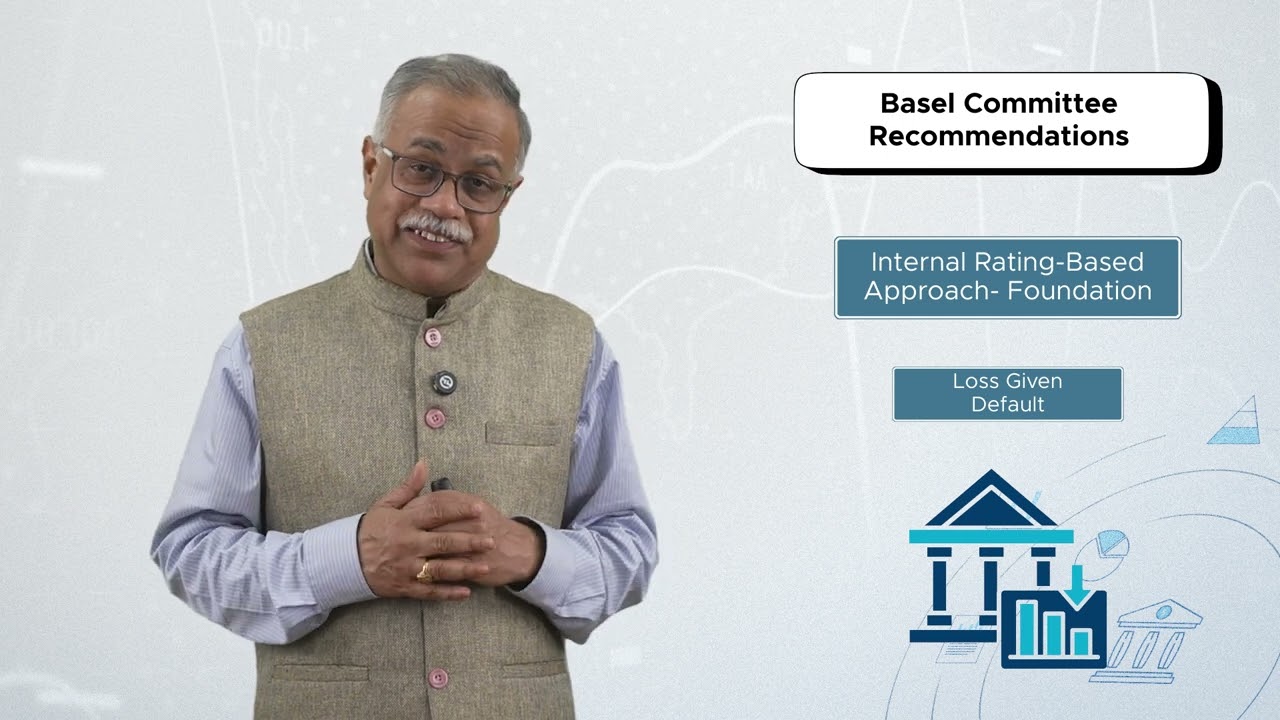
  • Basel 2 was implemented in 2006 for advanced banks, introducing capital adequacy requirements and internal risk assessments.
  • The 2008 global financial crisis exposed weaknesses in capital models, underwriting standards, and liquidity buffers.
  • Banks underestimated capital needs due to poor risk assessment, excessive leverage, and securitized instruments like CDOs.
  • Basel introduced the Internal Capital Adequacy Assessment Process (ICAAP) to cover specific risks beyond capital requirements.
  • ICAAP includes risks such as liquidity, concentration, interest rate risk in the banking book, strategic, reputational, and pension risks.
  • Economic capital is defined as capital needed to cover losses beyond regulatory minimums, with stress testing as a key tool.
  • Governance and board-level risk management have become critical post-Basel 2 and the financial crisis.
  • Basel 3, introduced in 2015, supplements Basel 2 by increasing capital quality and quantity, adding liquidity coverage ratios, and countercyclical buffers.
  • Basel 3 also addresses leverage ratios, counterparty credit risk, and aims to reduce procyclicality in banking capital requirements.
  • Overall, Basel reforms emphasize stronger capital buffers, improved risk management, and enhanced supervisory responsibilities.

Answers

Questions about this video

What is the main difference between Basel 2 and Basel 3?

Basel 3 builds on Basel 2 by increasing the quality and quantity of capital banks must hold, introducing liquidity coverage ratios, countercyclical capital buffers, and stricter leverage limits.

Why was the 2008 financial crisis significant for banking regulations?

The crisis exposed weaknesses in banks' capital adequacy models, underwriting standards, and risk management, leading to reforms like ICAAP and Basel 3 to better cover risks and improve governance.

What is ICAAP and why is it important?

ICAAP (Internal Capital Adequacy Assessment Process) is a mandatory internal program for banks to systematically identify, assess, and manage specific risks beyond regulatory capital requirements, ensuring better risk control.

Full Transcript — Download SRT & Markdown

00:06
Speaker A
Now the story is Basel 2 has been implemented and made mandatory for some advanced banks in 2006, and some banks have adopted this, especially in the US and in other markets.
00:25
Speaker A
Then, what happened is a lot of banks have followed different types of models, and by following the models, it is understood that some models have underestimated the capital requirements.
00:44
Speaker A
So the 2008 global financial crisis did not protect the banks which followed the capital adequacy requirements with the advanced approaches.
01:00
Speaker A
Of course, it exposed the banks which did not follow the standardized method also.
01:07
Speaker A
But in spite of following the advanced approaches, still some banks faced huge losses, and net worth or capital requirements were grossly underestimated and understated.
01:26
Speaker A
And that was not sufficient enough to cover various types of risks emanating from the global financial crisis or emerging out of the global financial crisis.
01:39
Speaker A
So, various reasons are identified for the global financial crisis: compromise over the underwriting standards. Underwriting standards mean credit rating standards, providing loans to subprime loans, or rating the subprime loans as better rated ones.
02:00
Speaker A
Inadequate quantity and quality of the capital and insufficient liquidity buffers, and banks have excessively leveraged.
02:13
Speaker A
That means the overall capital to assets ratios have come down, and inadequate coverage of certain risks and various options of the regulatory framework for addressing specific risks.
02:29
Speaker A
So various reasons have combined together, especially more and more securitized instruments, collateralized debt obligations, collateralized mortgage obligations; all these things have resulted in huge losses for a couple of banks, and the governments have interfered in bailing out the banks.
02:55
Speaker A
That means the public money has been used for bailing out the banks. These are the instances of the global financial crisis. Still, banks have to learn many lessons out of the global financial crisis which may be applicable
03:12
Speaker A
to the current scenario also. Maybe we can discuss it a little later in detail about these things. So to cover these weaknesses, the Basel committee has come out with various other specific risks which need to be addressed systematically,
03:33
Speaker A
not necessarily with the capital adequacy framework. They called this internal capital adequacy assessment.
03:43
Speaker A
So various specific risks to be covered under the internal capital adequacy risk assessment, ICAP, are liquidity risk, concentration risk, interest risk, which is interest rate risk in the banking book.
03:58
Speaker A
No capital requirements are needed for interest rate risk on the banking book, but this is to be covered under the ICAP.
04:08
Speaker A
Similarly, any other type of risks arising out of securitization and strategic risk, business risk, reputation risk, and other types of pension obligations. So various types of specific risks are being identified, and even the regulators have
04:31
Speaker A
flexibility and freedom to decide a few more components under the specific risk, and it becomes mandatory on the part of the banks not only to follow the capital norms but also a systematic program of internal capital adequacy assessment program, which is called ICAP,
04:55
Speaker A
to assess the specific risks. So ICAP is to see that adequate controlling mechanisms are there for various risks.
05:08
Speaker A
Risks are properly identified, and materiality assessment is being made. Materiality assessment means what will be the approximate loss if this risk is going to materialize.
05:23
Speaker A
In monetary terms, the materiality assessment is to be made, and aggregation of the various risks and what type of monitoring and reporting systems are there, and what type of capital planning is there for the bank, and what type of balance
05:39
Speaker A
sheet forecasting the bank is doing, and is the bank estimating the economic capital is an interesting question. What is economic capital? Economic capital is whatever the capital required to cover various types of losses or risks arising out of
06:03
Speaker A
the bank's balance sheet. That is slightly above the regulatory capital requirements.
06:12
Speaker A
So the economic capital allocation and finally stress testing. Stress testing is if stress events are identified by the bank or banks are expected to identify the stress events and to see what would be the impact of these
06:29
Speaker A
stress events on the balance sheet of the bank, income of the bank, net worth of the bank, capital funds of the bank, and these things are to be estimated periodically, and these are to be reported to the risk management committee,
06:43
Speaker A
and the risk management committee has to discuss these things, and those discussions are to be taken to the board level also. So huge importance is given to the board-level risk management committee as well as the board. So
06:58
Speaker A
the governance of the bank has assumed greater importance after Basel 2.
07:07
Speaker A
So especially after the global financial crisis, there is a huge responsibility on the part of the board to see that various types of risks are identified by the bank properly and all materiality assessments are being made, and
07:23
Speaker A
the bank has a systematic plan and control systems to see how these risks are being managed in addition to estimating the capital adequacy or maintaining the capital adequacy as suggested by the Basel 2 approach. This reform program has continued,
07:45
Speaker A
and step by step the Basel committee has issued several guidelines and sound risk management systems, what type of features to be maintained. The Basel committee has talked about these things also, and subsequently a new document came in 2015 that is called Basel 3.
08:08
Speaker A
Remember, Basel 3 is not a substitute for Basel 2. It is in addition to Basel 2. Banks are expected to maintain quality of the capital as well as augment the quantity of the capital to meet various types of other
08:30
Speaker A
risks. So there is a countercyclical capital buffer emphasized under the Basel 3 approach, and also liquidity coverage ratio has been emphasized.
08:46
Speaker A
So Basel 3 talks about additional capital requirements, quality of the capital instruments, as well as adequate liquidity and responsibility on the part of the supervisor.
09:04
Speaker A
So the Basel 3 rules do not per se replace the existing Basel 2 rules, but in addition to Basel 2 rules, Basel 3 rules are to be followed by the banks. It is increasing the quality and quantity
09:20
Speaker A
of the capital, consistency of the capital, increasing the counterparty credit risk charges, and restricting the leverage. That means what should be the overall assets to liabilities ratio, or assets to equity ratio.
09:38
Speaker A
What should be the assets to equity ratio? That means how much equity a bank is expected to maintain for the entire assets. So this is called the overall leverage factor, and reducing the procyclicality.
09:55
Speaker A
Procyclicality means in the boom period banks give good loans, and unfortunately in recession and depression periods, the loans may become NPA. So what is considered a quality loan or well-rated borrower may be declining, and the capital estimation
10:16
Speaker A
what is being made at the time of sanctioning the loan or giving the loan during the boom period may not be sufficient during the recession and depression periods. In that case, banks are required to have additional capital
10:32
Speaker A
for the same account which the bank is holding or same credit exposure. This is called procyclicality.
10:42
Speaker A
In addition to that, capital buffers are to be maintained by the bank. So increasing quantity and quality of liquid assets, that is where liquidity coverage ratio has been emphasized. So these are the things which are being talked about in Basel 3.
11:01
Speaker A
Basel 3 is in addition to Basel 2, with various other compliances relating to quality and quantity of the capital, modification in provisioning norms, comprehensive disclosures, and more and more liquidity assurances are being taken care of by Basel 3. So this is where
11:23
Speaker A
we are talking about capital requirements of the banks. Fundamentally, what is to be understood is how much additional...
11:40
Speaker A
required to maintain additional capital not only for credit up market and operational risks but also capital for procyclicality or counteryclical capital buffer and capital cushions. These are the additional things which are being emphasized by the vessel committee. So
12:02
Speaker A
this is where we are talking about the capital risk part of it is capital risk or solvency or capital adequacy. So capital adequacy is to sum up capital adequacy is very very essential for a bank for its growth for its solvency and
12:24
Speaker A
for overall financial stability. So capital needs are to be planned very systematically and if the banks are unable to raise the capital and capital infusion program has been taken by the governments where the banks are owning banks are owned by governments
12:45
Speaker A
especially in Indian context huge amount of the capital infusion has taken place during 2018 2019 to meet the additional capital requirements of the banks because banks capital has been eroded due to various risks.
13:04
Speaker A
Also, capital adequacy estimation and risk management all these is changed the scenario of risk based pricing.
13:15
Speaker A
It started estimating the expected losses by following the approach of dynamic approach and there is a governance responsibilities board responsibilities additional risk disclosures.
13:31
Speaker A
So stress testing has become a essential component of risk management and overall a risk culture has been spreading over the banks and banks are thinking about uh if for any type of the business question it what additional risk we are taking this business
13:52
Speaker A
decision. This is the essential change in the thinking of paradigm change in the bank thinking with reference to introduction of the basel 2 and basel 3 knobs. Thank you.
Topics:Basel 2Basel 3capital adequacyICAAPfinancial crisis 2008risk managementbanking regulationstress testingliquidity coverage ratiocountercyclical capital buffer

Get More with the SozAI App

Transcribe recordings, audio files, and YouTube videos — with AI summaries, speaker detection, and unlimited transcriptions.

Or transcribe another YouTube video here →