Skip to content

M06_C01

This video explains bank performance evaluation through accounting, regulatory, economic, and risk-based approaches, emphasizing leverage and solvency ratios.

Key Takeaways

  • Bank performance evaluation integrates accounting, regulatory, economic, and risk-based perspectives.
  • High leverage in banks amplifies returns but also increases risk and solvency concerns.
  • Return on equity depends on both return on assets and leverage, highlighting the trade-off between profitability and risk.
  • Regulatory capital adequacy requirements are essential to maintain solvency and protect depositors.
  • Efficiency and risk-adjusted measures complement traditional accounting ratios for a holistic bank performance assessment.

What the video covers

  • Performance evaluation of banks can be approached through accounting information, regulatory frameworks, stock market measures, economic efficiency, and risk-adjusted metrics.
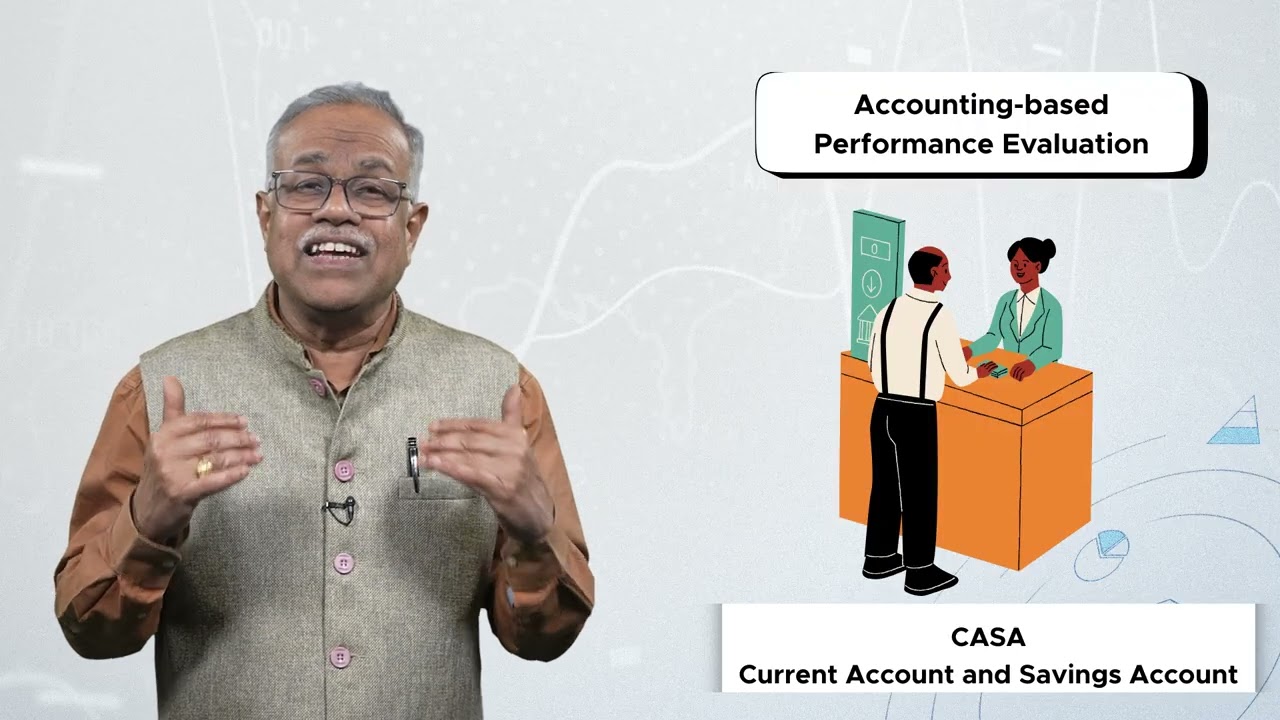
  • Accounting approach involves analyzing financial statements like balance sheets and income statements to derive ratios such as return on equity (ROE).
  • Regulators use the CAMEL's approach, which incorporates some accounting ratios and risk measures to assess bank performance.
  • Stock market evaluates banks based on price-to-book value, price-to-earnings ratios, and stock price volatility relative to indices.
  • Economists analyze bank performance using efficiency measures based on input-output models, employing techniques like Data Envelopment Analysis (DEA) and stochastic frontier analysis.
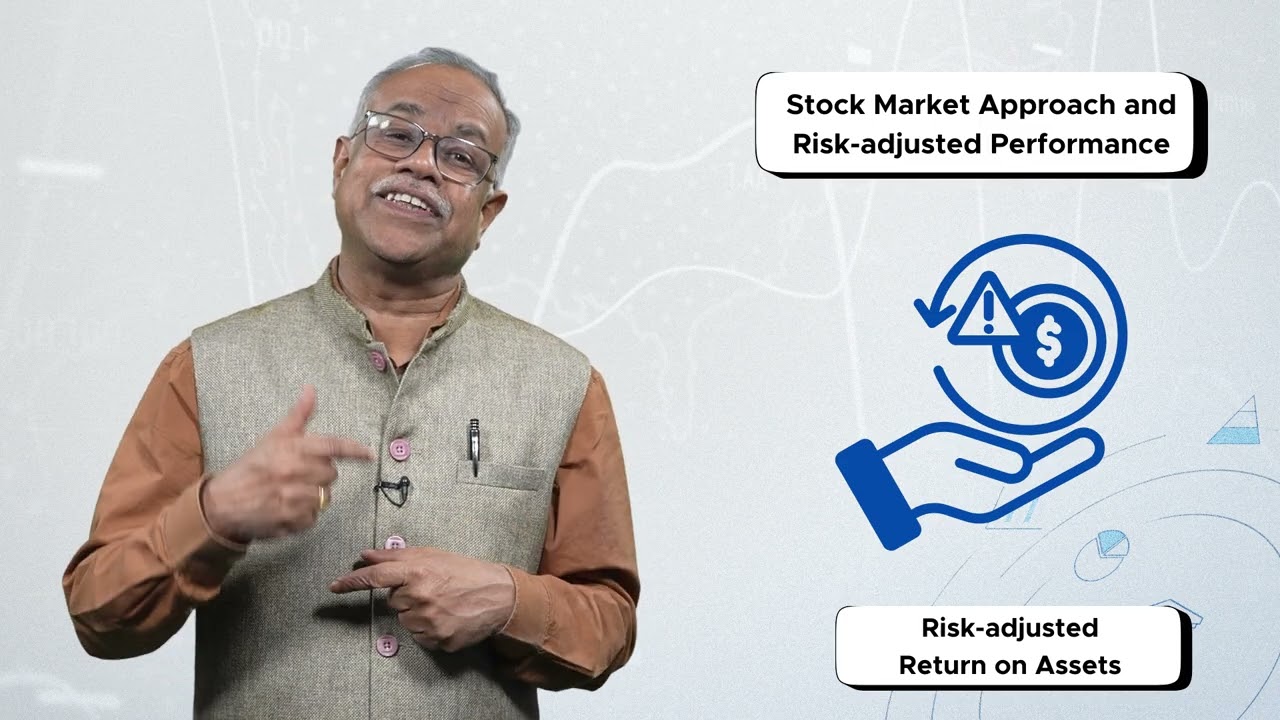
  • Risk-adjusted performance evaluation considers various risk types including credit, market, liquidity, and portfolio risks to assess economic profit.
  • Return on equity (ROE) is a key metric, calculated as net income divided by total equity, reflecting shareholder returns.
  • ROE is influenced by return on assets (ROA) and leverage multiplier, where leverage is the ratio of total assets to total equity.
  • Banks typically have high leverage, meaning assets are largely funded by deposits and borrowings rather than equity, increasing both ROE and risk.
  • Capital adequacy ratio, the reciprocal of leverage, is critical for solvency and risk management, with regulators enforcing minimum levels to protect depositors and ensure bank stability.

Answers

Questions about this video

What are the main approaches to evaluating bank performance?

Bank performance can be evaluated through accounting information, regulatory frameworks like CAMEL, stock market measures, economic efficiency models, and risk-adjusted performance metrics.

How does leverage affect a bank's return on equity?

Leverage amplifies return on equity by increasing the ratio of total assets to equity. Higher leverage means more borrowed funds are used, which can increase ROE but also raises the bank's risk.

Why is the capital adequacy ratio important in banking?

The capital adequacy ratio measures the bank's equity relative to its assets and acts as a solvency indicator. Regulators enforce minimum capital adequacy to protect depositors and ensure the bank can absorb losses.

Full Transcript — Download SRT & Markdown

00:06
Speaker A
After understanding the various dimensions of risk management in banking, can we relate it to performance evaluation of banks with the approach of risk management or by using the measures of risk?
00:25
Speaker A
We have multiple dimensions of understanding performance evaluation. Let us see the normal way of looking at the accounting approach of understanding the performance of banks. Then we will come to how to put it in the risk-based performance evaluation system. So what
00:45
Speaker A
are the various approaches of understanding the performance of banks? Number one, normally like any other business entity, banks release the accounting information, financial statements, balance sheet, income statement, and some additional information is also being released by the banks.
01:09
Speaker A
So analyzing this balance sheet and income statement information and coming out with a few inferences on performance of the banks, that is analysis through the accounting information. Regulators follow a different approach that is called CAMEL's approach. We will come to
01:33
Speaker A
details of this CAMEL's approach. Then the stock market will evaluate the performance in terms of the price to book value or price to earnings and how much of the stock price volatility with reference to the index.
01:56
Speaker A
So these are the measures from the stock market point of view. We'll come to this later.
02:03
Speaker A
Economists analyze the performance through efficiency measures. Efficiency measures are economists consider it as input and output. What is the input used by the banks and what is the output generated by them? So the measures of input and output vary
02:25
Speaker A
from different dimensions. For example, input can be deposits and output can be investment and advances.
02:34
Speaker A
And how much of the deposits are used to generate what is the advances? How much of our advances and investments? Can we measure the performance of a particular bank with reference to other banks? Here we use efficiency
02:53
Speaker A
frontiers which is called DEA, data envelopment analysis, or there is another alternate approach, stochastic frontier analysis also there. This is the economists are basically looking at the optimization and input-output based performance and finally risk adjusted and from the
03:19
Speaker A
dimensions of economic profit. So having measured the risk of various business units, it may be advances portfolio or it may be investment portfolio or it may be market risk and it may be the credit risk and it may be liquidity risk. From
03:40
Speaker A
these dimensions, how do we see the risk-adjusted performance of the banks? More or less sometimes these things are overlapping also there.
03:53
Speaker A
Some of the accounting ratios are being used by the regulators also and similarly whatever is being suggested as a risk-adjusted performance which is being partly covered under the regulatory approach also. So a bit of overlapping will be there here and
04:10
Speaker A
there. We will come to that overlapping part also a little later. So let us try to understand first of all with the basic accounting information how do we analyze the performance of the banks.
04:25
Speaker A
A business entity's performance is what is the return on equity or ROE. That means how much is the rate of return the bank or the business entity has generated over the capital funds or over the shareholder funds is an important
04:46
Speaker A
parameter for any business organization. So the dimension starts with what is the return on equity, that is net income to total equity the bank has generated over a particular accounting period. It can be over the previous year or it can
05:06
Speaker A
be compared with the other peer group banks also. So this return on equity is, as you know, it is a popular accounting ratio. So net income or net profit after tax upon total equity when we are considering equity it is capital funds
05:25
Speaker A
plus shareholder funds or we can call it as net worth. So return on equity or return on net worth indicates the rate of return generated by the business entity by using the shareholder funds or on the shareholder funds. What is the return on equity
05:46
Speaker A
generated? This is a combination of two things. One is return on assets, that is net income upon total assets.
05:57
Speaker A
The second one is the leverage. So the first one is very clear to all of us most of us.
06:09
Speaker A
Return on assets is net profit after tax or net income upon total assets of the bank. Even we use this parameter for other business entities also.
06:22
Speaker A
And the second parameter is degree of leverage or we call it as leverage multiplier.
06:30
Speaker A
Leverage multiplier is a ratio between total assets to total equity. Now when it comes to a non-bank entity, that means any other corporate entity which is in the business of manufacturing and trading services and those types of businesses,
06:50
Speaker A
the degree of leverage can be one also. That means total assets can be funded with the total equity, equity funds only.
07:02
Speaker A
That means the company can be a no leverage company also. In that case the return on equity and return on assets for this company, for that company, would be same. But in case of bank it is not possible.
07:20
Speaker A
Banks are financial intermediaries. So financial intermediaries necessarily they take the deposits and then deploy the deposits for the advances or investments. So the degree of leverage is very high for a bank.
07:40
Speaker A
So the total assets are, for example, if a bank has total assets of 100, 90 may be funded by the deposits and borrowings and 10 is necessarily by equity.
07:57
Speaker A
So the ratio would be 90 upon 10, that means, sorry, 100 upon 10, that means it will be 10 times. The degree of leverage is 10 times whereas for a corporate entity degree of leverage can be one also.
08:16
Speaker A
Total is entire assets are funded by equity. So what happens because of this? That means if the bank is trying to keep low amount of equity and giving more amount of the assets based upon the borrowed funds and deposits, the bank's
08:39
Speaker A
degree of leverage would be high. If the bank's degree of leverage is high, return on equity will also be very high.
08:50
Speaker A
So a particular bank's degree of leverage can be 10 or it can be 12 also.
08:57
Speaker A
So suppose if the return on assets is 2% and degree of leverage is 10, 2 multiplied by 10% return on equity will be 20%.
09:12
Speaker A
Whereas if the degree of leverage is 12 and 2 multiplied by 12 it comes to 24% as the return on equity.
09:24
Speaker A
So a bank can increase the benefit to the shareholders or return on shareholder funds by increasing the leverage.
09:36
Speaker A
This itself is a parameter for risk. This itself is a parameter for solvency. So if the bank is having higher amount of the borrowed funds, deposits and borrowings, the solvency ratio would be very low and the bank is at risk. So the
10:00
Speaker A
bank's solvency is an important parameter in assessment of the risk-based performance also. So even though it is a basic accounting information analysis which provides the dimension of the risk because the degree of leverage would be necessarily more than one and
10:24
Speaker A
it will increase the return to the shareholders. So that is the reason why if you take the leverage parameter reciprocal of leverage parameter. So what it will be reciprocal total equity upon total assets.
10:45
Speaker A
So total equity upon total assets means it is nothing but a proxy for capital adequacy ratio.
10:55
Speaker A
So how much is the capital the bank is keeping against the various types of the assets which are carrying the risk that is an important parameter to judge the solvency.
11:11
Speaker A
So the lower the solvency ratio, that means total equity upon total assets, the bank is having higher exposure to risk.
11:23
Speaker A
Higher exposure to risk is low protection for depositor funds and low protection for depositor funds means if the depositor's funds are not protected, the protection available to shareholders' equity would be a far more distant from the depositor's
11:47
Speaker A
protection. So even their funds are also exposed to higher risk. So that is the reason why the regulators are insisting on maintenance of a minimum capital adequacy ratio to increase the total equity to total assets or to reduce the degree of leverage or
12:13
Speaker A
leverage multiplier.
Topics:bank performance evaluationrisk managementreturn on equityleverage multipliercapital adequacy ratioCAMEL approachData Envelopment Analysisstochastic frontier analysisfinancial statementsbank solvency

Get More with the SozAI App

Transcribe recordings, audio files, and YouTube videos — with AI summaries, speaker detection, and unlimited transcriptions.

Or transcribe another YouTube video here →