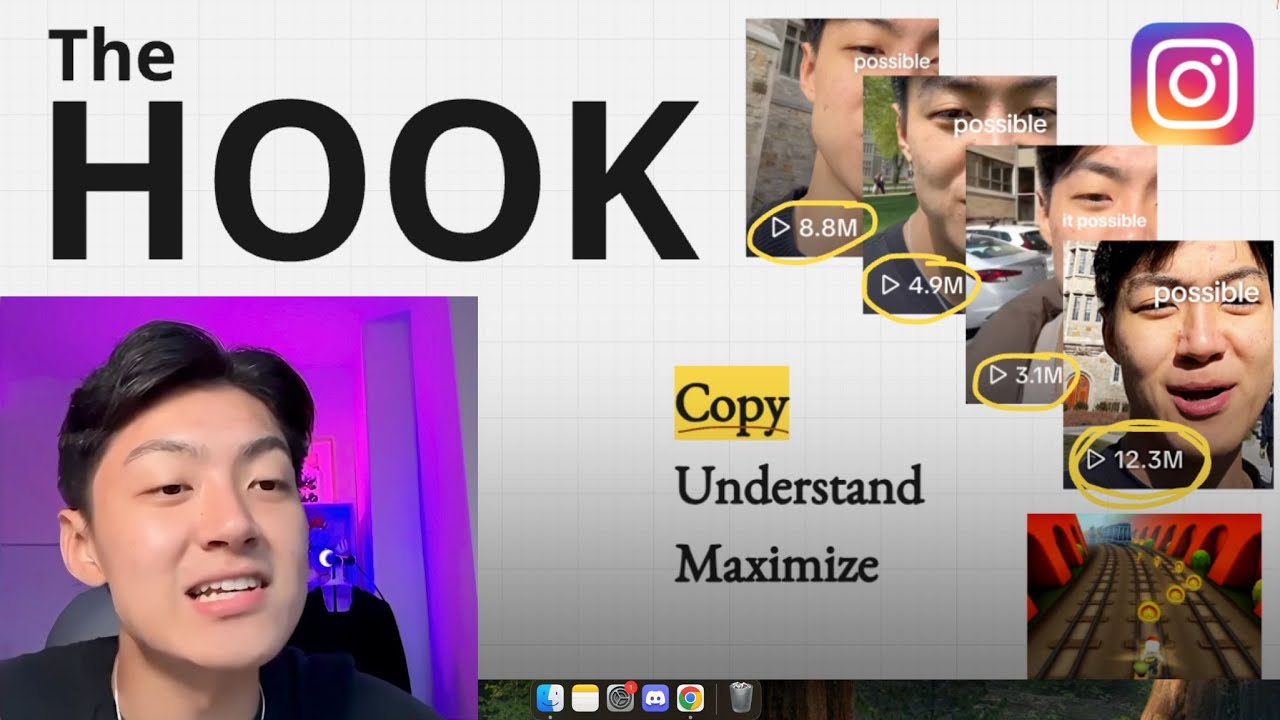
Mino Lee breaks down four rules of storytelling for viral Instagram Reels and TikToks, covering hooks, emotion, trust-building, and structure.
Key Takeaways
- Storytelling builds trust and emotional connection with strangers, making them receptive to your message.
- Keep the core message of each video simple enough to express in a single sentence.
- Use vulnerable, relatable personal anecdotes to create emotion early in the video.
- Structure stories with clear stakes, escalating conflict, and a climax that receives the most attention.
- Emotion comes primarily from the words and story, not from flashy visual effects.
What the video covers
- Mino Lee claims a repeatable storytelling formula has produced consistent million-plus view videos and grown his personal brand.
- Storytelling is presented as a way to convey a message indirectly, building trust with strangers before they accept advice.
- Stories help viewers get past passive scrolling by triggering emotion quickly, which the speaker links to dopamine and other neurochemical responses.
- Vulnerable, relatable personal anecdotes (e.g., 'I can't afford to propose') are used as examples of effective emotional hooks.
- Storytelling works for educational content and lead generation, not only artsy or cinematic videos.
- Flashy visual effects are not the goal; the words themselves can be enough to create emotion.
- The first of four rules is that a video's core purpose should be simple enough to state in one sentence.
- Hooks should pose a clear premise, conflict, and goal, such as a simple binary question.
- Stories should build tension with escalating stakes, including a 'rehook' that introduces new emotional events.
- Pacing matters: the climax should be the longest, most important part of the story, while setup should be brief.
Chapters
- 00:00Introduction and Storytelling Formula Overview
- 03:00Why Storytelling Matters for Trust and Impact
- 06:00Rule One: Define a Simple Core Purpose
- 08:40Crafting Hooks and Premise-Conflict-Goal
- 11:50Building Stakes and Rehooks
- 16:40Pacing and Story Structure
- 26:00Music, Emotion, and Editing Techniques
- 36:40Applying Storytelling and Closing Example
Full Transcript — Download SRT & Markdown
Speaker A
In the past 3 years, I've developed a storytelling formula that is so repeatable that it's allowed me to get consistent 1 million plus view videos on a [music] repeatable format. And those storytelling videos alone have literally gotten me over a 100,000 followers and
Speaker A
are responsible for me now running my 200k a month personal brand. So, this [music] video is going to be so in-depth. It's a private recording from my paid community, Content Academy, where I go super [music] in-depth into the four key rules to master
Speaker A
storytelling in your Instagram reels and Tik Toks [music] so you can go viral every single time and blow up your personal brand. Let's get into it. Now, something I want to make very clear with storytelling. I think a lot of people
Speaker A
misconrue storytelling as this very artsy fartsy style of content where it has to be super cinematic, right? Super stylistic. This is an example of storytelling content that I really like, right? This is Prosper. This video, right, boyfriend maxing very much starts
Speaker A
off with this hook. Two years ago, I was driving your hinge for every waking hour cuz I was lonely and wanted emotional values. You can start with this very deep emotional hook with storytelling.
Speaker A
But I also think storytelling helps you if your goal is to simply educate people too. I think that's what's so powerful is how many you guys here do educational style of content where you're teaching something. You want to help people get
Speaker A
towards an outcome, right? Or you want to generate leads for a business, for example. I think storytelling helps with that style of content, too. And I also like to think of it as like micro stories. You can just have small
Speaker A
anecdotes that you sneak in into your videos, right? To help essentially drive home your ideas. So storytelling, right?
Speaker A
And we'll get to it right now. Why is it important and why does everybody talk about storytelling? I want to make it as simple as possible for you guys to understand after today. Storytelling, simply put, is a strong way to convey a
Speaker A
certain message without explicitly telling someone the message. And I think of this example of let's say if you have a hook for a video, right? or an idea for a video where you have this message like let's say guys in business money is
Speaker A
not everything. Now I could make a video saying you know today I learned that money isn't everything in business and sure that's like a somewhat profound idea that I believe people need to hear.
Speaker A
A lot of times you might have a message that you want to tell your viewer. Maybe you have an ideal viewer or you're targeting a specific painoint or problem that you know somebody out there is going through. Maybe you had a really
Speaker A
deep conversation with your friend and you're like holy [ __ ] I want to make a video about that. Maybe you just think of your younger self and you're like, "Dang, my younger self used to struggle with this problem of never being
Speaker A
consistent with his habits and I want to help make a video about habits." If you just say outright, "Guys, habits are so important and today I want to give you guys a lesson on why you can build strong habits or how you can build
Speaker A
strong habits," you're probably going to get scrolled off of because nobody has the context of why they should actually trust you and listen to you. So, storytelling is a great way to build this actual trust and rapport with a
Speaker A
stranger. Cuz at the end of the day, the science of getting videos to hit 100K plus million plus views. At the end of the day, your video needs to hit and be retentive and engaging to an absolute stranger on the algorithm. And
Speaker A
storytelling is a powerful format to build that trust. So eventually, someone will actually be receptive towards taking your core message, your core idea, right? The core thing you want them to say or want them to believe or take away in their life, right? So
Speaker A
essentially, if you have a desire for impact, if you have a desire for a message, if you want to market anything, storytelling can help somebody actually get the idea through to their skull. And most people, all of us when we scroll
Speaker A
social media and content, it's very easy to just get into this brain offstage. So most people when they're watching and stumble across your hooks, odds are they're probably just unconsciously like, "This is not interesting. Boom, scroll." Storytelling is a way to get
Speaker A
through that, right? And just to drive this home even more, it's like a 100,000 years ago, the only way we actually could survive as humans, right? Is by sharing information like where danger is through stories, right? Storytelling simply put is just a way to convey
Speaker A
information. Okay? And when we tell or when we hear stories, our brains literally emit like dopamine, cortisol, oxytocin, serotonin, endorphins. I added these words into sound smart to be honest, but it's like the whole goal of storytelling in your hooks and
Speaker A
storytelling hooks is to make somebody feel an emotion as quickly as possible. So things like vulnerable language, like I think of Prosper's video, right? I think of Brad as another example, right?
Speaker A
He's in content academy. But Brad's story of holy [ __ ] 14 million views.
Speaker A
Do the math. I am at $6,54. Actually, this is a celebratory video. So I'll go into like his first ever video cuz Brad got like 11 million views on this day one of his series. And the way he was able to do that is through a
Speaker A
storytelling style of video. I can't afford to propose to my girlfriend. So, right. So, targeting for example, telling his own story and leading with an anecdote that's vulnerable of I can't afford to propose is a really strong method to then create emotion in a
Speaker A
viewer. It's like, oh [ __ ] wait, that's shocking or I feel I feel his pain. I feel relatable to his pain. Right? Or the main point I'm trying to make here is that storytelling and leading with a
Speaker A
storytelling hook, right? Leading with a I'm in this situation helps somebody feel emotion as quickly as possible and gives them a reason to trust you early on. The number one reason too why somebody probably won't take your advice
Speaker A
on social media if you give any sort of advice videos or you have any sort of message or talking head in your videos is just like who is this person? Why should I listen to them? Telling some small anecdote about your life like I
Speaker A
can't afford XYZ helps them recognize oh okay this person has a story worth listening to because I resonate emotionally with it. Okay, that's goal, right? And no, this is not just a let's just throw in a bunch of flashy [ __ ] on
Speaker A
the screen. Zoom in, zoom out sound effects, right? Vine boom, right? just add a bunch of text on the screen just to trigger some like, you know, flashy emotion. That's not the goal. Your words and just simply the words that you say
Speaker A
can be enough to actually trigger emotion. And often times it's actually way better than trying to trigger emotion by adding all these flashes on the screen, right? Stories exist to once again commu communicate information and actually get it through a skull.
Speaker A
Actually a really difficult art because a viewer is paying you. You're a stranger to them with their time, right?
Speaker A
So how do you convince somebody to actually actually care about you and your message, right? And the way you do that is by evoking a range of emotion which we'll talk about in a second.
Speaker A
Okay. So this lesson today is meant to teach you exactly how to do this. So you can absolutely eviscerate destroy all the other boring storytellers on the internet. Let's go. So these are the four rules of storytelling. Okay. Now
Speaker A
first off storytelling overall exists to convey a purpose, a value, a goal. And I actually think one way of thinking about this is that your hook and the goal of your video, right? what you're trying to convey should actually be very simple
Speaker A
and easy to say in one sentence and easy to understand in one sentence. Often times we can have this really complex story in our brain that we want to tell, but it's like what is the most important emotion provoking detail? How can I say
Speaker A
in the most simple wording possible in the first sentence? Okay, I actually took Brad's hook and I used it in my own video, right? I can't afford to pay rent for me and my girlfriend. So instead of asking her to split the rent, I started
Speaker A
to just resent her for it. This was me detailing this entire story around moving in. Okay, I have this whole spiel about moving into apartment, apartment hunting, like providership and relationships. This whole message like I also want to talk about like my business
Speaker A
goals around like, yeah, that's why I want to make a lot of money this summer.
Speaker A
But at the end of the day, when you're crafting a hook for a storytelling video, you have to ask yourself, right, what is the most shocking emotion provoking detail out of all the sentences I've laid out in my script?
Speaker A
How can I frontload the emotion? And I think Brad did a great job of this in his like I can't afford hook. I just took it and then spin it into my own story. I can't afford to pay rent,
Speaker A
right? And that's also a big hack for storytelling and just hooks in general is like if you see if you have a story but you're not exactly sure how to make it go as viral as possible, find another
Speaker A
creator who's got over a million views with that format and see how they did it. See how you can spin their version of a script into your words.
Speaker A
I can't afford to. Right? Same same hook, different story. Okay? And all it is is it's supposed to convey some sort of value to the viewer.
Speaker A
So another reason why I'm saying this is because right your stories that you're telling to your viewer should be viewer centric as in when I'm telling my story and I'm frontloading the emotion in my hook. I'm also thinking about what is
Speaker A
the sentence and what is the wording that can make the viewer feel the most emotion. Okay. So I'm asking myself what would a viewer relate to? What would someone else get gain a lot of value from or feel a lot of emotion in
Speaker A
hearing? Thinking viewer first helps you lead with something that actually is interesting and valuable. Okay. Second rule, start with storytelling that work.
Speaker A
So, I actually have a very simple storytelling framework right here. Okay, you guys have probably heard this before. It's called the hero's journey.
Speaker A
Okay, I'll pull up this image to make it even clearer. So, the threeact story structure. I have used this formula to consistently put up over a million views on this video series. Is it possible?
Speaker A
Okay, so this is like the bread and butter of the storytelling method. I have turned into pretty much a [ __ ] template. Like, so here it is, right?
Speaker A
the three-act story story storytelling structure. It starts off with a hook that goes through the actual conflict and challenge that you're going to go through in your video. So, in this case, in this video, and actually use that as
Speaker A
an example as I tell this story, is it [music] possible to ace a midterm after studying for just 1 hour? Think about the hook as simply, can you explain the premise and the conflict and the goal of your story of whatever you're going
Speaker A
through today in one sentence that is as extreme as possible? Wait, all of this theory on storytelling is probably super [ __ ] helpful, but I'll be honest, it probably does not apply to you unless you actually understand the three phases
Speaker A
to building a personal brand that's actually monetizable. And after doing a lot of research on who actually watches my videos, I realized there's three phases that you need to go through that you're probably struggling with as a creator. And I created a live master
Speaker A
class that I'm doing for free in the first link in the description that's going to walk through how to find your direction as a creator and know exactly what to post, the three mistakes that are keeping your videos stuck under
Speaker A
a,000 views. No, you're not [ __ ] shadowbanned videos. Just need to go through these basic fundamentals. And three, how to turn your skill set of getting views on your videos into actual dollars in a monetizable income. So, if
Speaker A
you want to be like the over 100 creators now that have successfully helped coach to get over 10,000 followers on their personal brand, just sign up for that free class in that first link in the description below on
Speaker A
this video. Anyways, on to the rest of the lesson. Okay, so is it possible to ace an exam after studying for just 1 hour short time duration? I use the word ace just because even though my ass was
Speaker A
never gonna ace this exam, I just use that word to make it like start with this absurd question rather than if I just said, "Is it possible to take an exam after studying for 1 hour?" It's like, "Yes, of course you can."
Speaker A
Proposing a slightly more extreme version of a question can shock a viewer, right? Pattern interrupting with the hook. So that's this moment right here. Right now, I want to make very clear, too. I know like this is the
Speaker A
classic Hollywood framework, but I kind of want to break down today not only why is it so powerful, but also how you can apply it into short form videos that are between 60 to 90 seconds. That's kind of
Speaker A
the time frame that I operate with in terms of reals and storytelling reels or Tik Toks. The reason why I don't do any longer than that is because when you touch upon the 2 to 3 minutes, often times what I found is that videos tend
Speaker A
to perform worse and it is harder for the videos to get lots and lots of views on Instagram because it's harder for people to just simply maintain their attention for over like 2 minutes, right? That's a general rule of thumb.
Speaker A
So, I try to keep it within this frame. And also reason why I like to keep it shorter is because odds are with your videos and just a rule across the board.
Speaker A
If you can make your video shorter and more concise while still containing the same amount of information, do it. Cut it out. Make it as short as possible.
Speaker A
That's another key hack. Okay. So, you start off with the hook here. Introduce the conflict and the premise with your hook. Right? So, that's the first sentence. The hook. This is between seconds 0 to 10. Okay? It's the hook.
Speaker A
This is where you set the scene. Now, next stage in any story, right? So, think of this as sentence number two is exposition and detail. Now, a quick hack is that this portion of setting the stage and giving context around your
Speaker A
situation should not be any longer than 10 seconds. As in, within 10 seconds of your video, the story should progress to the next inciting incident. And I'll go into what an inciting incident is. But an inciting incident, you can also think
Speaker A
of as a rehook, right? Some new event happens that provokes more emotion. So, an example here of a bad example of how I could have just absolutely cooked this video's retention and instead of getting 12 million views, it got 2,000 views. Is
Speaker A
if I said, "Is it possible to ace an exam after studying for just 1 hour?" So, my rhetorical traditions midterm is tomorrow. By the way, guys, I go to Boston College. If you guys don't know, my name is Mino Lee. And if you guys are
Speaker A
new here, this is day one of Exam Max. It's like, yo, like, chill with the [ __ ] context. Just get on with the story. Okay, that's what I mean by don't let your exposition where you're just giving random context and background
Speaker A
detail drag on for too long. This is a number one mistake that I see with a lot of storytelling creators is they drag on for too long around background detail that doesn't provoke emotion. Right? And I like this ex I like this visual of the
Speaker A
like up down up down up down. Right? What does this up down actually signify?
Speaker A
I think it signifies a viewer's emotion when they watch your video. You should be trying to create peaks of emotion even after your hook. Right after your hook, your job is not done. You still need to show events, right? And walk
Speaker A
through things in your video that actually incite emotion. So what do I do? I give one sentence of exposition here, just one hour. This [music] is my third time doing this and my rhetorical traditions midterm is tomorrow. So, I'm
Speaker A
going to be using my exact study method to get the highest grade possible after studying for just 1 hour. Right? So, in that case here, it's actually kind of funny. The inciting incident, quote unquote, is me like chugging caffeine.
Speaker A
This is like a small example of adding in something that's either interesting or humorous, right? So, think of like exposition as you just explaining [ __ ] like yabbering on about like how how things work. Like, I could explain how
Speaker A
my midterm works. I could explain my study method. Something I did in this video is instead of explaining. So my study method involves pneumonic devices, it involves drawing pictures. Instead, I just flashed it on the screen. I also
Speaker A
traditions I showed a visual of B-roll of the actual study plan instead of trying to explain it verbally. These are all methods to cut down the amount of exposition time because odds are in your story there's a lot of background detail
Speaker A
that you need to catch people up on. If you're telling a story about let's say this, this video is about exams. Let's say you you want to start a business in one day and you want to document that
Speaker A
journey, right? You could cush up the the viewer on all this detail like, "Yeah, so I'm in college right now and you know, I don't really like how my college doesn't really teach entrepreneurship, so I saw this other
Speaker A
video talking about entrepreneurship." It's like lot of detail. How can you condense it down without dragging on and on and on and let the next interesting, funny, or entertaining moment happen within the first 10 seconds? Main point here I want to really cover exposition
Speaker A
should be concise, as concise as possible. And that's the main challenge with a lot of content creation is how can you make the boring [ __ ] concise because the boring [ __ ] is necessary.
Speaker A
The exposition around how my exam works, what my study method is. It's necessary information, but it's not it's not interesting. Study highest grade possible after studying for just 1 hour.
Speaker A
Officially done studying. So this is like now when the second act kind of starts in a story. Now, the second act, right? I think of it as almost like this concept of a rehook where the best videos, if you think of like Mr. Beast,
Speaker A
right, getting hundreds of millions of views on long form videos. What he has is almost a secondary conflict that he brings up in the middle of his YouTube video. So, you have the primary conflict of let's say studying for an exam,
Speaker A
right? But in this case, I actually finish up the studying, the boring part, right, of the story as quickly as possible. So this is about maybe I believe this is probably around like 15 seconds in to the actual video that I'm
Speaker A
already done with the one hour studying portion. So what actually happens then I've realized over time that people actually don't want to see you study.
Speaker A
It's similar with like if I'm making a video talking about growing a business in one day. People don't want to hear me yabbering about how a business works.
Speaker A
They don't want they don't even give a [ __ ] about my business plan. What do they care about? They care about this singular question. Is it possible? Is this person going to take the exam? Is this person going to ace the exam? Is
Speaker A
this person going to fail the exam? You propose this binary question somebody's curious about and every point of the video should do as best as possible to get closer to answering the question.
Speaker A
Studying and dragging on for 30 40 seconds about this timer of me studying just it's not getting closer to the to the answer to the question. Right? So that was like a huge hack in making this video as retentive as possible. Right?
Speaker A
We are officially done studying. Can you test me on another question? The limits of rhetoric.
Speaker A
I never did. Oh my god. This is actually a small hack that I did too. is in this script, right? I just added one more piece of proof in terms of like making it very very clear that I'm actually studying in 1 hour. And
Speaker A
that's like a key part is like what makes a storytelling video actually good. I believe it's actually believability. I I don't think enough people talk about this when it comes to storytelling content. Most of the time when you are telling a story on social
Speaker A
media, you are a stranger to somebody else on the for you page when they're scrolling. Therefore, they don't believe you. They don't believe, right, that I actually took an exam for 1 hour. My instinctual thought when I see somebody
Speaker A
else talking about school is like, "Oh, they're probably smart. Oh, they probably don't care about school. Oh, they probably are not. They're lying about studying for just 1 hour." So, to prove it, I literally just added in clips of me talking to my friend being
Speaker A
like, "Holy [ __ ] I don't know about this. This is crazy, right?" And then I end that off by saying, "Oh my god." So, I just made a bet with my friend who's going to study for another [music] like
Speaker A
3 hours tonight. And whoever does better on the test has to buy them dinner. This is me adding in a secondary plot point test.
Speaker A
So, now there's a secondary open loop. There's a secondary question in the viewer's mind. Who's going to buy dinner? And that adds a second plot point on top of just what exam grade is he going to get? Right? And the the more
Speaker A
simple the questions can be, the better it will do, right? So the question, the first question is very simple. Will he ace an exam or not? Or will he fail?
Speaker A
Very simple, very binary. It's either A or B. This one as well is very simple question. Is he going to buy dinner or is she going to buy dinner? Who's going to do better? Who's going to do worse?
Speaker A
Binary question, A or B. Right? So also, I think the simpler the question can be, the better the video can actually perform. Do storytelling girls have to be part of a series? I'm having trouble figuring out what type of series to
Speaker A
create or if that's applicable to my niche. Story telling girls rules do not have to be part of a series? So, this video in this case was a one-off video about story or about studying for an exam. I just put part three because I
Speaker A
just made this video multiple times. But that is another hack as an aside. If you have a video do well, try your best to just double down on it and remake it, tweaking a couple words, right? So, in
Speaker A
this case, I was like, "Holy [ __ ] this exam video absolutely printed. I need to make five more. So like one, two, three, four. Right? And that's an example, I guess, of a quoteunquote series. But it's like the core principle here is
Speaker A
just if you have a good video, make it again. Right? So now this is we're about halfway through the video and it bring up this next like intense moment, which is the actual exam. I'll go into a little bit of a little hack of how to
Speaker A
make the moments in your stories actually hit harder and feel more intense, right? It's not just the sequencing of events. There's also a couple other hacks when it comes to editing and when it comes to footage and filming to actually make your stories
Speaker A
feel more intense without necessarily changing up or adding more to the video. That was so [ __ ] I wrote the last essay question in like 2 minutes. Oh my god, I think we actually got like a D.
Speaker A
Once again, this is just me building more believability around and more suspense around failure right now. This is one of those moments where I was also kind of like playing up the extremes.
Speaker A
It's like no, the like I wasn't actually that like holy [ __ ] I got a D. I also didn't really care about the exam that much. But for the sake of the story, I think it's very powerful to build more
Speaker A
moments of like suspense. Right? If you can capture these raw moments of emotion where I'm feeling an emotion, I'm expressing an emotion, then it also helps the viewer by process just by carously watching the video and your story or hearing your story feel the
Speaker A
emotion too. The exam grade is [music] up. There it is. Let's check three. You know what? I'll take it. Now the only [music] thing is I have to ask my friend what she got. What is right? So in this case too, I close the
Speaker A
first loop. Right now, a loop as in just a open question. So, the open question or the open loop as they say in storytelling/content lingo is what did he get on the exam? I've closed that loop. I've closed this loop. Now, at
Speaker A
around what 80% through the video, it's%. So, now I've closed that loop. People know the answer. They have permission to scroll. And the way to prevent them from just instantly scrolling is having a secondary question in the back of their mind. That's why I
Speaker A
believe having that secondary question of the dinner opens the second loop. Now it's like who bought the dinner, right?
Speaker A
Who what? That's a secondary question now that has been proposed. So ask yourself what questions can I create in the viewer's mind subtly that keeps them watching till the end, right? And keeps them curious till the end. It's very
Speaker A
helpful, right? And then you get Wait, so what did you get? And at this point now, it's just teasing out the ending a little bit longer cuz at this point towards the end of the video, you're at the climax of a story,
Speaker A
right? The climax and at which that's like the emotional peak. Nice. Right. So you can play out and actually think the climax, right? The moment where the viewer feels the the question being fully answered, fully resolved.
Speaker A
Drag that out. It should actually be longer than you might think. So it's like in reality, this is the longest and most important part of the story. This is the shortest and least important part of the story, right? And if I see a
Speaker A
common mistake with storytelling styles of videos or challenge styles of videos, I'll notice that the climax is very short and doesn't feel very dragged on, but the exposition feels too long and draws on for too long in the first 10
Speaker A
seconds of the video. Do we have to close the first loop first or could we leave it open and close the second loop?
Speaker A
You can also do a combination. You could also close one loop and then open the like and open a second one, right? And I know I gave a very specific example of a challenge video, but you can also do
Speaker A
this with spoken content too where you're just speaking out loud where you could you can just open up like questions or cliffhers just by the words that you're using. But in this case, I'm showing it based on like the events that
Speaker A
I'm telling in the story. Okay? And then thank you answer the question literally in the last second of the video. And that's how the video actually I was able to keep a viewer watching until the very end of the video. Right? And as a result
Speaker A
once again of creating this ups and downs of emotion right it also makes your content a lot more memorable. So as a creator makes you a lot more memorable right and in terms of your content it keeps a lot more where people are
Speaker A
watching for as long as they possibly can. Okay so that is also the benefit of storytelling content. Now I covered a lot of concepts around creating emotion opening loops right but do you guys see now the structure of general
Speaker A
storytelling videos start with a hook create conflict and conflict is a centerpiece of content right another example that I want to highlight too from before is 2 years ago I was swiping through hinge for every waking hour right that in that case that is
Speaker A
prosper's hook talking about his own internal conflict to find emotional validation right and did he find it no that opens up a subtle loop of like okay well if he was looking for emotional validation and did it find it? Where did
Speaker A
he find it? Did he end up finding it? Right? Okay, cool. So, now that we know the sequencing, right? Start with the hook, create conflict, create emotional moments. How do you actually make the moments in your story feel more
Speaker A
emotional? Now, yes, a lot of it comes down to the wording that you use.
Speaker A
Extreme language, right? Telling vulnerable moments, thinking about who is your ideal viewer and what stories would they relate to, what desires do you share with them? And that kind of helps inform what uh details in your story to actually lean into and tell
Speaker A
more of. So for example, if I know my ideal viewer in this case who's a student doesn't really care about studying and learning, but instead only cares about the result of an exam and only cares about whether a person failed
Speaker A
or did well. I'm going to highlight all of these moments more in my story and talk less about the studying method. So, I'm going to spend more time showcasing myself doing stupid things like chugging caffeine or making bets, right? Or
Speaker A
[snorts] stressing out rather than talking about the technicalities, right? So, ask yourself, what does your viewer care about? What do they not want to see? That's also another really powerful question. What do they not like? What bores them? What type of content do they
Speaker A
hate watching? And then counter position against that by just showing less of that detail, right? And I know this is a very exam specific example, but I'll tie it back to let's say like a business creator, right? Because I've made a very
Speaker A
similar example of this video, but in the in the business niche, is it possible to make an entire business in one day, right? So in this case with the business example, how does that apply as well? Well, in a business related video,
Speaker A
what do people not want to see? People don't care about funnels. People don't care about learning how the intricacies of a business plan work. They just want to see money or no money, right? And caffeine, that's another one. It's like
Speaker A
people respond more to the idea of like caffeine and grinding as an aesthetic and motivation rather than they do about like technical skills, funnels, breakdowns, right? So ask yourself, what does your ideal viewer want to see? What do they not want to see? What bores the
Speaker A
hell out of them? What's confusing to them? And avoid the things that are confusing and boring and slow.
Speaker A
Now, now that we covered the threeact storytelling structure where we go from conflict, introducing the conflict to building up, working towards the answer to the question, and then eventually a climactic moment where the question gets answered at the end, right? How do we
Speaker A
actually create more emotion, right? Let's say with these kind of storyteller challenge related videos, having in the back of your mind that you are trying to achieve a goal helps going in. So, you just know what to generally record. So,
Speaker A
it's like, okay, I need to get clips of me studying. I need to get clips of me showing emotion on camera, right? So, in this case, right, I literally screenshotted all these moments where I'm facial expressioning, where I'm
Speaker A
like, "Oh my goodness, I'm stressing out. I need to clip up moments of that." It's like clip farming, right? Another one, clip up my reaction to things cuz people want to see the reaction to a test score. Make sure I collect that
Speaker A
footage. I need to collect footage of me tweaking out even more, right? And I last need to get the time lapse. But it's like you won't know 100% of the footage you will will and will not use.
Speaker A
So, something I always like to say, and this is a huge hack, is overrecord, overf film footage, and just collect more footage than you think you need.
Speaker A
It's probably the biggest hack cuz imagine if I just didn't have any clips of my actual exam. And then I also missed out on like one clip of me making the bet with my friend. Now, suddenly the story loses out on these emotional
Speaker A
moments. So, even though it takes a lot more storage on my phone, frankly, it's like actually one of the biggest hacks that I have is just upgrade. If you're if you're on an iPhone, I I bought the one tabby version or I know people also
Speaker A
have this is another piece of advice. It's like you can buy two terabytes a month on iCloud storage to like basically just increase your cloud storage on your iPhone for like an extra 10 bucks a month, I believe. So, it's
Speaker A
like that's another huge hack. It's like you never want to have a footage problem as in you don't have enough footage. You always want to have an editing problem where it's like, damn, I have so much footage. It's probably going to take me
Speaker A
a little bit longer to edit. But you know that as long as you know what to actually add into your video, what moments are the most interesting cuz you know the storytelling framework, then you can create the story in the editing
Speaker A
process. Does it work for all niches? Yeah, 100%. It's like I did it in exams.
Speaker A
I've seen people do it like in I mean relationships is another example for Brad's niche. I've seen people I've seen somebody in the academy make a storytelling video around like a proposal before. Um I've seen I mean this one's about studying. I've seen it
Speaker A
work for business, right? Fitness. I saw somebody make a video trying to master a song on the saxophone in one day. I'll send that example where it's like, this guy's actually a cool example. I really like his content. Luke Proof.
Speaker A
That's not it. It's Luke Proof. He gained a million followers in 23 videos. And his storytelling videos are incredible.
Speaker A
But he makes a bunch of videos talking showcasing like challenges around trying new things, trying a bunch of different things.
Speaker A
Okay, so cool. Now, how do you create more emotions? First one is I mentioned it a little bit briefly, but curiosity loops, right? Instead of trying to create a big reveal at the start, always try to ask yourself how can you word
Speaker A
things in a way that actually doesn't answer the question. And it's kind of annoying. But for example, right, you might have an idea of Prosper's video.
Speaker A
Yo, I was swiping through Hinge for every waking hour because I was lonely and I wanted emotional validation. Did it help me find a girlfriend?
Speaker A
Nope. Now, in this case, Prosper's I'm going to spoil the ending of the video right now. Prosper's video is about now he's on a mission to become the best possible boyfriend so he can become the best possible future husband for his future
Speaker A
wife. Now, he could have said that at the very beginning, but that that's the answer to like why he's telling this story. And if he says that right at the start, it's like, "Guys, welcome back to my series about becoming the best
Speaker A
possible boyfriend because I don't feel like I am at the answer of like, you know, this personal development journey of be becoming the ideal man." Right? If he says that at the beginning, then a viewer doesn't really have a strong
Speaker A
reason to stand to the end. So start with the question of um 2 years ago I was in this painful situation to create the question in the viewer's mind of like is he still in there? How did he
Speaker A
get out of it? Right? And then don't answer it immediately. You might have this temptation to open a loop. open the question of like, can I study, let's say, can I bake the world's hardest cake in one day, right? Let's say that. And
Speaker A
you could be tempted to be like, "Yeah, I've done this challenge before and I did it in two days. So, today we're going to try to do it in one day." And I know you might think like, "Oh, yeah,
Speaker A
that's not a bad second sentence in your story." That can actually close the loop subtly, which is like it now paints you as an expert at cake baking, which then means that the viewer watching is going to be like, "Oh, so I already know what
Speaker A
to expect. I'm subtly getting my question answered that this person is good at cake baking, so I'm not going to watch some crazy failure. And because you've omitted the possibility of a crazy failure, the story is no longer
Speaker A
believable, it lacks stakes and it lacks tension, right? So ask yourself, how can you create sentences and how can you tell sentences and see in details that actually do the opposite of telling the answer but actually almost mislead them
Speaker A
in a different direction, right? Because if I said in my is it possible to uh in this video it's like if I said is it possible to build a business in one day and make my first $2,000 off of it. So
Speaker A
my business already does seven figures a year. I I wasn't doing that by the way at this point. I've already done this before five times but I'm going to see if I can do it quicker. It's like okay
Speaker A
well now I know that this is not going to have much stakes and intensity to the story. So instead of that I actually go the opposite direction. I try to make the situation and the problem and the conflict and the goal as difficult and
Speaker A
as intense as possible. I create that gap instead in the second sentence and make my first thousand off of it. So, I'm in college right now and my bank account's looking a little You guys got to keep this on the deal. I actually had
Speaker A
like 800s at the time, but I moved over $600 to my savings account so I can get this shot. You can't tell anybody, but right instead of saying, "Guys, I'm an expert business owner. I have this crazy big plan and I'm pretty smart, so I
Speaker A
think I'm going to do this." It's like, no, I should actually paint the picture that I'm going to [ __ ] fail so when I actually do succeed at the end, it seems so much more intense and climactic,
Speaker A
right? Cuz imagine if you watch a movie Spider-Man Brand New Day and the villain is some like weak [ __ ] shrimp. You're going to be like, "Oh, I think it's boring. This is the story's boring. Like there's not much intensity to this."
Speaker A
Right? So always try to um create as big of a gap as possible. That creates more curiosity and anticipation because that genuinely makes it now like you want to make both possibilities and both outcomes as possible as as possible as
Speaker A
plausible as possible. That's a better way of putting it. So in this case, the prospect of failure needs to feel equally possible as success does in this business goal. Same with the prospect of an exam and a study video. The prospect
Speaker A
of failing should be really palpable. It should feel very possible that I'm about to fail and you're about to watch something hilarious and a hilarious failure. And that is what actually creates more anticipation and curiosity.
Speaker A
So goal with sentences in storytelling videos is to dig in the pain more, right? or dig in the conflict more. Make the conflict feel more believable in your story rather than closing the loop and being like, "So, I was fine at the
Speaker A
end, but I got I got to tell you the the it's like imagine if you lead a story being like, "So, two years ago, I almost lost my brother in a car accident, right? But now he's fine. This is my
Speaker A
brother right here. But anyways, let me tell you the story." It's like, "Sorry, like, yeah, that's cool, but um I don't feel as much tension and suspense." Another example is like instead of that hook, I almost lost my brother. You
Speaker A
could say two years ago I got a phone call from a hospital saying my brother had gotten into a terrible accident. Now it actually opens up the question of holy [ __ ] right? And I know this is
Speaker A
very morbid, but it's like holy [ __ ] did he die? Right? And you want to it's like kind of dark, but you actually want to leave that possibility open so a viewer can feel tangibly like oh wow
Speaker A
this is very believable that that's that this happened and that creates more suspense. I know that it's like a very this is a very small nuance in wording that can either create curiosity and create deeper curiosity or subtly answer
Speaker A
a question in the viewer's mind and it's very easy with storytelling to almost accidentally make very obvious what happens at the end. Right? So ask yourself how can you make it how can you word things in a way that makes it
Speaker A
genuinely believable that failure occurred. Okay. Right. So, another key point is if you do end up closing a loop, right, you want to try opening up a secondary loop, introducing a new conflict. And you can actually do this
Speaker A
too with educational content. So, let's say if I'm making a video about hooks, right? Like, let's say I'm making a video about social media advice and I'm teaching you about hooks. Now, I could say here's um this hooks method, this
Speaker A
method of creating viral hooks got me 2 million views in the last 48 hours.
Speaker A
Okay? And the method is what I call uh zoinkin twist. Now most people think zoinkin twist means just take an existing idea and twist it a little bit.
Speaker A
But what they don't understand is so in a sense I'm closing the loop. I say there's a hook method that got me millions of views. And I close the loop by saying um the hook method is called zoink and twist. Right now zoink and
Speaker A
twist also creates a little bit more curiosity because the word itself is kind of confusing. It's like what the [ __ ] does zoink and twist even mean?
Speaker A
Right? What does that even mean? So that can also create a little bit of curiosity. But then I kind of close a loop there because it's like now the viewer knows what the method is. And if they already have heard those words
Speaker A
zoink and twist before they're going to scroll. So instead I say now for those of you guys who might be thinking I already know what twist is. I already know what a good hook is. You probably haven't heard it phrased in this way
Speaker A
before. That's a way of creating a new curiosity loop that says okay this is novel information that you haven't heard before. This is really good for saturated niches. Think of niches like AI. Think of niches like fitness. For
Speaker A
example, you could say like these these are the like the thing that really started working for for my triceps was a super hidden exercise that I only learned from my grandfather. It's like, you know, some some random [ __ ] where
Speaker A
it's like everybody knows tricep exercises when it comes to gym gym videos. So, you want to create an added curiosity loop on top of it of like, you know, I only got the secret information from somebody you've probably never
Speaker A
heard before. Okay? And that's that's a way of opening up uh secondary curiosity loops when it comes to uh educational content. So that's why also I want to make very clear it's like yes even though storytelling content is its own
Speaker A
kind of like format of content when you think of like this type of stuff challenge videos but these storytelling principles of curiosity loops and keeping people curious throughout the duration of the video and keeping people actually feeling emotions feeling
Speaker A
feeling some form of anticipation right helps even with educational videos helps even with advice videos. Okay. Also, another small hack. If you're looking through your script and you just notice that you say the word and a lot, replace
Speaker A
the word and with but, yet, so, although, or even though, and that's a small way to just make the viewer or make the video and the script feel like it has these twists and turns. So, that's just a small thing, right?
Speaker A
Transitions words like but, yet so, although, even though are a great way to just add more suspense in a story or in a script. All right. And lastly, and this is what I was alluding to before, this is like advanced storytelling tech.
Speaker A
I genuinely don't think like most storytelling creators will will like or like content gurus will say this, okay?
Speaker A
This is like something I felt I'm very passionate about. Music and sound are crucial to feeling a story. Okay? And when I say this, this uh this line, this I'm going to highlight it in yellow.
Speaker A
this line that represents the emotion that somebody should feel throughout watching your video. This also represents how intense the music should be in that moment of the video. Okay?
Speaker A
So, the most intense moment of the background music and the song should occur on the climax. Meanwhile, the starting song should feel like it has a rising feeling to it like that. That's like a huge hack. So, a lot of the songs
Speaker A
that you see in this playlist, right, will actually start off with this rising sort of sound effect. And to really like make this very clear, some of the best storytelling songs that I've seen before, like this one from the social
Speaker A
network can cover, right? A lot of times the best storytelling content will start with this song because it has this like violin that creates this feeling of subtle anticipation and drama, but it's like I just feel like that sounds very
Speaker A
intense, the sound of this violin going off, right? So, a big hack that I have for music is like take from famous movies. It's a huge hack. If you're going to do storytelling content, famous movies are a huge hack. And try to make
Speaker A
sure that the intensity of the song matches what component of the story you're actually in. You don't want to start off with the beat drop in your hook unless you have an even bigger beat drop prepared for the climax of your
Speaker A
video. So, another one is like Interstellar is like a a favorite of mine. This is now just like getting super nerdy about like music specifics, but like this song um was used in a part of the movie where the main characters
Speaker A
were on a planet where time was like speeding up and like dilating. I don't know. I just think that concept is so cool. So that's why I used it in this video. Is it possible to make an entire
Speaker A
business in [music] one day and make my first $1,000 off of it? So I'm in college right now and my bank account's looking a little low. [music] So let's try and do this. So now in this case right literally as there's an inciting
Speaker A
incident and the story starts progressing to the next moment the song also has this beat drop slp progression little low [music] so let's try and do this all right so the name so that creates like an added layer of new
Speaker A
suspense that kicks in once I go into this next segment of the video so it feels like it gets its own dedicated feeling and emotion and segment to the song or to the video itself right and I'll kind of skip to the end right but
Speaker A
it's like base principle use songs that feel dramatic, right? And movies are a great place to actually source this from. I'm a big fan of Christopher Nolan, so like that's why I used I I use his songs repeatedly in my in my
Speaker A
storytelling videos. And make sure the climax of your video towards the end, the payoff moment where you finally answer the question, the viewer finally feels this cathartic moment of like, I've been waiting for the last 60 seconds to see if this this dude failed
Speaker A
his exam or not, right? Or made the money or not in the business, right?
Speaker A
That's when the beat drop of the song should hit. for this. I'll just message [music] you there. So, something I like to do is like I I'll have these moments in these storytelling videos where I'll like literally yell out loud like, "Oh
Speaker A
my god. Wow. Holy [ __ ] I just got my exam grade back. Wow. I did not expect it to get a 95." And I'll time the exact beep drop moment to the moment where I start yell. It's very s. But timing the
Speaker A
music. How do you time that music? That's a great question. Uh, did I act those out? No, I was actually feeling that in the moment. That is something too. Like you can fake it. Honestly, you can act it out, you know, but I was like
Speaker A
actually hyped cuz this was actually like a difficult challenge for me. And that's what makes a video's ending feel so rewarding. And I think that's what makes for a [ __ ] banger storytelling video as well. Sometimes, and I'll bring
Speaker A
up example in a second where I use multiple songs. But in this case, I think it was just one song and I spliced it halfway through. I did a fade in and fade out in cap cut because I think this
Speaker A
is like the starting portion of the song in like between seconds 20 to 30. And this portion of the song happens like at two minutes to three minutes into the song. So it's like kind of Frankenstein the audio clips together inside Cap Cut.
Speaker A
That's like more like editing sauce. But like a lot of times it won't match up perfectly. So that's where some like audio like up segments of the audio and Frankensteining them together can be very helpful. Right. And to give you
Speaker A
some more examples of like songs that have like built-in suspense. This is a personal favorite of mine. Like this beginning of portion of the song literally is a buildup to a beat drop.
Speaker A
So, it's like if you're doing an educational video, there's going to be a moment in your educational video where it's like, I figured out like here's the one way to grow on Instagram. No, it's not hooks. No, it's not posting times.
Speaker A
No, it's not hashtags. It's and then you reveal the answer. When I reveal the answer in a how-to or educational video, that's when the beach drop moment will happen in the song. That's another hack is like, let's say you're using a song
Speaker A
like this, right? It's called storytelling. So, in this video, I'm going to break down my three-step [music] storytelling framework. You know, it's like beat drop the reveal.
Speaker A
Like the beat drop and the reveal should happen simultaneously. That's how you make a video feel emotional. This is like this is like my niche sauce. All right. I want to see y'all [ __ ] start using some crazy music in the background
Speaker A
of your songs, right? And if you want like the actual technical sauce, like how to add the songs into your videos, that's in like the [ __ ] uh day one through seven boot camp in the content boot camp inside [ __ ] Okay. But yeah,
Speaker A
just to like give very tangible example, it's like you might have thought I just made that up on the spot. Like that's literally a hook that I've done in one of my videos, right? So you can see I
Speaker A
build up. I do a buildup, build up, build up, and then I reveal. And on the reveal, the beat drop of the song happens.
Speaker A
One thing you need to know if you actually want to blow up on Instagram.
Speaker A
And no, it's not what niche you're in. It's not what captions are above your head. And it's not knowing which creator to copy [music] next. I know you guys are watching thinking, "Oh, we should stand on a roof for our next video." The
Speaker A
one thing you actually need to know is simply so I've also I cut the song in cap cut using the split button and then I just moved it over so I could extend the pause and that makes this sentence I
Speaker A
feel like hit a little harder who your viewer is. Like I literally have an entire Google doc about [music] who my ideal viewer is.
Speaker A
Yeah, that's some sauce on how to splice music well into your educational videos, right? And I think that's a huge hack that I wanted to tell is like music and sound genuinely do make up a good storytelling video. These storytelling
Speaker A
examples that I've shown you guys wouldn't feel like they hit as hard without the music actually. Like music literally informs how a viewer should feel in the moment. Okay? So, use song choices and use them wisely. And if
Speaker A
you're not sure what emotion or what song to choose, right? Think first about what emotion you're trying to give a viewer right now. Right? This is also another way to describe it. It's like in the first act of a story, they should
Speaker A
feel suspense, anticipation. In the third act of a story, they should feel catharsis. they should feel uh a feeling of like finally getting the answer climax, right? And that's the uh when it when it comes to a a song, that's like
Speaker A
the beat rock. That's when the song actually hits like its most climactic moment, you know? So, something I actually like to uh pay attention to when I listen to songs literally is just like when is the beat drop moment of the
Speaker A
song, you know? Like that's even something to be more conscientious of, right? So, it's like I'll show you this.
Speaker A
This is like a random example from Naruto, but it's like I I'll show you the example here and I'll just like riff off a script around uh [ __ ] energy drinks. 3 years ago, I found the best
Speaker A
energy drink video fitting. But there was one problem. The energy drink didn't have this one thing. And that one thing changed everything for me. And once I figured that out, I was literally able to change my life. You know what that
Speaker A
one thing is? It's caffeine now. Caffeine. Like, so I was just waiting to like build up, build up, build up on the beat drop. I reveal the answer caffeine.
Speaker A
And then the song actually goes into it. See, like notice how you feel that now.
Speaker A
Notice how literally just in that one example, it literally like it accentuates my words so much more powerfully. I love learning about the music part. I think the music part literally makes or breaks the story, makes or breaks a talking head video.
Speaker A
All my best performing uh talking head educational videos also follow that same formula. So, it's like time to beat of the song to to the beach moment of the review of your video, right? When is the payoff happen? When does the viewer get
Speaker A
their answer? Right? Time to beat with that. Okay? And then this playlist as well walks through different moods. So depending on the mood of your video, and that's another key hack is that sometimes you're going to have videos
Speaker A
that maybe aren't this like intense buildup and hype moment. Maybe actually it's sad. Sometimes you might have these sad awe videos where you're like, you know, I really thought like this this song for example, 3 hours, you know, you
Speaker A
might have some some song some video that's like like you know that that's like a sad song. So depending on the mood of your song, you know, or depending on the mood of your video, right? Choose songs wisely from there.
Speaker A
It's like inspirational, etc. You guys kind of get what I mean here. And it's like there's no one right answer to. I know I've like tried to make it uh as like objective of science here. Just ask yourself sub what emotion are you trying
Speaker A
to make another viewer feel? If I'm making this video reflecting on how my life didn't get better after this moment in my life that I thought would be good and I felt misled by my goals, maybe that's a little sad. Maybe that's a
Speaker A
little somber. Um so maybe instead of using uh Tyler the Creator, I'm going to be using that song that I just showed you guys. A lot of times what I'll do is I'll clip up a bunch of moments from an
Speaker A
event in my life that I just think is interesting. And an example for that is this arcade video, which I believe I have. Ever since I was 5 years old, I always wondered, [music] is it possible to get one of the big prizes at an
Speaker A
arcade conventional wisdom? So, in this case, I actually scripted it out later, right? And I filmed the hook later, but I just went to the arcade and I filmed like an hour worth of footage of just me playing this game. It's like that's what
Speaker A
a lot of videos will feel like. It's going to actually feel kind of weird.
Speaker A
It's like, "Wow, I just clipped up an hour of footage and now I have to figure out how to tailor it into a story." That's actually normal, right? A lot of the story is actually built in your editing. So, what I can say is like, if
Speaker A
you think you have something interesting going on, just get a bunch of footage and you'll figure out the editing afterwards and the story kind of comes together after you finish the entire event. Cuz I didn't know when I went
Speaker A
into this arcade whether I would even get close to winning this Lego Bowser prize. Um, so I kind of made the story up after I went. Do you have any rules of thumb around how many songs you do
Speaker A
per video? It depends. What I will say is I would say up to three. And the reason why I say up to three is because of the classic threeact story structure.
Speaker A
So in this case, and I'm glad I brought up this video, I use three different songs based on the three different acts of the video. So I'll show you guys this video actually to play it out as an
Speaker A
example. But I always wondered, is it [music] possible to get one of the big prizes at an arcade?
Speaker A
Conventional wisdom says the house always wins. You'd either have to spend months at the arcade or thousands of dollars. But I found this arcade game that cost [music] just gives you 500 tickets if you win the jackpot. I know I
Speaker A
sound like a gambling cash, but this game was actually real. On our first day, Sam got seven jackpots. Meanwhile, I on the other hand just kept failing.
Speaker A
But just when I was about to quit saying, "Okay, this [music] [ __ ] is rigged." Never getting that 60,000 ticket. I finally got my first jackpot.
Speaker A
So in this case, act one set up the premise and there's a small victory of getting my first jackpot. But because there's a larger open loop of can I get the big prize, you know, the full video is not done, but I wrap up literally a
Speaker A
third into the video, act one of the story. So it's like that's another hack.
Speaker A
Each of these three acts should actually be like in a short form video generally equal in length. So that's another great way to think about like let's say it's a 90-cond video. It's just like 30 seconds. 90 seconds is even kind of long
Speaker A
if I'm being honest, but it's like 30 seconds, 30 seconds, 30 seconds, right? And then I'll show you act two. Not a bad end to the first day at [music] 12,000 tickets, but we were not ready for what was about to happen on day two.
Speaker A
Act people, we found our infinite ticket. [music] So now this is act two where it's like, oh, we're winning now, right? Momentum.
Speaker A
So in this case, I was like, wow, this is Kendrick Lamar, not like us. Feels good. Feels like very cool. And then you're going to notice a very stark transition when it comes to act three of the video, which is going to happen
Speaker A
around here in the timeline. We went from 12,000 to 6,000 tickets. All we had to do was train from Amsterdam to Utre where the big prizes were and get 14,000 more tickets. Easy. Except when we got to Utre 1 hour before closing time,
Speaker A
there [music] was one problem. We don't have Pop here. Utre didn't have the game. That was our ticket gold. We tried fighting another game without a jackpot. But to cover 14,000 [music] tickets when the arcade was closing in an hour, no matter how
Speaker A
hard we tried, we had to accept our So in this case right now, I see it in very intense music to signal a shift in tone in the video. And yes, my script changes. I say, you know, we arrived at
Speaker A
the arcade, but we ran into a problem, but the music matches that. And then the ending, it's actually the fourth song that I think about it. So, it's like there's two songs in this last act three of the video, but it's sad. So, I have a
Speaker A
sad classical music song um to signal that last shift. After 2 days and $300 [music] spent at the arcade, the last thing we wanted to do is leave with a random mixture of tiny.
Speaker A
In this case, I'm actually not even answering the question yet. I could have easily just said like, but at the end, like, but after 2 days, we didn't get the prize. It's like I'm hinting at it, but I don't fully reveal it until
Speaker A
literally like this last two seconds. Like we always do. But sometimes in life, we try our best and we just fall short. Moral of the story, don't go to [ __ ] arcades. What are you, 5 years old?
Speaker A
It's so much better. So the the answer of the first open loop, Ken, is it possible to win a big prize at the arcade? Finally gets answered at the very end with sad music.
Speaker A
So yeah, this is like super super niche advice at this point on storytelling and music. Y'all, if you guys actually start utilizing the music tech in your videos, it's lifechanging. And once you start seeing content in this way, you're going
Speaker A
to start noticing all the best storytelling videos that perform really well. Use music to their advantage so so well. It's like another example, I guess, like this video as well. I've seen people copy it. Is it possible for
Speaker A
a blah blah blah person to make 100K a month or 10K a month or whatever? The reason why I have seen a lot of them actually not do as well is because of some of the principles I told you guys
Speaker A
about. The the stakes weren't believable. It didn't feel difficult. It didn't feel intense or the music didn't match up with the climactic beats of the of the song or the of the video. Spend 10 hours building one good storytelling
Speaker A
video or 20 talking heads. It depends. So storytelling is like for the level of editing that I just described in let's say this video. This video did take me I'm going to be completely honest 12 hours to put together probably all in
Speaker A
all. And if you count actually like me going out and taking the exams probably an extra like 5 hours on top of that.
Speaker A
So, it took me probably all in all like 16 hours to make this video. It's a lot of time. I spent I I genuinely I remember for this video I spent um I know for this video I spent an hour
Speaker A
looking for the music. Um but it helped a lot. It's like way harder. It's It's way harder to do like a scriptless just yapping style talking to the camera and still hitting all the beats of storytelling that I've mentioned. Trying
Speaker A
to find there's a couple really good storytellers that I put in here that were like really cool. This guy This guy's crazy. Let me pull him up.
Speaker A
And if it was up to me, I'm sending that ship to the bottom of the [ __ ] ocean.
Speaker A
Y'all know what ship I'm talking about. I did not tell you to get on that cruise. I did not tell you.
Speaker A
So, this guy, Halo, he's like an incredible story teller. He just straight yaps. No script, but he's really good at creating these like open loops and keeping them open.
Speaker A
3:24 p.m. I'm sat in a barber shop chair, haircut pending. My barber's doing his due diligence on my hairline, getting that [ __ ] in a proper orientation. Now, I feel my phone buzzing in my pocket, but with the
Speaker A
buzzing, I hear a ringtone I've never heard before in my life. It sounds like some magical [ __ ] reach into my pocket, pulling my phone, I see my I think one cool thing that he does in his storytelling videos is that he goes
Speaker A
really deep into the details of these events. It's like 3:24 on my phone. I hear this magical buzzing while I'm at the barber shop. It's like he goes not he doesn't just say, "So, I got this phone call while I was getting a
Speaker A
haircut, right?" He goes deep into 3:24, right? My barbers like I forgot the exact specific details, but he like goes really zooms in on an event. And I think this is a great example of a creator who's like, you know, I don't even know
Speaker A
what he's telling a story about here, right? But he he's able to captivate attention through just I think one is also just tonality and literally just using his hands, for example, to express himself and just really zooming in on
Speaker A
specific details in a story. How do you get the right sound effects? I want to say there's only a couple that I like use very regularly. So like there's not too many. It's like one is like vine boom, right? This one's for
Speaker A
funny stuff. Vine Boom, right? Vine Boom. That's a classic. Another one that's like trending in the last year is FA. This one's for also funny stuff, right? That's one. This one's for like moments that are building up in
Speaker A
suspense. I put a riser in this video's hook. Quite sadly, and with regret. The dean's office is drawn from the Carol School of Management. I see really. So, in that case, that's what you call a riser where it goes I'll just play it
Speaker A
here. That's to build suspense. I'll be honest. Those are like the main ones I use. I don't really use too much more.
Speaker A
All right, thank you guys so much for watching this full master class on how to master storytelling. Hopefully, this was helpful. And if you want more practical, actionable tips on how to actually post your very first video if
Speaker A
you're still in the beginning phases of your content, I made this full 7-day course walking you through how I script, film, and edit all of my videos. And it's completely free on YouTube. So, go check out the video in the second link
Speaker A
in the description or just like put it right there. Aboom. All right. See you guys later. Bye-bye.
Topics:storytellingInstagram ReelsTikTokshort-form videoviral hookspersonal brandvideo retentioncontent creationemotional hooksvideo editing