Lecture on data center security: power redundancy, cooling, fire protection, physical and logical barriers, rack/switch networking, and Tier-level availability standards.
Key Takeaways
- Redundancy in power, internet connectivity, and cooling is essential for high availability.
- Security must be layered, combining physical barriers, logical controls, and data protection.
- Rack and switch architecture determines how efficiently servers communicate and scale.
- Data center tier standards quantify availability and the trade-off between cost and uptime.
What the video covers
- Introduces data centers as large facilities for storing and processing data, supporting cloud services, research, and AI model training.
- Requires multiple independent power sources and multiple internet providers (e.g., satellite, wireless) to maintain availability if one line fails.
- Stresses environmental control, especially cooling, and fire-handling systems to protect servers and maintain performance.
- Describes security layers: physical barriers (fences, gates, access cards) and logical barriers (firewalls, access control).
- Notes high energy consumption of data centers, with some AI-focused facilities suggested to rely on dedicated nuclear power.
- Explains facility components: server racks and cabinets arranged in rows with aisles for front and rear access.
- Covers networking: Ethernet ports (10/40/100 Gbps), Top-of-Rack switches connecting servers within a rack, and higher-speed links connecting racks to the external network via routers or firewalls.
- Discusses cabling types, including backbone cabling between rooms and floors, and how cable faults can disconnect communication.
- Introduces layered protection, including protecting data during storage and processing, and protecting the network itself.
- References data center standards covering six functional areas (e.g., entrance room, computer room) and redundancy, backup, and archiving requirements, with Tier levels defined by availability and downtime.
Chapters
- 00:00Introduction to Data Center Security
- 01:33Data Center Specifications and Power Redundancy
- 02:55Physical and Logical Security Barriers
- 04:26Server Racks, Cabinets, and Layout
- 06:37Network Switches and Connectivity
- 10:10Layered Protection and Data Protection
- 22:00Data Center Standards and Functional Areas
- 28:05Tier Levels, Availability, and Cost Trade-offs
Full Transcript — Download SRT & Markdown
Speaker A
In the name of God, the Most Gracious, the Most Merciful. We will continue today, God willing, with section 5.8, which is...the last section in the fifth chapter. We will talk about data center security.
Speaker A
These are massive data centers. We use them to store data on a very large scale . Data processing. And maintaining data .
Speaker A
The data center, okay. It supports what is known as cloud computing services. Such as search engines like Google and others.
Speaker A
Large companies or research centers tell you...that have big data, especially those related to space research and climate research, need who?
Speaker A
They need high computing capabilities and high storage capabilities, so they need a data center.
Speaker A
Large IT companies that train big models like ChatGPT, OpenAI, Anthropic, and others, also need what? A data center.
Speaker A
Well, what are the specifications of a data center? Our data center specifications are as follows: first, we must have multiple power sources, okay?
Speaker A
Why? If one source goes down, another source is working. To maintain it to a very large extent, we must have multiple power sources.
Speaker A
I don't just have one line coming to our organization, or one internet line. No, we have more than one internet provider. It could be satellite internet , wireless internet, so that if one line is disconnected, the internet remains
Speaker A
working on our servers. Right, we have control over the air conditioning; the air must remain cold, or the environment inside the facility must remain cool so that you get the highest performance from the servers we have.
Speaker A
There must also be fire handling systems to protect the system we have. Another thing we have...
Speaker A
Okay. It means that my organization, my facility, or my data center location must have barriers for...security, whether physical barriers or logical barriers.
Speaker A
Physical barriers could be real obstacles, fences, entry gates, or access cards, okay. In addition to whom? Firewalls and other logical matters.
Speaker A
Okay, all data centers consume very high energy, okay? They consume very high energy, and therefore, we must have a very large power source. A large data center could consume energy equivalent to an entire city, it's clear. So we
Speaker A
need the power supplier for the data centers to be what? A very high supplier. Okay, currently in artificial intelligence, AI content, we have started saying that some AI models , in order to keep running and not affect the country's energy system, are
Speaker A
being considered to be powered by whom? Nuclear power plants. The next thing, okay. Our building could contain it; it could be in one room, it could be a whole floor, it could take up several floors, it could take a whole building, or
Speaker A
several adjacent buildings. Therefore, the building where it is located must have the possibility to develop and expand, which is what? Our data center.
Speaker A
Okay. What are the components of a data center ? The data center, our data center components; what does the data center consist of? We must have a place to store a lot of data; to store a lot of
Speaker A
data, we have a group of servers. Right. A group of servers. Open racks, like these; these are open racks, open on both sides, where I store the servers, placing them one on top of the other as shown in the picture here,
Speaker A
right? Or closed cabins, closed cabinets that contain who? Our servers. Of course, these are examples; there are other shapes for racks and cabinets, okay.
Speaker A
And the arrangement of the racks and cabinets, what about it? They must be arranged in a way that I can access the cabinet or rack from the front or the back; the front for settings adjustments and the back to
Speaker A
perform the required connections, right . So, their arrangement must be in a form right?
Speaker A
We have one row and another row, with a corridor between them, and another row behind them with another corridor, and so on, so that I can reach my cabinet either from the front or from the back, allowing me to perform maintenance,
Speaker A
adjust connections, or replace parts without needing to move other cabinets to access a specific one, right.
Speaker A
Therefore, it must be what? Stored in a way that, as we said, we have the...
Speaker A
Right, it's stored inside which is, or each one of them will be present in, and between each, there is what?
Speaker A
Right, aisles, so that I can reach the servers and control them, right. How do we connect the networks in the ...and every server or storage unit in the data center usually contains an Ethernet port or Ethernet ports, and it
Speaker A
has common speeds like, for example, 10 Gbps, 20 Gbps, or 40 Gbps, right? Each of these ports must connect the servers together inside the switch; we will have a switch, usually located where?
Speaker A
It is located at the top of the cabinet or at the top of, who?
Speaker A
Which is, or in the entire facility, right? The connections are made through them to connect the cabinets or the entire rack ; each rack, I mean, is a rack or cabinet, right, that contains, who?
Speaker A
I connect all the servers inside the rack within it, right? And consequently, I finally connect all these switches together and with the servers so that the whole organization forms a single unit.
Speaker A
The goal is that we have in... What is the goal? It says there is very high pressure on the network; meaning when the organization is hosting 10, 20 , 100, or 1000 websites, we will have huge pressure on the network, and
Speaker A
therefore we need to do... Right, that enters the servers or leaves like this; so we have the server, every server or...
Speaker A
Every rack has Ethernet; I will connect the servers in each rack to the Ethernet switch, right, and after that, I connect the entire organization all together.
Speaker A
Right. That is on top of the rack; we said every switch we have will have a speed from 10 to 40 Gbps. Okay.
Speaker A
What is its speed? Which could be 10 Gbps. 40 Gbps, or it could reach up to whom?
Speaker A
for 100 gigabytes, whether this 10 gig is who, okay? The 40 or 100 is the fastest one among them, or why do we use them?
Speaker A
The switch that is located above our rack, okay? The one the server connects to directly, what do we call it?
Speaker A
Why do we call it that? Because it is actually the switch that has a direct connection to the server, okay?
Speaker A
Alright. Sometimes the Top-of-Rack switch is not physically present above the rack, but this switch is known to rack number one , the second switch is known to rack number two, and so on.
Speaker A
Which is this one. Why do I use it? To connect the racks together, so the ten and forty are for the rack itself.
Speaker A
The 100 gig, who is it for? To connect the racks together so I can let them reach whom?
Speaker A
To the external network, either by connecting it directly to the external network or via a router or firewall, okay?
Speaker A
It will be either in the router or in ... Okay? A firewall, of course, a security wall to manage what is coming from the outside okay.
Speaker A
Now we talked about the racks, we talked about the servers, we talked about the switches, okay, and we talked about the connection. So, how does the connection happen? He tells me there are three types of connections we have: we have
Speaker A
this, we have that, and we have regarding... We use it at the end of the cable that I want to connect directly with whom? With the device, Okay?
Speaker A
I want to connect a cable to a cable, or I want to connect the cable directly with whom? With the device we have, with the server or others.
Speaker A
This is found in the ceilings, that is, in the ceilings or in the floors of the level, so that what?
Speaker A
It does for me... So that I can connect who? The rack switches together, what is this like?
Speaker A
At the entire floor level, it is not present directly, it is either in the floors or in the ceilings.
Speaker A
I have a room, and a room next to it also has [racks], and a room next to it has a third room, so to connect them together we have the backbone, okay?
Speaker A
This cable connects all the rooms together. If any problem happens in this cable, the connection is cut between whom? Between the...and consequently, I lose who? Communication between the servers. So we have three types; what do I use this one for?
Speaker A
To connect the switch directly to the device you connect it with, like the server, or with the horizontal one, it is at the room level, extended either in the ceiling or in the floor, creating a local network inside the room.
Speaker A
We have the one that will connect the rooms to each other. Okay? Of course, we are talking about data, this data has a very high value for me as an organization, okay?
Speaker A
And consequently, I want to preserve it , which means we have security considerations I must take into account .
Speaker A
Why, of course, does it need attention or discussion? Because the amount of data in it is very huge, it belongs to either one organization or several organizations, and therefore I must preserve it. So, how do we preserve it?
Speaker A
He says first of all, our data, what is it? We must take into account that our data volume will be very large, located in one physical place, so I want to prevent any physical access to whom?
Speaker A
To this place. In this place, we also have another problem: anyone who enters can simply plug a flash drive or hard drive into the server and extract its data, so this is another issue we must consider.
Speaker A
We are talking about a data center for a company or multiple institutions connected to it, which means I cannot run it offline; therefore, you have access to the institution, and we need to include this in our security precautions.
Speaker A
It tells me, if an attacker is simply able to get through who? From, for example, the physical security measures you have in place, what will happen?
Speaker A
Effectively, the data center will become like an open book to them; they can take whatever they want and read whatever they want from it.
Speaker A
As we said, the data center contains our greatest asset and our most valuable resource, which is whom?
Speaker A
Which is our data, right? Therefore, securing it must come first or be at the top of the priorities of any entity trying to manage whom?
Speaker A
Okay, regarding the data center, we will have four layers; the first layer will be followed by...
Speaker A
As we move from the outer layer to the deeper, inner layer, we will have higher and more stringent security standards, right? So we will have...
Speaker A
Related to the building and the areas surrounding the... Such as gates, for example. And so on.
Speaker A
Related to whom? Related to the network devices, while the data is related to the perspective of...
Speaker A
And in terms of these matters, right? Each one has different concepts and different tasks to protect what we have .
Speaker A
Let's come to the first one; we basically protect whom? We do... For the site completely by building, for example, barriers, building walls, placing barbed wire, setting up cameras right?
Speaker A
This will all be part of supporting the obstacles for, meaning we will secure our facility by surrounding it securely with, for example, an electric fence, by building high walls, and so on, right?
Speaker A
So what does it contain? Which is protecting the building that contains... The area surrounding the building, and we also use backup and additional sources for water, communications, and electricity, so that we protect the facility as a whole and ensure its
Speaker A
continuous operation even if one of the utilities fails. If a generator breaks down, we have another one; if the main power line is cut, we have another generator or an alternative power line to solve the problem.
Speaker A
If the water is cut off, we have another source for water; we have water coming from the government, for example, and we may have another source like a well or a water line coming from the sea, and so
Speaker A
on. This is to protect the system so it remains secure and operating with high efficiency, and this is basically us protecting the entire facility, for example, the building and its surrounding environment, to ensure the continuity of operations, right?
Speaker A
The second layer we had—in the first, we had—now, what is the next? I have now reached the building door. I reached the door itself; what should I do now? I want to set up external or protected doors, okay? We have a two-gate system
Speaker A
support, okay? Here is one gate and here is another. You enter the first gate, the external gate closes, then you come to the internal gate and enter your fingerprint , okay, or your [credential], or anything okay?
Speaker A
You enter it, then you go into the building. The goal is to prevent two people from entering the place at the same time, or to stop an intruder from tailgating behind the authorized person, who is?
Speaker A
So, we have an external gate. I will enter it to get to what is a confined space between two gates.
Speaker A
You enter the first gate, you are held, okay, and the gate closes behind you.
Speaker A
You come to the second gate, enter your [credential], and then you can get inside.
Speaker A
Which are barriers that obstruct physical access. We talked about it here. Which is, for example.
Speaker A
Fingerprint or others. Okay, it also tells me that there must be a security guard present at this gate , a security guard present at this gate , okay, so that no one tampers with the device here and there, and to prevent
Speaker A
another person from entering behind them . I have surveillance cameras monitoring every movement, also where? In the system, okay? Is the idea clear?
Speaker A
Okay, the third layer of protection, which we said is a huge dataset being accessed from outside the system. Access from outside the system means there is a connection, which means there is a network. This means the existence of a
Speaker A
network makes it very important for me to protect the network. Well, we must protect it, and therefore.
Speaker A
All the security systems discussed in this text, such as. And so on, and so on.
Speaker A
In my [network], I must apply all network security standards as we discussed at the beginning, and as we will see in the chapters.
Speaker A
Our primary goal is to protect. I want to protect whom? Which is the fourth infrastructure, as we said, which is who?
Speaker A
Regarding us, I want to protect not just the systems, I want to protect the data itself. Now, system protection includes whom? Infrastructure protection.
Speaker A
Okay, we said it protects the infrastructure and protects the servers themselves. It also covers site, physical, and network protection, okay? This talks about whom?
Speaker A
The second type of protection we are talking about, the fourth layer: I want to protect the data itself. I want to protect it during the storage process or during the process of? Processing, okay ?
Speaker A
Data protection will be carried out such that it is applied; I want to protect the data itself, I want to protect data processing.
Speaker A
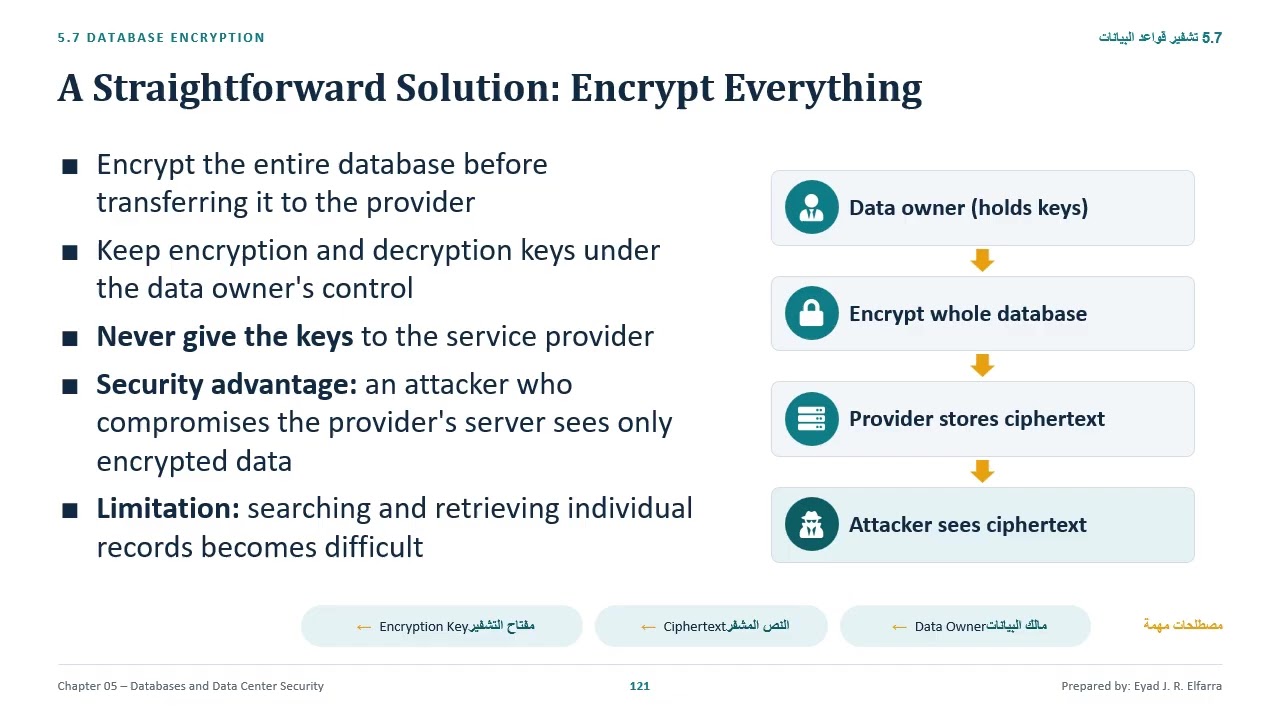
Even if an attacker succeeds and reaches my server, the data must remain what? Protected and hidden from them.
Speaker A
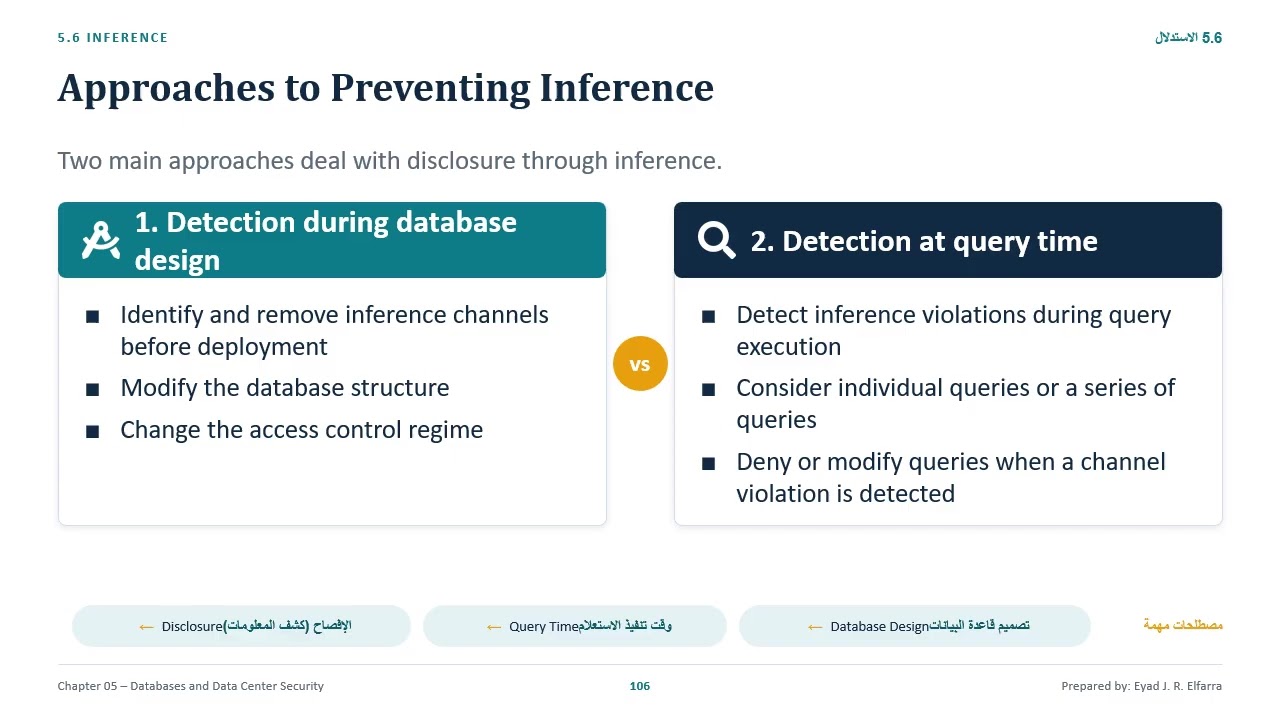
To achieve this, we must use techniques like encryption and data access control , and protect the data from inference, okay?
Speaker A
We have a global standard called. Okay, this system is the Telecommunications Infrastructure Standard for Data Centers, okay?
Speaker A
This standard was established by the Telecommunications Industry Association to determine the minimum requirements for this infrastructure.
Speaker A
The standards cover wide areas of network operations, electrical design, power management, file storage, backup and archiving, or system redundancy, okay?
Speaker A
It also covers website and application hosting, content distribution, environmental control, and protection from physical hazards, okay?
Speaker A
And so, what will we have? The first thing we said, what does it want to protect?
Speaker A
It aims to protect the building itself and power sources, ensuring there are backup power sources available.
Speaker A
I need to have a file backup system so that if a problem or data corruption occurs, I can restore the last valid version.
Speaker A
It also discusses concepts like access control; not just anyone should reach the server or the network.
Speaker A
I must protect the network using firewalls and access control. It also talks about whether my data should be in one place or distributed across multiple locations.
Speaker A
My content should be distributed across multiple servers so that if a failure occurs, the entire system does not fail completely.
Speaker A
We also discuss environmental variables and the disasters that occur: what if there’s a hurricane, a power outage, a water outage, a storm, an earthquake, or a lightning strike?
Speaker A
How can we protect our system and keep it running for the longest time possible ?
Speaker A
What are the goals of the 942 standard regarding what we need to protect within data centers?
Speaker A
It says, first, we must take into account future development—where do I want my data center to reach, and what about the applications within my database?
Speaker A
My database or system will experience downtime when I am installing updates; I want that to be as short as possible because the longer it is, the lower the availability.
Speaker A
Therefore, I can update applications, servers, databases, or even the firmware of network communication devices.
Speaker A
The more I reduce downtime, the better things are. Providing a homogeneous environment facilitates and supports high availability.
Speaker A
We also discuss, as we mentioned, In line with high availability, the systems should be homogeneous or compatible so they do not complicate the process of protecting data.
Speaker A
For example, if I install Windows Server and use SQL Server—a database related to Windows—the two systems are homogeneous and from the same company.
Speaker A
Consequently, the vulnerabilities and problems between them are much fewer than if I were to bring two systems from different companies, where there is no homogeneity between them.
Speaker A
This standard defines for us the six functional areas it aims to protect . First, we have the computer room; by computer room, we mean the place where the data processing equipment is located —the room or the building where it
Speaker A
resides. Then we also have the entrance room. The entrance room refers to the spaces that contain the equipment for connecting to the external network.
Speaker A
It contains the main router, the main Mikrotik server, or, for example, our main firewall. This is what we refer to in the entrance room. We also have the main distribution area, which is We said each rack has a switch, the
Speaker A
second rack has a switch, and the third rack has a switch, right? The place where these switches are connected together, what would it be?
Speaker A
It would be the Main Distribution Area. The next area, which is what? We said this room, we connected its routers, so there will be communication with the second room, so we will have what?
Speaker A
A main cable. Okay, also a distribution location for what? Which is the devices, the servers, and the cabinets we have.
Speaker A
Who? Which is an additional area. So, we have six functional areas. The functional areas include the entrance room, the computer room, right? The computer room contains data processing equipment. The entrance room contains external communication provider equipment.
Speaker A
The main distribution area is the center with the main cross-connection and the routers right?
Speaker A
The HDA, which is the horizontal cable distribution and the primary switches, right? Between rooms, right? Which is the place where we store racks and cabinets, right ? And each one of them, right?
Speaker A
Okay, where are the devices that will process data? RAMs and things like that, it contains for me, as we said, what relates to processing.
Speaker A
Devices related to connecting the data inside our center to what is... Which is the outside world, right?
Speaker A
Okay, so to... Or the reliability we have, the 942 standard will give us four, right?
Speaker A
Right, the higher we go up, the more we increase...right? The more we head from bottom to top, the more we increase...
Speaker A
Right. A comparison between them, right? Comparing them, we will talk about who? We have 99.67.
Speaker A
74, 982, 99.5, right? The more that increases, which we have, the more what increases, the more that decreases, okay ?
Speaker A
Right, we have how much... Right. Tier 1, we don't have... We have... Actually, we have, so we have one active power path. In Tier 3, we have one active power; in Tier 4, we have...
Speaker A
Right, in case I want to perform scheduled maintenance, what happens to me regarding the shutdown?
Speaker A
It tells me in Tier 1, I will have a shutdown. In Tier 2, we will have a shutdown; in Tier 3 and Tier 4, we won't have a shutdown right?
Speaker A
So, I will do maintenance without a shutdown. Okay, what does this say? It tells me that Tier 1 is approximately, we have how much, 28.8 hours.
Speaker A
Tier 2, 22 hours. Right, meaning our downtime in Tier 4 does not exceed 24 minutes in a whole year.
Speaker A
Okay, what does this tell me? It tells me that the infrastructure for my...to achieve this, you need high...
Speaker A
and you need a strong...So, the design and implementation process of the... Applied to Tier 1 standards, it tells me on average it takes me how much, three months; Tier 2 takes me from three to six months.
Speaker A
Tier 3 takes me from 15 to 20 months. Tier 4 is the same thing, so if I want high...
Speaker A
Power shouldn't stop, that means I am talking about...I am talking about... Very high, from 15 to 20 months. Of course, this is a cost we have in human effort, a cost in resources, a cost in energy sources, and therefore, it will
Speaker A
have a cost in time and effort, and it requires very high expenses. Tier 1 and Tier 2 have low or relatively low costs, let's call it that, because it's not exactly low cost, but relatively less compared to Tier 3 and
Speaker A
Tier 4, and the implementation time is short right? Let's talk about a point we keep mentioning, 99.9999%, which is very high , right? What difference does the number after the decimal point make to me? It simply tells you that the number after
Speaker A
the decimal point, 671, makes a difference from 28.1 hours a year to what? To 0.4 hours a year, right? So, we are concerned with the fractions.
Speaker A
The more nines there are after the decimal, the higher our [availability] is, and the more our [reliability] is, what?
Speaker A
The better our [performance] is. As we said here, we have the... It was for us, it was a bit higher, it was the highest of them.
Speaker A
Right? Which are the simple numbers after the decimal that mean to me... From 28.8 to 0.4 hours per year, right?
Speaker A
That’s how we finish the [section], we talked about what [it] is, and why [it] is important?
Speaker A
That threaten our [data]. We talked about the [vulnerabilities] and talked about the [threats]. And we talked about the [risks].
Speaker A
Thank you very much. Of course, that’s how we finish the [ course], where we talked about five or eight sections.
Speaker A
Why is database security important? What are database systems? What are relational database systems? About inference and database encryption , and we talked about the [security] and the security of database centers.
Speaker A
This is how we finish the [course], thank you very much, and we will continue God willing in a next lecture with a new [topic], and thank you very much.
Topics:data centerdata center securityredundancycloud computingserver rackstop-of-rack switchnetwork architecturephysical securityfirewalluptime tiers