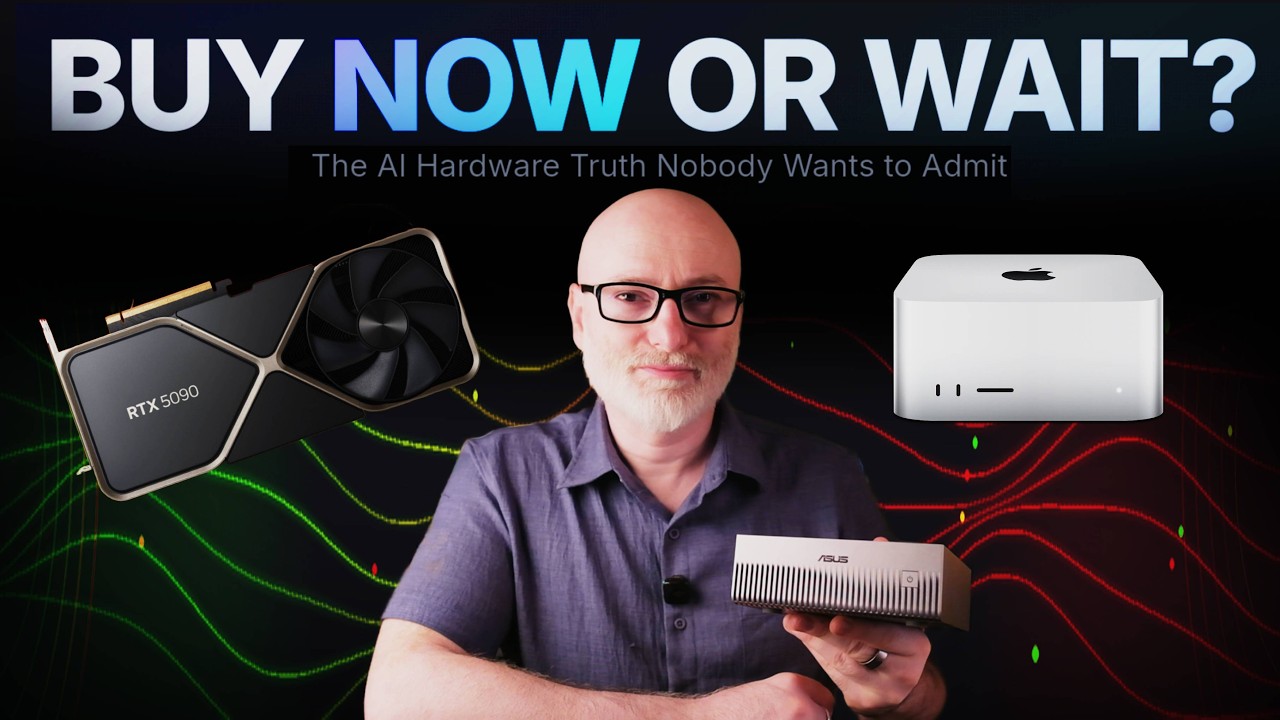
Manolo Remiddi explains running AI locally: model plus harness, memory vs. speed tradeoffs, hardware options from Mac minis to GPUs, and why sovereignty matters.
Key Takeaways
- Local AI requires both a local model and a local harness; both are integral to the system.
- Memory quantity limits model size, while memory bandwidth determines generation speed.
- The right hardware depends on the specific problem and required token throughput, not on hype.
- Local models are now good enough for many practical tasks, even if not perfect.
What the video covers
- Running AI locally requires both a local model and a local harness (the software managing memory, loops, and context), and both are essential components of the AI system.
- The model acts like a next-token predictor; the harness manages memory, context window, and loops, and its capabilities are bounded by the model's limits.
- The author argues that owning a sovereign local AI setup avoids dependence on companies or governments and augments personal productivity.
- Two key hardware metrics matter: memory quantity (determines which model size can run) and memory bandwidth/speed (determines tokens per second).
- Around 10-20 tokens per second is usable for simple tasks like transcription and summarization, while 30-50+ tokens per second is needed for heavier software-development work.
- Mac minis and mini PCs are good for running harnesses but limited for large local models; unified-memory systems like the Asus GX10 offer lots of memory but modest bandwidth (~273 GB/s).
- Laptops with high-end mobile GPUs (e.g., RTX 5090 mobile with 24 GB) are less powerful than desktop equivalents but portable.
- The author envisions local AI assistants handling research, file organization, and routine tasks, and eventually managing the user's own AI infrastructure, though frontier models still make mistakes.
- Hardware prices are sometimes inflated by hype; buyers should match hardware to the specific problem and model they need.
- The video includes a sponsored segment from Micro Center promoting AI hardware and a new Austin, Texas store.
Chapters
- 00:00Introduction: Running AI Locally on Almost Anything
- 01:14Model vs. Harness: The Engine and the Car
- 02:40Why Own Your AI: Augmentation and Sovereignty
- 04:40Sponsor Segment: Micro Center
- 05:30Personal Assistant and AI Engineer Goals
- 07:40Hardware Reality: Memory, Speed, and Tokens per Second
- 11:00Mini PCs, Mac Mini, and High-End Desktop Options
- 14:00Laptops and Final Recommendations
Full Transcript — Download SRT & Markdown
Speaker A
You can run AI locally on almost anything. I tested I built software with it. The speed difference is massive.
Speaker A
Shall we spend so much money to have this kind of AI at home? I believe there is a big misunderstanding of what it means to run a local AI. I tested a lot of different hardware. This is not all
Speaker A
of it. I also have 15 ID 5060 Ti GPUs plus you can see other computer there and in the other room. So I had tested this on a lot of different devices and I can tell you that you can run AI locally
Speaker A
on almost anything. And soon I will test it on the Raspberry Pi because I want to see what is possible to do with it. Plus build some software for it because I want to use it for some agentic work.
Speaker A
Now what is the biggest elements that we need to understand? When we say we want to run AI locally, we mean two things.
Speaker A
First of all, the model needs to run locally. Second, the harness needs to run locally. So what are these two elements? One is the engine and the other is the car. So the car is the software that run the model. So you need
Speaker A
both of them to run on your computer and both of them are AI. It's not like the model is AI. No, both of them are the artificial intelligence because the model by itself is like a calculator.
Speaker A
Calculator of the next token, of the next most probable token. The harness is what manage the memory, the loops, the context window and so on. So it's extremely extremely important. Now you can have the same harness and you change
Speaker A
the model according to the kind of work that you need to have. The harness manage everything for you and it's one of the most important part of AI. The limits of the harness are connected to the limits of the model. So you change
Speaker A
the model, you give a more powerful one. Now you have another scenario. So what is possible to do with this kind of a technology with our hardware? I tested a lot of things, okay? I do it because I
Speaker A
love it. I do it because it part of my job, but also because I'm passionate about this technology. I really see the impact that this technology did to me, meaning I've been augmented in working with this technology. So now I can do
Speaker A
more things, I can do them better and faster. This is augmentation. Now, because of this, for me is extremely important to own this technology. I don't want to have to ask permission to some company, some government, or whatever entity to ask, can I use AI?
Speaker A
Can I have Can I do this? No, I don't want to have this. For me, AI now is part of the way that I work and I don't want to stay without. Therefore, I need a sovereign system. Now, the cost is
Speaker A
going insane and this is why we're doing this video, because we need to understand where shall we put this money? There are different kind of solution. I've been testing also my 5090, 5060 Ti, and I can tell you that
Speaker A
sometimes the price doesn't make sense at all. Sometimes hardware is overpriced because of the hype and because of the dynamics that are happening. So we are going to talk about all of this. I'm going to tell you what machine you
Speaker A
should get, what are the limits, the real limits of running AI locally, and I'm going to try to remove all the misunderstanding that you might have.
Speaker A
Shout out to Micro Center that is sponsoring this part of the video. If you're looking for hardware to build your AI lab, this is the place. You can find both AMD Halo and NVIDIA DGX Spark, but also the latest RTX Spark laptop. My
Speaker A
pick will be this ASUS ProArt P14. This has the Blackwell GPU and 128 GB of RAM.
Speaker A
Really powerful, really portable. I would love to test this machine. Now, the big news here is this. They're opening at Austin, Texas. You should register. The shop look amazing. I love this kind of things. I truly love. I
Speaker A
could spend days wandering around, looking and dreaming about what I would build here. I really, really love these places. I'm I'm sure if you're on this channel, you'll love them too. And robots. I mean, it's what?
Speaker A
No. This is too much for me. I can't watch it, but everyone, if you registered, you can get a free 128 GB flash drive, t-shirts, and and more. So if you go there, I look at this place. If you go there,
Speaker A
look how big it is. So, if you go there, please say high to Gary for me. I really appreciate this sponsorship. So, now let's go back to the video. So, what I learned so far that we need from this
Speaker A
local AI two major function. One is to be my personal assistant. The other one is to be the AI capable of managing and fixing any problem that I have with my AI stack. Because once we solve these two problem, I'm basically
Speaker A
self-sufficient because I have an agent that can help me with my work, mainly doing research, help me summarize document, organize files, do daily routine jobs. We have at the moment models that can be good at doing this kind of work. So, for the other part,
Speaker A
the engineer that look after my AI stack is a much more complex, much more difficult things to do. This is because AI sometimes hallucinate, sometimes make problems. So, it is really tend to make things sometimes more complicated than
Speaker A
they should be and therefore the risk is that they break something. But we are really really close to have an AI that we can trust in managing our own hardware.
Speaker A
And this AI it's also good enough to make a small software. Once we have this, okay, that today we have it but it it doesn't feel right not all the time.
Speaker A
But at the moment we have models that can write software that can understand the complex infrastructure that you might have with your AI stack and can fix most of the problem. Not everything, not all the time, that is what is
Speaker A
missing. But I'm pretty confident that maybe even before the end of the year we will have something like this. Now, let's make it clear. Not even the frontier model we can trust 100% on doing this kind of job. Every single AI
Speaker A
makes mistakes, they hallucinate, they just don't follow of order, they just they are a mess. So, I'm not talking about a perfect system, I'm talking about a system that we can trust enough and work together to fix whatever kind
Speaker A
of problem I might have. So, now let's look at the reality of what we have.
Speaker A
First of all, want to talk about this mini PC, okay? This is a Mac mini, an incredible machine that can do a lot of work, but mainly is good for running local harnesses and not local model, even though the pro version is much
Speaker A
better. What is the limit here? You can add actually pretty enough quantity of memory, unified memory, which is a really good thing, but what we need to take in consideration that there are two elements, the quantity of memory and the speed of it. The quantity
Speaker A
tell us how big is the model that we can run, but the speed tell us how many token per second this model can generate so we can work with it. Let's say that a couple of tokens are one word. If we
Speaker A
create 10 token per second means is a slow, but at least I can use it, okay, for simple work like transcribing, writing an email, summarizing in a document or whatever. But if I want to make a software where I need millions of
Speaker A
token to be generated, then that model will be not fast enough. At this price range that actually is not even cheap, we have the Mac mini, but also like mini PCs, okay? This is even cheaper and again not good for local model, but also
Speaker A
more powerful mini PC which they can run local model, but again at 10 20 token per second. So it started to become useful, but ideally we're looking for something that is over 30 over 50 token per second. Plus we are looking more and
Speaker A
more to have much more powerful model so they can do more complex work. So for that kind of solution we need a different kind of hardware. And we have a few option in that direction. So I have this. This is the
Speaker A
Asus GX10. This is the equivalent of the DGX Spark. This has 128 GB of unified memory. The only problem of this hardware is that we have a lot of memory, but the memory is low. This is 273 GB per second. On this hardware I
Speaker A
usually run 12 3.8 flash next and it runs around 35 token per second. So a speed that is definitely usable, and this is the best model we can run locally at moment. It's a quantized version of the Flash Next, but it's
Speaker A
performing really well. Now you can have more than one of them connected together. The other problem that we have with this is the price. So now this kind of hardware it's around $6,000 or more depend on the size of the hard drive
Speaker A
that we have inside. So this one is the smallest one with 1 terabyte, which I believe is enough. I paid €3,200 and at the moment is I believe is around €6,000.
Speaker A
Think about this. But the technology is incredible. It's basically a micro super computer where you can run exactly the same software that Nvidia runs on their data center. Incredible, really really incredible. So this is one of the best
Speaker A
machine for learning, but it's slow. The other option is to use GPUs. GPUs are the fastest solution out there. They offer the larger bandwidth that you can find. My Nvidia RTX 5090 GPU has 1,792 gigabyte per second bandwidth. Think
Speaker A
about this one, 273 gigabyte per second. The gap is huge. The speed difference is massive, but also is the cost, okay? Now the 5090 that has only 32 gigabyte of VRAM is at moment around $8,000 if you find it.
Speaker A
Again, I've been really lucky to pay less than $3,000 for it. And at that price makes a lot of sense. At $8,000 it doesn't. So on one of my previous video I explained about this technology called the Strata. Strata, what it does
Speaker A
allows a model to be split in part and be allocated part inside the VRAM, part inside the system RAM, and part inside the SSD. That means we can optimize our hardware and have pretty big, pretty intelligent model running locally. That
Speaker A
model that I'm referring to is Quant 3.8 Flash Next, the same model that I'm running on this machine. But because of Strata now I can run it on a much higher speed on this other machine.
Speaker A
This is Ollaris One. They're not sponsoring this video, but they were previous sponsor of another video, so here's the link for it.
Speaker A
This has an incredible hardware inside because it run the RTX 5090 mobile version. This GPU it's half of the speed in bandwidth of the 5090 desktop version and has 24 GB of RAM. So it's definitely less powerful, but also less power
Speaker A
hungry. This all system run 175 W instead of just my GPU uses 600 W, the entire computer is around 1,000. So the saving on electricity is incredible.
Speaker A
Those kind of hardware is built to run 24/7. I also tested this hardware with the same model that I'm running on this hardware and here I'm getting around 54 token per second. So much faster and cheaper. This is a proper computer built
Speaker A
to run as a cloud, to stay there headless while you connect maybe your laptop or your other computers to it. So it's built to stay on 24/7. Extremely powerful, 96 GB of RAM. I love it. I personally really like it. So what kind
Speaker A
of hardware shall we buy? Because it is a lot of money and it's hard to justify something like this for running a lot of model that is not even that intelligent. Because Quen Flash Next is not like a different tier
Speaker A
model. It is the best system that we can run locally, but it 's not even close to those frontier model.
Speaker A
So shall we spend so much money to have this kind of AI at home? Before we say no, no, no, no, no, let's also consider what is out there as a alternative to what I own. Because there are other GPUs
Speaker A
from Nvidia and AMD and now you know how to choose them. The quantity of RAM and the speed, the bandwidth of it. So check those two elements. The sweet spot at moment is what we have on this machine,
Speaker A
which is 24 GB of VRAM. Try to get the one that you can afford, of course, that gives you the fastest RAM. There are rumors that soon, maybe even within the end of the years, but probably within the first quarter of 2027, we will have
Speaker A
the Nvidia RTX 5080 Super with 24 GB of RAM. Now, how things are going, the scenario doesn't look good, okay?
Speaker A
The hardware will be probably ideal for a local model, but the price it's unknown.
Speaker A
And here is what I'm expecting. They're probably going to present it at around $2,700.
Speaker A
But then you will never find it at that price. You will only find it at over $4,000. This is what I'm expecting to see. But now you need to think that you need the rest of the computer. So if you
Speaker A
already have a computer, you just add this GPU and then you're good. If not, you need to spend at least $1,000 on top to have a computer to run it. But in theory, you need 96 GB of RAM to run
Speaker A
strata with that GPU at a speed that makes sense, which is the same that I'm getting on this machine.
Speaker A
So unless you look in the second hand market with a 3090, it's going to be really difficult to have this kind of speed at less than $4,000. After that one, we have a solution like Mac Studio.
Speaker A
Mac Studio is amazing, is beautiful, is great, but it's extremely expensive. But this makes me think that there is another element that we need to consider. The other elements here is what kind of operating system you need.
Speaker A
Because when you buy a computer, you're not just buying an AI, okay? It's not just AI, it's also a machine that you're going to use.
Speaker A
So what kind of a problem this machine is to solve? And here what I've experienced so far.
Speaker A
So I've been running AI with macOS, Linux, and even Windows. And what I learned is if you just need a machine for AI, use Linux. It's the most flexible one. It's the one that allows you to do anything you want with that
Speaker A
machine. If you need that computer to do something else, like play video game, make music, do video editing, then you need to think much more deeply. Because maybe the software you need to run or maybe the hardware that you need to
Speaker A
connect only works on Windows or macOS. So if you have any of those constraints, look exactly what they are and then make that decision. And here what I think about laptops. Okay, so I have my MacBook. They are incredible machines.
Speaker A
One element that for me has is extremely important with laptop is the battery life and how they manage the battery and so on. So Apple managed to do something incredible and I don't believe there is anything closer to what they can do.
Speaker A
What I don't fully understand is a $7,000 $10,000 laptop. To me it doesn't make sense. I'd rather have a MacBook Air, for example, and then a system to stay home like this Polaris or this GX10. They stay at home,
Speaker A
they run the model locally, they stay on 24/7 and I just need to turn on the computer and work with it. Okay, I don't need to have the model running here. All I need is my harness to run here the
Speaker A
model over here. But then if you have a kind of nomadic life, if you don't have a stable place where you can leave your hardware, then of course the laptop is the only way that makes sense. And the
Speaker A
MacBook Pro are the best for this. Now there are those RTX Sparks that seems to be amazing. I haven't tested them, so I don't have much experience, but the idea that runs on Windows to me is makes me
Speaker A
scared already. But maybe for you is the right machine. I would rather have a powerful MacBook Pro than a Windows laptop. If on those laptop you can actually install successfully Linux, then they're probably pretty good. So I haven't tested them, so I can't tell. So
Speaker A
if this makes sense, okay, of course like and subscribe, but if this makes sense, try to answer yourself to this question, what kind of problem I need to solve? What is the model that I need to run to solve that problem? What kind of
Speaker A
hardware do I need to run that model? If you realize that there is no local model that can actually solve your problem, now you have an answer. You don't need a local model. But if you see that the
Speaker A
problem is so big, but it can be unpacked and then some parts needs or must run locally, then you need to look at what kind of a model and hardware you need to solve that kind of problem.
Speaker A
Because there is one thing that everybody should understand, you can't have privacy if you use a cloud model.
Speaker A
You can't build your business around someone else's business model. If you are 100% dependent to someone else's model, to someone else's infrastructure, then as soon as they change the price, as soon as they decide if you can have access or not to a
Speaker A
specific model, to a specific harness, then you don't have a business, you have a liability. And that is not how you should work. So I really believe that each one of us, each kind of business should have at least something,
Speaker A
a minimum AI that they can trust, they can control, they can have it working 24/7 for them, and then leverage the cloud model with the real scenario that they need.
Speaker A
And I want to conclude with this. There's a lot of people think that the local model are not good enough. I tested it, I built the software with it, and I can tell you they are good enough.
Speaker A
They require much more work. They require much more interaction. You can't do what you do with Opus or Fable or whatever that you give one massive prompt and then wait for a mega output that is amazing. That is not happening
Speaker A
at the moment with local models. But if you stay behind it, if you stay in the loop, if you help and support this AI, if you work together, if you make decision yourself, then you can achieve a lot.
Speaker A
So working hybrid is for most people is the right solution. But I want to tell you one thing about this working hybrid.
Speaker A
Now you have a frontier model with a lot of hype that says and shows that it's capable doing amazing work. Then you have your local model that everybody says, ah, it's not good enough.
Speaker A
It's really difficult emotionally to go and carry on working with your local model when you have access, maybe a subscription with your cloud model. But let me tell you this thing.
Speaker A
In reality, if you have the strength, and this is a psychological strength, to say I'm not going to use the model, I'm not going to work hybridly, I'm going to just use my local model, I believe that that is a much better
Speaker A
solution, a much better path for all of us, because then we need to become good at it. We need to plan better, we need to think more, we need to optimize more, we need to learn how to interact with
Speaker A
this technology properly. Plus, more people use local models, more innovation will happen around this technology. And the last last thing, because there's so much to tell but we need to close this video, I want to tell you one more thing and
Speaker A
this is extremely important, I should have said at the beginning, okay? So, when I bought this machine, I could only run basically nothing, okay? I couldn't run much on it. But the best model that I managed to run on on
Speaker A
here was the Qwen 3.5 35 billion with the 3 billion active parameters. We have now the 3.6 version of that model and soon hopefully it's going to come out the 4.0 version of that model.
Speaker A
What that model gave to this machine is the ability to run a model that it was good enough to do agentic work, meaning be my personal assistant, do research, go online and do work for me at the same time
Speaker A
running at a speed that was decent. Because there is nothing, at least for me, there's nothing worse than something that is extremely intelligent but then it doesn't move, okay? You see one word by word, you know, it takes ages to give
Speaker A
you an answer. So now, this exact machine that before was running a model that was not good enough for doing coding for example, today is running the most powerful model that I can run locally.
Speaker A
So it means that this hardware over time is capable of running more and more intelligent models. But this is happening with any hardware, not just this machine. This is the first machine that I bought to run local model. And this is the reason why
Speaker A
those machine keeps going up in prices because before it was running a model was pretty basic. At the moment it's running a model that can actually do serious work. Soon we'll run a model that it can do even better.
Speaker A
And this is why the price of this hardware is not going to go down. And I'm when I say this hardware I mean the hardware that is capable of running local model is not going down and it's not going down until we have a serious
Speaker A
change in technology. This kind of hardware, even though we can call it optimized for AI, in reality it's not optimized for AI. It's not optimized for inference, for producing token really really fast.
Speaker A
I really believe that in the next few years we will have dedicated hardware just for this. And they will run not at 100 token per second, but maybe, you know, 500, maybe 1,000, maybe 2,000 token per second, maybe even 5,000 token
Speaker A
per second. So something that is going to be completely different. At that moment we will see that this kind of hardware doesn't make sense anymore because the gap of capabilities is going to be so huge that the only right thing
Speaker A
to do is to update your hardware. But until now for the next probably two, three years those machine are going to stay there, are going to keep running and they're going to keep delivering more and more over time.
Speaker A
I hope that this video help you out. If Again, one more thing, one more thing, there's always one more thing because I promised that I would say, what if you don't have any money and you have like a
Speaker A
a little mini PC like this one? These PC are not made to run any kind of a local model, but they can run an harness. At the moment that you can run a harness on this means you have half of
Speaker A
the sovereignty that you need and in reality you have the important half because it's the half that create the most of the stability. It's the half that maintain your memory. Is the half that is really important. For the model
Speaker A
you can plug something from the cloud. Now there are a lot of models that are out there that are free to use. So install Open Code and you will see a list of free models that you can use.
Speaker A
Some of those model are pretty good. Maybe they are served to you at slower speed, but they are really really good.
Speaker A
Most likely you won't have the privacy that you have with your local model because you send your data to those corporations and they probably give it for free because they can train their model on your data, but at the same time
Speaker A
it's free. And if you're willing to spend a few dollars per month I would suggest to use DeepSeek. The latest DeepSeek Flash 4.1, it's extremely good and extremely cheap. I like it, I use it. It's not frontier model, but it's
Speaker A
not that far. Okay? And it is really, really good. This is what I wanted to share today. I'm going to add a deep dive article where I give you more details about this hardware, more details about the model that I'm
Speaker A
running, the kind of harness that I'm using because there is so much to learn. So like and subscribe, watch the next video. And wait, wait, wait, wait, wait. There's more, there's more, there's more. There is a community. There is a community that I'm
Speaker A
building. So we are on Discord. We are almost 4,000 people at the moment. We are learning from each other. We talk about AI every single day.
Speaker A
Join us if local AI is something that resonate with you, if you want to learn, if you have something that you want to share with your community, if you want to contribute, join us.
Speaker A
Ciao.
Topics:local AILLM hardwaretokens per secondunified memoryAI harnessMac miniGPUself-hosted AIAI sovereigntyAsus GX10