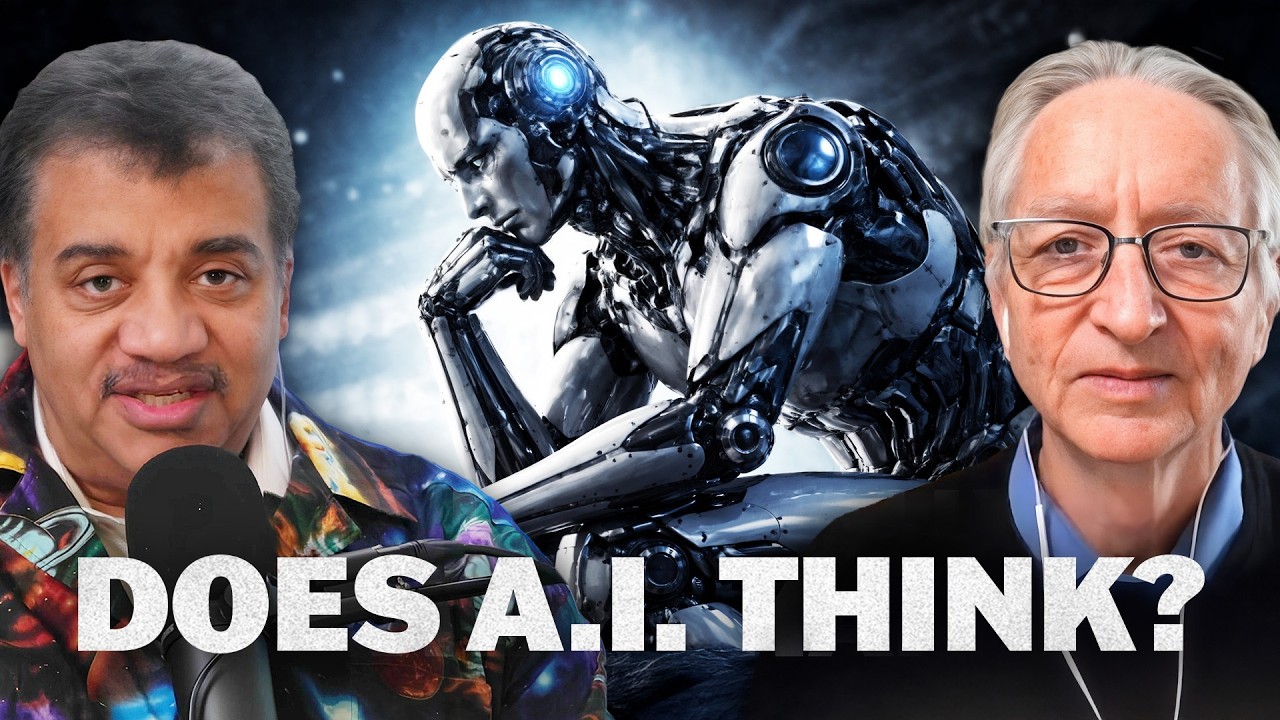
StarTalk explores whether AI solved a Millennium Problem on the Navier-Stokes equations, with astrophysicist Mordai Mark Mikkelo explaining fluids, turbulence, and singularities.
Key Takeaways
- Navier-Stokes equations are foundational for modeling fluids across astrophysics and everyday physics.
- The Millennium Problem asks whether smooth, finite solutions always exist, and blow-up to infinity would disprove this.
- Turbulence is not inherently bad and can be exploited in engineering, such as golf balls and aircraft design.
- The AI-related claim is plausible but requires careful independent verification and formal checking.
What the video covers
- The episode opens with the claim that AI has solved the Navier-Stokes equations, one of the Millennium Prize Problems.
- Astrophysicist Mordai Mark Mikkelo explains that Navier-Stokes describes fluid flow and merges with Newton's laws of motion.
- A fluid is defined as a continuous substance that flows and lacks forces holding it together like a solid, covering both liquids and gases.
- The equations govern astrophysical processes such as star and galaxy formation, as well as weather, climate, and ocean ships.
- The central open question is whether solutions stay smooth and finite or can blow up to infinite speed (singularities).
- The equations model velocity, density, and pressure/energy over time, forming a system of partial differential equations.
- Turbulence is discussed as a phenomenon that can be useful, such as golf ball dimples that reduce drag by managing airflow.
- Newton's particle-based view contrasts with continuum fluid mechanics, and Navier-Stokes assumes gas behaves as a continuous fluid.
- The guest believes the AI-assisted result is more likely true than not, while noting independent verification and the need for formal proof checking.
Chapters
- 00:00Introduction: AI and the Navier-Stokes Claim
- 00:58What the Navier-Stokes Equations Describe
- 03:23Defining Fluids and Continuum Mechanics
- 05:42Astrophysical Modeling and Fluid Behavior
- 08:57Turbulence: Good, Bad, or Useful?
- 14:40Infinity, Singularities, and the Millennium Problem
- 20:40AI Proof Claims and Verification
Full Transcript — Download SRT & Markdown
Speaker A
What's this? AI has solved the Navier-Stokes equation. What's up with that?
Speaker A
I have an expert in that. In my own department here at the American Museum of Natural History, the astrophysics department, we have Morai Mark Mikllo.
Speaker A
[music]
Speaker A
Absolutely. Because you're a fluid guy. I'm a fluid guy. I think about astrophysical fluids.
Speaker A
The Navier-Stokes equation describes fluid flow over and around objects, merges with Isaac Newton's laws of motion, and brings an understanding to that phenomenon, to that process.
Speaker A
Fair enough. It's anything that is continuous that can flow and doesn't have forces holding it together like a solid.
Speaker A
I have an expert in that. In my own department here at the American Museum of Natural History, the astrophysics department, we have Mordai Mark Mikkelo.
Speaker A
But it's but water or gas, the air, the oceans, they're fluids. They're all fluids. Yes. And the Navier Stokes equations don't care which is which ultimately. No, it's just a change of parameters.
Speaker A
Welcome back to StarTalk.
Speaker A
Um, well, I study the formation of stars, galaxies, planets, and all of those formed either in gas or from gas.
Speaker A
Lovely to be back.
Speaker A
the Navier Stokes equations because that's what describes them. Same as on the earth if we think about the atmosphere if we think about the weather if we think about the climate if we think about like a ship on the ocean
Speaker A
Excellent. You spend your life modeling with the Navier-Stokes equation.
Speaker A
Yeah. Okay. Uh we've all seen uh wind tunnel uh patterns where the fluid does not reconnect or or behave smoothly. You see this this dust up swirling swirling and and I guess that's turbulence.
Speaker A
Absolutely.
Speaker A
You should not value judge the turbulence because you can do useful things with it. Like if you want an airplane to be particularly efficient, you can start little bits of turbulence to prevent big swirls from slowing the plane down.
Speaker A
Because you're a fluid guy.
Speaker A
air goes smoothly around it and it's not touching the ball itself. Yes. So the ball goes farther.
Speaker A
I'm a fluid guy. I think about astrophysical fluids.
Speaker A
And these are two dudes from these are two dudes from the 19th century. Okay. Na'Vi uh I don't remember their names but Navier I bet one of them is Navier and the other was Stokes.
Speaker A
So, a fluid, I've had it defined as anything that takes the shape of its container. Is that a fair enough definition?
Speaker A
the equations would predict a value of the fluid speed that reached infinity and infinity is bad in equation because it's bad for physics because mathematically sure an equation can asmtote to infinity. These things happen but but in a physical system
Speaker A
Fair enough. It's anything that is continuous, that can flow, and doesn't have forces holding it together like a solid.
Speaker A
laws of motion and they're pretty good at the human scale. But then as you learn more physics, you realize that well Newton's laws have been known to be approximate for more than a century now because you have to
Speaker A
Got it. So that's why it can't be a canister of salt. It can't be the shape of its container, because it's not continuous, right?
Speaker A
improve on it. All right. So when you say you could not show or prove in some regimes wouldn't give you infinite fluid speeds.
Speaker A
Yes.
Speaker A
Okay. How would you know if the solution was not smooth? It hit infinity. Okay. and it hits infinity because you are somehow calculating with this in future times of the system.
Speaker A
But water or gas, the air, the oceans, they're fluids.
Speaker A
behaving over time. Okay. So now you take those three equations y and they're differential equations. So uh I guess partial differential equations we call that because each variable has its own tracking behavior. And so now you go into the future and you ask is this
Speaker A
They're all fluids.
Speaker A
That's right. And no one could prove that this system wouldn't blow up mathematically. Exactly.
Speaker A
Yes. And the Navier-Stokes equations don't care which is which, ultimately.
Speaker A
Yes. And the millennium problems was a set of unsolved mathematical problems. Somebody put a million dollars behind each one of those.
Speaker A
No, it's just a change of parameters.
Speaker A
So the problem was are the Navier Stokes equations always smooth and if you can find a counter example where no it's not smooth it goes off to infinity you're done then you're done. You have shown that that hypothesis is false.
Speaker A
Okay. So what kind of modeling do you use the Navier-Stokes equation for in astrophysics?
Speaker A
principles you have started. Okay. So somebody had to write that something had to write that. [laughter] So what they did that had to be written.
Speaker A
Well, I study the formation of stars, galaxies, and planets, and all of those are formed either in gas or from gas.
Speaker A
GPO graphic processing unit. Yeah. Yes. So it cost them more than even what the prize would have been even if they were going to take the prize. Yes. So they generate this and then um two guys one of them's from NYU
Speaker A
So I'm asking, how do fluids interact with gravity?
Speaker A
Did you have your model read our inputs and train on it? Open AI says we don't think so.
Speaker A
But to do that, we first have to understand how fluids are behaving. And pretty much anything in astrophysics is behaving as a turbulent fluid, and thus we have to think about the Navier-Stokes equations, because that's what describes them. Same as on Earth. If we think about the atmosphere, the weather, the climate, or a ship on the ocean, those are all fluids, and all of them are Navier-Stokes calculations.
Speaker A
Do you believe this result? Okay. I think it's more likely true than not. Now, we're asking, does Lean have any issues? Now, that's a whole another project, right? There's someone up at MIT, I think, who is sitting there
Speaker A
So let's spend a moment on turbulence.
Speaker A
Okay. And indeed the fact that Buckmaster and Alpugay also think that they have a proof that sounds like probably independent verification.
Speaker A
Yeah. Okay. We've all seen wind tunnel patterns where the fluid does not reconnect or behave smoothly. You see this dust kicked up, swirling, and I guess that's turbulence.
Speaker A
Yes. It doesn't mean you will actually get infinity in a real system. Now it means there's a larger understanding of fluid dynamics that the Navia Stokes equations do not give you.
Speaker A
That is one form of turbulence. Yes.
Speaker A
Okay, so gas is not really a continuous fluid. Oh, and the Boltzman equation, the entire assumption of Navier Stokes is that it's a continuous indivisible fluid. Yes.
Speaker A
Is turbulence good, bad, or indifferent?
Speaker A
Not ever. [laughter] Democrus knew it forever, but the rest of us took another couple of millennia to figure it out. Okay. But the point is, if gas is atoms, those are bouncing around like they're Newtonian particles.
Speaker A
Turbulence is... [laughter] Okay. I will value-judge the turbulence.
Speaker A
Morai, I got to bring Newton into this conversation. Well, hello Isaac. [laughter] Okay, now Isaac is so Isaac has told us how a single particle behaves.
Speaker A
You should not value-judge the turbulence, because you can do useful things with it. If you want an airplane to be particularly efficient, you can introduce little bits of turbulence to prevent big swirls from slowing the plane down.
Speaker A
bouncing off of each other." That's crazy. It is. And yet that is because Newton, like you said, Yes.
Speaker A
So you can combat turbulence with turbulence.
Speaker A
That's right. Now it's an ensemble. And we have to leave Newton and go to something bigger.
Speaker A
You can combat turbulence with turbulence.
Speaker A
Exactly. Okay. Okay. So now how you doing here Newton? You all right? Okay. Yeah, he's good.
Speaker A
Interesting. And I think I remember this correctly: don't the dimples in golf balls create mini turbulence just on the outer edge of the ball, so that the rest of the air flows smoothly around it and doesn't detach from the ball itself?
Speaker A
Navier Stokes equations from the that's first principles that's first principle that was the first principles but to do that they had to make approximations and that's where the problem came So to derive Navier Stokes, you assume that all the the changes across
Speaker A
Yes. So the ball goes farther.
Speaker A
If you're running off to infinity, they're huge, right? So that approximation fails, then that approximation fails. Okay?
Speaker A
Yes.
Speaker A
Did the AI proof that such a singularity exists in the solution? Yes. Did it get to that from Boltzman or just from the Na'vi Stokes itself?
Speaker A
So tell me what was unknown that then got solved.
Speaker A
Yeah. [laughter] Okay. I don't care about the mathematicians. I'm sure you have a number of mathematicians who watch you who are now going to be sorry. Me and Newton we're cool. We're cool with this. So what you're saying is
Speaker A
Okay. We have a set of mathematical equations called the Navier-Stokes equations, and these are two dudes from the 19th century.
Speaker A
Got it. Well then I'm fine with that. I don't know what everybody's getting all give me the million dollars. [laughter] You do the solution, you get the million bucks. As a mathematical uh question of how do partial differential equations behave, it's very
Speaker A
Okay. Navier... I don't remember their names, but I bet one of them is Navier, and the other was Stokes.
Speaker A
even solids are subject to partial differential equations, even if not this one, it's got it own set.
Speaker A
You got it. [laughter] They wrote down a set of equations that have stood the test of time. We still use them today. But they could not prove that these equations would never blow up, that you would not get regions where the equations predict a value of fluid speed that reaches infinity. Infinity is bad in an equation, because it's bad for physics. Mathematically, sure, an equation can asymptote to infinity, and these things happen, but in a physical system, that suggests your equation needs an additional approximation to come close to reality.
Speaker A
So, more let me try to digest this and maybe even tie a bow on it. Uh we've had experience before as you've said earlier where you had Newton's laws and they were really good but they were incomplete. We would learn.
Speaker A
So when you first learn physics, you learn Newton's laws of motion, and they're pretty good at the human scale. But then, as you learn more physics, you realize that Newton's laws have been known to be approximate for more than a century now, because you have to take relativity into account, and quantum mechanics. Those are better descriptions of reality. They're more accurate, but they include Newton's laws within them. So when we improve equations, you still have to meet the old standards, but you have to improve on them.
Speaker A
What we did was we found that they were an approximation to these bigger picture to the bigger pictures. So now when I think in of people attempting to solve a problem and they're human beings doing it, not AI in a black box, often some of
Speaker A
All right. So when you say you could not prove that in some regimes they wouldn't give you infinite fluid speeds...
Speaker A
here is there is some insight into the blackbox. And indeed the two human mathematicians who were pursuing this and seem to almost be there, maybe are there, were devoting their time to exploring what was in the black box and
Speaker A
Yes. This is taking these equations into the future.
Speaker A
uh along the path to that solution that's I wouldn't even say mining I would say laying down the road in a way that other people could travel on the problem with the open AI solution is that wasn't unpacked so they as you
Speaker A
No, it's asking the question of stability. Are these equations stable, and always finite? The existence of smooth solutions without singularities is what was debated.
Speaker A
you work with something like that? And maybe the answer turns out to be you set another AI agent on it and say explain this part to me.
Speaker A
Okay. How would you know if the solution was not smooth?
Speaker A
and saying, "Well, it's done." Yeah. Yeah. So, tell me, let's to wrap this up, uh, in what way are you using AI in your research today?
Speaker A
It hits infinity.
Speaker A
that the sources it identifies are real. It does not guarantee that it has interpreted them correctly and it still hallucinates. But it'll only hallucinate an interpretation, not the original source.
Speaker A
Okay. And it hits infinity because you are calculating forward in time for the system.
Speaker A
And it is claimed to be relevant. So it's helpful to you. It's helpful because most of the time the papers actually are relevant just [laughter] often enough. But it will do things like hallucinate who wrote them.
Speaker A
Yes. These are differential equations about the development of the fluid variables: the velocity, the density, how much material is there, and the energy, the pressure of the fluid. Those three equations determine how the fluid behaves over time.
Speaker A
Okay. But the paper's real. The paper is real. Sometimes it's relevant. Okay. Often even often enough that I do turn to it on the regular.
Speaker A
Okay. So you take those three equations, and they're differential equations, so I guess partial differential equations, because each variable has its own tracking behavior. And now you go into the future and ask: is this behaving normally, as the variables interact with each other smoothly, changing each other's values as we go forward?
Speaker A
least one AI principal is addressing two both open AI and throwback they each have their reps uh addressing the most powerful people in the world.
Speaker A
That's right. And no one could prove mathematically that this system wouldn't blow up.
Speaker A
that AI is with us. It's real, and we all should keep an eye on it for better or for worse.
Speaker A
Exactly.
Speaker A
Hey everybody, this is my latest book, Lost in Space, a collaboration between my podcast, Star Talk, and [music] National Geographic Books. And my co-author is senior producer on the podcast, [music] Lindsay Nicks Walker.
Speaker A
Okay. So now OpenAI makes a big announcement: they have used AI to solve one of the Millennium Problems, which is why you invited me.
Speaker A
Come on.
Topics:Navier-Stokes equationsfluid dynamicsMillennium Prize ProblemsturbulenceastrophysicsAI mathematicssingularitiesStarTalkIsaac Newtongolf ball dimples