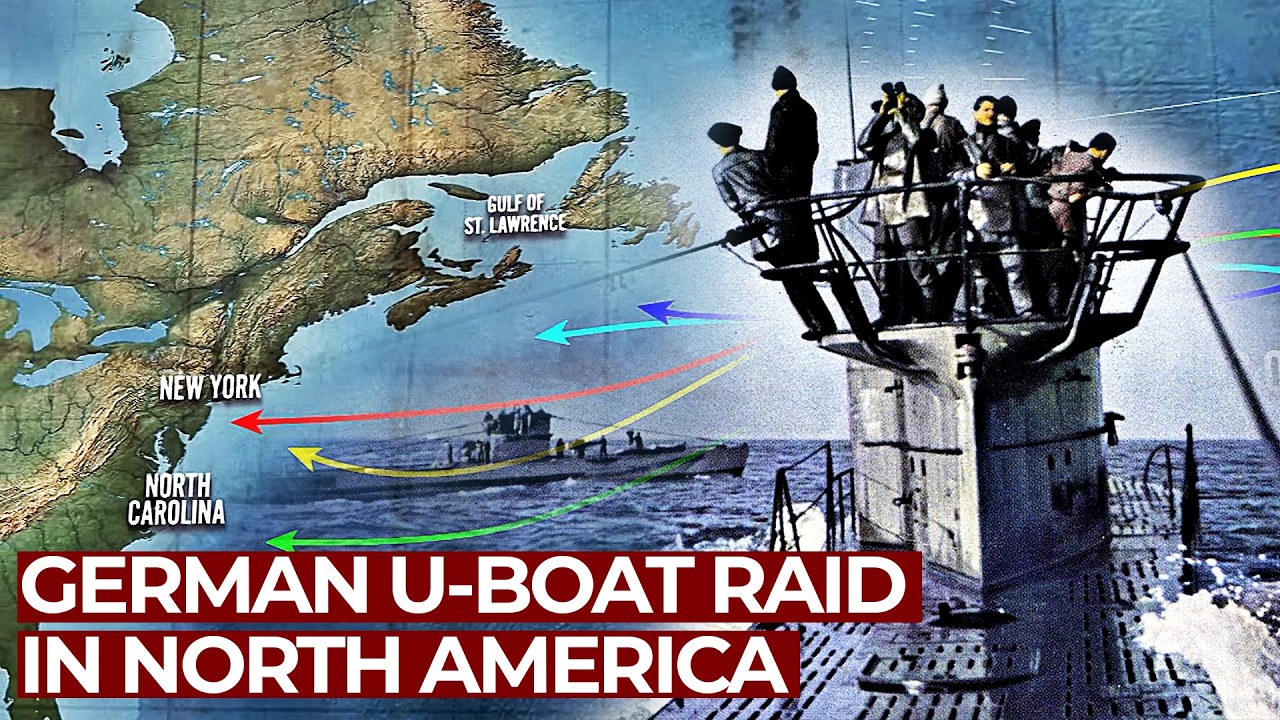
Documentary on Hitler's 1941 invasion of the Soviet Union, Operation Barbarossa, detailing key battles, strategies, and turning points of WWII Eastern Front.
Ask about this video. Answers come from its transcript only — with the timestamp, so you can check them.
Generated from the transcript and can be wrong — check the timestamp.
Key Takeaways
- Operation Barbarossa was Hitler's largest military gamble aimed at defeating the Soviet Union quickly but ultimately failed.
- Stalin's purges weakened the Red Army, but Soviet resilience and new technology like the T-34 tank proved critical.
- Hitler's diversion of forces to Kiev delayed the capture of Moscow, which was a major strategic error.
- The siege of Leningrad caused immense civilian suffering and demonstrated the brutal nature of the Eastern Front.
- The harsh Russian winter and Soviet counteroffensives marked a turning point that halted the German advance.
What the video covers
- Hitler planned Operation Barbarossa to invade the Soviet Union, aiming to conquer its vast resources and defeat communism.
- Despite Stalin's purges weakening the Red Army, the Soviet Union mobilized millions and deployed formidable new weapons like the T-34 tank.
- Germany invaded the Balkans to secure its southern flank before launching the massive assault on the Soviet Union in June 1941.
- Operation Barbarossa involved over four million German troops with three main thrusts targeting Leningrad, Moscow, and Ukraine.
- Early German advances were rapid, capturing large numbers of Soviet prisoners and surrounding key cities like Minsk and Kiev.
- Hitler's strategic decision to divert forces from Moscow to Kiev delayed the advance on the Soviet capital, allowing Soviet resistance to strengthen.
- The siege of Leningrad began with severe starvation and hardship for its citizens, lasting months with limited supply routes.
- The German advance stalled near Moscow by December 1941, where Soviet counterattacks and harsh winter conditions halted the Blitzkrieg.
- The documentary highlights key Soviet commanders like Marshal Zhukov and the turning tide of war following German overextension.
- The video covers the strategic and operational challenges faced by both sides, emphasizing the scale and brutality of the Eastern Front.
Chapters
- 00:00Hitler's Plans Against the Soviet Union
- 02:51Tensions and Preparations in Eastern Europe
- 04:35Launch of Operation Barbarossa
- 06:36Early German Advances and Soviet Response
- 09:11Encirclement of Soviet Forces and Prisoners
- 11:37Soviet New Weapons and Growing Resistance
- 16:01Siege of Leningrad Begins
- 17:45Final Push Towards Moscow and Soviet Counterattack
Full Transcript — Download SRT & Markdown
Speaker A
[Music] Heat. [Music] Heat. [Applause] [Music] Adolf Hitler had never disguised his belief that the Soviet Union would be his regime's ultimate enemy.
Speaker A
He hated communism and saw the vast open spaces and abundant natural resources of Soviet Russia as the prize which would finally enable the German people to become the master race.
Speaker A
[Applause] Throughout the early months of 1941, as he stayed at the Berghof, his country retreat in the Bavarian Alps, Hitler planned his greatest gamble.
Speaker A
Operation Barbarossa, the assault on the Soviet Union. Steadily, his armies were redeployed to the east and re-equipped for what would be their greatest challenge.
Speaker A
In theory, Stalin's Soviet Union was still Hitler's ally, and Stalin was keen to keep it that way, for his country was woefully unprepared for war.
Speaker A
[Applause] The mighty Red Army, once the largest and most technologically advanced in the world, had been devastated by Stalin's purges in the late 1930s.
Speaker A
Some three-quarters of its senior officers had been shot or imprisoned. [Music] Despite appearances, there had been a catastrophic collapse in morale and efficiency.
Speaker A
[Music] As German soldiers now flooded into neighboring Poland, Stalin, desperate to maintain the peace, gave orders that nothing should be done to offend Hitler.
Speaker A
[Applause] But Hitler had one other task to perform before he could push on to Russia.
Speaker A
[Applause] He needed to secure his southern flank. Romania, Bulgaria, and Hungary were Germany's firm allies.
Speaker A
But in March 1941, the Yugoslav government, sympathetic to Germany, was overthrown by pro-British forces.
Speaker A
[Music] Its next-door neighbor, Greece, was also pro-British. So on April the 6th, 1941, the German army invaded the Balkans.
Speaker A
Thirty-three German divisions moved into Yugoslavia. They swiftly tore its defenses apart. The capital, Belgrade, surrendered on April the 12th.
Speaker A
[Music] Greece fell almost as quickly. Despite British help, Athens was captured in less than three weeks.
Speaker A
The way was now clear for Operation Barbarossa. Over four million men were to be deployed.
Speaker A
They were supported by more than 3,000 aircraft. The plan called for three simultaneous thrusts. Army Group North would overrun the Baltic states and seize Leningrad.
Speaker A
[Music] Army Group Center was to advance to Moscow. [Music] And Army Group South would occupy the Ukraine.
Speaker A
Hitler's generals went silent when he showed them the plan. They were worried it was too ambitious and would spread their forces too thinly.
Speaker A
But none dared voice their doubts. The Red Army was much bigger. It had nearly two million men within striking distance of the Western Front and millions more in reserve.
Speaker A
The Russians also had more than 20,000 tanks, far outnumbering Germany's 6,000. They were older and less powerful, but they were still a formidable fighting force.
Speaker A
The issue for Germany was could its superior technology and speed overwhelm the Russians before the Red Army's vast numbers ground them down.
Speaker A
[Music] Operation Barbarossa began at 3:15 a.m. on June the 22nd, 1941. The Luftwaffe joined in at dawn targeting Soviet airfields.
Speaker A
Simultaneously, the ground attack began. The Germans swiftly crossed the river Bug on the border between Poland and the Soviet Union.
Speaker A
Hitler's panzer divisions were soon thrusting deep into Soviet territory. Within two days, the panzers had penetrated more than 50 miles.
Speaker A
Ill-coordinated Red Army counterattacks were swiftly brushed aside. Tens of thousands of Soviet prisoners were rounded up.
Speaker A
Meanwhile, the Luftwaffe had total domination of the air. The Red Army's leadership seemed paralyzed by the German onslaught.
Speaker A
On June the 29th, seven days after the start of the assault, two panzer thrusts met up near Minsk, surrounding huge pockets of Soviet troops.
Speaker A
[Music] As the follow-up infantry arrived, more than 300,000 prisoners were taken. [Applause] Often the Germans found themselves welcomed as liberators, particularly in the Ukraine, where anti-Russian feeling was widespread.
Speaker A
In Moscow, Stalin appeared to have suffered a near breakdown at the news of his betrayal by Hitler.
Speaker A
He remained silent for more than a week. Not until July the 3rd did he appeal to his people's patriotism to save the motherland.
Speaker A
In Britain, the prime minister Winston Churchill received the news of Operation Barbarossa with very different feelings.
Speaker A
It meant the country no longer stood alone. He announced that any enemy of Nazi Germany was a friend of Britain, no matter what the political differences in the past.
Speaker A
He then sent a mission to Moscow to sign a treaty of mutual assistance with Soviet foreign minister Vyacheslav Molotov.
Speaker A
But apart from sending aid by sea, there was little Britain could do immediately to help the Soviet Union.
Speaker A
As June turned to July, the German Blitzkrieg slashed deeper into Soviet territory. It was beginning to look as if nothing could stop Hitler, but he was about to make his first major strategic blunder.
Speaker A
[Music] In early July 1941, over 300,000 Red Army troops were surrounded west of Minsk.
Speaker A
Hitler's panzer commanders, in particular General Heinz Guderian, begged to be allowed to race on.
Speaker A
Operation Barbarossa was working like clockwork. Within a week, the panzers were at Smolensk, deep inside Russia and only a couple of hundred miles from Moscow.
Speaker A
On July the 22nd, a panzer pincer movement met to the east of Smolensk, trapping another 310,000 Soviet troops.
Speaker A
Here [Music] there was a brief pause while the rest of the army caught up.
Speaker A
Though the tanks could move at spectacular speed, most of the army still had to walk or rely on horse-drawn transport.
Speaker A
But it still only took them five days before they arrived and began mopping up.
Speaker A
The operation was completed in just nine more days. Vast columns of Soviet prisoners began trudging west to captivity.
Speaker A
Over two and a half million never returned. Moscow was now only 200 miles away and the road lay open. It seemed certain it would fall by the end of the summer as planned.
Speaker A
But elsewhere, the German advance was finding the going more difficult. The Red Army was counterattacking more effectively, and by mid-July, Army Group South was still more than 50 miles from Kiev.
Speaker A
[Music] Hitler decided Guderian's panzers should delay their advance on Moscow and swing south to Kiev to provide help.
Speaker A
Guderian objected strongly, but Hitler was adamant. There should be no further advance on Moscow until Kiev had fallen.
Speaker A
It would turn out to be a fateful decision. There were already worrying signs the Red Army was not going to be the pushover Hitler had been expecting.
Speaker A
[Music] Soviet manpower seemed endless. More than 16 million troops were now mobilized and the Red Army now had some formidable new weapons.
Speaker A
[Music] In particular, a new tank, the 37-ton T-34. It had a 76 mm gun and was faster and better cross-country than the Panzer Mark IV.
Speaker A
[Music] Yet, as the Blitzkrieg continued, it was easy to miss the warning signs.
Speaker A
Guderian's Panzer Group began its thrust south on August the 23rd, 1941. The panzers of Army Group South struck north three weeks later.
Speaker A
The pincers met east of Kiev on September the 16th. Two more Soviet armies were utterly destroyed. Half a million men were killed or captured.
Speaker A
On the same day, more than a thousand miles to the north, Army Group North surrounded the city of Leningrad, today's St. Petersburg.
Speaker A
It was immediately cut off from the rest of the Soviet Union. [Music] The city was besieged.
Speaker A
Hitler decided not to storm it, and the German troops settled down to starve it into surrender.
Speaker A
Conditions in the city became dire. The only link to the rest of the Soviet Union was across Lake Ladoga to the east.
Speaker A
But only a small amount of food could come in by water. [Music] Starvation set in. Over 11,000 people died in November.
Speaker A
[Music] Not until December could an ice road be opened across the lake. And there was a slight increase in rations.
Speaker A
But 3,700 people died of starvation on one day in December alone. Meanwhile, Army Group Center now prepared for the final assault on Moscow.
Speaker A
The Darian's panzers had rejoined it to lead the Blitzkrieg. The Germans had a 2:1 superiority in tanks and me
Speaker A
[Music] The assault started on September the 20th 1941. Once again, Gudderians panzas slashed deep through the Red Army.
Speaker A
By October the 7th, yet more Soviet troops were surrounded. [Music] But Stalin was determined to defend Moscow to the last.
Speaker A
He appointed Marshall Gogi Zhukov to organize the defense of the city. [Music] The people of Moscow were mobilized to dig a series of defensive lines.
Speaker A
But the real obstacle to German advance would be the weather. On October the 8th, heavy rains set in.
Speaker A
[Music] German vehicles soon became bogged down in a sea of mud. By late October, appalling weather and an increasingly stubborn Soviet resistance meant Army Group Center was still some 50 mi short of Moscow.
Speaker A
Hitler was finally paying the price for his decision earlier in the year to delay his advance on Moscow.
Speaker A
At around the same time, Army Group South reached the Black Sea, trapping yet more Soviet soldiers. Another 100,000 prisoners were taken.
Speaker A
[Music] But they too were hampered by the weather. [Applause] Even so, the city of Karkov was captured on October the 24th, 1941.
Speaker A
[Music] But the weather was now starting to freeze. The German forces, confident the campaign would be over by the summer were caught unprepared. With no winter clothing, they now suffered terribly [Music] on the Moscow front. Army Group Center
Speaker A
was now beginning its final push to capture the Soviet capital. By December the 4th, its leading units were just 19 miles from Red Square. Some reconnaissance patrols claimed they could see the golden domes of the Kremlin glinting in the distance.
Speaker A
But that night, the temperature plunged again. Tank engines would not start. Weapons froze. Many soldiers were severely frostbitten.
Speaker A
[Music] On December the 5th, the Germans halted the attack. Winter had come to the rescue of the Red Army, but the Germans were confident that come the spring, they could finish the job.
Speaker A
For much of autumn 1941, Stalin's armies reeled under the German onslaught. But all the while, he had another worry that the Japanese would attack his forces in Siberia.
Speaker A
But in November, the Soviet dictator received a message from his top spy in Japan, assuring him the Japanese had no such intention.
Speaker A
Immediately, more than 30 divisions began moving west along the Trans Siberian Railway to Moscow.
Speaker A
They were well equipped and well trained in winter fighting. By early December, more than half a million extra men were in position near the capital.
Speaker A
On December the 5th, just as the Germans were abandoning their attempt to capture Moscow, they were hit by a savage Russian attack.
Speaker A
[Music] First came a massive Soviet artillery barrage. Then swarms of Soviet T34s crashed through the German defenses.
Speaker A
Stunned by the savagery of the attack by an enemy they had assumed was on the ropes, the Germans fell back.
Speaker A
For the next 7 days, the Soviet troops tore into the German forces. For Hitler, who had only reluctantly agreed to halt the attack on Moscow, it was a terrible blow.
Speaker A
[Music] On December the 19th, he sacked his overall commander-in-chief, Field Marshal Valter von Brahich, and assumed command himself.
Speaker A
Hines Codderion was also sacked along with 35 other senior officers. [Music] Hitler now ordered that there would be no more retreats. The German troops should fight and if necessary die where they stood.
Speaker A
It worked. The German line gradually steadied. [Music] But Stalin, elated by the Red Army's success, now demanded a massive advance across the whole front.
Speaker A
[Music] Marshall Zhukov, one of Stalin's most trusted commanders, tried to dissuade him, but Stalin was determined.
Speaker A
[Music] For the next 4 months, fighting swirled inconclusively around the German defensive positions. For Hitler, this was a very uncomfortable situation. He was used to and expected quick results.
Speaker A
Now he was dangerously bogged down in the Soviet Union and facing an enemy that never seemed to give up.
Speaker A
[Music] Nor was Russia his only headache. On December the 7th, 1941 Germany's ally Japan attacked the United States without warning.
Speaker A
Hitler, with almost no thought, also declared war on the US. With no advanced planning, he had taken on a massive new enemy.
Speaker A
[Music] As 1941 became 1942, Hitler remained determined to go on the offensive again in Russia. But he needed a new strategy.
Speaker A
The original plan of fighting across the whole front was no longer tenable. [Music] Moreover, as his economic advisers told him, Germany's oil supplies were running low.
Speaker A
So he decided to halt the attacks in the north and instead head for Russia's oil fields in the south.
Speaker A
[Music] The initial plan for Operation Blue, as it was called, envisaged an assault south of Karkov with Army Group A swinging down to seize the oil fields while Army Group B covered its flank along the river Dawn.
Speaker A
Straight away there was a brutal encounter with Soviet forces trying to retake Kov. Another 200,000 Soviet troops were captured.
Speaker A
70,000, were, killed. As, part, of, the, same, operation,, the Germans tightened their siege of the port of Sebastapol in the Crimea.
Speaker A
For eight months, the defenders had been under constant bombardment from German artillery, including a massive 400 mm railway gun.
Speaker A
In late June 1942, Sebastapol finally fell to the Germans. It was now safe to head for the oil fields.
Speaker A
[Music] On June the 28th, the offensive began. Army Group B forced its way through to the River Dawn and advanced along its western back.
Speaker A
[Music] [Music] Army Group A faced stronger resistance. But by July the 9th, it was close to Rosto.
Speaker A
Hitler now made a series of what would turn out to be serious strategic blunders.
Speaker A
As Army Group B made its way along the dawn, the Fura ordered it to capture Stalinrad. Even though the city had no immediate strategic significance [Music] the army had suddenly been given a massive new task.
Speaker A
[Music] Two weeks later, Hitler compounded his misjudgment. Frustrated by the slow progress of the campaign in the Caucasus, he diverted the bulk of his panzas down to the mountains. The march on Stalingrad slowed noticeably.
Speaker A
The reinforced Army Group A now raced across the Caucuses to within 70 mi of the Caspian, threatening to cut off all the Soviet armies in the area.
Speaker A
[Music] But then Hitler changed his mind again. Enraged by Army Group B's slow progress to Stalingrad, he now ordered the paners back up north.
Speaker A
[Music] On August the 9th, Army Group A seized the first of the southern oil fields at Michael.
Speaker A
It found them comprehensively trashed but without reinforcements, it could get no further. And the huge oil fields in the central Caucuses and those near the Caspian Sea remained beyond its grasp.
Speaker A
But by now, Hitler's attention had shifted again. In late August, German forces were within striking distance of Stalingrad.
Speaker A
The assault on the city, which bore the name of Hitler's arch enemy, had begun.
Speaker A
It would be one of the most crucial battles of World War II. [Music] On August the 17th, 1942 General Friedrich Paul's sixth army crossed the dawn and began a final push on Staling Road.
Speaker A
6 days later, one Panza thrust had reached the Vular River just north of the city and German forces were fighting in the outer suburbs.
Speaker A
Hitler seemed poised for a famous victory. Stalingrad was an important industrial center. It straggled for more than 12 miles along the west bank of the river.
Speaker A
Its factories produced over a quarter of the Soviet Union's tractors and trucks as well as tanks and guns.
Speaker A
The Russian people had turned it into a formidable fortress. They had been helped by Hitler's decision to send Army Group B's panzas to the south. This had given them another two weeks to prepare.
Speaker A
The German plan was to make a direct assault on the city. Now began one of the most prolonged and intense battles of World War II.
Speaker A
Slowly [Music] the Germans edged forward street by street with Stooka dive bombers blitzing just ahead of them.
Speaker A
[Music] The fighting was savage. House to house room by room. [Music] The Soviet defenders use the sewers for shelter and communications and the ruins above for sniping.
Speaker A
Russian reinforcements had to be brought across the river. [Music] Often they were under assault from the air, but even so thousands got through.
Speaker A
By late September, the Germans had pushed their way through most of the city, almost to the vulva.
Speaker A
For Hitler, the capture of Stalingrad was now an obsession. On October 4th, 1942 General Paulus launched what was meant to be the final assault on Stalingrad.
Speaker A
Tanks led the way, grinding over the rubble and firing point blank into courtyards. One German officer said, "The advance is measured in corpses, not meters." [Music] German victory seemed certain, but in fact, the Germans were dangerously overextended.
Speaker A
[Music] By mid- November, the Soviet army was bringing in reinforcements. More than a million troops, 13 12,000 guns, 900 tanks, and over 1,000 aircraft were secretly moved to the battle zone.
Speaker A
[Music] On November the 19th, they attacked the Germans northern flank. After a massive artillery barrage, the T34s and assault infantry burst through the German positions.
Speaker A
[Applause] Now it was the Germans who surrendered in their thousands. The next day, a Soviet assault in the south was equally successful.
Speaker A
[Music] And on November the 23rd, these Pinsir movements met west of Stalingrad cutting off the German sixth army.
Speaker A
General Paulus in charge of the German forces could have broken out, but Hitler ordered him to stand and fight.
Speaker A
The Fura had been assured by the Luftwaffer that sufficient supplies could be airlifted into Stalingrad. This was enough for him to announce that the German positions must hold out until relieved.
Speaker A
to help Paul's field marshal Eric von Mannstein the overall German commander in the region launched operation winter storm on December the 12th.
Speaker A
It was an attempt by the German panzas to break the Soviet encirclement of the city.
Speaker A
[Applause] For 2 days it went well, but then Red Army resistance increased. By December the 23rd, the German rescue attempt had ground to a halt about 30 mi from the city.
Speaker A
Manstein advised the belleague at Paulus to attempt to break out of Stalingburg [Music] but Paulus wanted Hitler's permission.
Speaker A
This was refused. It was probably too late anyway. Marshall Zhukov now unleashed the next stage of his master plan.
Speaker A
It was a massive assault on the Panza relief operation. [Music] The panzas were pushed back away from the city and by the end of December all hope of relieving the German forces in Stalingrad had gone.
Speaker A
[Music] Worse still, plans to airlift aid into the city were a fiasco. The German troops needed 700 tons of supplies a day to survive. They never received more than 80.
Speaker A
[Music] The weather was too bad, and the Red Air Force now commanded the skies.
Speaker A
Steadily, the Soviet troops squeezed in on the encircled Germans. [Music] 200,000 men were trapped.
Speaker A
[Music] On January the 8th, the Soviets called on the Germans to surrender. They refused.
Speaker A
[Music] On January the 31st, 1943, Paulus was forced to surrender. [Music] [Music] [Applause] [Music] Over, a, 100,000, men, stumbled, off, into captivity.
Speaker A
Only 5,000 would ever return to Germany. [Music] Stalinrad had been a bloody battle. The Germans had been savaged. They had lost some 300,000 of their men and at least as many of their allies.
Speaker A
[Music] The Russians had lost about the same number, including thousands of civilians. [Music] It was Germany's greatest catastrophe in the war so far, but it wouldn't be the last.
Speaker A
The Red Army was now inflicting massive defeats on Hitler's forces across the whole Eastern front.
Speaker A
[Applause] Stalingrad had been a great triumph for the Soviet army. Now its operational commander, Marshall Zhukov, set his sights on Germany's Army Group A, still camped in the Caucuses.
Speaker A
Soviet troops thrust their way west of Stalingrad and by early December 1942 were within 120 mi of Rosto.
Speaker A
There was a real possibility all the German forces in the south would be cut off.
Speaker A
With little choice, Hitler reluctantly gave Army Group A permission to fall back. Over the next month, the Germans fought a skillful rear guard action.
Speaker A
[Music] Hundreds of thousands of troops withdrew. Then on January the 12th, 1943, Zhukov launched an allout assault.
Speaker A
The Soviets attacked along a 500mile front. [Music] [Applause] Outnumbered 7 to1, Fon Manstein, the overall commander of the German forces in the region, fought a brilliant mobile retreat.
Speaker A
[Music] But by the end of February, the Red Army had recaptured both Kursk and the nearby city of Kov.
Speaker A
[Applause] This Russian winter offensive had struck a crippling blow to German power. Over a matter of months, it had lost a million men and vast numbers of tanks and guns.
Speaker A
[Music] The Red Army still had enormous reserves of manpower. It was also benefiting from a huge increase in weapons production and aid from the United States and Britain.
Speaker A
The Germans also no longer had the technological upper hand. The T34 tank was more than a match for the Panza Mark IV.
Speaker A
And they also had the terrifying Katusha multiple rocket system which shattered German troops. [Music] Yet Hitler refused to give up hope.
Speaker A
He still dreamed of a preemptive summer assault that would throw the Soviet Union off balance and regain the initiative.
Speaker A
The, city, of, Kursk, seemed, the, obvious place to start. Here the Soviet assault had pushed a bulge deep into the German lines. It looked temptingly exposed.
Speaker A
Hitler decided it should be cut off and annihilated. [Music] He also had an ace up his sleeve. The German counterattack would be led by a new generation of German tanks specially designed to combat the formidable Russian T34.
Speaker A
[Music] The massive but slow 55ton Tiger had a lethal 88 mm gun and its frontal armor made it almost impervious to Soviet tank guns.
Speaker A
[Music] And then there was the faster 43ton Panther with a new 75 mm gun also capable of knocking out the T-34.
Speaker A
These tanks were so new, Hitler was forced to delay the attack while sufficient numbers were manufactured and delivered to the front.
Speaker A
But even as the German forces began to assemble, the Soviet commander, Marshall Zhukov, guessed what was about to happen.
Speaker A
Soon afterwards, he received information from a Soviet spying inside the German high command, confirming the sight of the attack.
Speaker A
Zhukov ordered the construction of a series of defensive lines with anti-tank ditches, minefields, and deep belts of barbed wire.
Speaker A
He also massively built up Soviet forces in the area, pulling in troops and tanks from less vulnerable parts of the front.
Speaker A
By the eve of the assault on Kusk, the Germans were hugely outnumbered by Soviet defenders who also knew exactly when the Germans would attack.
Speaker A
On July the 5th, 1943 just as the German troops prepared to assault, they were hit by a huge Soviet artillery bombardment.
Speaker A
[Music] Even so, the next morning the panzas still rolled forward [Music] but this time they were up against a well- entrenched enemy.
Speaker A
There was no realistic chance of a lightning blitzcree breakthrough. [Music] The results were disastrous.
Speaker A
In the north, the German army gained a mere 6 mi for the loss of 25,000 men and more than 200 tanks.
Speaker A
In the south, the Germans fared a little better. A wedge 25 mi deep was driven into the Soviet defenses, but it also came at a high price.
Speaker A
[Music] 10,000 men were killed and 350 tanks destroyed. But for a brief moment, it looked as if a German breakthrough might be possible.
Speaker A
Then Zhukov threw in his reserves. On July the 12th, 1943 900 tanks charged into the German flank.
Speaker A
[Music] [Music] Almost 2,000 tanks now engaged in what was the largest armored battle of World War II.
Speaker A
[Music] The Soviet T-34s drove into the German lines and opened fire at Point Black Range.
Speaker A
[Music] After a single day of brutal combat, the Germans had lost a further 350 tanks and were retreating.
Speaker A
Meanwhile, overhead there was an epic air battle. Eventually, the Soviet air force established supremacy over the Luftvafer.
Speaker A
[Music] Now the Russians could unleash their formidable Illusian IL2 Stormavic tank kills. By July the 23rd, the Germans had lost any ground they had gained. and with it the cream of their army.
Speaker A
[Music] Hitler's adventure at Kursk had cost him at least 50,000 troops and more than 700 tanks.
Speaker A
Never again would the Germans launch a major offensive on the Eastern front. The Russians had turned the tide of the war.
Speaker A
Heat. Heat. [Applause]
Topics:Operation BarbarossaWorld War IIEastern FrontHitlerSoviet UnionRed ArmyLeningrad siegeBattle of MoscowT-34 tankMarshal Zhukov