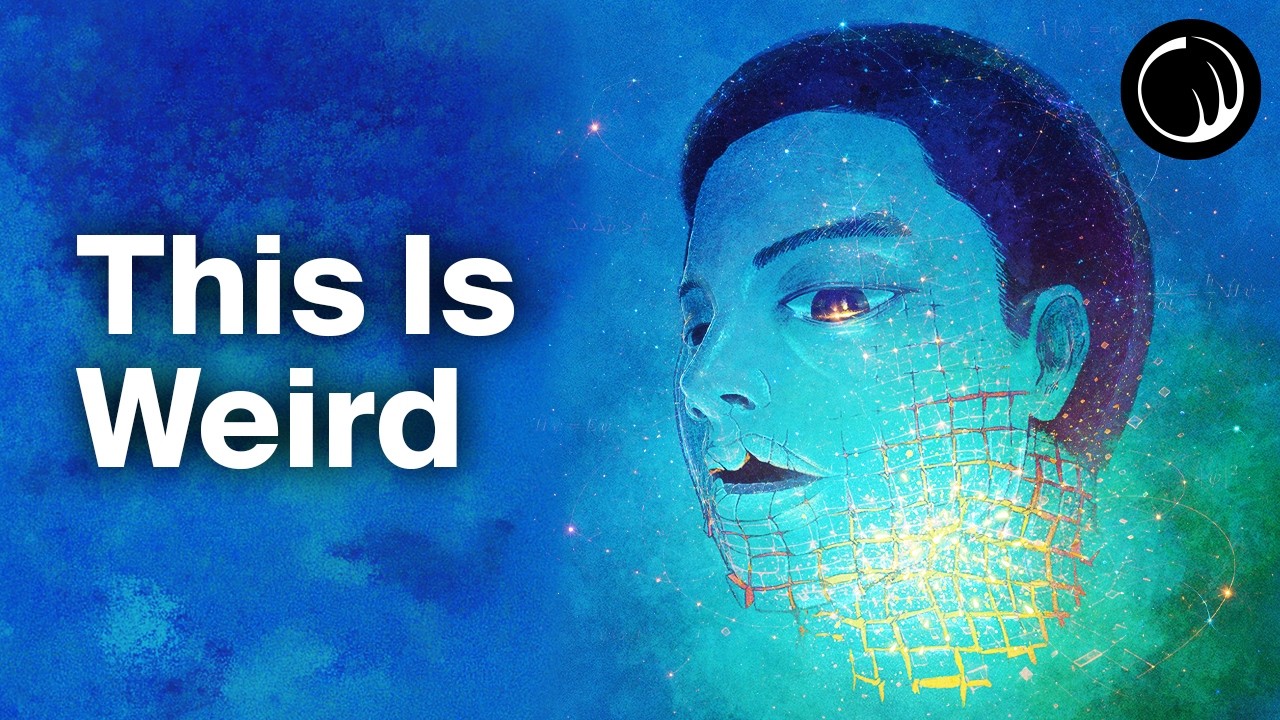
Explores the quantum immortality theory, its implications for consciousness, and the strange nature of quantum mechanics.
Key Takeaways
- Quantum immortality suggests consciousness may never experience death, continuing in some branch of reality.
- Quantum mechanics challenges classical deterministic views, introducing fundamental randomness and superposition.
- The many worlds interpretation provides a framework where all possible outcomes occur in separate branches.
- Identity and self are complex and unstable concepts when viewed through the lens of quantum theory.
- Despite controversy, quantum immortality raises profound existential questions about reality and consciousness.
What the video covers
- The video introduces the theory of quantum immortality, suggesting a probabilistic continuance of awareness beyond death.
- It discusses the teleportation thought experiment to illustrate identity and consciousness in quantum mechanics.
- Quantum mechanics reveals a fundamental randomness at the microscopic level, contrasting with deterministic classical physics.
- Particles exist in superposition until measured, causing the wave function to collapse into a definite state.
- The measurement problem questions what constitutes observation and how it affects quantum states.
- The many worlds interpretation proposes reality splits into branches for every possible outcome.
- Quantum immortality implies at least one branch where a version of you survives all causes of death.
- The video highlights the philosophical and existential implications of these quantum theories on self and identity.
- It acknowledges the speculative nature and lack of consensus around quantum immortality.
- Sponsored segment promoting boot.dev, a gamified software development platform, is included at the end.
Chapters
- 00:00Introduction and Sponsor Message
- 01:06Quantum Immortality Theory Overview
- 02:22Teleportation Thought Experiment
- 03:23Duplicate Copies and Identity Questions
- 04:16Quantum Mechanics and Microscopic vs Macroscopic Worlds
- 06:11Determinism at Macro Level vs Quantum Randomness
- 07:01Superposition and Wave Function Collapse
- 08:07Measurement Problem in Quantum Mechanics
- 09:08Interpretations of Quantum Mechanics
- 11:03Many Worlds Interpretation and Branching Reality
Full Transcript — Download SRT & Markdown
Speaker A
This video is sponsored by the gamified software development platform boot.dev. Stick around for the sponsored segment at the end of the video to receive a unique discount that isn't in the description.
Speaker A
There's a theory in physics that, when followed to its conclusion, something very strange happens. The entire universe seems to open up like a cosmic accordion. One world becomes many.
Speaker A
The future sort of becomes everything. The weirdest part is what it implies for you, about you.
Speaker A
According to this particular idea, you will never experience your own death. Not because upon your death you will no longer be around to experience anything, but because you will never actually die.
Speaker A
When physicists attempt to make sense of the theory known as quantum mechanics, which deals with the fundamental particles that make up reality, there seems to be a kind of immortality that emerges. This immortality is not the kind we typically think of.
Speaker A
It's not heaven or hell, not eternal youth, not technological augmentation, not legacy. Rather, it is a kind of probabilistic continuance of your awareness forever.
Speaker A
The idea is known as quantum immortality. Despite the seemingly absurd proposition of this, and despite the highly contentious arguments around it, the idea has become increasingly popular over the last few decades and has been seriously explored by leading physicists
Speaker A
and philosophers. In the last couple of years, it's also become increasingly popular in various pockets of the internet. Naturally, there's a lot of misunderstanding, misrepresentation, and divergence in discussions around it. And of course, there's no real consensus.
Speaker A
In large part, that's primarily because it's seemingly unfalsifiable. It's simply a highly speculative philosophical exploration of one interpretation of quantum mechanics.
Speaker A
But it does eerily map onto this interpretation, which itself cleanly fits the math of quantum mechanics.
Speaker A
Quantum mechanics is just extremely weird in relation to our sensibilities. In the words of physicist Niels Bohr, "Those who are not shocked when they first come across quantum theory cannot possibly have understood it." Regardless of consensus or verifiable
Speaker A
truth, the existential implications of quantum immortality remain undeniable and profound. It reveals something extremely destabilizing about the nature of who each of us are, or perhaps what we are in this verifiable reality.
Speaker A
The teleportation thought experiment. Consider the following thought experiment. It is some many years in the future.
Speaker A
Science and technology has since developed a new way to travel. You can now get to and from any accessible destination in a matter of moments through teleportation.
Speaker A
Using a global network of ports, travelers step into a dedicated teleportation pod, and then every particle of their body and brain is scanned, mapped, and modeled. In an instant, each particle's position and state are then perfectly reassembled in
Speaker A
the location of their choosing. You've already used this method for a few vacations. Most people have. It's painless, cheap, and obscenely convenient.
Speaker A
Today you're about to head to Bermuda. Like every other time, you enter the teleportation pod and follow all the instructions. In an instant, without missing a beat, you arrive on the archipelago as if nothing had happened.
Speaker A
As if you had simply taken a next step. Except this time, when you look next to you, there's a problem. During the reconstruction phase, there was a glitch and the system ran the model twice.
Speaker A
At the landing pod, now there are two of you. Two perfect identical copies. Clones. Both picking up exactly from where you left off when you were scanned.
Speaker A
Now in both versions, all of your memories are the same, all your preferences and values, all your body parts and birthmarks.
Speaker A
Everything is preserved and identical. But now there are two separate versions of you that will go two separate ways in the world.
Speaker A
Like with all transportation methods, sometimes there are accidents. Sometimes there are tragedies. It's unclear exactly what this is.
Speaker A
After all, you survived. You didn't lose anything. From your perspective, everything remained the same and went exactly as it should.
Speaker A
Only now it seems this way from the perspective of two of you. What if instead of both of you arriving cleanly, one of you arrived normally and the other arrived as a puddle of flesh, liquid, and brain matter? All the
Speaker A
particles still there, but not containing any life. Did you die? Did you live? Which one is you?
Speaker A
Are both you? Is neither you? This isn't quantum mechanics, but it illustrates the extremely weird and unsettling relationship we each seem to have with the theory.
Speaker A
At least one interpretation of it. The problem of quantum mechanics. I remember discussions with Niels Bohr, which went through many hours till very late at night and ended almost in despair.
Speaker A
And when at the end of the discussion, I went alone for a walk in the neighboring park, I repeated to myself again and again the question, "Can nature possibly be so absurd as it seemed to us in these atomic
Speaker A
experiments?" Werner Heisenberg. At its foundation, quantum mechanics is a theory in physics about the behavior of microscopic particles, photons, neutrons, electrons, and so on.
Speaker A
Seems simple enough, but at this level, for some unknown reason, all the ordinary classical understandings of physics seem to break down.
Speaker A
Quantum mechanics attempts to make sense of this, but in doing so, it seemingly only reveals a dissonance between the microscopic and macroscopic worlds.
Speaker A
Things are so weird down there that all our terms, understandings, and explanations seem to struggle to cleanly map onto it, if at all.
Speaker A
It's as if these particles at the quantum level are a kind of tiny window into another realm of reality, which we can peer into, but can't get through.
Speaker A
The key issue that quantum mechanics reveals is that these particles do not seem to function in a deterministic way.
Speaker A
That is, at this most fundamental level of reality, everything seems to be random. At the macro level, of course, when we push a domino, it falls. And if there's another domino in front of it, it hits it, and that one falls, too. So, on and
Speaker A
so forth. We press the accelerator pedal in a car, more fuel and air are supplied to the engine, the engine spins faster, the wheels turn, and we accelerate forward.
Speaker A
We pull a trigger or flip a switch over and over in the exact same way, with the exact same conditions, and over and over, the same things happen.
Speaker A
Everything operates through clear cause and effect. But at the quantum level, if you push a particle, what it does next is uncertain, apparently random.
Speaker A
It does different things and shows up in different places for seemingly no clear reason.
Speaker A
Through various research and experiments, like the famous double-slit experiment and quantum eraser experiment, what seems to be the case is that particles behave more like waves, not waves of energy, but a kind of distribution of probability.
Speaker A
This is described by what is known as the wave function, which is a mathematical description physicists use to describe all the possible ways a particle could behave and their probabilities.
Speaker A
The result of this is that particles are in a state of a kind of uncertainty.
Speaker A
They're in what is known as superposition, where multiple different positions or states exist simultaneously. But things get even weirder. When a specific particle is measured, its state or position suddenly becomes defined in accordance with normal deterministic physics. The
Speaker A
wave function collapses. In other words, measurements or observations seem to be almost part of the equation itself.
Speaker A
The most famous demonstration of this is through what is known as the double-slit experiment, where researchers fire individual particles at a barrier with two vertical slits, without obs
Speaker A
other side of the slits against a backdrop wall, known as an interference pattern, as though each particle behaved like a wave, each moving through both slits at the same time. But when a detector is placed at the slits to
Speaker A
determine which slit each particle passes through, suddenly the wave-like pattern disappears [music] and the particles behave as though they were defined and had a single path, creating two lines on the back wall.
Speaker A
When we look, particles seem to suddenly almost play [music] along, like a Toy Story character whose behavior decides the literal conditions of everything.
Speaker A
But why does measurement or observation change anything? And more importantly, what constitutes a measurement or observation?
Speaker A
This is what is known as the measurement problem. Measurement here can often be conflated with a kind of conscious observation, but most modern physicists think that is likely both unnecessary [music] and deviating from the reality. The requirement for measurement or
Speaker A
interaction seems to be nothing more than a particle simply interacting with its environment, [music] like an electron bumping into a photon.
Speaker A
But if this is true, how then is not everything a kind of measurement? Wouldn't the wave function just always be collapsing?
Speaker A
Or to the contrary, if everything is made of quantum particles, why wouldn't everything always be caught in the continuous evolution of the wave function to begin with?
Speaker A
Perhaps everything [music] is. Infinite worlds and infinite yous. In 1957, in an effort to make sense of and resolve the problems of quantum mechanics, physicist Hugh Everett offered a revolutionary interpretation.
Speaker A
Up until this point, prior interpretations primarily involved trying to map the classical world at the macro level onto the quantum realm.
Speaker A
In what is known as the Copenhagen interpretation, which was the leading interpretation following the 1920s, the idea was that to when a particle is measured, the wave function collapses and the particle goes from an indeterminate state to suddenly a
Speaker A
defined one, just how it appears to us. [music] Everett, however, found this to be both incomplete and disingenuous to the reality of what is happening.
Speaker A
There is no part of the equation that suggests a sudden collapse or observer variable.
Speaker A
Referring to his efforts to resolve the conflict, Everett says, "This paper proposes to regard pure wave mechanics [music] as a complete theory.
Speaker A
It postulates that a wave function that obeys a linear wave equation everywhere and at all times supplies a complete mathematical model for every isolated physical system without exception." And so, Everett suggested we simply follow the wave function wherever it
Speaker A
takes us. Put differently, we shouldn't assume it collapses simply because that's what our observation suggests. Rather, we should accept that the complete math is complete and fully describes reality.
Speaker A
If we do this, however, what it suggests is that every possible state of every quantum particle is [music] real simultaneously.
Speaker A
Of course, this raises the following questions. If all possible states of a particle are real and exist simultaneously, why do we only see one when measuring and observing them? And why does only one outcome of the world appear to exist?
Speaker A
Everett's answer is one of the strangest ideas to be taken seriously in modern science, the many worlds interpretation.
Speaker A
According to the many worlds interpretation, this conflict is essentially a consequence of our abilities or inabilities of observation, not a conflict in reality.
Speaker A
Since we as observers are also part of the quantum world, when we interact with or observe quantum particles, we become entangled with the particles we measure and thus also with the one outcome we see.
Speaker A
But reality fundamentally splits into branches at each point of interaction, [music] each branch containing all the different possible outcomes.
Speaker A
As physicist Bryce DeWitt eloquently put it, "Every quantum transition taking place on every star in every galaxy and every remote corner of the universe [music] is splitting our local world on Earth into myriads of copies." In other words, if all possible states
Speaker A
of quantum particles exist, then all physically possible outcomes of the universe exist or will exist. We merely only see the one we see because that is the branch we have become entangled with.
Speaker A
To us, everything appears continuous and fixed, but in reality, it sort of isn't. Instead, the universe comprises infinitely or near infinitely many parallel non-interacting worlds, each branch on the quantum tree evolving outward in its own direction.
Speaker A
Quantum [music] immortality. What does this mean for each of our lives and each of our [music] deaths? Of course, it could mean nothing. It could be wrong. But if we follow the current a bit further, the idea of quantum
Speaker A
immortality suggests that if all physically possible outcomes of the universe exist or will exist, every possible outcome of your life will as well.
Speaker A
Where things get even stranger and more unsettling, yet remain fully coherent with the mathematics of quantum mechanics, is that every possible outcome of your life includes at least one branch in which you or some version of you survives everything.
Speaker A
Every near-death experience you've been aware of but evaded, every near-death experience you weren't aware of but evaded, a car crash you barely avoided, a disease you had that didn't kill you. Every physically possible cause of death you could have
Speaker A
died from but didn't. In each of these moments, reality split and branched outward on the quantum tree.
Speaker A
In certain branches, you died in each of those moments. But in this reality, containing this version of you right now, you survived all of them.
Speaker A
So far. Perhaps in some upcoming moment, this version of you right now might not be so lucky. The particular branch you're entangled with will bring you in front of a car [music] or under a storm or into an illness or
Speaker A
simply unto late age and a natural death. But according to the premise of quantum immortality, some version of you will continue [music] to be lucky.
Speaker A
Some version, like the version of you up until this point, will continue to evade every physically possible cause of death, including old age itself.
Speaker A
Some branches will contain medical breakthroughs. Some will [music] have different environmental conditions. Some will have biological mutations or technological augmentations. Some will harbor incredibly improbable events.
Speaker A
And at least one will contain you riding on the wave of these conditions forever.
Speaker A
[music] Some semblance through line of your subjective conscious experience that continues to feel like you.
Speaker A
According to the philosopher David Lewis, this version of you would eventually find out the truth of the many worlds interpretation, and your improbable survivorship bias would be the proof.
Speaker A
The unending illusion of the self. Even if nothing is true about the many worlds interpretation and quantum immortality, what remains deeply interesting and significant about the ideas is what they bring up about the very nature of the self.
Speaker A
We might reject the many worlds interpretation and quantum immortality, but we cannot reject the fact that in every moment there is a kind of split happening. A split between moments and the self.
Speaker A
If you keep surviving, regardless of the universe splitting, in this world right now, you keep changing. You keep departing from prior versions of yourself and into [music] new present ones, only for the new present ones to quickly be departed from.
Speaker A
Across your lifetime, [music] across each stage, each year, each week, each day, each moment, a new version of you emerges.
Speaker A
A clone based on what was clonable from your prior [music] self. Our bodies, our memories, our preferences, our beliefs, and our values are cloned from each moment into the next.
Speaker A
But in each moment, things are [music] different. Each new moment is lived in a new world with a new state of the body and mind.
Speaker A
Across time, the changing of the self becomes increasingly perceivable. Our bodies are different, made of entirely [music] different cells.
Speaker A
Our preferences and values change. Our memories become recontoured [music] and amalgamate into new structures with new memories and new vantage points. Our external circumstances vary, evolve, and erode. Altogether, very little, if not nothing, remains consistent and stable.
Speaker A
Except some kind of continued sense of subjective awareness. Just like what is required and considered in quantum immortality.
Speaker A
[music] We continue to call this assemblage us, me, I. And we perceive and feel it as if it were fixed and continual.
Speaker A
But it isn't at all obvious if it actually is. What is this continued sense of awareness?
Speaker A
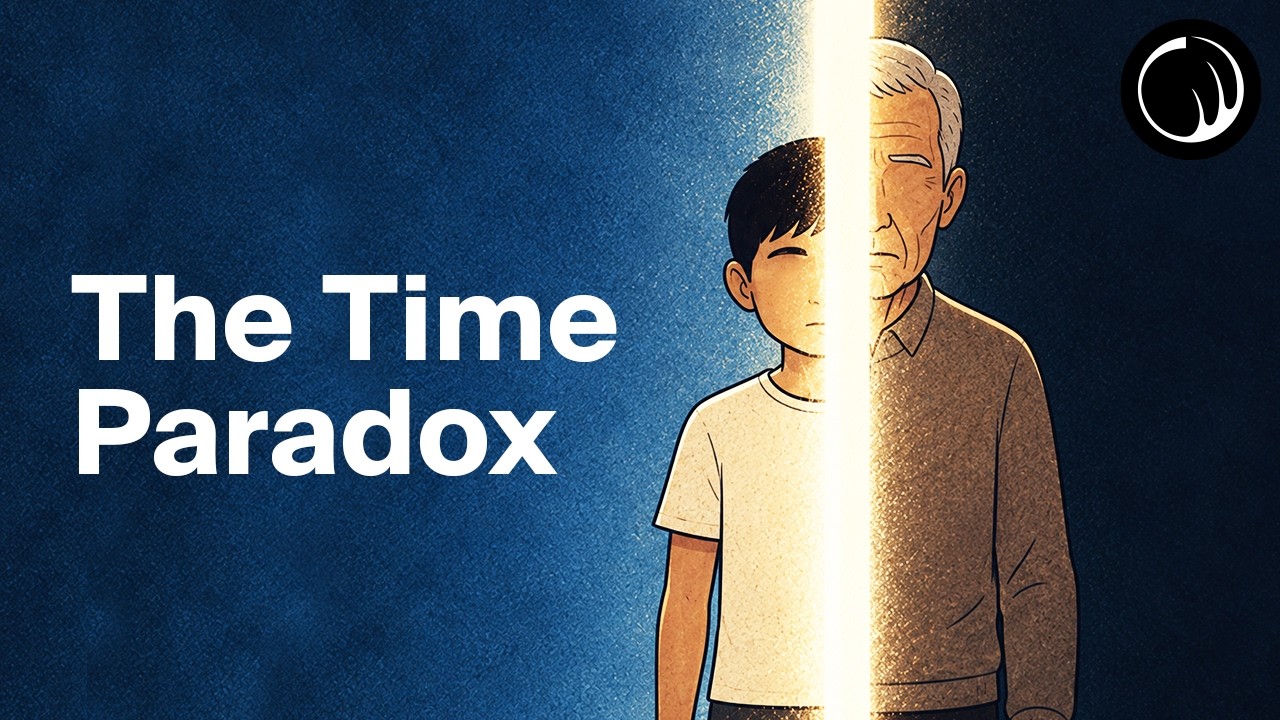
If we return for a moment to the question configured in the teleportation [music] machine, that clone version of you represents the same kind of split in reality suggested in the many worlds interpretation and suggested in the very teleportive nature of time itself.
Speaker A
In every moment, an identical version of you suddenly diverges into a new separate reality, [music] into a separate condition.
Speaker A
But which one is you? Is it always the same you? Is it never the same you?
Speaker A
What are you? If it's unclear in the teleportation machine or in the many worlds interpretation, then why is it clear right now?
Speaker A
In the end, [music] quantum immortality forces us to realize not only the underlying uncertainty of everything we are made of and exist through, but also the uncertainties of who and what we are philosophically.
Speaker A
It forces us to question if there ever really could be a world in which you exist at all.
Speaker A
Even if something like you might continue on forever. Whatever the self is, illusion or not, immortal or not, there is, of course, something here.
Speaker A
Something you experience as you. Whether we live forever or die tomorrow. [music] To have been here at all, in any form, on any branch on which we can sit and ponder the night sky or the landscape below, is so unfathomably unlikely, perhaps it
Speaker A
can only mean one thing. We are each proof of some kind of absurd [music] improbability. Whatever it might be.
Speaker A
Perhaps there is a through line of each of our subjective conscious [music] awareness currently on its way to infinity.
Speaker A
Perhaps you are everywhere all the time all at once. But either way, right now you are here.
Speaker A
You are still alive. You made it this far. Only time in the universe will tell how much farther you will go.
Speaker A
While we're here in this branch of [music] reality, we have to make the most of it. This includes paying close attention to the details of this life.
Speaker A
[music] To the relationships we hold close. And to taking the unique chances that this version of us can. Pursuing our interests relentlessly.
Speaker A
This video's sponsor, boot.dev, helps you do just that [music] in a way that is meaningful and effective.
Speaker A
In a world of increasing digital opportunity, boot.dev makes keeping up and learning coding in modern cloud engineering [music] enthralling and addictive. What I love most about boot.dev is not only its vast course offerings, but that it uses modern game design to literally turn
Speaker A
learning into an RPG game. You go on quests, fight bosses, earn XP, levels, and achievements, all while building skills that give you a huge competitive advantage in the real [music] world. You can learn Linux, AWS, Go, Docker, and
Speaker A
how to make AI work for you rather than what is so often the other way around.
Speaker A
In today's world, boot.dev helps make the difference between stagnating in software or advancing ahead. All while avoiding the tedium of tutorials or the exorbitant expenses of traditional education.
Speaker A
[music] On boot.dev, all content is free to read and watch, and a paid membership, which is just 1% the price of traditional education, unlocks all interactive features and hands-on coding.
Speaker A
In the US in 2025, the median salary for DevOps engineers or professionals was $165,000.
Speaker A
So, the upside here is obvious, [music] and the risk is fun. And since you stuck around, boot.dev is offering you a special 30% off your entire first year. That's an extra 5% off compared to all those who didn't
Speaker A
make it this far in the video. Just go to boot.dev and use code [music] immortal.
Speaker A
And of course, as always, thank you so much for watching in general, and see you next video.
Topics:quantum immortalityquantum mechanicsconsciousnessmany worlds interpretationwave functionsuperpositionmeasurement problemteleportation thought experimentphilosophy of physicsquantum theory