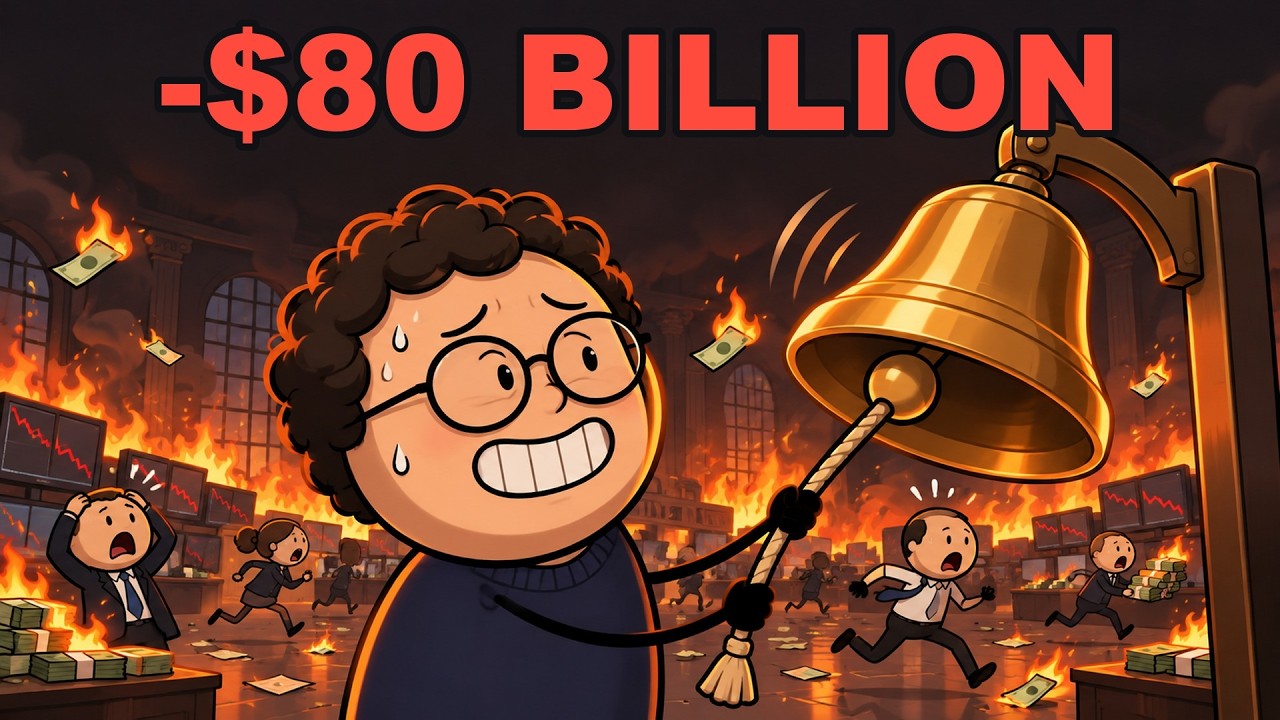
Analysis of Nvidia's dependence on Jensen Huang after his resignation, covering CUDA's decade-long bet, the lack of succession planning, interim CEO Colette Kress, and retirement-fund exposure.
Key Takeaways
- Nvidia's value and strategy were tightly concentrated in Jensen Huang, creating key-person risk with no clear successor.
- Interim leadership at major tech companies after leadership shocks has historically correlated with weaker stock performance, according to the video's examples.
- Long-term bets like CUDA can look unprofitable for years before becoming foundational, making the company's future dependent on leaders willing to fund them.
- Index fund investors hold concentrated Nvidia exposure without choosing it, so leadership changes can affect retirement savings broadly.
- The video's analysis is opinion-driven and includes promotional content, so claims about valuations and outcomes should be independently verified.
What the video covers
- Jensen Huang's sudden resignation exposes Nvidia's lack of a number two, with about 60 executives reporting directly to him and no succession plan.
- Wall Street estimates put roughly two trillion dollars of market value on Huang's presence, with one analyst valuing shares at $300 with him versus $225 without.
- Huang's history of near-collapse (1990s Sega deal) and his bet on CUDA, which cost years of margin before paying off with AI demand, is presented as the core of his value.
- CUDA later made Nvidia dominant in AI chips, with the transcript claiming nine of every ten AI-running graphics chips are Nvidia's.
- Finance chief Colette Kress becomes interim CEO while remaining CFO, a structure the video suggests is designed to keep things steady rather than bold.
- Comparisons to HP (Mark Hurd) and Intel (Brian Krzanich, Bob Swan) show that interim leadership after scandals or departures often coincides with underperformance.
- The video argues Nvidia's three-generation chip roadmap provides near-term security but that uncertainty grows beyond 2028 and in China.
- Rivals such as Google's new AI chip launch are cited as opportunities that grow the longer Nvidia lacks a permanent CEO.
- The video notes that S&P 500 index investors have large, unchosen exposure to Nvidia, roughly 6-7% of a fund, tying retirement savings to the company's leadership.
- The transcript includes a paid sponsorship segment for trench.io, a leveraged trading platform, which is promotional content rather than analysis.
Chapters
- 00:00Jensen Huang's Sudden Departure
- 00:26Wall Street's Valuation of the Leadership Gap
- 01:12Nvidia's Early Survival and the Sega Deal
- 02:36The CUDA Bet and the AI Payoff
- 03:44A Company Built Around One Leader
- 05:04Index Fund Exposure and Retirement Risk
- 07:29Interim CEO Colette Kress and Past Leadership Transitions
- 12:15Competitive Risks and the Road Ahead
Full Transcript — Download SRT & Markdown
Speaker A
This is Jensen. And Jensen has a huge problem. For thirty-three years, he built one company.
Speaker A
It almost went broke, and he saved it. He bet a huge share of his profits on software nobody wanted, and waited ten years to be right.
Speaker A
He turned a video game chip maker into the most valuable company on Earth. Thirty-three years.
Speaker A
And this week he lost it, because he couldn't keep his pants zipped. We accept your resignation.
Speaker A
Can I keep the jacket? No. But that's Jensen's problem. Here's Nvidia's. Nobody thought he would actually go.
Speaker A
Two days before he quit, the betting markets gave it eighteen percent. Because nobody could picture Nvidia without him.
Speaker A
Nvidia never had a number two. Sixty people reported straight to one man. No backup.
Speaker A
No plan B. There has to be somebody else. The guy in the leather jacket.
Speaker A
That's Jensen. The other guy in the leather jacket? Wall Street has even put a price on it.
Speaker A
One analyst says Nvidia is worth three hundred dollars a share with Jensen in that jacket.
Speaker A
And two hundred twenty-five with it empty. That gap is almost two trillion dollars. Right now, the finance chief is holding it.
Speaker A
The President wants to hand it to Tim Cook. And on Tuesday, Nvidia reports its numbers without him for the first time ever.
Speaker A
So how does a man throw away thirty-three years of work? We've told that story already.
Speaker A
The big question is the one he left behind. Can Nvidia survive without him? April nineteen ninety-three.
Speaker A
Jensen Huang and two other engineers start a graphics chip company. They call it Nvidia.
Speaker A
Jensen. Microsoft just set the rules for PC games. Everything's triangles. Our chip does curves.
Speaker A
Only curves. Nvidia has cut a beautiful key for a lock that just got changed.
Speaker A
Worse, its biggest customer, Sega, is paying for the next chip, built the same wrong way.
Speaker A
So Jensen flies to Japan. Our chip is a dead end. Cancel our contract. Hire someone else.
Speaker A
You flew here to fire yourself? Yes. And keep the money you still owe us inside Nvidia.
Speaker A
As an investment. In the company whose chip doesn't work. You'll probably lose it. Sega said yes.
Speaker A
Five million dollars, and it kept Nvidia alive. The reason? Sega's boss simply believed in him.
Speaker A
How long have we got? Thirty days. Same as always. That was the company's motto: thirty days from going out of business.
Speaker A
In nineteen ninety-seven, its next chip sold about a million in four months, and within a few years, Nvidia was the king of gaming chips.
Speaker A
Then, in two thousand six, Jensen spent a big piece of the money on something gamers would never see.
Speaker A
He called it CUDA. A graphics chip does thousands of tiny sums at once. Scientists could use that for anything.
Speaker A
Who pays for it? Nobody. Yet. It cost Nvidia a huge share of its profits, and for years it earned almost nothing.
Speaker A
Three years. Still flat. It's eating our margins. It's early. I can't put "early" in a forecast.
Speaker A
Then leave it out of the forecast. Keep it in the company. In twenty twelve, a team in Toronto won an image-recognition contest by a mile, with a program trained on two Nvidia gaming cards.
Speaker A
Every AI lab on Earth noticed. CUDA took a decade to pay off. Today, nine of every ten graphics chips that run AI are Nvidia's.
Speaker A
And that finance chief? He was right. Every year CUDA lost money, cutting it was the sensible call.
Speaker A
Even the investors who think Nvidia will be fine give Jensen's pipeline two years. So who signs year three?
Speaker A
As of this week, Nvidia's boss is its finance chief. Back to that test. Name one Nvidia executive who isn't Jensen Huang.
Speaker A
You can't. That was on purpose. For years, Jensen was Nvidia's only face, inside and out.
Speaker A
Most big companies are built like an office tower. Nvidia was built like a bicycle wheel.
Speaker A
Sixty people reported straight to Jensen. No chief operating officer. No one-on-ones. "I don't have one-on-ones with them because it's impossible." He even reviewed every employee's pay.
Speaker A
Who needs a decision? Me. Yes. Yes. No. Yes. Next. It made Nvidia fast. In Jensen's own words, "My management style is what made it possible for the company to grow." It also meant this.
Speaker A
So who's number two? There isn't one. No succession plan either. So what was the hub holding?
Speaker A
First, the customers. Who buys all these chips? Three direct buyers. About forty-four cents of every dollar, this year so far.
Speaker A
And who did they deal with? Guess. One investor, Thomas Ferguson, said this: "As a student of economic history, I don't know if there's ever been such a key man holding so much of this industry up." And that industry includes your money.
Speaker A
I don't own Nvidia. Got an S&P five hundred fund in there? Yes. Then you own Nvidia.
Speaker A
Put ten thousand dollars in an S&P five hundred fund, and six or seven hundred of it is Nvidia.
Speaker A
One of the biggest bets in your whole retirement is riding on one company. And that company was riding on one man.
Speaker A
I never picked this guy. You didn't have to. You just had to save for retirement.
Speaker A
So my retirement rides on Tuesday. And I didn't even get a vote. Everybody has a call on Tuesday.
Speaker A
Most people never act on it. Nvidia sits inside a fund they never picked. I do have a theory.
Speaker A
I'm just not betting my retirement on it. You don't have to. trench.io gives you access to stocks, crypto and more with up to 1000x multiplier.
Speaker A
Meaning a trade that would normally make twenty dollars in profit could make twenty thousand dollars with a thousand x multiplier, because your position size is a thousand times larger.
Speaker A
You can also never lose more than you put into a trade, but your upside is uncapped.
Speaker A
So if you think Nvidia is going down because their CEO just resigned, you can place that trade with up to 1000x, like this.
Speaker A
Then the candles do what candles do, and you close the trade whenever you like.
Speaker A
Thousands of people are already trading on trench.io every day, with over ten billion dollars in notional trading volume, and more than two million withdrawn so far.
Speaker A
Signing up is free, and trench.io is giving five people five hundred dollars each. Sign up with the code PAPERB.
Speaker A
It's on screen, and in the first link in the description. Now, back to Nvidia.
Speaker A
For thirty-three years, one man made the big bets there. As of this week, someone very different makes them.
Speaker A
Thursday, November twelfth. Nvidia's new boss is Colette Kress. Thirteen years running Nvidia's money. Before that, Cisco, Microsoft and Texas Instruments.
Speaker A
Her job in public was reading out the results. Now she's interim CEO and still CFO, so the finance chief reports to herself.
Speaker A
I'd like money for something bold. Show me the numbers. There aren't any yet. Then come back when there are.
Speaker A
Is she the new Jensen? She's "the one" to "steady the ship." For a year.
Speaker A
Then they hire an outsider. That's what an interim boss is for. Keep customers calm.
Speaker A
Hit the numbers. Break nothing. We've seen this exact move before. August twenty ten. HP's CEO, Mark Hurd, resigns after an investigation finds a "close personal relationship" with a contractor and inaccurate expense reports.
Speaker A
So who runs HP now? Me. Temporarily. In two weeks, HP was fifteen billion dollars lighter.
Speaker A
One study later looked at six big CEO scandal exits. Over the next year, HP did the worst of all six: nearly forty points behind the market.
Speaker A
Intel tried it too. In twenty eighteen, its CEO resigned over a past relationship with an employee.
Speaker A
So who runs Intel now? Me. Temporarily. Want to make it permanent? Sure. Under Swan, Intel's next manufacturing step slipped again, and in twenty twenty-one, it replaced him with an engineer.
Speaker A
Too late. Last year, the company that had passed it, Nvidia, put five billion dollars into Intel.
Speaker A
A burger chain can run on a spreadsheet. A kitchen with three Michelin stars can't.
Speaker A
Its best dish exists because the chef tried something weird and said, "Again." Nvidia is that kitchen, and the chef just walked out.
Speaker A
Rivals can smell it. The first morning after the scandal broke, Google unveiled a new AI chip built for governments and regulated industries.
Speaker A
And every month Nvidia goes without a permanent boss, rivals' sales pitch gets easier. Steadying the ship is the job.
Speaker A
Look at what calm costs. Colette. Would you bet a huge share of our profits on something with no customers for years?
Speaker A
What's the return? Nobody knows. Then no. Perfect answer. It is. It's also the answer that would have killed CUDA.
Speaker A
Apple lost Steve Jobs twice. The first time, it nearly went broke. The second time, it became one of the richest companies on Earth.
Speaker A
The difference was who picked the next boss. Nineteen eighty-five. Apple's board strips Jobs of his duties.
Speaker A
We're backing the professional, Steve. We'll take it from here. Sure you will. In September he resigns.
Speaker A
Apple goes through three CEOs in twelve years, and a pile of forgettable computers. In two years, it loses almost two billion dollars.
Speaker A
When Jobs comes back, he takes a hundred fifty million from Bill Gates. Apple got rescued by Microsoft?
Speaker A
That's how bad it got. Twenty eleven is the opposite. Jobs is dying, and he picks his successor himself: Tim Cook, who had run Apple's operations for years.
Speaker A
It's yours, Tim. You already know where everything is. Cook took over at about three hundred forty-seven billion dollars.
Speaker A
This September, Apple was worth four point seven trillion. Nvidia, this week, is nineteen eighty-five.
Speaker A
There was no plan B. In March, on a podcast, Jensen waved off classic succession plans.
Speaker A
His idea was to pass on what he knew "as often and continuously as you can." And for thirty-three years, a company now worth trillions had no board chair.
Speaker A
It announced its first one on Thursday. We have a chair now. Since when? Since Wednesday night.
Speaker A
So who's on the list? Colette. A few of Jensen's engineers. Lisa Su, who runs AMD.
Speaker A
Isn't AMD the rival? Yes. She's also his cousin. The real list doesn't exist yet.
Speaker A
The board hired an outside firm to write it. Nobody had one ready. Whoever gets it also inherits Washington, where Jensen did the talking himself.
Speaker A
Last year, Trump wanted twenty percent of Nvidia's China chip sales for the government. Jensen talked him down to fifteen.
Speaker A
"So we negotiated a little deal." That deal was personal. Now Congress wants answers, and Nvidia's forecast counts on nothing from China's data centers.
Speaker A
A new boss inherits the hearings, not the friendship. Then the President joined the search.
Speaker A
"There is only one man to take his place - TIM COOK of Apple." "A Legend replaces a Legend!" Doesn't Tim Cook already have a job?
Speaker A
He stepped down as Apple's CEO on September first. So the pick to replace a CEO who just left...
Speaker A
Is a CEO who just left. Elon Musk had already said hiring Jensen "would be an honor." Cook is a great operator.
Speaker A
Under him, Apple got the Watch and AirPods, but never another iPhone. An operator keeps a machine running.
Speaker A
Nvidia's machine was one man making bets. On Tuesday, Nvidia reports. What are they expecting?
Speaker A
About a hundred and eight billion dollars of sales for the quarter. More than a billion a day.
Speaker A
The numbers will be great. That's the trap. Those chips were designed, ordered and promised while Jensen was in charge.
Speaker A
The first report after a founder leaves is the founder's last bets paying out. Intel kept making money for years while it lost its lead.
Speaker A
Wall Street is split three ways. Analyst Jay Goldberg says the quarter will be good, and nobody will care.
Speaker A
Investor Dan Niles bet his interviewer dinner that a strong report sends the stock up, whoever is CEO.
Speaker A
And Ives says it's worth a quarter less without him. The bulls have a real case.
Speaker A
Nvidia's next three chip generations are already mapped out, through twenty twenty-eight. In March, Jensen said he could see at least a trillion dollars of sales from his two newest chips, through next year.
Speaker A
It has about forty thousand employees, not one. Fund manager Jeremiah Buckley says, "We think visibility is extremely high for twenty twenty-seven." And in twenty eleven, the year Jobs stepped down and died, Apple's stock went up.
Speaker A
So it's fine. For two years. Then somebody has to make the next bet. Okay.
Speaker A
Tuesday. What am I watching? Who answers the questions. For the first time, it won't be Jensen.
Speaker A
And? Anything after twenty twenty-eight, where the map ends. And China, now that the man who cut the deals is gone.
Speaker A
That's how Nvidia fails. Not with a crash on Tuesday. It keeps making money for years, and never makes the next CUDA, because nobody left in charge is paid to bet like that.
Speaker A
In twenty thirteen, Morris Chang, the founder of TSMC, the company that makes Nvidia's chips, offered Jensen the top job there.
Speaker A
Chang spent ten minutes making his pitch. Jensen listened, and said no. He already had a job.
Speaker A
He doesn't anymore. His plan for this day was to pass on everything he knew, as often as he could, to everyone at Nvidia.
Speaker A
That two-trillion-dollar gap is Wall Street betting that it didn't. Tuesday won't settle that. The next big bet will.
Speaker A
And right now, nobody knows who gets to make it. And don't forget to go check out trench.io.
Speaker A
They have multipliers of all the way to 1000x on stocks and crypto. They're also giving away five hundred dollars to five people who sign up for free and use code PAPERB.
Speaker A
Link is in the description and pinned comment.
Topics:NvidiaJensen HuangCEO successionCUDAAI chipsColette Kressinterim CEOkey-person riskS&P 500semiconductor industry