Skip to content

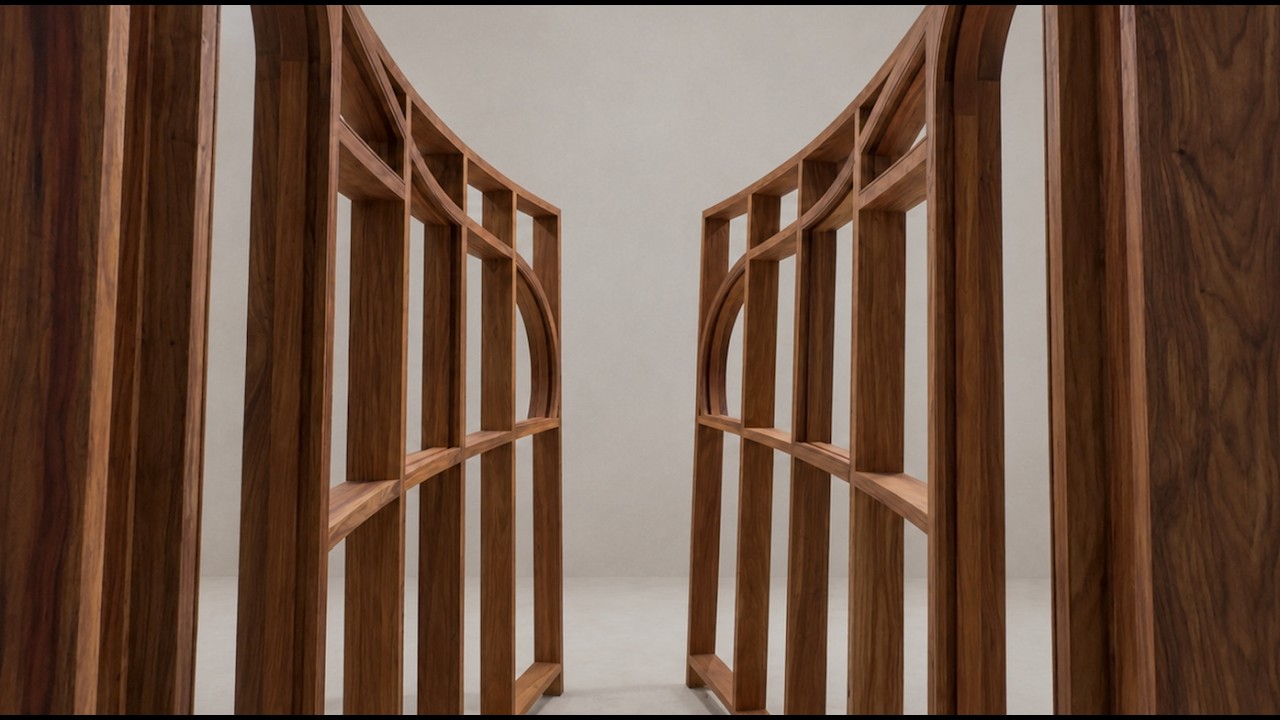
The Most Complex Door Frame I've Ever Built

Watch Aolani Studios build the most complex door frame using unique woodworking techniques and practical tips for a precise, strong assembly.

Ask about this video. Answers come from its transcript only — with the timestamp, so you can check them.

Generated from the transcript and can be wrong — check the timestamp.

Key Takeaways

  • Building complex joinery requires careful planning, patience, and practical problem-solving.
  • Using oversized stock and relief cuts simplifies clamping curved pieces.
  • Simple joinery techniques can be strong and efficient for architectural projects.
  • Improvised tools can be just as effective as specialized equipment.
  • Proper dry fitting and timing during glue-ups are critical to avoid assembly issues.

What the video covers

  • Aolani Studios demonstrates building a complex door frame with unique techniques and problem-solving approaches.
  • The video covers template creation, milling timber, and strategies for clamping curved wood.
  • The creator shares a practical tip: glue oversized stock and cut it later for easier clamping.
  • Tools used include a bandsaw, router bits, and improvised tools from scrap materials.
  • The importance of dry fitting and timing glue-ups in hot weather is emphasized.
  • Bent lamination is used for window beading, with a cautionary note on the difficulty of the process.
  • The video highlights the balance between fast joinery methods and structural strength.
  • A new machine is introduced mid-project, improving workflow despite some setbacks.
  • The creator humorously reflects on workshop organization and tool management.
  • The project concludes with finishing touches and preparation for oiling the door frame.

Answers

Questions about this video

What is the main tip for clamping curved wood pieces in this project?

The main tip is to glue oversized stock and add relief cuts before clamping. This allows for easier pressure application and makes cleaning up excess material simpler than struggling with clamps.

Does the creator use specialized tools for every task in this door frame build?

No, the creator often uses improvised tools found in the scrap bin, such as a scrap dowel and sandpaper on a drill, which can be more effective than specialized attachments.

Are the joinery techniques used in this project complicated and time-consuming?

Not necessarily. While fancy joinery is appreciated, the project uses simpler, faster methods like domino joinery that provide strong structural integrity suitable for architectural work.

Full Transcript — Download SRT & Markdown

00:00
Speaker A
How you going? This is a pretty cool door design. It took a bit of concentration to build.
00:06
Speaker A
Some pretty unique techniques. So, today I'm going to show you how I did it.
00:17
Speaker A
Most buildings are the result of dozens of people solving different problems. The architect defines the vision, engineers make sure it stands up, builders coordinate the site.
00:28
Speaker A
Then there's me who has to decipher and make this with only this as a reference.
00:35
Speaker A
And starting with the template, I'd love to be sipping coffee with my feet up watching a CNC cut this, but I don't have one. So, here's a bit of a cheat code to avoid building a lopsided arch or template.
00:49
Speaker A
Just build one perfect half, then flip the template to mirror it. As with every project, there's hours of milling rough-sawn timber into slightly less rough-sawn timber.
01:09
Speaker A
Now, I know some of you are here for the process, but I don't think anyone needs a 15-minute montage of me standing next to a thicknesser.
01:17
Speaker A
So, here's the heavily edited version. If you only learn one thing from this build, make it this.
01:57
Speaker A
Glue it big, cut it later. Clamping curves is usually an exercise in frustration. But, if you keep your stock oversized, you can add some relief cuts to get the pressure exactly where you need it.
02:10
Speaker A
It is way easier to clean up the excess later than it is to wrestle with clamps that won't stay put.
02:16
Speaker A
Ask me how I know. So, from there we're going to rough cut on the band saw and then what I like to call the butt clincher.
02:31
Speaker A
If you haven't seen this before, it's basically an oversized router bit spinning at 8,000 RPM in your hands just inches from your crotch.
02:53
Speaker A
You'd think after all this time I'd have a specialized tool for every scenario. But no.
02:59
Speaker A
I spent way too much time trying to make a fancy grinder or Dremel attachment work before realizing a scrap dowel and some sandpaper on a drill was the actual answer.
03:11
Speaker A
Sometimes the most effective tool in the shop is just whatever I found in the scrap bin.
03:55
Speaker A
I spent more time checking, double-checking, and triple-checking dry fit off camera than I care to admit.
04:02
Speaker A
Not because I don't trust my joinery and dominoes, but for those of you that have tried a complicated glue-up in the middle of summer, you know what I mean.
04:12
Speaker A
But seriously, what makes it so stressful is that when you have multiple components that need to go together in one assembly, you risk the glue starting to dry before it's even clamped together.
04:47
Speaker A
I've been calling this piece the antler for pretty much the entire build. If you want to make one yourself, I've got great news and terrible news. The great news is it's absolutely possible.
04:58
Speaker A
The terrible news is I never made plans. But, if you want more in-depth videos and build plans, you can also head over to my Patreon.
05:08
Speaker A
Actually, you can't. I don't have one. Now, I know this isn't your stunning hand-crafted sliding dovetail joint.
05:22
Speaker A
As much as I love fancy joinery, some projects, especially architectural joinery, need a faster approach if I want to win the job.
05:30
Speaker A
Clients don't usually ask how many hours you spend making one joint unnecessarily complicated. That said, don't mistake simple for weak. Two dominoes and a 100 mil bugle have an approximate shear strength of 800 kilos and a direct pull strength of
05:45
Speaker A
600 kilos. I've probably spent hours watching Japanese woodworkers admiring their clean, organized, almost meditative workspaces.
05:59
Speaker A
Then, I look at my shop where I spent 5 minutes today hunting for a pencil.
06:06
Speaker A
Coming up short, I did what any normal person would do. This is not to assume I'll never lose a pencil again, but I am saying that if I manage to lose all of these, I'm just going to give up and start a pottery
06:30
Speaker A
channel. [snorts] Time for the window beating. I'm using bent lamination and I've got a technique that I'm calling never do this again.
07:38
Speaker A
It was time-consuming and quite frankly, a massive oversight on my part. Even these 1 mm strips would snap unless they were steam bent into a form before glue-up.
08:13
Speaker A
While you're enjoying me trim up the beading, you might notice I got a new machine since the start of the video.
08:18
Speaker A
So, enjoy the sound of this thing. Now, normally I'd say I learn from my mistakes, but in this case, I had just enough foresight to realize that gluing these laminations directly into the rebate without some sort of plastic
08:56
Speaker A
barrier would create a pretty big future problem for myself. And future me has already got enough problems.
09:04
Speaker A
Plus, the benefit of doing it this way is that when it's finished, it'll be schmick.
11:37
Speaker A
This top beading is tough because each strip has to be precisely cut to fit edge to edge.
11:44
Speaker A
And as you can see, it is dark outside and probably explains why I'm currently using a high precision machinist square to knock them into place.
11:54
Speaker A
I know, I know, it's a precision instrument designed for accuracy, but it's a clear sign that I just want to go home for dinner.
12:11
Speaker A
And just like every other project I start, it ends with an excuse to use every clamp in my workshop.
12:36
Speaker A
So after all that hard work, I'm going to take it to my shiny new machine and okay, we're going to ignore that last part where the beading went through the thicknesser wrong, hit an edge, and gouged. So I saved you the pain of watching me
13:03
Speaker A
spend a day remaking it again, and here we are, magically done and ready for oil.
13:10
Speaker A
Thanks for watching. This is a Mhm.
Topics:woodworkingdoor framejoinerybent laminationwoodworking tipsDIY woodworkingwoodworking toolsAolani Studioswoodworking techniqueswoodworking project

Get More with the SozAI App

Transcribe recordings, audio files, and YouTube videos — with AI summaries, speaker detection, and unlimited transcriptions.

Or transcribe another YouTube video here →