Skip to content

I Think I Invented a New Joint

Aolani Studios explores inventing a new woodworking joint for a large, lightweight door using traditional techniques and modern tools.

Ask about this video. Answers come from its transcript only — with the timestamp, so you can check them.

Generated from the transcript and can be wrong — check the timestamp.

Key Takeaways

  • Traditional joinery techniques can be adapted with modern tools to solve complex woodworking challenges.
  • Precision and tolerance are critical in joinery, with small errors causing significant issues.
  • Cutting mortises before tenons simplifies fitting and improves joint accuracy.
  • Using polyurethane glue with long open time aids in complex glue-ups requiring adjustments.
  • Vacuum pressing provides superior, even pressure for veneering large surfaces compared to clamps.

What the video covers

  • The video explores the challenge of creating a large yet lightweight door, focusing on innovative joinery.
  • The creator experiments with a traditional through-hunched wedged tenon joint, adapting it with modern tools.
  • Detailed explanation and diagrams illustrate the joint’s mechanical advantages and construction process.
  • Challenges include working without traditional large mortising tools and maintaining tight tolerances.
  • The importance of cutting mortises before tenons and the use of a spindle molder for shaping is highlighted.
  • A unique 'hunch' in the tenon is introduced to improve joint strength by avoiding end grain wedging.
  • Polyurethane glue is used for its long open time and waterproof qualities, ideal for external joinery.
  • The door’s lightweight design incorporates plywood backing and veneers, requiring vacuum pressing.
  • The vacuum press is emphasized as essential for even pressure during glue-up despite its simple appearance.
  • The video concludes with reflections on woodworking as a blend of tradition and innovation.

Answers

Questions about this video

What is a through-hunched wedged tenon joint?

It is a traditional woodworking joint used in large doors where wedges lock the tenon in place, preventing the joint from pulling apart. The 'hunch' is a shallower section of the tenon that avoids wedging against weak end grain, improving strength.

Why is polyurethane glue used for this woodworking project?

Polyurethane glue is chosen for its long open time, allowing more time to adjust during glue-up, and its waterproof properties, making it ideal for external joinery.

Why is a vacuum press necessary for veneering the door?

A vacuum press provides even, solid pressure across the entire door surface, which is essential for bonding veneers to plywood evenly, something that clamps cannot achieve as effectively.

Full Transcript — Download SRT & Markdown

00:00
Speaker A
There you go. I think I invented a brand new woodworking joint. Or more likely, I spent the last three weeks accidentally reinventing something a Japanese apprentice could have figured out 500 years ago. Now, let's find out if this
00:15
Speaker A
is brilliant engineering or if I've just invented a really complicated way to glue two blocks of wood together.
00:26
Speaker A
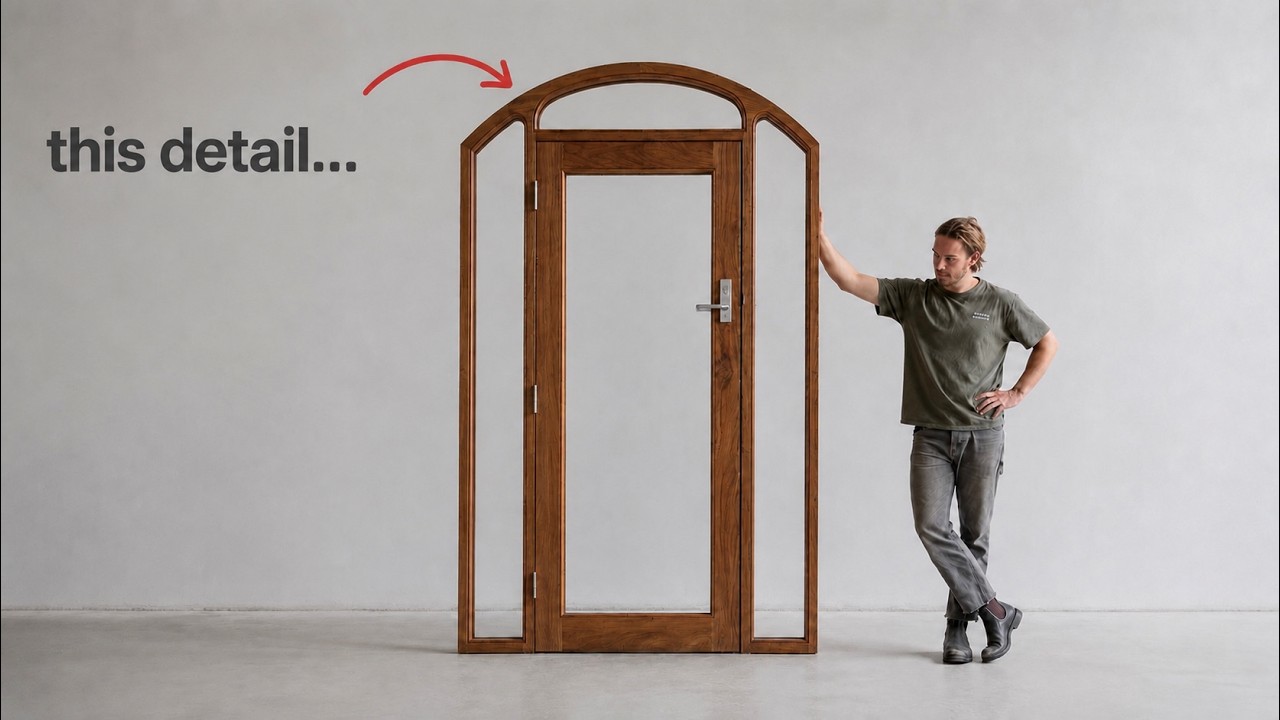
When it came to making this door, the brief was fairly straightforward. Make it big and make it lightweight. Okay.
00:34
Speaker A
One, the words big and lightweight really don't belong together when it comes to woodworking. Usually, the bigger a door gets, the heavier it gets and the more engineering you need to stop it from becoming a very expensive banana.
00:48
Speaker A
Two, the design brief was, let's be honest, a little bit boring. Okay, maybe boring is a bit harsh, but compared to some of the other doors I build, this one isn't exactly the most exciting thing I've ever designed.
01:02
Speaker A
So, solution. Let's bring a whole lot of the detail into some of the exposed edge joinery. But the joinery also needs to be functionally strong because this door is large, which takes me back to a pretty traditional joinery technique, a
01:18
Speaker A
through-hunched wedged tenon. Okay, that did probably sound like I just performed a spell. So, here's a diagram of what that actually is.
01:31
Speaker A
You'll notice this joint in a lot of older, larger doors, so it's clearly stood the test of time. And it's a really nice joint because mechanically it makes a lot of sense. The wedges lock everything together, making it
01:43
Speaker A
practically impossible for the joint to pull apart. The only drawback is I don't have a large chisel mortiser, which is how you traditionally make this joint.
01:53
Speaker A
So I started thinking, could I do this with the DF700? And that's where things started to get a little bit stupid.
02:15
Speaker A
As I jump into the milling process, you'll notice I'm using this new flattening sled and the jointer. So, this sled table was really reserved for longer lengths of wood and bananas. I've been using this flattening bit with carbide inserts and it's been really
02:31
Speaker A
good. Really good. The only drawback is this whole process makes a massive mess, which could probably be solved with some sort of bath and a vacuum duct underneath it.
02:44
Speaker A
But who can be bothered making that? I'll just sweep it. Thanks. I'd egotistically say that furniture makers and joiners have the tightest tolerances in the building trades. Look, where a carpenter might aim for 5 mm and a concreter is happy with 50,
03:22
Speaker A
we're out here fighting for the width of a shadow. And yet 90% of our existential dread stems from the exact same design flaw.
03:31
Speaker A
That little metal hook on the end of the tape measure has a bit of built-in play, and we just eyeball which side of the pencil line we're meant to cut.
03:40
Speaker A
Now, the good news is the timber I'm using isn't an exotic hardwood worth a monthly car payment, and I cut a few extra lengths just in case. Now, that safety net really boosts your confidence until reality hits.
03:55
Speaker A
You know that rule I've probably said before, measure twice, cut once, panic twice, go to the scrap bin, and realize your board is somehow still too short.
04:07
Speaker A
I had pretty much this exact same thing happen to me today while I was making some chairs.
04:13
Speaker A
I was in the zone working through about 48 mortise joints and you know that repetitive factory work where your brain just checks out around joint 37.
04:24
Speaker A
I finished, stacked the legs together, and froze. One of the joints looked completely out of place. Just totally wrong. I spent the next five agonizing minutes just staring at it and scanning the scrap bin trying to figure out how to salvage the
04:39
Speaker A
piece so I don't have to machine a whole new leg from scratch. Then I just, I flipped it over. I was just looking at it upside down. Five minutes of pure psychological terror because I stacked it upside down. So
04:53
Speaker A
next time you're planning a repair or placement to a perfectly good piece of timber, just flip it around to double-check.
05:04
Speaker A
All right, so let's talk about what we're actually here for. I'm basically marking out lines to mortise completely through the stile in this section. Then at these wider points on the outside of the stile, I'm going to cut the mortise
05:17
Speaker A
wider to accommodate the wedges. And to get this angle, I used a highly engineered accurate method of angling the machine to perform the cut.
05:36
Speaker A
Okay, seriously, it's actually not very complicated when you break it down. Here's the diagram again, and here's a real-life model of what's happening.
06:27
Speaker A
Okay, little tip for you guys. Cut your mortise first and cut your tenon second.
06:32
Speaker A
It is way easier to size your tenon to the mortise than to fluff it and try to do it in the inverse. And I am going to use possibly my favorite tool in the workshop to do this. This old '90s
06:45
Speaker A
spindle molder just eats wood. But let's be honest, it's probably only my favorite tool because it's so satisfying to use.
07:49
Speaker A
All right, we're going to jump over to the bandsaw to cut the size of the tenon and the hunch.
07:55
Speaker A
Yeah, you're probably thinking hunch? What's that? I've only ever heard that word when describing someone.
08:02
Speaker A
But this is the hunch. And let me tell you why it's important. Because this joint is going to be right at the end of the door stile. If we run a completely full through tenon and then wedge against the end grain, there's a pretty
08:17
Speaker A
good chance we're just going to blow the end grain out when we drive the wedges in.
08:22
Speaker A
And even if somehow we don't, we're actually relying on this tiny little bit of end grain to hold the joint tight.
08:29
Speaker A
And that's not exactly what I'd call structural engineering. So instead, we're going to cut a shallower section here. This gives us a much better area of long grain for the wedge to bear against rather than trying to wedge against what is essentially a
08:44
Speaker A
toothpick worth of end grain. And considering this door is pretty big, I'd rather not find out what happens when that toothpick snaps.
09:36
Speaker A
Now, you probably see type on this and type on that throughout YouTube woodworking all the time. All right. Can I share with you a highly toxic honey?
09:48
Speaker A
Now, this is actually a polyurethane glue, which is perfectly fine so long as you use gloves and you don't spray it directly into your mouth.
09:58
Speaker A
It's especially good for this because it has a longer open time, which for most of you means nothing. Basically, it means it's wet and squishy for longer, so you've got more time to make mistakes during a glue-up, which is exactly what
10:13
Speaker A
I need. It's also highly waterproof, and so it's ideal for external joinery, and you get this really satisfying foaming effect as it dries.
11:27
Speaker A
Heat. Heat. All right. Now, I'm going to make the boring bit of the door, which in the process of making it isn't actually boring. It's just really time-consuming.
12:11
Speaker A
If we look back to the brief, make it big and make it lightweight. Okay, we need this door to be lightweight. So, a normal vertical cladding isn't really going to work. So, instead, we're going to do a skin on the
12:26
Speaker A
door with some plywood backing it. And to do that, we need to make a lot of chunky veneers.
12:42
Speaker A
You know how modern cars basically drive themselves these days? I think there's even self-driving taxis in the US, which is crazy.
12:52
Speaker A
I see this power-fed bandsaw setup similarly, especially because when you take your hands off the wheel, it has a fit.
13:38
Speaker A
Now, this isn't really something you can do without a vacuum press, which is probably the most underwhelming thing you will ever purchase. You look at it and think, why is it that much money?
13:50
Speaker A
It's basically a big plastic bag. But unfortunately, it is almost essential for this job because we need a really solid even pressure across the entire door to bond these veneers to the plywood. And apparently the easiest way to achieve that is to recreate the
14:09
Speaker A
atmospheric pressure of outer space or something. Basically, the vacuum is worth a thousand clamps.
14:23
Speaker A
And as always, because I was in a bit of a rush to get this done, I didn't film myself putting this in and out of the vacuum bag multiple times, but you get the point. Took it out, put glue on t
14:34
Speaker A
door, put it back in, put more glue on the other side of the door, took it out, put it in, waited, did it again. Okay, you get it. But since I missed that, we are now skipped ahead to the finishing
14:46
Speaker A
process. And this is definitely not an ad for this product because check this out. I asked these guys if they could offer some sort of improved industry pricing because I spend so much money with them and they sent this back.
15:02
Speaker A
They basically just told me to piss off. Okay, did I actually invent a new woodworking joint? Honestly, probably not. But I haven't seen this exact combination before. A wedged horn tenon cut around a domino mortise using the DF700, which makes the process a whole
15:23
Speaker A
lot faster. That's the thing I like about woodworking. You can take something that's been done for hundreds of years, change one little thing, and suddenly you've got something completely different. Or you just reinvented something some guy was doing in 1723.
15:39
Speaker A
So that's it. The potentially new, potentially stolen, definitely slightly over complicated woodworking joint. Let me know if you've seen something similar before. And if you have, be gentle because I've actually got feelings.
16:03
Speaker A
Hello. Happy
Topics:woodworkingjoinerythrough-hunched wedged tenondoor makingvacuum presspolyurethane gluespindle molderwood joinery techniqueslightweight doorAolani Studios

Get More with the SozAI App

Transcribe recordings, audio files, and YouTube videos — with AI summaries, speaker detection, and unlimited transcriptions.

Or transcribe another YouTube video here →