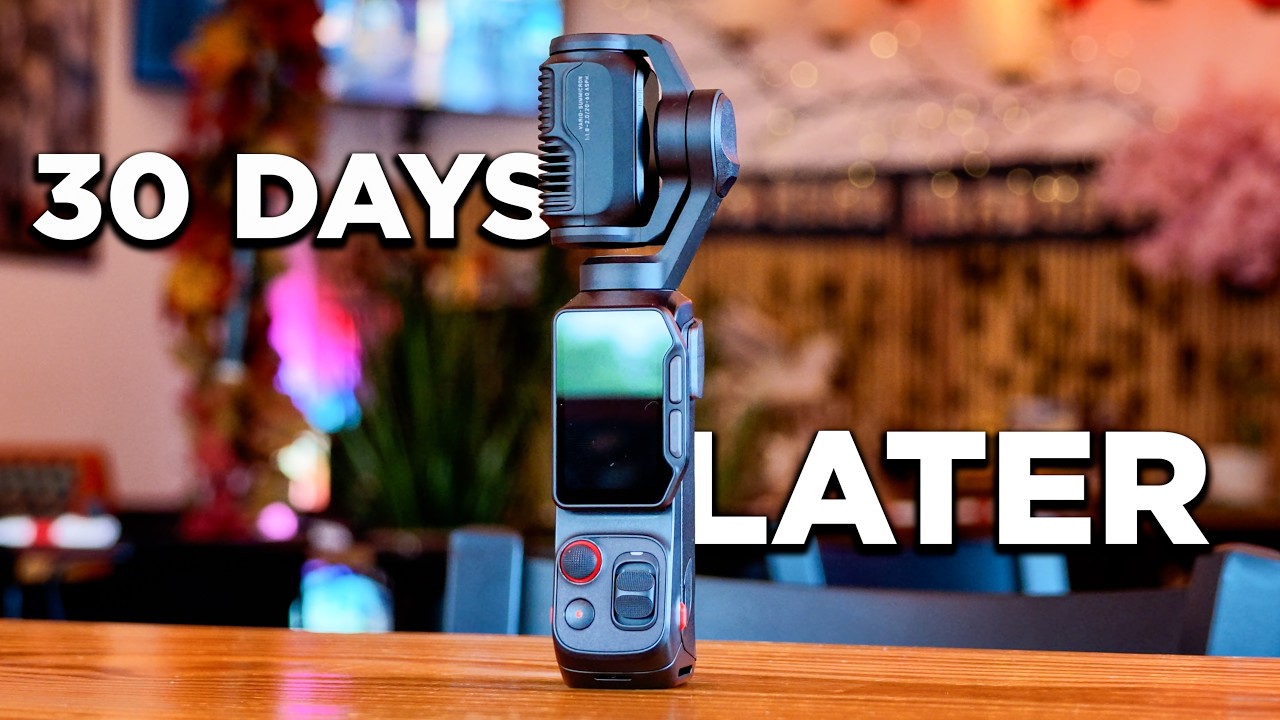
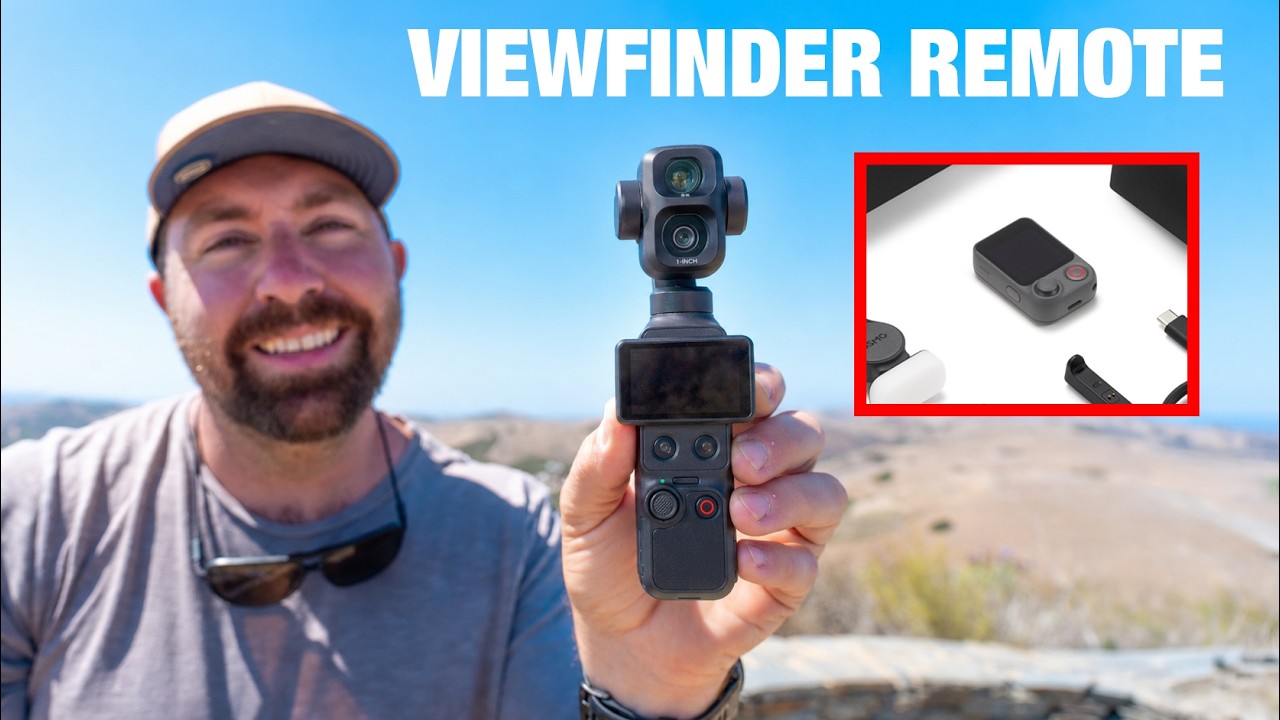
Brandon Li reviews DJI Osmo Pocket 4P, testing its cinematic capabilities through a short documentary and detailed feature analysis.
Key Takeaways
- DJI Osmo Pocket 4P is highly capable for cinematic filmmaking with excellent dynamic range and dual lenses.
- The camera’s internal storage and fast transfer speeds streamline professional workflows.
- Active Track 8.0 significantly enhances tracking shots, especially with the telephoto lens.
- Some operational inconveniences remain, such as manual lens mode switching and limited Active Track framing options.
- The Pocket 4P balances portability with professional features but is best used as a complementary camera.
What the video covers
- Brandon Li films a short documentary using the DJI Osmo Pocket 4P to test its suitability for filmmaking projects.
- The Pocket 4P offers up to 17 stops of dynamic range with Dlog-M shooting, allowing highlight and shadow recovery in post.
- It features two lenses: a 20mm wide-angle and a 60mm telephoto, enabling cinematic defocused backgrounds.
- Slow motion supports up to 4K 240fps but only with the 1X lens and horizontal orientation without log recording.
- The camera includes 103GB internal storage and ultra-fast data transfer speeds up to 800 MB/s for efficient workflow.
- Active Track 8.0 improves automatic subject tracking, enabling shots difficult to achieve manually, especially with the telephoto lens.
- Limitations include manual switching between lenses for Dlog-M mode and no framing offset in Active Track.
- The gimbal is lighter and portable but not the best in stabilization compared to full-size cameras.
- No overheating issues with the camera body, though occasional gimbal overheating warnings occurred in heat.
- The Pocket 4P is versatile for POV, high-angle, and self-filming but realistically complements rather than replaces larger cameras.
Chapters
- 00:00Introduction and Filmmaking Approach
- 00:59Short Documentary: Salvaggia's Story
- 01:52Filmmaking Experience and Emotional Connection
- 03:12Image Quality and Dynamic Range Features
- 04:02Video Modes and Slow Motion Capabilities
- 04:50Dual Lens System and Cinematic Benefits
- 05:41Digital Zoom and Image Quality Limitations
- 06:32Internal Storage and Data Transfer Speed
- 07:20Active Track 8.0 and Tracking Performance
- 08:08Limitations of Active Track and Framing
Full Transcript — Download SRT & Markdown
Speaker A
Hey, welcome back. I'm Brandon Lee, and this is going to be my video all about DJI's new top-of-the-line pocket camera, the Osmo Pocket 4P, which I'm actually using to film myself right now. So, you've probably already heard a lot of
Speaker A
hype about this camera. You've probably already watched a few videos about it, but I wanted to take a very specific approach with my video, which is to test if it can be used for actual filmmaking projects. [music] So, I went out and I
Speaker A
made a short documentary, and you're about to see that short, and then after the short film, I will give you my review. And just so you know, this video is sponsored by DJI. That's how I was able to get early access camera, but I
Speaker A
made sure they let me give my full thoughts about the Pocket 4P, both [music] good and bad. So, let's watch the short film, and then I'll be back with the review.
Speaker A
My name is Selvaggia. [music] And this is Calcione, my family's castle in Tuscany. My family has lived here [music] for over 500 years.
Speaker A
And now, it's my responsibility [music] to help take care of it. And the animals have always been part of my life. It is a beautiful chaos that brings me so [music] much joy.
Speaker A
With horses, I have the deepest connection. You cannot pretend with them. They feel everything.
Speaker A
[music] Why? Why? Gigi is my trainer. He's helping me reach my ultimate goal, riding the Palio di Siena, Italy's oldest horse [music] race.
Speaker A
The Palio, it's not just a race. It is emotional, brutal, and traditionally, it has been for men.
Speaker A
[music] So far, there's only been one female jockey in history. And someday, I want to be the second.
Speaker A
[music] [music] When I ride, [music] I feel I'm chasing something even more important. That feeling when everything disappears [music] for a moment.
Speaker A
And I feel completely alive. [music] My future will be the next chapter of a long story.
Speaker A
And no matter where the story goes, I am ready. [music] Okay, thanks for watching this short film. Now, I'm going to talk to you about what's new with the Pocket 4K, and we're going to start with the image
Speaker A
[music] quality. So, the first thing I noticed shooting with this camera is that it has a lot more dynamic range [music] than any other Pocket camera that I've used before, and it's not an exaggeration. It has up to 17 stops of
Speaker A
advertised dynamic range, [music] and I found it to be close to that in practice when I was filming outdoors in high-contrast scenarios. The Pocket 4K uses Low Light technology, which is a way of storing the excess brightness data [music]
Speaker A
and then bringing it back and allowing you to recover it in post. So, what that means [music] is you can recover your highlights and your shadows even in extremely contrasty scenarios. But, you have to be shooting in Dlog-M to get
Speaker A
this dynamic range. In this example shot, Salvaggio was in the shadows, and the top of the building was getting direct sunlight. [music] I was able to expose for Salvaggio and then recover the highlights in color grading. [music] There's also a new portrait color
Speaker A
science that DJI's using here to improve the skin [music] tones. While this is, of course, subjective, I do think the skin overall looks quite nice in my footage. I especially liked the lighting on Salvaggio's face here in this archive
Speaker A
scene. She had a beautiful edge light from the window and some more bounce light from the books and from the scrolls around her.
Speaker A
And in the swimming scene, the reflected sunlight was rendered beautifully on both their faces with natural warmth [music] that didn't feel over processed.
Speaker A
The 4P shoots up to 4K 60 frames per second in normal video mode and up to 4K 240 frames per second in slow motion [music] mode. But slow motion mode only supports the 1X lens and it's only horizontal and it doesn't shoot [music]
Speaker A
log. But if you really want vertical super slow mo, you can just hold the camera sideways.
Speaker A
The other obvious new thing about the Pocket 4P is that it now has two lenses instead of a single lens on the Pocket 4 and all the previous Pocket cameras. You get a 20 mm wide lens at F2.0 and a 60
Speaker A
mm portrait lens at F1.8. That also makes it a bit bigger, a bit bulkier. It doesn't fit in your pocket quite as easily and that's one thing you should be aware of. But the trade-off I think is totally worth it because now you can
Speaker A
have defocused backgrounds on your telephoto shots. I'm shooting myself right now with the 3X lens so you're seeing what that looks like behind me.
Speaker A
And as I get closer to the camera, you can see that the background defocuses even more. Now you can shoot scenes that feel more like a real movie because we're not stuck on that wide focal length the entire time. There's one
Speaker A
limitation of these two lenses that you really need to be aware of which is that only the wide-angle lens shoots Dlog-M.
Speaker A
The telephoto lens, the 60 mm, does not shoot Dlog-M. And that wouldn't be so annoying to me if it was an automatic switch between the log modes when I switch lenses. But what you actually have to do is, in order to switch
Speaker A
lenses, if you're shooting Dlog-M on the wide lens, you need to go into the menu, switch back to Dlog-M, and then switch to the 60 mm lens. And then you have to reverse that process if you want to go
Speaker A
back to the wide lens with Dlog-M again. So it adds extra steps and probably in future firmware it will become an automatic switch, but as of the time of this review it was all manual and I just thought you should be aware [music] of
Speaker A
that. There is also a digital zoom on the Pocket 4P which lets you zoom way way in, but I really recommend ever using that because the image degrades pretty quickly, especially if you're shooting in lower light. So, if you
Speaker A
stick to the two optical lenses, the 20 and the 60, you'll get great image quality. But, if you try to zoom in between them or zoom beyond 60, then you will see an immediate loss in image quality.
Speaker A
[music] One thing I love about the Pocket 4P is that it has internal storage. It has 103 GB of internal memory, which means that you can shoot for one or two heavy days shooting log 4K without having to
Speaker A
download your footage or format. Or, I would say you could shoot up to a week or two of light shooting and not have to worry about downloading or formatting.
Speaker A
And another great feature I want to mention is when you do your downloads or your backups, this camera is ultra fast.
Speaker A
It transfers up to 800 MB per second, which means that you can download a whole day's footage in less than a minute. Sometimes it only took a few seconds for me to download everything I had shot. So, basically, the internal
Speaker A
storage plus the ultra fast USB just made for a really easy and fast workflow.
Speaker A
In my filmmaking, I've never been a huge fan of automatic tracking. I've always felt like I could just do it better myself. However, with the new Active Track 8.0 on the Pocket 4P, there were some scenarios where I was able to get
Speaker A
shots that I could never have gotten otherwise. For instance, I used the 60 mm lens [music] with tracking for this orbit shot of GG the trainer as he gave instructions to Salvaggia. Without Active Track, there would have been no
Speaker A
way for me to move this fast around him and maintain perfect framing, especially using the 60 mm lens. And since he was wearing a DJI mic, I was able to even record his dialogue at the same time.
Speaker A
For shots of Salvaggia riding through the vineyards, I handed off the camera to her friend. [music] I didn't give her any real training with the camera. I just asked her to tap on the screen on Salvaggia's face and then ride alongside
Speaker A
her. And she was able to get this perfectly tracked shot even at high speed. Next, they switched roles and then the camera went to Salvaggia and [music] Salvaggia tapped on her friend's face and got this tracking shot. So,
Speaker A
they were both able to get perfectly framed tracking shots of each other [music] even while galloping on a horse.
Speaker A
Now, there is a limitation that you need to know about with the ActiveTrack, which is that currently it doesn't support framing [
Speaker A
no way to move them to one side of the frame so that it continues to track with them staying [music] offset from the center. To me, that's really important being able to offset the framing while tracking so that I can do more creative
Speaker A
framing in my compositions and [music] not just always have a center-locked subject. So, I'm hoping that DJI updates the firmware and adds framing offset sometime in the near future.
Speaker A
The Pocket 4 P has multiple autofocus modes. It defaults to the continuous mode, but within continuous autofocus, there are a few different sub settings.
Speaker A
The default setting prioritizes faces, which means that my face will continue to stay in focus even if I put the camera [music] closer to the lens. Then, there's the product showcase mode, which will prioritize whatever object is closest to
Speaker A
the camera. So, this is of course for if you're showing off some kind of a product in a video and then you want it to go back to your face when you lower the product. So, you raise up the
Speaker A
product, focuses on that, lower it, focuses back on the face. Then, there's subject lock tracking, which honestly I never used, but it's supposed to lock onto whatever subject is nearest to the center of your frame and then continue
Speaker A
[music] to track them as they move. And finally, there's registered subject tracking so [music] you can register a face in advance and then it will continue to track them even if they're surrounded by other people. So, that's great for filming people in crowds when
Speaker A
you want to keep your subject in focus no matter [music] who else comes in the frame. Single focus mode just focuses once when you tap on the subject and then it holds that focus after that. I use this mode a lot when I was shooting
Speaker A
in controlled situations. For the cinematic look, sometimes manual focus looks better than auto. Okay, I want to take a second here to talk about why gimbals are so important on pocket cameras because a lot of people may think, "Well, I have
Speaker A
stabilization on my phone or on my action camera, so why do I need a mechanical stabilizer? Doesn't that just add bulk? Well, here's the thing. The stabilization of phones and action cameras and cameras like that requires a faster shutter speed in order [music] to
Speaker A
work, which means that you won't get that motion blur that you're seeing right now that makes the shot look more natural and more cinematic. So, you have to sacrifice that motion blur in order to get a steady image. And also, the
Speaker A
stabilization won't work as well in low light because [music] in low light, you can't use a fast shutter. Otherwise, the image will be too dark. So, with that said, here's my opinion of the gimbal on the Pocket [music] 4P.
Speaker A
I think that it's perfectly fine for vlogging. It looks great if you're just filming yourself and walking around.
Speaker A
[music] However, you might find that it's a little bit more jittery and there's a little bit more pogo bounce than [music] you would want because it's a tiny camera and there's no gravity, there's no weight to counteract those
Speaker A
little extra movements. [music] So, I had to move extra carefully with this gimbal in order to get smooth shots and I would recommend even maybe looking into [music] a fourth axis stabilizer which some third-parties like SmallRig sell if you want to get perfectly
Speaker A
gliding smooth shots with the Pocket 4P. But also, because of the extremely small size, it was easy [music] to put this on an extension pole and hold it up high and get angles that would be really difficult with a full-size gimbal and a
Speaker A
full-size camera. So, it's a trade-off. It's not the world's [music] best gimbal, but it's also a much lighter package which makes it a lot easier to use for a variety of applications.
Speaker A
[music] Okay, let's quickly talk about battery life. I never had to recharge the Pocket 4P [music] even when I was shooting 8 hours plus with it. However, I almost always used this extended battery grip on it. So, with the extended battery
Speaker A
grip plus the internal battery of the 4P, I was able to get a good long day out of it and I didn't have to stop and charge. However, if you want to use a smaller package, you don't want to use
Speaker A
that extended grip, then I would expect that you'd probably get about a half day of shooting. [music] In other words, like 2 hours of continuous shooting. But if you're going to do any serious shooting with a Pocket 4P, I do
Speaker A
recommend getting the external grip or maybe even getting two of these. [music] And while we're on the topic of long shoot days, I will address overheating.
Speaker A
I did not experience any overheating of the actual camera. However, [music] one time while I was shooting in the heat in the middle of the day, I did see a gimbal overheating warning.
Speaker A
[music] The camera just said gimbal overheating, but it didn't shut down, it didn't stop me from using anything, it just warned me about it. So, I don't know what that means. I hopefully [music] didn't damage the gimbal. It worked just fine the next
Speaker A
day, but there was that warning. So, probably if you shoot in extreme high temperatures for long periods of time, you [music] will have to take a break because of the gimbal.
Speaker A
One thing I found a bit frustrating about the Pocket 4P is the touchscreen. [music] Because of the complexity of it, and I was trying to shoot fast, and I had no physical controls [music] to do my manual settings. Basically, if
Speaker A
you want to shoot manually, to access your settings, you have to swipe, and then you have to tap, and then you have to do your adjustments by scrolling, which [music] to me feels really imprecise. But I guess that comes
Speaker A
with the territory because it is a pocket camera. Now, you can also change the settings on the Mimo app, but the problem there is that it takes some time to connect it. [music] So, every time I would turn on the camera, I would have
Speaker A
to reconnect to the Mimo app, which would take up to a minute, maybe 2 minutes even, and then I was able to access my settings. That's not something I expect to get fixed anytime soon. It's just part of the design of this pocket
Speaker A
camera and every other pocket camera out there, but I would like for DJI to find some way to access manual controls a bit faster.
Speaker A
Here's some footage from a festival to show the low-light performance of the Pocket 4P. I was able to get a solid image on these dimly lit medieval streets, [music] both with the 20 mm lens and the 60 mm lens. The advantage
Speaker A
of using a pocket camera in low light instead of using a phone is that you can do camera movements with the appropriate shutter speed, 180° shutter, without causing stabilization artifacts like you're seeing in the BTS footage, which was shot on an Osmo Nano. I shot all the
Speaker A
slow-light footage in D-Log or D-Log 2, depending on the lens I was using, and I didn't do any noise reduction. If you want in-camera noise reduction, you can use the special low-light mode, which will give you a clean image, but I
Speaker A
didn't test that because if I want to reduce the noise, I always do it myself in post. [music] Next, let's see how the 4P looks at dusk.
Speaker A
The sun set about half an hour ago, [music] so it's pretty dark around me, and I'm still shooting at base ISO with the 3X lens, and I think it looks beautiful. I would say that the low-light performance of this camera [music] is probably much
Speaker A
better than you'd expect from a phone, not quite as good as an APS-C or a full-frame camera, but it's definitely good enough for shooting in moderate low-light environments like after sunset.
Speaker A
Okay, final thoughts. Do I recommend the Pocket 4P for vlogging? [music] Yes, absolutely. I'm going to keep using it all the time for casual shooting and for BTS. Do I recommend it for filmmaking? Yes, as a specialty camera.
Speaker A
I'll use it for high angles on extension poles, [music] POV shots, horse and vehicle shots, and whenever I need to let the talent film themselves. The Pocket 4P is very capable as an A camera as well, but realistically, it's never
Speaker A
going to totally replace my full-frame camera and my interchangeable lenses. This is just the camera that I'm going to keep all the time in my bag so I can get an extra angle or shoot some BTS.
Speaker A
It's definitely [music] the best-looking pocket camera out there, so if that's your priority, this is the one to get.
Speaker A
All right, that's it. I'm out of here. Thank you so much for watching. I'm Brandon Lee. Links will be in the description, and I will see you next time.
Topics:DJI Osmo Pocket 4Pcinematic pocket cameraBrandon Li reviewdynamic rangeDlog-Mdual lensesActive Track 8.04K slow motioninternal storagefilmmaking camera