Skip to content

How You Could Be Making 1:7 RR in 5 Hours

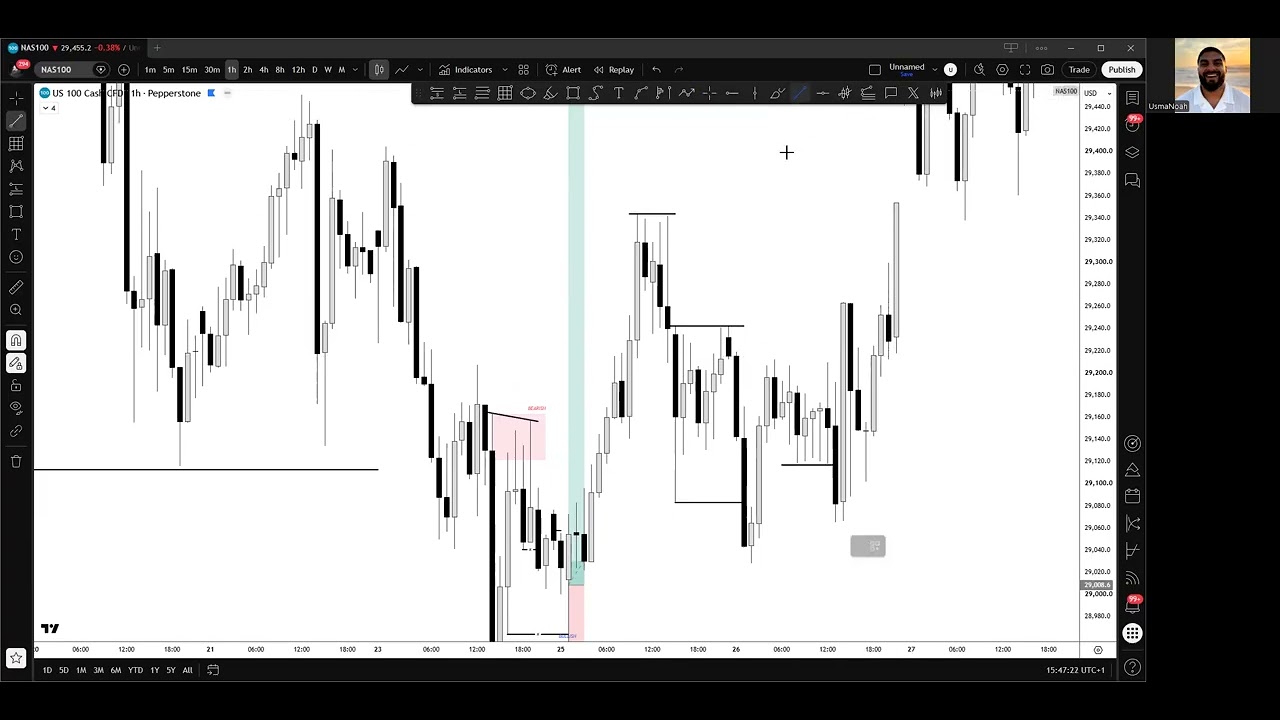
Learn how to achieve a 1:7 risk-reward ratio in 5 hours trading NAS using liquidity, order blocks, and divergence strategies.

Key Takeaways

  • Start analysis from higher timeframes (daily and weekly) to understand market context.
  • Use liquidity, FVGs, BPR, and order blocks to identify potential trade setups.
  • Confirm entries with divergence on lower timeframes for higher accuracy.
  • Aligning multiple timeframes helps in finding precise entry points and better risk-reward setups.
  • A 1:7 risk-reward ratio is possible with disciplined application of this strategy.

What the video covers

  • The video explains a trading strategy focused on NAS (Nasdaq) using daily and weekly timeframes as the foundation.
  • Key concepts include identifying liquidity, Fair Value Gaps (FVGs), Break of Structure (BPR), and order blocks.
  • The strategy involves aligning higher timeframes with lower timeframes (1, 5, 15 minutes) to find precise entry points.
  • Divergence on multiple timeframes (1 minute, 5 minutes, 1 hour) is used to confirm trade entries.
  • The presenter emphasizes the importance of understanding liquidity zones to predict market reactions.
  • A risk-reward ratio of 1:7 or even 1:6 is achievable by following this method.
  • The video also briefly reviews EuroUSD to show the strategy's applicability to forex trading.
  • Volume considerations are discussed, noting higher volume on higher timeframe liquidity zones.
  • The presenter highlights the use of a 'springboard' or booster concept for big moves after liquidity is taken.
  • The video concludes with a promise of a market review and further explanations in upcoming sessions.

Answers

Questions about this video

What is the main trading strategy discussed in the video?

The video discusses a trading strategy based on identifying liquidity zones, Fair Value Gaps, order blocks, and divergence across multiple timeframes to achieve a high risk-reward ratio on NAS trading.

How does the presenter suggest finding precise trade entries?

By aligning higher timeframe analysis with lower timeframe charts (1, 5, 15 minutes) and confirming entries using divergence and liquidity concepts, traders can find precise entry points.

Can this strategy be applied to markets other than NAS?

Yes, the presenter briefly reviews EuroUSD forex trading to demonstrate that the same principles of liquidity, order blocks, and divergence can be applied to other markets.

Full Transcript — Download SRT & Markdown

00:02
Speaker A
Good morning, good afternoon, hello, and all the rest. So, I wanted to talk about NAS today because NAS by was to the tea to the tea. This was perfect if today you were trading my strategy, and I'm going to explain from A to Z why. So,
00:28
Speaker A
first of all everything start from the daily and the weekly. Remember guys everything start from the daily and the weekly. When you understand the where you understand the when and you understand the now. So weekly what do we
00:45
Speaker A
First of all, everything starts from the daily and the weekly. Remember, guys, everything starts from the daily and the weekly. When you understand the where, you understand the when, and you understand the now. So weekly, what do we
01:04
Speaker A
You see a rest of FVGs which is fine. So from there when the market opened here we see that the market market is going down. Take the liquidity and look at it. What happened here? We see the displacement here. And what do
01:27
Speaker A
have? Everything started from there because look at this. If I trace this line, you can see that we have two equals at the bottom. What do we have below those two equals? A rest of FVG?
01:43
Speaker A
happened in the five minutes. Uh yeah, five or even one. I think one was better but yeah. Yeah, one was better but it's fine. We can just start with a five.
01:54
Speaker A
You see a rest of FVGs, which is fine. So from there, when the market opened here, we see that the market is going down. Take the liquidity and look at it. What happened here? We see the displacement here. And what do
02:13
Speaker A
a BPR or FVG or an order block. So what do we have here? A beautiful BPR.
02:25
Speaker A
we see? What do we see? We see a BPR. So based on this BPR, which is plan A, and the all the block at the bottom, which is plan B, this is where now you go to the five minutes. And look at what
02:40
Speaker A
Uh yeah, divergence in five minute. Boom. But look at this. Perfect. And even in one hour.
02:52
Speaker A
happened in the five minutes. Uh yeah, five or even one. I think one was better, but yeah. Yeah, one was better, but it's fine. We can just start with a five.
03:12
Speaker A
and this right now will be your one to seven risky reward. That's it. You see guys, when you understand the liquidity, you understand everything behind. So I'm going to go through it again daily.
03:25
Speaker A
Look at what happened in five minutes. Boom. We take this liquidity. So the question now is to understand what do we have here? What do we have here to have this type of reaction and after jump? And like I said previously, there is always
03:43
Speaker A
how many uh points in here we've done like around 400 points so if let's say you have this exact same setup this exact same thing let's say it's not daily here it says 1 minute you may going to have 20 tick
04:01
Speaker A
a BPR or FVG or an order block. So what do we have here? A beautiful BPR.
04:16
Speaker A
or 400 pips now we are aligning the bigger time frame with a bigger picture but we are taking like a microscope to find the entry. Okay. So, find the liquidity in the higher time frame. When it's done, you go to the 4 hours and you
04:31
Speaker A
A beautiful BPR. You see beautiful BPR. We have also divergence. Look at this divergence in one minute. Divergence in five minutes.
04:47
Speaker A
The only thing is this order block but that's it. Is that is that the No.
04:56
Speaker A
Uh yeah, divergence in five minutes. Boom. But look at this. Perfect. And even in one hour.
05:10
Speaker A
Sorry. Okay. Okay. Okay. So, so based on the order block, we have the divergence from here to here.
05:24
Speaker A
Divergence in one hour. This could be your entry. This could be the perfect trade and start Monday as the best way as possible. You could be taking the trade from here. We have an FVG, BPR, order block, stop loss below,
05:43
Speaker A
also liquidity in here. Look at this trend line of liquidity in here. And now for some reason at 10:25 the market say no. Now we start to wake up.
06:01
Speaker A
and this right now will be your one to seven risk-reward. That's it. You see, guys, when you understand the liquidity, you understand everything behind. So I'm going to go through it again daily.
06:08
Speaker A
So that's why the market decided to react from there which is after this created this FVG started from there which is after this we have uh an FVG that is aligned with the structure. So that's why after this boom we have an
06:23
Speaker A
Remember, the more you get the liquidity on a higher time frame, the more the volume will get better because whenever you have those types of liquidity in one minute, you're going to have like, uh, a low volume. When I say low volume, I mean like how many
06:45
Speaker A
crazy. However, look at the springboard that I love to talk here. the springboard uh which is for me something that um I've I've talking on the PFT podcast the booster and from the booster we've got this higher higher big move and this is
07:04
Speaker A
how many, uh, points in here we've done, like around 400 points. So if, let's say, you have this exact same setup, this exact same thing, let's say it's not daily here, it says 1 minute, you may going to have 20 tick
07:14
Speaker A
For me that was like clean and that could be like a 1 to6 1 to7 riskreward on NAS directly. Um, let me also review quickly EuroUSD because um on EuroUSD we also got something quite interesting because look at this.
07:44
Speaker A
or for those who trade forex, 20 pips, okay? But if, let's say, you're doing this on a daily and you, after this, you couple this with the one minute, five minutes time frame, this is where you can get 400 tick
08:00
Speaker A
However, we can see that there is a bit of liquidity just here. And that's what the market Oh, the market didn't took this.
08:16
Speaker A
or 400 pips. Now we are aligning the bigger time frame with a bigger picture, but we are taking like a microscope to find the entry. Okay. So, find the liquidity in the higher time frame. When it's done, you go to the 4 hours and you
08:26
Speaker A
Okay, so it means that the we're going to go more down. It means that we're going to go more down, guys. Like look at this. We have two equals. I thought we took this lower. Actually, we didn't. Okay, so
08:37
Speaker A
try to understand better. In 4 hours, there is nothing more to understand here. But do we have something in one hour that can help us understand better?
08:52
Speaker A
What going to happen here? Um do we have another? Whoa. Beautiful. Wow. That looks very nice. That looks very clean. This one looks very clean. Okay. Okay. Okay.
09:09
Speaker A
The only thing is this order block, but that's it. Is that, is that the—No.
09:30
Speaker A
MVG with order block with aligned institutional level the 4,270. This is clean. So the question that we we need to know now is we have a divergence.
09:43
Speaker A
So apparently it goes below. So below that, it looks like there is something below this. No. Okay. So this is, so, so basically it's the order block.
09:58
Speaker A
to the five minute like I want to see a divergence like for example from here to here. That's the divergence that I want to see. So let me trace in advance from here to here.
10:10
Speaker A
Sorry. Okay. Okay. Okay. So, so based on the order block, we have the divergence from here to here.
10:25
Speaker A
We have look at this. We have the displacement. In the displacement we've created an order block with an FVG. So let's highlight only the FVG that is here. The market just go back inside. Boom.
10:41
Speaker A
Amazing. When the market tapped for the first time, look at the D. Look, look at the displacement here. And if we take, um, a microscope, look at this. Look at how the displacement is. And look at how this is so algorithmic. Look at this
11:02
Speaker A
Second TP. This one. And uh Oh, this one is nice. And this will be the last one in here.
11:17
Speaker A
also liquidity in here. Look at this trend line of liquidity in here. And now for some reason at 10:25, the market says no. Now we start to wake up.
11:31
Speaker A
Um, so yeah, so that was just for today price action. Don't worry, tomorrow morning I will be doing like a market review. Um, hopefully I'm not going to get sick.
11:44
Speaker A
So in the one minute, we were, we were supposed to have like, yeah, there's BPR in here, but there is another one here.
11:59
Speaker A
right now, I'm a bit uh I'm a bit in uh I'm a bit uh wondering wondering what is going on because um I was not planning this right now. It's a bit annoying right now. So, let's see. Let's see.
12:13
Speaker A
So that's why the market decided to react from there, which is after this created this FVG started from there, which is after this we have, uh, an FVG that is aligned with the structure. So that's why after this boom, we have an
12:19
Speaker A
Wednesday I will be streaming New York Open 2 PM British Time. New York Open Wednesday. Bye-bye.
Topics:Nasdaq tradingliquidityFair Value Gaporder blockBreak of Structuredivergencerisk reward ratioforex tradingEuroUSDprice action

Get More with the SozAI App

Transcribe recordings, audio files, and YouTube videos — with AI summaries, speaker detection, and unlimited transcriptions.

Or transcribe another YouTube video here →