Lecture on public key (asymmetric) encryption: how it differs from symmetric keys, the role of public/private keys, confidentiality, authentication, and algorithms like RSA, Diffie-Hellman, and ECC.
Key Takeaways
- Public key encryption solves the key distribution problem of symmetric encryption by using a key pair.
- Encrypt with the recipient's public key for confidentiality; sign with your private key for authentication.
- Symmetric encryption remains faster and is used for bulk data, while public key encryption handles key exchange.
- Public keys must be verified through a trusted protocol to ensure they belong to the claimed party.
What the video covers
- Introduces public key encryption as a solution to the key distribution problem of symmetric (secret key) encryption.
- Explains that public key encryption uses two mathematically related keys: a public key shared openly and a private key kept secret.
- Describes confidentiality: encrypting with the recipient's public key ensures only the private key holder can decrypt.
- Describes authentication and digital signatures: signing with the private key and verifying with the public key proves the sender's identity and prevents denial.
- Compares symmetric and public key encryption: symmetric is much faster and suited to large messages, while public key solves key exchange.
- Notes that public key encryption does not make symmetric encryption obsolete; the two are typically used together.
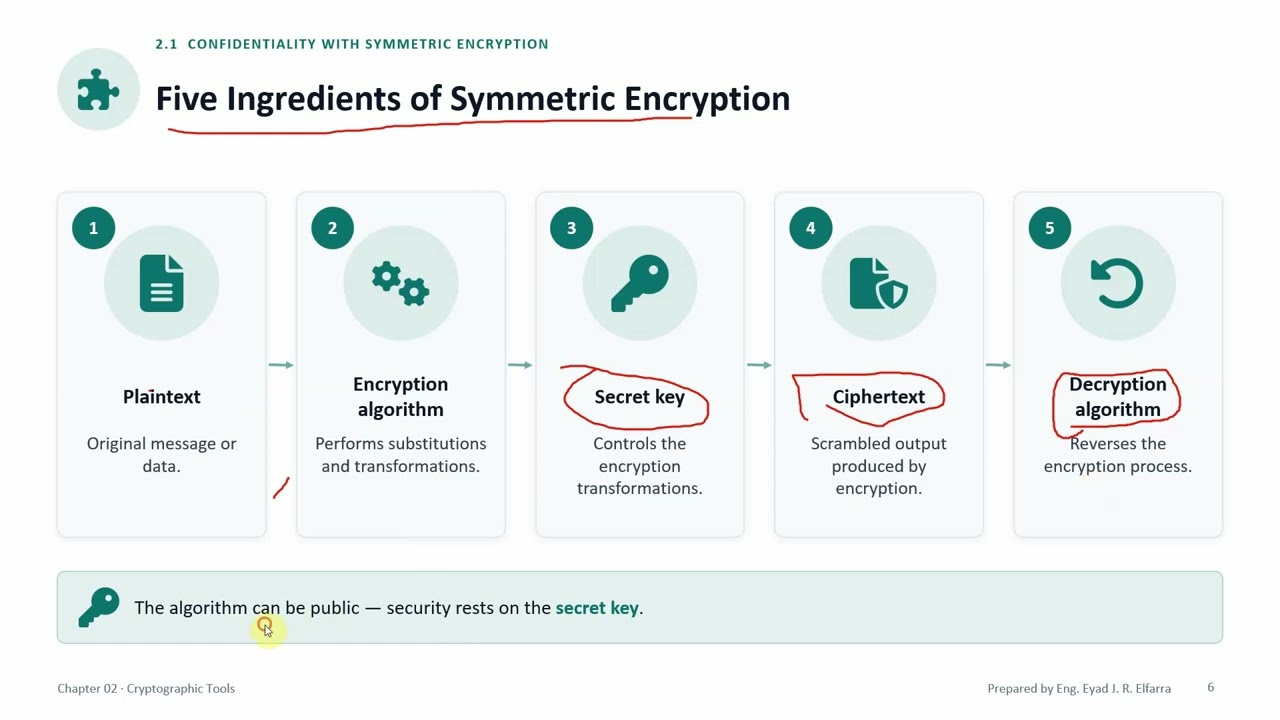
- Outlines the six components of public key encryption: plaintext, encryption algorithm, public key, private key, decryption algorithm, and ciphertext.
- Mentions key algorithms: Diffie-Hellman (first published 1976), RSA, ECC, and DSS, with symmetric examples AES, DES, and Triple DES.
- Discusses public key distribution, stressing that a protocol or trusted mechanism is needed to verify a public key really belongs to its claimed owner.
- Covers efficiency tradeoffs: ECC needs fewer computational resources and storage than RSA for comparable security.
Chapters
- 00:00Introduction and Lecture Overview
- 02:00Limitations of Symmetric Key Encryption
- 04:00Public Key Encryption Basics and History
- 08:00Confidentiality, Authentication, and Digital Signatures
- 12:00Symmetric vs. Public Key Encryption Comparison
- 16:00Components of Public Key Encryption
- 22:00Public Key Distribution and Trust
- 30:00Algorithms: RSA, Diffie-Hellman, and ECC
Full Transcript — Download SRT & Markdown
Speaker A
In the name of God, the Most Gracious, the Most Merciful. Welcome everyone to a new lecture. In our computer and network security course. We will discuss in this lecture, God willing.
Speaker A
This is the second or third lecture of the second chapter. We will talk about public key encryption. Alright. We will discuss public key encryption. What is a public key? Why do we need a public key? We will talk about confidentiality
Speaker A
and authentication. How do they relate to keys and encryption? We will talk about algorithms like RSA. And like Diffie-Hellman, DSS, and ECC. We will discuss some misconceptions related to the encryption process. Let's talk about. Public key encryption. We talked
Speaker A
in the previous section about symmetric key encryption. In symmetric key, we were talking about encryption with one key held by both parties. What is encrypted at the first party's end using the key, which is the private key . Or what is called the secret key. Was
Speaker A
decrypted at the other end using whom? The same key. Well, this has a problem, that I. This single key, how do I get it to both parties? This has a problem, alright. If the key is discovered by one of the parties, or if a group of
Speaker A
parties are exchanging the same key, then effectively, all the data I am sending becomes exposed to the eavesdroppers standing outside. Well. I want to solve this so that I can encrypt data and send it to recipients while keeping the decryption key
Speaker A
unknown to the public. The decryption key should be for me alone. And at the same time, I want people to encrypt data and send it to me. So we have a term which is. It is public encryption, alright? Sometimes called asymmetric
Speaker A
encryption. What is meant by asymmetric encryption? It is an asymmetric encryption process. I have one key. A key I encrypt with. And another key I decrypt with. The first appearance of this term was with the Diffie-Hellman algorithm. In the year 1976, alright.
Speaker A
After that, it developed. We got algorithms like RSA. And like ECC. Also built on what. On public encryption, it says. It says that generally, public encryption is built on pure mathematical equations and operations.
Speaker A
Alright. So, in public key, I use two keys. A public key, and another key I call the private key. Alright. So, what are the major applications for it? It supports confidentiality, meaning as long as I encrypt. The data. And the
Speaker A
eavesdropper standing in the middle of the path. Or the hacker is unable to see or understand the data. With that, I also achieved what. Confidentiality.
Speaker A
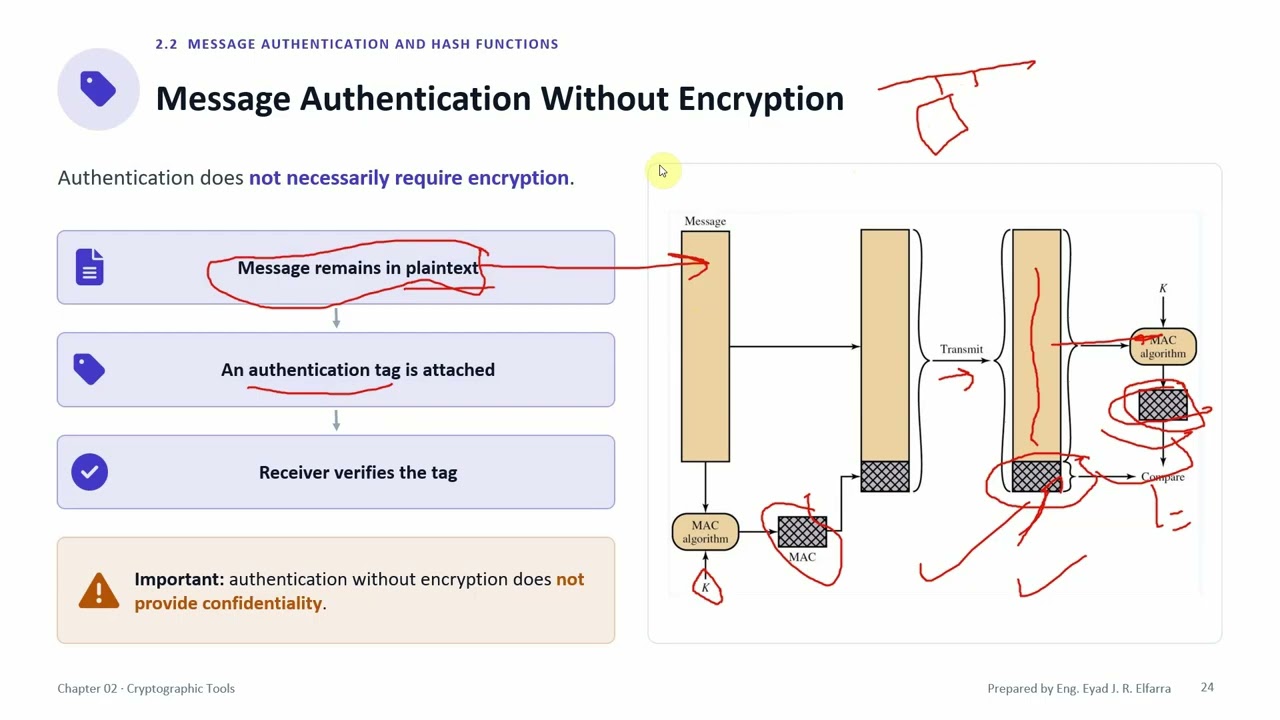
Well, I can perform verification, or something I call authentication. I can say that this data really arrived from the sender, whoever sent it to me. We will see how. Therefore, I need to perform authentication. Two things we want, we call it digital signature. I
Speaker A
want to ensure the data I received is correct. From the correct person. And the person who performed the data sending process will not be able to deny it. So we have here. Something called digital signatures, which is a
Speaker A
digital signature. We will also talk about something called key distribution . We mentioned the symmetric key, remember it from the previous chapter or section? If I want to transfer a key from person to another, how do I transfer the key? Public key encryption
Speaker A
provided us with the solution. As we will see shortly in this section or in the next one. As we said, public key encryption relies mainly on mathematical equations. Exactly, and not just on operations related to bit patterns. As we had in symmetric key.
Speaker A
Okay, what is the difference between the two? In symmetric, we had one key, which is called the secret key. However , in public key, we have two keys. One is called public, and the second is called private key. Exactly. In
Speaker A
symmetric key, the key I encrypt with is the same key I decrypt with, whereas in. In public key encryption, I encrypt with the private and decrypt with the public key. Or I perform verification, or I do encryption with the private and
Speaker A
perform verification with the public. In the case of encryption and decryption, I will use: encrypt with the public and decrypt with the private . In the case where I am doing a signature or verification, I. Will encrypt with the private key to confirm
Speaker A
that this actually belongs to the person who performed the encryption using their own public key. Okay.
Speaker A
Regarding symmetric encryption, the key transfer process must be done in a secure and guaranteed way because if the key is exposed, our entire encryption process becomes useless, whereas in the case of public key, only the private key is what concerns me.
Speaker A
Which is forbidden to distribute? And it is forbidden to be disclosed to others. While the public key will be available to others. Exactly. Regarding the encryption process, it tells me that symmetric encryption is often much faster than what? Than public, because
Speaker A
the public key has high and extensive computational processes. Examples of symmetric, we said AES which is the Advanced Encryption Standard, or we have DES Data Encryption Standard, or Triple DES. As for public encryption, we have things like RSA, ECC, and
Speaker A
Diffie-Hellman. Okay, we have a very important piece of information: public key encryption does not, public key encryption does not eliminate symmetric encryption, it doesn't make it obsolete , or something to be discarded. Why?
Speaker A
Because for us, symmetric key is much faster in the encryption and decryption process, so if I have a large message I want to encrypt, encrypting it with a public key will take a lot of time. And this will cause me a problem. I want to
Speaker A
encrypt it using the symmetric key. But I want to find a way. To transfer the key, and public key encryption. Solved this method for us. Therefore, we reiterate the information again. Public encryption does not. Eliminate, it does not eliminate symmetric encryption.
Speaker A
Both exist, but each of them has its own use. Exactly. Okay, public encryption relies on five components.
Speaker A
We have the plaintext, the encryption algorithm, the public key, and the private. Key, and we have the decryption algorithm. And we have the ciphertext. So, how many are we talking about? Six, not five. Okay. So, public-key encryption is based on six
Speaker A
components. The first component, who is it? The text I want to encrypt, or the plaintext. Okay. Now, how do I encrypt the text? I need an algorithm for encryption. The encryption algorithm requires an encryption key. In this case, who will I use? The public key.
Speaker A
Okay. In this case, who am I going to use? The public key. I will encrypt with—why the public and private— both the public key and the pri—The public key and the private key, these two belong to whom? The same person.
Speaker A
And let's assume it belongs to whom? To Alice. Okay. I want to send a message to Alice. And I want to encrypt the message. So, what do I take? I take the public key belonging to whom? Belonging to Alice, I encrypt the message with it
Speaker A
; now I have the ciphertext for whom? For Alice. Alice has now received the message from me; she will perform the decryption process. So we have the fourth component, which is the decryption algorithm. Now, how will the decryption algorithm decrypt it? It
Speaker A
will use the private key belonging to whom? Belonging to Alice. So both belong to the same person, whether public or private. We decrypted it, and out comes the original text that was sent by us. Okay. There is information
Speaker A
here saying that these are two different keys. But they are related to each other. There is a way that links them together. One key I use to encrypt with, which is the public key. And the other key I use to decrypt with, which
Speaker A
is the private key. Okay, regarding the public and private. The public must be available to others. Right? Or how would they send the data? As the name implies, public, it must be available to others. It is used by others to
Speaker A
encrypt the messages they send. Okay. Whereas the private key stays with me. As the owner, it stays with me, secret and secured. It is forbidden for any other person, even a trusted party, to see the private key. As the name
Speaker A
implies, private, it is mine. Okay. It must be protected. Very heavily. And I use it for the decryption process, or to check a digital signature. Okay.
Speaker A
Consequently, the public key is shared. It is shared with others. Whereas the private key must remain secret. It is forbidden to be handed over to others.
Speaker A
Okay. What are the basic steps to generate a public and private key? It says, first, each user generates a pair of keys. One for encryption and the other for message decryption. The encryption one is the public, and I
Speaker A
give it to others. The decryption one is the private, and I keep it with me.
Speaker A
Each of them must submit one of the two keys to whom? To a public register, to a public company or institution. Or it is public to make this key available to others. Okay. If one of them wants to
Speaker A
send a message to the other, they must. Meaning, if Bob wants to send a message to whom? To Alice. Bob will use whose public key? His own or Alice's? He will use the public key belonging to Alice.
Speaker A
Now, who will decrypt it? The one who will decrypt it is me, Alice. Thus, the message will be encrypted with Alice's public key. And so, Alice will be the one to decrypt the message. Alright.
Speaker A
Let's talk about confidentiality using public-key encryption. Do we achieve confidentiality or not? It tells me if I encrypt the message using Alice's public key, effectively, only Alice will decrypt the message. Therefore, since Alice is the only one who can
Speaker A
decrypt the message, this means I have achieved the confidentiality aspect. Alright, things are clear. I will use Alice's public key, and thus, only Alice will decrypt it. The decryption key, which is the private key, is with whom? Only with Alice. So, only Alice
Speaker A
can read the message. Thus, the principle of confidentiality is achieved. Alright. Let's talk about what? Authentication. It follows the same principle, since I encrypted using Alice's public key, Alice will decrypt it. If someone intercepts the message midway and tries to decrypt it, can
Speaker A
they understand it? No. Okay, let's talk about if the message reaches someone. Let's talk about it regarding authentication. Authentication is different from what? From confidentiality. Regarding authentication, who will encrypt? I will be the one to encrypt. So, how do
Speaker A
people know that I actually encrypted this message? Okay, as Bob, I have a message, I encrypted it using my own private key, and I placed my signature underneath saying that I am Bob.
Speaker A
Alright. How will other people know that it was actually Bob who sent this message? I sent a message and my signature across the network. I will use the public key belonging to whom?
Speaker A
Bob's, which is what encrypted the message. And I will perform a verify. If I was able to perform verification with Bob's public key, that means the message is valid. If I could not perform verification with Bob's public key, that means Bob did not send the
Speaker A
message. Thus, in this case, the principle of authentication is achieved . Yes, the principle of authentication is achieved. Why? Because Bob's public key is published to the public, and if a message comes to me saying "I am Bob,
Speaker A
" to know you are actually Bob, I cannot perform verification with your public key unless you encrypted it with what? With your private key. So, your private key is with whom? With everyone , or just you? Only with you. Now, if
Speaker A
your private key actually became available to someone else, and they were able to impersonate you, that is your problem. Why did you make your private key available to others?
Speaker A
Alright. So, authentication, does this method support who? Does this method support authentication? It supports data integrity. Why does it support data integrity? I will perform verification, I will take the message and the signature, okay. If the message has been tampered with, automatically
Speaker A
when I perform verification, the signature will not match it. Thus, it will become invalid. So, this method supported data integrity, or data safety. And the digital signature, Bob sent it, I verified with what? Bob's public key. Alice sent it, I will
Speaker A
verify with what? With Alice's public key. Thus, I have fully confirmed that Alice is indeed the sender. Is everything clear? So, how do people handle this? As an individual wanting to send a message, for example, I am Bob and I want to send a message to
Speaker A
Alice. What will happen? I will have the public keys for all the people. Those who are studying, Joy, Mike, and Alice. Each one of them has a public key. It is stored with you. Okay. I have their public key. I will take the
Speaker A
public key and encrypt with it using an algorithm like RSA or others. Okay. She , or he, encrypted whom using the public key, abbreviated as PU. Our abbreviation for the public key. When I say PU, it's Alice's public key. Okay.
Speaker A
And X here represents the message. So I encrypted my message using whose public key? Alice's. The message reached Alice . Alice, how many private keys does she have? One single private key. So with her private key, she will decrypt the
Speaker A
message. Of course, PR is for the private key, and Y is the encrypted text, and therefore. Therefore, I restore the original text. Okay. If I want to do encryption with the private key. After that, I will allow others to
Speaker A
do what? Not to decrypt the message, but to verify that the message was sent by me. Clear. Now, here in the case where I use encryption with the public key. I will send you the encrypted message only. Whereas with the public
Speaker A
key, if I want to do verification with the private key like here, I will send you the message along with the signature so you can confirm that the message has not been tampered with and that I sent it. To you, clear. So let's
Speaker A
repeat again. In the case that I want to send an encrypted message to whom?
Speaker A
To Alice. I will encrypt using whom? Alice's public key. I will send whom? I will send the message only. Clear? I will send whom? The message only.
Speaker A
Whereas if I want to send, if I want to say that I am Alice and I sent the message, or I am Bob and I sent this message, I will encrypt it with the private key. I will send you the
Speaker A
message with what? My signature. You will verify that the message is correct . You will verify that, which is what?
Speaker A
That it was sent by Bob. Okay? You will verify that Bob sent it in this way. Is everything clear? Okay. Two different uses of the key pair. We have two different uses, as we saw. We have confidentiality and we have what?
Speaker A
Authentication. Confidentiality, I want to maintain data privacy. I want to transfer data to Alice. Alice is whom for us? The receiver. So I will use whom? Alice's public key to encrypt the data with it. And Alice will decrypt,
Speaker A
or she will decrypt the data with the private key she has. So if I want to say I am the owner of this message, or I am the source of this message, we are talking here about what? About
Speaker A
authentication and digital signature, okay, a digital signature. So I will sign the message using whom? Using myself, the sender. Because I want to say I am the source of the message. So, I am the sender, so who will I sign it
Speaker A
with? With my private key. Okay, the people on the outside will perform verification, to confirm this message is mine, using whom? Using my public key. Let's repeat this information and emphasize it. In the case of confidentiality, I want to send an
Speaker A
encrypted message to another person. I will encrypt the message using whom? Using the recipient's public key. While the recipient will decrypt the message using whom? Using their own private key , exactly. Now, I want to tell people that I am the one who sent this message
Speaker A
, and that the message has not been altered. Who will I use then, as the sender? I will sign the message using whom? Using my private key. Now, will other people do what? Verify that this message is actually from me, the sender
Speaker A
. Using whom? Using my public key, exactly. So the public key protects the message's privacy, its security, and its nature. The private key proves its identity. Is that clear? It proves what ? Its identity. Okay, we have three
Speaker A
concepts, or three misconceptions. The first concept says to me that public encryption is inherently...more secure.
Speaker A
It tells me the word "more secure" here is vague or flexible. It doesn't depend on the algorithm as much as it depends on the key size. Meaning, it doesn't depend on the algorithm. No, it depends on the key size for me. It depends on
Speaker A
the algorithm for me. It depends on the complexity of the mathematical operations I use to attack the algorithm, exactly. And the implementation method. So, it doesn't depend on the algorithm. No, it depends on the algorithm, key size, algorithm
Speaker A
complexity, and implementation. The second piece of information, or the second misconception, or misconception number two, is who public encryption replaces symmetric encryption. I said it a while ago and I'll say it again.
Speaker A
Public key encryption is a complex process. Its calculations are very high . So if I want to encrypt a large message using a public key, what will happen here? Decrypting the message will be a very complex process, and it
Speaker A
will consume high resources from me. That's one thing. Two things, I have, for example, the Internet of Things ( IoT), which are small peripheral devices. They have a limited battery, limited CPU, and limited RAM. If I want to communicate with them using a public
Speaker A
key, I will exhaust them, drain their battery, and consequently, it will cause me a problem. So, the public key does not replace, it does not replace symmetric encryption. Why? Because its cost, or its operational cost, is high, right. The third misconception we have
Speaker A
is who public key distribution requires no protocol. Nothing in the world works without a protocol. I mean, we said " public key," meaning a key available to the public, great. But what guarantees to you that this key belongs to Bob? Or
Speaker A
what guarantees to you that it is Alice's public key? Or the public key of Ahmed, or Ali, or Elias, or anyone else? So we need a trusted authority to ensure that the public key is actually Ahmed's, Ali's, Khalid's, Bob's,
Speaker A
Alice's, John's, David's, or anyone else's. Clear. Consequently, public key distribution requires a protocol. So that I can actually guarantee that this public key is truly for Ahmed, Ali, Khalid, or anyone else. Clear. Well, what applications do we have for public
Speaker A
key cryptography? We have three main applications. We have digital signatures. We have symmetric key distribution. We have encryption of secret keys, okay. These two might overlap in a similar domain. First thing. What does a digital signature guarantee for me? It guarantees
Speaker A
authentication. Right. That if I encrypt with my private key, and people have the public key. You will be sure that I am the one who encrypted it. It ensures integrity. Because if the message was tampered with, its signature will not match the sender's
Speaker A
signature. And therefore, it is guaranteed. Integrity and non-repudiation; as long as the message is verified using my public key, there is no way for me or anyone else to deny this. Because your public key will not verify any message. Unless you
Speaker A
encrypted it with your private key. So. If you lose your private key. That is your problem. And you bear the consequences and responsibility. Right.
Speaker A
Let's talk about the symmetric key, which is symmetric key distribution. What do we mean by symmetric key distribution? I mean, I have a key.
Speaker A
Which is the primary encryption algorithm, like AES, DES, and Triple DES. Right. It says, how do I want to distribute these keys? Because I can distribute it using. Public key encryption. As we will see in the film.
Speaker A
Right. That the key itself is generated using whom? Using the Diffie-Hellman algorithm, which is public key distribution. I want. To distribute the keys. I encrypt with your public key and send it to you. I encrypt with your public key and send you the secret key.
Speaker A
Then the two of us start communicating with our secret. Right. Or something like that. Right. Encryption of secret keys. Protecting the symmetric session key. We will talk about this in something called a digital envelope.
Speaker A
Right. Digital envelope, we will talk about it. That I can give every message a separate secret key. Or a session secret key. To maintain data confidentiality. And minimize damage.
Speaker A
Because if the secret key is discovered , we change it for other messages. So we talk about something called a digital envelope. Right. Okay. What requirements do we have for public key encryption or cryptography? So that it becomes usable. First, we must have
Speaker A
ease in the process of generating public and private key pairs. Right. It should not be a complex process. And therefore, I can encrypt. I can generate a public key and a private key for myself easily without. It shouldn't
Speaker A
take a lot of my time or effort. Secondly, I need the ability to easily perform encryption with the public key, and have the ability for the recipient, or the person who generated the private key, to easily decrypt it with their
Speaker A
private key. The fourth point is that I want to make the process extremely costly and exhausting. For anyone trying to regenerate or, what they call , derive the private key from the public key. Because the entire process is essentially based on deriving the
Speaker A
private from the public. Another thing, is that I also want to impose a cost.
Speaker A
So that for an eavesdropper or intruder , it takes a very long time or is a very costly operation to retrieve the original text from my encrypted text, especially since they have the public key, okay. In the year 1994, they tried
Speaker A
to do an operation like this. They spent eight or nine months until they retrieved it. One encrypted message from the original; meaning they recovered the original message from the ciphertext using the public key. They spent, how long, eight months with a
Speaker A
129-digit key size, then the public key was developed. And we increased the key size to 300 digits. Consequently, the process became difficult. And almost impossible. Okay. Right. The first algorithm we have in public key encryption. Or, not the first algorithm
Speaker A
. It is actually the second algorithm. But the most famous one is who, RSA.
Speaker A
RSA, the RSA algorithm. The report was published. Its scientific paper was published in 1978 at MIT. MIT, which is the Massachusetts Institute of Technology, this is a famous institute in America, it's considered one of the leading technology institutes; it was
Speaker A
developed by three scientists: Rivest, Shamir, and Adleman. Okay. It got its name from the first letters of their surnames. RSA. Okay. Which is RSA. Okay . So RSA came from their names. First of all, its characteristics. We are
Speaker A
talking about what, public encryption. So naturally, what would it be, public key cryptography. It supports encryption and digital signatures. Okay . What else does it tell me. It relies primarily on what. On factoring large integers. It works on very large prime
Speaker A
numbers. In order to be generated. RSA is a block cipher. What does block cipher mean? I take a block and encrypt it, and a block comes out on the other side. It says its key size is 1024 bits
Speaker A
, which is equivalent to a number that, true, consists of 300 digits. Okay. Consequently, it is strong enough to be difficult for guessing. Does the key size matter to us? Necessary. Yes, the key size is important and necessary.
Speaker A
Okay. If we remember just now, when we said in the misconceptions that some. Misconceptions that public key is strong; we said no, the algorithm itself is strong, but to be strong enough, the key size matters to me, the
Speaker A
same thing said earlier, when the number of decimal digits in 1994 was 129 digits. Decryption was performed.
Speaker A
Okay, after eight months. But you are talking about. In 1994, computer resources were limited compared to the current situation using GPUs, TPUs, and such, which are now much more available . Therefore, the key size matters to me ; the larger the key size, the harder
Speaker A
the task becomes for attackers to breach my algorithms. Right. Well, the first algorithm we had in public-key was Diffie-Hellman. Right.
Speaker A
Diffie-Hellman keys. Right. This is an algorithm. The first algorithm to emerge in public-key algorithms. It was invented by two scientists, Diffie and the other named Hellman. Right. And it is commonly known as Diffie-Hellman key exchange. This task or this algorithm
Speaker A
was proposed for one thing only. If Alice and Bob want to transfer data between each other. How do we create a key to encrypt this data? And transfer it between them without this key being exposed to the public. Meaning we both
Speaker A
agree on a key without exchanging the key itself. Right. So, if we both want to encrypt with the number two or with the number five, for example. We both want to encrypt with the number five.
Speaker A
Without, focus with me here, without us explicitly sending the number five between us. Right. Meaning the number five must not be sent. We will see in a little bit how this process is carried out. Right. So, this is the first
Speaker A
process, the first algorithm to spread in public-key algorithms. It is used for key agreement, which I need to transfer data between users. Its primary task, and therefore, I will say no. Is it only for whom? For key transport. We have another one from the
Speaker A
NIST institute, which is the Digital Signature Standard. Right. It is a standard developed by NIST, the information institute, Digital Signature. Which is the algorithm DSS.
Speaker A
What does that mean? It tells me that this algorithm is only for signatures. Do I encrypt data with it? Do I perform encryption? No. I only use it for what?
Speaker A
To say, oh yes, this data was sent by Bob. This data was sent by Alice. This data was not tampered with and was sent by Ahmed. Right. Can I decrypt data with it? No, I only ensure that the
Speaker A
data was sent by the authorized person, right. So we use this algorithm for what? For digital signatures, authentication, and data integrity. Do I use it for encryption? No, I do not use it for encryption, right. And so, what about general-purpose encryption?
Speaker A
Elliptic Curve Cryptography, public encryption, depends on the mathematics of elliptic curves, right. What are its advantages? Why did we invent it? We have RSA. It tells me that when comparing security, it gave me lower computational requirements with smaller
Speaker A
keys compared to RSA. It required fewer computational resources. It required less storage space for my keys. And since I need less storage space and the message size is smaller, what will happen? Will the size of the data encrypted this way and transmitted over
Speaker A
the network decrease? Yes. And so what will be the third advantage? Smaller communication overhead, right. So this algorithm is called Elliptic Curve Cryptography. Built on what? Elliptic Curve Mathematics. Compared to RSA, how are its keys? Smaller. Therefore, its
Speaker A
computation is less. It uses less key storage. The overhead on the network. For transmitting encrypted blocks will be less. Why do I use it? It is used for digital signatures and key agreements. I can transmit via the keys
Speaker A
. And I also use it for public key cryptography. Right, it covers almost all the tasks I need from encryption.
Speaker A
So it is available to us. As long as we said digital signature, it surely includes it. It includes a digital signature, what does it include within it? Authentication and data integrity.
Speaker A
Right, it includes authentication. And data integrity. Let's make a comparison between the four algorithms. RSA, of course, the four algorithms related to the main public key algorithms. I use RSA for encryption and signatures.
Speaker A
Right. I perform encryption and I perform. It includes signatures, relying mainly on integer factorization . The number of digits in the integer, the larger it is, the better. Currently , the standard is identified as how much, 300 digits. Meaning I have an
Speaker A
integer composed. Of 300 digits, Diffie-Hellman was the first. But it is used only for key agreements, for agreeing. Or on an encryption key between two parties. Right. DSA, which is Digital Signature Algorithm. Used only for digital signatures, that.
Speaker A
Ahmed sent a message. And the message has not been tampered with. Therefore, digital signatures perform signature generation and verification. That I generate the signature in it. At the sender and receiver side, I verify that you actually generated the signature,
Speaker A
ECC I use it in key agreements. I use it in signatures. In the signature process. We use it in encryption. I use it. In encryption. Which is in the encryption process, right. Built mainly on Elliptic Curve Mathematics. Right,
Speaker A
so in practical public cryptography. It handles key establishment. Which is the process of generating keys. It also helps me in generating keys. And sending them. While. Symmetric cryptography is more effective. If I want to encrypt large messages and send
Speaker A
them across. The network as general information, the public key has two keys: the public I distribute and is available to people, the private remains secret, right. It supports encryption and key distribution. RSA is the most famous. Diffie-Hellman is the
Speaker A
first. And ECC gives me strong security . But. Its keys are smaller in size.
Speaker A
Therefore less computation. And less storage. Less overhead or network load. Public key is the most costly, costly in terms of what, or public key in general is more costly in terms of computational cost than symmetric key.
Speaker A
Therefore, both should be used together . Right. So I take the public key to encrypt the key. And the secret or symmetric key for what? To encrypt the message I want to send, this is in public key encryption, thank you very
Speaker A
much, we will continue in the next lecture, God willing, on digital signatures and key agreement, thank you very much.
Topics:public key encryptionasymmetric encryptionRSADiffie-HellmanECCdigital signaturesymmetric encryptionkey distributionconfidentialityauthentication