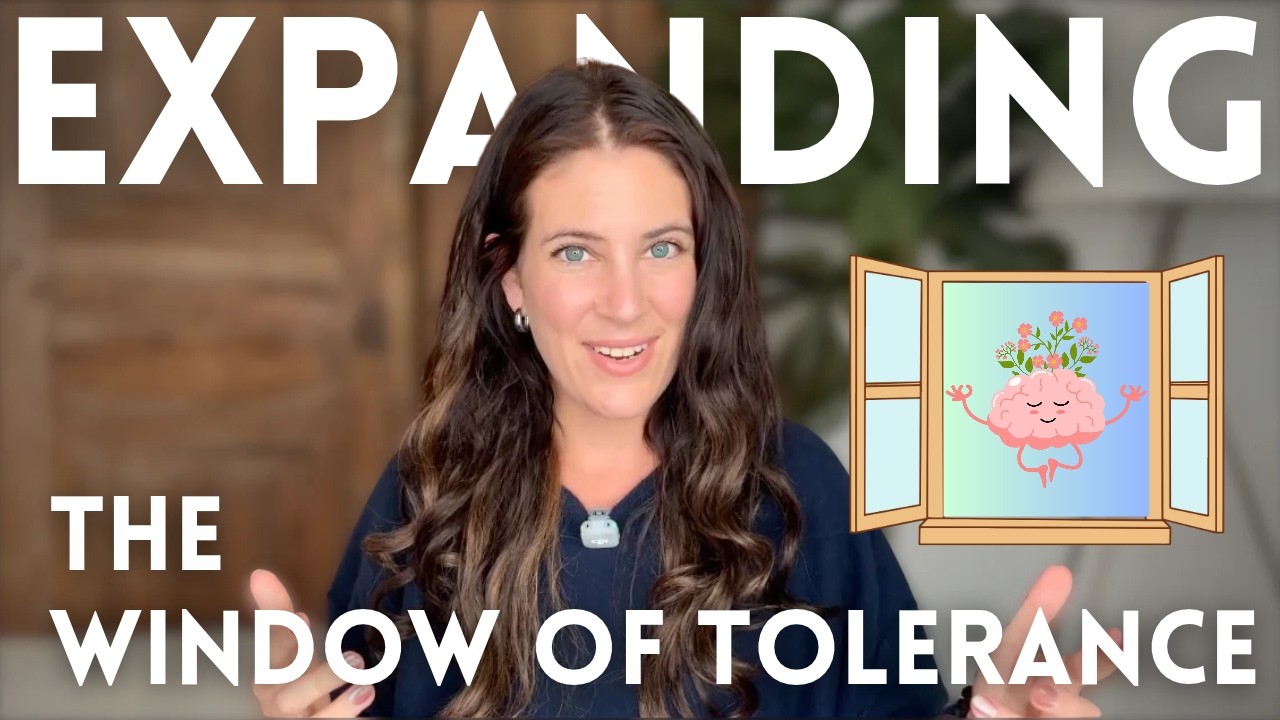
Heidi Priebe explains why intellectual insight alone doesn't break repeated patterns, and why learning requires staying inside the window of tolerance where embodied change happens.
Key Takeaways
- Cognitive understanding helps but does not by itself change patterns; embodied learning requires time inside the window of tolerance.
- The key question for change is whether you are spending enough time in conditions where learning can happen, not what you don't understand yet.
- When overwhelmed, prioritize restoring safety and stability before trying to solve problems or make decisions.
- Manageable challenges combined with regulation allow the nervous system to acclimatize and gradually form new, healthier responses.
What the video covers
- Intellectual understanding of one's patterns and wounds is not enough to change them; embodied learning is needed.
- The window of tolerance is a zone of optimal arousal where emotions can be felt without being overwhelmed, and it is where learning happens.
- Fight, flight, freeze, or fawn responses prioritize immediate safety and crude all-or-nothing categorization, not long-term accuracy or growth.
- The speaker spent about 30 years making intellectual self-analysis without lasting change, until she spent sustained time within her window of tolerance.
- During a period of extreme stress she made repeated poor choices, leading her to conclude that problems can't be solved from a dysregulated state.
- When overwhelmed, the recommended move is to deliberately return to stability and safety before making decisions.
- Reducing open loops, such as postponed practical tasks like booking medical appointments, helps calm the nervous system (sponsored segment for ZocDoc).
- Staying in the window requires both regulation and adequate challenge, with needs for stability and for healthy stimulation both met.
- Mixed feelings can coexist inside the window, and emotional pain can be processed without being dismissed or overindulged.
- Change happens through manageable doses of new experience that gradually build a body-based repertoire of different memories and responses.
Chapters
- 00:00Introduction: Why Insight Isn't Enough
- 02:14Embodied vs. Cognitive Learning and the Window of Tolerance
- 04:17Fight, Flight, Freeze, Fawn and Long-Term Decision Making
- 06:18The Speaker's Personal Experience with Repeated Mistakes
- 08:18Returning to Stability Under Stress and Reducing Open Loops
- 10:18Sponsor Segment: ZocDoc
- 12:05What Staying Inside the Window Looks Like Day to Day
- 16:40Mixed Feelings, Emotional Pain, and Challenge in Manageable Doses
- 26:40How the Nervous System Learns Through Trial and Experience
Full Transcript — Download SRT & Markdown
Speaker A
Hey guys, I'm Heidi Pribb. Welcome back to my channel or welcome if you're new here. Today on this channel, we're going to be talking about the window of tolerance and why we need to be inside of it for learning to happen. So, I
Speaker A
won't spend too much time on this point because I think it's probably so familiar to so many of us watching this, which is this concept that we can have almost everything on earth intellectualized about which patterns we're repeating, where those wounds come
Speaker A
from, why we keep being attracted or drawn into the same types of relationships or the same types of situations, and still finding ourselves playing those things out over and over and over again. And I think that the reason why this happens is because we're
Speaker A
kind of asking the wrong question about what it takes to change these patterns in the first place, right? So, we do need cognitive understanding. That helps a lot in at least being able to strategically choose which environments we're going to place ourselves in next.
Speaker A
But the main question we need to be asking ourselves when we're looking at how to change our patterns is not what do I not understand yet. It's am I actually spending enough time inside of the conditions where embodied learning
Speaker A
can happen. So what we're going to go over in this video is what the heck that means. So what is embodied learning as opposed to cognitive learning and also which conditions make it possible. So in a past video which I've linked in the
Speaker A
description of this one, I talked about the concept of a window of tolerance. So when we are inside of our window of tolerance, what it means is that our nervous systems are in this zone of optimal emotional arousal where
Speaker A
essentially we're able to be in touch with our emotional experience without feeling totally overwhelmed by it. And this is the zone in which learning happens. Okay? Because when we are inside of that zone where we're able to be present with what's going on for us,
Speaker A
without having to distort it or without having to make a situation into something that it's not, when we're able to just be with what is and all of the feelings that come up around what is, we're also able to access the accurate
Speaker A
information about reality that we need to make different choices. When we are in a fight, flight, freeze or fawn response, essentially we are running a program that is very valuable in some scenarios. But what this program does is
Speaker A
it looks at what is immediately going to get me to safety in this exact moment.
Speaker A
Am I going to be able to categorize this person or this situation as all good or all bad? Is actually a really useful frame when we are not safe. Right? We're not worried about accuracy and about long-term impact when we feel like we
Speaker A
are in immediate danger. What we're worried about is whatever information, however kind of distorted or slightly inaccurate, is going to help us make quick, immediate decisions that change the situation that we're in. What it's not looking at is which choices are
Speaker A
going to be best for me long term. Which experiments might I want to start running on my life and inside of my relationships that are going to give me more information about what I need to stay focused and regulated? What can I
Speaker A
learn from my past experiences by actually feeling into the pain of them and the joy of them and figuring out what signal exists inside of those things? These are the types of questions that we're able to sit with when we
Speaker A
spend a lot of time, ideally a long period of our lives, mostly inside of that window of tolerance. So, I spent probably the first 30 years of my life not really learning from any of my mistakes. I've always been a very
Speaker A
intellectual person and a very self-aware person. And at any point in time, I could more or less sit you down and give you a long explanation of what I was doing wrong, but I would just keep doing it. And it wasn't until I reached
Speaker A
the first point in my life, which spanned for a couple of years, where I felt like I was relatively inside of my window of tolerance most of the time, that I started to notice, hey, I'm actually making changes that are
Speaker A
sticking in my life. like I'm actually breaking patterns and choosing different things. And I wonder what has made that possible.
Speaker A
And then I went through another period where I was under an extreme amount of stress and I made a bunch of wrong choices that I was not learning from.
Speaker A
This period lasted for about a year and a half of my life. But what I ended up realizing through that period was I actually think I can't solve the problems of my life from inside of this state. What I need to do is go create a
Speaker A
massive amount of safety and stability for myself. And then I'm going to try to solve my problems from inside of that state. And this is what this video is going to focus on. Whenever I notice that I am overwhelmed, that I am too
Speaker A
stressed out to think clearly or decide clearly, instead of focusing all of my energy on trying to make better decisions or kind of override what I'm feeling from that state, I go, "Right now, it is time to quadruple down on
Speaker A
stability. It's time to get myself back inside of my window of tolerance, back inside of conditions that feel safe, where I feel like my dignity is online, and then to choose what happens next from there. And my belief at this point
Speaker A
is that if we want learning to be really deeply possible for us and we want change to be really deeply possible for us, this is a move that we have to learn to make sometimes over and over and over
Speaker A
again in life is deciding to deliberately return ourselves to the conditions where learning is possible for us rather than trying to intellectualize harder about the problem and then shame ourselves for not having solved it. The cognitive mind is a
Speaker A
wonderful, beautiful tool, but it has its limitations. Now, one of the underrated parts of getting back inside of our window of tolerance is just reducing the number of open loops that our nervous system is carrying. And sometimes those open loops are
Speaker A
emotional, but sometimes they're also incredibly practical. So there might be something that you've been meaning to get checked out or you need a new doctor or you know you need to book an appointment but the process feels stressful enough that you just keep
Speaker A
putting it off which is a good place to thank the sponsor of today's video Zach.
Speaker A
So a lot of the time we don't put off healthcare because we don't care about it. We put it off because booking something requires a whole series of tiny decisions. So figuring out what kind of doctor we need, who takes our
Speaker A
insurance, who's accepting new patients, who even has availability and then actually going through with making the appointment. Zdoc collapses a whole bunch of those micro decisions into one place. Zoddoc is a free app and website where you can search for in-et network
Speaker A
doctors and specialists in your area, compare real patient reviews, see their availability, and book appointments online. So instead of spending a bunch of time calling around to different offices trying to piece together all of that information yourself, you can put
Speaker A
in what kind of care you need, your location, and your insurance, and immediately see providers who fit those criteria. If there's something that you've been meaning to deal with that keeps sitting in the back of your mind, just making that appointment can be a
Speaker A
very simple way of closing that loop and giving your nervous system a little bit of peace. Go to zdoc.com/hidypb to download the Zoddoc app for free.
Speaker A
Then find and book a top rated in network doctor today. Thanks again to ZuckDoc for sponsoring this video.
Speaker A
So we're really quickly going to go over what it looks like to be inside of a period where we're functioning inside of our window of tolerance. Like what does that concretely mean for most of us?
Speaker A
Essentially, we can think of it as the act of being in a state where both our needs for stability and regulation are relatively met, but also our needs for healthy challenge and kind of alertness and excitement are healthfully met.
Speaker A
Right? If we're safe, but we are completely shut down, we're not inside of that window of tolerance because we're not being adequately stimulated and engaged with our lives. But if we are kind of drowning in stimulation and drama and yet we don't have ways to
Speaker A
downregulate and keep ourselves grounded and in touch with what we want when we're not just constantly responding to the next demand, we're also not inside of that window of tolerance because we're disconnected from that kind of stabilizing part of our own physiology.
Speaker A
So when we want to spend more time inside of the window of tolerance, the two things we focus on are one stabilizing our lives. So giving ourselves routines that regulate our physical bodies, right? So letting ourselves know how we are going to take
Speaker A
care of ourselves and then doing that self-care over and over and over again rather than letting our lives be in chaos. And again, there's a time and place for everything. Sometimes it's nice to have our routines disrupted, but
Speaker A
when we find ourselves over stimulated, often what we need is to return back to a sense of predictability in our lives.
Speaker A
Let our bodies know you are going to be cared for. And also building relationships that regulate us emotionally. So being embedded inside of relational systems where we don't feel like we have to distort who we actually are or what we want or what we're
Speaker A
feeling in order to be loved. And a big part of this is setting boundaries and saying no to the relationships that do not allow for this. If we are bleeding a bunch of energy into relationships that require us to perform or to distort what
Speaker A
we want or need or relationships where we're putting that pressure on ourselves, that's going to be inherently disregulating, right? To stay in that window of tolerance, we want to as much as possible put ourselves in environments where we don't have to perform or
Speaker A
pretend to be who we're not in order to regulate ourselves and stay connected to other people. And then the second part of staying inside of that window of tolerance is making sure that we are adequately challenged so that our lives
Speaker A
feel interesting to us that we have something we are excited about or looking forward to that we're kind of cohering our energy around or making sure that we have healthy hits of dopamine in whatever way that means. So
Speaker A
we have a goal that we're working towards that feels interesting or we have a new group of people that we're getting to know that it feels exciting to engage with. So making sure that our comfort and our protection needs are
Speaker A
met, but also our stimulation needs and our need to cohhere ourselves around some interesting goal is being met.
Speaker A
These are kind of the primary ways that we design a life around our window of tolerance.
Speaker A
And when we are inside of that window, a whole bunch of capacities come online for us that we don't have access to when we're outside of it. And this is something that I think is really interesting around the way that certain
Speaker A
trauma experts talk about that window of tolerance or about regulation. So people like Peter Lavine, Steven Pores, they talk not just about what it looks like to be disregulated, but what we regain access to when we find ourselves back in
Speaker A
a state of regulation. We have the capacity when we are regulated to think of our lives on a long time horizon to grieve things that have happened to process emotions a little bit at a time without getting overwhelmed by them and
Speaker A
feeling like there's something we must do right now to solve our entire lives. Right? So we can actually integrate and learn from inside of that state.
Speaker A
Something that always surprises me when I go through a long period of feeling like I'm mostly centered inside of that window of tolerance is actually being able to notice what happens when my nervous system kind of takes a hit. So
Speaker A
in survival mode, when I was living a lot of my life from those four F responses, I would have like four things that were severely disregulating happening in my life at all times and I wouldn't even clock them as
Speaker A
disregulating. I would just kind of think that's how life is. I'm chronically stressed out. that I'm chronically upregulated and unable to downregulate or downregulated and unable to upregulate. And it wouldn't clock to me to care about the fact that when
Speaker A
significant conflict happens in relationships, that is a blow to my nervous system. That is a lot of stress on it. when a really significant challenge comes online that I need to kind of summon all of my willpower up to meet
Speaker A
that is a blow to my nervous system that it needs time to recover from. Right?
Speaker A
And when I'm inside of that window of tolerance, I can so notice these things.
Speaker A
I can go, yeah, this is kind of pushing me right to the edges of what I'm capable of dealing with without going into one of those four F responses. And what I need to do is make some time in
Speaker A
my life to be able to absorb that blow and return to a state where I feel more focused. And being aware of that, being aware of what the circumstances of my life are doing to my nervous system allows me to intelligently design my
Speaker A
life to be one that is more nervous system friendly. The first thing that's really beautiful about being in that window of tolerance, especially for a prolonged period of time when we've really put the work into building and maintaining that stability for
Speaker A
ourselves, is that we're able to stay associated to emotional pain because we're not worried that it's going to overwhelm us or cease to allow us to cope.
Speaker A
Okay? And this is useful in learning from our mistakes because pain contains a humongous amount of information about what is and isn't good for us, right? Or what does or doesn't align well with our unique psychology and nervous systems.
Speaker A
And if the conditions of our lives are kind of chronically requiring us to dissociate or tune out from pain because maybe there's a series of neverending problems that need to get solved. Or maybe we're inside of conditions where
Speaker A
if we were to feel the pain of the conditions we were inside of, it would be completely overwhelming. Right? This is often what happens if we find ourselves inside of really unhealthy relationships or work environments or whatever it is. It's actually quite
Speaker A
adaptive in the short term to numb ourselves out from the pain. But if we are numbed out from pain, we cannot learn. Pain informs us about where our nose are, about where we have become disconnected from our dignity and our
Speaker A
sense of selfrespect. Our pain teaches us what we need to let go of, what isn't working, what needs to be grieved, what's not aligned for us. All of these things we can only really access if we're inside of a scenario where it
Speaker A
feels safe for us to process our sadness. One of the wildest grief experiences I think I ever had in my life was when I was younger, so when I was a teenager, I was in a relationship that was quite longterm. It lasted
Speaker A
almost a decade. And then that relationship ended at a time in my life when I had a very sick parent who ended up passing away about a week after that relationship ended. And at the time, so much was in flux in my life that I
Speaker A
simply could not grieve. Like I did not cry once about the end of that very long-term, very loving relationship. And that stayed the case for years and years and years. And then I reached this point in my early 30s, which was about 5 years
Speaker A
after this relationship ended, where I had a very stable life, a very beautiful friend network of people who I had a lot of support with. And one day I logged online and I saw a picture of that exartner getting married. And it was
Speaker A
like this total wall of grief just broken me. I saw this picture about five minutes before heading over to a friend's house and I walked to the friend's house. I walked through the front door and I just cried through the
Speaker A
entire hangout and then I went home. I cried the whole night. I woke up the next day. I was hosting a party that day. I cried through my own party. It became this joke at the party that was
Speaker A
actually very playful and loving in the way that my friends kind of encircled me around that. But in this 48 hour period, it was like my body finally knew I'm safe to process the grief now. I've arrived at this place in my life where I
Speaker A
have a really beautiful and stable life. I have beautiful friends around me. I have good conditions for allowing myself some honesty about what I really miss and what was really beautiful about that connection that's gone now. And after
Speaker A
that 48 period, it was like my nervous system just kind of adapted to that new reality, too. like okay that chapter is fully over and we know that and we can move forward accordingly. And what was really beautiful was that after that
Speaker A
period I noticed myself for the first time since that relationship had ended being really genuinely open to love again in my life because grief had closed that door and reopened myself to what was right for me now at this point
Speaker A
in my life. And this is what time inside of that window of tolerance does for us.
Speaker A
It allows us to accept, you know what, I don't have to pretend that that long relationship didn't affect me or that knowing that we weren't the right people from each other saves me from the 48 hours or in other cases months or years
Speaker A
of crying that we need to do about something, right? We can experience mixed feelings inside of our window of tolerance and we can allow all of them to be true. This thing wasn't the best for me and I'm really sad to be letting
Speaker A
it go. this thing wasn't completely right for me and there's so much about it that I'm gonna miss and that I need to mourn. Anyways, we're able to actually understand that multiple things can be true at once inside of that
Speaker A
window of tolerance. We don't have to make things all one way or another because our nervous system is oriented towards making quick decisions about things, right? That's what happens when we're in one of those 4 F responses. A
Speaker A
lot of the time our thinking is a lot more localized as opposed to expansive and integrated.
Speaker A
Another thing that we can do inside of our window of tolerance that's really hard to do when we're outside of it is we can notice our own vulnerability.
Speaker A
And what I mean here is not just notice our feelings of sadness or pain. I mean notice the parts of our lives where we are or have been genuinely unsafe.
Speaker A
Because from inside of that window of tolerance where we are safe, we're not in a position where we're dependent upon tolerating unsafe conditions.
Speaker A
Right? So our livelihood does not depend upon us performing well inside of a really toxic work environment or we're not otherwise severely dependent upon dangerous people. When this is the condition that we're in, and for some of us in life, we will find ourselves here
Speaker A
over and over again. it is very natural for our brains to start distorting the situation because that's kind of what they have to do to survive, right? So, we might be able to recognize, yeah, I can kind of see that I'm in some
Speaker A
conditions that are not ideal or that I'm surrounded by some people who are not the best for me, but you know, I'm tough enough to tolerate it in these ways or I kind of understand what's going to happen and I have the lay of
Speaker A
the land and so I know how to handle this. When we get back to safety, when we get back to a point in our lives where we can look at previous points and go, you know what, I was in a really
Speaker A
messed up scenario there. What we get access to is accurate thinking about our conditions. All of us have weaknesses and vulnerabilities and areas where we are prone to be exploited if someone who wants to exploit us comes along. When we
Speaker A
have a lot of safety in our lives, what we do is we start to naturally cover our bases in those areas, we go, you know what? I know that it's really easy for someone to bait me in this particular
Speaker A
way. So, I'm going to make sure that I recognize that feeling when it comes along, and I have a way of responding to it that does not put me in harm's way.
Speaker A
We construct our boundaries around our vulnerabilities and protecting ourselves from bad actors. And I think that this is something where a lot of us who like to really think of ourselves as people who have strong internal locuses of
Speaker A
control. So people who are always looking at where we can take charge and where we can direct our own fates can actually have the most severe distortions because we can be prone to focusing so intensely on our own agency
Speaker A
that we develop a huge blind spot around the fact that sometimes bad luck hits us. Sometimes people exploit us specifically for that trait, right?
Speaker A
People come into their lives and they go, "Wow, here's a person who takes radical self-responsibility. They're probably going to look really heavily at their own role in things for a very long time before they're willing to consider that I might be exploiting them in some
Speaker A
way. I personally am someone who has a very long history of putting myself in incredibly unsafe conditions both emotionally and literally and believing that I have this unique kind of toughness or this unique intelligence that's going to allow me to not get
Speaker A
taken advantage of inside of dangerous situations. And it's only been once I've spent more time inside of safe conditions that I've realized just how scary some of those situations were and just how lucky I am to have not had
Speaker A
many, many worse things happen to me when I was in vulnerable states. When we are in our window of tolerance, what we can start to notice are things like here are the areas where I am actually quite easy to manipulate or exploit. Maybe
Speaker A
because I believe the best in people. Maybe because I believe the worst in people, right? Essentially, anything that we believe strongly is exploitable.
Speaker A
But the more unsafe we are sometimes, the more we need to construct these identities of ourselves as unexploitable or as impossible to manipulate or as invulnerable to danger. And then when we bring ourselves to safety, we can see
Speaker A
the exact areas where that's not true, where we have not been safe, and how we need to safeguard our lives in the future to make sure that we don't end up in those same unsafe scenarios over and over and over again because we're lying
Speaker A
to ourselves about them being safe. Right? So time inside our window of tolerance helps us construct more and more boundaries that keep us in our window of tolerance longer term because again we're not needing to distort the conditions of our lives to convince
Speaker A
ourselves were safe when we're not. The third thing we're able to do from inside of that window of tolerance is that we can make decisions really slowly from a place of regulation.
Speaker A
So again inside of that window our time horizon feels naturally longer. So we can recognize things like when we're getting disregulated and we can make an intentional choice not to try to solve our life from inside of a disregulated
Speaker A
state. We can go, you know what, I remember the past five times that I let this feeling pass and then actually attended to it from a more regulated place the next day or the next week or whatever it is. So, we take our problems
Speaker A
seriously, but we also notice when we are not in the right mindset to act on them. And we give ourselves space and time to care for ourselves when we're feeling either overstimulated and like we want to go immediately into a fight
Speaker A
response or under stimulated and like we cannot seem to rally ourselves up to deal with the conditions of our lives.
Speaker A
We first care for our regulation, getting ourselves back in that window of tolerance through whatever means we need to do that and then we look at how to solve our problems from there. This is a massive skill that living inside of our
Speaker A
window of tolerance returns to us. Right? the capacity to make integrated choices because we've had time to sit with those mixed feelings know that we don't need to decide on anything right away and choose over time how we want to
Speaker A
respond. So generally when I feel a really strong feeling at this point in my life that feels a little bit like oo that might be some disregulation coming in what I tell myself is not you're crazy that feeling is wrong. I go, this
Speaker A
is one piece of information. How disregulated I am right now is a valuable piece of information. How I feel tomorrow is also going to be a valuable piece of information. And over time, I can put those pieces together
Speaker A
and start to understand a bigger picture of what I feel about this situation or this person or whatever it is over time.
Speaker A
And I can choose from a place of having that expanded perspective, not just the one that I have right now in this moment of disregulation despite the fact that it's also a piece of information that will get factored in. Right? So, we're
Speaker A
neither dismissing how we feel when our feelings start kind of pushing at the edges of our window of tolerance, but we're also not abandoning how we'll feel in the future and how we felt in the past and believing only our emotions in
Speaker A
that moment. We're caring for ourselves through the tough moments of dysregulation and then we're making long-term choices once we're back in that window of tolerance. The fourth capacity that we get back when we spend more time inside of that window of
Speaker A
tolerance is that we can actually notice the moments where we have an opportunity to choose differently and then we can stay online and associated to the outcome of choosing differently. So this is essentially what we were talking about at the beginning of the video when
Speaker A
it comes to running little experiments. Our cognitive minds learn through theory, but our bodies and our nervous systems learn through experience.
Speaker A
Right? So if we believe, okay, it is better for me to share my feelings in a moment where I'm feeling kind of frozen, we can internalize that all we want, but our bodies are only going to believe it's the right thing on a deep level
Speaker A
that eventually becomes instinct if we actually practice it and then notice something different happening. So maybe I shared my feelings in 10 scenarios and in seven of those sharing went better than not sharing would have. But in three of those scenarios, maybe sharing
Speaker A
felt terrible and I regretted it afterwards. Now what we're developing is a map that is specific about when these skills are good to use and when they are not. And we are absorbing that information inside of our nervous
Speaker A
systems, not just our minds. Okay? So our bodies, if we're able to stay associated as we are trying out new skills, are going to be logging things like I felt a moment of panic when I was testing out this new thing and then I
Speaker A
felt a moment of relief after when the world didn't end and then how did I feel 5 minutes later? How did I feel a week later? Sometimes the answer is much better. Sometimes it's worse, right?
Speaker A
Sometimes we have a theory about how we want to do things that turns out to not be the best strategy. But when we are challenging ourselves in manageable doses, so we are not doing something that feels so scary that the only way to
Speaker A
get through it is to dissociate. When we are challenging ourselves in a way that allows us to stay emotionally online throughout the entire challenge by giving ourselves the space that we need to move slowly through it, giving ourselves the support that we need to
Speaker A
feel as though if things go wrong, we're not going to be left totally alone with all of these terrible consequences.
Speaker A
Right? When we're able to design the right level of challenge that allows us to stay associated the entire way through, our nervous systems learn. They start absorbing and developing memories of a new pattern. So, I always kind of
Speaker A
joke to myself that I know I'm changing when I start feeling terrible in new ways. And it's not to say that change always feels terrible, but what I mean by that is that any change we're going to be making comes with pros and cons.
Speaker A
And so a lot of us when we're thinking of the changes, we're like, "Yeah, it's going to be amazing. I'm going to feel great all the time." But something I've learned to develop a bit of fondness around is encountering the consequences
Speaker A
of new behaviors that I have never encountered before. So, man, there are new forms of embarrassment that come online when we're learning new skills.
Speaker A
There are new ways that we're going to cringe at ourselves as we try out new skills and we get them wrong the first couple of times, right? encountering new forms of discomfort and being able to regulate around them. So, sharing about
Speaker A
them with other people, being able to kind of laugh at them with ourselves like, "Yeah, I'm really getting this new thing wrong." These are all ways of keeping that challenge manageable and inside of our window of tolerance. And
Speaker A
then we get to be at choice around, do I like the pros and the cons of doing this new thing better than I liked the pros and the cons of this old thing. This is how we change. We acclimatize ourselves
Speaker A
to new pros and cons, to new mixed feelings, and then we decide if that's the path that it feels better for us to keep walking down or if we want to turn back to our old ways of doing things.
Speaker A
But in order to really make that decision and stay grounded in it, we can't just imagine the different outcomes. We actually have to live out those new experiments. See how they feel in our nervous system 5 minutes later, 2
Speaker A
days later, 1 year later. And eventually our nervous systems will start to develop new instincts for what feels good or bad because we've actually given them the data they need and given them the integration time that they need to
Speaker A
be able to know the difference. And this basically already covers the fifth thing that we were going to go over, which is that when we spend a lot of time inside of that window of tolerance, one of the
Speaker A
main ways it helps us in making better decisions is that we have enough time and space where we are in relationship to ourselves to notice how new decisions pattern out over time and then integrate that. So we can look back and have data
Speaker A
in both directions after enough time. So we can go I have 30 years of experience behaving in this way and then I have let's say 10 instances of trying something different and I remember how it felt in my body to try that different
Speaker A
thing and how I did prefer the way it patterned out into the next 6 months of my life to have tried things differently. And so now when I come to this crossroads again where I'm going, do I want to operate based on the
Speaker A
instincts that I developed in early life and what they're telling me to do or do I want that outcome that I got the last couple of times where I did it this way and realize that in the long run, this
Speaker A
is the one that makes me feel better 6 months from now. We start developing a bodybased repertoire of memories and experiences that are different from what we have done in the past. This is how the nervous system learns through trial,
Speaker A
error, correction, reiterating on a given process and eventually learning what feels better and worse about new strategies. But we have to give ourselves the experience of going through those things and trying them and staying associated and online in the
Speaker A
reflection period of them in order to internalize those new things as instinctual. So in those high pressure moments, our first instinct after enough practice might be to reach for that healthier pattern, right? Something that I thought was really cool after years and years
Speaker A
and years of putting myself through essentially authenticity insecure attachment boot camp through all of these different courses and skills that I was building was realizing that in moments that were heavily relationally stressful, the first place my mind was
Speaker A
starting to go was to the place of how do I ground myself, figure out what's true for me and what I want to communicate with compassion and equinimity. And that feels like what is most imminently important right now is
Speaker A
to get clear from my own side and then think about how to communicate it directly to other people. But if we want to actually behave from a secure place, what we need to be doing is figuring out both what does the secure response look
Speaker A
like for me and how can I continuously put myself inside of scenarios where that is the best response which involves developing that discernment for which scenarios are more and less healthy for our nervous systems. Time inside of our
Speaker A
window of tolerance teaches us that as well. So, this has been a lot of information, but essentially the heart of what we're getting at here is that if it feels like we are not learning, like we're making the same mistakes over and
Speaker A
over again, like we have all of the cognitive information on Earth about what we should be doing differently and yet we just cannot seem to make ourselves behave differently. It might be that the problem is not that we need
Speaker A
more theory or that we need to shame ourselves harder. It might be that we need to create the conditions where our bodies feel safe enough to go through the embodied learning process of trial and error of testing things out and
Speaker A
noticing how we feel of feeling safe enough and resourced enough to absorb some hard blows to learn some hard lessons to acknowledge that there have been positions we've put ourselves in that are not safe that are not loving to
Speaker A
ourselves and others. Right? to process things like shame and disappointment. It takes a lot of stability to process feelings like that. And so if we're struggling to learn from our mistakes, tripling down on creating that stability for ourselves is often going to go a
Speaker A
much longer way than trying to force ourselves into better decisions is ever going to because we're giving our bodies an environment where they actually feel safe to experiment.
Speaker A
All right, that's all I'm going to say on this topic for today. But as always, any thoughts, anything that's been coming up for you as you've gone through this video, please leave in the comment section below. I love you guys. I hope
Speaker A
you're taking care of yourselves and each other, and I will see you back here again really soon.
Topics:window of toleranceembodied learningnervous system regulationtraumafight flight freeze fawnemotional regulationpattern changeself-developmentHeidi Priebesomatic therapy