Skip to content
Get App

How Starlink Actually Works

How Starlink delivers internet from space: the receiver ('Dishy'), phased-array antennas, satellite laser links, and ground gateways explained.

Key Takeaways

  • Starlink's low-orbit design and phased-array receivers make high-speed internet possible in remote areas.
  • Laser inter-satellite links allow global coverage without a ground station in every region.
  • Reusable rockets were the key enabler of the constellation's economics.
  • Starlink may evolve into a broader space-based infrastructure, including AI computing.

What the video covers

  • Starlink began in May 2019 with 60 satellites and has grown to roughly 11,000 satellites in orbit.
  • Starlink has been used for battlefield communications in Ukraine, disaster relief, and communication for activists in Iran.
  • A Starlink user connection has three parts: the receiver (Dishy), a satellite, and a ground gateway.
  • Dishy uses a flat phased-array antenna with over 1,200 mini antennas, allowing it to track satellites without physically moving.
  • Starlink satellites orbit about 500 km up, far lower than traditional geostationary TV satellites at over 35,000 km, which reduces latency.
  • Satellites relay data to each other using lasers when no direct gateway line of sight exists, such as over the open ocean.
  • Laser links carry 10 to 100 times more data per beam than radio, though they are scattered by weather and cannot easily reach the ground.
  • Reusable Falcon 9 rockets made the low-orbit constellation economically viable.
  • The upcoming Starship-class V3 satellites will greatly increase payload capacity per launch.
  • SpaceX reportedly plans a second constellation of AI data center satellites, potentially called Starmind.

Answers

Questions about this video

How many Starlink satellites are in orbit according to the video?

The video says the constellation has grown to about 11,000 satellites, starting from the first batch of 60 launched on May 23, 2019.

Why does Starlink use lasers between satellites?

Laser light carries far more data per beam than radio, and it lets satellites relay data to each other when no ground gateway is in view, such as over the middle of the Pacific Ocean.

Why doesn't Starlink use lasers to connect directly to the ground?

Laser beams are easily scattered by small particles in the atmosphere, such as clouds and rain, so radio is still used for satellite-to-ground links.

Full Transcript — Download SRT & Markdown

00:00
Speaker A
I want to take you back to one of the most important events in the history of space exploration.
00:07
Speaker A
May 23rd, 2019. That's the day that these odd lights started appearing in the night sky. A string of 60 little dots all flying in a perfect row. When people first saw this, a lot of them thought it was the beginning of an alien
00:24
Speaker A
invasion. But what they were actually seeing was the arrival of a new way to connect the world. Fast forward to today and those 60 little dots have already grown into a massive constellation of 11,000 Starlink satellites. That's more
00:42
Speaker A
than every other non-S Starlink satellite combined. And just look at the impact [music] this technology has already had. Starlink has played a critical role on the battlefields of Ukraine. It has enabled disaster relief across the US and around the world. It's
00:58
Speaker A
been a communication lifeline to pro-democracy activists inside the authoritarian fortress of Iran. This initial success of Starlink has propelled SpaceX from a simple rocket maker with dreams of landing on Mars to one of the most valuable publicly traded
01:15
Speaker A
companies in American history. And here's the reason why. It's because Starlink is more than just a new way to access the internet. This is the beginning of a new internet that exists entirely in outer space. So, the first
01:31
Speaker A
thing that we should do is take a look at how Starlink can actually get high-speed internet from space all the way down to you out here in the middle of nowhere. There are three main pieces in the chain of communication. One is
01:45
Speaker A
your receiver, two is a satellite, and three is a gateway. You might notice that only one of the three is actually in space for now at least. Starting with the receiver, which SpaceX has affectionately named Dishy, short for
02:01
Speaker A
Dishy McFlatace. But this is not actually a satellite dish in the way that you've known them before. Maybe you're like me and still have one of these satellite television receivers attached to the side of your house. It hasn't been used in a very long time,
02:14
Speaker A
but I really like the early 2000s aesthetic, so I leave it up there as a decoration. Anyway, these classic dishes were not flatfaced, and that's because the U-shape or parabola, to be scientific, is necessary to concentrate radio waves onto the antenna, which is
02:30
Speaker A
this thing that sticks out. Yes, TV from space travels on radio, and so does internet from space, but we'll get there. Now, you might remember the time when home satellite TV dishes were the size of a gazebo, and they would have to
02:44
Speaker A
physically move around to change channels by pointing at different satellites to pick up the signal. These second generation dishes don't need to move because newer satellites broadcast multiple channels. So, your mini dish only needs to be pointed at one of them.
02:59
Speaker A
And that satellite is parked in an orbit that we call geocynchronous, which means that relative to the surface, the satellite is always in the same place overhead. But for this to work, the satellite needs to be orbiting at an
03:12
Speaker A
altitude of over 35,000 km, which even for space is very high. Keep that in mind. Now, to understand what makes Starling different, we need to appreciate why Dishy is so flatfaced.
03:27
Speaker A
And the best way to do that would be to crack Dishy open and start pulling out his guts to see what they look like. The first thing that we're going to find underneath the face is the antenna layer. It's basically a whole bunch of
03:38
Speaker A
little circles made from very fine wires. Each one of the circles is a mini antenna. There are over 1,200 of them on here. And this is the reason why your Starlink receiver can talk to multiple different satellites without ever having
03:52
Speaker A
to physically move around. To see how that works, we go down one more layer and find the motherboard. This is the reason why a Starlink receiver costs so much. It is the brain that turns your sheet of a thousand circles into
04:05
Speaker A
something called a phased array. In very simple terms, Dishy is shooting an invisible beam of information into space using radio waves. The phased array allows the beams to be pointed in any direction, so it can actually move in
04:19
Speaker A
real time to track a Starling satellite as it flies overhead. And that distance to the Starlink is just about 500 km, which is a whole lot less than 35,000.
04:30
Speaker A
So inside the beam is what we call a data packet. That's your request to the internet. And it just got launched into space where one of those 11,000 satellites is waiting to receive it. On board each Starlink, there are five
04:43
Speaker A
phased arrays just like Dishy that are dedicated to receiving data packets from users. That's what your beam is firing at. And then the satellite is going to take your request and transfer it over to another three-phased arrays that are
04:56
Speaker A
dedicated to gateway down links. This is the third piece of the puzzle that most people are probably less familiar with.
05:03
Speaker A
So the gateway is actually here on the ground. There are over a hundred of them spread out across the USA and another 50 or so around the world. But just like the satellites, this number keeps going up. Each gateway looks like a collection
05:19
Speaker A
of nine balls, but these are just round covers that keep rain and snow off of the instruments. Inside the cover is a satellite dish, not a flat one, an actual parabolic dish. And these do physically move around to capture data
05:32
Speaker A
packets from the satellites. They don't have to move very much or even very fast. That's why there are nine with each one pointing in a different direction. So, our request from Dishy has gone up to space, bounced off a
05:45
Speaker A
satellite, and come back down to our closest gateway location. And many of these gateways happen to be conveniently located next to a Google data center.
05:55
Speaker A
This is not a coincidence. Google was actually an early backer of SpaceX and contributed $900 million way back in 2015 to fund the development of the Starlink network in the first place. So they have this agreement where SpaceX
06:11
Speaker A
can rent out space inside Google's computer clusters and use them to connect with the local internet. Now let's say that you are outside of the United States in some remote location or maybe in an airplane over the middle of
06:24
Speaker A
the Pacific Ocean. Because Starling satellites are relatively low to the ground, they're not going to be able to see one of these gateways and your antenna at the same [music] time because the curvature of the Earth is going to
06:36
Speaker A
obscure the view. So in this case, the satellite that receives your data packet is going to fire up a laser and blast the information through space to another satellite, which will then relay the signal via laser to another satellite.
06:50
Speaker A
And then the chain continues until eventually it finds a clear view of a gateway and the packet is finally delivered to the internet, at which point your request is processed. And then the web page is returned back through the same chain to your dishy and
07:04
Speaker A
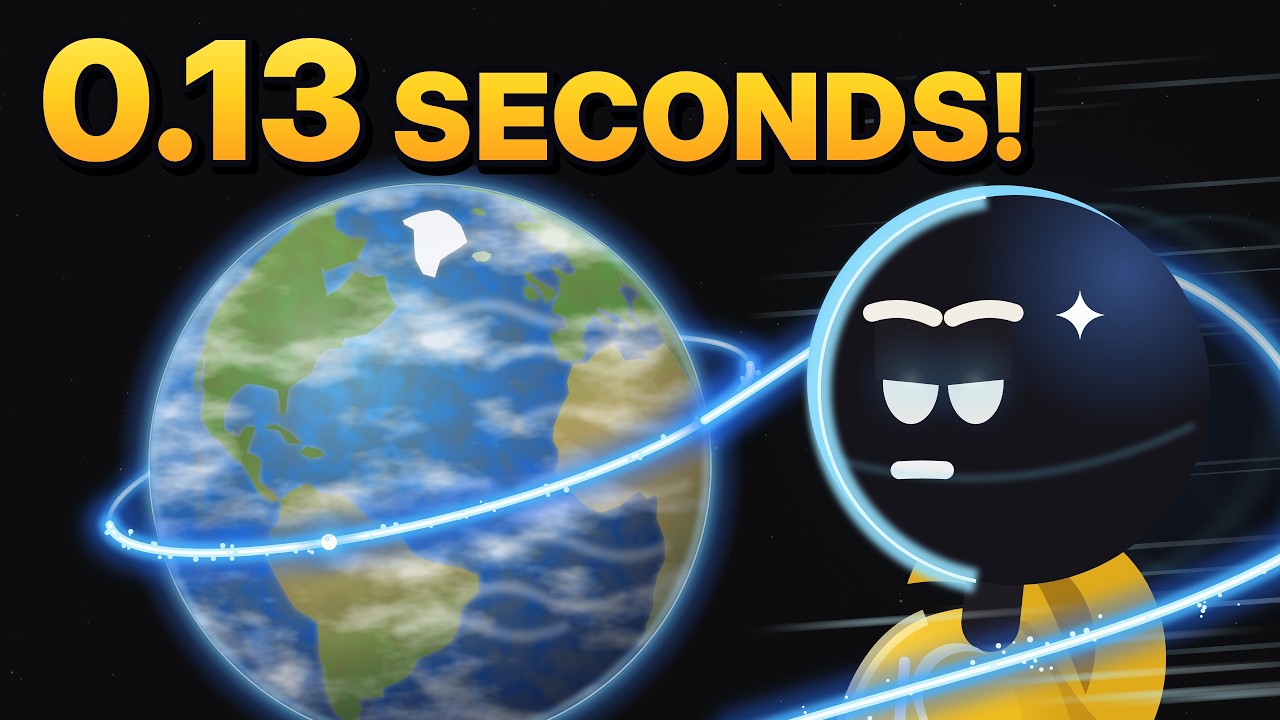
onto your computer screen, which sounds like way too much stuff to be happening in a split second, but it starts to make sense once you wrap your head around how fast all of this stuff moves through space. You may have noticed that there
07:18
Speaker A
are two methods used by Starlink to transfer data. The first is radio. That's how individual satellites talk to the ground. And the second is laser.
07:28
Speaker A
That's how satellites within the constellation [music] talk to each other. The reason that we use laser communication in space is not because it travels faster. Radio [music] is actually light. It's just invisible to the human eye. So, it travels at the
07:42
Speaker A
same speed. [music] But laser light is able to carry more data on one signal, between 10 and 100 times more information per beam thanks to its higher frequency range. So while each satellite can receive multiple beams at once from multiple dishes, it has to
07:57
Speaker A
compress that down into one single beam that travels to the next satellite. So why don't we use laser light to connect from space to the ground? Well, the downside to a laser beam is that the higher frequencies can be easily
08:12
Speaker A
scattered by small interruptions such as clouds, rain, or even just fog. basically any kind of water vapor which the Earth's atmosphere is full of has a tendency to scatter some light waves which is why the sun looks yellow in the
08:26
Speaker A
sky. It's not actually the real sun is white. It just turns yellow when the light passes through [music] our sky.
08:33
Speaker A
Radio waves carry lower frequencies that are able to pass right through water molecules. So that's what we need for data to reach the ground from space intact. [music] Which might raise another important question. How do we turn the internet
08:46
Speaker A
into waves that shoot back and forth through space? And the answer can be easier than you think as long as we keep this all relatively simple. So everything that you see and hear from your computer starts out as binary code,
09:01
Speaker A
ones and zeros. Now if we look at a wave, there are two ways to show binary information. One is amplitude. That's the height of the wave on a vertical scale. So we could say that a tall wave is one and a short wave is zero. [music]
09:15
Speaker A
The second method is frequency. That's the length of the wave on a horizontal scale. So likewise, a long wave can be one and a short wave can be zero. This is the basic idea. And within that method, there are a million different
09:29
Speaker A
ways that data can be encoded. But that's [music] essentially how we move information around the world. Now, here's the reason why Starlink works so well compared to any other global transmission network. Back in the day, a satellite communication from the middle
09:45
Speaker A
of the ocean would have to go all the way up to 35,000 km geocynchronous orbit, then bounce all the way back down to a ground station thousands of kilometers away on the mainland. [music] And even though the signal moves at the
10:00
Speaker A
speed of light, it's still traveling over a long distance and moving through some generally outdated and inefficient computer processing along the way. So this means there will always be some inherent lag or latency in the signal enough that even holding a live
10:15
Speaker A
conversation becomes challenging. You know those clips on television news when a reporter is trying to call in from a war zone to a live broadcast and [music] there's always that really awkward delay with the host and people end up just
10:27
Speaker A
sitting there staring blankly into the camera. That is satellite communication lag and you can't have a serviceable modern internet connection with that kind of nonsense going on. Gamers would revolt. This is why Starling satellites are positioned so low. At 500 km, they
10:45
Speaker A
are about 70 times closer than traditional satellite communications. This even has an advantage over traditional groundbased fiber optic internet. So like 99% of all communications that cross the Atlantic Ocean flow through underwater cables.
11:00
Speaker A
Inside these fire hosed sized tubes are bundles of fiber optic cable, basically glass lines that we fire laser beams through and carry information from point A to point B. Laser light can travel easily through glass as long as it's
11:14
Speaker A
high quality and clear, but it still gets slowed down just a little bit compared to light moving through the vacuum of space. So, a laser signal traveling between Starling satellites from New York to London will move about 30% faster than even the highest quality
11:29
Speaker A
fiber optic line. Now, it's not like we needed Elon Musk to figure out that lower satellites equal lower latency, but we did need SpaceX and particularly the reusable Falcon 9 rocket to make a lowaltitude communication constellation economically viable. Because Starlink is
11:45
Speaker A
not hovering in place like a geocynchronous satellite, they are flying around the Earth at a rate of about one orbit every 90 minutes. This means that from your position on the ground, it would take one satellite about five minutes to cross from the
11:59
Speaker A
western horizon to the eastern horizon. And in order to make sure there are enough satellites that you always have at least one visible from any given location on Earth, you need to have thousands of them in service all at
12:11
Speaker A
once. Meanwhile, from 35,000 km, you only need three satellites to cover the entire habitable Earth, which is excluding the North and South Poles. So, from a business standpoint, do you want to launch three satellites or 3,000?
12:27
Speaker A
[music] Any reasonable capitalist is going to choose the lower number. Elon Musk chose the high road. But Elon also knew that he'd never get to 3,000 satellites or even 300 satellites without first totally reinventing the rocket as we know it. So, the first
12:44
Speaker A
phase of SpaceX was figuring out how to make an orbital rocket booster reusable. This proved to be a really difficult task. It took them many years and a lot of exploded rockets. But by the mid2010s, SpaceX was finally starting to
12:58
Speaker A
figure it out. And that's why they waited until 2019 after the Falcon 9 booster had finally become fully reliably reusable to start ramping up Starlink launches. With Starlink V1, each Falcon 9 launch was able to carry around 60 into orbit at one time. That
13:15
Speaker A
has gone down over time as SpaceX has upgraded to the bigger and more powerful V2 satellite with them now being limited to just 20 per launch, but they've compensated by flying their rockets at a much higher frequency. [music] So in
13:29
Speaker A
2019, SpaceX conducted a total of 13 orbital launches. In 2023, when they upgraded to Starlink V2, the company launched 96 times that year. By 2025, Falcon launches were up to 165. But there comes a time when you reach a
13:45
Speaker A
limit for how many rockets you can launch at any given time, even with reusable boosters, which is why SpaceX is developing their next rocket platform, the Starship. This is not just a little bigger than Falcon 9. Starship dwarfs every other rocket ever made. And
14:02
Speaker A
compared to Falcon 9, it increases payload capacity to low Earth orbit from 20 tons to 200 tons. That is going to allow SpaceX to make even bigger and more powerful Starlink V3 satellites and return to launching 60 of them at a
14:16
Speaker A
time. And because Starship makes the entire rocket fully reusable, not just the booster, they will be able to launch even more frequently at an even lower cost than the existing Falcon 9. But why do Starling satellites need to keep
14:30
Speaker A
getting bigger anyways? Well, bigger is better, of course, but one of the main reasons is that Starlink has already begun moving to a service where you don't even need a dishy in order to access the network. This involves direct
14:44
Speaker A
to cell phone communication. Makes sense, right? Of course, we all want a highquality mobile network everywhere we go. But unfortunately, this is very hard to achieve even for Starlink. So the V2 satellites are about twice as wide to
14:59
Speaker A
accommodate the extra phased array antennas made specifically for direct to cell. These actually need to be bigger and more powerful than the standard Starlink antennas because the beam strength coming up from a cell phone is so weak compared to the signal from a
15:13
Speaker A
dishy. So you need more power just to hear it. And then on the return back down, the beam has to be concentrated enough to hit a moving cell phone and cut through any surrounding radio noise, which also requires extra power. What's
15:27
Speaker A
crazy is that even with the V2 upgrade, the best that Starling can do for direct to cell service right now is voice and text, no streaming internet. So, there's a key reason why V3 is necessary. It's going to have a much bigger and more
15:42
Speaker A
powerful mobile antenna. It's also going to have an even bigger and more powerful space laser connection system, which is also very much needed. [music] Remember before I said that moving data with a laser through space is much faster than moving data across the ocean
15:56
Speaker A
through fiber optics. That is true for latency, but as it stands, the Trans Ocean cable network can still move 100 times more data per second than Starlink. So, it's not actually a better solution for all people. And that's the
16:10
Speaker A
big hurdle that SpaceX needs to overcome. If every one of us right now decided to switch our internet connection over to Starlink, the amount of traffic would completely overload the network and it wouldn't work for anybody. So, as of right now, Starlink
16:24
Speaker A
is a great option when you have no other good options, like when you're located in the middle of nowhere. But anywhere else, there's really no point. Not yet, at least. Of course, SpaceX has a plan, and that involves a lot more than just
16:38
Speaker A
replacing the existing constellation with V3 satellites. It means growing the network to 10 times its current size.
16:45
Speaker A
Over 100,000 active Starlinks in Earth orbit, which sounds crazy, and it is, but that's not even the end game. Elon Musk wrote in May 2026, "If growth continues, Starlink will one day carry the majority of internet traffic." At that point, it is
17:04
Speaker A
the internet and everything else just connects to Starlink. That means no more gateways or ground stations or fiber optic cable. Your request goes up and the answer comes straight back down. The internet as we know it today would exist
17:19
Speaker A
entirely in space. Which is the reason why SpaceX is already considered to be one of the world's most valuable companies because owning the internet has a potential value that is almost beyond comprehension. And that's just for Starlink alone. But this all really
17:36
Speaker A
plays into Musk's other long-term goal for SpaceX, which is to launch a second mega constellation of AI data center satellites called Star Mind. These would sit much higher above Starlink where they can capture more light from the sun
17:51
Speaker A
for solar power. And that is where all of the AI models of the future would live. So in this future, your personal device will radio a request to Starlink.
18:01
Speaker A
Starlink will laser that further up to Star Mind where a super intelligent AI will process the answer. Star mind will laser it back and Starlink will radio it directly to you. Musk says that to accomplish this, SpaceX needs to launch
18:16
Speaker A
1 million satellites into Earth orbit between both Starlink and Star Mind. And if you want to see how SpaceX will build their Star Mind AI satellites on the moon and then launch them into space with a giant electromagnetic rail gun,
18:29
Speaker A
we've got that video for you on screen right now. Check it out. It's actually a really good one. I think you'll enjoy it.
Topics:StarlinkSpaceXsatellite internetphased arraylow Earth orbitlaser communicationFalcon 9ground gatewaylatencyspace internet

Get More with the SozAI App

Transcribe recordings, audio files, and YouTube videos — with AI summaries and speaker detection. 30 minutes free.

Or transcribe another YouTube video here →