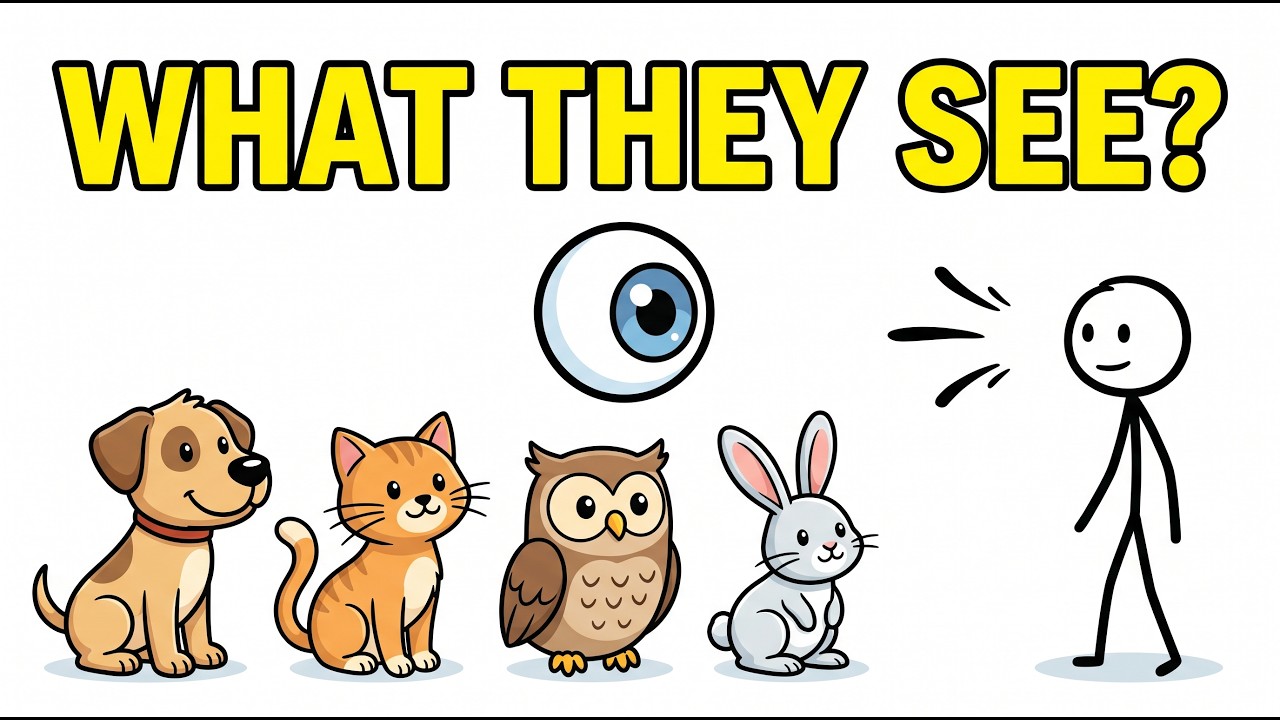
Explore why you feel like someone is watching you, the brain's perception of gaze, and how uncertainty shapes this sensation.
Ask about this video. Answers come from its transcript only — with the timestamp, so you can check them.
Generated from the transcript and can be wrong — check the timestamp.
Key Takeaways
- The brain often interprets uncertain gaze as directed at oneself, causing the feeling of being watched.
- This sensation is a result of perceptual and attentional systems working with incomplete information.
- There is no conclusive evidence for a supernatural 'stare detector' ability in humans.
- Social observation affects behavior and self-awareness significantly.
- Context and meaning assigned to observation cues heavily influence human reactions.
What the video covers
- Humans are highly sensitive to others' eyes and gaze direction, which conveys important social information.
- When gaze direction is unclear or uncertain, the brain tends to interpret it as being directed at oneself.
- The feeling of being watched can arise from subtle sensory cues or incomplete information processed by the brain.
- Perception and attention mechanisms are designed to prioritize potentially important but uncertain stimuli.
- The 'cone of gaze' explains that gaze perception has a range of angles perceived as directed toward the observer.
- There is no reliable scientific evidence supporting a supernatural ability to sense unseen staring.
- Believing you are being watched influences self-awareness and behavior, even without physical changes in the environment.
- Artificial cues like images of eyes can sometimes influence behavior, but results are inconsistent and context-dependent.
- The sensation of being watched is complex and influenced by expectation, context, and subtle environmental signals.
- Ultimately, the brain provides reasons to check or pay attention rather than definitive facts about being observed.
Chapters
- 00:00Introduction: The Feeling of Being Watched
- 00:43Common Experiences of Feeling Watched
- 01:24Human Sensitivity to Eyes and Gaze
- 02:10Uncertainty in Gaze Perception
- 02:59Brain Bias Toward Self-Directed Gaze
- 03:43Perception and Attention Under Uncertainty
- 04:29The Cone of Gaze and Its Implications
- 05:09Investigating the Supernatural Stare Claim
- 05:57Effects of Being Watched on Behavior
- 06:46Artificial Surveillance Cues and Their Limits
Full Transcript — Download SRT & Markdown
Speaker A
You're walking home alone. The street is quiet. Your footsteps are the only sound. Then something changes. You can't explain what. You slow down. And suddenly, you stop. You turn around.
Speaker A
Empty pavement. No footsteps. No voice. Nobody standing behind you. You look again. Nothing. And yet, that strange feeling remains.
Speaker A
That unmistakable sensation that somehow someone is watching you. But here's the strange part. You didn't see anyone. So why did your mind tell you to turn around? Maybe you've experienced it in an empty house, a dark hallway, a quiet
Speaker A
office, even sitting alone in your room. Nothing obvious happens. And then for some reason, you look behind you.
Speaker A
Sometimes there's nothing there. Sometimes there is. And that makes the experience even stranger because if you happen to turn around and find someone looking at you, it feels like your instinct was correct. But what about all the other times? The times you turned
Speaker A
around and found absolutely nothing. Where did the feeling come from? Was your mind picking up something you hadn't consciously noticed? Or can the feeling of being watched sometimes come from the way the brain interprets uncertainty itself? To understand that,
Speaker A
we have to start with something humans are remarkably sensitive to: other people's eyes. Think about how quickly you notice a face looking directly at you. You don't need someone to wave. You don't need them to call your name.
Speaker A
Sometimes a single glance is enough. Human vision is especially sensitive to faces and gaze direction. Researchers have found that direct gaze can stand out during visual searches, making it easier to detect among faces looking in other directions. And gaze isn't just
Speaker A
another visual detail. It tells you something socially important. Where is that person looking? What has caught their attention? Are they looking at something behind you or are they looking at you? That question matters because another person's gaze tells you where
Speaker A
their attention may be directed. And your visual system has mechanisms that are unusually sensitive to this information. But now we reach the real mystery. What happens when the information isn't clear? What happens when you can't quite tell where someone
Speaker A
is looking? That's where things get much more interesting. Imagine seeing someone in the distance at night. You can make out a face barely. You can see the outline of their head, but their eyes not clearly enough to know where they're
Speaker A
looking. Your brain still has to make a judgment. And research suggests that under this kind of uncertainty, humans don't interpret gaze completely neutrally. In one experiment, researchers showed people faces with different gaze directions and added noise to make the eyes harder to read.
Speaker A
When the information became uncertain, participants systematically tended to perceive the gaze as being directed more toward themselves. In other words, when you aren't sure where someone is looking, your perception can lean toward "they're looking at me." That's important
Speaker A
because it means perception isn't always a perfect measurement of what's happening outside you. Sometimes the brain has incomplete information and has to make its best guess. But that still doesn't explain the strange feeling you get when there doesn't appear to be a
Speaker A
person at all. Think about what happens when you hear a sound behind you. You don't first calculate every possible explanation. You turn around, then you find out what made the noise.
Speaker A
The same basic principle can apply to attention. When something is uncertain but potentially important, checking can be cheap. Ignoring it can sometimes be costly. That doesn't mean your brain has a special detector for invisible observers. It means perception and
Speaker A
attention are built to deal with incomplete information. And sometimes they have to make a decision before you have a complete explanation. A movement in the corner of your vision, a change in the light, a shape that briefly resembles a person, a sound that doesn't
Speaker A
quite fit the environment. Any one of these might be enough to make you pay attention. And you may not consciously remember the tiny signal that triggered the reaction. You only notice the result. I feel like someone is watching
Speaker A
me. But now comes an even stranger question. If humans are so sensitive to gaze, can we actually tell when someone is looking at us? Researchers have found something fascinating about the way we perceive gaze. You don't always need
Speaker A
someone's eyes to point perfectly at you to feel as though they're looking at you. There's a range of angles within which gaze can be perceived as directed toward the observer. Researchers call this the cone of gaze. And experiments
Speaker A
suggest that under uncertain conditions, our perception can be biased toward interpreting gaze as being directed at us. That doesn't mean humans have a supernatural ability to detect a stare.
Speaker A
It means our perception of gaze isn't perfectly precise. And that distinction matters because there is another much stranger claim. For years, researchers have investigated whether people can actually sense when someone is staring at them from behind, even when they
Speaker A
cannot see the person. Some experiments have reported results above chance. But those findings have been controversial and they do not establish a reliable supernatural stare detector. So, if you suddenly feel watched, the feeling itself is not proof that somebody is
Speaker A
actually there. It may simply mean that your brain has reached a conclusion from incomplete information. And that becomes even more interesting when we ask what happens after you believe you're being watched. Imagine you're doing something completely ordinary. Then you realize
Speaker A
someone is watching. Nothing about the room has physically changed. But suddenly you become more aware of yourself. You may change how you sit, how you move, what you're doing. Because observation has social meaning. Research on social attention has shown that
Speaker A
knowing or believing your behavior is being observed can influence what you look at and how you behave. And that tells us something important. Being watched isn't merely a piece of information. It can change the way you experience yourself. The moment another
Speaker A
person's attention becomes relevant, you become part of the scene. But researchers discovered something even stranger. And sometimes you don't even need a real person. You just need a suggestion that somebody might be watching. In 2006, researchers placed a
Speaker A
simple image of a pair of eyes near an honesty box in a university coffee room.
Speaker A
People contributed considerably more when the eyes were displayed than when a control image was shown. The result was striking. A picture couldn't actually see anything. It couldn't remember who paid. It couldn't punish anyone. And yet, behavior changed. At first,
Speaker A
findings like this seem to suggest that even artificial signs of observation could influence human behavior. But then researchers tried to reproduce these effects, and the picture became much less clear. A later meta-analysis found no overall evidence that artificial
Speaker A
surveillance cues increased generosity, concluding that these effects should be interpreted cautiously. Other research on artificial surveillance cues has also found inconsistent or null effects. So the lesson isn't pictures of eyes control human behavior. It's more interesting than that. Our reactions to
Speaker A
being watched depend heavily on context. The meaning we assign to the observer matters. And the feeling of observation isn't a simple switch that is either on or off. So go back to that empty street.
Speaker A
You stop. You turn around. Nobody is there. What happened? There may not be one answer. Sometimes you may have noticed something subtle without consciously identifying it. A movement, a sound, a shape, a change in the environment. Sometimes uncertainty
Speaker A
itself may push your perception toward interpreting another person's gaze as being directed at you. Sometimes expectation and context may influence what you think.
Speaker A
That's important because the feeling of being watched isn't a perfect measurement. It's a conclusion. And conclusions can be wrong. Your brain is constantly trying to turn incomplete information into something meaningful.
Speaker A
Most of the time that works well enough that you never notice the process. But every once in a while, the conclusion arrives before the explanation. You feel watched. Then you look for the reason.
Speaker A
So the next time you're alone and you suddenly get that feeling again, don't immediately assume that someone is there. But don't assume the feeling came from absolutely nothing either. Your mind may have picked up something small.
Speaker A
Or it may simply have encountered enough uncertainty to make checking seem worthwhile. And that's the fascinating part. Your brain doesn't always need certainty before it directs your attention. Sometimes it only needs a possibility. A possibility that someone is there. A possibility that something
Speaker A
moved. A possibility that you missed something important. And turning around is cheap. So you check. You look behind you. There's nothing there. And for a moment you wonder whether your mind simply imagined the whole thing, maybe.
Speaker A
But perhaps that's the wrong way to think about it. Because your brain wasn't necessarily giving you a fact. It was giving you a reason to look. And those are very different things. So, when you feel that strange pressure at
Speaker A
the back of your neck, when you suddenly turn around in an empty room and find absolutely nothing, remember the feeling isn't proof that someone is watching.
Speaker A
It's evidence that your mind noticed a possibility and decided it was worth checking.
Topics:gaze perceptionfeeling of being watchedsocial attentionhuman visionperception and uncertaintycone of gazepsychology of observationbrain and attentionsocial behaviorsupernatural stare