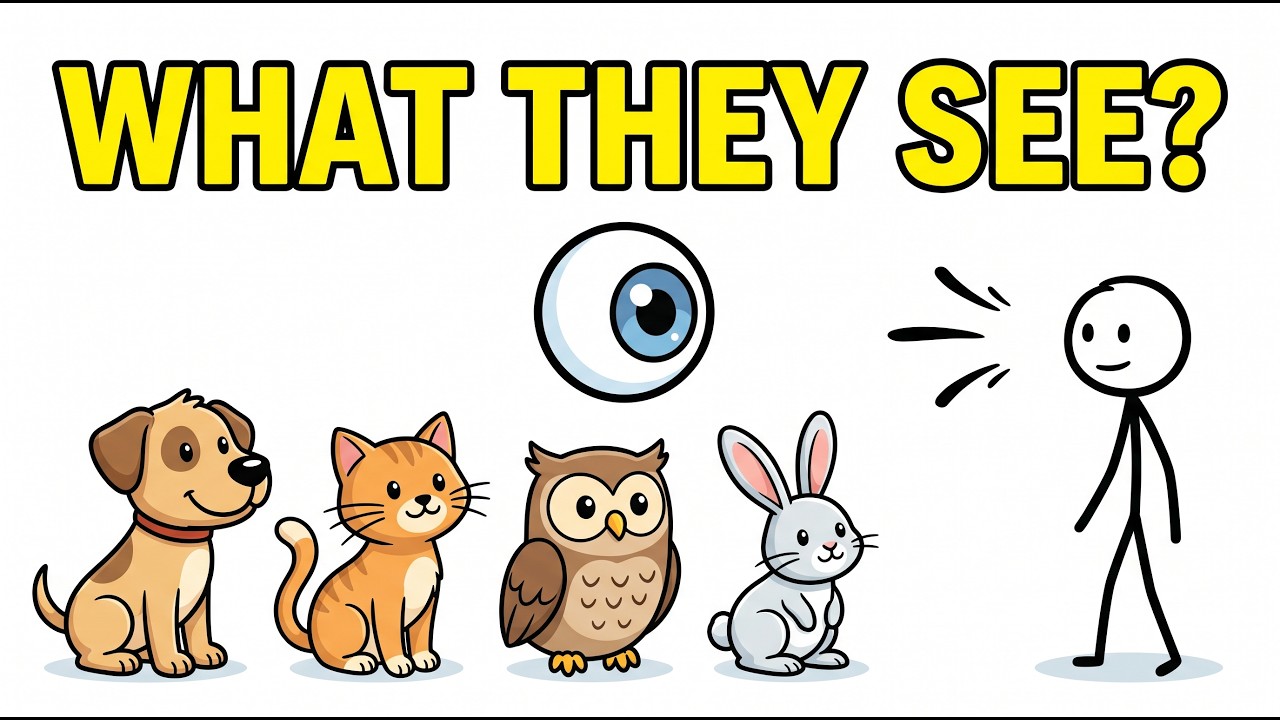
Explores how ancient humans survived darkness before mastering fire using biology, behavior, shelter, and cooperation.
Ask about this video. Answers come from its transcript only — with the timestamp, so you can check them.
Generated from the transcript and can be wrong — check the timestamp.
Key Takeaways
- Darkness removes critical sensory information, making humans vulnerable before fire.
- Survival depended on group cooperation, shelter, and behavioral adaptations.
- Fire was a gradual technological breakthrough that changed human interaction with night.
- Predators actively hunted early humans, confirming the danger of darkness.
- Natural vigilance patterns helped ancient humans manage nighttime risk without formal systems.
What the video covers
- Darkness before fire was not just absence of light but a loss of crucial sensory information, increasing vulnerability.
- Human eyes are adapted for daylight with poor night vision, unlike many nocturnal predators.
- Early humans survived night dangers through a combination of biological traits, social cooperation, shelter, and vigilance.
- Predation evidence, such as leopard attacks on early hominins, highlights real nighttime threats.
- Groups likely maintained natural rotating vigilance without formal night watch systems.
- Shelters like caves and rock overhangs provided partial protection but did not eliminate night dangers.
- Fire was gradually discovered and controlled, transforming nighttime environments by providing light, warmth, and safety.
- Fire did not create a perfect barrier but changed predator-prey dynamics and human behavior at night.
- Modern research on hunter-gatherers suggests varied sleep patterns and natural vigilance in groups.
- The evolving relationship with night involved learning when to sleep, move, listen, and stay together for survival.
Chapters
- 00:00Introduction: The Challenge of Darkness
- 00:57Why Darkness Was a Problem for Humans
- 02:23Human Vision and Nighttime Limitations
- 03:41The Nature of Night and Loss of Information
- 05:07Predation Risks and Evidence from Fossils
- 09:17Group Vigilance and Behavioral Adaptations
- 10:37The Gradual Discovery and Control of Fire
- 15:01Modern Insights and Evolution of Nighttime Behavior
Full Transcript — Download SRT & Markdown
Speaker A
The sun goes down, and the world disappears. No street lights, no glowing windows, no flashlight in your pocket, just darkness. Something moves nearby. A branch cracks in the distance. You listen, but you can't see what caused it. And there is no way to check. For

Speaker A
most of human history, this wasn't unusual. This was night. And before humans could reliably control fire, darkness wasn't simply the absence of light. It changed what you could see, what you could hear, where you could move, and how vulnerable you became. So,
Speaker A
most of human history, this wasn't unusual. This was night. And before humans could reliably control fire, darkness wasn't simply the absence of light. It changed what you could see, what you could hear, where you could move, and how vulnerable you became. So,
Speaker A
and eventually fire. But to understand how humans survived the night, we first have to understand why the darkness was such a problem. Human eyes are remarkably good at seeing in daylight.
Speaker A
how did a primate with poor night vision, no claws, no fangs, and no natural armor survive in a world that never stopped moving after sunset? The answer wasn't one invention. It was a combination of biology, behavior, shelter, cooperation
Speaker A
conditions, but they don't give us the sharp, colorful vision we're used to during the day. So, as the sun disappeared, the world didn't simply become darker. Information began disappearing with it. Edges became harder to distinguish.
Speaker A
and eventually fire. But to understand how humans survived the night, we first have to understand why the darkness was such a problem. Human eyes are remarkably good at seeing in daylight.
Speaker A
And for a human standing in an open landscape, that uncertainty mattered because we weren't necessarily the only ones moving through the darkness. Many predators were better adapted to low light conditions. Some nocturnal or kpuscular mammals have a structure
Speaker A
But darkness exposes their limitations. Our retinas contain two main types of photoreceptors. Cones allow us to see color and fine detail, but they work best when there is plenty of light. Rods become increasingly important as light levels fall. They are sensitive to dim
Speaker A
darkness, night wasn't necessarily a blank space. It was a different visual environment, and humans had to survive in it with far less information. We don't have a recording of an early human waking up in the middle of the night.
Speaker A
conditions, but they don't give us the sharp, colorful vision we're used to during the day. So, as the sun disappeared, the world didn't simply become darker. Information began disappearing with it. Edges became harder to distinguish.
Speaker A
Africa, researchers found the skull of a juvenile paranthropus robust with puncture marks that match the spacing of leopard canine teeth. The evidence has been interpreted as showing that leopards prayed on some early hominins.
Speaker A
Distances became harder to judge. Objects that were obvious in daylight could become uncertain shapes at night.
Speaker A
darkness isn't dangerous because it is dark. It is dangerous because darkness removes information. You cannot see what is approaching. You cannot easily judge distance and you cannot know whether the sound you just heard is meaningless or the beginning of an attack. Before fire
Speaker A
And for a human standing in an open landscape, that uncertainty mattered because we weren't necessarily the only ones moving through the darkness. Many predators were better adapted to low light conditions. Some nocturnal or crepuscular mammals have a structure
Speaker A
is harder to surprise than an isolated individual. More ears can detect a sound. More eyes can scan the surroundings. And if one person reacts to something unusual, everyone else can react, too. Shelter could also change the problem. A rock overhang, cave, or
Speaker A
behind the retina called the tapetum lucidum. It reflects available light back through the eye, increasing the amount of light their visual system can use. That is why the eyes of some animals appear to glow when illuminated at night. For a predator adapted to
Speaker A
danger is reduced. So, how could a group sleep without everyone becoming vulnerable at exactly the same time?
Speaker A
darkness, night wasn't necessarily a blank space. It was a different visual environment, and humans had to survive in it with far less information. We don't have a recording of an early human waking up in the middle of the night.
Speaker A
Across 20 days of observation, there were only 18 minutes when every person in the observed group was recorded as asleep simultaneously.
Speaker A
Behavior doesn't fossilize. So, we have to be careful. We cannot say exactly how every ancient group slept, where every person positioned themselves, or how often they encountered predators. But we do have clues, and some of those clues are unsettling. At Swartkrans in South
Speaker A
Some people naturally became sleepy earlier, others stayed active later. The result looked somewhat like a rotating window of vigilance. But there is an important distinction. This does not prove that ancient humans deliberately assigned nightw watch shifts. The Hadza
Speaker A
Africa, researchers found the skull of a juvenile Paranthropus robustus with puncture marks that match the spacing of leopard canine teeth. The evidence has been interpreted as showing that leopards preyed on some early hominins.
Speaker A
That could have provided an opportunity for vigilance in environments where nighttime danger mattered. In other words, humans may not have needed a formal security system. The group itself could create one. Not perfectly, not consciously, but naturally, at some
Speaker A
The fossil doesn't tell us what happened that night, but it tells us something important. Our ancestors were not imagining the danger. Predators really did interact with early hominins. And that changes how we should think about darkness. For a vulnerable animal,
Speaker A
fire developed gradually. Early hominins may first have exploited naturally occurring fires. Later populations learned to maintain and control them.
Speaker A
darkness isn't dangerous because it is dark. It is dangerous because darkness removes information. You cannot see what is approaching. You cannot easily judge distance, and you cannot know whether the sound you just heard is meaningless or the beginning of an attack. Before fire
Speaker A
ago. Other sites provide evidence of controlled fire use at later dates. At Kessum Cave in Israel, for example, researchers have identified evidence associated with a central fireplace and burned materials dating to hundreds of thousands of years ago. And more recent
Speaker A
became a dependable part of human life, there was no technological solution waiting to be invented. Humans had to work with what they already had, their bodies, their senses, their shelters, and each other. One of the simplest strategies was staying together. A group
Speaker A
humans discovered fire. It was a long technological transition from finding fire to preserving it to controlling it and eventually to making it. And once humans could reliably maintain fire, darkness itself began to change. Imagine sitting beside a fire after sunset.
Speaker A
is harder to surprise than an isolated individual. More ears can detect a sound. More eyes can scan the surroundings. And if one person reacts to something unusual, everyone else can react, too. Shelter could also change the problem. A rock overhang, cave, or
Speaker A
Hands become visible. Faces become visible. Objects become visible. People can move, work, prepare food, and interact after sunset. Fire created a small zone where darkness temporarily lost its power. It also provided warmth.
Speaker A
protected sleeping location could put a physical barrier between humans and the surrounding landscape. But shelter did not make the night disappear. It only reduced exposure to it. And there was another problem. Sleep. When you're asleep, your ability to respond to
Speaker A
automatically fled from every human campfire. Animal responses to fire vary. So fire was not a magical wall. It was something more interesting. It was a way of changing the environment around us.
Speaker A
danger is reduced. So, how could a group sleep without everyone becoming vulnerable at exactly the same time?
Speaker A
darkness can still feel strangely threatening today. Your modern bedroom is not the African savannah. Your locked door is not a cave entrance. A noise in your hallway is usually not a predator, but your brain does not receive a
Speaker A
Modern research gives us an intriguing clue. Researchers studying Hadza hunter-gatherers in Tanzania found something remarkable about nighttime activity.
Speaker A
person. A branch against a window can become movement. A harmless noise can suddenly demand your attention. You don't necessarily fear darkness itself.
Speaker A
Across 20 days of observation, there were only 18 minutes when every person in the observed group was recorded as asleep simultaneously.
Speaker A
Some evolutionary researchers have proposed threat simulation theory. The idea that dreams may sometimes simulate dangerous situations and allow the brain to rehearse responses to threats.
Speaker A
For almost all of the sampled nighttime periods, at least one person was awake or in a lighter stage of sleep. The researchers linked this pattern partly to differences in chronotype and age.
Speaker A
We cannot look into the dreams of ancient humans, and we cannot prove that nightmares evolved specifically as a prehistoric predator training system.
Speaker A
Some people naturally became sleepy earlier, others stayed active later. The result looked somewhat like a rotating window of vigilance. But there is an important distinction. This does not prove that ancient humans deliberately assigned night watch shifts. The Hadza
Speaker A
evidence leaves it. Today, darkness is almost optional. We turn on a light. We illuminate entire streets. We carry screens in our pockets. We install motion sensors and cameras. We lock our doors. We have transformed night into something humans can largely control.
Speaker A
study was conducted on a living human population, not on prehistoric humans. What it shows is that group sleeping can naturally produce periods when some people are awake while others sleep.
Speaker A
night. We slowly changed our relationship with it. For hundreds of thousands of years, our ancestors lived with a world that became less predictable every evening. They learned where to sleep, when to move, when to listen, when to stay together, and
Speaker A
That could have provided an opportunity for vigilance in environments where nighttime danger mattered. In other words, humans may not have needed a formal security system. The group itself could create one. Not perfectly, not consciously, but naturally. At some
Speaker A
somewhere in that darkness, something might have been watching. Your ancestors survived anyway. Not because they could see through the night, but because they learned how to live with what they couldn't see. And then one day they brought the light with them.
Topics:ancient humansdarkness survivalprehistoric firehuman evolutionnight visionearly homininspredatorshunter-gatherersfire controlhuman behavior