Explore how ancient Egyptians managed vision problems without glasses through medicine, social roles, and adaptation.
Key Takeaways
- Ancient Egyptians did not have glasses but used observation, medicine, and social adaptation to manage vision problems.
- Eye diseases were common and treated with various remedies documented in medical texts like the Ebers Papyrus.
- Not all vision problems can be corrected by glasses; many required different approaches including social support.
- Vitamin A-rich foods were used to treat night blindness, showing early empirical medical knowledge.
- Visually impaired individuals still held valued social roles, highlighting community-based survival strategies.
What the video covers
- Ancient Egyptians lived without corrective glasses but still accomplished precise work and daily tasks.
- Presbyopia, or age-related difficulty focusing on close objects, was common but did not render people useless.
- Glasses only correct certain vision issues and do not cure infections, cataracts, or blindness.
- The Ebers Papyrus documents ancient Egyptian eye diseases and treatments, showing eye problems were common.
- Trachoma, a bacterial infection causing eyelid scarring and blindness, was a serious threat in dusty environments.
- Egyptian treatments included oils, resins, and minerals, some possibly effective despite limited scientific understanding.
- Night blindness treatments sometimes involved liver, rich in vitamin A, showing observational knowledge preceding scientific explanation.
- When vision loss was permanent, social roles like the blind harpist allowed visually impaired individuals to contribute meaningfully.
- Ancient societies adapted by reorganizing life around biological limitations rather than relying solely on technology.
- Human survival depended on community and shared knowledge rather than individual physical perfection.
Chapters
- 00:00Introduction: Vision Problems Without Glasses
- 01:06Presbyopia and Aging in Ancient Egypt
- 01:54Understanding Different Vision Issues
- 03:04Medical Evidence from the Ebers Papyrus
- 04:10Eye Infections and Treatments
- 05:10Empirical Knowledge and Vitamin A
- 06:58Social Roles for the Visually Impaired
- 08:46Community and Adaptation Over Technology
- 10:57Conclusion: Survival Through Observation and Adaptation
Full Transcript — Download SRT & Markdown
Speaker A
Imagine waking up tomorrow and discovering that your vision has become blurry. Not blind, not completely, just blurry enough that the world has lost its sharp edges. You reach toward your bedside table for your glasses. They're gone. No contact lenses, no optometrist,
Speaker A
no eye exam, no pharmacy selling reading glasses. And whatever is happening to your eyes may never be fixed. For most of us, that sounds terrifying. But for the people of ancient Egypt, it was simply reality. They built monuments
Speaker A
with astonishing precision. Scribes copied dense columns of hieroglyphs. Craftsmen produced intricate jewelry. Farmers navigated a landscape shaped by the Nile. Yet, they lived thousands of years before corrective spectacles existed. So, how did ancient Egyptians survive without glasses? The answer
Speaker A
turns out to be stranger than simply finding an ancient substitute for modern technology. Because the first thing we need to understand is this. Bad eyesight is not one problem. And glasses would not have solved most of the problems
Speaker A
ancient Egyptians actually faced. Imagine an Egyptian scribe. Every day he sits with a scroll covered in tiny symbols. For years, his eyes can focus effortlessly. Then something changes.
Speaker A
The writing hasn't changed. His hands haven't changed. His knowledge hasn't changed. But slowly bringing nearby objects into focus becomes harder. This is a problem almost every human eventually encounters.
Speaker A
It's called presbyopia. As we age, the lens inside the eye gradually becomes less flexible. Focusing on nearby objects becomes increasingly difficult.
Speaker A
Today, the solution can be almost trivial. Reading glasses. For an ancient Egyptian, there were no reading glasses.
Speaker A
And yet aging didn't make a person useless. That distinction may be central to understanding how ancient societies dealt with imperfect vision. A person's abilities were never contained entirely inside their eyes. Knowledge, memory, experience, physical skill, and social position could remain even as biological
Speaker A
abilities changed. But aging was only one problem. Human vision can fail in many different ways. Someone might struggle to see distant objects. Someone else might struggle with close-up work.
Speaker A
Someone could lose their vision in darkness. And someone could suffer infection, injury, inflammation, or blindness. These problems are fundamentally different. And this is where our modern intuition can mislead us. When we hear the words bad eyesight, we immediately think they needed
Speaker A
glasses. But glasses only correct certain problems involving the way light is focused onto the retina. They don't cure infection. They don't remove cataracts. They don't repair an injured eye. They don't cure blindness. So before asking what ancient Egyptians
Speaker A
used instead of glasses, we need to ask a more basic question. What was actually damaging their eyes? And remarkably, ancient Egypt left us evidence. Around 1550 B.C.E., Egyptian physicians compiled one of the most extraordinary medical documents from the ancient world. Today
Speaker A
we call it the Ebers Papyrus. The scroll contains numerous medical prescriptions, including an extensive section devoted to diseases of the eye. That fact alone tells us something important. Eye problems were not rare enough to ignore.
Speaker A
Egyptian physicians encountered them often enough to record treatments. The conditions described appear consistent with a wide range of eye disorders, inflammation, eyelid problems, clouding of the eye, night blindness, and infections. One of the most devastating was likely trachoma. Trachoma is caused by
Speaker A
bacterial infection. Repeated infections can scar the inside of the eyelid. Eventually, the eyelashes can turn inward. With every blink, they scrape against the surface of the eye.
Speaker A
Untreated, the damage can become permanent. In a hot and dusty environment where communities lived closely together, eye infections could be a serious threat. This was not a problem that a pair of glasses could solve. So, Egyptian medicine attempted
Speaker A
something else. Treatments recorded in ancient texts included mixtures of oils, resins, minerals, and other substances applied to the eye. Some of these remedies probably did little. Some may have caused irritation.
Speaker A
Others may have contained ingredients with properties that genuinely affected symptoms. We should resist the temptation to imagine ancient Egyptian medicine as secretly modern science. It wasn't. Egyptian physicians didn't know about bacteria. They didn't understand retinal chemistry. They didn't know how
Speaker A
light was focused by the eye. But that doesn't mean their medicine was random. It was built from generations of observation. People noticed symptoms.
Speaker A
They tried treatments. Some practices were repeated. Others were preserved in writing. And occasionally, those ancient observations may have stumbled surprisingly close to biological truth.
Speaker A
One example involves something even more mysterious. Imagine that the sun has disappeared. The Nile Valley is dark. Shapes that were clear during the day begin to dissolve into shadows. For someone with night blindness, darkness doesn't simply become inconvenient.
Speaker A
It becomes a different world. Night blindness can have multiple causes. But one of them is vitamin A deficiency. And vitamin A is essential for normal vision. Here is where ancient Egyptian medicine becomes particularly fascinating.
Speaker A
Ancient Egyptian medical texts included treatments involving liver for problems associated with poor vision in darkness. Today we know that liver is one of the richest natural sources of vitamin A.
Speaker A
That doesn't mean Egyptian physicians understood vitamins. They didn't. And we cannot assume every case of night blindness described in ancient texts was caused by vitamin A deficiency. But the possibility is remarkable. A person notices a pattern. Someone struggles to
Speaker A
see at night. A particular food is used as treatment. Thousands of years later, biology discovers that the food contains a nutrient essential to the visual system. This is not proof of modern scientific understanding hidden in antiquity. It's something arguably more
Speaker A
interesting. Human beings can discover useful patterns long before they understand the mechanisms behind them. Observation can come before explanation. But medicine had limits and sometimes no remedy could restore what had been lost.
Speaker A
Cataracts could cloud the lens. Infections could scar the eye. Injuries could permanently damage vision.
Speaker A
Eventually, some people would become partially sighted. Others would become completely blind. This brings us to perhaps the most important part of the story. What happened when the eye could not be fixed? The answer may not have been found in medicine. It may have been
Speaker A
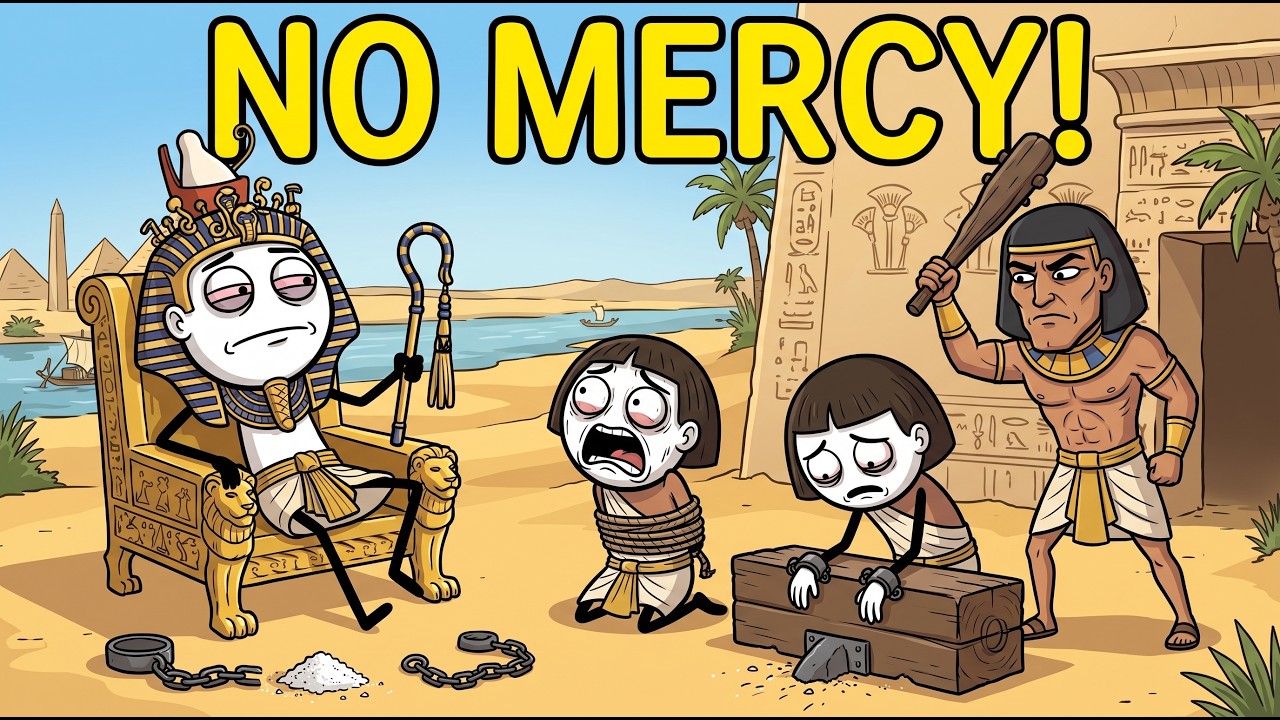
found in society. Ancient Egyptian art repeatedly depicts a fascinating figure, the blind harpist. In tomb paintings, musicians are sometimes shown with visual characteristics interpreted as blindness. This image appears repeatedly, particularly in New Kingdom art. We must be careful about what this
Speaker A
proves. Ancient art is not a census. A painting cannot tell us exactly how every visually impaired person was treated. And we should not romanticize ancient Egyptian society as some kind of perfect sanctuary for people with disabilities. Life with blindness was
Speaker A
almost certainly difficult. But these images reveal something important. A person who could not see could still occupy a recognizable social role. A musician did not need perfect distance vision to perform. Memory mattered.
Speaker A
Hearing mattered, touch mattered, years of practice mattered. The loss of one biological ability did not necessarily mean the loss of every useful ability.
Speaker A
And perhaps that is one of the oldest solutions humans ever developed. Not fixing every weakness, but reorganizing life around it. Think about how different that is from our modern assumptions. Today, we often imagine the individual human body as something that
Speaker A
should function independently. If your eyes fail, you buy glasses. If your hearing declines, you get a he...
Speaker A
should function independently. If your eyes fail, you buy glasses. If your hearing declines, you get a hearing aid.
Speaker A
If your mobility changes, you search for technology that restores independence. Ancient societies had far less technology, but they possessed something else, other people. Human survival has never been an individual achievement. A farmer could know a field so well that
Speaker A
visual precision wasn't necessary for every task. A skilled craftsman could eventually teach younger hands. A musician could rely on hearing rather than sight. Family members could guide an elderly relative. Communities could redistribute work according to ability.
Speaker A
We cannot reconstruct every adaptation used by every Egyptian. The evidence simply doesn't allow it. But the broader principle is difficult to escape. Humans survive not because every individual body is perfect, but because human societies are flexible. And this may be
Speaker A
the real answer to our original question. Ancient Egyptians didn't survive without glasses because they discovered some lost Egyptian version of spectacles. There is no convincing evidence of that. Corrective eyewear simply did not exist during the great span of ancient Egyptian civilization.
Speaker A
The first wearable spectacles would not appear until thousands of years later. But perhaps asking what Egyptians used instead of glasses was the wrong question from the beginning because not every visual problem requires the same solution. Some problems could be treated, some could
Speaker A
possibly be prevented, some could be managed, some could be compensated for, and some simply had to be endured.
Speaker A
Ancient Egyptian medicine attempted to treat disease with the tools available. Observation sometimes led physicians toward remedies that may have contained genuine biological value. But medicine could not repair everything. And when it failed, the individual didn't necessarily disappear from society. Life
Speaker A
adapted around the limitations of the body. Return now to that Egyptian scribe. Imagine his vision beginning to change.
Speaker A
At first, perhaps he holds the writing slightly farther away. Perhaps fine work becomes slower. Perhaps younger eyes eventually perform tasks that his aging eyes can no longer do easily. But his knowledge remains. His memory remains.
Speaker A
Everything he learned over decades remains. His eyes may have changed, but the person did not suddenly become useless.
Speaker A
That may be the deepest difference between how we think about vision today and how people experienced it for most of human history. We live in a world where blurry vision feels like a technological problem. Something is wrong. Something needs fixing. And
Speaker A
usually it can be. For ancient Egyptians, vision was more unpredictable. Sometimes medicine helped. Sometimes it didn't. Sometimes the body adapted. Sometimes society adapted and sometimes people simply continued living with limitations that modern technology has taught us to forget. So how did ancient Egyptians
Speaker A
survive without glasses? Not through a secret invention. Not because their eyesight was somehow perfect and not because they had discovered ancient optical technology lost to history. They survived the way humans have always survived biological imperfection through observation, adaptation, medicine, skill, and perhaps
Speaker A
most importantly through other people. Because the remarkable thing about human civilization is not that we evolved perfect bodies. We didn't. Our eyes age, our joints weaken, our hearing fades, our bodies accumulate damage. What makes humans unusual is what happens next.
Speaker A
When biology fails, we don't always stop. We change the environment. We change the task. We invent tools. We share knowledge. And sometimes when there is no tool at all, another human being becomes the thing that helps us see. Perhaps that is the strangest
Speaker A
answer of all. Ancient Egyptians didn't need to defeat every weakness of the human body. They only needed to find a way to keep living with it. And for thousands of years they
Topics:Ancient Egyptvision problemspresbyopiaEbers Papyruseye diseasestrachomaancient medicinenight blindnessvitamin Asocial adaptation