Skip to content
Get App

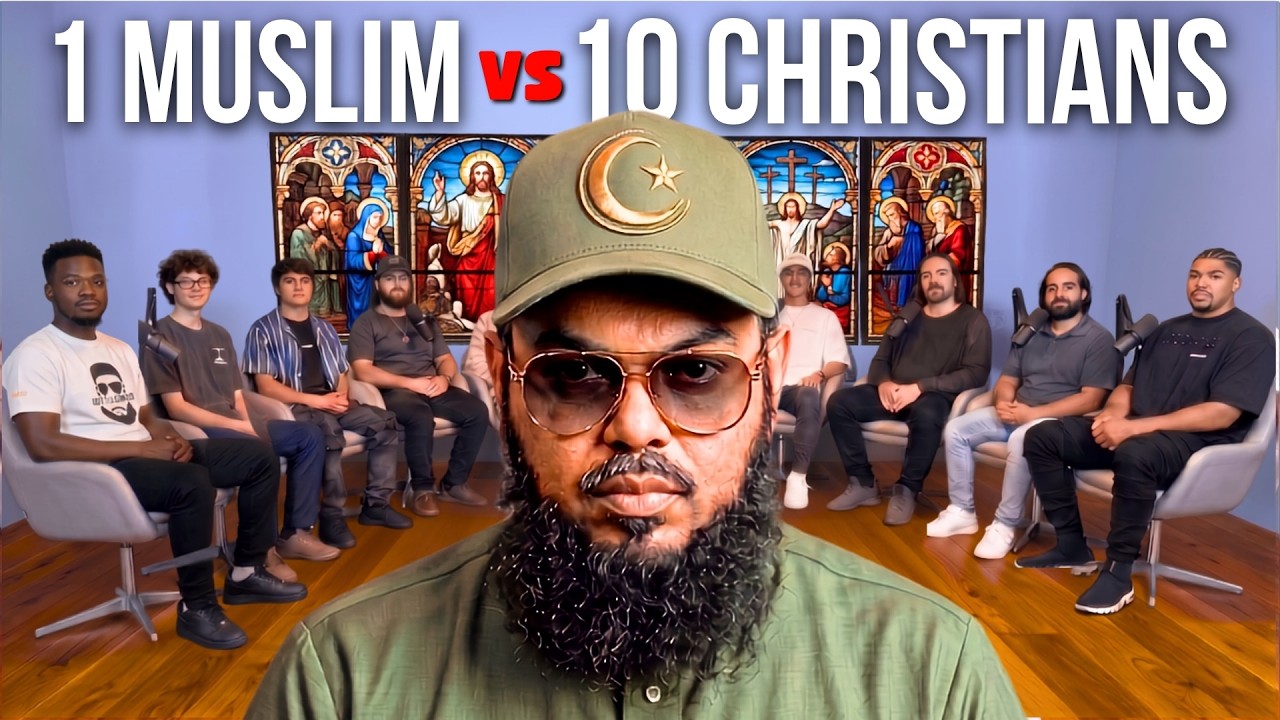
1 Ex-Muslim vs 10 Muslims

A moderated debate on whether Islam is compatible with the West, featuring a former Muslim and Muslim speakers who contest Quranic verses on jizya, fighting non-believers, and religious equality.

Key Takeaways

  • The core dispute is whether Islamic scripture, particularly Quran 9:29, is compatible with Western ideals of equality and religious liberty.
  • Participants disagree on whether verses about peaceful neighbors qualify or override verses calling for fighting non-believers.
  • Individual Muslims living peacefully in the West is distinguished from the question of whether the religion itself aligns with Western values.
  • The debate features contested historical and theological claims about Islam, Christianity, and Muhammad that are not resolved within the episode.

What the video covers

  • Host Justin Admiral Gibbs moderates a debate titled '1 Ex-Muslim vs 10 Muslims' on the Digital Social Hour podcast.
  • The first prompt is whether Islam is compatible with Western values, with the ex-Muslim speaker arguing it is fundamentally incompatible.
  • The ex-Muslim speaker argues Western intrinsic human dignity and equality before God conflict with Islamic teachings on religious hierarchy.
  • A Muslim speaker from Chad argues Islam teaches peace and that individual Muslims can live anywhere, distinguishing individual actions from the religion itself.
  • The debate centers heavily on Quran 9:29 (fighting and jizya for People of the Book) and 98:6, with disagreement over whether verses about not being unjust to peaceful neighbors soften these passages.
  • Speakers repeatedly talk past each other, with participants accusing one another of responding to points not made.
  • Later segments touch on Islamic law support among British Muslims, violence in early Islam versus early Christianity, and whether Muhammad was a prophet.
  • A later topic addresses whether Jesus was intended as the final prophet, citing biblical statements about being sent to the lost sheep of Israel.
  • Several claims made in the video, including statistics on terrorism, are asserted without verification in the transcript.
  • The episode is framed as a provocative debate format rather than a neutral academic analysis.

Answers

Questions about this video

What is the main question debated in this video?

The main question is whether Islam is compatible with Western values. The ex-Muslim speaker argues it is fundamentally incompatible, while the Muslim speakers argue Islam teaches peace and that Muslims can live anywhere.

Which Quranic verses are central to the discussion?

Quran 9:29 about fighting non-believers and paying jizya, and Quran 98:6 about People of the Book, are central. Speakers disagree over how these verses should be interpreted in light of other verses about peaceful coexistence.

Does the debate reach a conclusion?

No clear consensus is reached. The discussion often becomes repetitive, with speakers accusing each other of misrepresenting arguments, and several topics are left unresolved.

Full Transcript — Download SRT & Markdown

00:00
Speaker A
And I'm conservative, and 57% of the terrorist attacks in the United States are from far right-wing individuals.
00:08
Speaker A
The West doesn't know enough about Islam. If you knew more about Islam, you would be terrified of it.
00:13
Speaker A
Islam is the major contributor to deadly terrorist attacks in the world. The biggest, by far, the biggest contributor to religious terrorist attacks in the world. Islam is a religion of honor.
00:25
Speaker A
Islam respects and honors and is kind to its neighbors. There is no United Islamic Caliphate going out and conquering the world today. It is that the West imposed it, and I thank the West for doing that.
00:45
Speaker A
All right, welcome in to another exciting episode of the Digital Social Hour with Sean Kelly. I am not Sean Kelly. I'm Justin Admiral Gibbs, special guest moderator. I don't have a suit on today because we've got to catch a flight. But
00:55
Speaker A
that doesn't mean this debate's any less serious. We're going to have Mr. Apostate Prophet here versus several individuals that are pro-Islam today, and it's going to be exciting. Why don't you go ahead and read us your, well,
01:06
Speaker A
tell us who you are first. First off, you go ahead and tell us who you are. You want me to go with the prompts? Yeah, go ahead with the prompt. I guess we'll go with that first.
01:19
Speaker A
Okay, so I have three prompts ready. The first prompt that we're going to discuss will be that Islam is not compatible with the West. All right, and give us your intro. That's it. I think that Islam is not compatible with the West. I think that Islam is, contrary to what many
01:34
Speaker A
Muslims claim nowadays, actually very much at conflict with the West, and that Islam cannot be reconciled with the West, that Islam is necessarily, fundamentally, and foundationally in contradiction with the West and actually a threat to the West.
01:51
Speaker A
All right, go ahead, sir. [clears throat] Thank you. Thank you for having me. I'm from Chad, Central Africa. I'm an author, entrepreneur, and diplomat.
02:05
Speaker A
I wrote Islam in My Heart as a practical guide to Quranic ayat and daily duas.
02:10
Speaker A
I'm also a founder of Judi Foundation and Tim Chad Clothing. Through my platform, I educate and inspire people.
02:19
Speaker A
Back to your contradiction about Islam not being compatible. Islam is compatible. I believe it's compatible.
02:26
Speaker A
As a Muslim, we don't have one place. We don't have one location. So we can live everywhere. We can live everywhere in any society.
02:35
Speaker A
Islam teaches us to be peaceful, honest, and respectful. So we are compatible to live everywhere.
02:45
Speaker A
Well, that is not what I said, though. I agree with you. I think Muslims can live everywhere. I think Muslims can live in the West. I think Muslims can actually pursue a very good life in the West. Muslims can also occasionally
02:57
Speaker A
become contributors to the West. Muslims can establish communities in the West. Muslims can, you know, prove to be able to live in the West. But my position here, my prompt, is very specific. It is that Islam itself is not
03:12
Speaker A
compatible with the West. So what I'm saying is not that you can't be in the West or that you can't fit into the West. I'm saying that Islam, fundamentally, the religion itself, does not work together with Western ideals.
03:26
Speaker A
For example, when we talk about the West, we're talking about certain values that we hold, such as intrinsic human dignity, which actually comes from Christian ideas, that all humans are equal before God and created in the image of God. Islam
03:40
Speaker A
doesn't agree with that. Islam doesn't hold that all human beings are equal. Islam doesn't hold that all human beings should be equally judged or that all human beings can equally exist in a society like the West.
03:53
Speaker A
Islam's idea of grouping people into religious groups and then judging them, and even persecuting them based on their religious beliefs, is in direct contradiction with fundamental Western beliefs. For example, I know you're shaking your head, but
04:14
Speaker A
in chapter, I don't agree with that, and as I said, I will let you finish. I will let you finish your... I'll let you finish. So, for example, in chapter 98:6 of the Quran, it says,
04:26
Speaker A
"Indeed, those who disbelieve among the People of the Book and the polytheists will be in the fire of Hell to abide therein forever. They are the worst of all creatures." So the problem here is not that it says that disbelievers will go to
04:37
Speaker A
Hell. It says that they are the worst of all creatures. In chapter 9:29 it says that Muslims are to fight those who disbelieve, fight those who don't believe in Allah and His Messenger and who do not adopt the religion of truth,
04:50
Speaker A
that is Islam, from among the Christians and Jews, and fight and subjugate them and take protection money, jizya, from them. These things make Islam incompatible with the West.
05:02
Speaker A
Again, we are compatible. We can live anywhere in society, and this is individual action. So you cannot define the whole religion with one action of an individual. Islam teaches peace, patience, respect. And Islam also teaches justice
05:20
Speaker A
and good character. In the Quran, Allah says, "O you who believe, fulfill your contracts." Our contract is to live peacefully amongst our neighbors. Okay, but you were once again responding to something that I didn't say. I
05:38
Speaker A
already agreed with you. Muslims can live in the West, and individual Muslims can very well exist in the West and, you know, do whatever they want. That does not mean that Islam is compatible with the West. I have the
05:52
Speaker A
Quran right here. Do you have a Quran with you? I do have the Quran with me.
05:57
Speaker A
So in the Quran, chapter 9, I have it right here for you. I have it opened up if you want to read it. This is Sahih International, chapter 9, verse 29.
06:05
Speaker A
It says, "Fight against those who do not believe in Allah or in the Last Day and who do not consider unlawful what Allah and His Messenger have made unlawful and who do not adopt the religion of truth, from those who were given
06:18
Speaker A
the Scripture, until they give the jizya willingly while they are humbled." So, but Allah teaches, Allah... with what Muslims do and what Muslims say. I'm not judging this based on what certain
06:35
Speaker A
Muslims do or do not do. I judge this by what the Quran itself teaches and what Islam teaches.
06:41
Speaker A
Allah does not forbid us from being kind. Allah says you don't have to fight those who don't fight you. You have to be kind toward those who don't fight you, because the religion explains clearly that Allah loves those who act justly. So we
07:01
Speaker A
can live anywhere in the West, anywhere. We don't have geographic localization. Islam is everywhere in the world.
07:09
Speaker A
Okay, but notice what you just said. You just said that Allah does not forbid you from dealing justly.
07:14
Speaker A
No, I didn't say forbid you. Allah does not forbid you from being kind.
07:20
Speaker A
No, that's what I just said. So that's what you say. Or just, it does not forbid... Allah does not forbid you from being kind to those who disbelieve. It doesn't say be kind to everyone who disbelieves.
07:30
Speaker A
No, to those who have not fought you. So to those who have not fought you.
07:36
Speaker A
Okay. Yeah. Does it say, because of your religion, does it say be kind, nor expel from your homes? Indeed, Allah loves those who act justly. This is what I said.
07:45
Speaker A
Does it say tolerate and be nice and be good and host all those? Yes, be kind, be peaceful. No, you just be respectful, be honest. You just read it yourself. It says Allah does not forbid you. That doesn't mean always be
07:58
Speaker A
nice and always be tolerant and always be good to those who don't fight you. It means Allah does not forbid you from being nice.
08:05
Speaker A
Allah does not punish you. Yeah, Allah does not punish you. Okay, which is not in contradiction.
08:11
Speaker A
Okay, which is a contradiction. We have to live with our neighbors. And even the Bible says, "Love your neighbors as yourself," Mark 12:31.
08:19
Speaker A
I know that's what the Bible says. The Bible says... I know that's what the Bible says. The Quran does not say it.
08:23
Speaker A
The Quran says the Quran says live just leave live peace peacefully and respectfully. Okay, let's get back to chapter 9 29. Do you agree that the Quran does say there very clearly that you are supposed to fight those who do not believe in Allah
08:38
Speaker A
and his messenger and who do not adopt Islam as as the true religion? Not fight. Uh Islam respect all religion. Not fight.
08:47
Speaker A
Can you can you read to me what chapter 9 verse 29 says? You say chapter 9 verse 29 verse 29.
09:04
Speaker A
I have it right here. If you don't trust my it's a it's an Islamic Quran chapter 9 verse 29. It starts with fight against.
09:20
Speaker A
It says fight those who not believe in God in the last day nor comply with what God has his messenger and have forbidden nor embrace religion of truth from amongst those who are given the scripture until they pay the tax and willingly
09:39
Speaker A
submit fully h fully humble it. Okay. This is in this is in different this this is in different context. This is a comm command of fighting.
09:49
Speaker A
Yeah, this is and fighting who? This is this is this is in different context. This is not Islam didn't say that directly fight those who does doesn't believe. We don't fight. We don't persecute.
09:59
Speaker A
You just read it. The Quran literally says fight against those who do not believe in Allah in the in this uh in the last day who do not consider unlawful what Allah and his messenger have made unlawful yada yada yada. It
10:09
Speaker A
says fight against those who don't believe and who don't accept Islam. fight and humiliate them and take protection money from them.
10:17
Speaker A
This is this is in different context. This isn't the command to fight. This is uh fighting those who not not believe in God. Fighting those who not believe in God in the last day nor comply with God his message forbidding.
10:30
Speaker A
So this is in different context. The Quran the Quran and Islam didn't say directly to fight not non-believer.
10:39
Speaker A
This is this is one of the command. This is Sharia the command. I can explain to you the context here directly. Okay, the context here starts with um chapter 20 uh chap the same chapter verse 28. It says, "Oh you who have believed indeed
10:52
Speaker A
the polytheists are unclean. So let them not approach al masid al-h haram which is the cabba after this their final year. And if you fear privation, poverty or loss of money, Allah will enrich you from his bounty if he will." So what
11:07
Speaker A
Allah tells the Muslims to do is to forbid the polytheists from approaching Mecca after this time after the Muslims have conquered.
11:15
Speaker A
No, no, no. This is not what Allah says. Allah says no more adulter adultery. So at the cabba. So he prevent where do you adultery from the cabba?
11:25
Speaker A
Where do you read this in the in the verse? You know it's here. It's here. No no no more adultery at the cabba.
11:32
Speaker A
Adultery at the cabba. Where in the verse? So no more adultery at the cab.
11:35
Speaker A
The verse do you read this? It's here. Oh believer indeed. I don't know what you're reading.
11:41
Speaker A
Don't let them approach the secret mosque after this year. Yeah. If you fear poverty, God will enrich you or of his bounty.
11:51
Speaker A
Yes. If he will surely God is all knowing. Okay. All wise. Where does it say adultery?
11:58
Speaker A
Idolatry is here. It's here. You mean you mean idolatry? Yeah. Idolatry. Yes. adultery. He says no more adultery. So the Cabba is this is in the context of make the Cabba because the Cabba is a secret place to
12:13
Speaker A
we know this. We know the polytheists were idoltors. What he says is don't let them approach the our secret palace where we pray where we pray our secret uh mosque uh the Cabba.
12:24
Speaker A
Okay. That's not the topic. I know I know polytheist. This is what you just read.
12:29
Speaker A
Polytheists are idoltors and they are not supposed to approach the cab. I'm just reading the context to you. So the context is the polytheists who are unclean, who are idolatrous are no longer allowed to approach the kaba after this point. However, you notice it
12:42
Speaker A
says it if you fear poverty, Allah will enrich you. Why fear poverty? Because the polytheist, the idolaters were actually enriching the place.
12:50
Speaker A
Yes. Allah says Allah even the Quran says and they were selling stuff. They were selling stuff. They were doing commerce.
12:57
Speaker A
Exactly. One at a time. One time. Sorry. Go ahead. Go ahead. So if you if you fear poverty so if you if you leave if you push the p the polytheists away away you might have poverty in the region because
13:08
Speaker A
the merchants are no longer be therefore in the next verse it tells you to fight against those who don't believe in a line let's clear the first one the first verse 2 that's just the context let me finish let me finish
13:21
Speaker A
those people were enriching enriching the cabba and Mecca and Muslims are no longer to supposed to benefit from this they are supposed to ban the idolist from because of that because it says if you fear poverty Allah will enrich you. It
13:35
Speaker A
then goes to verse 29 and says fight those who don't believe in Allah and who don't adopt the religion of truth that is Islam from among the Jews and Christians and tells the Muslims to fight and take protection money from
13:48
Speaker A
them. Now that the Muslims have stopped the polytheads from coming to the Cabba, they have made significant financial losses. Which is why Allah instructs them to go and fight the Christians and Jews to take protection money for them
13:59
Speaker A
to make up for their losses. Allah is is big. Allah says when he says do not do not worry, I'll make you rich even in the Quran he says Allah Allah mercy is so huge.
14:12
Speaker A
He prevent them. He said prevent them to come do adultery there. adultery there. So because as a secret place, okay, you know, but Allah rah because they didn't show up, Allah is not gonna stop.
14:25
Speaker A
It's big. Allah is so huge. I mean, I wasn't going I wasn't expecting somebody to disagree with me on this. So I would have pulled up all the taps.
14:31
Speaker A
I disagree with you because I disagree because Islam is peaceful religion. Islam Islam teaches kindness.
14:37
Speaker A
You know, that's very nice. But you are disagreeing with the historical context here. Context in the taps, the interpretations by Islamic scholars.
14:45
Speaker A
This is a taps. We go we go by the Quran. We don't go by the taps.
14:49
Speaker A
Okay. But you are just making up your own interpretation. We go I'm not I'm not I'm I'm clearly telling you why Allah says because they they worshiping they worshiping uh statues. They worshiping statues. They come in there. They're selling stuff and
15:02
Speaker A
then it's not going it's not it's not matching with Islam offering. Okay. We don't worship no statue. We worship Allah subhana wa tala the one. agree with me that in then in verse 29 it says to fight those who don't believe in
15:18
Speaker A
Allah and who don't who don't adopt Islam as true religion no this you showing you show in hadith you show in hadith say that we go by the Quran we don't go by hadith I'm I'm reading you we just read dude we
15:29
Speaker A
just had the no we just read the verse we just read the verse in chapter in verse 29 it says fight those Christians and Jews who don't accept Islam as the true religion and take protection money from them. This is what matters here.
15:45
Speaker A
Islam commands Muslims to go and fight the Christians and Jews and to take protection money from them if they do not accept Islam as true religion.
15:54
Speaker A
I don't agree. Respectfully, I don't agree with you. Scholar knows that because this is what I don't agree with you. Islam teaches to be peaceful to be honest. Okay.
16:03
Speaker A
We don't persecute. We don't denying what the Quran tells you. No, the Quran didn't say that. You just said it hadith.
16:09
Speaker A
We just read it. You can't. We just read the verse, man. The Quran didn't say that.
16:14
Speaker A
We just read the verse 29. Do you want to be Islam teaches peace? Islam teaches peace, respect, and we can live in any society and we have to contribute.
16:23
Speaker A
Dude, if you want to come into the debate and and deny what we just read before our eyes.
16:28
Speaker A
I don't agree that Islam Islam tell us to fight our neighbors. Islam tell us to live. Even the Bible, your Bible said that say love yourself for love love your neighbor as you love you love you love your neighbors as yourself.
16:42
Speaker A
Does the Quran say that? And the Quran say that Allah says oh believer fulfill your contract. Our contract is what?
16:50
Speaker A
No. Does the Quran also say the contract is to live with your neighbor and to be to live with your neighbor and to be to live justly.
16:58
Speaker A
Okay. So we have just established we have read it here. Everybody can see that the Quran says to fight those who don't believe in Allah and who don't who don't adopt Islam as true religion to fight those and to take
17:09
Speaker A
and again to go to go back to go back to your your Bible unfortunately our Muslim uh interlocutor and debater denies what we have just read here before our eyes which not even Muslim scholars deny. So the Quran
17:21
Speaker A
clearly commands the fighting and the I'm not a Muslim scholar. I'm a student. I'm not a Muslim scholar.
17:26
Speaker A
Clearly you're not. I know. I'm a student. I know clearly. So even even go back to your Bible.
17:32
Speaker A
Matthew Matthew 5:9 says, "Blessed are the peacemaker." In Islam, we are the peacemaker. Wherever we go, we are the peacemaker. We always find a way to live justly and peacefully with our neighbors.
17:46
Speaker A
So here's the problem. You as a person might be a very good person. You as a Muslim person.
17:52
Speaker A
No, you're not judging the religion right now. What you're talking, you're judging the individuals too. You're talking about the individuals. You say you persecute because I'm telling you about the religion, not me. Let let myself let let my personality. I'm
18:03
Speaker A
talking to you about the religion. Let me make my point. Go ahead. You as a person and you as Muslims might very well be uh integrated or good individuals. You might be kind. You might be nice. You might be okay. Only
18:15
Speaker A
Allah knows. You might be good. Only Allah knows. You might be. As I said, I don't say that you are. You might be. However, Islam is the problem. There are lots of Muslims in the world who don't who don't
18:24
Speaker A
hold what you hold. They read the scripture just as I read it, which is how Muslims have read it for a,400 years. And they make it their mission to go and fight the disbelievers. For a,400 years, Islam spread vastly to most of
18:37
Speaker A
the land that it spread today, most of the Muslim world. It spread through warfare. Islam didn't grow with like giving out invitations and roses and all that. Islam conquered most of the Muslim world by the year 750 AD through
18:50
Speaker A
warfare. And it did that because of Do you know what? Can you tell me one other religion different than Islam teach monotheism to worship one God?
19:00
Speaker A
Yeah. Without any partner. Yeah. Christianity. It's Islam. It's Islam. Yeah. It's Christianity. And you know why? One thing Islam preserved the Quran 1400 years.
19:10
Speaker A
The problem is what does this have to do with the topic? Yeah. The topic I'm telling you how Islam how Islam is just how Islam is fit to live anywhere in the world.
19:18
Speaker A
Okay. The Quran since 114 years the Quran is still the same. And Islam challenged the humanity to show to show the opposite. Nobody can come up and show the opposite. Islam is a true religion. That's very cool. Um the other
19:35
Speaker A
western value is that u we have equality before the law for all people. In Islam, you don't have equality before the law.
19:42
Speaker A
For example, in Quran 4 verse 11, it says that women or that girls Let me check before it might be a hadith. You're saying only inherit. It might be a hadith because you you you keep reciting a bunch of hadith.
19:54
Speaker A
What hadith? I literally just said Quran. Do you know what Quran mean? So I have to check. I have to make sure.
19:58
Speaker A
[clears throat] Can you repeat which which Quran verse you read? Quran 4:1. I can read it to you too while we have the Quran. I can check it too.
20:06
Speaker A
Quran 4 verse 11. I'm not sure why you're talking about hadith. I literally said Quran. Allah instructs you concerning your children. For the male what is equal to the share of two females.
20:17
Speaker A
This is a law in Islam. According to to Islamic inheritance laws, fem women or girls only inherit half of what uh boys or men inherit.
20:28
Speaker A
Similarly based on that you have hadiths you have other things established in Islamic law and Islamic which uh always have made it the rule that men and women are not equal before the law and that girls or women only inherit half of what men
20:45
Speaker A
inherit or that the testimony of women in front of a court is only worth half that of a man. This is incompatible with with western values.
20:54
Speaker A
This is this is a this is a Sharia law. This is Sharia law. This is Islam of and this is obligation from God and surely Allah knows and he's all wise.
21:02
Speaker A
Okay. So do you agree that according to Islam a girl only inherits half of what a boy inherits?
21:08
Speaker A
I agree this is a shar. Okay. That means Islam is not Islam is not compatible with western values.
21:13
Speaker A
That's the point. The west the western value is the location is the country. Islam is a religion.
21:18
Speaker A
Okay. But the debate is as you may have noticed Islam is not compatible with the west.
21:22
Speaker A
I understand. So it is not compatible with the west. It is compatible. It is compatible. We don't ask people to agree with Islam.
21:30
Speaker A
Okay? You know, we ask people to learn about Islam. You have to learn about Islam.
21:34
Speaker A
Okay. Do you agree? We don't ask you to agree with You have to learn Islam. You have to understand Islam.
21:38
Speaker A
Okay. In Western values, people are equal before the law. In Islam, they are not equal.
21:45
Speaker A
Everybody's equal. Um in God eyes, everybody. [clears throat] You just read it. They're not equal before the law.
21:52
Speaker A
No. No. This is a Sharia. This is a Sharia. You cannot say man and a woman are the same. You can't say that.
21:57
Speaker A
I don't say they are the same. I say they're equal. So that's why I said only Allah know he's he's all wise.
22:03
Speaker A
Okay. So then you agree with me that Sharia is not is is not compatible with western values. That's the discussion we have.
22:12
Speaker A
Western values say everybody is equal before the law. What does Sharia values values say everybody is not equal before the law. That is the problem. That ex that exactly there is the problem. I'm not saying that uh therefore Muslims
22:26
Speaker A
can't live in the west. I'm not saying therefore Islam is false. I'm saying Islam and its values, Sharia values are not compatible with the western values that we have. That is the problem.
22:39
Speaker A
It's compatible to us. It's compatible to us. Well, good for you. The Sharia law, the Sharia law is clear. The Sharia law is to teach justice. There is no ribba. Reeba mean there is no benefit.
22:50
Speaker A
There is no um um uh what you call ribba what you call um on benefit on top of the interest on top of interest benefit you take this is this is our Sharia law because it's for forbidding it's haram
23:03
Speaker A
from uh according according to Islam okay so I could I could read the rest of what I have here uh and I and I have tons of things on why Islam is incompatible with the west we can also
23:14
Speaker A
add to that fact that the majority of Muslims in the world agree that Islamic law Sharia should be the law of the of the government.
23:22
Speaker A
You can you can read it. However, yes, go ahead. It seems that there is no point to having this discussion. We have already established that Islam is not compatible with the West. You have literally just agreed with me that the Quran says to
23:33
Speaker A
fight those who don't believe in God. This is not This is not what I said.
23:36
Speaker A
This is not what I said. I told you Islam is a peace. Even the Bible says the Bible I told you right now what the Bible says.
23:43
Speaker A
I know what the Bible says. I'm a Christian. I told you right now what the Bible says.
23:47
Speaker A
The Bible says the good one are the peacemaker. Islam is a peacemaker, a religion.
23:54
Speaker A
Islam teaches to be just, to live justly, and to to respect and be kind toward our neighbors.
24:01
Speaker A
You know what the problem? And fulfill our contract. Muslims. So I didn't say that the Quran teach us to persecute, to beat or to fight our neighbors. The Quran, this is this is the problem that we have. You try to appeal to Christianity
24:15
Speaker A
by going to certain Bible verses. What you claim Islam does, Christianity actually does. Christianity actually is a religion that is about peacemaking.
24:26
Speaker A
Christianity is actually a religion where the central figure, the foundation of Christianity, Jesus Christ, says, "My kingdom is not of this world. If it were of this world, my followers would be fighting on my behalf." But they do not.
24:42
Speaker A
Christianity is the religion where the where the apostle St. Paul says that our weapons are not fleshly and worldly weapons. Our weapons are spiritual weapons and through preaching and through the truth and through goodness we defeat strongholds. Islam doesn't do
25:00
Speaker A
that. Christianity teaches that people should be shown and given the truth and the light of God of Christ. Islam doesn't do that. Islam fights. Islam subjugates. Islam oppresses. Islam discriminates. That's not true.
25:15
Speaker A
Persecutes. Islam harms. That's not true. Islam honor. Islam honor. Islam honor all the prophet.
25:24
Speaker A
And the message that Islam convey in the oneness of God is the same message convey was conveyed by the previous prophets.
25:32
Speaker A
Mus Alisam, Isa, Abraham. You don't you don't you don't know what Jesus taught. Don't don't speak.
25:37
Speaker A
It's the same message. don't speak about you. You don't know what it's the same message. Jesus Jesus Jesus what he says Jesus what he says.
25:46
Speaker A
Let's get back to the one point here. Um and then we No, you didn't tell me what Jesus Jesus says because because it's a different topic.
25:52
Speaker A
No, let's let's come. It's not a different topic. It's is I'm telling Islam is honor. Islam is a religion relig religion of honor. Islam respect and honor and kind to his neighbors.
26:05
Speaker A
That's very cool. And there is nothing. Unfortunately, we don't see that kindness in the Muslim worlds.
26:10
Speaker A
Have you been to Islamic community? Yeah. Uh where where have you been? I was a Muslim myself.
26:15
Speaker A
You was a Muslim? Yeah. Where in which country you from? I was a Muslim in Turkey. I spent time among Muslims in Germany, in England. I went to Iraq. I spent time among Muslims over here in America. In many places.
26:28
Speaker A
What have you learned? I've also studied. What have you learned? I also studied. You studied? What I learned is that the prophet Muhammad according to the agreement by all four Muslim schools of Jewish prudence among Sunni Muslims by
26:40
Speaker A
all Islamic scholars in history by all Islamic scholars today said whoever leaves his religion kill him I am somebody who has left his religion according to Muhammad I should be killed that's not true my friend you just study
26:53
Speaker A
study Islam you just you just study Islam man and woman but you didn't study Islam deeply go back and study Islam well here the the problem is go back and study like I have actually studied you just met few people
27:05
Speaker A
I actually studied and they studied them their their individuality and studied them and then you crossing point about Islam you just did you just had a problem with hadith for example the the vast majority of Muslims will not have a problem with
27:18
Speaker A
hadith because Muslims know that Islam is built on the hadith there is authentic hadith Islam is no Islam is built on the things that that Muhammad said and did there are uh I don't know how much you have
27:30
Speaker A
studied hadith studies I actually have I actually went through academic hadith studies. So I have come across the mutawat hadith the hadith that are agreed upon because we have so many sources delivering us the same hadith.
27:44
Speaker A
There is no reasonable doubt that the hadith is I agree with you. You look like somebody who study a lot of hadith and hadith my friend is like a book.
27:52
Speaker A
Can you finish my point? Can I finish my point? The true go ahead go ahead. I actually studied the hadith. Mutawat hadiths is a field in hadith studies which which says mutawat means agreed upon. It is that a
28:05
Speaker A
hadith, a tradition, a saying, a report about Muhammad has been delivered by so many sources that it cannot be reasonably argued that it's inauthentic.
28:14
Speaker A
Which is why it is generally included in the sahis, the sahib bkari, sah Muslim and all that and they are mutawat agreed upon by Muslims. According to those hadiths, according to for example um Sah Al Bukhari 6922, Sah Al Bkari 6878, the prophet Muhammad
28:34
Speaker A
said that a Muslim's blood cannot be spilled unless under three circumstances. The one circumstance is in retaliation for murder. The second circumstance is that he has committed uh illegal sexual acts. The third circumstance is that he has left Islam
28:52
Speaker A
and the Muslims. So in Muhammad's words which are not under any dispute by Muslim scholars in the sahi hadiths, he says that people who leave the religion should be killed and can be killed.
29:04
Speaker A
Which is why in Islamic history this has never been a dispute. That's not true. That's not true. The hadith the hadith you can write a hadith yourself and say a bunch of stuff bunch of stuff on Muhammad but [snorts] you cannot you cannot write
29:18
Speaker A
the Quran you can write a hadith but you cannot write the Quran. All right all the 114 surah here are true [clears throat] and open one chapter says Muhammad says that kill and let me ask one one verse open says that
29:33
Speaker A
Muhammad says uh says about if someone leave the religion persecute him and kill him. Do you pray five times a day?
29:40
Speaker A
I do. Alhamdulillah. Does it say in the Quran that you should pray five times a day?
29:43
Speaker A
You should pray five times a day. Does it say in the Quran you should pray five times a day?
29:46
Speaker A
That's That's not That's not the question that I asked you right now. It's a question that I asked you. Does the Quran?
29:51
Speaker A
Prayer is the one pillar of Islam. Does the Quran say you should pray five times?
29:53
Speaker A
Prayer is a pillar of Islam. One of the pillars. Does the Quran say you should pray five times a day?
29:59
Speaker A
The prayer was mentioned in the Quran, but there is nowhere mentioned five time. But the prayer is mentioned in the Quran. Preserve your Thank you. So the Quran does not say you should pray five times a day.
30:08
Speaker A
No, we have the pillar. Where does the Quran where do you get five prayers from then?
30:13
Speaker A
This is a pillar of Islam because from the hadith this is no I'm not saying all the hadith are false. There is a hadith that are false. There is hadith that are true.
30:21
Speaker A
Okay. Yeah. Let me ask you a question though. A lot of them are we know a lot of them.
30:26
Speaker A
Let me let me ask you a question. A pointed question. Let's say we have a hadith in Sah al- Bukhari and the hadith is authenticated by all the scholars going back with Bkari and the others surrounding them and we have the general
30:39
Speaker A
agreement in in hadith studies that it has been verified by over a dozen by dozens of sources by reliable trustworthy people and the hadith says so and so and so by that standard would you consider that sah that hadith an
30:54
Speaker A
authentic hadith? It's still it's still I can question as a Muslim I can question. I can read it myself. I can caution and also I can go by the Quran and put them together. You don't trust Islam. So what is your trust Islam?
31:05
Speaker A
Yeah. Let me ask this there. What what is your state like to like decide what is a true hadith and what is not?
31:10
Speaker A
There is a lot of hadith. Some of them are true some of them are not true. Some of them are like my friend says he he went he just meet bunch of Muslims and he he believed that Islam is not a true
31:20
Speaker A
religion. Islam persecute and murder people which is not true. So there is a sah a lot some standard. How do you determine like I determine the Quran is it true? We go by the Quran.
31:32
Speaker A
Okay. But how do you determine that the hadith has to be verified? You have to verify the hadith.
31:36
Speaker A
How do you verify personally that that a hadith is actually true? You can verify myself. I'm not a scholar but you can verify it through through uh through a scholar. You know I just I just told you how it's
31:46
Speaker A
verified but you said you would still question it. Yeah I I can still question.
31:50
Speaker A
So what is your criterion then? I cannot question. I'm a student, but how do you determine whether I'm Muslimic or not? I go by the Quran.
31:59
Speaker A
Okay. Well, let's uh I think maybe we should move to the second topic then since it seems like we're circling a bit. Do you want to read the second topic and go and we'll go into So, Islam, we we don't have no
32:09
Speaker A
geolocization. We can live everywhere in the west. Yeah. Hold on. Let him read the second topic and then he can give an opening on it if you want to. Go ahead.
32:15
Speaker A
All right. The second prompt is that Muhammad was not a true prophet of God.
32:21
Speaker A
I repeat, Muhammad was not a true prophet of God. That is the prompt. All right.
32:28
Speaker A
So, my argument uh the Islamic argument would be that um that Muhammad was indeed a true prophet sent by the one true God, the creator of all. I would say that this is uh demonstrably undoubtedly false, that Muhammad was
32:45
Speaker A
certainly not a true prophet of the true God. What would you say to that?
32:52
Speaker A
I say Muhammad is a true prophet. Muhammad's uh sallallahu alaihi wasallam is a true prophet. He's a true prophet.
32:59
Speaker A
We believe as a Muslim he's a true prophet. You know, he conveyed the the message of the previous prophet Abraham Musa and Isa.
33:09
Speaker A
So he's a true prophet. He sent and Allah subhana wa ta'ala says in the Quran he say he's the one who Allah subhanaa tala seal him after him there is no prophet okay he's the last the thing is I could come along and I
33:24
Speaker A
can say that I convey the very same message that the previous prophets conveyed and I am therefore also a prophet or a true prophet how would you how would you uh argue that I'm not a true prophet how would I argue you're not a true
33:38
Speaker A
prophet Yeah, I can I can see as a Muslim says right here apostate prophet as as as a Muslim I can uh [laughter] as a Muslim I know what is a true prophet. This is what this is why
33:53
Speaker A
my religion teach me the true prophet is Muhammad sallallahu alaihi wasallam the last one.
33:56
Speaker A
Okay. So after Muhammad there is no apostal prophet there is no other prophet there is just Muhammad. He's the last prophet.
34:05
Speaker A
How do you think um people who believe in the Bible, who follow the Bible, who are Jews and Christians in their time respectively, how do you think they would determine whether somebody is a true prophet or not?
34:18
Speaker A
As a messenger. So, how do you think they would determine if a prophet is a true prophet or not?
34:26
Speaker A
He has the messenger of Allah. Okay. So he has the messenger and Allah says in the Quran he's the last prophet.
34:35
Speaker A
Okay. Fantastic. So I can actually go into what what a true true prophet of God would be. And we have the we have the um the criteria out for example um in Deuteronomy 13 1-3 in the Bible it says the following. If a
34:52
Speaker A
prophet or a dreamer of dreams arises among you and gives you a sign or a wonder and the sign or wonder that he tells you comes to pass and if he says let us go after other gods which you
35:04
Speaker A
have not known and let us serve them, you shall not listen to the words of that prophet or that dreamer of dreams.
35:10
Speaker A
For the Lord your God is testing you to know whether you love the Lord your God with all your heart and with all your soul. It then goes on into saying that you can basically kill that person. But
35:20
Speaker A
um so the criteria here are the person might be might be actually probably predicting things or even showing miracles, showing signs, showing wonders. However, if that person does not preach in line with the with the teachings of the true God, then he is a
35:38
Speaker A
false prophet. He is. So he is according to that's what I'm saying. Muhammad is a true prophet because he always teach us sallallahu alaihi wasallam tell us always teach us to worship only Allah and to live righteousness.
35:52
Speaker A
The problem is that Islam makes a very very big mistake. Muhammad made a very big mistake. Muhammad mistake Muhammad adopted the figure of Jesus as a as a great prophet as a great figure beloved by God. We have the things that
36:06
Speaker A
Jesus taught. You know Muhammad didn't didn't call himself Allah. Muhammad didn't call himself God.
36:12
Speaker A
Muhammad call himself. I know he's Allah. But the Islam adopts adopts Jesus as a character as a as an important.
36:18
Speaker A
He's our prophet. He's our prophet. We love him. We love him. The problem is that the problem is that at the same time, Islam completely denies the things that Jesus taught and completely twists the story of Jesus.
36:30
Speaker A
Denies what he is, denies what happened. We never did that. We never deny him. We love him. We still love him. We still call him Isa.
36:37
Speaker A
Do you agree that that that Jesus was crucified? was crucified. Do you agree that he was crucified and killed?
36:44
Speaker A
I don't agree. I don't agree to that. Why? I don't agree to that. Why?
36:49
Speaker A
Because I don't know. Okay. But the this is what guys you claiming that he was crucified. He was he was crucified.
36:56
Speaker A
He was he was dead at the cross for you guys. This is what guys you claiming.
37:00
Speaker A
But I don't believe that because all of his followers I don't believe that. All of his disciples. All of his followers.
37:04
Speaker A
He's a prophet like the other prophet Ibraim Mus. And then the last one is Muhammad sallallahu alaihi wasallam.
37:10
Speaker A
Christians believe that because the contemporaries of Christ, right, his disciples, his own chosen disciples, his followers, their disciples, the earliest Christians, they all told us that Jesus was crucified and killed in Jerusalem.
37:24
Speaker A
But you deny it. For who? He crucified for who? Well, that's not the point.
37:28
Speaker A
That's what you believe in for you. That's the point. The point is that he was crucified. You don't even agree that he was crucified.
37:32
Speaker A
I don't agree to that. And why do you not agree with that? Because the Quran says he was not crucified.
37:35
Speaker A
He was not crucified. He was he was he was prophet. We respect him. We love him. Jesus is Alisam.
37:41
Speaker A
The problem is that the crucifixion of Jesus is one of the most important things if not the most important thing.
37:46
Speaker A
One of the most important things up until his resurrection in the life of Jesus. It is the it is the central point of why Jesus lived. It is the central point of why Jesus was here on earth with us. It is it is what the disciples
38:01
Speaker A
affirmed. It is what the apostle Paul You see you telling you you talking about what the Bible says. The Bible was reading hundred times. The Quran was written one time. That's why I don't believe on Jesus was crucified.
38:13
Speaker A
The Bible was what? 100 times. You have a lot of Bible. But you have one Quran.
38:17
Speaker A
You know the you read a lot of Bibles telling you Jesus was was been done this by his disciples.
38:24
Speaker A
You know the 100 you're talking about are just translations of the same Bible. No, the the one the one Quran was written just one time. The Bible you have a lot of Bible. You're reading from a lot of Bible.
38:33
Speaker A
When was it? When was the Quran? We're reading with a lot of Bible. When was the Quran written? We're reading we're you reading with a lot of uh 1400 years 1400 years when exactly was that written 1400 years and it wasn't
38:45
Speaker A
how was it how was it written who wrote it 1400 years Allah subhana wa tala was revealed to prophet Muhammad sallallahu alaihi wasallam okay but that book and wasn't changed the first book the first book that came into
38:54
Speaker A
challenged humanity to even when did it come into challenged humanity challenged humanity to even bring something close to closest to the Quran when was the first but there's a lot Bible. You can go to the hotel. You can
39:08
Speaker A
go to the hotel right now. You can you can find a Bible, but you cannot find a Quran. Only in the mosque, only in the masjid.
39:14
Speaker A
So I I guess what he's asking though is he wants to know like when it was written though.
39:17
Speaker A
I told him 1400 years. No, I'm asking you a very specific question. Yeah, we know Allah wrote it in his basement or something. I'm asking a very simple question.
39:25
Speaker A
Subhan Allah. The first book physically that came into existence and was called the Quran. When exactly was it written down?
39:32
Speaker A
The Quran was written 114 years ago. Okay. Yes. Under what circumstances was was it written down? Did Allah just Allah reveal? This is exactly why Allah Allah want to reveal that Islam is compatible with the west.
39:45
Speaker A
Allah sent the Quran. Allah sent down a physical book. He read the Quran. He read the Quran for you question. I'm asking a very specific question. Did Allah send down a physical book with the name Quran on it to Muhammad?
39:57
Speaker A
Quran was reading Allah Allah sent the Quran down to Prophet Muhammad sallallahu alaihi wasallam. Look, I'm asking a very very certain question.
40:05
Speaker A
I know that you believe Allah revealed it to Muhammad. I know that Muhammad recited to the people. However, Muhammad did not write it down with his hands, right? The phys the physical book. I'm talking about the physical existence of
40:17
Speaker A
the book. Let's say I believe there's a pattern of living has to be the word the word has to be. If it wasn't reading, how are we going to have the Quran?
40:25
Speaker A
So, so I guess what he's asking is like I understand his question. So, so I his question he trying to find out he just say Allah wrote the Quran in his basement. Oh, no.
40:32
Speaker A
That's what I'm ask That's what I'm asking you. That's what I'm asking you. When was the moment of power?
40:37
Speaker A
So, we did the Muslim debates, not Muslim, Mormon debates earlier this week, right? And uh their prophet, right, he like saw gold tablets and then he translated them and wrote, you know, the Book of Mormon, right? And that I I
40:50
Speaker A
apologize Mormons if I butchered your your history, right? Uh so, I guess what he's asking is what is the process that got the Quran written? Did like uh an angel come and talk to him and then Muhammad wrote it down? Where was it
41:02
Speaker A
written down? What was the process? 1400 question 1400 years I wasn't even born. I was trying to steal man.
41:09
Speaker A
1400 years I wasn't even born. If I told you to I can tell the process.
41:12
Speaker A
Can can you re can you ask me to can you can you allow me to reframe my question here for a second so that we have it uh out and that we can have it we can tackle it directly. So my question is
41:21
Speaker A
this the following one. Let us grant for a second that Allah did indeed reveal the Quran through inspiration to Muhammad and that Muhammad did indeed recited to his followers around him. When exactly was the moment that the Quran itself,
41:37
Speaker A
despite what Allah revealed and what Muhammad said, when was it when was the first time that it that that somebody actually picked up the papers and put it all together into one clean book called the Quran?
41:49
Speaker A
Allah sent down the revelation. Allah sent down the revelation of the Quran to prophet Muhammad and the Quran was reading as a as a as as a pattern of time. The Quran was reading according to the message according to the message our
42:02
Speaker A
beloved prophet Muhammad sallallahu alaihi wasallam was receiving and the revelation he received and the Quran was the sent to him.
42:09
Speaker A
Okay. So I don't I'm not going to tell you exactly they went to this library or they went to this uh printing shop and then they print Quran. No.
42:16
Speaker A
So you have you haven't studied Islam. I can actually answer the question for you.
42:20
Speaker A
Go ahead. After Muhammad died, during Muhammad's lifetime, there was no there was no collection or a book called the Quran.
42:26
Speaker A
So you you're answering your question after Muhammad died. No, no, because contradicting himself contradicting himself. So I said clearly that I said no no you cannot you cannot ask me a question and then answering the same debate right here if you don't want
42:40
Speaker A
to. No, you can't you can't ask me the question and then answer the same thing.
42:46
Speaker A
Okay. So but but he does let him make his point because I told you clearly there is no hold on there is no library there is no printing shop that they went the re revelation was coming as as Allah sent
42:55
Speaker A
me down so that's what I told you the same thing right now hold let let him explain the difference Muslims are compatible to live in the west so everybody stop stop all right go ahead and tell us tell us to explain the
43:10
Speaker A
difference go ahead what happened is the following Muhammad revealed or recited the things that were supposedly spoken to to him. There were no witnesses at all at any time that Allah was speaking to Muhammad. Muhammad revealed things and Muhammad died. At
43:22
Speaker A
the time of Muhammad's death, there was no single I said revelation. I didn't say speak to I said revelation. So you're saying the same thing. Hold on. Let him respond and then we'll go to you.
43:30
Speaker A
Can I finish my freaking point? Go ahead. When Muhammad died, his respectfully one second. Go ahead.
43:36
Speaker A
Don't Don't tell me what to do. Okay, let's pause. You're cursing fre. I said freaking. It's not a curse.
43:42
Speaker A
All right. Cool. All right. Go ahead. Go ahead. Go ahead. Pause. Go ahead. Answer answer that.
43:46
Speaker A
Go ahead, please. But one note on that point. You don't tell me what to do. You're not in charge.
43:50
Speaker A
I didn't tell you what to do. All right. So, after Muhammad died, his followers came together and decided we have to turn this.
43:56
Speaker A
That's how prophet Let him answer. Hold on. Just let him answer, please. Prophet Muhammad sallallahu alaihi wasallam. Don't act like that.
44:02
Speaker A
Get out of here. All right. Just let him answer here. I think I'm done this guy.
44:05
Speaker A
All right. Yeah, I guess he's calling it. Yeah, I guess. Thank you for your time, brother. We're going to get No problem. Thank you. Thank you for having me.
44:11
Speaker A
All right. Appreciate it. All right. All right, looks like we're going to be compatible to live everywhere in the in the West everywhere. So, you have to read Quran. Go learn about about Islam.
44:20
Speaker A
Clearly, I know Islam better than you. Go learn about We're done with that. You learn You learn a bunch of the next person. Thank you. Thank you so much.
44:30
Speaker A
So, I have to get out of that mood to just No, you're good. You're good. I understand.
44:33
Speaker A
Calm down. Calm down. Guava. What was that movie? You know, the anger management. There you go. The the prompt is Islam is not compatible with the west. Islam is not compatible with the west.
44:49
Speaker A
Well, I can start by letting you know I am not Muslim. I am not Islam.
44:54
Speaker A
Why are you here? I'm here I cuz [laughter] I can hear I can defend the the western value that people shouldn't only be judged by their actions, not only automatically judged because of their religion. So I know millions of Muslims
45:06
Speaker A
contribute to that community, working, raising family, living peacefully. So I feel as if as long as they contribute to society and doing their part, I feel like they're as much compatible as anybody else. What makes them not? So I
45:20
Speaker A
want to point out one thing first. Uh I want to thank you for jumping in because we had 10 Muslims coming here to debate.
45:27
Speaker A
Uh but the the majority of them backed out. You jumped in. So I appreciate that.
45:32
Speaker A
Of course, very much. It's my first one too. So, um, so my argument would not be that Muslims can't live in the west or that Muslims can't meaningfully contribute to the west or Muslims can't be, uh, can't be compatible with or, you know, live at
45:46
Speaker A
peace in the West. An an individual Muslim or even millions of Muslims could very well be well- behaved Muslims and, you know, be nice neighbors.
45:56
Speaker A
My argument would rather be that Islam as a religion itself is incompatible with the West. So their beliefs, yeah, their beliefs, what they believe in.
46:03
Speaker A
What they believe in. But how was that saying that they're not compatible? We all have different beliefs. Muslims come from all cultures, white, black, this way, that way. But what what says they're not compatible?
46:15
Speaker A
Cuz I feel as if Muslims all through the West are contributing to the society.
46:20
Speaker A
They raising families, starting businesses, you know. So I'm saying, what is it besides their beliefs?
46:25
Speaker A
Because we all have our personal beliefs. So this is only an opinion. But what is it besides their beliefs?
46:31
Speaker A
Because they believe they I thought the west was built on religious freedom. It is.
46:37
Speaker A
So but Islam contradicts that. That is the problem. Islam does not believe in religious freedom. You know the the western values that we have are very much inspired by Christian values. In fact the the the people who are mainly
46:49
Speaker A
responsible for giving us um the western values that we have were themselves very often Christians. And the the the values that we have for example the first one I mentioned earlier intrinsic human dignity the goodness in all human beings
47:03
Speaker A
the equality before you know before the law is directly inspired by the the idea or the Christian belief the biblical belief that all humans are created in the image of God and all are equal before God. In Islam Islam doesn't agree
47:17
Speaker A
with this. In Islam, all people are not created in the image of God as we understand it in the biblical sense or in the Christian or even in the Jewish sense. And all people are not equal before God or before Allah. In the
47:29
Speaker A
sense, Islam directly discriminates between human beings and traditionally by Islamic beliefs groups people into different religious groups and says that Muslims should rule and the others should be subjugated and should pay protection money for example. I mean, I
47:43
Speaker A
I I I understand that. Like, I understand where you going with it. But I'm pretty sure every ways well, every word that's in the Quran, I'm pretty sure every person don't live exactly the way that their book tells them to live.
47:59
Speaker A
So, you may have extremists that take words from the Bibles and the Qurans and whatever books that they read to for their faith. They you might have extremists that take their words and turn them into different things and act
48:13
Speaker A
upon how they feel they need to act. But I don't judge off of like I'm not going to judge a whole religion based off a few acts of a few, you know, like I'm not going to judge it might be
48:24
Speaker A
terrorists that are Muslims. So me I personally think that's why they feel like Muslims aren't compatible because they kind of see them as a threat in some way. I actually agree with you that uh not all Muslims uh live by what the
48:40
Speaker A
Quran says. But you make a mistake when you say that um that it is that there are extremists who might take it in this way. In Islam, if you ask any Muslim, any serious devout religious Muslim, they will tell you that all Muslims are
48:53
Speaker A
supposed to believe and practice every single thing that the Quran says and take it as it is. extremists that we talk about. When extremists take it to an extreme level, they are not necessarily doing something that is contrary to what the Quran says. They
49:07
Speaker A
are following the Quran. They are applying it. The average Muslim very often doesn't properly follow the Quran.
49:12
Speaker A
The average Muslim doesn't properly apply what the Quran teaches, but the average Muslim generally will do their best to affirm what the Quran says. The gentleman uh before you for example agreed with me that the Quran does very
49:25
Speaker A
clearly say uh to fight those who don't become Muslims who don't adopt Islam as true religion and to fight and subjugate and do you think they mean literally physically fight or yeah um I don't think they and the context for that is uh I mean
49:41
Speaker A
when you when you go into the Muslim world right now uh in over 20 countries it is literally illegal against the law to say something offensive about Islam and that can be treated very loosely and also very harshly. If you say for example, I am
49:56
Speaker A
not a Muslim because I don't like this certain thing about Islam, you're already in trouble with the law, right?
50:01
Speaker A
So, uh I speak from experience because most of the Muslims I know they pretty peaceful. That's like one of the most united groups I've ever seen. Like as far as religion, I never seen people come together like Muslims from any
50:16
Speaker A
religion. Christians. I have Christians in my family, Muslims, all religions. And I've never seen a religion that was more strong felt than than Muslims. They they be so unified and together like I never seen that in no other religion.
50:30
Speaker A
And I think that alone, like them alone not being want to be controlled by anything else. I think that scared people. So like I don't know. But I pretty I pretty much feel like they as much compatible as anybody else as far
50:42
Speaker A
as their beliefs and what they believe in. That should be on them. that they should be able to practice that in peace as long as they not putting society in jeopardy, you know, the West in jeopardy. As long as they not decreasing
50:53
Speaker A
the value of Western society, I feel like they should. There's no reason. I mean, it's a good thing that we have religious freedom, right, in the in the United States of America, in the Western world in general.
51:03
Speaker A
The problem is u when you speak of Muslims being at peace and you know being good over here, this is not a result of Islam. It's a result of Western values. As you can very well observe, the Muslims in question are
51:14
Speaker A
very often immigrants from Muslim countries. They come to the west to live with the Christian values that we have and the western values that we have.
51:23
Speaker A
Unfortunately, this is a very unfortunate thing. uh half of those Muslims if not more I'm not sure about the statistics in America but the statistics in the UK for example and others are very very worrying generally say that um that Islamic law should be
51:39
Speaker A
applied to a government level or they wouldn't be against doing that. So here is the problem. If you suddenly had a massive growth of that Muslim population in this country or in in an average uh western Christian country, those people
51:53
Speaker A
would very likely tend to say, "All right, we want to make Islam part of the legislative, you know, branch, part of the government. We want to make it part of religious or part of the law in this country." If that happens, we would no
52:08
Speaker A
longer have religious freedom. You would have religious freedom for Muslims. you wouldn't have religious freedom for me or for others for you.
52:14
Speaker A
So what what what would make Muslims more compatible just their their is it simply them not being Muslims? Is it like some type of judgment towards Muslims just because simply what they believe or we're making the mistake again of saying
52:29
Speaker A
uh Muslims. I never said Muslims. So I would say Islam. Okay. Um I can I can totally understand that individual Muslims you know can be very very much compatible with the west and all that. I would say that their religion is the
52:42
Speaker A
problem. I would um I would expect or I would I would hope for those people to let go of their Islamic beliefs and to believe in something else to become Christians to no longer be Muslims. As long as Islam grows we have a problem.
52:56
Speaker A
You know, whenever there is a terrorist attack um in the world, deadly terrorist attacks, the vast majority of them are are results of Islamic terrorism.
53:05
Speaker A
Whenever there is an Islamic terrorist attack somewhere in the world, people have this reaction of how did this happen? This is shocking. We don't know why this happened. It happened because because of Islam.
53:14
Speaker A
It happened because of the growth of Islam. It happened because Islam directly teaches the things that the these so-called extremists So, does Islam directly affect the West?
53:24
Speaker A
Yeah. So they make no contribution at all. Is there cont is there is there effect that they have on the west overweighing the contribution that they do? Because I I'm just trying to put it together of where where it's going besides what they the
53:39
Speaker A
Islamic belief is. Is their effect on the west that much of a deal that their contribution to society doesn't matter is what I'm getting at. No, I I would be totally fine with the idea of having Muslim minorities here and there that are not
53:56
Speaker A
vastly or rapidly growing in certain western countries. If I mean if Muslims want to come and live in the west and you know be contained to a certain area or mixed with the population and you know be cool with western values and all
54:09
Speaker A
that I think yeah there's nothing wrong with that. My problem would be this is the mistake that the that the west in general made that Europe made for example that the UK made. Uh their idea was that we will host Muslims and we
54:20
Speaker A
will be will we will be open and tolerant. Now the Muslim population is growing at such a rapid pace that it is estimated that by the end of this uh century Muslims will have grown to not just a small minority but a very
54:33
Speaker A
significant minority that will be a voting block. If that minority grows to a to a major voting block, they will be able to impose Islamic laws and Islamic values upon the rest of society.
54:45
Speaker A
It just seem to me it just seem as if like the West wants control like they want to be able to control them and it's like they're they're a religion that people don't understand. So it's fearful to the
54:57
Speaker A
west. Am I guessing they because they don't have an understanding of it or they don't have their hand in in what they have going on. cont. I think that uh the west isn't even afraid enough because the west doesn't know enough
55:08
Speaker A
about Islam. If you knew more about Islam, you would be you would be terrified of it. If you knew about Islam, you would you would start signaling.
55:15
Speaker A
I mean, I know a lot of wild I know a lot of Christians that did a lot of wild stuff. I know a lot about that.
55:20
Speaker A
Muslims that did a lot of wild stuff. But that's that's not the issue we have.
55:23
Speaker A
You can compare then Christianity to Islam. For example, when you go back to to how Christianity started, Christianity began and spread and became a major religion through preaching, through being killed for their beliefs.
55:35
Speaker A
Islam started and became a major religion by fighting and killing people. the majority of what makes up the Muslim world today was conquered through warfare by I mean we within the from the birth of uh Islam in the 600s 610 to um
55:52
Speaker A
to 750 AD in less than 150 years the majority of what makes up the Muslim world today was conquered by warfare by force and it continued that way throughout its history until the beginning of the last century when the
56:07
Speaker A
west defeated the past Islamic Empire that is the Ottoman Empire and imposed upon them the western western values that we have. The only reason that there is no united Islamic caliphate going and conquering the world today is that the
56:21
Speaker A
west imposed it and I thank the west for doing that. The west told them you cannot do this anymore. Crushed their empire and imposed western values upon them. in Muslim countries today still it is vastly um against the law or
56:38
Speaker A
dangerous at best if you uh if you say something offensive about Islam in in a dozen countries it is illegal to leave the religion by by the Islamic faith itself and the half of the Muslims in the world agree
56:51
Speaker A
with this if you leave the religion you should be punished in one way or another people generally favor that you should be killed so I am I am a I'm a former Muslim I was a Muslim myself I'm a Christian Today
57:02
Speaker A
when I say that I left Islam, this is already offensive to people and according to Islamic law, I should be killed. The people that are so nice to you as Muslims will not be so nice to me once I tell them that I'm no longer a
57:13
Speaker A
Muslim. Of course, but I don't I don't judge off that, man. As far as being compat compatible to the West, I feel like they make a good contribution to society, man. I feel like they help out a lot. I
57:25
Speaker A
feel like if we took all the Muslims and move all the Muslims away, it would kind of like go down. I feel like they they play a part in holding the table up that it's a big number of them that's
57:38
Speaker A
contributing to society and I feel like they very much are compatible. So I'm going to just stick to that.
57:42
Speaker A
I think statistically actually uh speaking I mean for for the for the United States it's very difficult to say because we don't have that many Muslims in the United States. Um, for European countries, for example, if you took out
57:53
Speaker A
all the Muslims and removed them from the country, which I'm not saying you should be doing, but just hypothetically, if we did, um, the harm that happened would be reduced. The benefit of doing that would be uh would
58:09
Speaker A
would outweigh the harm that would come from removing the Muslim population. Well, once again, I'm not saying you should be doing this, but uh the harm that has come, the social uh burden, the financial burdens upon the countries,
58:23
Speaker A
the massive increase in crime, in sexual crime rates and so and so on have massively increased as a result of Muslim immigration and would go down and the the contributions are generally generally don't outweigh the harm that is done. I mean if we speak of certain
58:40
Speaker A
populations uh coming from major Muslim majority countries Pakistan, Somalia and all the other things when you look at the statistics um they are generally statistically underachievers. I think half of um the UK employment unemployment benefits or so or a
58:57
Speaker A
significant number disproportionate number go to Muslims. There is very little contribution. I'm not saying that um that certain Muslims don't contribute in any way to the west. M I know Muslims who are very nice people. They can. What
59:10
Speaker A
I'm saying is that their beliefs are a very very big problem. Yeah. And I feel like I agree I cuz I don't agree with everything that I hear and read about certain faiths and religions. So I can understand where you
59:22
Speaker A
coming from in some way. But I feel like that's why laws are in place. I feel like as long as they following the laws and keeping they their beliefs to a personal level, it shouldn't have much effect. Now, when it comes to extremists
59:37
Speaker A
and taking things to a different level that might spike people to dislike a certain religion, but I feel like as long as they following the law and doing what they need to do, their religion shouldn't have shouldn't even matter to
59:50
Speaker A
us. Like, I mean, it it can be effective once you sit down and think about it like how you said the statistics and everything and the growing rate and everything, but I feel like it's just maybe more learning you guys need to do
60:02
Speaker A
about it. like maybe we should learn more and you know come together more instead of being against everything and trying to push everything out and and looking at things from maybe we should just look at it from a different point
60:12
Speaker A
of view. I'm going to let you respond and then uh we're going to go to I'm going to give you a closing. Go ahead.
60:16
Speaker A
So the the the major problem is um we speak about the term extremism for example. Uh the major problem is this actually or one of the [clears throat] major problems. If you have a ma if you have a large Muslim population in your
60:29
Speaker A
country, you run the risk of having uh run a very high risk of having extremists in your country as well.
60:36
Speaker A
There is often a very funny number that is given which is that only 1% of Muslims commit terrorist attacks or only only less than 10% commit terrorist attacks and all that. That's a very massive number. So um if you have a
60:48
Speaker A
Muslim population, you will always have people sticking to the fundamentals of Islam and how it should be foundationally fundamentally interpreted. Um how it should be seen.
60:57
Speaker A
The way they the way extremists generally interpret Islam is the way it was historically or has been historically interpreted. The way Muslims generally live in the West today is not how Islam was mostly practiced throughout its history.
61:10
Speaker A
As long as you have a Muslim population in existence and as long as you have a Muslim population in your country, you will have the risk of extremists who take their religion very seriously doing extremist things. You don't have the
61:25
Speaker A
same problem with other religions. You don't have the same problem with Christianity. You don't have the same problem with any other religions I can think of. you have this problem with Islam, which is why Islam is the major
61:37
Speaker A
contributor to deadly terrorist attacks in the world. The biggest by far the biggest contributor to um [clears throat] to religious terrorist attacks in the world, as long as you have a Muslim population, no matter how good they are, no matter how much they
61:51
Speaker A
contribute, you will have a population within them that will say, "Hey, don't be too worldly. Don't be too westernized. Be Islamic." And that population that says be Islamic is a danger not only to all of us but also to
62:05
Speaker A
the Muslims themselves. And that is the problem. Okay. Closing thoughts? Anything from you? Well, my closing statement compatibility does not require everybody to look alike, worship the same, or agree on every moral question. It requires peaceful coexistence and equal rights
62:22
Speaker A
and respect for the law to me. So I feel as if as long as they following the law and um bringing peace where they go, I feel like they should be a much fit for society as anybody else. Now when it
62:35
Speaker A
goes to breaking the law and taking religious beliefs to a different level, then that's where the law will strike.
62:43
Speaker A
But to me, as long as they doing their due part as a human, regardless of religion, as long as they doing their do part for society, I feel like they should be welcomed here as much as anybody else. If you like watching
62:56
Speaker A
people actually defend their [music] beliefs instead of hiding behind the internet, subscribe right now. We're building the biggest debate show on YouTube, and we have some insane matchups [music] coming. Hit subscribe, turn on notifications, comment who you want to see debate next. Before we get
63:10
Speaker A
back to it, hit subscribe. So, here's the prompt again. Uh, I would argue that Islam is not compatible with the West.
63:18
Speaker A
Cool. First off, nice to meet you, Redborn. Nice to meet you. Um, yeah. So, um, I obviously don't believe that. And I'll clarify the reason as to why I don't believe that.
63:30
Speaker A
And then I'll just ask you um, a question if that's cool with you. Sure.
63:34
Speaker A
Cool. So um my first reason why I don't believe that would be if we look at the history of the United States of America um if we look at the founding fathers we'll see the treaty of Tripoli which
63:47
Speaker A
was ratified in 1796 by President John Adams and I believe it was initially created um in uh George Washington's administration and in that treaty it [snorts] says verbatim that America was not founded on the Christian relig igion and it has no character of enmity
64:07
Speaker A
against Islam, the tranquility of Muslims or Islamic law which is literally just Sharia law. So that's the founding fathers example and then I'm also going to give a contemporary times example as well which would be the international Islamic fick academy which
64:24
Speaker A
has agency and authority over I believe 52 majority Muslim countries and that essentially they they had two rulings.
64:33
Speaker A
one in 2005 that said that the requisites of citizen citizenship in the West do not contradict Islamic identity um in any way, shape or form. And then in more specifically in 2006, they made another ruling that said Sharia does not
64:50
Speaker A
prevent Muslims from enacting in political, economic and social aspects in the West and in non-Muslim countries.
64:58
Speaker A
So those are two examples. And then my question would be, what does Islam require me to do as a Muslim living in the United States of America to violate the Constitution of the United States?
65:12
Speaker A
So um I know that that uh so so your point was more about about Christianity. I would agree that that that the United States of America as it was originally founded was not founded upon uh Christian values or on the religion of Christianity. I
65:28
Speaker A
would in fact uh say that much of what what the what what the United States is has little to do with with what Christianity is traditionally. However, Western values which the United States has adopted are as generally agreed
65:45
Speaker A
philosophically a development of Christian ideals, Christian views. For example, I brought this up before, but um the intrinsic human dignity is something that is directly derived from the Bible. It is something that is directly derived from the idea which
66:00
Speaker A
comes from the Bible and from Christianity that all humans have inherent dignity and are created in the image of God. This is something directly learned from Christianity. However, the the debate topic would rather be that um Islam is not compatible with the west
66:17
Speaker A
with western values, not that Islam is not compatible with Christianity about which I would have a lot to say. The funny thing about um what you said about the treaty is that in the 19th century, the USA had its first interaction with
66:31
Speaker A
uh political Islam, which was in the early 1800s where two wars were fought between between the US and Muslims, the Barbar Wars, between the Barbary pirates and the United States of America.
66:45
Speaker A
[clears throat] the the United States was a little bit confused as to why the Barbar States and pirates are engaging in this great hostility against the US fleets in the Mediterranean. The the reasoning by the barbar states was that
67:01
Speaker A
it is our religion because you are disbelievers. We are commanded to fight you because you are disbelievers because you are idolattors we are allowed to capture you and to capture your people and to subjugate them and humiliate them. This was an very early wakeup call
67:18
Speaker A
for the United States of America of how Muslims actually think and of what the US in its naivity expects Muslims to think. But the issue is once again that Islam itself is not compatible with the West. If a Muslim organization in the
67:36
Speaker A
world comes and says uh being a Muslim and having Western citizenship or Western values is not inherently contradictory. I honestly do not really care about what what they say and how they argue it because we have just established that in
67:52
Speaker A
western values one of the fundamental ideas is that all humans have intrinsic human dignity that they all have the same value the same you know rights before before the law and before God.
68:07
Speaker A
This comes from Christianity but it is a western value. Islam does not have that.
68:13
Speaker A
In Islam, not every single human being has an inherent human dignity. Not every single human being is equally valuable before the law and before God. Islam is directly in contradiction with that and directly says in chapter 98 verse 6 of
68:29
Speaker A
the Quran that those who do not believe that those who disbelieve among the Christians and the Jews and the polytheists are word by word the worst of creatures, the worst of all beings.
68:42
Speaker A
this is directly in contradiction with everything we believe in the west. Okay, sure. Um I appreciate that response. Um let me try to respond to that stuff in chronological order. Um to begin with I would like to clarify my
68:58
Speaker A
initial points. I was not comparing Islam to Christianity. I was simply just giving um data um and evidences of Islam being compatible with the west. Um, so the founding fathers thing, I wasn't trying to compare Islam to Christianity.
69:16
Speaker A
Um, and then, um, I forgot a couple of the other points that you had said right after that, but, um, the most recent one, um, you were saying you don't really care of what the International Islamic Fic Academy says. So, I could
69:30
Speaker A
use sources from, um, Pew Research data. Um, so we have um I believe they did a poll and it was like um said something along the lines and I would be paraphrasing something along the lines of um do Muslims inherently feel that
69:48
Speaker A
the constitution um aligns with Islam and 67% of Muslims in America said yes it does. And then another important study that I would also like to bring would be uh the Pew Research did a a another study. They
70:07
Speaker A
said um can it ever be justified for the killing of civilians based off of a political slogan or a religious cause?
70:18
Speaker A
And 76% of Muslims in the United States said it could never be justified. And they did the same poll for non-Muslim Americans and only 59% said that it could never be justified.
70:31
Speaker A
And this is something that can be fact checked. Um, so right and I I'll finish, but right there we see that actually the data would be pointing more towards Muslims being more compatible with Western values than non-Muslims. And I'm
70:48
Speaker A
not really trying to make that claim, but um I think that that data is very important. So yeah, I would like to clarify those few things.
70:57
Speaker A
There there is one very important distinction to make here which is that um when when Christians or other religious groups for example um go by certain religious declarations and you know religious declarations and justifications for war and things like
71:12
Speaker A
that. What they mean is generally quite different from what Muslims mean when they when they make these statements.
71:17
Speaker A
For example, uh to understand that more precisely, you would have to go back to what Christianity teaches versus what uh Islam teaches. Christianity in general has from the very beginning taught nonviolence. Has from the very very beginning taught that only once you have
71:33
Speaker A
a justification should you be able to in self-defense or to in some aspects to dispel offense against God to fight back against certain people. But you should never be you should never be collectively fighting. You should never be compelling people to as as soon as
71:50
Speaker A
you fight convert to Islam for example or convert to Christianity for example. In Islam this is quite different. Islam from the very beginning has has told people because it teaches that in the Quran that as soon as you are in a
72:02
Speaker A
conflict with disbelievers with non-Muslims you are supposed to go and tell them that they are to convert to Islam. If they reject the conversion to Islam, you are supposed to fight them and kill them or take protection money
72:16
Speaker A
from them. If they don't if they don't give protection money, you are supposed to kill and execute them or enslave them or otherwise. This directly comes from the the Quran in chapter 9 verse 29. I also find one aspect very interesting
72:29
Speaker A
which is the very same research I believe that you appeal to from pure research says something. I think this is the same one. I don't know remind me if I'm wrong.
72:38
Speaker A
Sure. This is the very same one that says that American Muslims are particularly very distant from how mo how Islam is generally practiced in the rest of the world. that American Muslims uh in contrast to Muslims around the
72:52
Speaker A
world often don't have any connection to other Muslims are much less um engaged in the daily prayers or the Friday prayers even that American Muslims are very very different from other Muslims around the world to um to bring an
73:08
Speaker A
example there is a a peer research poll which um compares or or which which uh asks Muslims around the if they agree with making Sharia, Islamic law, the law of the land. In different countries like in Pakistan for
73:23
Speaker A
example, over 80 up to 90% say yes. When you take the the cumulative of all Muslims around the world who are asked this question and you include into the data western Muslims, Muslims from very non-religious countries, still you will get that over 60% of
73:43
Speaker A
Muslims around the world say that Islamic law should be the law of the land. We clearly have a problem here.
73:51
Speaker A
Islamic law is directly in contradiction with Western values, directly in contradiction with our values in general. But Muslims around the world seem to say, "We want Sharia law to be part of the law of the country." Under that law, I wouldn't have a right to
74:06
Speaker A
exist. Under that law, offending Islam would be banned. Under that law, people wouldn't be equal before the law. Muslims would be prioritized and would be number one citizens. the rest would be less than that.
74:21
Speaker A
Um I think there's a lot of nuances there for sure. Um I mean I I could give an example of Azarbaijan. It has a 96% Muslim population and they their law is secular. It's not influenced by Sharia law in one bit. Um and then Yeah. Go
74:39
Speaker A
ahead. Would you like that's a Yeah. No, that's a terrible example [laughter] because Azarbaijan Oh, no. I hate I I'm not I'm not a fan of the Azerbaian government. I'm going to give examples of these countries. It doesn't mean I'm
74:50
Speaker A
It's a very non non-religious country. So, it's a very secular country by their religious the government is and their beliefs. The population too.
74:57
Speaker A
It's it's one of the examples of um of of people I don't know how to word this of people who have uh the least agreement with traditional Muslim statements.
75:08
Speaker A
Then why would they in the world for example? Sorry. Why would they not be Muslims then? Because the law is not based off of Sharia. they they're not going to get killed. So why would if they don't agree
75:17
Speaker A
with Islam historically they are historically Muslims are historically Muslims but generally the Muslims in Azaran are significantly less traditional Muslims than for example Muslims in Pakistan define traditional Muslim you mean like they're kind of Sufi or they're they're
75:32
Speaker A
not practicing the Quran they're not very practicing they don't do uh the five daily prayers they don't believe in much of the stuff that is generally believed in they have very loose interpretations of how how Islam should be practiced individually and as
75:44
Speaker A
a as a society I mean it is a it is a remnant of Soviet stuff.
75:49
Speaker A
Yeah, sure. I would agree with that. Is is it's it's a very new development that countries like that exist in which Islam is barely practiced.
75:57
Speaker A
Okay. Sure. Let let me just take us back a little bit because I think we've kind of drifted a little bit. We kind of stay on topic but just drifted a little bit.
76:05
Speaker A
I just want to stay on the point where I asked what does Islam require me to do that forces me to violate the constitution? I didn't get the answer to that question yet. Well, it's um it's a difficult question to say what does it
76:17
Speaker A
require you personally to do. Uh my issue would be that Islam itself would require a violation of the constitution or of western values in general. I also don't want to restrict this conversation to simply the American constitution. It
76:30
Speaker A
is very specifically about the west about about western values. So the one example that we brought before um western values say that we have all intrinsic human value. Islam does not say it. Islam directly violates it and actually um says we don't
76:45
Speaker A
how so I mean Islam says the Quran literally says that disbelievers are the worst of creatures. In the west we have the value that uh we have freedom of conscience, freedom of religion, freedom of expression. Islam directly denies this
77:00
Speaker A
and says that um that those who are who do not believe in Allah in the last day and who do not become Muslims are to be fought for not becoming Muslims and and that's and this is my thing with
77:13
Speaker A
that. I think that's a very dangerous thing to say if you know and I'm sure you have done your due diligence and have actually read the context behind a lot of these verses.
77:23
Speaker A
Good. Because you brought one verse, right? And that is very well averse, but the context absolutely matters because I can find um other congruent verses that say the Christians are the closest of us. The people of the book are the
77:39
Speaker A
closest of us. The Christians are named one number one and then the Jews after.
77:44
Speaker A
Right? So I mean there's a lot of minimiz um but can you explain the context to me of chapter 9 vers 29? I I don't know the off the top of my head the 100% context.
78:00
Speaker A
I mean, I could um draw a a con I could probably assume that it would have to do with a war that was being fought, but I'm not familiar with that that said verse right there. But well there is a less popular explanation
78:14
Speaker A
which is that it took place when there were rumors that people from the Roman Empire that is the Eastern Roman or Byzantine Empire were coming to uh take revenge or to fight the Muslims. And so this verse this verse was revealed. The
78:29
Speaker A
more popular explanation and the context is is actually can actually be very easily derived here from simply reading the the verses in question. Chap uh chapter 9 verse 28 is where the context starts. It says you who have believed
78:44
Speaker A
indeed the polytheists are unclean so let them not approach the cabba as al- mas haram after this their final year and if you fear privation poverty Allah will enrich you from his bounty if he wills then comes the next verse fight
78:59
Speaker A
against those who do not believe in Allah or in the last day and who do not consider unlawful what Allah and his messenger have made unlawful and who do not adopt the religion of truth that is Islam from those who were given in the
79:11
Speaker A
scripture, Christians and Jews, fight until they give the Jiza willingly while they are humbled. So, Muslims are told to expel the idolaters from the Caabba.
79:21
Speaker A
The problem with that is that the idolaters around the Cabba were bringing lots of money to Mecca because they were running the place. They were hosting other polytheistic people. They were merchants. If you suddenly kick those people out, you will be you will get rid
79:34
Speaker A
of a major market and a financial situation there. You will have financial losses. Yes.
79:38
Speaker A
Which is why the next verse says, "Fight the Jews and the Christians, those who don't become Muslims, and humiliate them and take protection." That's not why that says it.
79:46
Speaker A
Because those are not the those are not the um Arabs that were polytheists putting statues in the Cabba. That's completely different. The Jews and the Muslim I mean the Jews and the Christians, they were not putting idols in the Cabba. They were not selling.
80:01
Speaker A
I know. That's not what I'm That's not what I'm saying. What I'm saying is the Muslims incur financial losses by kicking out the polytheists. To make up for that, Muslims are told to fight the Christians and Jews, other people, the
80:12
Speaker A
Christians and Jews. They'll make money by finding to take to take protection money from them. Yes, this was actually a very significant source of income for the Muslims early on. Um I mean Islamic history u scholarship generally agrees
80:23
Speaker A
with this. Historians generally agree with this. Uh my favorite is Robert G. Holland. I spoke to him myself. He studies Islam. He's a scholar on it on Islamic history. M he wrote a book uh called in God's path.
80:34
Speaker A
He explains for example very well that um in the beginnings of the Islamic conquests when the Muslims conquered they generally conquered without even preaching to people about Islam and they conquered and took protection money from their subjects and protection money made
80:49
Speaker A
a lot made a lot of income for them which allowed them to continue fighting and continue expanding. They didn't even initially bother preaching to the population and turning them into Muslims because turning them into Muslims would incur losses. They would lose what they
81:03
Speaker A
get from the protection money. The Jiza Jiza was always an income. You have uh instead of killing the Jews and Christians, you make them your subjects.
81:11
Speaker A
They work and you take protection money from them for their lives. If they refuse to give it, you kill them.
81:17
Speaker A
Okay. Um, and there again there's a lot of nuances with jizzy attacks. Um, from the research that I've actually done, um, I've came I've came to the conclusion that there's actually been with Christianity, there's been a lot more
81:36
Speaker A
forced violence throughout history. Um, I don't have data to prove that, but I'm sure maybe we can do some sort of fact checked on there on Christian expansionism versus um, Islamic expansionism and um, kind of who loses the moral high ground there. But, um,
81:53
Speaker A
again so where explain it to you? Okay, I can explain it to you. All right, but I I think we're kind of getting off topic, man. The prompt was, "Is Islam compatible with the West?" Yes. Yes. No, [snorts] I mean what is I
82:06
Speaker A
mean we're I kind of want to skip. Good point. Yeah. Okay, fair enough. So, um the the other values, but can we agree that that Islam has a problem here with the Western values that we have because Islam imposes the fighting of
82:20
Speaker A
different people based on their religious beliefs? No. What I'll quickly say is I'll say that we're having a huge flux of immigrants that are coming into the country um that can be Muslim whether they're from Pakistan, whether they're
82:33
Speaker A
from India, um whether they're from Morocco, wherever, Syria, um we're having a massive flux of these immigrants coming in and um they're not assimilating with Western culture. Is that Islam? No, that's the culture of the people that are coming in. And I'll
82:50
Speaker A
give an example. We have Mexicans that are predom uh Mexicans and Venezuelans who are predominantly Catholics and we we we're not going, "Oh, all these Catholics, they're contradicting the Protestant um the Protestant um United States, right? I mean, a lot of the
83:09
Speaker A
founding fathers are Protestant." So, we're not saying, "Oh, Catholicism's infiltrating." We're just like, "Oh, these Mexicans, these Venezuelans, illegal immigrants, we got to deport them back." Right? So immigration is an issue. It's not Islam. It's not the religion. And I find it funny how we
83:25
Speaker A
exclusively target these Muslim immigrants where a lot of the problem is the culture and they're not going to assimilate with a first world country when they're coming from a war torn Iraq or Syria. Right.
83:37
Speaker A
What about Pakistan? Um Pakistan I mean I I I'll give a kind of an unorthodox answer to this that I gave Shabos. Um I'm Indian, right?
83:48
Speaker A
Indians are and Pakistanis are kind of similar. Um, you know, a lot of Indians, a lot of Pakistani Pakistanis have a tendency, you know, to smell bad. And, you know, I can say that cuz I'm Indian, right? So, no, no, hear me. No, hear me.
84:03
Speaker A
No, no, it's not an insult. It's it's just, you know, it's not an insult. I'm Indian. So, now we're not that's a cultural thing, right? You know, maybe we need to start wearing some deodorant, man. right now. That is a cultural
84:18
Speaker A
thing, right? That is not a Islamic or Christian or Jew Jewish thing, right? That is a cultural thing. So, yeah, I I would I would branch that out to the Pakistanis for sure. Yeah.
84:31
Speaker A
Well, the thing is, so my first problem is that I I never made the argument that uh that we have a problem because of all these these immigrants. You just went into that. Um my point was actually about going back to the whole issue of
84:43
Speaker A
fighting the disbelievers where we have a problem with uh where Islam contradicts with with western values. If we briefly want to address that I wouldn't have a problem with Pakistanis coming and smelling differently.
84:55
Speaker A
I would rather have a lot of people would a lot of people in in your [gasps] political affiliation would I'll just say that they might disagree with you on that. at Ridmont I would rather have a problem with them
85:04
Speaker A
acting in ways that you do not act in the west act in Christianity for example uh if we look at um and this is where I make a big difference between what you say is uh based on culture versus what
85:17
Speaker A
is based on religion the Pakistani problem is a very big problem in the United Kingdom statistics the governments have tried to deny it and tried to uh you know whitewash it and sugar coat it all the way we have a significant sex crime problem
85:33
Speaker A
that is a result of uh Pakistani immigration. We see that when it comes to sex crimes, when it comes to um grooming gangs, when it comes to child sex crimes, the perpetrators seem to be um disproportionately of Pakistani
85:51
Speaker A
for example, they are disproportionate. So this but disproportionately means that um based on the number of Pakistanis in the country there is a significantly higher number of sex crimes by Pakistanis than there should be.
86:04
Speaker A
So um there we have a huge problem for example. Why is that? Sure. Why is that?
86:08
Speaker A
It's because because Islamic Islam and Western values teach completely different things. Islam and Christianity teach completely different things on uh human dignity, on the intrinsic human value, on how to treat women, on how to treat girls, on um how sex is
86:23
Speaker A
accessible, on what you do to other women who are non-Muslims, who are children, and so on and so forth.
86:31
Speaker A
Generally, the idea is that these are disbelieving uh non-Muslim girls, so we we can just do to them whatever we want.
86:38
Speaker A
Would I say that that is completely compatible with Islam? would have difficulties about that. There's some nuance there. But you can clearly see that their viewpoint, their Islamic understanding um differs and makes them different. It makes them act differently
86:52
Speaker A
from how we act in the west, how we act in Christianity, for example. I will allow you to say something about that, but I want to move back to the whole um 929 issue.
87:03
Speaker A
Yeah, sure. Thanks for allowing me the chance to respond to that because I would say that we can draw parallels to Christianity. We can look at Deuteronomy where um Moses um who led Moses peace be upon him according to Deuteronomy um led
87:18
Speaker A
military campaigns and um I believe what was it Deuteronomy 7 I forget the exact verse but it said that um Israeli men and women um that had intercourse and these are children it specifies children who've had intercourse um and um they
87:38
Speaker A
must be killed. They must be killed. Um and then another verse says that any Israeli man or woman who worshiped other than God must be killed. So I mean we see parallels um in your own scripture, right? So I think we have to hold the
87:58
Speaker A
the same standard there. But that would be my response and you can get into go ahead.
88:03
Speaker A
So the the the first problem would be that that is not part of the topic. The second problem would be that um we are specifically speaking of Christianity here. Christianity uh in the context of western values for example.
88:14
Speaker A
Yeah. Sorry I actually lost a train [clears throat] of my point train of thought on my point there. So actually I was getting to the greater point um that um if we look at that we see that Christians are predominantly in the west
88:28
Speaker A
like whether it be Australia or America right and the as you had said yourself earlier in this in the west we don't we're not relying our law off of Christian law yes some may be influenced by early Protestant founding fathers um
88:45
Speaker A
but as a American law, the Constitution is not based on Christianity. So therefore, you're probably not going to see a whole lot of very traditional Old Covenant, Old Testament things happening in Australia.
89:00
Speaker A
Uh well, that would that wouldn't be the reason for it. The reason for that would be that uh that the Old Covenant is called the Old Covenant for a reason, which is Christian values are very different from um
89:10
Speaker A
Sure. But God still demanded it in in practice from old old testament values. For example, when it comes to um certain commands given to to Moses or to Saul, for example, in in warfare, it is in Christianity, it has always been
89:23
Speaker A
understood that these commands were given to uh the prophets at a certain time within a certain context and that Christians don't have the permission and the standard for Islam and the allowance to do these to do these things in today's time. We are by
89:35
Speaker A
we are bound by a new covenant which says very clearly Jesus says my kingdom is not of this world. He says, "If it were of this world, my followers would be fighting for me, the leaders." Um, the apostle Paul, I mentioned this
89:49
Speaker A
earlier, says that our weapons are not worldly and fleshly weapons. Our weapons are the truth. Our weapons are our faith and so on and so forth. Islam makes a very great distinction there. Islam has been violent from the very beginning of
90:02
Speaker A
its history. And Islam has from the very beginning preached that you should fight the disbelievers. If they reject, if they refuse to believe in your religion, you should fight them and you should subjugate them. I mean, we read it just
90:14
Speaker A
here in the in chapter 9 verse 29. It's a very clear and direct statement and instruction for the Muslims and this has inspired Muslims from the very beginning, which is why Islam conquered most of what the Muslim world is today.
90:28
Speaker A
It conquered what it what it has today. The most of the Muslim countries that you have today are Muslim countries because they descended from what the Muslims themselves conquered. This is not how Christianity spread.
90:40
Speaker A
Christianity spread through preaching until it became the major the state religion of the Roman Empire. It already it already was 10% of the population of the Roman Empire. You could say that um within the Roman Empire after the death
90:55
Speaker A
of Constantine who himself became Christian, you can say that certain emperors started imposing and wanted to speed up the the adoption of Christianity and wanted to suppress paganism for example. The predominant idea from that very from the beginning
91:09
Speaker A
though and throughout that period as well by the Christian scholars and the Christian leaders, the Christian bishops has always been our religion is not a religion that forces people that destroys things that harms people.
91:23
Speaker A
People should be believing on their own accord and then we can do away with the idols and with the pagan temples and all that. First you should convince the people this is not how Islam has acted.
91:34
Speaker A
Islam has from the very beginning acted violently and we have it right here in the Quran as we just read and this is in contradiction with the with western values.
91:41
Speaker A
Okay, cool. So I would say that I'll give a real world example. Indonesia was not um conquered by Islam um in by by the sword I guess. Um and um I would say that um we also have a very popular
92:00
Speaker A
verse in the Quran that says there's no compul there's no compulsory in religion, right? So, I mean, um, if we want to stick strictly to the Quran, it also says that I mean, there's other verses and that's something again, and
92:14
Speaker A
I'll never come on here and claim that I'm an Islamic scholar because I don't have the knowledge of all of the verses in the Quran given the exact context.
92:23
Speaker A
But that's where I would encourage anybody to look at the verses that you're bringing up and look at the context surround surrounding them because a lot of the time which from what I've seen 100% of the time there's
92:37
Speaker A
a very very important context um to all of them whether it's the battle of butter or whatever it is and I'll give an example that's kind of parallel to what you said which there was um a verse that God revealed in the Quran um one of
92:53
Speaker A
the early times in um whenever Islam was just kind of getting established in Mecca and there were people who would fake convert into Islam and then they would get out like they would make a huge thing and get out of it. So the
93:12
Speaker A
verse kind of paraphrasing they converted into Islam and then they went out of Islam to try to convince people to not be Muslim. Right? Because as you said previously, there was a lot of money being made in Mecca from the
93:24
Speaker A
polytheists, right? So in that in that verse, those people were not killed, right? Those people weren't killed cuz I know that's like a point that you like to bring is the apostate point. Um those people were not killed. So I mean a lot
93:40
Speaker A
of this stuff is very nuanced and I would like to extend the same standard amongst both religions because you talked about the early Islam. early Islam's all violent. Well, I'm talking about early Christianity. I'm talking and let me just finish the point. So,
93:56
Speaker A
I'm talking about early Christianity. We have verses of innocent babies getting their heads stoned and killed brutally.
94:05
Speaker A
We have multiple verses of genocide. Joshua carried out military campaigns. Prophet David carried out military campaigns. Moses carried out military campaigns. He was a political leader.
94:18
Speaker A
car carried out military campaigns. And that's not early Christianity. That's not early Christianity. No.
94:24
Speaker A
Oh, well, I mean, okay, I guess what the Jesus is the same author as the I mean, same God in the Old Testament, right? I mean, you you can you can discuss about the nuances of that uh forever, but this
94:35
Speaker A
is a this is a theological issue as well. Okay. And Christians are given a new covenant in uh in Christianity, but it's the same.
94:42
Speaker A
Yeah, sure. You you can say that. And I and I do acknowledge that in the Old Testament very harsh commands were given to the leaders to act. And uh in many cases I think it's it's entirely justified. I don't have I don't have a
94:54
Speaker A
problem with it. In many cases, in many cases, for example, with the Amalachites, it was said that these guys have acted absolutely horribly, absolutely disgustingly, and repeatedly in uh unjustly against God's people, Israel, who are a holy people, a
95:09
Speaker A
priestly nation, a light upon the nations. And God is with them directly guiding them and protecting them at that time. So, he gives them occasional specific orders to deal with specific people at that time and says, "Go and
95:21
Speaker A
destroy them entirely." This is what God does at that time. Has this ever been in in Christianity seen as a blanket statement as as as a direct command that this is what you should do to all people? No.
95:32
Speaker A
No. Because in in Christianity that is not how things work. In Christianity, Christ comes. He's the ultimate revelation.
95:38
Speaker A
The Bible, the New Testament says that God spoke through us in the past through different prophets through the scripture. In these last days, this is the final. This is the end. In these last days, he has directly come to us as
95:53
Speaker A
a man and spoke to us by his own word. And this is what we go by. This is the New Testament. This is what we live by.
96:00
Speaker A
This is how we are supposed to be. We are supposed to be like Christ and imitate him in all things.
96:06
Speaker A
Matters of the Old Testament were matters that God himself directly guided for a certain occasion. Islam doesn't have this distinction. In Islam, you will find uh the Quran's direct statement to as a blanket declaration, fight those who do not believe in Islam
96:22
Speaker A
and who do not accept the religion of truth. Subjugate them, humiliate them, take protection money from them. You will not find such a general statement in the Bible or in Christianity.
96:32
Speaker A
Muhammad says that you are supposed to kill those who leave the religion. You have this both in I assume you are Shia.
96:42
Speaker A
I'm actually not Shia just sympathetic towards Shia. They have this both in Sunni tradition and in Shia tradition undoubted accepted as what Muhammad said.
96:51
Speaker A
I can explain the nuances to that as well. Now you can say that there are instances where where apostates were not killed.
96:57
Speaker A
But you also have the ruling which is why the traditional the the the Jewish prudence and the scholars have agreed this is what we do to apostates. We can treat them differently. We give them a chance to repent. We can give them a few
97:09
Speaker A
days. We can see what they have actually said and done. But it is a general rule.
97:14
Speaker A
We are supposed to kill the apostates. Christianity doesn't have such statements. So you are comparing two completely different religions in which one is completely violent and has directly violent statements on how to treat and discriminate and persecute against persecute populations
97:31
Speaker A
versus another religion that is from the very beginning overtly nonviolent. Whether Christianity throughout its history did things that are violent is a different matter. I agree that Christianity had its problems. I agree that Christian rulers have had their
97:46
Speaker A
problems. But it's not intrinsic to Christianity. It is intrinsic to Islam. And the main problem, which is what we're discussing here, is that what is intrinsic to Islam is a is contradictory with Western values on such a huge
98:00
Speaker A
level. Okay. Do we want to move to the uh second topic? Um could I just respond to that point real quick because I think that one's actually very important to um kind of educate like the viewers on um so
98:14
Speaker A
we have you said that is an intrinsic intrinsic sorry how do you say that intrinsic yes okay cool um trait to Islam um now again and I I could point back to that verse that I brought earlier I know that you had just said
98:28
Speaker A
that the Old Testament wasn't Christianity but I think a lot of people would disagree on that But a clarification if I go ahead.
98:35
Speaker A
I wouldn't say it's not Christianity. I wouldn't say it's not early Christian. It's not early Christianity in the way that we define early Christianity.
98:41
Speaker A
Okay. If you want to historically define early Christianity, we would talk about the emergence of uh Christ, revelation, crucifixion, and resurrection. Um we could say that the Old Testament is part of Christianity and that it is Christianity in some
98:55
Speaker A
sense, but historically early Christianity, I would say, is after Jesus. So, okay, fair enough. Um, so I'll I'll still say my point um regarding that specific point which was that that verse where there were people the is um the
99:11
Speaker A
Israelis they choseites Israelites. Yeah, I knew it was was a little bit different. Yes. Israelites, they chose to worship other than God.
99:20
Speaker A
They chose other gods and Moses said to kill them. So that is like quite literally the definition of apostasy.
99:28
Speaker A
Now, you've clarified that that's part of Christianity, but it's not Christianity. So, fair enough. Um, but then I want to get into the nuances of the hadith that you brought. Um, I know there's multiple sahi, meaning authentic hadiths from the prophet Muhammad, peace
99:44
Speaker A
be upon him. Um, and I know the one that you just mentioned and then there's a parallel one um that I actually think has a stronger train uh chain of transmission which is Saki Albkari 6878 or 67 6878. Yeah.
100:01
Speaker A
Yes. Um so in the end of that um the prophet Muhammad peace be upon him he says um who leaves the English translation who leaves the Muslims. Now the original Arabic is the Jama which is the community. So um I would like to
100:19
Speaker A
give a real world applicable analogy here which would be if we look at um well first I want to look back in 7th century Arabia right so if you have somebody in early Islam when Islam is coming together there's polytheism in 7th
100:37
Speaker A
century Arabia um that's very rapid they're burying seven-year-old girls alive and Islam comes together and reforms that And then as you had mentioned, it was very prosperous on the money that was being made with these idols in the Cabba. So
100:56
Speaker A
when you have these people that are pretending to be Muslims and then get out of it to try to tell everybody like this is bad, like get out of it. Well, they are leaving Islam to join a political cause, right? they're joining
101:13
Speaker A
a political entity or a group of people to create animosity, violence, and hatred towards the Muslim community. And I'll give a real world um more modern example of this in the West. So like think of the Iraq war when the Americans
101:31
Speaker A
when we went to Iraq um I consider it an invasion, but when we went wrongly in my opinion into Iraq, um we had soldiers.
101:40
Speaker A
Imagine if an American soldier was like, "You know what, guys? I think I'm going to go join the Ba'is Saddam Hussein um Arab nationalist state of Iraq and start shooting at you guys and join them." Well, I think the Americans are probably
101:58
Speaker A
not going to take too kindly to that and they're probably going to fight back. So um I would agree with you that there is um disputes with classical scholars um about apostasy. But the very um majority consensus opinion on this is if you in
102:18
Speaker A
good faith if you in good faith decide that you want to be a Christian or you want to be a zorastian or you want to be um well I mean you can't really convert into Judaism um but you can
102:30
Speaker A
okay with the Noahheim laws I guess but a lot of orthodox Jew no you can you can convert to to Judaism it's a misconception but you have to that's a misconception kind of difficult You I mean you can't
102:41
Speaker A
anybody can become a Jew, but you have to follow the Noahheim laws right? No, you can you can learn you can learn Judaism and convert over time.
102:47
Speaker A
That's very interesting. It just takes a while. I never heard of that. Maybe I was fed propaganda on that for a while, but I don't think so. Um you can All right. I would like to fact check that cuz I think most Okay, cool. So um
103:00
Speaker A
anyways um the point was sorry I lost my train of thought a little bit there but the point is you can privately the m the majority consensus is if you in good faith convert to another religion you're not going to be called an apostate and
103:17
Speaker A
you had already con or you're you you'll be I mean I guess maybe considered an apostate but you're not going to get the capital punishment of being killed and you had even mentioned earlier that there is absolutely you know they could
103:27
Speaker A
treat others differently and repent um etc etc and you know you absolutely see the real world application of that you know if you're in um I don't know if you're in we'll give Iran for example you convert into zorastrianism they're
103:44
Speaker A
not going to kill you yes they are no they're not they have it is the law they have no they have many zorastrians that are a part secretly it is the law it's not secretly it's all public bro
103:54
Speaker A
it is the law man no this is all public. They have a Christian that has a seat in their government. They have Sunni Muslims.
104:01
Speaker A
That's a Shia majority Shia country. We have people who were literally sentenced. They have synagogues who had sentenced for apostasy in Iran over the last decades.
104:09
Speaker A
Okay. You you know they have in 19 I only heard of one in 1990. And I know there's synagogues not executed sentenced.
104:16
Speaker A
Oh, okay. Okay. Fair enough. I didn't do too much research on that. But you know there's synagogues in Iran. You know, is Israel just missileled a synagogue a few months ago?
104:26
Speaker A
I know there are synagogues in Iran. I know there are churches in Iran. You know what the No, there synagogues synagogues.
104:30
Speaker A
You know what the interesting thing is? There are churches in Iran. Iran has uh Iran follows Islamic law as interpreted by Kumeni. um which he laid out in his in his major work which I would advise you to read at some point
104:42
Speaker A
because he also said that it is there that it is Iran's mission at this point to not only uh uphold authoritatively and um in a totalitarian way the values of Islam until the coming of the Mai inside Iran. It is also the duty of Iran
104:57
Speaker A
to influence the region and to work toward the Islamification of the regions and the nations around the world. Which is why, as you might very well know, Iran has a force, part of their military that is called the Kutz force. Yes.
105:10
Speaker A
Whose entire mission it is to engage in covert operations and to assist uh Shia forces within other countries where it's not supposed to be operating. Plus the mission at the and the constitution itself says that they're preparing and
105:26
Speaker A
paving the way for the returning or the coming of the mai upon which he will take the sword and he will rule upon the world and establish Islam as a force upon the world. So the very uh country whose
105:40
Speaker A
symbol you're wearing there actually affirms that their primary goal is militaristic and imperialist in the world. The here is my issue. Um, when it comes to Christians, this is actually a very good example. You have churches in Iran. Sometimes I see people posting
105:54
Speaker A
hundreds of them. Sometimes I see people post, why is nobody telling us that Iran churches?
105:59
Speaker A
Well, you know what's very funny about those churches? Those churches are only reserved under a under an agreement that is an Islamic agreement for those people being part of the agreed upon um dimmi system where they may sorry the what
106:17
Speaker A
system the dimmi system where they may exist as long as they pay money to the government and as long as they keep to themselves. I don't think Iran calls it Jizia, but traditionally that's the idea. And um they are not allowed to
106:30
Speaker A
procelitize. They are not allowed to convert people. They can wear their Christian stuff within the churches.
106:37
Speaker A
They may not do public processions, which is something that has always been done, always been part of Christianity, public processions, celebrate Christmas, going outside and and and doing liturgies outside and and all those things. I don't know about Christmas.
106:49
Speaker A
Um, and you are only restricted to doing Christian things within Christian uh neighborhoods. You cannot go outside and wear your cross proudly, for example.
106:58
Speaker A
Um, you cannot go and preach to a Muslim that he should become a Christian. It is literally illegal. It is not allowed for a Muslim to go and join the church. The Armenian churches are only allowed to are only allowed for Armenians. If a
107:12
Speaker A
regular Iranian Shia Muslim goes and joins the Armenian church, the Armenian church will tell them you can't. Or at least they will try to accept that person secretly.
107:21
Speaker A
Maybe the Armenian churches that doesn't that's not all of the churches in Iran because it is illegal. No, it's it is illegal in Iran to convert to No, I'm I'm not saying I I never said convert. So I mean that's kind of
107:32
Speaker A
that's apostasy. So if you No, it's not. You can go into a church. The words you said go into a church, right? You didn't say convert into Christianity and work.
107:40
Speaker A
Okay. We were just talking about apostasy. For example, you said people can change their religion. If an Irani a Shia Muslim person wants to convert to Christianity, become a Christian and leave Islam behind, that is that is against the law. It is against the laws
107:52
Speaker A
of Iran for example. They take this from Islam. They take this directly from and uh according to the apostasy laws, here's the problem to go back to your and I want to cl to clarify. You're talking about fake. Are you talking
108:04
Speaker A
about the like the first ayat h the ayati? Okay. Okay. Right. Yeah. Yeah. No, I mean there was two.
108:15
Speaker A
No, I mean that's a good point to have. Third one. There's common. Yeah. The third. Yeah. There's a there is the the original lawy the leader of the Okay. Exactly. I I was just clarifying because some people just Okay. Yeah.
108:27
Speaker A
Fair enough. So when it comes to apostasy laws, here is the issue. The nuance that you gave would be somewhat reasonable if we also had a later development in Islam that said okay you know what apostates people who leave Islam shouldn't actually be
108:42
Speaker A
killed do we have that no we don't we have the words of Muhammad that anybody who leaves the religion should be killed you say that you want to go to this hadith we also have sah bkari 6922 which
108:53
Speaker A
says um that Ali brought certain zanadaka certain heretics and burned them uh upon which it was said you did not burn them but you should kill them because the prophet Muhammad said whoever changes his religion kill him.
109:05
Speaker A
Now you might say this was just part of um a military society. Well that is the problem. Islam is a military a militant religion a militarist religion. It is a militarist society.
109:19
Speaker A
You to compare it to Americans in in war at war to American soldiers only makes my point.
109:28
Speaker A
If we compared it to regular American civilians who say, "Hey, I don't want to be an American anymore. I give up my American citizenship." And those people were therefore executed or locked up.
109:39
Speaker A
That would be more comparable to what Islam actually does. Okay, great. In Islam, once you leave your religion, you are subjected to apostasy laws.
109:46
Speaker A
Whether you want to reduce the context to simply a a uh a military situation or the imperial era is completely different. When I say in public I left Islam, Muslims around the world tell me I should be killed for that. I shouldn't
109:59
Speaker A
be allowed for that. And I condemn that. When I go to Pakistan, the majority, the vast majority of Pakistanis should say that people who leave Islam should be executed. Why do they say that? They say it because they learned it from Islam.
110:10
Speaker A
Because that's what Islam preached for a,400 years. So once again, if you had rulings within Islam that said this was only for that time, but people who leave their religion should actually not be killed, then we could talk. But you
110:24
Speaker A
don't have that. I'm sorry. Say that again. If we had what? If we had rulings that said apostates should actually not be killed, then we could talk. But we don't have it. You only have the the rules that apostates
110:36
Speaker A
should be killed. I believe there is a international Islamic fick academy ruling doesn't make a simple blanket statement like that like apostates shouldn't be killed but regarding Muslims that are living in um Muslim majority countries um yeah I believe it
110:52
Speaker A
does have like a specific ruling on that um and then it also grants those countries to have the ability to have their own laws. So like for example like um there was a prompt I was talking about um the minimum age um type of
111:09
Speaker A
thing and you know Saudi Arabia has um minimum age of 18 years old for both genders um and that's completely Islamic. Even the US Library of Congress um says that that's based off of Sharia law. So, um, not to get into another
111:25
Speaker A
point, but yeah, there there is contemporary, um, Islamic jurist prudence that absolutely does hold authority and agency over, um, apostasy laws. And that point that you had just said actually does not really work for you in my opinion because um, I would
111:42
Speaker A
say that the example I gave was if somebody in bad faith, right, I would consider that bad faith. If you're going to just go join another military and then shoot your own people, I think that's I would say that's bad faith. Um,
111:56
Speaker A
I'm saying the same exact holding the same exact standard with apostasy and Islam. If somebody in bad faith is joining a political entity or military or community for the sole and inherent purpose of killing, destroying or um enacting out violence on Muslims, then
112:17
Speaker A
yeah, that would be the same exact standard that I I said. And again, just read into it. Can I read the text to you?
112:24
Speaker A
Yeah, I I know the text. You can read it to me. This is the very same hadith that you just brought up.
112:28
Speaker A
Yes. Sah Alb Bukari 6878 Allah's messenger said the blood of a Muslim who confesses that none has the right to be worshiped but Allah and that I am his apostle cannot be shed except in three cases in retaliation for murder
112:45
Speaker A
a married person who commits illegal sexual intercourse and the one who reverts from Islam and leaves the Muslims right now your conditions of I don't know being in bad faith becoming hostile to the Muslims joining the other side,
112:59
Speaker A
fighting them and so on. These are simply things that that you're reading into it.
113:03
Speaker A
No, they're not. Yes, they are. Yeah. So, the Muslims part, right? I already explained I already clarified that's an English translation where it says Muslims in the end.
113:13
Speaker A
Okay. Leaves the community. Yes. Leaves the community, leaves the the Jama. Yeah. majority consensus of scholars, more contemporary scholars, but a lot of classical scholars have commonly agreed that that would be that would mean joining leaving the Muslim
113:30
Speaker A
community and joining the enemy, right? But who says that? Most call that's something that could be fact checked. Mo majority consensus on apostasy gives that condition.
113:41
Speaker A
What do they define as enemy? I guess is the question. Yeah. So somebody um I have read the works of of each of each of the four jurist prudence Jewish prudential schools of Sunni Islam.
113:50
Speaker A
Okay. All formal they all they all agree that this is a general ruling of if you become a non-Muslim after being a Muslim and make it so what they say is um it's it's very funny what they what they
114:02
Speaker A
usually say is that if you simply do this in private without telling anybody. So what they mean that thereby is if nobody knows that you left Islam then there is no harm. Well, obviously, but if you say if you publicly declare and
114:17
Speaker A
make it known that you have left Islam, then you are subjected to the apostasy laws and you would be uh brought before the court. Your punishment would be death. You would be allowed to give the to be given the chance to return to the
114:32
Speaker A
faith and say you repent. You want to become a Muslim again. And you might be granted repentance and you might be granted the permission to continue living. If you have offended Islam after leaving Islam, this goes this comes to
114:45
Speaker A
your point. If you have offended and fought against Islam after having left Islam, that is by physically fighting or by even openly saying things against Islam, against Muhammad, against Allah, against the Quran, then you are to be put to death without even the chance to
115:02
Speaker A
repent for it. That is the general ruling agreed upon in all four jurisial schools of Islam.
115:08
Speaker A
Sure. And if that's the general ruling, then I would I would say that the contra that it would completely contradict what we see what the real world application of that is. I I personally I mean there's one influencer that's um now a
115:23
Speaker A
um what you I guess would say a Christian apologist. Um he's a Pakistani. He came out of Islam in Pakistan. Um his parents are still Muslim was public on social media. Um I don't know all the little its and bits
115:39
Speaker A
of all his family probably being like, "Ah, why'd you do that?" But the Pakistani government didn't do anything to him. They live in America now. And you know, you Why does he live in America?
115:50
Speaker A
I don't I don't know, man. I I I don't I don't know. Does I'm sure you could lead your your own conclusion as to why he's What the Pakistani government does, I have seen too many examples in real life. Too many
116:01
Speaker A
people who came to me and spoke about it, too many people who work with organizations that provide refuge to such people. What the Pakistani government does is they don't have it in their laws which they adopted from Britain that people who leave Islam
116:14
Speaker A
should be should be punished or killed or anything like that. What they do have in their laws though is um punishing people who say something offensive or who offend the religious beliefs held by the population which is only applied to
116:26
Speaker A
to to Islam of course not to other religions. So um if you come out and and you say you have I have left Islam f first off uh the population will generally be very riled up. If you say
116:36
Speaker A
something offensive about why you have left you'll probably be lynched. We have many instances of it. uh if you survive the lynching, the Pakistani government will probably put you away for for having offended Islam and might even give you the death penalty. Although it
116:49
Speaker A
is very rarely applied because the Pakistani government is kind of afraid of getting into more trouble than they actually are.
116:55
Speaker A
Gotcha. So you're nitpicking these examples in said m Muslim countries where these there's cases of this happening. The prompt is is Islam compatible with the West? Well, in the west I don't I mean it's it's difficult to nitpick
117:08
Speaker A
for me considering that I'm I've had like six lawsuits against me in Turkey because which is supposedly a way not a huge fan of the Turkish government supposed to be a secular country because I offended Muslims by saying the Quran
117:20
Speaker A
is a book of ignorance. So um this stuff doesn't happen in the west. Yeah.
117:24
Speaker A
Yeah. No, no, no. Exactly. I'm I'm actually not a huge fan of the the Turkish government, but yeah. No, I I would say that like exactly in the west you're not having Muslims that are enforcing this rule. And this is one of
117:39
Speaker A
the things that I had um explained um on my Instagram is well if you yeah if you look we have um we do not have a Sharia court in the United States. Okay. But we do have a Beth Den court which is a
117:57
Speaker A
Jewish rabbitic court um that actually has the ability to have legally binding laws regarding um financial disputes um real estate um disputes and I I think just personal disputes. Um we don't have that. We don't have a Sharia court that
118:13
Speaker A
has the ability of having um legal um legally binding laws. So it's just something that we don't have. It's an illusion. And it's something that is getting stirred up in the media to get everybody afraid of Muslims where we
118:29
Speaker A
actually where really man Muslims aren't a problem in America. They really aren't. Muslims as as a majority population um of or the the majority of Muslims in America, they're not a problem. And if you look at the terrorist stats, you actually, and I'm
118:46
Speaker A
conservative, and 57% of the terrorist attacks in the United States is from far right-wing individuals. And I'm conservative. And then the next stat, I believe, is this is verifiable. This is a pure research.
119:00
Speaker A
I know what I'm what I'm gritting about is the fact that Muslims are 1% of the country.
119:04
Speaker A
Sure. But wouldn't it be disproportionately? Okay. Dis Muslims once again have disproportionate numbers. Okay. With terrorism.
119:10
Speaker A
Yeah. But it's okay. It's not dis in in the US. Sorry. Yeah. No, it's not disproportionate.
119:15
Speaker A
It is disproportionate to their number. Uh same same thing if we want to take this to the global stage. For example, um I in the [clears throat] UK MI5 and MI6 just recently said that 75% of the of their of their uh of their in
119:29
Speaker A
investigations into terrorism in the country are related to Islamic terrorism. Uh we have the statistics uh on global terrorism. You can fact check this if you want to. uh the majority I think even the vast majority of terrorism related deaths in the world
119:44
Speaker A
are due to Islamic terrorism. The majority of religiously motivated terrorist attacks in the world are due to Islamic terrorism. There is no other religious group that suddenly has a that strangely has a tendency to commit terrorist attacks. Islam dominates the
119:59
Speaker A
market in these in terrorism for some reason. Sure. Why and how are all of those immigrants getting into those countries that are creating all all of those acts of violence?
120:10
Speaker A
I don't know what you're asking me. I mean, it's very simple. I mean, how are these immigrants getting into these countries? Example, UK, how are they getting into these countries and why?
120:23
Speaker A
Like, oh, good question. I think they shouldn't be able to actually this is because of western values and the the this the stupidity with which we explain western values in today's time by uh modern liberal governments and we say we
120:37
Speaker A
should just welcome everybody into the country and we shouldn't uh judge people by their religious beliefs and all that.
120:41
Speaker A
I think we should people we should judge people by their religious beliefs. We should judge groups by their religiously held beliefs. I think we shouldn't be opening our borders to massive amounts of refugees and immigrants to come into
120:51
Speaker A
the country and expect them to act decently. I think I would agree on that part. Yeah.
120:55
Speaker A
The uh the the UK has these um hypermodern liberal uh values by which they have opened their gates to everyone to flood in. And with the number of Muslims that come in, you also bring them bring in tons of Muslims who say I
121:11
Speaker A
want to kill. And why disbelievers? Okay. Okay. Gotcha. and these people that are committing acts of third world violence, whether that be the rape gangs that you had brought up in the UK, um, or any other terrorist act. Well, I
121:28
Speaker A
mean, if we look into these people and the countries they're coming from, well, it's a lot of these war torn countries.
121:35
Speaker A
So, then we got to look at the context of why these countries got into wars.
121:39
Speaker A
Why are they No, that's that is that that's a weak argument. A lot of people are asking that you have Saudis coming in doing terrorism. You have Pakistanis coming in doing terrorism.
121:48
Speaker A
Pakistan, you have Bangladeshies coming in doing terrorism. Sure. You also have certain people from uh certain war torn countries coming in. I think actually statistically Afghans are under reppresented in terms of terrorism which you would expect. You would expect
122:02
Speaker A
people from Afghanistan to come because of the recent history with war between the United States and the West and Afghanistan. You have um Syrians coming in, you have certain other people coming in, you have some Iraqis coming in, you
122:13
Speaker A
have different people from North North Africa, Tunisians coming in. It it's not just because of uh because of Western intervention. The West didn't do a single thing to Pakistan, for example.
122:22
Speaker A
For some reason, you have Pakistanis committing all kinds of horrible crimes in the West in the UK. I mean, Pakistan owes their whole existence, their whole country to the United Kingdom. and uh they are so much represented among
122:35
Speaker A
sexual crimes in the UK and among uh acts of violence against people in the UK. I this this has very very little to do with how you treat people and how they respond to your inter.
122:47
Speaker A
So you don't think an influx of immigrants would happen because you go to war and kill millions of Sure it would. Sure it would happen. But um this is also the very very weird thing. Why would you come to the lands
122:59
Speaker A
of the people who are supposedly make your life worse? And the other question is how ex how was your country actually doing before the west get went in and and and bombed the hell out of it? I'll let you respond, but it does seem we're
123:10
Speaker A
circling a bit. Do we want to uh move to the next topic? Sure, we can move to the next Yeah, you want to topic?
123:16
Speaker A
Oh, yeah. Okay. Um, yeah. So, anyway, you agree with me completely. Anyway, [laughter] um, the last thing I would say to there, and we're moving on to the next topic. You don't got to respond to this. Just quickly quickly
123:29
Speaker A
yeah, actually, we're already moving on. Okay, go ahead. Well, I mean, you just said that. I mean, of course, I I didn't [laughter] get to like respond to what you just said. It'll be odd to move on. Let's
123:38
Speaker A
look very quickly. Yes. Okay. I would say I I'm no support supporter of Saddam Hussein. I'm no supporter um of not a huge supporter of Gaddafi, but yeah, they were a a very authoritarian um dictators. Um I don't agree with
123:54
Speaker A
that. I don't think they represent um Islamic values at all. But I would say that yeah, those countries were a lot more stable before we complete Yeah, they were. Yes, Ba'isty Rock was a lot more stable before we devastated the
124:10
Speaker A
population and installed a puppet of government. Very loose definition of what you mean by stable. If you mean stable as in no political stable arrest.
124:19
Speaker A
Sure, I could agree with that. I could install I mean if a lot of people agreed with me, I would make this make this country a major dictatorship and it would be perfectly fine. That's not the issue. Saddam Hussein also massacred his
124:31
Speaker A
own. He did and I condemn that. the country was was already torn with poverty pockets everywhere. I mean, you have other countries like Afghanistan, 50% of the population was living below the poverty line before any war happened.
124:42
Speaker A
Yeah. The these these places were not paradise. No, they weren't. And I didn't say that.
124:47
Speaker A
And that's why I said I condemn them, the the leaders. But if you on paper, if you look at the economic numbers, the GDP, they were absolutely more stable.
124:57
Speaker A
They nationalized their oil. They nationalized a lot of their products. Of course it's, you know, they're going to have poverty be more stable than uh in the middle of war. Sure, I would agree to that, but that would be a given, you
125:08
Speaker A
know. So, it would be more stable during war. You said more more stable compared to their status during the war. I mean, of course, that's that would be a given.
125:16
Speaker A
Iraq is a lot is in much poorer condition right now under their current government than they were under Saddam Hussein. And I don't like Saddam Hussein or the Ba'ist. Yeah, you could certainly say that uh that they had certain positives about their
125:31
Speaker A
country, but it was by no means comparable to the average western country in their success.
125:36
Speaker A
Okay, sure. But that wasn't the point you were making. It was by no means a topic. Yeah, I think we we've killed this one a little bit. Go on. [clears throat] The next topic is uh Muhammad was not a
125:47
Speaker A
prophet. Sorry. Muhammad was not a true prophet of God. Okay. Okay. Um I think I would start by just asking you to clarify um what would what classifications what criteria does a prophet of God need to have?
126:06
Speaker A
Well, the Bible gives us certain um certain instructions on how to see if a certain person is a true prophet of God or not. Mhm.
126:16
Speaker A
For example, it says that um that person has to speak on behalf or speak for in the name of the true God and not lead people away from that true God into doing something different. The person has to be incon uh consistent
126:35
Speaker A
with the message of God. The person has to be consistent with what God revealed before. The person has to not make weird blanket statements or or weird uh predictions and wonders that uh do not come true or that lead people to
126:50
Speaker A
something else. Even a even a prophet who does wonders and signs that do come true is not necessarily a true prophet as long as that person does not call people to come and worship the true God.
127:03
Speaker A
If that person calls people to worship something else than the true other than the true God, that person is not a true prophet. Okay. Yeah. No, I I I would agree with that um 100%. Um what I would
127:14
Speaker A
say to that would be well um the prophet Muhammad peace be upon him when he re when he received his first revelation um and he went back to Khadijah um because you know he was unsure um you know like
127:33
Speaker A
is this really revelation from God. He went to Cadesia which was his wife and um she had talked to him and she was like yes like you um had met the archangel Gabriel like he revealed himself to you and then in order to
127:50
Speaker A
confirm that the prophet Muhammad sallallahu alaihi wasallam he met with um Kadishas I believe it was her uncle or her brother not 100% I don't 100% remember but um he was nonetheless a priest he was a monotheist. Um, now
128:08
Speaker A
would you he he was a convert according to the Islamic uh text or tradition and was was supposedly writing the gospel in his own language with his hands. But he knew something about Christianity or the Bible supposedly.
128:23
Speaker A
I'm sorry. He was a convert into Christianity or convert into Muslim. What are you saying?
128:26
Speaker A
Convert to Christianity. Okay. The guy that he met. Okay. Cool. And he was a priest. He held authority within the community.
128:32
Speaker A
A priest. Where did you get that from? I I thought I I thought I read that he was a priest. May maybe not. No, he wasn't.
128:38
Speaker A
But either way, he whatever position he held, it was certainly um something that had um prominent um I guess what validity um within the community um for knowing Abrahamic faith.
128:51
Speaker A
I think that's very dubious. It could be just a random person who converted to Christianity and who was uh writing things or learning the faith. You say it could be, but but I would I would want to historically check what his position
129:01
Speaker A
was because all virtually all re sources that I have seen have all unanimously said that this guy had a very high authority during seven.
129:09
Speaker A
You can fact check it right now. But okay. Uh I can we I mean as far as as as far as we know from the Islamic sources, he had a she had a cousin called Waraka and and he was simply
129:20
Speaker A
fact check Waraka. Uh, w A R A Q A W A R A Q A Q A Was that was a priest?
129:32
Speaker A
Was he was he knowledgeable? Would we say was he know? Because I he might have not have been a priest. Authority figure.
129:39
Speaker A
Was he an authority figure? Sure. Historically, historically, we don't know anything about the guy.
129:46
Speaker A
He might [clears throat] be completely made up. I don't know. Yeah. as both a uh he was Nwaraka Iban Naf I'm going to butcher the name Nafel was a both a highly respected tribal authority figure and a deeply
129:58
Speaker A
knowledgeable religious scholar often describes a priest or monk within the pre-Islamic Arabian context okay as a monk often as a monk to be fair to just be genuine in conversation could you concede that point I mean you go on a little bit says
130:12
Speaker A
because Mecca did not have a formalized church hierarchy like Rome or the Bzantium uh his authority was a blend of his elite tribal status and his rare religious scholarship.
130:21
Speaker A
Yeah. So, we don't actually have any confirmation that he was a monk or a priest. Monk actually does make sense because uh the texts say that he was that he was a that he converted to Christianity and that he was writing the
130:33
Speaker A
scripture with his hands that he was writing scripture in his language. It is a it is a common thing for monks in distant places to do to to write to write the scripture.
130:43
Speaker A
Okay. What scripture are you talking about? like he's the injeal the the ine the gospel that he supposedly converted to Christianity and that he was writing the text or you know copying the text and something like that in Arabic that's supposedly what it
130:55
Speaker A
says uh whether he was an authority figure or not initially there's no description for it and I don't think that it can be just read it right there I mean in the initial hadith there is no description there is there is no
131:07
Speaker A
I mean it doesn't need to just be in plus historically this is very dubious historically we don't even know if the guy existed okay you don't want to conceive that That's that's okay. Um, so I I mean, bro, we just spread the fact.
131:19
Speaker A
Here's the thing. I'm a Christian. Yes. If I want to recognize that somebody was actually a priest or a monk or, you know, a figure of religious authority within the Christian faith, this would have to um especially if he's a if he's
131:32
Speaker A
a Christian figure within that environment and that religious landscape, you would expect that person to be recognized by his community as a leader of that community. that that person is canonized, that a person is in in some way uh leading people. We don't
131:46
Speaker A
have any evidence for that. We don't even have any real mentions of that. A priest sometimes or often described as a monk or a priest. What does it even mean?
131:55
Speaker A
I mean, we just read right there that he was in authority over his tribe and he was a priest priest and monk over his tribe. How how big were tribes at that time in Mecca?
132:04
Speaker A
Uh some were I mean the cures were pretty big. What is your estimate of how many people the cures were? Ah, I I don't know, man.
132:11
Speaker A
I don't have those numbers off the top of my head. You know what's funny? According to historical estimates, um, and this is this is a little bit debated, but according to historical estimates, Mecca had a population uh in 600s about
132:22
Speaker A
between uh 300 and 600 people. Wow. That's a very Islam spread pretty rapidly. Power of God, right? So somebody having authority over a tribe in that environment means somebody having a very small place of authority. Relatively speaking this is like
132:40
Speaker A
this is nothing. So a random person who might dedicate himself to become a priest. We don't even know what kind of Christian he was. Do you know what kind of Christian he was?
132:49
Speaker A
Well I I I don't know but we don't know because it's never mentioned. All right. Sure. You don't want to concede this point? I could go to the next.
132:55
Speaker A
There's nothing to concede. Okay. [laughter] I mean we just read right here but okay.
132:59
Speaker A
[gasps] So we can go on to the um Abbiscinian Empire. The the the actual No, this was a canonized priest, right?
133:07
Speaker A
Um uh in what? Abbiscinia, Ethiopia, right? So he was canonized. No, those were Christians. Yeah.
133:12
Speaker A
Yes. Were they Catholic, I think, right? No, they would be um some form of Eastern uh Oh, that's right. Oriental Orthodox.
133:20
Speaker A
Yes. Yes. Okay. You're Orthodox, right? A third Eastern Orthodox. Okay. Nice, man. I I actually respect the Eastern Orthodox denomination quite a bit. Yeah. But um yeah, anyways, the abbisoninian priest, he took in the Muslims cuz they cuz what he
133:37
Speaker A
was going to do is he was going to either jail or kill these Muslims that were taking refuge in Abbiscinia. And he took in these Muslims and I believe it was Umar um may Allah be pleased with him that was explaining to him what
133:53
Speaker A
Islam was. And that priest who was canonized, had authority um within Abbiscinia, he was like, "Yes, you guys are absolutely people of the book." And um yeah, they took him in. So I mean there's there's an authority right
134:07
Speaker A
there. Challenge that again because I don't think that person would have used uh people of the book. I also do not we also do not have any any records of that either. This is the Muslim narrative. I would accept or I would expect I would
134:19
Speaker A
actually consider it quite uh reasonable to expect that the Christian authorities in Ethiopia at that time had the Muslims come to them and said we are being persecuted in our land by idolattors but we believe in the one true God I would
134:33
Speaker A
expect the Ethiopian king and the religious authority to say okay you guys are safe here that's completely acceptable to me but that has no bearing on whether this religion is true or not because the here's the If the Ethiopian Christians were to
134:49
Speaker A
accept that these Muslims are actually part of a true religion, that their religion is actually true, they would have to by extension then accept that their own religion is false and they can't do that. The biggest problem is
135:01
Speaker A
also with the with the very person Waraka for example. According to the Muslim narrative, first of we don't know who this person is. We don't know what religious uh group he belonged to. Uh there is no explanation for that. We
135:12
Speaker A
have historical records preceding uh Islam saying that the Arabian Peninsula is full of all kinds of heretics that find no acceptance within the Roman Empire. So all kinds of weirdos might be there. Um if if among those people somebody who
135:27
Speaker A
proclaims proclaims to be a Christian comes and says, "Oh yeah, you are a true prophet of God. People should be following you." I think that person doesn't understand what Christianity is.
135:35
Speaker A
I I that's not the claim that he made. I mean historically from Islamic sources, that's not what the priest made. He didn't say go and follow the the Muslims.
135:42
Speaker A
No, no, no. I'm talking about Waraka. I'm talking about Waraka. So, Waraka himself according to the hadith says to him, "You are a prophet of God and uh it is the same God of the Bible who speaks to you." I think this would be a very
135:54
Speaker A
weird claim for regular Christians to make because Christians are not supposed to expect another new prophet after Jesus. Jesus is supposed to be the end of it all according to the Bible itself.
136:05
Speaker A
Well, I mean, we have um historical examples that are in um hadiths where Yeah. uh that a lot of Christians um accepted Islam not by the sword but accepted Islam because for what you said they you know they compared their faith
136:20
Speaker A
and they realized that yeah like the Quran was absolutely the seal um it was the seal of the Abrahamic faiths and it fell in line with what they believed. We have mult we actually have a plethora of historical examples of that coming from
136:35
Speaker A
not just Islamic sources but of just secular sources. We have a plethora of examples of Christians during early Islam accepting Islam through peace not by the sword because they believe that it fell in line with their Abrahamic fates and it cleared things up. Now
136:56
Speaker A
I'm [laughter] sure you can find one or two people the majority of Christians. I found one or two. It's a lot.
137:00
Speaker A
The majority of Christians didn't didn't uh didn't say, "Oh yeah, this seems like a wonderful religion. Let's convert to this." And this is not how Islam grew.
137:08
Speaker A
Even this is very funny. The person himself that we talked about just now, Waraka, he himself never became a Muslim according to Muslim accounts. He said to Muhammad, you are a prophet of the very same God that we believe in, the
137:21
Speaker A
Christians, the same God that that also sent the Bible. But we have no records of Waraka himself ever becoming a Muslim. We only have him affirming the pro Muhammad as a prophet of God. So the assumption here is that this guy is
137:34
Speaker A
supposedly a Christian but he declares that another person who comes 600 years after Jesus is suddenly also another new prophet of God. This is not compatible with Christian beliefs.
137:45
Speaker A
Okay. How many years did Jesus come after the last prophet before him? I mean um there is some tension here between uh what goes on with how we understand the the chain of uh the history and the revelations within the
138:01
Speaker A
within the Bible. But according to according to the the the the ancient and the orthodox belief and all that which does not uh reduce certain apocryphal texts as apocrypha but actually sees them as proper revelations as well. there is there are
138:16
Speaker A
only a few decades or so between the last thing that we consider a revelation and the arrival of Jesus. So there there is there is no major gap between Jesus and the and and and and the biblical prophets or anything like that. Islam
138:30
Speaker A
although or Muhammad comes 600 years in a completely unrelated place completely unrelated to the promises of the Bible in some distant land in Arabia where nothing biblical ever took place and which has no ties to Israel. Now this is
138:45
Speaker A
a very important point. The Bible makes actually a very very firm claim which which we can take as big qualifier on who is and is not a major prophet who is a prophet of God. The Bible says um God
138:59
Speaker A
makes a very very big uh promise to the people. And the Bible says that it will be the the kingdom of David, the Israelites that his kingdom will last forever. This kingdom will be forever until the end upheld. This is where God
139:18
Speaker A
will basically run things from. This is what Christians believe too. Christians believe that Jesus directly comes and descends from the line of David that Jesus directly takes the the the the throne of King David and that on this
139:33
Speaker A
throne he reveals to us the final revelation that we need which is himself. He is God. He is the Messiah and he sits on the on the on the throne of King David as God promised it from the very beginning. Where does Islam fit
139:48
Speaker A
into this? Islam certainly comes from a completely different place that has nothing to do with Israel. That has nothing to do with is with Israel.
139:55
Speaker A
Has nothing to do with with the throne of King David. Is not even related to the Israelites.
140:02
Speaker A
Is allegedly related to the Ishelites, which is also a very debated dubious topic. Okay. So it it comes from Christianity directly fits into the line of how the Bible does things. Islam doesn't.
140:17
Speaker A
Okay. Um well I mean so just to clarify, are you making the claim that the prophet um would have to be they would have to come for the Israelites. Is that what you're saying or not?
140:27
Speaker A
I wouldn't necessarily say that. I would say that if somebody is a true prophet Well, first of I can't even grant that somebody can be a prophet after Jesus in the sense that Muhammad is a prophet.
140:36
Speaker A
But uh even if it were before the time of Jesus and if he brought something so major, so big as Islam claims uh Muhammad brought, he would at least have to have some connection to the promises that God makes to his people, Israel,
140:51
Speaker A
because that is a consistent thing within the Bible. It is all about Israel. It goes from Abraham through Israel, through David, through the prophets to the awaited Messiah who is Jesus who dies on the cross, who is resurrected, who builds the church and
141:09
Speaker A
um brings the gospel, announces the kingdom of God through the lineage of David. There is a consistency from the very beginning to the very end and a final a finale with Jesus himself. And then suddenly 600 years later,
141:26
Speaker A
completely unrelated, some guy pops up in Arabia. Okay. So there's a very very clearly articulated verse in the Bible that very clearly says undoubtedly that Jesus peace be upon him was the last prophet.
141:46
Speaker A
Um, and if so, if we could I mean I mean it is um there is no verse that directly says he's the last prophet.
141:54
Speaker A
It says that he's the prophet, the awaited prophet. It says that he is the Messiah.
141:59
Speaker A
He is the awaited Messiah. He's the king. And um it says that before this time God spoke through us through the scriptures and in these last days in these last days that is no longer what is happening. God directly came to us and
142:15
Speaker A
spoke to us and this is what we have now from now until the day of judgment.
142:19
Speaker A
Gotcha. So you have certain details that you can try to substantiate the claim that Jesus peace be upon him was the last prophet of God. But we also have a verse, two verses actually with parallel accounts in both Mark and Matthew where
142:40
Speaker A
Jesus says that well I believe that a woman comes up she was a non-Jew came up to Jesus and she begged him and she was like Jesus or I think she said my lord my lord or my master or whatever um can
142:58
Speaker A
you please help my sick daughter. She was ridden from a demon. She's sick. And the first thing that Jesus did was he shued her away. He signaled to shoe her away. And then she asked again. She followed up. And then what Jesus did was
143:18
Speaker A
he said that something along the lines of he doesn't feed um or he doesn't help um and actually if we could bring this verse up that actually be good. But he says that would be very good because what happens immediately after that is
143:31
Speaker A
very important. Okay, cool. No, no, that'd be nice. No, I would like to to educate myself and clarify on that. But um I believe that he either threw a rock or he had said no like I only came for the tribe of
143:47
Speaker A
Israel. He only came for the Israelites, the lost sheep of of Israel, I think is what he said, right?
143:52
Speaker A
Only to the lost sheep of Israel. Okay, cool. So he's making it pretty clear there that he only came for the Israelites. So where is this prophet that's going to be the last seal for humanity that's going to have a clear
144:08
Speaker A
revelation that's for all of humanity and not just the Jews, right? I mean wouldn't us go like some revelation as well?
144:17
Speaker A
Yeah, it is it is Jesus himself because you have to read the context of it.
144:21
Speaker A
Okay. Jesus went away from there. Uh, and behold, a Canaanite woman from that region, this is Matthew uh, 15. Um, behold, a Canaanite woman from that region came out and was crying, "Have mercy on me, oh Lord, son of David. My
144:35
Speaker A
daughter is severely oppressed by a demon." But he did not answer her a word. And his disciples came and begged him, saying, "Send her away, for she is crying out after us." He answered, "I was sent only to the lost sheep of the
144:46
Speaker A
house of Israel." But she came and knelt before him, saying, "Lord, help me." and he answered, "It is not right to take the children's bread and throw it to the dogs." And the dogs who just quick housekeeping, I'm having to
144:58
Speaker A
leave to catch a flight, but we're going to thank you so much. Nice to meet you, man. Have [clears throat] a good one.
145:06
Speaker A
Um, she said, this is her response. She said, "Yes, Lord. Yet even the dogs eat the crumbs that fall from their master's table." Then Jesus answered her, "Oh woman, great is your faith. Let it be done for you as you desire." And her
145:23
Speaker A
daughter was healed instantly. And then he goes out and he repeats this. It is a very well-known thing that his disciples at some point start complaining and saying, "Why are you going to the Samaritans? Why are you going out of the land of Israel to
145:35
Speaker A
preach to random polytheists to read to preach to to random pagans?" And we have in the Bible itself Greeks, Gentiles coming to him and asking him and him then helping them. This gradually develops and eventually this becomes a
145:49
Speaker A
me message not simply to the Jews but also to the Gentiles. So within the biblical story and within the life of Jesus himself, it already develops from uh being about the lost sheep of Israel to within the story as well within this
146:04
Speaker A
story as well. It is supposedly meant to be for the Jews, but the gentile woman there shows great faith and then he grants it to the gentile woman and this opens up the path to preach to the Gentiles because he has come for all the
146:18
Speaker A
world not simply for the Jews. Okay, this is what he does. Understood. And and then he called her a dog because she was that's completely irrelevant. You can go you can go into into the matters of uh high ground of
146:28
Speaker A
of you can go into how the a dog in this context is not is not something that is uh despicable or lowly. You can have your modern conceptions on this. It is that um certain people are directly the
146:40
Speaker A
children of God. The dog is also part of the family. That is what is happening here. He's feeding his children. The crumbs fall down but the dog also eats.
146:48
Speaker A
But now but he said it was not for the dog. Yeah. At that point to make a point. But now the dog who is the gentile comes and starts eating the crumbs and suddenly what happens is that Jesus elevates that
147:00
Speaker A
dog to become part of the children. This is what happens when you become when you follow Jesus and become a Christian in the Christian message. You are supposedly taught from the very beginning that the message is only for
147:13
Speaker A
the Israelites and the Israelites are the direct children of God. All others are not. What Jesus comes and does within this context is to say you were seen as dogs and you are dogs as we are taught but as you now have faith you are
147:27
Speaker A
no longer dogs you are now children. Where does he clarify that she is no longer a dog by sharing what she gives to the children with the dogs and then including all the Gentiles as well and then making them children and then
147:41
Speaker A
saying that all those who have faith become children of God. That makes her not a dog.
147:45
Speaker A
Yeah. Because all those who have faith in him become children of God by adoption. That's what he also says. So we have the same including preaching to the Gentiles. He preaches to the Gentiles and says that all those who have faith in him become
147:57
Speaker A
children of God by adoption and are now the children of God. He goes to a bunch of Gentiles and tells them that if you believe and if you have faith, you are a child of God. The believers are children
148:10
Speaker A
of God. This is a consistent message that is thoroughly known and and and uh and consistent in the New Testament.
148:17
Speaker A
So we have the same rights. We have we're we're under the same uh level, same class as as the chosen Israelites.
148:27
Speaker A
I mean you you are you are conflicting here uh what Christianity teaches with Christianity says that um that Israel is basically that that there is an Israel by flesh right yes I'm aware of that yeah yeah and that Israel has basically
148:45
Speaker A
expanded God has grafted people who has who have rejected the belief in Jesus out and has grafted the Gentiles who were before this not part of Israel has grafted them in now Everyone who has faith in Christ is now grafted into the
148:59
Speaker A
tree and is part of Israel. This doesn't say that only they have rights and others don't have rights. This has a certain value and certain message within the Christian message. They are the children of God. They attain salvation.
149:12
Speaker A
This doesn't mean that others are lowly people as of this point. It simply means that they attain salvation. You have to become a child of God by faith to attain salvation. It's a salvific issue. It's not about your rights or anything like
149:25
Speaker A
that. But we have gone completely off track. You were talking about something completely different.
149:29
Speaker A
Okay. Yeah, fair. We can get back to the point. Yeah, we did get far.
149:32
Speaker A
We were talking about what makes one a prophet. Yes, we were. And you and you made the point that Jesus uh only came for the Israelites, for the children of Israel, we've established that he didn't that he initially said that. But just to make
149:44
Speaker A
the point that this now expands to all humanity, he already did this. This is already well established in the Bible that this is for all humanity. that all those who have faith in him will be saved by having faith in him whether
150:00
Speaker A
they are Jews or Gentiles which the New Testament very clearly says there is no longer Greek or Jew. There is no longer Gentile or Jew. This is for everyone. It is incumbent upon all people to believe in Jesus and to attain salvation. It is
150:15
Speaker A
for all people. So there is no expectation for some other prophet after Jesus to come forth and to bring a final message. the final message has already been brought and I can read that section to you very briefly because I was
150:28
Speaker A
looking for it in um in Hebrews 1 where it says uh long ago God spoke to our fathers actually let me the whole thing God who at various times and in various ways spoke in time past to the
150:44
Speaker A
fathers by the prophets has in these last days spoken to us by his son whom he has appointed heir of all things through whom also he made the worlds.
150:56
Speaker A
Who being the brightness of his glory and the express image of his person and upholding all things by the word of his power when he had by himself purged our sins sat down at the right hand of the
151:08
Speaker A
majesty on high become so much better than the angels and so on and so forth.
151:13
Speaker A
This is what Christianity believes in. It is that God spoke before this through us through the prophets through the scripture. Now he himself has sent his son has come to us and spoke to us directly by his word and this is the end
151:26
Speaker A
of it. Okay cool that that verse is awesome. So the specific words in these last days, what is the m so most scholars come to that consensus that in these last days is referring to the end of the world
151:41
Speaker A
like this is the last prophet because I think revelation would kind of contradict that, right? Like the esquetology of Christianity would kind of contradict that. I mean, that would be um I mean, we have warnings which are supposed to be way out from Jesus, peace
151:59
Speaker A
be upon him. Um I'm not I'm not arguing that this is about the end of the world.
152:03
Speaker A
Oh, okay. I'm sorry. No, that's fine. I'm arguing that this is the end of communication that this is the end of Revelations of how God speaks to us, of how he reveals things. I mean, um even when it comes to the term prophet,
152:13
Speaker A
people still prophesy because prophesying in the Bible means that you speak on behalf of God. that God gives you words and you speak on on his behalf. It's literally what prophet means actually in Greek and even in Hebrew and even where Arabic takes the
152:26
Speaker A
Hebrew from nebi nevi which means uh a spokesperson. So somebody who is a prophet is a spokesperson and speaks on behalf of God that is still supposed to happen but a new system a new covenant is not supposed to be established. It
152:39
Speaker A
has already been established. Sure. And I mean just log logically speaking on a human level, why would God in the Bible not explicitly say that Jesus peace be upon him was the last prophet of God? Because to me it seems like that would be kind
152:59
Speaker A
of a logical thing to do. I mean in the Quran and in the Hadith it's very clear that the prophet Muhammad peace be upon him is the seal of prophets. He's considered the seal of prophets. The Quran is considered the seal um
153:13
Speaker A
revelation for humanity. So wouldn't you think on just a logical level like wouldn't you think that God who's trying to very clear I mean the Bible says God is not the author of confusion. Wouldn't you expect there to be a very articul
153:28
Speaker A
articulate simple comprehensible verse that clearly defines Jesus peace be upon him as the final prophet.
153:36
Speaker A
It would be a weird expectation. And it would be like uh me expecting to for the Bible to also say, "And by the way, this is the end." We already know it's the [laughter] end. We already know it's the
153:46
Speaker A
end of the revelations. We already know that all is for this moment. This is clear in the in the context of the Bible that the the best the best um response to that that you can find for yourself
153:58
Speaker A
is that from the very beginning, people are expecting a prophet a prophet to arise among them. When uh yeah the Pharisees encounter Jesus, they ask him um or when they encounter John the Baptist, they ask if if this is the
154:12
Speaker A
prophet. When they hear of Jesus, they ask if this is the prophet. And then it is confirmed this is the prophet, the ultimate prophet.
154:21
Speaker A
Yeah. And he is the one who brings the revelation as it was revealed before to the end. And the Jews are expecting the Messiah to come and to save them forever. And the Jesus comes as the Messiah. He's supposed to be the final
154:37
Speaker A
thing. That is what the Messiah is. He establishes the kingdom. He is on the throne of King David. He brings us what we have all been waiting for, the good news. That we believe in him and are then saved from all our suffering
154:50
Speaker A
through our faith in him. That the kingdom of God has come. That it is coming. That we go to him by having faith in him. That he is now here to relieve us of all the waiting and of all
155:01
Speaker A
the suffering. This is the message of Christianity. You don't expect after this to All right. What now? Okay, let's have another message. Let's have another covenant. This is the final covenant.
155:10
Speaker A
This is the new covenant. This is what was expected and what was finalized. What was finished in Christ's own words.
155:17
Speaker A
He says it is finished. It is accomplished. This is what was expected from the very beginning and he has done it. There is no need to add to that. And by the way, there's not going to be another covenant or something like that.
155:28
Speaker A
Yeah. Okay. No. And so we look at Islam. I mean because I I I just want to point out that okay well you say that but then we have Jesus spoke Aramaic and I think he also I think it was bilingual, right?
155:44
Speaker A
He also spoke a little bit of I mean he probably spoke a little bit of Greek but mainly Aramaic. That was he probably spoke Hebrew and liturgically at least he spoke Aramaic.
155:52
Speaker A
He probably understood and spoke Greek. Greek. Yeah, I heard that. He probably knew some Latin.
155:57
Speaker A
Okay. Sure. So, I mean, if you look at the chain of transmission of the Bible, whether we're looking at the Old Testament, the Torah, or we're looking at the New Testament, I mean, the chain of transmission is, I mean, to be generous, just weak. I
156:16
Speaker A
mean, it's, you know, these, we can't confirm that a lot of this was Jesus exact words. I think the earliest gospel we have is from Paul. um which was what centuries after Jesus peace be upon him didn't give us a gospel the gospels are
156:35
Speaker A
from four other guys yeah Mark Matthew Luke and John that was the earliest text that we found the earliest epistle that we have is actually from the apostle Paul himself and it dates directly to a few years after Jesus
156:46
Speaker A
okay this historically established his letters directly date to just a few years after Jesus and he was together with the disciples so um if he wrote certain things about what Christians believe And what Jesus said he wrote together with the
157:00
Speaker A
disciples. The disciples approved of him. Okay. The apostle the disciple Peter who was chosen by Jesus directly was with him was in agreement with him.
157:08
Speaker A
So we know the things that they believed and that they they he also quoted Jesus on many occasions. We know the things that uh that they said. When it comes to a complete uh manuscript of the gospel texts, we have a complete manuscript
157:23
Speaker A
from the 4th century. Before that we have incomplete manuscripts and we have also multiple references that we can fact check from the second century and we have texts from the second century of the gospels.
157:33
Speaker A
Sure. And then we have the secular scholars who come to the common consensus sorry that um the gospels from Mark, Matthew, Luke and John. We can't confirm or verify that any of those gospels were written by those said
157:53
Speaker A
individuals. And in fact, I think most of the evidence points towards it was years later by I believe the Johannan community, the Johannan church um has kind of wrote a lot of those. And I'm not saying that to completely dismiss,
158:09
Speaker A
you know, the New Testament as a whole because I absolutely do think there's a lot of truth in it. I do think there's accuracy. And let me finish my point. I won't be long. So, you know, I think
158:21
Speaker A
that there's a substantial amount of evidence from secular just historians um throughout history and contemporary times that come to the consensus that these gospels um don't really have a strong chain of narration. I mean, if you look up on Google, if you go on chat
158:41
Speaker A
GPT, you look it up, was Mark, Matthew, Luke, and John actually written by Mark, Matthew, Luke, and John, what are the chances? It's very low for most of those.
158:51
Speaker A
What exactly do you have an issue with? So, here's the problem. Um, when we speak of the historical dating and the critical analysis of the texts, um, it's one issue to expect the, you know, the the the the critical analysis to
159:05
Speaker A
find exactly when it was dated. It's another to trust the early sources. I wouldn't expect the critical scholarly analysis to find exactly when these things were written down and find the earliest of it.
159:17
Speaker A
I would expect to trust what the earliest Christians believed in what they reported. The Ebianites who didn't believe Jesus was God. No, the Ebonites were a tiny minority who had no rece.
159:28
Speaker A
The earliest example we have is the Apostle Paul. His teachings are consistent with the things that are in the Gospels. with the earliest examples we have are the writings of um of of Peter the disciple whom your Quran
159:40
Speaker A
praises by the way his his teachings are completely consistent with the [clears throat] with the context of the gospel we also have documents like the ditaki and you can look this up it's a very very funny thing people often try to suggest that
159:52
Speaker A
uh early Christians didn't believe in the father the son and the holy spirit the ditki is a document from the first century it is basically a consensus and instruction on what Christians are supposed to believe how they are
160:03
Speaker A
supposed to do church. It for example directly says baptize people in the name of the father, the son, and the holy spirit.
160:07
Speaker A
And Jesus also says he's the servant to one god. And the dichi as well.
160:11
Speaker A
Well, Christians do believe in one god. So that's no problem. Um I mean so we are from the very from very very early on consistently the same ideas that are present in the gospel already presented by the earliest Christians. We
160:25
Speaker A
have St. Ignatius. We have Polycarp direct disciples of Jesus's own disciples telling us the very same things. But whether you want to have a problem with the exact wording and what exactly Jesus said in the gospels, that's a different issue. But the gospel
160:39
Speaker A
has delivered us what Jesus preached, what Jesus said, what Jesus did, what happened to him, and what early Christians believed in to doubt. I mean, I spoke to Bartman.
160:50
Speaker A
He would love to go to Bartman as a critical scholar and even he recently had a change of heart about when people came to believe that Jesus is God. But I spoke to him even before he had this
161:00
Speaker A
change of heart. He said that the disciples of Jesus himself believed at the moment of his death and resurrection that he is God. We can't deny this. This is his historical analysis. He's a non-Christian. He says it's undeniable
161:16
Speaker A
that Jesus was crucified, that people saw a resurrection of Jesus, and that the followers, the disciples of him believed him to be God. So Bartman said that it's undisputed that people saw that the majority of people saw the resurrection because
161:36
Speaker A
yeah he says he says that um he says that over 500 people saw Jesus the eyewitnesses saw a resurrection of Jesus. Of course he has a different different interpretation of what was actually seen which I find a little bit weird.
161:49
Speaker A
Okay. He says it might have been some kind of hallucination, mass hallucination. Like gnostics bleep that a lot or something like that. But but he says it's undeniable that it happened.
161:58
Speaker A
So sorry. Go ahead. No. Yeah. Finish your point. I don't want to. So the issue is um we know what what Jesus taught. We know what his disciples believed. We know what the apostle believed after him. We know what the
162:12
Speaker A
earliest Christians believed. for Islam to come and contradict with those things is very strange.
162:19
Speaker A
So, okay. So, let me pick up on that latter half. So, you're mentioning that Bart Arman said that, you know, there's kind of contradictory accounts whether like they were seeing illusions or whatever it was. As a Muslim and as most
162:31
Speaker A
Muslims, I don't think are necessarily going to contradict that there was some form of event that happened where a individual was on a Roman cross. Um now the Quran um clarifies that well you know it was made to appear as if a
162:54
Speaker A
resurrection happened. So me as a Musl You mean the crucifixion? Yeah. Yeah. So I'm sorry. Yes. The crucifixion. Yes. Um so me as a Muslim like it's not it's not surprising me like okay an event occurred. God makes
163:05
Speaker A
that clear in the Quran. Now, Bart Urman, who is formerly a Christian and who's done an immense amount of research on Christianity, um, and is a scholar on Christianity, a prominent one that has said that, okay, I mean there's some contradicting weird
163:23
Speaker A
events that happened during the crucifixion. So, clarification there. Yes, clarified. He says that uh it is absolutely undeniable that Jesus was crucified.
163:34
Speaker A
There is no doubt about it. this is what Burman says. And I'm not I'm not taking him as a um as a source or authority myself. I'm just I'm just uh and that wasn't even the point, but I got I I'll
163:45
Speaker A
get to the point after clarifying this. Um he says that it's absolutely undeniable that the crucifixion happened when it comes to the resurrection. So seeing Jesus alive again and preaching to people 3 days after his killing on the cross. When it comes to that, he
164:01
Speaker A
says it is historically attested that people did see Jesus walk among them again despite him having been killed on the cross. He simply has a different interpretation as to what people saw which I find a little bit ridiculous.
164:16
Speaker A
No, no disrespect about German. But um he says that he might not have actually resurrected after the killing. People might have had an an illusion or a mass hallucination or something which I think is kind of ridiculous but you know
164:31
Speaker A
whatever. Gotcha. But the main point of that why I brought that up was it shows that the early Christians as even he had other critics agree believed Jesus to be God.
164:43
Speaker A
Mhm. From the very beginning. Mhm. Here you have a problem with the Quran. The Quran says, the Quran directly praises the earliest Christians.
164:54
Speaker A
Directly says that those of his followers, his disciples are righteous people whom Allah guides and whom he will uphold from that day until the day of judgment.
165:06
Speaker A
Those people believed that Jesus is God. Those people believe that he brings the kingdom of God.
165:12
Speaker A
Yeah. Now suddenly Islam comes and contradicts with all these things. Not necessarily because I mean you you yourself said that there was a minority position um of early Christians whether that be the Ebianites or whether that be um you know
165:26
Speaker A
this happened what in first century right we can't completely verify the exact figures with the first and last name but yeah that absolutely it doesn't contradict there could absolutely be um a small um group of people that were
165:41
Speaker A
close followers to Jesus whether those be apostles or whoever they be that um absolutely did follow um Jesus Christ um peace be upon him in in the way that um the Quran describes and let me just say that
165:55
Speaker A
but that's not what the Quran says. The Quran says that those who believe in in him and the disciples his disciples and those who believe in him his disciples were 12 people.
166:03
Speaker A
So his disciples and those who believe in him as opposed to those who want him dead and who reject him are just and Allah will make them superior and they are true believers from then until the day of judgment.
166:14
Speaker A
Ebianites are a historically irrelevant tiny minority. I think they were like like maybe a thousand people or something like that at some point. They didn't matter. And they were also not part of the main body of disciples and
166:29
Speaker A
their disciples, the believers surrounding and following Christ. Those people, the main Christians, the main followers of Jesus, including his chosen disciples from the beginning to this day, were people who believed that he is God, that he is the son of God, that God
166:48
Speaker A
is father, son, and holy spirit. Yeah. And again, I I don't think I'm actually going to interrupt right here. We're going to move on to closing statements.
166:54
Speaker A
So, I just want to I just want to say what you're going to say, but we're going to wrap it for a closing statement. I'm going [clears throat] to give you about a minute. All right.
167:00
Speaker A
Yeah, sure. Um, so I mean I would say that well actually quickly are we doing the third prompt or no?
167:06
Speaker A
It's too late. We're we're gonna move on to the to the next debater. Oh. Oh, I'm Okay.
167:11
Speaker A
So, this is your closing statement for there's another debater. He's going to do the third one with us.
167:15
Speaker A
Do you have time for that? Uh, possibly. We'll see. All right. Um, I would say that I think that Islam and Christianity have a lot in common.
167:28
Speaker A
And I think that we should unite in truth. Obviously, we would both agree that only one of our religions is true, but I would say that we should we should work together against the common enemy. And what I mean by that is
167:47
Speaker A
I think that there's a very intentional um push in the media especially recently to divide us two groups and to spread a lot of misinformation um upon Muslims and that can go past a theological point just in Muslims in
168:07
Speaker A
general. a lot of um rhetoric, a lot of propaganda against Muslims and I think we should unite and I think that it would be a lot better for society. I think that all of the statistics that I had brought from the Pew Research data
168:23
Speaker A
all supports what I'm saying that Muslims absolutely um live in um peaceful autonomy with the West um with the Constitution of the United States.
168:35
Speaker A
And I think because of that we should um respect each other in faith and um yeah it's pretty much what I would say.
168:45
Speaker A
All right. I would say um I would say that um although I think it's a very nice idea and for you individually as a Muslim individual it might be a very good idea. I think uh it is also an absurd idea. There can be no
169:04
Speaker A
unity between uh evil and good. There can be no unity between falsehood and truth. I think the one advantage that Christianity has is that it is true. And the one uh the the other is that Christianity is good whereas Islam is
169:18
Speaker A
false and also evil. I think that you are a genuinely a good guy and a nice guy. And I think the best thing for you would be to move away from the evil and the falsehood that is deceptive and that
169:32
Speaker A
you do not properly represent. You might be a very nice guy. You might be a very good guy. You might not believe in the violence that Islam teaches, the oppression that it teaches, the blood through which it spreads itself and the
169:44
Speaker A
lies that it has established from the first day through Muhammad and all that that makes you a good person, not a good Muslim.
169:54
Speaker A
I would say that um you should test your beliefs against the Quran itself, against history, against what against the Bible, against what Jesus, the person that you claim to respect, actually thought actually taught to people. He came with a very true and
170:12
Speaker A
good message. The message that we all need. Islam corrupted the message and disturbed it and tried to turn it into something evil. It will not succeed in the end because what c Christ brought is the truth and I would just invite you to
170:29
Speaker A
that truth and call you a brother and a child of God one day and I put my hope in that in God in God.
170:37
Speaker A
I'm a brother now. Not in the way that I would call want to call you a brother.
170:42
Speaker A
A man and a child of God sometime. Ah. All right. You're a brother. You're a brother in a different way. But yeah.
170:50
Speaker A
Cool. All right, I appreciate you guys coming up to have their theological boxing match. I'd say shake hands and uh we're going to read some super chats.
170:56
Speaker A
I appreciate it. These debates only get bigger when you support the channel and we've got some of the wildest matchups coming next.
171:02
Speaker A
Subscribe now. Tell us in the comments who you want to see debate next.
Topics:IslamWestern valuesQuran 9:29jizyareligious debateMuslim ex-Muslim debateapostasyDigital Social HourinterfaithIslamic law

Get More with the SozAI App

Transcribe recordings, audio files, and YouTube videos — with AI summaries and speaker detection. 30 minutes free.

Or transcribe another YouTube video here →