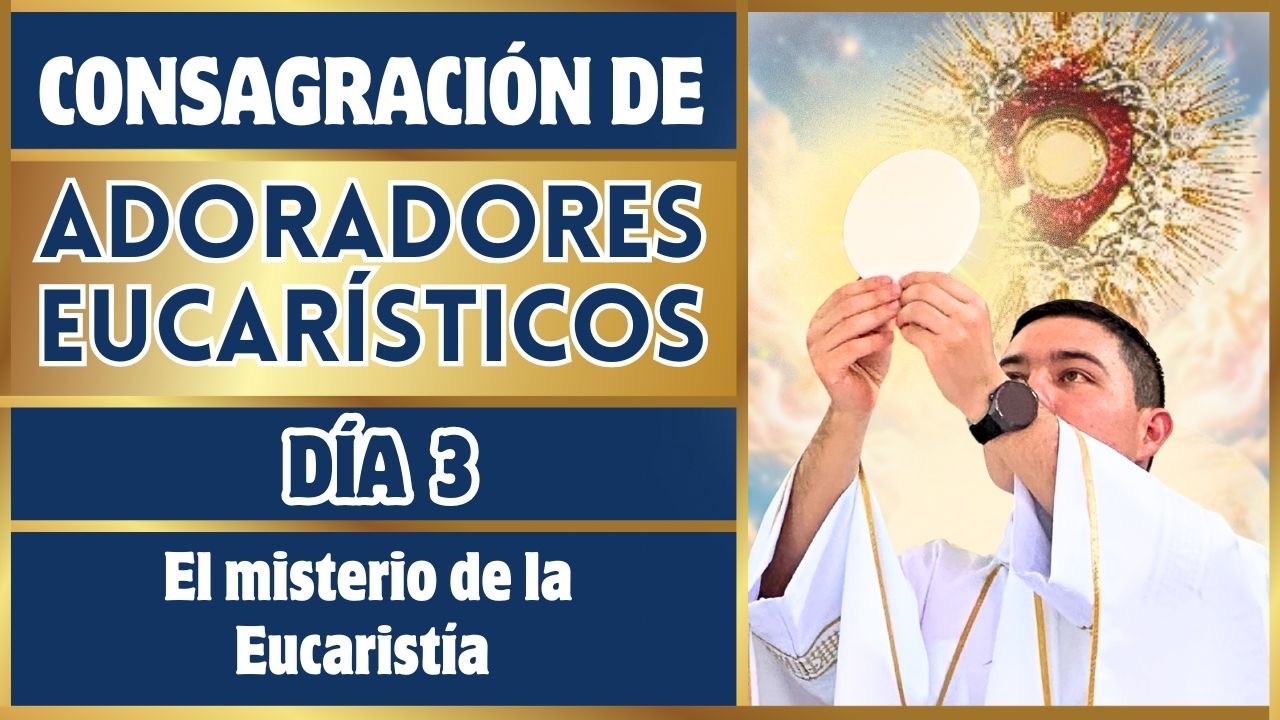
Padre Jorge Pulido teaches on the Eucharist as essential spiritual food for the soul's journey toward eternal life.
Key Takeaways
- The Eucharist is essential spiritual nourishment for the soul's journey toward heaven.
- Participation in the Holy Mass and reception of the Eucharist sustains eternal life and spiritual growth.
- Without the Eucharist, the soul experiences hunger and spiritual death.
- The Eucharist unites believers with Christ and cleanses venial sins.
- The Eucharist inspires mercy and charity toward others.
What the video covers
- The video is the fourth catechesis in a series on becoming adorers of the Eucharist.
- It focuses on the Eucharist as food for the journey and food of immortality.
- The catechesis includes a prayer invoking the Holy Spirit for understanding and sanctification.
- The Gospel of Luke 22:14-20 is examined as the fourth account of the institution of the Eucharist.
- The Eucharist is described as a foretaste and pledge of the kingdom of God and eternal life.
- The Holy Mass is divided into the liturgy of the word and the liturgy of the Eucharist, both essential.
- The hunger of the soul is deeper than physical hunger and can only be satisfied by the Eucharist.
- Old Testament examples prefigure how God nourishes His people on their spiritual journey.
- The Eucharist is necessary for spiritual growth, communion with Christ, and forgiveness of sins.
- Saint Ignatius of Antioch calls the Eucharist the antidote of immortality, emphasizing its vital role.
Chapters
- 00:00Introduction and Prayer to the Holy Spirit
- 02:28Preparatory Prayer and Topic Introduction
- 05:08Gospel of Luke 22:14-20 - Institution of the Eucharist
- 13:46The Eucharist as Food for the Journey and Immortality
- 19:33Spiritual Hunger and the Bread of Life
- 21:53Pilgrimage Toward the Kingdom of Heaven
- 24:55Old Testament Prefigurations of Spiritual Nourishment
- 27:37Eucharistic Fast and Preparation
- 30:42Fruits and Effects of Receiving the Eucharist
- 33:50Call to Mercy and Final Reflections on Eternal Life
Full Transcript — Download SRT & Markdown
Speaker A
What a joy to be with you, my dear brothers and sisters, once again in this fourth catechesis, this fourth meeting of our formation to be adorers of the Most Blessed Sacrament and to consecrate ourselves to Jesus in the Eucharist.
Speaker A
Today we are going to address a very interesting topic titled: The Eucharist, food for the journey, food of immortality.
Speaker A
I want to invite you to prepare yourselves at this moment. Let us place ourselves in God’s hands. Let us ask for the Holy Spirit together.
Speaker A
In the name of the Father, and of the Son, and of the Holy Spirit. Amen.
Speaker A
May it be the grace of God, the light of the Holy Spirit, that descends upon our lives and into our hearts.
Speaker A
May He illuminate us, may He come to dispel all darkness, and may He lead us out of the dual darkness into which we were born: sin and ignorance.
Speaker A
Holy Spirit, come and pour yourself out with strength, with power, upon each one of us.
Speaker A
Breathe your breath of life so that we may be renewed, healed, and restored.
Speaker A
Spirit of God, you are the strength that comes from on high, the love of the Father and the Son.
Speaker A
Come and blow powerfully into every heart, into every person who approaches at this moment to receive this catechesis, this consecration to become adorers.
Speaker A
Only you, Holy Spirit, will lead us to the true understanding of the Eucharist and you will guide us to be authentic adorers in spirit and in truth.
Speaker A
Holy Spirit, come and enlighten us, come and sanctify us.
Speaker A
Come, Holy Spirit, fill the hearts of your faithful and enkindle in them the fire of your love.
Speaker A
Send forth your Spirit, O Lord, to give us new life, and you will renew the face of the earth.
Speaker A
O God, who enlightens the hearts of your faithful with the light of the Holy Spirit, grant us to know what is right according to that same Spirit and always to rejoice in your consolations.
Speaker A
Through Christ our Lord. Amen.
Speaker A
Holy Spirit, enlighten us and sanctify us.
Speaker A
Hail Mary most pure, conceived without sin. Most Holy Mary.
Speaker A
I invite you to pray the preparatory prayer.
Speaker A
Lord Jesus, present in the Eucharist, I firmly believe that you are there, alive and real.
Speaker A
I adore you with humility and love you with all my heart.
Speaker A
Forgive my sins and purify my soul so that I may approach you with a clean heart.
Speaker A
Teach me to know you more, to love you more, and to follow you faithfully.
Speaker A
I offer myself to you in this time of preparation with all that I am and all that I have.
Speaker A
Make of me a true adorer capable of accompanying you, comforting you, and living always in your presence.
Speaker A
Stay with me, Lord, and transform my life. Amen.
Speaker A
Hail Mary most pure, conceived without sin. Most Holy Mary.
Speaker A
Blessed, praised, and adored be Jesus in the Most Holy Sacrament of the altar.
Speaker A
May my Jesus in the Blessed Sacrament, my sweet love and consolation, be forever blessed, praised, and adored.
Speaker A
Who could love you so much as to die of love for you?
Speaker A
Very well, my dear brothers and sisters, I want to share with you today this topic number four, the Eucharist, food for the journey, food of immortality.
Speaker A
I want us to take the word of God from the Gospel of Saint Luke, chapter 22, verses 14 to 20.
Speaker A
Luke 22, verses 14 to 20.
Speaker A
I am reminding you of the passages of the institution of the Holy Eucharist.
Speaker A
How many are there? Four.
Speaker A
There are four testimonies. Three that the synoptic gospels give us: Matthew, Mark, and Luke.
Speaker A
And the testimony that Saint Paul gives us in his letter to the Corinthians, chapter 11.
Speaker A
Today is the fourth topic, therefore, the fourth account of the institution.
Speaker A
Saint Luke, chapter 22, verses 14 to 20.
Speaker A
When the hour came, Jesus took his place at the table with the apostles and said to them, "I have eagerly desired to eat this Passover with you before I suffer, for I tell you, I will not eat it again until it is fulfilled in the kingdom of God."
Speaker A
Then he took a cup, gave thanks to God, and said, "Take this and share it among yourselves. For I tell you, from now on I will not drink of the fruit of the vine until the kingdom of God comes."
Speaker A
Then he took a loaf of bread and, after giving thanks to God, he broke it and gave it to them, saying, "This is my body, which is given for you. Do this in remembrance of me."
Speaker A
In the same way, he took the cup after supper and said to them, "This cup is the new covenant sealed in my blood, which is poured out for you."
Speaker A
The word of the Lord. Glory to you, Lord Jesus.
Speaker A
There we have, then, the fourth account of the institution that the evangelist Saint Luke gives us.
Speaker A
Jesus is insistent in saying that he will not sit at the table again until the kingdom of God comes.
Speaker A
We already know that the Eucharist is a foretaste of future glory, it is a pledge of eternal glory.
Speaker A
Therefore, the closest thing we have to the kingdom of heaven is conscious and active participation in the holy sacrifice of the Eucharist and that each one of us may approach and eat the Eucharistic banquet.
Speaker A
The Holy Mass is divided into two great parts.
Speaker A
The first part is called the liturgy of the word, where the gospel and the readings are presented to us.
Speaker A
The priest preaches the homily to us and the second very important part, the holy sacrifice of the Eucharist, the liturgy of the word and the liturgy of the Eucharist.
Speaker A
The two make up the Holy Mass.
Speaker A
We can all participate in the banquet of the word and the banquet of the Eucharist.
Speaker A
For this reason, my dear brothers and sisters, I invite you to delve into today's topic.
Speaker A
What is the goal of this topic? To understand that without this food it is impossible to move forward, that the Eucharist is necessary to obtain the gift of eternal life.
Speaker A
The Eucharist, food for the journey, food of immortality.
Speaker A
The hunger of the soul.
Speaker A
You know that today there is a lot of hunger in the world.
Speaker A
There are many people who feel hungry, they are in need of physical bread, but there is a hunger that is deeper, there is a hunger that is greater, and it is the hunger of the soul.
Speaker A
The hunger of the soul is not hunger for material bread.
Speaker A
There are people who humanly have everything, but if they do not have the Eucharist, they will feel empty.
Speaker A
It is the hunger for meaning, hunger for love, hunger for eternity.
Speaker A
The Eucharist is the food of the soul.
Speaker A
What happens if a person stops eating? They die.
Speaker A
They die of hunger.
Speaker A
It is called death by starvation, that is, for lack of food.
Speaker A
What happens if the soul stops being fed? It slowly dies.
Speaker A
That is why the Eucharist is the food of immortality, because this body is mortal, this body is going to die, but the soul is immortal.
Speaker A
And what is it that gives it immortality? Eternal life to the soul.
Speaker A
The holy and divine Eucharist.
Speaker A
The evangelist Saint Matthew says in chapter 4, verse 4, "Man shall not live by bread alone, but by every word that comes from the mouth of God."
Speaker A
Human beings do not live only by physical bread, by material bread.
Speaker A
Spiritual bread, the bread of the soul, is necessary.
Speaker A
We can have it all, humanly speaking, and still be empty.
Speaker A
God knows your hunger.
Speaker A
That is why He prepared a food so that you will never be hungry again.
Speaker A
He prepared a drink so that you will never be thirsty again.
Speaker A
Whoever eats His body will never be hungry again.
Speaker A
Whoever drinks His blood will never be thirsty again.
Speaker A
Jesus says so in the gospel.
Speaker A
We are all pilgrims here on earth.
Speaker A
We are not of this world.
Speaker A
We are travelers and we have a place we must reach.
Speaker A
What is our goal? The kingdom of heaven.
Speaker A
We sing it continuously.
Speaker A
We are the pilgrims heading toward heaven.
Speaker A
Our homeland is the kingdom of heaven.
Speaker A
Since the Old Testament, God has been concerned with feeding His people on their journey.
Speaker A
There are two figures in the Old Testament that show us the importance of food to keep walking without fainting.
Speaker A
The Eucharist is the food for the journey, it is the bread of eternal life.
Speaker A
And since the Old Testament, the word of God gives us two examples that prefigure how God feeds the people so they can keep advancing toward that promised land.
Speaker A
The first figure is very well known.
Speaker A
We remember first the people of Israel on their march through the deser...
Speaker A
most frequent in the sacrament of confession. How to understand this, brothers? Because the conscience of the saint is illuminated by the Holy Spirit . Holy religious, holy nuns, and holy popes went to confession frequently.
Speaker A
Investigate the life of any saint. A saint knows that a year without confession weakens the soul and that one will easily fall into mortal sin.
Speaker A
That is why frequent confession is needed to keep the soul purified. Let no one approach the sacrament of the Eucharist without first having made an examination of conscience. The apostle Paul says so in his letter. Be very careful, because you may run the danger
Speaker A
of eating your own condemnation. Faced with the greatness of this sacrament, the faithful can only repeat humbly and with ardent faith the words of the centurion. Lord, I am not worthy that you should enter under my roof, but
Speaker A
only say the word and my soul shall be healed. In every Eucharist, we say these words. Because no one is worthy, brothers, to approach such a banquet, bread of angels, heavenly drink. Who is worthy to receive the Eucharist? No one
Speaker A
. But the Lord makes us worthy. Only say the word and my soul shall be healed. The sacrament of reconciliation , when the priest lays his hands and says the words of absolution and then tells the penitent, you may go in peace
Speaker A
. You are in the grace of God. The soul at that moment is purified to approach in a less unworthy way to receive the body and blood of the Lord. To prepare properly to receive this sacrament, the faithful must also keep the fast,
Speaker A
observe the Eucharistic fast. This fast is prescribed by the Church in the Code of Canon Law number 919, Code of Canon Law number 919. We also prepare ourselves with our bodily attitude, the gestures, brother, the gestures we have
Speaker A
in the Eucharist when we celebrate Mass : a good posture, not legs up on the pews in any old way, like someone in their living room; no, I must maintain respect, a decorum in the celebration of the Holy Eucharist. Do not put your
Speaker A
feet on the kneelers, do not stick chewing gum under the pews. All of this manifests our Eucharistic devotion.
Speaker A
Attire, brothers, do not go to Mass dressed just any way. The way we dress manifests the respect, the dignity, the solemnity, the joy that we are going to meet the Lord at the Eucharistic banquet. This catechesis is necessary
Speaker A
precisely for present generations. Young people don't know, and sometimes the easiest thing is to say," No, get out of the church because you are poorly dressed. "No, what must be done?
Speaker A
We must catechize, we must teach the young, the women, how to be dressed. One cannot go to the church in shorts and flip-flops, like someone in their living room, like someone going to the beach. Our ancestors, our grandparents,
Speaker A
gave us testimony that they wore their best clothes on Sunday. On Sunday they wore their best suit. Why? Because that manifested Eucharistic devotion. In that moment when Christ becomes our guest, I must be prepared both interiorly and exteriorly. It is in
Speaker A
accordance with the very meaning of the Eucharist that the faithful with proper dispositions receive communion when they participate in the Mass. There are people who go to Mass and do not receive communion, and they are able to receive it. The faithful may receive
Speaker A
the Holy Eucharist only twice on the same day. This is an important point that we have to clarify in light of the doctrine of the Catholic Church. We as priests, as ministers, can receive communion as many times as we celebrate
Speaker A
the holy sacrifice for our work as priests. Lay faithful should not receive communion more than twice a day . And hopefully, one communion is in the morning and another in the afternoon. There should be at least a two-hour gap between one communion and
Speaker A
the other. Because if I have received the Lord, the Lord is with me. I do not need to receive Him again. There are people who receive the Eucharist up to three or four times in the same day.
Speaker A
The Church tells us that the maximum is twice in the same day. It is especially recommended to participate more perfectly in the Mass, with the faithful receiving the body of the Lord after the priest's communion of the same sacrifice. A perfect participation
Speaker A
in the Mass is when I manage to be fed by the Word and then manage to be fed by the Eucharist. You already know what has been said many times. Going to Mass and not receiving communion is like
Speaker A
going to a party and not eating the food. We are left incomplete. Obviously , my brothers and sisters, one must be well prepared. If I do not feel prepared, if I have not confessed, if I have not examined my conscience, if it
Speaker A
has been more than a year since my last confession, I should not approach the Eucharistic table. First, I must perform an examination of conscience, along with interior and exterior preparation. The Church obliges the faithful—that is, you, all the
Speaker A
baptized—to participate in the divine liturgy on Sundays and holy days of obligation. If a person stops going to Mass on a Sunday out of laziness, because of a trip, or because they had visitors, they must go to confession
Speaker A
before receiving communion again. We must be clear about this; whether it is due to illness or an unavoidable obstacle, such as a landslide blocking the road, making it impossible to reach Mass. That is different. Or because of distance. There are people who live
Speaker A
three or four hours from town and cannot get to the Eucharist because they live in a rural area. They are farmers. That is different. But when you live two or three blocks from the church and you stop going to Mass
Speaker A
because of a little rain, that is a mortal sin. You are failing against the third commandment of God's law and one of the five commandments of the Church, which obliges the faithful to participate in the entire Mass every
Speaker A
Sunday and holy day of obligation. How does the Church commandment state it? Hear the entire Mass on all Sundays and holy days of obligation, that is: December 8th, January 1st, obviously Holy Thursday, Good Friday, Holy Saturday, and December 25th. Those are
Speaker A
the days of precept other than Sunday, because they are fixed dates that can fall on a Monday, Tuesday, or Wednesday . I must participate in the Holy Eucharist. It is very common for many Christians not to go to Mass on January
Speaker A
1st. Why? Ah, because they stayed up late, because they were drinking. That is a sin, brothers and sisters. And before one approaches again to receive the body and blood of Christ, one must confess. We must keep that very present
Speaker A
and very clear. What does the commandment say? To hear the whole Mass . What happens if you arrive late to Mass? You should no longer receive Communion. In order to receive the Eucharist, you must participate in the celebration, unless you are a sick
Speaker A
person who is at home, in bed; it is different because they take the viaticum to you, the viaticum for the sick. In that case, you are no longer obligated to hear the whole Mass. But if you are in good health, you can walk
Speaker A
, you can get to the temple. If you arrive halfway through Mass, you should not get in line for Communion. You should not do it. If you arrived after the penitential act, you should no longer receive Communion. Why, my
Speaker A
brothers and sisters? Because the commandment says to hear the whole Mass , complete, from the time it begins until it ends. It is the commandment of the Church. And we must respect our mother, the Church, in her advice and
Speaker A
in her commandments. And also to receive the Eucharist at least once a year, if possible during Easter time.
Speaker A
The Code of Canon Law, number 920, says so. Prepared by the sacrament of reconciliation to be able to receive the Eucharist at least once a year during the time of Easter and resurrection. So I have to prepare myself with the sacrament of confession
Speaker A
. That is why confession, at a minimum, must be once every year. But the Church strongly recommends that the faithful receive the Holy Eucharist every Sunday and on feast days, or even more frequently, including every day.
Speaker A
Brothers and sisters, what happens if one only eats every three or four days? One survives, but one grows weak. If you can participate in Mass every day, do it. More frequent Eucharist will strengthen you much more, mainly on
Speaker A
Sunday, that remains clear, but if besides Sunday you can go during the week, you should do it. The Church strongly recommends it thanks to the sacramental presence of Christ under each of the Eucharistic species.
Speaker A
Communion under the species of bread alone already ensures that one receives all the fruit of grace proper to the Eucharist. There are people who ask," Father, I see that there are a few people who receive the Eucharist under
Speaker A
both species. "Others of us only receive it under the species of bread. Is that okay? Well, the Church teaches us that it is. Whoever receives one of the two species receives all the fruits of the Eucharist. Especially because
Speaker A
the Church Fathers explain that in the body, in the flesh of Christ, there is blood. In flesh, there is always blood.
Speaker A
Whoever takes communion with the consecrated host is receiving body and blood. But the Church teaches us that communion has a fuller expression by reason of the sign when it is done under both species, since that form most perfectly manifests the sign of
Speaker A
the Eucharistic banquet. On some occasions, you may be able to receive under both species. This depends a lot on the episcopal conferences; it depends a lot on the country. There are countries where communion under both species is more common. There are
Speaker A
others where it is less common. For example, in the United States, there are parishes where people take the body of Christ and then take the chalice and drink the blood of Christ. In South American countries, for example, here
Speaker A
in Colombia, when it is given under both species, it is by intinction. So the priest takes the consecrated host and dips it into the consecrated chalice and gives it under the intinction or immersion of the host in the chalice. That is the way it is done
Speaker A
, for example, here in Colombia. Here in Colombia, the custom of handing over the chalice for the faithful to drink is very uncommon. It occurs mainly at weddings. It is allowed. The priest says," Body of Christ, blood of Christ.
Speaker A
"It is wrong when the priest tells the couple," Give communion to each other. "They are not ministers of the Eucharist. They cannot give communion to one another. It is an error and must be corrected. My dear brothers. The
Speaker A
priest must say," Body of Christ, "and the faithful responds," Amen. "" Blood of Christ. "And the faithful responds," Amen. "In that way, yes, the chalice can be given, the consecrated host can be given. It is what the Church
Speaker A
prescribes, it is what the Church teaches us. And I am communicating it to you today. In the Oriental churches, of the Eastern rite, Eastern Catholics, communion under both species is very common. It is practically the habitual form. For us in Latin America, the
Speaker A
habitual form, and especially in the Western Roman rite, the habitual form is communion under a single species.
Speaker A
This is for pastoral reasons. When it is done under both species, the distribution of the Eucharist takes longer. So, for pastoral reasons, the bishops 'conferences and the Pope say that the Eucharist under one species alone contains all the fruit of the
Speaker A
Holy Eucharist. So that we have that notion, that clarity regarding it. A question we must answer. What does this food do? What are the fruits of Eucharistic communion? Let us learn the fruits of communion. What are the results of receiving the Eucharist?
Speaker A
First, communion increases our union with Christ. That is the first fruit. It unites us to Christ. Receiving the Holy Eucharist in communion has as its primary fruit intimate union with Christ Jesus. It is the primary fruit.
Speaker A
It puts us in direct communion with God . Another fruit, communion with the flesh of the risen Christ preserves, increases, and renews the life of grace received at baptism. First, it increases communion with God, with Christ. Second, it preserves, increases
Speaker A
, and renews the life of grace. That is to say, receiving communion produces spiritual growth. It is the food, it is the nutrient for the Christian to grow.
Speaker A
What happens if you plant a little tree ? You never water it, never fertilize it, it will stay small, it will never grow, much less will it produce fruit.
Speaker A
What happens to a Christian if they do not feed on the Eucharist? They will not grow, they will not produce fruit.
Speaker A
The Eucharist is food necessary for growth and for producing the fruits that God expects from each one of us.
Speaker A
Another fruit of receiving the Eucharist, communion separates us from sin. This is very interesting. The body of Christ that we receive in communion is given up for us, and the blood that we drink is shed for many for the
Speaker A
forgiveness of sins. That is why the Eucharist cannot unite us to Christ without simultaneously purifying us of committed sins and preserving us from future sins. Listen, communion wipes away sins and preserves us from sin.
Speaker A
Which sins does communion wipe away? Venial sin. Venial sin. Sins that are not grave are wiped away by receiving the Eucharist, by participating in the Eucharist. In the penitential act and at the moment of receiving communion, venial sins are wiped away. Pay
Speaker A
attention to what I am going to tell you. It wipes away venial sin, but it does not wipe away mortal sin. Wiping away mortal sin is an act proper to the sacrament of penance, of reconciliation , confession. Consuming the Eucharist
Speaker A
does not wipe away mortal sin; on the contrary, it makes you guilty of death for eating the body of Christ unworthily. The word of God says, every time we receive him, we proclaim the death of the Lord. If we proclaim the
Speaker A
death of the Lord, we also proclaim the forgiveness of sins. If every time his blood is shed it is for the forgiveness of sins, says Saint Ambrose, I must always receive him so that he may always forgive my sins. If the blood of
Speaker A
Christ is shed for the forgiveness of sins, I must always receive him so that he may always forgive my sins. He says, " I who always sin, must always have a remedy. "What wise words. I who always sin must always have a remedy at hand.
Speaker A
Of course. What is the medicine against sin? The Eucharist, the sacrament of the Eucharist. That is why one is sanctified through constant participation in the holy sacrifice of the Eucharist and then by receiving his body, receiving his blood as bodily
Speaker A
nourishment. It serves to restore lost strength. The Eucharist strengthens the charity that tends to weaken in daily life. And this enlivened charity wipes away venial sins. Another fruit of the Eucharist: it wipes away venial sins.
Speaker A
We already have four fruits. The first puts us in communion with Christ. The second produces spiritual growth. Third , it separates us from sin. Fourth, it wipes away venial sins. That is what the Sacred Council of Trent says. By
Speaker A
giving himself to us, Christ revives our love and makes us capable of breaking disordered ties with creatures and rooting ourselves in him. One sometimes has many attachments in their heart. There are things that are hard to let go of. What is the best remedy
Speaker A
for this? Frequent and continuous participation in the Holy Eucharist. If you go to Mass constantly, your heart will become more rooted in God and, therefore, it will let go of the things of the world. By the same charity it
Speaker A
kindles in us, the Eucharist preserves us from future mortal sins. That is the other fruit. It preserves us from future mortal sins. The more we participate in the life of Christ and progress in his friendship, the more difficult it will be for us to break
Speaker A
with him through mortal sin. The closer I am to Jesus, the farther I am from falling into mortal sin. The further I move away from Jesus, the closer I am to falling into mortal sin. It works both ways. If I draw closer to Jesus, I
Speaker A
move away from sin. If I move away from Jesus, I draw closer to sin. That is something that will always be true.
Speaker A
When one moves away from God, they end up falling into sin. When you stop going to Mass, from actively participating in the Eucharist, when you stop frequenting confession, when you stop receiving the body and blood of Christ, when you stop adoring Him,
Speaker A
you grow weak. Result, you fall into sin. The Eucharist is not ordered toward the forgiveness of mortal sins.
Speaker A
I already told you that a moment ago. That is proper to the sacrament of reconciliation. The purpose of the Eucharist is to be the sacrament for those in full communion with the Church . Therefore, another fruit of receiving
Speaker A
the Eucharist is to produce the unity of the mystical body. The Eucharist makes the Church. That is how Pope Saint John Paul II taught it. The Eucharist builds the Church; that is to say, it builds the communion of life.
Speaker A
Brothers, a person who is constant in the Eucharist is a person who seeks unity, seeks communion; they are a person who avoids discord, avoids fights, avoids arguments. That is why your loved ones are right when you arrive from Mass and you arrive
Speaker A
fighting, you arrive arguing, and they say," No, then what Mass were you at? " " Mom, why do you go to Mass so much if you come here to fight all day? "Of course, in that sense they are right,
Speaker A
because the Eucharist must produce in me a fruit of conversion that leads me to be more patient, to be less combative, to be less resentful, to forgive more easily. The Eucharist produces in me a fruit of conversion.
Speaker A
Those who receive the Eucharist are joined more closely to Christ. For this very reason, Christ joins all the faithful into a single body, which is what the Church is called. The Church.
Speaker A
Another fruit of the Eucharist is that it entails a commitment in favor of the poor. To receive in truth the body and blood of Christ given up for us, we must recognize Christ in the poorest of the poor, who are our brothers and
Speaker A
sisters. Matthew 25:40. Whenever you did it for one of these least of mine, you did it for me. Jesus says, the Eucharist must move us to charity.
Speaker A
Charity, the works of mercy. My dear brothers, look at what Saint John Chrysostom said. Saint John Chrysostom is a Father of the Church who speaks the most about the importance of charity and the care of the poor. He is
Speaker A
quite strong when it comes to speaking about the poor. Look at what he says.
Speaker A
You have tasted the blood of the Lord and you do not recognize your brother.
Speaker A
You dishonor this table, not judging him worthy to share your food who has been judged worthy to participate at this table. God has freed you from all sins and invited you to it, yet you still haven't become more merciful.
Speaker A
Saint John Chrysostom confronts us, saying," Well, you have sat at the Lord's table, the Lord has forgiven you , he has given you the bread of angels, and you go home, see the poor, and you are unable to share with them. "" It is
Speaker A
a contradiction. "That is why the Eucharist leads us to be kinder, more merciful. It entails in us a commitment to the poor. You have encountered Christ in the Eucharist, so you must find Him in the poor. We cannot be
Speaker A
hypocrites. Yes, I met the Lord, but I slam the door in the face of the poor.
Speaker A
We cannot be like that, my brothers and sisters. The Eucharist entails in us a special fervor and love for the poorest . The Eucharist produces unity among all Christians. That is why Saint Augustine of Hippo exclaimed:" O sacrament of piety, O sign of unity, O
Speaker A
bond of charity. "" The Eucharist strengthens our bonds. "I cannot receive the Lord's body while hating my brother. How is it possible that you take communion, yet you don't speak to your neighbor? How is it possible that you take communion, but you are
Speaker A
fighting with your own blood brother? That cannot happen to us. That would be hypocrisy. What does this food do in us ? It sustains you when you are weak, when you are tired, when you feel tempted. The Eucharist sustains you,
Speaker A
gives you inner strength, lifts you up like Elijah: get up and eat. Going to the Eucharist renews your strength, transforms you; it doesn't just help you, it changes you from within. Christ begins to live in you, John 14:23 says,
Speaker A
" We will come to him and make our home with him. "" In theology, this is called the indwelling of the Trinity. " It is God Himself who comes to dwell in your soul. When you take communion, when you receive Him, Jesus Christ
Speaker A
comes and becomes your guest. That is why you must prepare your heart very well. Fourth, it guides you. This food orders you, centers you, and turns you back to God. What then does this food do in you? Four things. It sustains you
Speaker A
, lifts you up, transforms you, guides you. Look at the fruits of receiving the Eucharist. It keeps us away from sin, unites us with Christ, preserves us from future sins, makes us brothers and sisters, produces in us the unity
Speaker A
of Christians, and makes us more merciful toward the poor. The Eucharist , food for eternal life. Brothers, let us remember that. The Eucharist is necessary, indispensable to have eternal life. If I ask you, how many want to go to heaven? Everyone says," I
Speaker A
want to go to heaven. "" And how can you go to heaven? "By feeding yourself on the Eucharist. How is it possible for a Christian to tell me," I want to go to heaven, "but you do not want to
Speaker A
receive Communion?" You don't worry about organizing your life to be able to receive the Eucharist. "It is contradictory to say I want it, but then not do what I have to do. The Eucharist is called the pledge of
Speaker A
future glory. In an ancient prayer, the Church acclaims the mystery of the Eucharist saying," O sacred banquet, in which Christ is received as food, the memory of his passion is renewed, the soul is filled with grace, and the
Speaker A
pledge of future glory is given to us. "" The Eucharist is the pledge of future glory. "The Eucharist is also the anticipation of heavenly glory. The closest thing on this earth to heaven is called the Eucharist. The Church
Speaker A
knows that even now the Lord comes in the Eucharist and is there in our midst . However, his presence remains veiled.
Speaker A
Behind the Eucharistic veils, one still cannot see him face to face as he is.
Speaker A
When will that happen? When we reach the kingdom of heaven. Now we see him in the Eucharist, but with the eyes of faith. If it is not through faith, as we already learned, it is not possible to approach the Eucharist. That is why
Speaker A
we await the moment in which we can meet face to face with the Lord. For the moment, what do we do? We go to the Eucharist. What is the closest thing we have to heaven? The Eucharist. It is a
Speaker A
pledge of future glory. Look at what Saint Ignatius of Antioch said. We break the same bread that is a medicine of immortality, an antidote to not die, but to live in Jesus Christ forever.
Speaker A
Saint Ignatius of Antioch is the one who says the Eucharist is an antidote of immortality. Do you want to be immortal? You must eat the Eucharist.
Speaker A
Whoever does not eat his body and drink his blood will not be able to have eternal life. The Eucharist is food for the journey, but it is also the food of eternity. The Eucharist makes you immortal so that you never die, so that
Speaker A
your strength never fails. What must be done? Constantly participate in the Holy Eucharist. Whoever receives Christ never dies. We say," Whoever believes in you, Lord, will not die forever. " Whoever believes in the words of the Lord has eternal life. You will not die
Speaker A
forever. The body, by its natural course, will die, but the soul will live. And that is what truly matters.
Speaker A
The Catechism of the Catholic Church says in number 1419. Christ, who passed from this world to the Father, gives us in the Eucharist the pledge of the glory we will have with him.
Speaker A
Participation in the holy sacrifice identifies us with his heart and sustains our strength throughout our life's pilgrimage. It makes us desire eternal life and unites us even now with the Church in heaven, the Blessed Virgin Mary, and all the saints. When
Speaker A
you celebrate the Eucharist, when you go to the Eucharist, you join in the praise of the angels. We do not see what happens in the Eucharist, but when the priest lays his hands over the bread and wine, invokes the Holy Spirit
Speaker A
, and pronounces the words of consecration and the institution narrative: the angels descend, heaven opens, the glory of God comes down, and Christ becomes present on the altar. We do not see that. Remember, brother, what I was telling you. What we do not
Speaker A
see in the sacraments is greater than what we manage to see. The invisible is always greater than the visible. That is why we must lift up our hearts, contemplate the mystery, live the mystery, vibrate for the Eucharist, and
Speaker A
fall in love with the Eucharist." Oh, Father, I go when I feel like it, "a person said. I know some Catholics who are pregnant. A man told me," Father, when I was pregnant... "How so? Are you a man?" Yes, because I was the type of
Speaker A
Catholic who went to Mass when I felt like it, and since I never felt like it , I was pregnant. "Look at that curious example. Well, we have many Christians who say," I go to Mass when I feel like
Speaker A
it. "No, brothers, it is not when I feel like it. I make the decision to go to Mass, to celebrate the sacrifice, to cultivate my inner life, to offer worship to God, to give thanks, to make reparation for my sins, and to pray for
Speaker A
the salvation of my soul. For those four purposes, I go to the Eucharist." Oh, no, it's just that today I woke up in a bad mood, like I don't have the energy for anything. "No, brothers, that is when you most need to go to the
Speaker A
Eucharist. What did the angel say to Elijah?" Get up and eat. "" There is still a long way to go. "When you feel tired, depressed, anxious, sad, what should you do? Go to the Eucharist.
Speaker A
That is when you need it most. The Eucharist is not a prize for the saints ; it is medicine for the sick, for sinners. Pope Francis said it: do not think the Eucharist is a prize for those who are good. On the contrary, it
Speaker A
is medicine, an antidote for us who are such sinners. This bread is not just for this world. Jesus says," He who eats my flesh has eternal life. "The Eucharist is a foretaste of heaven, a seed of eternity within you. Whoever
Speaker A
receives Communion with faith already begins to live eternally. The Eucharist doesn't just prepare you to die; it teaches you to live forever. God saw your weakness and did not leave you alone. He became food. The journey is long and difficult, but you don't have
Speaker A
to walk it without Him. Do not walk it without Him. If the road becomes heavy and difficult, that is when you need Him most. There are some questions we must ask ourselves. Are you feeding on Christ, or are you trying to live by
Speaker A
your own strength? He who does not eat grows weak. He who does not feed himself comes to a halt. But he who eats Christ walks toward eternal life.
Speaker A
The Eucharist is strength for today and life forever, food for the journey. And the Eucharist is a foretaste of eternity. Whoever eats His body and drinks His blood has eternal life, and I will raise him up on the last day,
Speaker A
says the Lord. We must believe in His words. What is today's topic? The Eucharist, food for the journey, food of immortality. May God bless you, my dear brothers and sisters. In the name of the Father, and of the Son, and of
Speaker A
the Holy Spirit. Amen. Blessings to all . We are preparing for the next episode . We are moving forward, delving deeper into this mystery. We are discovering new dimensions of the Eucharist, learning how to observe the Eucharistic fast and prepare our hearts well. We
Speaker A
are discovering the fruits of the Eucharist. How good it is to learn in the light of God's word and the doctrine taught to us by our holy mother, the Catholic Church. Blessings to all. M.
Topics:EucharistHoly CommunionSpiritual nourishmentHoly MassAdorationHoly SpiritEternal lifeCatechesisJesus ChristFaith formation


![How To Start Day Trading In 2026 [Full Tutorial] — Transcript](https://i.ytimg.com/vi/yiuFUp0kFz8/maxresdefault.jpg)