Skip to content

Ben & Jerry's: "We've been taxing ourselves"

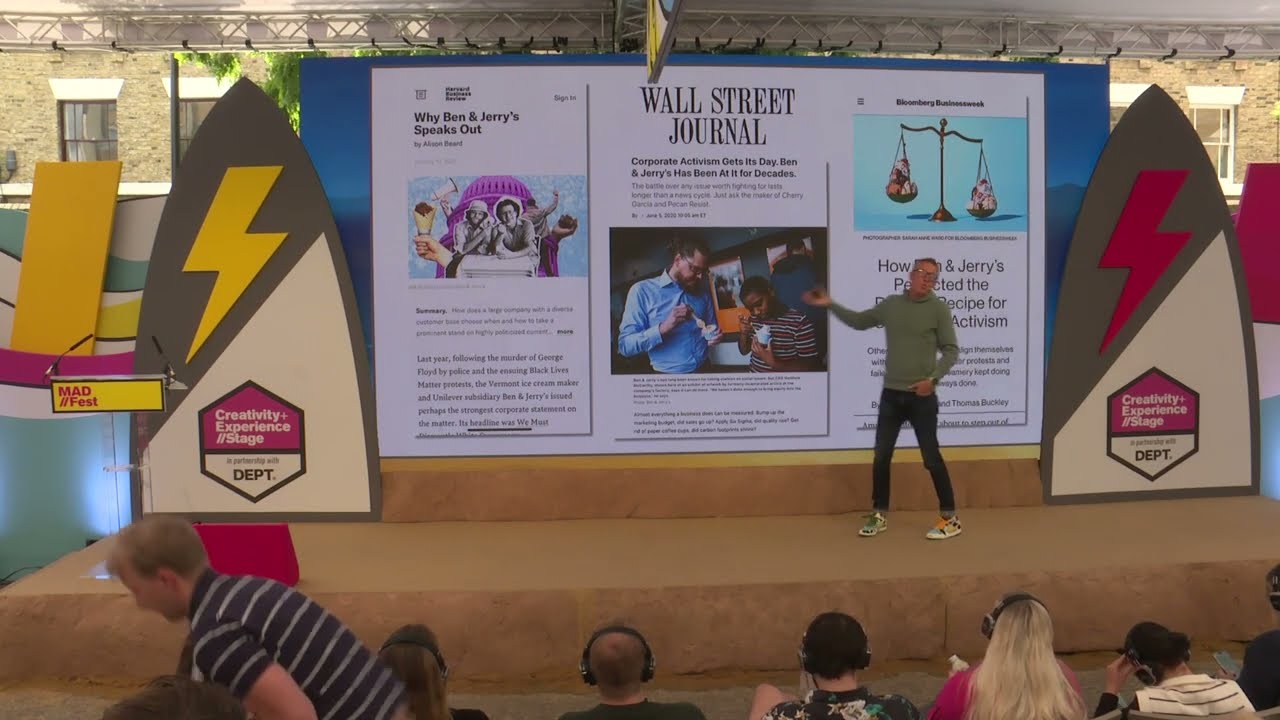
Ben & Jerry's CEO discusses the company's climate goals, carbon tax, and commitment to aggressive environmental action.

Ask about this video. Answers come from its transcript only — with the timestamp, so you can check them.

Generated from the transcript and can be wrong — check the timestamp.

Key Takeaways

  • Ben & Jerry's is committed to significant carbon reduction with clear science-based targets.
  • Methane emissions from dairy farming are a major challenge for the company’s climate goals.
  • Internal carbon tax funds innovation to reduce emissions on farms.
  • Business leaders must take aggressive action and support climate policies to make meaningful progress.
  • Consumers prioritize scientific evidence over corporate climate claims.

What the video covers

  • Ben & Jerry's CEO acknowledges the company has made progress but needs to do more to reduce its carbon footprint.
  • The biggest environmental impact comes from dairy farms, specifically methane emissions from cows.
  • Ben & Jerry's has set science-based targets to reduce carbon intensity by 40% in the near term and nearly 100% by 2050.
  • The company has implemented an internal carbon tax to fund investments in new technologies that reduce farm emissions.
  • The CEO emphasizes the importance of aggressive climate action by business leaders and policy support.
  • Consumers trust scientific data on climate change more than CEOs' statements.
  • The Science Based Target organization has defined net zero as a 90% carbon reduction with offsets used only for the remaining emissions.
  • The CEO declines to discuss political issues related to the Middle East, focusing instead on climate topics.
  • Ben & Jerry's aims to lead by example in climate responsibility and calls for stronger corporate and governmental commitments.
  • The company rejects a 'get there when we can' approach, advocating for urgent and aggressive climate action.

Answers

Questions about this video

What are Ben & Jerry's climate goals?

Ben & Jerry's aims to reduce its carbon intensity by 40% in the next few years and achieve nearly 100% reduction by 2050, focusing on emissions from dairy farms.

How does Ben & Jerry's fund its climate initiatives?

The company has implemented an internal carbon tax, using the funds to invest in new technologies that reduce carbon-intensive emissions on farms.

Why does Ben & Jerry's focus on methane emissions?

Methane emissions from cows on dairy farms represent the largest environmental impact for Ben & Jerry's, making it a critical area for reducing their overall carbon footprint.

Full Transcript — Download SRT & Markdown

00:04
Speaker A
Make sure people are not burning down virgin forest to grow. The CEO of Ben and Jerry's ice cream from Burlington, Vermont.
00:15
Speaker A
It is good to see. Ben and Jerry's is one of the most environmentally secure and well-known for this.
00:23
Speaker A
You're on the stage now really focusing down on things like plastic packaging and the various minor ingredients that go into it.
00:33
Speaker A
How much more have you got to do until you're happy with your environmental credentials?
00:41
Speaker A
Richard, it is great to have me, and it is an honor to be included here.
00:46
Speaker A
The fact of the matter is we haven't done enough, and we need to do a lot more, faster here at Ben and Jerry's.
00:51
Speaker A
So I'm proud of the things that we have done over the past few decades, but we still have a long way to go to reduce our direct carbon impact as a business.
00:59
Speaker A
And part of that is in scope one and scope two, the things that we directly control like our energy and power consumption.
01:07
Speaker A
We've made progress there, but the biggest impact as a company is on the farms, through the cows, through emissions, and there is a lot more work that we need to do to reach our own science-based goals at Ben
01:19
Speaker A
and Jerry's. If you make ice cream, unless it is dairy, you need milk and you need cows.
01:25
Speaker A
And we've seen the numbers from agriculture, from methane and the like. I don't know, Matthew, how you get around that problem.
01:34
Speaker A
It is something that has been with us a long time for us. And what I would tell you is that it is not easy.
01:40
Speaker A
And that is why I don't want to sugarcoat it. I think speaking to it directly.
01:45
Speaker A
What would you say is that we've put a strong science-based target for ourselves to reduce our carbon intensity across our business.
01:54
Speaker A
We want to have a 40% reduction in the next few years and by 2050 almost 100% reduction.
02:01
Speaker A
The way that we do that is we've been taxing ourselves at Ben and Jerry's.
02:06
Speaker A
We've had our own carbon tax, and we use those funds to invest in new technology to reduce carbon-intensive and total emissions on the farm.
02:15
Speaker A
So getting to zero is very difficult, but there is a lot of stuff that we could do and new technology that we're investing in to work with our farmers to do that.
02:26
Speaker A
I'll get back to climate in a minute. I need to ask you about the current Middle East and the policy now with the Palestinian territories and with Israel.
02:34
Speaker A
And are you planning to change your policy there, bearing in mind the Israeli reaction to the decision not to sell in the territories?
02:42
Speaker A
Richard, I appreciate you asking about that. That is not something I'm here to talk about today.
02:47
Speaker A
I really want to talk about climate and stay focused on this, and I think it is a pivotal moment for us and for business leaders to be talking about climate, especially with what is happening at the COP right now.
02:58
Speaker A
I'll allow you the dignity of that, and with your assurance that you'll come back and talk about other matters afterwards.
03:05
Speaker A
Finally on ice cream, the way in which you're going to move forward, I guess with the message I hear from you is some improvement is better than none, we get there when we can.
03:21
Speaker A
No. No, Richard, that is not the message at all. I'm excited to see the things happening at COP with countries taking action.
03:29
Speaker A
But I'm going to build on what Allen said, companies have to be stepping forward.
03:35
Speaker A
If we as business leaders have the privilege of leading businesses that do not take aggressive action,
03:40
Speaker A
we'll never get there. So policy is essential. The level of the playing field and frankly businesses that are not committing and those that are actually fighting against Build Back Better plan, they're fighting against some of the policies, they're in the way of
03:54
Speaker A
climate change, the way of fighting climate change on the business. And frankly I think it is an area where I think the data is quite clear, our consumers, consumers don't really trust CEOs on climate.
04:05
Speaker A
They trust the science. And so I think adopting science-based targets and something really cool happened last Friday.
04:12
Speaker A
The Science Based Target organization basically said they put a definition around what net zero means.
04:18
Speaker A
And so it is really important that all companies reduce their carbon intensity and have a plan to reduce it.
04:25
Speaker A
The Science Based Target organization said you have to reduce carbon by 90%, and you could use offsets as a way to get that last small amount.
04:32
Speaker A
So I think it is an exciting moment, but it is not get there when you can.
04:37
Speaker A
It is putting aggressive
Topics:Ben & Jerry'sclimate changecarbon reductionscience-based targetscarbon taxmethane emissionssustainable agriculturenet zeroenvironmental responsibilityCOP climate conference

Get More with the SozAI App

Transcribe recordings, audio files, and YouTube videos — with AI summaries, speaker detection, and unlimited transcriptions.

Or transcribe another YouTube video here →